 JAZZPROFILES lives in the music 1,572 Jazz Artists fully Profiled!
 James Moody
Last updated October 1, 2026
Listen on Spotify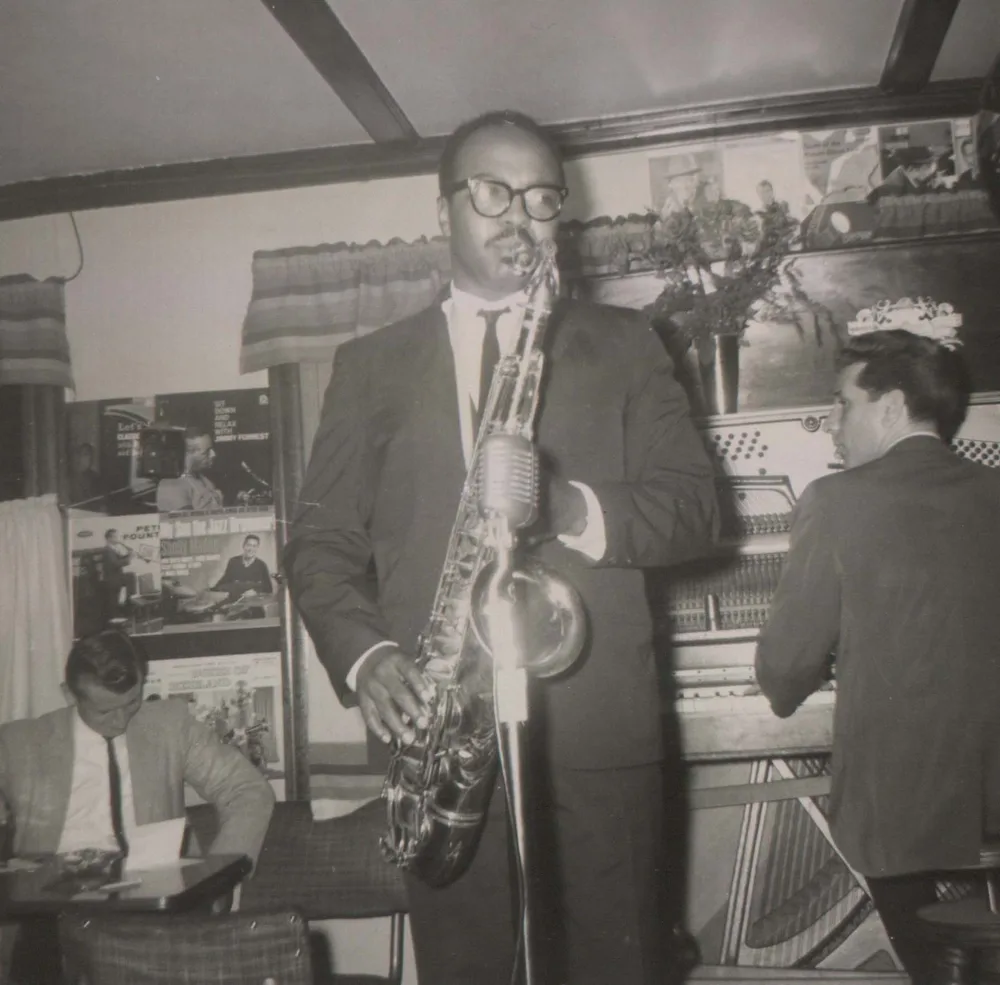
James Moody performing at Lennie's on the Turnpike, Newbury Street (Route 1), Peabody, Massachusetts, June 1963 CC BY 4.0 (attribution: Salem State Archives / Lennie's on the Turnpike Collection, Salem State University Archives and Special Collections, Salem, Massachusetts) — Wikimedia Commons - https://commons.wikimedia.org/wiki/File:James_Moody,_1963.jpg

James Moody was born partially deaf in Savannah, Georgia, on March 26, 1925, and raised in Newark, New Jersey, by his mother, Ruby Hann Moody Watters. His father, a trumpeter in Tiny Bradshaw's band, was absent from his life. The hearing loss cut off his high frequencies and pushed his ear toward the low register, a bias that stayed audible in his phrasing for sixty years. His uncle Louis bought him his first alto saxophone when he was 16. Moody taught himself by ear off records, taking his earliest cues from Jimmy Dorsey, Charlie Barnet, and Georgie Auld before Lester Young, Buddy Tate, Don Byas, Coleman Hawkins, and the Count Basie reed section pulled him toward the tenor.
He enlisted in the U.S. Army Air Corps in 1943 and was assigned to the segregated band at the Greensboro Training Center, where, as he told the Hamilton College Fillius Jazz Archive in 1998, the recruiters asked only whether the men owned instruments, not whether they could play them; official Air Force musicians were then brought in to teach the Black band. Discharged in 1946, he joined Dizzy Gillespie's bebop big band and stayed roughly two years. Gillespie became the central figure of Moody's professional life and remained so, on and off, for close to half a century. Moody's first sessions as a leader came at Apex Studios in New York on October 19 and 25, 1948, for Blue Note, billed as James Moody and His Modernists: an octet with Dave Burns and Elmon Wright on trumpets, Ernie Henry on alto, Cecil Payne on baritone, and arrangements by Gil Fuller, with Art Blakey taking over the drum chair and Chano Pozo adding congas and vocals on the second date's Afro-Cuban material.
Late in 1948 he left for Europe, telling interviewers he had been scarred by racism at home, and spent about three years based mainly in Paris. On October 12, 1949, on a short club engagement in Stockholm, he recorded the thing he is still best known for. Working with a Swedish pickup group for the Metronome label, he improvised on Jimmy McHugh's 1935 pop song "I'm in the Mood for Love" using a borrowed alto saxophone, an instrument he had not played professionally to that point. Moody's own explanation for the solo's dense, scrambling line was unsentimental: he was hunting for the right keys on a horn he did not know. Metronome later leased the side to the newly founded Prestige label in New York, and the singer Eddie Jefferson set narrative lyrics to Moody's solo note for note, one of the founding acts of vocalese. King Pleasure heard Jefferson perform it, won the Apollo Theater's amateur night with it in November 1951, and cut it for Prestige on February 19, 1952, with Blossom Dearie singing the woman's part and a band led by Teacho Wiltshire. Retitled "Moody's Mood for Love," the record entered Billboard's rhythm and blues retail chart on May 17, 1952, reached number five, and stayed on for sixteen weeks. McHugh sued over the borrowed harmony and won a partial victory, eventually sharing the proceeds with Moody. Moody, who had nothing to do with the hit and was not even in the country when it was made, spent the rest of his career playing and often singing the song, and never seemed to tire of it.
He returned to the United States in 1951 and 1952 and signed with Prestige, leading a working septet whose vocalist was Eddie Jefferson himself: Dave Burns on trumpet, William Shepherd on trombone, Pee Wee Moore on baritone, Jimmy Boyd on piano, John Lathan on bass, and Clarence Johnston on drums, cutting at Rudy Van Gelder's Hackensack studio from January 8, 1954. That band produced Moody (1955), Hi Fi Party (1955), James Moody's Moods (1956), and Wail Moody, Wail (1956), and worked the circuit hard: Moody and his orchestra played the eleventh Cavalcade of Jazz at Wrigley Field in Los Angeles on July 24, 1955, on a bill with Lionel Hampton and Big Jay McNeely. He was still an ear player at this stage. It was touring with the Brook Benton Revue that finally put him in front of music theory, and he credited trombonist and arranger Tom McIntosh with sitting him down and explaining chord changes.
Moving to Chicago's Argo label in 1956 gave Moody a nine-year run and his most varied catalog. Flute 'n the Blues (Argo LP-603, 1956) made a leader's case for the flute at a moment when almost nobody was playing it in a bebop context, and Moody's Mood for Love (Argo LP 613, 1957) finally put the song, sung by Eddie Jefferson, on an album under Moody's own name. His drinking and the mental-health problems that came with it caught up with him in April 1958, when, with his mother's help, he committed himself to Overbrook Asylum in Essex County, New Jersey; he was discharged that September. Two weeks later, in Chicago on September 7, 8, and 10, 1958, he recorded Last Train from Overbrook (Argo LP 637), a big-band date arranged by Johnny Pate with Junior Mance and Pat Patrick in the ranks, naming the record after the place he had just left. It remains the most direct statement he ever made on a record sleeve.
Moody rejoined Gillespie in the early 1960s and stayed until around 1970, working in the quintet alongside pianist Kenny Barron and guitarist Les Spann, both of whom kept turning up on his records for decades afterward. He recorded a string of his own dates through the period, including Another Bag (1962), Great Day (1963), and Running the Gamut (1964, with Thad Jones), then two ambitious Orrin Keepnews and Dick Katz productions for Milestone arranged by Tom McIntosh: Moody and the Brass Figures (recorded October 1966) with Mel Lewis and Jimmy Owens, and The Blues and Other Colors (1968 to 1969), which set his flute against strings, oboe, French horn, and a wordless vocal. He also cut a Prestige quartet date, Don't Look Away Now! (1969), with Barry Harris and Eddie Jefferson. From the mid-1970s into the early 1980s he took steady, well-paid work in Las Vegas show bands, backing touring headliners rather than leading a jazz group, a stretch he later described without apology as the period that paid his bills.
The comeback came through two channels. He joined the Gene Harris-led Philip Morris Superband, which opened a four-country, 18-concert tour in Perth, Australia, on September 3, 1986, and kept touring worldwide into the early 1990s alongside Jimmy Smith, Kenny Burrell, Jimmy Heath, Slide Hampton, and Jon Faddis. And he signed with RCA's Novus imprint for a run of well-made small-group records produced in part by Tom McIntosh: Something Special (1986) with Kirk Lightsey and Idris Muhammad, Moving Forward (1988) with Kenny Barron, Sweet and Lovely (1989) with Dizzy Gillespie guesting on trumpet and vocals, and Honey (1991). Moody settled in San Diego in 1989, the year he married Linda Petersen McGowan, and took up the Baha'i Faith after Gillespie's death in 1993. In 1997 he played William Glover, a law-firm porter who walks an invisible dog named Patrick, in Clint Eastwood's film of Midnight in the Garden of Good and Evil, shot in his birth city of Savannah. The National Endowment for the Arts named him an NEA Jazz Master in 1998.
His last two decades were busy. The James Moody Quartet, with pianist Renee Rosnes, bassist Todd Coolman, and drummer Adam Nussbaum, became his regular working group; he toured constantly with the Dizzy Gillespie Alumni All-Stars and the Dizzy Gillespie All-Star Big Band, worked with Jon Faddis and the WDR Big Band in Cologne in 2007, and cut Young at Heart (1996), Moody Plays Mancini (1997), Homage (recorded May 2003, released 2004), and Our Delight (2008) with Hank Jones. In 2005 he and his wife endowed the Moody Scholarship Fund at the Conservatory of Music at Purchase College, SUNY. On July 21 and 22, 2008, at Avatar Studios in New York, he recorded two albums' worth of quartet material with Barron, Coolman, and Lewis Nash, issued as Moody 4A (2009) and Moody 4B (2010). His wife announced on November 2, 2010, that he had pancreatic cancer and had chosen not to treat it aggressively; he passed away in San Diego on December 9, 2010, at 85. Two months later, at the 53rd Grammy Awards in February 2011, Moody 4B won Best Jazz Instrumental Album, Individual or Group, the first Grammy win of a career that had produced more than fifty records under his own name. The New Jersey Performing Arts Center in Newark named its annual jazz festival for him.
Moody was a bebop tenor player who spent his life refusing to specialize. He added alto to his working horns almost by accident on the 1949 Stockholm date, took up the flute at a point when the instrument had no real bebop vocabulary and built one for it across Flute 'n the Blues and the Milestone albums, and picked up soprano saxophone in the late 1960s. The partial deafness he was born with shaped the result: he favored the horn's low end and a broad, slightly hoarse tone rather than the bright upper-register attack most of his bebop contemporaries chased. What set him apart from the other Gillespie graduates was a willingness to be funny on the bandstand, singing "Moody's Mood for Love" in a light, unpolished voice and clowning between choruses without cheapening the playing that followed. Ira Gitler, who wrote liner notes for him across four decades from the Prestige years to Moody 4A, was among the critics who tracked that combination of humor and seriousness most closely. His most durable influence is indirect and enormous: one improvised alto chorus, transcribed and given words by Eddie Jefferson, turned into a jazz standard later recorded by King Pleasure, Aretha Franklin, George Benson, Van Morrison, and, in a star-loaded 1995 version on Q's Jook Joint that Moody sang on himself, Quincy Jones.
- Moody 4B (rec. July 2008, rel. 2010, IPO Recordings) - The quartet date with Kenny Barron, Todd Coolman, and Lewis Nash that won the 2011 Grammy for Best Jazz Instrumental Album two months after his death, his first Grammy win. Spotify - Moody 4B Listen
- Moody's Mood for Love (1957, Argo) - The album that put the song under his own name, with Eddie Jefferson singing the vocalese and Johnny Coles on trumpet. Spotify - Moody's Mood for Love Listen
- Last Train from Overbrook (1958, Argo) - Recorded in Chicago two weeks after his discharge from the Overbrook psychiatric hospital, a Johnny Pate-arranged big-band record named for the institution he had just left. Spotify - Last Train from Overbrook Listen
- Flute 'n the Blues (1956, Argo) - His first sustained argument for the flute as a bebop instrument, cut in Chicago with a twelve-piece Johnny Pate group. Spotify - Flute 'n the Blues Listen
- James Moody and His Modernists (rec. 1948, rel. 1952, Blue Note) - His debut leader sessions at 23, straight out of the Gillespie big band, with Cecil Payne, Art Blakey, and Chano Pozo. Spotify - James Moody and His Modernists Listen
- Moody and the Brass Figures (rec. October 1966, rel. 1968, Milestone) - A Tom McIntosh-arranged brass-choir setting for Moody's tenor and flute, with Mel Lewis, Jimmy Owens, and Snooky Young. Spotify - Moody and the Brass Figures Listen
- Feelin' It Together (rec. January 15, 1973, rel. 1974, Muse) - A tight quartet date with Kenny Barron, Larry Ridley, and Freddie Waits. Spotify - Feelin' It Together Listen
- Our Delight (rec. June 2006, rel. 2008, IPO Recordings) - A late quartet meeting with Hank Jones, Todd Coolman, and Adam Nussbaum, with Roberta Gambarini guesting on vocals. Spotify - Our Delight Listen
James Moody: Full Discography
Identity confirmed via the live Discogs API: artist ID 120620 ("James Moody," profile text giving born March 26, 1925, Savannah, Georgia and died December 9, 2010, San Diego, California, and describing him as the saxophonist/flutist with the long Dizzy Gillespie association and the "Moody's Mood for Love" hit). Discogs credits Moody on 973 releases: 151 in a "Main"/leader role, 597 sideman "Appearance" credits, 196 track-level credits, and 29 unofficial releases.
That is far too large to itemize. Selection criterion for this file: the "As Leader / Co-Leader" table below covers the 33 original leader and co-leader albums that (a) are documented studio or live projects rather than compilations or reissue repackagings, and (b) mark a distinct phase of his career (the 1948 Blue Note debut, the 1949 Swedish sides, the Prestige septet years, the nine-year Argo run, the Milestone and Muse albums, the Vanguard period, the Novus comeback, the Warner Bros. and IPO late work). Compilations, anthologies, and label repackagings such as James Moody's Greatest Hits!, Moody's Workshop, The Complete Argo Collection, Six Classic Albums, and the various Classics chronological CDs are deliberately excluded except where a compilation is the only surviving form of a session. The "As Sideman" table is a representative set of his most significant credits, not an inventory of ~600.
Buy is — throughout: no affiliate program is configured for this site. Where a release could not be confirmed on Spotify, the cell reads "Not found on Spotify" rather than a guessed link.
As Leader / Co-Leader
| Album Title | Recording Date(s) | Release Date | Label | Catalog Number | Format(s) | Personnel | Role | Reissue History | Spotify | Buy | Notes |
|---|---|---|---|---|---|---|---|---|---|---|---|
| James Moody and His Modernists | Recorded October 19 and 25, 1948, Apex Studios, New York | 1952 (10" LP; individual sides issued on 78 from 1948) | Blue Note | BLP 5006 | Vinyl, 10", LP, Album, Mono | James Moody (tenor sax), Dave Burns and Elmon Wright (trumpet), Ernie Henry (alto sax), Cecil Payne (baritone sax), Hen Gates (piano), Nelson Boyd (bass), Teddy Stewart and Art Blakey (drums), Chano Pozo (congas, vocals), Gil Fuller (arranger) | Leader | Reissued 1955 (Blue Note repress), 1991 (Blue Note/Capitol Original 5000 Series), 1999 (Toshiba-EMI Japan 10" TOJJ-5006) | Spotify - James Moody and His Modernists | — | Discogs's BLP 5006 credit sheet cites only the October 19 date; jazzdisco.org splits the eight titles across October 19 (Teddy Stewart on drums) and October 25 (Blakey in, Pozo added) |
| Swedish sessions, 1949-1951 (issued as James Moody's Greatest Hits! and More of James Moody's Greatest Hits) | Recorded October 7 and 12, 1949 and January 23-25, 1951, Stockholm | Metronome 78s from 1949; Prestige LP compilations 1966 and 1967 | Metronome (Sweden); leased to Prestige (US) | Metronome B 501, B 503, B 504, B 507 | Shellac, 10", 78 RPM; later LP and CD compilations | Quintet (October 12, 1949): Leppe Sundevall (trumpet), Moody (tenor sax), Thore Swanerud (piano), Yngve Akerberg (bass), Jack Noren (drums). Sextet (same day): Sundevall, Arne Domnerus and Moody (alto sax), Gosta Theselius (tenor sax), Per-Arne Croona (baritone sax), Swanerud, Akerberg, Anders Burman (drums). 1951 dates add Lars Gullin (baritone sax), Rolf Larsson (piano) | Leader | Endlessly repackaged; the most widely available current form is the compilation Original Moody's Mood for Love | Spotify - Original Moody's Mood For Love | — | Contains the October 12, 1949 "I'm in the Mood for Love" that Eddie Jefferson turned into "Moody's Mood for Love." jazzdisco lists two versions cut that day, a quintet take with Moody on tenor (Metronome B 501) and a sextet take with Moody on alto (Prestige 703); the celebrated solo is the alto one, played on a borrowed horn |
| Moody | Recorded September 9, 1954 and January 28, 1955 | 1955 | Prestige | PRLP 198 | Vinyl, 10", LP | Moody (tenor and alto sax), Dave Burns (trumpet), Jimmy Boyd (piano), John Lathan (bass), Clarence Johnston (drums) | Leader (James Moody and His Band) | Material later folded into the 12" compilation Moody's Workshop (Prestige PRLP 7179, 1960) | Not found on Spotify | — | |
| Hi Fi Party | Recorded 1955, Van Gelder Studio, Hackensack, New Jersey (exact date not confirmed) | 1955 | Prestige | PRLP 7011 | Vinyl, LP, Album, Mono | Moody (tenor and alto sax), Dave Burns (trumpet), William Shepherd (trombone), Pee Wee Moore (baritone sax), Jimmy Boyd (piano), John Lathan (bass), Clarence Johnston (drums), Eddie Jefferson (vocals); engineered by Rudy Van Gelder | Leader | Paired with Wail Moody, Wail on a 2012 CD twofer | Spotify - Hi Fi Party | — | |
| Wail Moody, Wail | Recorded December 12, 1955, Hackensack, New Jersey | October 1956 | Prestige | PRLP 7036 | Vinyl, LP, Album, Mono | Moody (tenor and alto sax), Dave Burns (trumpet), William Shepherd (trombone), Pee Wee Moore (baritone sax), Jimmy Boyd (piano), John Lathan (bass), Clarence Johnston (drums); recorded by Rudy Van Gelder | Leader (James Moody and His Band) | Original Jazz Classics CD reissue 1992 (OJCCD-1791-2) | Spotify - Wail Moody, Wail (Remastered) | — | |
| James Moody's Moods | Recorded 1954-1955, Van Gelder Studio, Hackensack | 1956 | Prestige | PRLP 7056 | Vinyl, LP, Album, Mono | Moody (tenor and alto sax), Dave Burns (trumpet), William Shepherd (trombone), Pee Wee Moore (baritone sax), Jimmy Boyd (piano), John Lathan (bass), Clarence Johnston (drums), Eddie Jefferson (vocals); liner notes by Ira Gitler | Leader | Stereo reissue 1968 (Prestige PRST 7554) | Not found on Spotify | — | Draws on the same 1954-55 septet sessions as Moody and Hi Fi Party |
| Flute 'n the Blues | Recorded February 1956, Chicago | 1956 | Argo | LP-603 | Vinyl, LP, Album | Moody (flute, alto sax, tenor sax), Johnny Coles (trumpet), William Shepherd (trombone), Pee Wee Moore (baritone sax), Jimmy Boyd (piano), John Lathan (bass), Clarence Johnston (drums), Eddie Jefferson (vocals); liner notes by Joe Segal | Leader | CD reissues 2000 and 2020 | Spotify - Flute 'N the Blues | — | Source conflict: Discogs's LP-603 credit sheet lists the septet above, while jazzdisco.org describes the February 1956 Chicago date as "James Moody with Johnny Pate's Orchestra," a twelve-piece. Not resolved |
| Moody's Mood for Love | Recorded December 14, 1956 and 1957, Chicago | 1957 | Argo | LP 613 | Vinyl, LP, Album | Moody (alto sax, tenor sax, flute), Johnny Coles and Donald Cole (trumpet), Tate Houston (baritone sax), Jimmy Boyd (piano, tenor horn), Johnny Lathem (bass), Clarence Johnston (drums), Eddie Jefferson (vocalese) | Leader | Japanese CD reissue 1997 (MCA MCVJ-19012) | Spotify - Moody's Mood for Love | — | The album that finally put the song under Moody's own name. Discogs additionally credits Benny Golson on piano here, which is not corroborated by any other source consulted and is treated as unconfirmed |
| Last Train from Overbrook | Recorded September 7, 8 and 10, 1958, Chicago | 1958 | Argo | LP 637 / LP-637-S | Vinyl, LP, Album | Moody (alto sax, tenor sax, flute) with a big band arranged and conducted by Johnny Pate (bass, tuba): Sonny Cohn, Earl Turner, Fortunatus "Fip" Ricard (trumpet), John Avant (trombone), Bill Atkins and Lenard Druss (alto sax), Eddie Johnson, Sandy Mosse, Vito Price (tenor sax), Pat Patrick (baritone sax), Junior Mance and Floyd Morris (piano), John Gray (guitar), Red Holt (drums); produced by Dave Usher, liner notes by Frank London Brown | Leader | CD reissues 2000, 2018, 2020 | Spotify - Last Train from Overbrook | — | Recorded two weeks after Moody's September 1958 discharge from Overbrook Asylum and named for it. Alternately titled "James Moody, Volume III" on the back cover |
| James Moody | Recorded August 1959, Chicago (probably Ter-Mar Studios) | 1959 | Argo | LP-648-S | Vinyl, LP, Album | Moody (flute, tenor sax, alto sax), Johnny Coles (trumpet), Tom McIntosh (trombone), Musa Kaleem (baritone sax), Gene Kee (piano), John Lathen (bass); liner notes by Jack Tracy | Leader | Not found on Spotify | — | Discogs's credit sheet omits a drummer; not confirmed elsewhere | |
| Hey! It's James Moody | Recorded December 29, 1959, Ter-Mar Recording Studios, Chicago | 1960 | Argo | LP-666 | Vinyl, LP, Album | Moody (flute, tenor sax), John Gray (guitar), Eldee Young (bass), Clarence Johnston (drums), Eddie Jefferson (vocals); arranged and conducted by Tom McIntosh | Leader | CD compilation reissue 2005 (Lone Hill Jazz) | Spotify - Hey! It's James Moody | — | |
| Moody with Strings | Recorded July 5-6, 1960 and February 1961, RCA Victor studios, New York | 1961 | Argo | LP-679 | Vinyl, LP, Album | Moody with a string orchestra arranged and conducted by Torrie Zito; engineered by Bob Simpson, supervised by Jack Tracy. Rhythm section not itemized on Discogs | Leader | CD reissue 2000 | Spotify - Moody with Strings | — | |
| Cookin' the Blues | Recorded live at the Jazz Workshop, San Francisco, 1961 | 1965 | Argo | LP 756 | Vinyl, LP, Album | Moody (tenor sax, alto sax, flute), Howard McGhee (trumpet), Bernard McKinney (trombone), Musa Kaleem (baritone sax), Sonny Donaldson (piano), Steve Davis (bass), Arnold Enlow (drums), Eddie Jefferson (vocals); produced by Jack Tracy, liner notes by Ira Gitler | Leader | Paired with Another Bag on a 2014 Fresh Sound CD; the same live tapes underlie At the Jazz Workshop (GRP, 1998) | Not found on Spotify | — | Date conflict: Wikipedia's discography dates this album 1961 (the recording year); the Argo LP 756 pressing itself is 1965. Release date given here follows the physical record |
| Another Bag | Recorded January 30, 1962, Ter-Mar Recording Studio, Chicago | 1962 | Argo | LP-695 | Vinyl, LP, Album | Moody (tenor sax, flute), Paul Serrano (trumpet), John Avant (trombone), Kenny Barron (piano), Ernest Outlaw (bass), Marshall Thompson (drums); arranged by Tom McIntosh, engineered by Ron Malo | Leader | 2014 Fresh Sound CD paired with Cookin' the Blues | Spotify - Another Bag | — | Kenny Barron's first substantial recorded work with Moody |
| Great Day | Recorded 1963 | 1963 | Argo | LP-725 | Vinyl, LP, Album | Moody (tenor sax, alto sax, flute); arranged by Tom McIntosh, supervised by Esmond Edwards, liner notes by Benny Golson. Full band not itemized on Discogs | Leader | Not found on Spotify | — | Full personnel not confirmed from a primary source | |
| Comin' On Strong | Recorded 1963 | 1964 | Argo | LPS-740 | Vinyl, LP, Album, Stereo | Moody (alto sax, tenor sax, flute), Kenny Barron (piano, organ), George Eskridge (guitar), Chris White (bass), Rudy Collins (drums); liner notes by Bob Porter | Leader | Not found on Spotify | — | Rhythm section drawn from the Dizzy Gillespie quintet Moody was then working in | |
| Running the Gamut | Recorded August 1 and 4, 1964, New York | 1965 | Scepter | (S) 525 (sleeve) / SPS 525 (labels) | Vinyl, LP, Album | Moody (tenor sax, alto sax, flute), Thad Jones (trumpet), Patti Bown (piano), Reggie Workman (bass), Albert Heath (drums), Marie Volpe (vocals) | Leader | Spotify - Running the Gamut | — | Date conflict: Wikipedia dates the album 1964 (the recording year); the Scepter LP carries 1965 | |
| Moody and the Brass Figures | Recorded October 1966, New York | 1968 | Milestone | MSP 9005 | Vinyl, LP, Album | Moody (tenor sax, flute), Joe Newman and Snooky Young (trumpet), Jimmy Owens (flugelhorn), Jimmy Cleveland (trombone), Don Butterfield (tuba), Kenny Barron (piano), Bob Cranshaw (bass), Mel Lewis (drums); arranged and conducted by Tom McIntosh, produced by Orrin Keepnews and Dick Katz | Leader | Remastered CD 2004 | Spotify - Moody and the Brass Figures | — | Date conflict: Wikipedia lists the album as 1966 (the recording year); Discogs's first pressing is 1968 |
| The Blues and Other Colors | Recorded August 14, 1968 and January 3 and February 11, 1969 | 1969 | Milestone | MSP 9023 | Vinyl, LP, Album | Moody (flute, soprano sax), Johnny Coles (trumpet, flugelhorn), Britt Woodman and Tom McIntosh (trombone), Joe Farrell (alto flute, oboe, alto sax), Cecil Payne (baritone sax), Jim Buffington (French horn), Kenny Barron and Dick Katz (piano), Sam Brown (electric guitar), Ron Carter and Ben Tucker (bass), Connie Kay and Freddie Waits (drums), Charles McCracken and Kermit Moore (cello), Alfred Brown (viola), Linda November (wordless voice); arranged and conducted by Tom McIntosh | Leader | Spotify - The Blues and Other Colors | — | His most ambitious writing-and-arranging vehicle, built around the flute | |
| Don't Look Away Now! | Recorded 1969 | 1969 | Prestige | PRST 7625 / PR 7625 | Vinyl, LP, Album | Moody (tenor sax, alto sax), Barry Harris (piano), Bob Cranshaw (electric bass), Alan Dawson (drums), Eddie Jefferson (vocals); produced by Don Schlitten | Leader | Spotify - Don't Look Away Now! | — | ||
| Never Again! | Recorded 1972 | 1972 | Muse | MR 5001 | Vinyl, LP, Album | Moody (tenor sax), Mickey Tucker (organ), Roland Wilson (electric bass), Eddie Gladden (drums); produced by Don Schlitten, liner notes by Doug Ramsey | Leader | Not found on Spotify | — | The first release in the Muse catalog | |
| Feelin' It Together | Recorded January 15, 1973 | 1974 | Muse | MR 5020 | Vinyl, LP, Album | Moody (alto sax, tenor sax, flute), Kenny Barron (piano, electric piano, harpsichord), Larry Ridley (bass), Freddie Waits (drums, percussion); produced by Don Schlitten, liner notes by Gary Giddins | Leader | Spotify - Feelin' It Together | — | ||
| Sun Journey | Recorded 1976 | 1976 | Vanguard | VSD 79381 | Vinyl, LP, Album | Moody (soprano, alto and tenor sax), Clark Terry (trumpet, flugelhorn), Randy Brecker (trumpet), Kenny Barron (electric piano), Roland Prince (guitar), Bob Cranshaw (bass), Eddie Gladden (drums), Emmanuel Abdul-Rahim (percussion); produced by Ed Bland | Leader | Not found on Spotify | — | Companion to the same year's Timeless Aura (Vanguard VSD 79366), which shares most of the band | |
| Beyond This World | Recorded 1977-1978 | 1978 | Vanguard | VSD 79404 | Vinyl, LP, Album | Moody (saxophone, flute, vocals), Mark Grey (keyboards), Billy Butler, Carl Lynch and Roland Prince (guitar), Herb Bushler (bass), Jimmy Johnson (percussion); produced and arranged by Tom McIntosh, liner notes by Herb Wong | Leader | Not found on Spotify | — | Date conflict: Wikipedia dates it 1977; the Vanguard LP carries a 1978 copyright | |
| Something Special | Recorded 1986 | 1986 | Novus (RCA) | 3004-1-N | Vinyl, LP, Album | Moody (tenor sax, alto sax, flute), Kirk Lightsey (piano), Todd Coolman (bass), Idris Muhammad (drums); produced by Tom McIntosh, liner notes by Ira Gitler | Leader | Not found on Spotify | — | First album of the Novus comeback run | |
| Moving Forward | Recorded September 11 and November 18, Van Gelder Studios, Englewood Cliffs, New Jersey | 1988 | Novus / RCA | PD83026 | CD, Album | Moody (tenor sax, alto sax, flute), Kenny Barron (piano), Todd Coolman (bass), Akira Tana (drums); produced and arranged by Tom McIntosh, engineered by Rudy Van Gelder | Leader | Not found on Spotify | — | Date conflicts on two counts: Discogs's sleeve note gives the session days without a year, and Wikipedia's discography lists the album as 1991 against Discogs's 1988 pressing. The 1988 date is followed here as the better-evidenced one | |
| Sweet and Lovely | Recorded 1989 | 1989 | Novus (RCA) | 3063-1-N | Vinyl, LP, Album | Moody (alto sax, tenor sax, flute, vocals, producer), Marc Cohen (piano, synthesizer), Todd Coolman (bass), Akira Tana (drums), Dizzy Gillespie (trumpet, vocals); executive producer Steve Backer | Leader | Not found on Spotify | — | One of the last studio meetings between Moody and Gillespie, who died in 1993 | |
| Young at Heart | Recorded February 21-22, 1996, The Power Station, New York | 1996 | Warner Bros. | 9 46227-2 | CD, Album | Moody (saxophones, flute), Mulgrew Miller and Larry Goldings (piano), Gil Goldstein (electric piano, celeste, arranger, conductor, producer), Todd Coolman (bass), Billy Drummond (drums), Frank Wess and Jerry Dodgion (alto and bass flute), Alan Cox and Timothy Malosh (flute), Sara Cutler (harp), string section; liner notes by Bob Blumenthal | Leader | Spotify - Young at Heart | — | ||
| Moody Plays Mancini | Recorded 1997 | 1997 | Warner Bros. | 9362-46626-2 | CD, Album | Moody (tenor, alto and soprano sax, flute, vocals), Gil Goldstein (keyboards, arranger, producer), Todd Coolman (bass), Terri Lyne Carrington (drums); recorded by James Farber | Leader | Spotify - Moody Plays Mancini | — | A programme of Henry Mancini themes | |
| Homage | Recorded May 21-23, 2003, Avatar Studios, New York | 2004 | Savoy Jazz | SVY 17200 | CD, Album | Moody (tenor sax, spoken vocal), David Hazeltine and Scott Kinsey (piano, electric piano, keyboards), Todd Coolman and Hans Glawischnig (bass), Billy Kilson and Anthony Pinciotti (drums), Jeremy Pelt and Jim Rotondi (trumpet, flugelhorn), David Gibson (trombone), John Clark (French horn), Lou Marini, Lawrence Feldman and Charles Pillow (flutes, English horn), Vic Juris (guitar), Don Alias (congas, percussion); arranged and produced by Bob Belden | Leader | Spotify - Homage | — | Wikipedia dates the album 2003 (the recording year); the Savoy Jazz CD is 2004 | |
| Our Delight | Recorded June 28-29, 2006, Sear Sound Studios, New York | 2008 | IPO Recordings | IPOC1013 | CD, Album | Moody (tenor sax, flute), Hank Jones (piano), Todd Coolman (bass), Adam Nussbaum (drums), Roberta Gambarini (vocals, credited only in the liner notes); produced by Michael Patterson, executive producer William F. Sorin | Co-leader (The James Moody and Hank Jones Quartet) | Spotify - Our Delight | — | ||
| Moody 4A | Recorded July 21-22, 2008, Avatar Studios, New York | 2009 | IPO Recordings | IPOC1016 | CD, Album | Moody (tenor sax), Kenny Barron (piano), Todd Coolman (bass), Lewis Nash (drums); produced by Michael Patterson, liner notes by Ira Gitler | Leader | Spotify - Moody 4A | — | Cut at the same two-day session as Moody 4B | |
| Moody 4B | Recorded July 21-22, 2008, Avatar Studios, New York | August 25, 2010 | IPO Recordings | IPOC1017 | CD, Album | Moody (tenor sax), Kenny Barron (piano), Todd Coolman (bass), Lewis Nash (drums); produced by Michael Patterson, liner notes by Ira Gitler | Leader | Spotify - Moody 4B | — | Nine tracks, 61:04, including Barron's "Nikara's Song" and Coolman's "O.P. Update." Won Best Jazz Instrumental Album, Individual or Group, at the 53rd Grammy Awards in February 2011, two months after Moody's death and the first Grammy win of his career |
Also released as leader dates but not itemized above: James Moody with Strings / Moody's Mood (Vogue, France, 1952, conducted by Andre Hodeir); The Teachers (Perception PLP 6, 1970) and Heritage Hum (Perception, 1971); Sax & Flute Man (Paula LPS 4003, 1973, recorded at P.S. Recording Studios, Chicago, with Jodie Christian and Richard Evans); Timeless Aura (Vanguard VSD 79366, 1976); Honey (Novus PL83111, 1991, produced by John Snyder); Moody's Party: Live at the Blue Note (Telarc CD-83382, 1995, personnel not confirmed from a primary source); Warner Jams, Vol. 2: The Two Tenors (Warner Bros., 1997, with Mark Turner and Larry Goldings); At the Jazz Workshop (GRP, 1998); and the posthumous 80 Years Young: Live at the Blue Note (Origin Records ORIGIN 82920, 2025).
As Sideman (selected major credits)
| Year | Project (Leader) | Title | Label | Catalog | Role | Notes |
|---|---|---|---|---|---|---|
| 1946-1949 | Dizzy Gillespie Big Band | Big Band in Concert (1948); The Complete RCA Victor Recordings (compiled 1995) | GNP Crescendo; Bluebird | Tenor saxophone | Moody's original tenure in the Gillespie orchestra, the association that launched his career | |
| 1952 | Max Roach Quintet / Art Blakey's Band | New Sounds | Blue Note | 10" LP | Tenor saxophone | Split 10" with Max Roach, Kenny Dorham and Art Blakey |
| 1953 | Jack Dieval Quartet with James Moody and Annie Ross | New Sounds From France | Prestige | 10", Album, Mono | Tenor saxophone | Cut during his European years |
| 1962 | Milt Jackson | Big Bags | Riverside | Tenor saxophone, flute | Also Milt Jackson at the Museum of Modern Art (Limelight, 1965) and Milt Jackson and the Hip String Quartet (Verve, 1968) | |
| 1962 | Tubby Hayes | Return Visit! | Fontana | Tenor saxophone | Credited under the pseudonym "Jimmy Gloomy" for contractual reasons | |
| 1962-1968 | Dizzy Gillespie | The New Continent (1962); Something Old, Something New (1963); Dizzy Gillespie and the Double Six of Paris (1964); The Cool World (1964); Jambo Caribe (1964); The Melody Lingers On (1966); Swing Low, Sweet Cadillac (1967); The Dizzy Gillespie Reunion Big Band (1968) | Limelight, Philips, Impulse!, MPS | Tenor saxophone, flute | The second Gillespie period, when Moody was a fixture of the working quintet | |
| 1965 | Gil Fuller and the Monterey Jazz Festival Orchestra featuring James Moody | Night Flight | Pacific Jazz | Tenor saxophone, flute | Reunion with the arranger of his 1948 Blue Note debut | |
| 1965 | Lalo Schifrin | Once a Thief and Other Themes | Verve | Tenor saxophone, flute | ||
| 1965 | Quincy Jones | Quincy Plays for Pussycats; I/We Had a Ball | Mercury; Limelight | Saxophone | ||
| 1966 | New York Jazz Sextet (Art Farmer) | Group Therapy | Scepter | Tenor saxophone, flute | ||
| 1967 | Bobby Timmons | Got to Get It! | Milestone | Tenor saxophone, flute | ||
| 1969 | Dexter Gordon | The Tower of Power!; More Power! | Prestige | Tenor saxophone | Two-tenor dates from the same Prestige sessions | |
| 1969 | Cedar Walton | Soul Cycle | Prestige | Tenor saxophone | ||
| 1971 | Gene Ammons and James Moody | Chicago Concert | Prestige | Tenor saxophone | Co-led live two-tenor date | |
| 1972 | Charles Mingus | Charles Mingus and Friends in Concert | Columbia | Tenor saxophone, flute | Mingus's 1972 Philharmonic Hall concert | |
| 1973 | Flute Summit (Jeremy Steig, Sahib Shihab, Chris Hinze) | Flute Summit: Jamming at Donaueschingen Music Festival | Atlantic | Flute | A four-flute summit at the Donaueschingen festival | |
| 1976 | Elvin Jones | Summit Meeting | Vanguard | Tenor saxophone, flute | With Clark Terry, Bunky Green and Roland Prince | |
| 1981 | Dizzy Gillespie | Musician, Composer, Raconteur | Pablo | Tenor saxophone | ||
| 1989 | Dizzy Gillespie | Live at the Royal Festival Hall | Enja | Tenor saxophone | Gillespie's United Nation Orchestra | |
| 1992 | Paquito D'Rivera with James Moody | Who's Smoking?! | Candid | Tenor saxophone | ||
| 1995 | Quincy Jones featuring Brian McKnight, Rachelle Ferrell, Take 6 and James Moody | "Moody's Mood for Love," from Q's Jook Joint | Qwest / Warner Bros. | Tenor saxophone, vocals | A star-cast remake of his own signature piece, with Moody playing and singing on it | |
| 1999, 2001 | Dizzy Gillespie Alumni All-Stars | Dizzy's World (Shanachie, 1999, directed by Jon Faddis); Things to Come (Telarc, 2001) | Shanachie; Telarc | Tenor saxophone, flute | ||
| 2005, 2006 | Thad Jones tribute ensembles | One More: Music of Thad Jones (2005); One More: The Summary, Music of Thad Jones, Vol. 2 (2006) | IPO Recordings | Tenor saxophone, flute | With Hank Jones, Benny Golson, Frank Wess, Richard Davis, Jimmy Owens | |
| 2006, 2009 | Roberta Gambarini | Easy to Love (2006); So in Love (2009) | Groovin' High / Kindred Rhythm; EmArcy / UMe | Tenor saxophone, vocals | Moody plays and sings with Gambarini on "Lover Man" and "Centerpiece" on Easy to Love | |
| 2006, 2009 | Dizzy Gillespie All-Star Big Band | Dizzy's Business (2006); I'm Be Boppin' Too (2009) | MCG Jazz; Half Note | Tenor saxophone, flute | The last of the Gillespie legacy bands Moody worked with |
Beyond these, Moody's Discogs log records 597 further "Appearance" credits and 196 track-level credits spanning 1948 to posthumous releases. They are not itemized here.
- Dizzy Gillespie - the defining relationship of Moody's career: big-band sideman 1946 to 1948, quintet member from the early 1960s to around 1970, and a recurring partner afterward (Gillespie guests on Sweet and Lovely, 1989). Moody kept working with the Gillespie Alumni All-Stars and the Dizzy Gillespie All-Star Big Band until the end of his life.
- Eddie Jefferson - wrote the vocalese lyrics that turned Moody's 1949 solo into "Moody's Mood for Love," then sang in Moody's working band through the 1950s and appeared on Hi Fi Party, James Moody's Moods, Flute 'n the Blues, Moody's Mood for Love, Hey! It's James Moody, Cookin' the Blues, and Don't Look Away Now!. Moody reciprocated on Jefferson's Letter From Home (1962), Body and Soul (1968), and The Jazz Singer (recorded 1965).
- Kenny Barron - joined Moody's band as a teenager, played on Another Bag (1962), Comin' On Strong, the Milestone albums, Feelin' It Together, Timeless Aura, Sun Journey, Moving Forward, and the final Moody 4A and Moody 4B sessions in 2008. The longest continuous musical partnership of Moody's life after Gillespie.
- Tom McIntosh - the trombonist and arranger who taught Moody chord changes during the Brook Benton Revue tour, then arranged and conducted Hey! It's James Moody, Another Bag, Great Day, Moody and the Brass Figures, The Blues and Other Colors, and Beyond This World, and produced the Novus albums of the 1980s.
- Todd Coolman - bassist in Moody's working groups from the mid-1980s onward, on Something Special, Moving Forward, Sweet and Lovely, Young at Heart, Moody Plays Mancini, Homage, Our Delight, and both 2008 quartet albums, and a member of the James Moody Quartet with Renee Rosnes and Adam Nussbaum.
- Hank Jones - co-billed on the 2006 quartet date released as Our Delight (2008), and a bandmate on the Thad Jones tribute albums One More: Music of Thad Jones (2005) and its 2006 sequel.
- Roberta Gambarini (vocals) - guest vocalist on Our Delight (2008, with Hank Jones), and in turn Moody guests on tenor saxophone and vocals on Gambarini's own Easy to Love (2006) and So in Love (2009). Discogs-confirmed. Profiled on JazzProfiles.com.
- Cecil Payne, Art Blakey, Chano Pozo, Dave Burns, Gil Fuller - the 1948 Blue Note octet, drawn almost entirely from the Gillespie big band.
- Gene Ammons - tenor partner on the live Chicago Concert (recorded 1971, released on Prestige), a two-tenor date of the kind Moody enjoyed.
- Milt Jackson, Max Roach, Quincy Jones, Dexter Gordon, Cedar Walton, Bobby Timmons, Charles Mingus, Elvin Jones - leaders Moody recorded with as a sideman between the 1950s and the 1970s.
More Bebop Artists
See all 166 Bebop artists →More American Jazz Artists
See all 567 American artists →- Wikipedia: James Moody (saxophonist)
- Wikipedia: Moody's Mood for Love
- Wikipedia: Moody 4B
- National Endowment for the Arts: James Moody, NEA Jazz Master 1998
- Encyclopedia.com (Contemporary Black Biography): Moody, James
- Discogs: James Moody (artist 120620)
- JazzDisco.org: James Moody discography and session details
- Hamilton College Fillius Jazz Archive: James Moody interviewed by Monk Rowe, San Diego, February 13, 1998
- Moody's Mood for Love: The Story of a Song (documentary project site)