 JAZZPROFILES lives in the music 2,303 Jazz Artists fully Profiled!
Illinois Jacquet
Last updated November 6, 2026
Listen on Spotify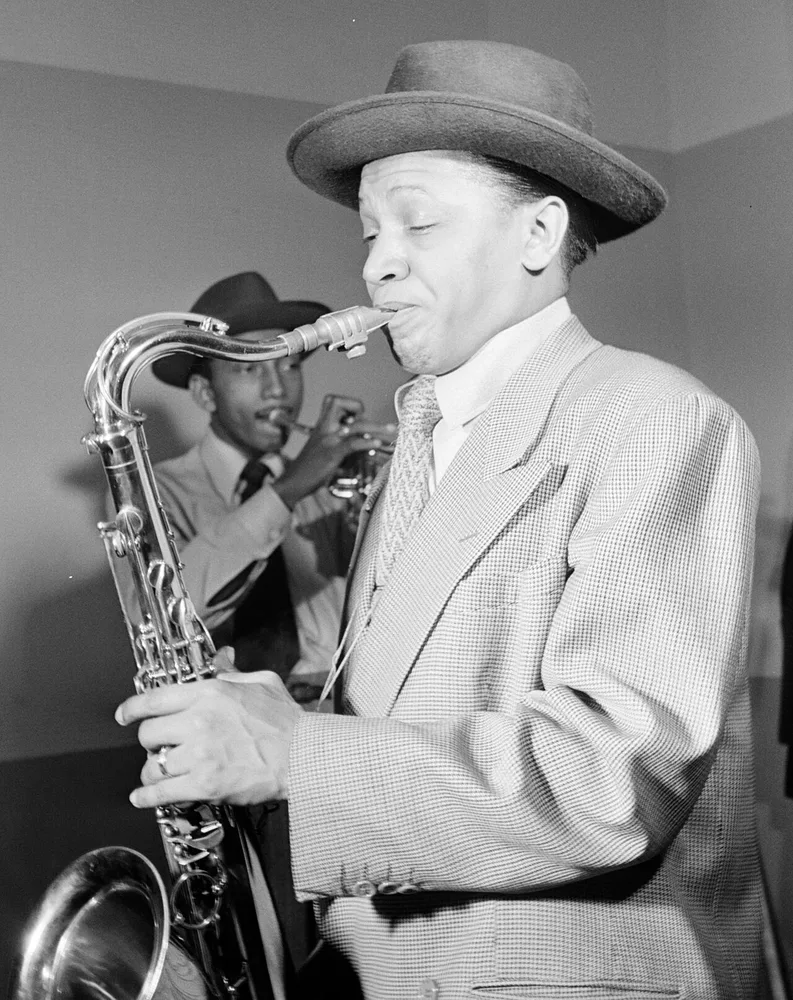
Illinois Jacquet playing tenor saxophone, New York City, c. May 1947, photographed by William P. Gottlieb (cropped detail) Public Domain (William P. Gottlieb collection, Library of Congress; no known copyright restrictions) — Wikimedia Commons: https://commons.wikimedia.org/wiki/File:Illinois_Jacquet,_New_York,_N.Y.,_ca._May_1947_(William_P._Gottlieb_12581)_(profile).jpg

Jean-Baptiste Illinois Jacquet was born on October 30, 1922, in Broussard, Louisiana, to Gilbert Jacquet and Marguerite Trahan, both Creoles of color. The family moved to Houston, Texas, while he was an infant, and he grew up there as one of six children. His father led a band part-time, and as a boy Jacquet played in it, mostly on alto saxophone; his older brother Russell played trumpet and his brother Linton drums. At 15 he joined the Milton Larkin Orchestra, a Houston-area dance band, while attending Wheatley High School.
In 1939 he moved to Los Angeles, where he met Nat King Cole and sat in now and then with Cole's trio. In 1940 Cole introduced him to Lionel Hampton, who was putting together a big band after returning to California. Hampton wanted to hire him but asked him to switch to tenor saxophone. On May 26, 1942, the Hampton orchestra recorded "Flying Home" for Decca, with the 19-year-old Jacquet taking a long tenor solo built to weave in and out of the arrangement. The record was a hit, the solo became the climax of the band's live shows, and it is widely cited as the first rhythm and blues saxophone solo. The tenor players who followed him in the band, among them Arnett Cobb and Dexter Gordon, played it almost note for note, and Jacquet grew tired of having to bring down the house with it every night. He left Hampton in 1943 for Cab Calloway's orchestra and appeared with Calloway's band in the film Stormy Weather (1943).
In 1944 he returned to California and started a small band with his brother Russell and a young Charles Mingus. That year he appeared in the Academy Award-nominated short film Jammin' the Blues alongside Lester Young, and he was on the bill of the first Jazz at the Philharmonic concert, held July 2, 1944, at the Philharmonic Auditorium in Los Angeles, where he, Cole and guitarist Les Paul created the evening's biggest sensation. In 1946 he moved to New York and joined the Count Basie Orchestra, replacing Young. His own sessions of 1945 to 1950 for Philo and Aladdin, Apollo, ARA, Savoy and RCA Victor were collected in a four-disc Mosaic set in 1996. In 1949 he wrote the instrumental "Black Velvet" with the arranger Jimmy Mundy; Al Stillman added lyrics, and Harry James recorded it that year as "Don'cha Go 'Way Mad," a song later performed by Frank Sinatra and Ella Fitzgerald among many others. J.J. Johnson worked in his band from 1947 to 1949, and baritone saxophonist Cecil Payne from 1952 to 1954, according to their own profiles.
Jacquet was a featured soloist on Jazz at the Philharmonic tours in the late 1940s and returned to them in 1955, and he recorded for Norman Granz's Clef and Verve labels in the 1950s, including a 1954 meeting with Ben Webster. He also used his standing against segregation. In Houston he had earlier made the Rice Hotel drop its rule that Black guests use an alley entrance by threatening to cancel his band's engagement. On October 5, 1955, Granz brought a Jazz at the Philharmonic package with Jacquet, Fitzgerald, Dizzy Gillespie, Oscar Peterson and Buddy Rich to Houston's Music Hall for a desegregated concert, with no advance ticket sales and the "white" and "black" signs removed. Houston vice officers then used a dice game in a dressing room as the pretext to arrest Jacquet, Gillespie, Fitzgerald and her assistant, who were taken to the station for the waiting photographers, paid their fines, and returned to play the second set.
In the 1960s and 1970s he worked mostly in small groups and often in Europe. For Argo he made The Message and Desert Winds with guitarist Kenny Burrell in 1963 and 1964, and he played on the singer Johnny Hartman's I Just Dropped by to Say Hello, recorded in October 1963. At Prestige in 1968 and 1969 he made Bottoms Up, The King!, The Soul Explosion and The Blues; That's Me! for producer Don Schlitten, and in the 1970s he recorded for Black Lion and Black & Blue with organists Wild Bill Davis and Milt Buckner and drummer Jo Jones. From 1981 until his death he led the Illinois Jacquet Big Band, which was recorded live at the Village Vanguard in 1986 and 1987 and at the Blue Note in 1987, and which made Jacquet's Got It! for Atlantic in 1988. In 1983 he became the first jazz musician to serve as an artist-in-residence at Harvard University, and in 1993 he played "C-Jam Blues" with President Bill Clinton at an inaugural event. The documentary Texas Tenor: The Illinois Jacquet Story is about his life.
His last performance was on July 16, 2004, at Lincoln Center in New York. He passed away six days later, on July 22, 2004, at the Queens home he shared with his partner Carol Scherick; he was 81, and the cause was a heart attack. A memorial service was held at Riverside Church, and he is buried at Woodlawn Cemetery in the Bronx. In 2008 the Chapel of the Sisters at York College in Jamaica, Queens, was restored and rededicated as the Illinois Jacquet Performance Space, and the Illinois Jacquet Foundation supports scholarships and education in his name.
Jacquet was a leading figure in the Texas tenor tradition, alongside Buddy Tate and James Clay, and a pioneer of the honking tenor sound: a big, shouting tone that stressed the instrument's lowest and highest registers and took the brash sound that had come from Lester Young's playing further. Behind the raw surface he was a melodic improviser at fast tempos and on ballads, and he was one of the few jazz musicians to double on bassoon, which he played on dates such as The Message (1963) and The King! (1968). His solos of the 1940s and his Jazz at the Philharmonic showpieces shaped the tenor saxophone style of rhythm and blues and early rock and roll. Coleman Hawkins's profile traces a line from Hawkins and Ben Webster through Herschel Evans, Buddy Tate and Don Byas to Jacquet, Paul Gonsalves and Arnett Cobb. Cobb, who also played "Flying Home" with Lionel Hampton, Eddie "Lockjaw" Davis, Jimmy Forrest and Sonny Rollins are the players whose work Wikipedia says carries his influence. Stanley Turrentine and Houston Person have each named him as an influence, and the blues guitarist B.B. King cited his phrasing as a model, according to their profiles. His compositions include "Black Velvet," known as "Don'cha Go 'Way Mad," and "Robbins' Nest," written with the pianist Sir Charles Thompson.
- Flying Home (1942, Decca) - Lionel Hampton's orchestra, recorded May 26, 1942, with the 19-year-old Jacquet's tenor solo, the performance that made him famous.
- The Kid and the Brute (1955, Clef) - A two-tenor meeting with Ben Webster, recorded December 13, 1954; Webster plays on the two long blues, and the other four tracks use a horn section with Russell Jacquet, trombonist Matthew Gee and baritone saxophonist Leo Parker.
- Swing's the Thing (1956, Clef) - A sextet date recorded October 16, 1956, with trumpeter Roy Eldridge, pianist Jimmy Jones, guitarist Herb Ellis, bassist Ray Brown and drummer Jo Jones.
- The Message (1963, Argo) - Recorded May 7 and 8, 1963, with Kenny Burrell on guitar and Jacquet also on bassoon. Spotify - The Message Listen
- Bottoms Up (1968, Prestige) - A quartet date recorded March 26, 1968, with pianist Barry Harris, bassist Ben Tucker and drummer Alan Dawson. Spotify - Bottoms Up
- The Blues; That's Me! (1969, Prestige) - A quintet date recorded September 16, 1969, at Van Gelder Studio, with pianist Wynton Kelly, guitarist Tiny Grimes, bassist Buster Williams and drummer Oliver Jackson. Spotify - The Blues; That's Me! Listen
- Jacquet's Got It! (1988, Atlantic) - The Illinois Jacquet Big Band on record; the trombonist and euphonium player Bernard McKinney held a chair in the band from 1984 to 1987 and is documented on the album, according to his profile. Spotify - Jacquet's Got It Listen
- Flying Home: The Best of the Verve Years (1994, Verve) - A compilation of his Clef and Verve recordings of the 1950s. Spotify - Flying Home: The Best Of The Verve Years Listen
Illinois Jacquet: Full Discography
Discogs artist ID 257114 ("Illinois Jacquet," real name Jean-Baptiste Illinois Jacquet, born in Broussard, Louisiana, died July 22, 2004, in Queens, New York) lists more than 1,100 entries across leader, sideman, track-appearance and compilation releases, most of them reissues. Some of his leader work is filed under separate Discogs entries for his named groups, among them Illinois Jacquet and His Orchestra (artist ID 368181), Illinois Jacquet and His All Stars (artist ID 374984), Illinois Jacquet & His Big Band (artist ID 1670870) and several quartet, quintet and sextet entries; these hold mostly 1940s and 1950s singles, which are summarized rather than itemized here. Because his catalog is large, the leader table is a curated selection of 31 releases: the Clef and Verve albums, the Argo and Prestige sets, the 1970s European dates, the big-band albums and the principal compilations. Catalog numbers, release years, recording dates and personnel follow Wikipedia's discography and album articles; where a date or lineup is not given, the cell says so.
As Leader / Co-Leader
| Album Title | Recording Date(s) | Release Date | Label | Catalog Number | Format(s) | Personnel | Role | Reissue History | Spotify | Buy | Notes |
|---|---|---|---|---|---|---|---|---|---|---|---|
| Battle of the Saxes | Not specified | 1951 | Aladdin | LP-701 | 10-inch LP | Illinois Jacquet (tenor saxophone), Lester Young (tenor saxophone) | Co-leader (billed with Lester Young) | Not itemized | — | — | Tenor duel album, listed with Young on Wikipedia. |
| Jazz by Jacquet | Not specified | 1953 | Clef | MGC-167 | 10-inch LP | Illinois Jacquet (tenor saxophone), Russell Jacquet (trumpet), Matthew Gee (trombone), Cecil Payne (baritone saxophone), Johnny Acea (piano), Al Lucas (bass), Shadow Wilson (drums) | Leader | Issued in 1954 as two EPs; Discogs dates the 10-inch LP 1954 | — | — | Personnel is as credited on the first of the two EPs that carry the set. |
| Illinois Jacquet and His Tenor Sax | Not specified | 1954 | Aladdin | LP-708 (10-inch) | 10-inch LP | Illinois Jacquet (tenor saxophone) | Leader | Aladdin LP-803 (1956); Imperial LP-9184 and LP-12184 (1962) | — | — | Compilation of earlier Aladdin sides. |
| The Kid and the Brute | December 13, 1954, New York City | 1955 | Clef | MGC-680 | LP | Illinois Jacquet (tenor saxophone), Ben Webster (tenor saxophone, tracks 1 and 4), Russell Jacquet (trumpet, tracks 2, 3, 5, 6), Matthew Gee (trombone, tracks 2, 3, 5, 6), Leo Parker (baritone saxophone, tracks 2, 3, 5, 6), Johnny Acea (piano), Al Lucas (bass), Osie Johnson (drums), Chano Pozo (congas, tracks 3 and 4) | Co-leader (billed with Ben Webster) | Verve MGV-8065 | — | — | Webster plays on the two long blues. |
| Illinois Jacquet (septet) | Not specified | 1955 | Clef | MGC-676 | LP | Illinois Jacquet (tenor saxophone), Harry "Sweets" Edison (trumpet); full lineup not itemized | Leader | Verve MGV-8061 | — | — | Septet date; only Edison is named in the sources used. |
| Swing's the Thing | October 16, 1956, Radio Recorders, Hollywood | 1956 | Clef | MGC 750 | LP | Illinois Jacquet (tenor saxophone), Roy Eldridge (trumpet), Jimmy Jones (piano), Herb Ellis (guitar), Ray Brown (bass), Jo Jones (drums) | Leader | Verve MGV-8023; CD by Lone Hill Jazz, LHJ-10228 (2005) | — | — | Produced by Norman Granz. |
| Illinois Jacquet Flies Again | Not specified | 1959 | Roulette | SR-52035 | LP | Illinois Jacquet (tenor saxophone) | Leader | CD by Lone Hill Jazz, LHJ-10229 (2005) | — | — | Personnel not itemized. |
| Illinois Jacquet and His Orchestra | Not specified | 1962 | Epic | BA-17033 | LP | Illinois Jacquet (tenor saxophone), Roy Eldridge (trumpet); full lineup not itemized | Leader | CD by Lone Hill Jazz, LHJ-10229 (2005); reissued as Banned in Boston, Portrait RJ-44391 (1989) | — | — | Wikipedia lists Eldridge as a featured guest. |
| The Message | May 7 and 8, 1963, Van Gelder Studio, Englewood Cliffs, New Jersey | 1963 | Argo | LPS-722 | LP | Illinois Jacquet (tenor saxophone), bassoon; Kenny Burrell and Wallace Richardson (guitar), Ralph Smith (organ), Ben Tucker (bass), Ray Lucas (drums), Willie Rodriguez (percussion) | Leader | CD by Lone Hill Jazz, LHJ-10230 (2005) | Spotify - The Message | — | Produced by Esmond Edwards. |
| Desert Winds | February 13, 1964, Van Gelder Studio, Englewood Cliffs, New Jersey | 1964 | Argo | LPS-735 | LP | Illinois Jacquet (tenor saxophone), alto saxophone; Kenny Burrell (electric guitar), Tommy Flanagan (piano), Wendell Marshall (bass), Ray Lucas (drums), Willie Rodriguez (congas) | Leader | CD by Lone Hill Jazz, LHJ-10230 (2005) | — | — | Produced by Esmond Edwards. |
| Bosses of the Ballad: Illinois Jacquet and Strings Play Cole Porter | Not specified | 1964 | Argo | LPS-746 | LP | Illinois Jacquet (tenor saxophone) with strings; personnel not itemized | Leader | CD by Lone Hill Jazz, LHJ-10231 (2005) | — | — | Cole Porter program. |
| Spectrum | April 29 and 30, 1965, RCA Recording Studio, New York City | 1965 | Argo | LPS-754 | LP | Illinois Jacquet (tenor saxophone), alto saxophone; Russell Jacquet (tracks 6 to 9), James Nottingham and Ernie Royal (tracks 1 to 5) (trumpet); Buddy Lucas (tenor saxophone) and Haywood Henry (baritone saxophone) (tracks 1 to 5); Patricia Bown and Edwin Stoute (piano); Billy Butler and Eric Gale (guitar); George Duvivier and Leonard Gaskin (bass); Herbie Lovelle and Grady Tate (drums); Candido (conga); Bert Keyes (arranger, conductor) | Leader | CD by Lone Hill Jazz, LHJ-10231 (2005) | — | — | Different groups play tracks 1 to 5 and tracks 6 to 9. |
| Go Power! | March 1966, Lennie's on the Turnpike, West Peabody, Massachusetts | 1966 | Cadet | LPS-773 | LP | Illinois Jacquet (tenor saxophone), Milt Buckner (organ), Alan Dawson (drums) | Leader | CD by Lone Hill Jazz, LHJ-10232 (2005) | Spotify - Go Power! | — | Live album; produced by Esmond Edwards. |
| Bottoms Up: Illinois Jacquet on Prestige! | March 26, 1968, New York City | 1968 | Prestige | PR 7575 | LP | Illinois Jacquet (tenor saxophone), Barry Harris (piano), Ben Tucker (bass), Alan Dawson (drums) | Leader | Original Jazz Classics OJC-417 | Spotify - Bottoms Up | — | Produced by Don Schlitten. |
| The King! | August 20, 1968, New York City | 1968 | Prestige | PR 7597 | LP | Illinois Jacquet (tenor saxophone), bassoon; Joe Newman (trumpet), Milt Buckner (organ, piano), Billy Butler (guitar), Al Lucas (bass, tuba), Jo Jones (drums), Montego Joe (congas, bongos) | Leader | Original Jazz Classics OJC-849 | — | — | Produced by Don Schlitten. |
| The Soul Explosion | March 25, 1969, Van Gelder Studio, Englewood Cliffs, New Jersey | 1969 | Prestige | PR 7629 | LP | Illinois Jacquet (tenor saxophone); Russell Jacquet, Joe Newman and Ernie Royal (trumpet); Matthew Gee (trombone); Frank Foster (tenor saxophone); Cecil Payne (baritone saxophone); Milt Buckner (organ, piano, arranger); Wally Richardson (guitar); Al Lucas (bass); Al Foster (drums); Jimmy Mundy (arranger) | Leader | Original Jazz Classics OJC-674 | — | — | Large-ensemble date; produced by Don Schlitten. |
| The Blues; That's Me! | September 16, 1969, Van Gelder Studio, Englewood Cliffs, New Jersey | 1969 | Prestige | PR 7731 | LP | Illinois Jacquet (tenor saxophone), bassoon; Wynton Kelly (piano), Tiny Grimes (guitar), Buster Williams (bass), Oliver Jackson (drums) | Leader | Original Jazz Classics OJC-614 | Spotify - The Blues; That's Me! | — | Produced by Don Schlitten. |
| Genius at Work! | 1971, Ronnie Scott's Club, London | 1971 | Black Lion | BL-146 | LP | Illinois Jacquet (tenor saxophone); personnel not itemized | Leader | CD as The Comeback, Black Lion BLCD-760160 | — | — | Live album. |
| Volume 1: Jazz at Town Hall | Not specified | 1973 | J.R.C. Records | 11433 | LP | Illinois Jacquet (tenor saxophone), Arnett Cobb (tenor saxophone) | Co-leader (billed with Arnett Cobb) | Also issued as The Blues from Louisiana | — | — | Tenor pairing with Cobb. |
| Illinois Jacquet with Wild Bill Davis | Not specified | 1973 | Black & Blue | 33.044 | LP | Illinois Jacquet (tenor saxophone), Wild Bill Davis (organ) | Leader | CD as The Man I Love, Black & Blue BB-865; a second volume, 33.082, followed | — | — | Organ-and-tenor recordings. |
| Illinois Jacquet with Milt and Jo | Not specified | 1974 | Black & Blue | 33.070 | LP | Illinois Jacquet (tenor saxophone), Milt Buckner (organ), Jo Jones (drums) | Leader | CD as Bottoms Up, Black & Blue BB-893 | — | — | Not the same album as the 1968 Prestige Bottoms Up. |
| Volume 2: Birthday Party | Not specified | 1975 | J.R.C. Records | 11434 | LP | Illinois Jacquet (tenor saxophone), James Moody (saxophone) | Co-leader (billed with James Moody) | CD by Groove Note Records (1999) | — | — | Companion to the Town Hall volume. |
| Here Comes Freddy | Not specified | 1976 | Sonet | SNTF-714 | LP | Illinois Jacquet (tenor saxophone), Howard McGhee (trumpet) | Co-leader (billed with Howard McGhee) | CD, Sonet SNTCD-714 | — | — | Sonet release. |
| Jacquet's Street | Not specified | 1976 | Black & Blue | 33.112 | LP | Illinois Jacquet (tenor saxophone); personnel not itemized | Leader | CD, Black & Blue BB-972 | — | — | Also issued by Classic Jazz as CJ-146. |
| God Bless My Solo | Not specified | 1978 | Black & Blue | 33.167 | LP | Illinois Jacquet (tenor saxophone); personnel not itemized | Leader | CD, Black & Blue BB-941 | — | — | Black & Blue release. |
| Jacquet's Got It! | Not specified | 1988 | Atlantic | 81816 | LP | Illinois Jacquet (tenor saxophone) with the Illinois Jacquet Big Band, including Bernard McKinney (trombone) | Leader | Not itemized | Spotify - Jacquet's Got It | — | Big-band album. |
| The Black Velvet Band | 1947 to 1950 | 1988 | Bluebird (RCA) | 6571-1-RB | LP, compilation | Illinois Jacquet (tenor saxophone) with his band of the period; personnel not itemized | Leader | Not itemized | — | — | Compilation of 1947 to 1950 recordings. |
| Flying Home: The Best of the Verve Years | Not specified | 1994 | Verve | 521644 | CD, compilation | Illinois Jacquet (tenor saxophone); personnel varies by track | Leader | Not itemized | Spotify - Flying Home: The Best Of The Verve Years | — | Compilation of Clef and Verve recordings. |
| The Complete Illinois Jacquet Sessions 1945-1950 | 1945 to 1950 | 1996 | Mosaic | MD4-0165 | 4 CD box set | Illinois Jacquet (tenor saxophone) with his bands of the period; personnel varies by session | Leader | Not itemized | — | — | Gathers his Philo, Aladdin, Apollo, ARA, Savoy and RCA Victor sessions. |
| The Illinois Jacquet Story | 1944 to 1951 | 2002 | Proper | BOX 49 | 4 CD box set | Illinois Jacquet (tenor saxophone); personnel varies by track | Leader | Not itemized | — | — | Budget-label retrospective. |
| Swingin' Live with Illinois Jacquet: His Final Performance | 2004 | 2006 | Jacquet Records | UPC 837101208147 | 2 CD | Illinois Jacquet (tenor saxophone) with the Illinois Jacquet Big Band | Leader | Not itemized | — | — | Recorded in the year of his death. |
As Sideman (selected major credits)
His sideman and guest work is a representative set rather than an exhaustive one. It includes the 1942 Lionel Hampton record that made him famous and his Jazz at the Philharmonic appearances.
| Year | Project (Leader) | Title | Label | Catalog | Role | Notes |
|---|---|---|---|---|---|---|
| 1942 | Lionel Hampton and His Orchestra | Flying Home | Decca | Not specified | Tenor saxophone soloist | Recorded May 26, 1942; the solo that made his name. |
| 1944 | Norman Granz (short film) | Jammin' the Blues | Warner Bros. (film) | Not applicable | Tenor saxophone | Appears with Lester Young, Harry "Sweets" Edison and others; nominated for an Academy Award. |
| 1944 (released 1994) | Jazz at the Philharmonic | Jazz at the Philharmonic: The First Concert | Verve | 521646 | Tenor saxophone | Recorded at the first concert, July 2, 1944; also features Nat King Cole, Les Paul and J.J. Johnson. |
| 1955 (released 1983) | Jazz at the Philharmonic | Jazz at the Philharmonic: Blues in Chicago 1955 | Verve | 815155 | Tenor saxophone | With Oscar Peterson and Herb Ellis. |
| 1960 | Count Basie Orchestra | String Along with Basie | Roulette | Not specified | Tenor saxophone | Credited to Jacquet on Wikipedia's list of his sideman work. |
| 1962 (released 1983) | Kenny Burrell | Bluesin' Around | Columbia | Not specified | Tenor saxophone | Recorded in 1962 and shelved for two decades. |
| 1963 (released 1964) | Johnny Hartman | I Just Dropped by to Say Hello | Impulse! | Not specified | Tenor saxophone | Recorded in October 1963 with Kenny Burrell, Jim Hall and Hank Jones, per Hartman's profile. |
| 1966 | Sonny Stitt | What's New!!! | Roulette | Not specified | Tenor saxophone | Listed among his sideman credits on Wikipedia. |
| 1967 | Count Basie Orchestra | Half a Sixpence | Dot | Not specified | Tenor saxophone | Listed among his sideman credits on Wikipedia. |
| 1973 | Buddy Tate | Buddy Tate and His Buddies | Chiaroscuro | Not specified | Tenor saxophone | Listed among his sideman credits on Wikipedia. |
| 1974 | Buddy Rich | The Last Blues Album Volume 1 | Groove Merchant | Not specified | Tenor saxophone | Reissued in 1991, with three added tracks, as Loot to Boot. |
| 1990 | Joey DeFrancesco | Where Were You? | Columbia | Not specified | Tenor saxophone | Listed among his sideman credits on Wikipedia. |
| 1994 | Modern Jazz Quartet | MJQ & Friends: A 40th Anniversary Celebration | Atlantic | Not specified | Tenor saxophone | Listed among his sideman credits on Wikipedia. |
- Lionel Hampton - bandleader who hired him after the 1940 introduction by Nat King Cole, and on whose 1942 "Flying Home" record he took the famous solo.
- Cab Calloway - bandleader in whose orchestra he played from 1943, including on screen in Stormy Weather.
- Count Basie Orchestra - his band from 1946, replacing Lester Young; he also appears on Basie's String Along with Basie (1960) and Half a Sixpence (1967).
- Norman Granz - producer of Jazz at the Philharmonic and of his Clef and Verve albums, and the organizer of the desegregated 1955 Houston concert.
- Lester Young - Basie's tenor predecessor, with whom he appeared in Jammin' the Blues (1944) and shared the 1951 Battle of the Saxes.
- Russell Jacquet - his older brother, a trumpeter who played in his bands from the 1940s into the late 1960s.
- Charles Mingus - bassist in the small band Jacquet formed in Los Angeles in 1944.
- J.J. Johnson, Cecil Payne - trombonist and baritone saxophonist in his bands, from 1947 to 1949 and 1952 to 1954 respectively, per their profiles.
- Ben Webster - tenor rival and partner on The Kid and the Brute (1955).
- Kenny Burrell - guitarist on The Message and Desert Winds, and the leader of Bluesin' Around (recorded 1962, released 1983), on which Jacquet is a sideman.
- Johnny Hartman - singer on whose I Just Dropped by to Say Hello (recorded October 1963) he played tenor saxophone.
- Milt Buckner, Wild Bill Davis, Jo Jones - organists and a drummer on his 1960s and 1970s records, including Go Power! (1966) and With Milt and Jo (1974).
- Barry Harris, Wynton Kelly, Buster Williams, Al Foster, Frank Foster - pianists, a bassist, a drummer and a tenor saxophonist who played on his 1968 and 1969 Prestige albums.
- Will Anderson, Peter Anderson - saxophonist twins who held the Illinois Jacquet Scholarship in Jazz Studies at Juilliard from 2007 to 2009, per their profiles.
More Swing Artists
See all 217 Swing artists →More American Jazz Artists
See all 820 American artists →- Wikipedia: Illinois Jacquet
- Wikipedia: Jazz at the Philharmonic
- Wikipedia: Jammin' the Blues
- Wikipedia: Flying Home
- Wikipedia: The Kid and the Brute
- Wikipedia: Swing's the Thing
- Wikipedia: The Message
- Wikipedia: Bottoms Up
- Wikipedia: The Blues; That's Me!
- JazzTimes: Illinois Jacquet Dies (2004)
- Discogs: Illinois Jacquet (artist 257114)
- MusicBrainz: Illinois Jacquet
- JazzProfiles.com: Lionel Hampton
- JazzProfiles.com: J.J. Johnson
- JazzProfiles.com: Cecil Payne
- JazzProfiles.com: Johnny Hartman
- JazzProfiles.com: Bernard McKinney
- JazzProfiles.com: Stanley Turrentine
- JazzProfiles.com: Houston Person
- JazzProfiles.com: B.B. King
- JazzProfiles.com: Will Anderson
- JazzProfiles.com: Coleman Hawkins