 JAZZPROFILES lives in the music 1,572 Jazz Artists fully Profiled!
 B.B. King
Last updated September 12, 2026
Listen on Spotify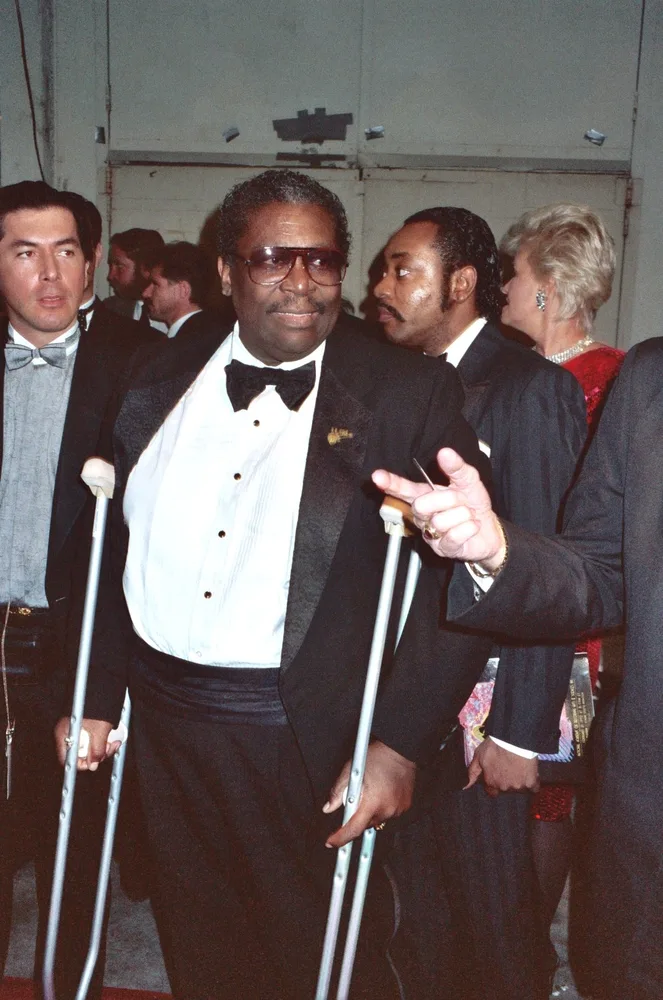
B.B. King at an industry event. CC BY 2.0 — Wikimedia Commons — https://commons.wikimedia.org/wiki/File:B._B._King_(2088048328).jpg
.jpg)
Riley B. King was born September 16, 1925, on a cotton plantation near Itta Bena, Mississippi, and grew up picking cotton before an army deferment for essential farm labor kept him out of World War II service. He moved to Memphis in the mid-1940s, took the stage name "Beale Street Blues Boy," later shortened to "B.B.," and built a career that made him, by wide consensus, the single most influential electric blues guitarist of the second half of the 20th century. King toured relentlessly for decades — by his own account playing 342 shows in 1956 alone, and averaging over 200 concerts a year into his 70s — and racked up 15 Grammy Awards, a 1987 Rock and Roll Hall of Fame induction, and a 1980 Blues Hall of Fame induction over a catalog of more than 40 studio and live albums. This profile does not attempt that full career; it is scoped specifically to the two chapters of King's work with a genuine, documented jazz connection.
The clearest of those is Blues 'N' Jazz, a 1983 studio album for MCA Records, cut in New York and Texas sessions and released to coincide with King's 58th birthday. Every horn arrangement on the record was written by trumpeter and bandleader Calvin Owens, who had first served as King's music director from 1953 to 1957 and returned in 1978 to lead King's touring band and horn section through 1984. For Blues 'N' Jazz, Owens assembled a genuine jazz lineup around King: tenor saxophonist Arnett Cobb (a Texas tenor legend out of the Milt Larkin and Lionel Hampton bands) took the lead saxophone chair, trumpeter Woody Shaw — one of the defining post-bop trumpet voices of his generation — appeared alongside Owens's own trumpet, vibraphonist Warren Chiasson (known for his work with George Shearing and Chet Baker) added a genuinely jazz-idiomatic color, and the rhythm section included bassist Major Holley and drummer Oliver Jackson, both journeymen of the New York jazz scene. Discogs itself tags the release "Jazz, Blues" and "Big Band" in its genre and style fields, not blues alone — an independent, third-party classification that supports treating this specific record as a real jazz crossover rather than a stretch. The album won the Grammy Award for Best Traditional Blues Recording at the 26th Annual Grammy Awards in February 1984, King's third Grammy win.
The other anchor point predates Blues 'N' Jazz by more than a decade: a July 7, 1972 performance at Yankee Stadium as part of that year's Newport Jazz Festival, which producer George Wein had relocated to New York City and staged across multiple venues, including Yankee Stadium and Radio City Music Hall. King sat in on guitar for an extended jam alongside organist Jimmy Smith, guitarist Kenny Burrell, trumpeters Clark Terry and Joe Newman, tenor saxophonist Zoot Sims, and drummer Roy Haynes — a genuine gathering of major jazz names, not a billing coincidence. The performance was released as part of the sprawling Newport in New York '72 box set and later reissued as a standalone LP, Newport Jazz Festival 1972 Volume I. Its centerpiece, a 15-minute reading of "Blue 'N' Boogie," is a multi-horn blues-jazz jam built around successive solos, with King's guitar taking its turn alongside Terry, Sims, Burrell, and Newman.
Beyond these two specific records, King's guitar vocabulary itself carried a jazz debt: he cited jazz guitarists Django Reinhardt and Charlie Christian, alongside blues players T-Bone Walker and Lonnie Johnson, as formative influences, and described listening closely to jazz horn players — Illinois Jacquet in particular — for the vocal-like phrasing, dynamics, and economical note choices that became his signature. King himself said he came "from the big-band era," naming Count Basie, Duke Ellington, Benny Goodman, and Jimmie Lunceford as admired figures, which is consistent with his lifelong preference for horn-driven backing bands even on records with no direct jazz personnel. King died May 14, 2015, in Las Vegas, Nevada, at age 89.
King's connection to jazz runs in two distinct directions. The first is stylistic: his celebrated single-string, vocal-like guitar phrasing — precise bends, sparing note choices, the "butterfly" vibrato — was shaped in part by jazz guitarists Django Reinhardt and Charlie Christian and by close listening to jazz horn players, especially Illinois Jacquet, whose economical tenor-saxophone phrasing King cited as a direct model for how he approached the guitar. The second is concrete and documentary: on Blues 'N' Jazz (1983), arranger Calvin Owens built an actual big-band horn section around King out of working jazz musicians — Arnett Cobb, Woody Shaw, Warren Chiasson chief among them — and Discogs' own genre tagging of that record as "Jazz, Blues" rather than blues alone backs up treating it as a real crossover. The July 1972 Newport Jazz Festival-New York jam adds a second, earlier data point: King improvising alongside Jimmy Smith, Kenny Burrell, Clark Terry, Joe Newman, Zoot Sims, and Roy Haynes in a genuine multi-artist jazz-festival jam, not a guest-star cameo. None of this makes King a jazz musician in any sustained sense — his catalog of 40-plus albums is blues catalog through and through — but these two records are real, documented, and specific enough to earn a place in a jazz-scene history, not an overstated one.
- Blues 'N' Jazz (1983, MCA Records) - Grammy-winning big-band studio album, horn arrangements by Calvin Owens for a lineup including Arnett Cobb, Woody Shaw, and Warren Chiasson; Discogs genre-tags it "Jazz, Blues." Spotify - Blues 'N' Jazz Listen
- Newport Jazz Festival 1972 Volume I (1972 performance, reissued 1982, Accord) - live jam recorded at Yankee Stadium during the 1972 Newport Jazz Festival-New York, with King sitting in alongside Jimmy Smith, Kenny Burrell, Clark Terry, Joe Newman, Zoot Sims, and Roy Haynes. Not found on Spotify — not confirmed.
B.B. King: Discography (Jazz-Relevant, Selected)
Identity confirmed via Discogs artist ID 37729 ("B.B. King"), distinct from the separate "B.B. King Orchestra" Discogs entity (655884). B.B. King's studio and live catalog runs to 40-plus albums over six decades and is overwhelmingly blues, not jazz. Only the two releases with a genuine, documented jazz-scene crossover are itemized here: the big-band studio album arranged by Calvin Owens for a lineup of working jazz musicians, and the 1972 Newport Jazz Festival-New York jam session where King sat in with a group of major jazz names. His broader blues catalog is out of scope for this profile.
As Leader / Featured Artist
| Album Title | Recording Date(s) | Release Date | Label | Catalog Number | Format(s) | Personnel | Role | Reissue History | Spotify | Buy | Notes |
|---|---|---|---|---|---|---|---|---|---|---|---|
| Blues 'N' Jazz | September 16, 1983 (King's 58th birthday), sessions at M & I Recording Studio (New York City) and Rivendale Recorders (Pasadena, Texas) | 1983 | MCA Records | MCA-5413 (US LP); MCF 3170 / MCFC 3170 (UK) | Vinyl, LP, Album | B.B. King (guitar, vocals), Calvin Owens (arranger, trumpet), Arnett Cobb (lead tenor saxophone), Woody Shaw (trumpet), Fred Ford (tenor saxophone), Don Wilkerson (saxophone), Harold Austin (saxophone), Eddie Synigal (baritone saxophone), James Bolden (trumpet), John Longo (trumpet), Warren Chiasson (vibraphone), Major Holley (bass), Oliver Jackson (drums), Billy Butler (guitar), Lloyd Glenn (piano), Sidney A. Seidenberg (producer) — all confirmed via Discogs release 3667195 extraartists credits | Leader | Reissued on cassette (MCAC-5413/MCAC-27119) and CD (MCAD-27119) by MCA; UK reissue MCL 1836 (1987); international pressings in Japan (VIM-6309), Canada, Portugal, Spain, Italy, Argentina, and a 2015 Japanese "Best Collection" reissue (UICY-77476) | Spotify - Blues 'N' Jazz — verified via Spotify Web API, track listing (9 tracks: Inflation Blues, Broken Heart, Sell My Monkey, Heed My Warning, Teardrops From My Eyes, Rainbow Riot, Darlin' You Know I Love You, Make Love To Me, I Can't Let You Go) matches the Discogs release exactly | — | Discogs genre-tags this release "Jazz, Blues" / styles "Electric Blues, Big Band" — a rare case of Discogs itself classifying a King record as jazz, not just blues, which is why it anchors this profile. Won the Grammy for Best Traditional Blues Recording/Performance at the 26th Annual Grammy Awards (1984) — King's third Grammy; see notes file for a caveat on the exact contemporary category name. Calvin Owens, King's bandleader from 1978-1984, wrote all the horn arrangements. |
| Newport Jazz Festival 1972 Volume I (reissue title; originally issued as part of Newport in New York '72: The Jimmy Smith Jam, Vol. 5) | Live, July 7, 1972, Yankee Stadium, New York (Newport Jazz Festival-New York) | Original 1972 (Cobblestone, as part of the 6-LP Newport in New York '72 box); this single-LP edition reissued 1982 | Cobblestone (1972 original, part of Buddah Records' box set); Accord (1982 reissue) | Cobblestone 9027 (1972, per secondary source, not independently confirmed via Discogs); Accord SN-7212 (1982 reissue, confirmed via Discogs master 268487 / release 4705969) | Vinyl, LP, Album | B.B. King (guitar), Kenny Burrell (guitar), Jimmy Smith (organ), Clark Terry (trumpet), Joe Newman (trumpet), Zoot Sims (tenor saxophone), Illinois Jacquet (tenor saxophone, per secondary source only — not listed in the Discogs top-line artist credit, see notes), Roy Haynes (drums) | Featured/sideman (King is one of several co-billed lead artists, not the sole leader) | No further reissue history found beyond the 1982 Accord single-LP repackaging of the original 1972 box-set volume | Not confirmed — no matching release found on Spotify | — | Recorded at the 1972 edition of the Newport Jazz Festival, relocated that year to New York City ("Newport Jazz Festival-New York") and staged across multiple venues including Yankee Stadium and Radio City Music Hall. The main track, "Blue 'N' Boogie" (15:15), is a multi-horn blues-jazz jam with King soloing alongside Clark Terry, Zoot Sims, Kenny Burrell, and Joe Newman. Discogs logs "Roy Haynes" under the misspelled artist-credit variation "Ron Haymes" on this release. |
His broader blues catalog — including Live at the Regal (1965), Completely Well (1969, "The Thrill Is Gone"), Live and Well (1969), Indianola Mississippi Seeds (1970), and the 40-plus other studio and live albums spanning 1949 to 2008 — is not itemized here; it falls outside this project's jazz scope.
- Calvin Owens - trumpeter and bandleader; King's music director 1953-1957 and again 1978-1984; wrote all horn arrangements for Blues 'N' Jazz (1983).
- Arnett Cobb - lead tenor saxophone on Blues 'N' Jazz; Texas tenor veteran of the Milt Larkin and Lionel Hampton bands.
- Woody Shaw - trumpet on Blues 'N' Jazz; a leading post-bop trumpet voice of his generation.
- Warren Chiasson - vibraphone on Blues 'N' Jazz; known for his work with George Shearing and Chet Baker.
- Major Holley - bass on Blues 'N' Jazz.
- Oliver Jackson - drums on Blues 'N' Jazz.
- Fred Ford - tenor saxophone on Blues 'N' Jazz.
- Jimmy Smith - organ; co-billed alongside King on the July 1972 Newport Jazz Festival-New York jam.
- Kenny Burrell - guitar; same 1972 Newport jam.
- Clark Terry and Joe Newman - trumpets; same 1972 Newport jam.
- Zoot Sims - tenor saxophone; same 1972 Newport jam.
- Roy Haynes - drums; same 1972 Newport jam (logged on Discogs under the misspelled credit "Ron Haymes").
- Illinois Jacquet - tenor saxophone, per a secondary source describing the same 1972 jam; not listed in the Discogs top-line artist credit for the reissue — flagged as unconfirmed via Discogs in the notes file.
More Big Band Artists
See all 202 Big Band artists →More American Jazz Artists
See all 567 American artists →- Discogs: B.B. King (artist 37729) — verified via Discogs API
- Discogs: Blues 'N' Jazz (master 359681 / release 3667195) — full personnel, genre/style tags, label, and catalog numbers verified via Discogs API
- Discogs: Newport Jazz Festival 1972 Volume I (master 268487 / release 4705969) — artist credits, tracklist, label, and catalog number verified via Discogs API
- Wikipedia: B.B. King — birth/death dates and place, career overview, Grammy history
- Wikipedia: Blues 'N' Jazz — recording dates/locations, label, personnel, Grammy win, critical reception, verified via direct page fetch
- Wikipedia: Calvin Owens — dates of both tenures with King, arranger role on Blues 'N' Jazz, verified via direct page fetch
- Wikipedia: Newport Jazz Festival — confirmation of the 1972 relocation to New York City and Yankee Stadium/Radio City Music Hall venues, verified via direct page fetch
- Grammy.com: B.B. King — Grammy win listing for Blues 'N' Jazz, retroactively labeled "Best Traditional Blues Album" on the current site; see notes file for a caveat on the exact 1984-era category name
- Spotify: Blues 'N' Jazz — verified via Spotify Web API (artist ID 5xLSa7l4IV1gsQfhAMvl0U), 9-track listing cross-checked against Discogs and confirmed to match exactly
- Spotify Web API search for "Newport Jazz Festival 1972" and related terms — no matching release found; marked "not confirmed" rather than guessed
- WebSearch-sourced secondary description (RateYourMusic / Dusty Groove listings for "Newport in New York '72: The Jimmy Smith Jam, Vol. 5") — used only for instrument-level personnel detail (organ, trumpets, tenor saxophones, drums) not present in the Discogs credits for this release; flagged as a secondary, not Discogs-verified, source in the notes file
- WebSearch of guitar-press sources (Guitar World, All About Jazz artist listing, JazzTimes) — used for King's stated jazz guitar influences (Django Reinhardt, Charlie Christian) and jazz horn phrasing influence (Illinois Jacquet); AllAboutJazz.com and JazzTimes.com both returned 403 on direct fetch, so these are cited via WebSearch excerpt only