 JAZZPROFILES lives in the music 1,572 Jazz Artists fully Profiled!
 Carl Perkins
Last updated September 7, 2026
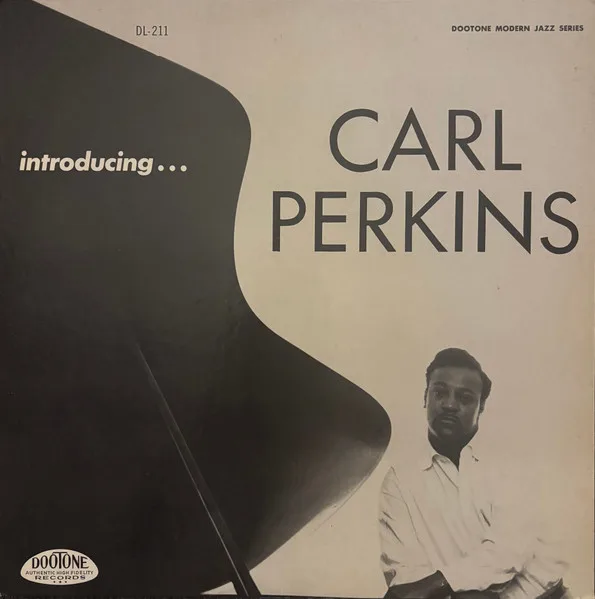
Front cover of *Introducing Carl Perkins* (Dootone Records DL-211, 1956), Perkins's only album as a leader. Perkins is pictured at lower right, seated beside a grand piano. Album cover art (not a CC-licensed artist photo) - used as the only available image showing the artist. No free-licensed or public-domain photograph of the jazz pianist Carl Perkins (1928-1958) exists on Wikimedia Commons; every "Carl Perkins" image there is of the rockabilly guitarist (1932-1998), the Kentucky congressman, or landmarks named for them. — Discogs, cover scan of Dootone DL-211 - https://www.discogs.com/release/36961809
Carl Perkins was born August 16, 1928, in Indianapolis, Indiana, and taught himself the piano as a boy. Childhood polio left his left arm weakened and short of reach, and rather than work around the limitation he rebuilt his technique around it, turning the arm sideways so that it lay parallel to the keys and striking the bass notes with his elbow. He described the adaptation in plain terms: "When I was small, my hand was too little to make bass chords so I turned my hand around and used my elbow to make them." Other musicians nicknamed him "the crab." His first professional work came in the rhythm-and-blues bands of Tiny Bradshaw and Big Jay McNeely between 1948 and 1949, and in 1949 he left Indiana for Los Angeles, which stayed his base for the rest of his life. That November he cut his first sessions for Savoy, a run of solo and trio sides that included "Summertime," "Smoke Gets in Your Eyes," and "The Rosary," with Edwin Perkins on bass and Herb Williams on drums for the trio date.
The early 1950s were broken up by the draft. Perkins played dates around Los Angeles with Miles Davis in 1950 and recorded with the Illinois Jacquet Quintet on January 18, 1951, before entering the Army that same month; he served until November 1952. Back on the scene, he took a steady chair with guitarist Oscar Moore, working in Moore's trio and quartet from 1953 to 1955 and recording for Skylark, Tampa, and Norgran. On July 13, 1954, he filled the piano chair for the Clifford Brown and Max Roach quintet at a Gene Norman concert in Pasadena alongside Teddy Edwards and bassist George Bledsoe, a performance later issued on GNP.
Nineteen fifty-five put him in front of much stronger company. On March 31 he played in a Frank Morgan septet for Gene Norman that also carried Conte Candoli, Leroy Vinnegar (a fellow Indianapolis native, born there five weeks before Perkins in 1928), and Wardell Gray, whose last recorded performances the album preserves. On November 8 he was the pianist on a Dizzy Gillespie orchestra date for Norgran with Harry Edison, Melba Liston, and vocalist Toni Harper, and days later he made Dexter Blows Hot and Cool with Dexter Gordon for Dootone, with Vinnegar again on bass. Dootone's Dootsie Williams then gave him a trio session of his own. Introducing Carl Perkins (Dootone DL-211) holds eleven tracks including five Perkins originals, among them "Way Cross Town," "Marblehead," "Westside," and "Carl's Blues," with Leroy Vinnegar on bass and Lawrence Marable on drums. It was the only full album he made as a leader.
October 1956 brought the association he is remembered for. Bassist Curtis Counce assembled a quintet with trumpeter Jack Sheldon, tenor saxophonist Harold Land, drummer Frank Butler, and Perkins, and recorded it for Lester Koenig's Contemporary label across sessions running from October 8, 1956, to January 6, 1958. Three albums came out of that book: The Curtis Counce Group (1957), You Get More Bounce with Curtis Counce! (1957), and the posthumously titled Carl's Blues (1960). The group worked steadily enough to appear on KABC-TV's Stars of Jazz in November 1956 with Anita O'Day. Perkins was in demand elsewhere at the same time. He played the October 31, 1956, sextet date that produced Playboys for Chet Baker and Art Pepper; the January 1957 trio sessions for Jim Hall's first album as a leader, Jazz Guitar, with Red Mitchell on bass; the Richie Kamuca Quartet date for Mode in June 1957; Pepper Adams' recorded debut as a leader, the Pepper Adams Quintet album cut in Hollywood in July 1957 for Mode with Stu Williamson, Vinnegar, and Mel Lewis; Victor Feldman's Vic Feldman on Vibes that September; and Vinnegar's own Leroy Walks! for Contemporary across three 1957 dates.
His last documented studio work came in January 1958. The Counce group's closing session on January 6 supplied most of what became Carl's Blues, including the title blues Perkins wrote. A week later, on January 13 and 14, he joined Harold Land, Rolf Ericson, Leroy Vinnegar, and Frank Butler at Contemporary's studio for the album issued as Harold in the Land of Jazz and reissued as Grooveyard, after the Perkins blues that anchors it. Carl Perkins died in Los Angeles on March 17, 1958, at twenty-nine, of a drug overdose. Counce dissolved the quintet not long afterward. Lester Koenig, who had recorded nearly all of the group's output, put the reason bluntly: without Perkins, whose piano style was basic to the group's sound, the band could not be rebuilt.
Perkins was a blues-soaked bebop player whose whole conception grew out of a physical constraint. With his left arm turned flat against the keyboard he voiced two- and three-note chords with a hand that could not stretch, and dropped in bass notes with his elbow, which left him a spare, percussive left hand and threw the weight of the music onto his right-hand line and his time. Bassist Leroy Vinnegar, who worked with him more than anyone else did, called him the dream pianist for a bass player and singled out the infectiousness of his time feel; the relaxed, forward swing invites comparison with his Los Angeles contemporary Hampton Hawes. As a writer he stayed close to blues and rhythm heads, and the pieces that survive him are "Carl's Blues," "Mia" (also issued as "Westside"), "Way Cross Town," and above all "Grooveyard," a minor-key line over an E-flat-minor to A-flat vamp that outlived him as a standard: the Montgomery Brothers named a 1961 Riverside album after it. Paul Tanner, Maurice Gerow, and David Megill's textbook Jazz names him among the strongest of the funky hard bop pianists while noting that his death at twenty-nine cut off the legacy he would otherwise have left. The bulk of his best playing is compressed into eighteen months, which is why he turns up on so many West Coast dates of 1956 and 1957 for leaders as different as Chet Baker, Dexter Gordon, and Curtis Counce.
- Introducing Carl Perkins (1956, Dootone) - His only album as a leader, a trio date with Leroy Vinnegar and Lawrence Marable carrying five of his own compositions. Spotify - Introducing Carl Perkins Listen
- Harold in the Land of Jazz (1958, Contemporary) - Harold Land's quintet date of January 13-14, 1958, Perkins's last session, and the first recording of his "Grooveyard"; reissued under that title. Spotify - Harold in the Land of Jazz Listen
- The Curtis Counce Group (1957, Contemporary) - The first of the Counce quintet's albums, recorded October 8 and 15, 1956, and the record that introduced his tune "Mia." Spotify - The Curtis Counce Group Listen
- Carl's Blues (1960, Contemporary) - Counce material from 1957 and January 1958 named for Perkins's blues, assembled and issued after his death. Spotify - Carl's Blues Listen
- Playboys (1957, Pacific Jazz) - The October 31, 1956, sextet date with Chet Baker, Art Pepper, and Phil Urso, later reissued as Picture of Heath. Spotify - Picture of Heath
- Jazz Guitar (1957, Pacific Jazz) - Jim Hall's debut as a leader, a piano-guitar-bass trio with Red Mitchell and no drummer. Spotify - Jazz Guitar
- Pepper Adams Quintet (1957, Mode) - Pepper Adams' recorded debut as a leader, cut in Hollywood in July 1957 with Stu Williamson, Vinnegar, and Mel Lewis. Spotify - Pepper Adams Quintet
- Dexter Blows Hot and Cool (1955, Dootone) - Dexter Gordon's first album after a long recording gap, with Perkins and Leroy Vinnegar in the rhythm section. Spotify - Dexter Blows Hot & Cool
Carl Perkins: Full Discography
Identity confirmed via the live Discogs API. The jazz pianist is artist ID 2000011, disambiguated on Discogs as "Carl Perkins (4)" with a profile giving the correct birth and death dates (August 16, 1928, Indianapolis; March 17, 1958, Los Angeles) and naming Curtis Counce, Harold Land, Jack Sheldon, Oscar Moore, Frank Butler, Clifford Brown, Max Roach, Frank Morgan, Chet Baker, Dizzy Gillespie, and Dexter Gordon as associates. This is a different entry from artist 251877, the rockabilly guitarist "Blue Suede Shoes" Carl Perkins (1932-1998).
Discogs credits the pianist on 222 releases: 14 in a "Main" role (which includes shared-billing anthologies and posthumous compilations), 195 sideman "Appearance" credits, 10 track-level "TrackAppearance" credits, and 3 unofficial releases. The large sideman figure is inflated by reissues, foreign pressings, and compilations; the underlying body of work is roughly two dozen original sessions recorded between November 1949 and January 1958. Perkins made exactly one full album as a leader, Introducing Carl Perkins, plus three 1949 Savoy singles. Recording dates below come from Discogs release notes, Wikipedia album articles, and Noal Cohen's session-by-session Carl Perkins discography; where sources disagree the conflict is noted here and in carl-perkins_notes.md.
The Buy column is — throughout: no affiliate program is set up for this site yet.
As Leader / Co-Leader
| Album Title | Recording Date(s) | Release Date | Label | Catalog Number | Format(s) | Personnel | Role | Reissue History | Spotify | Buy | Notes |
|---|---|---|---|---|---|---|---|---|---|---|---|
| "Summertime" b/w "Lullaby in Rhythm" | Recorded November 30, 1949, Los Angeles | 1949 | Savoy Records | Not confirmed | Shellac, 10", 78 RPM | Carl Perkins (piano), Edwin Perkins (bass), Herb Williams (drums) | Leader (Carl Perkins Trio) | None found | — | — | His first commercially issued record |
| "The Rosary" b/w "Ave Maria" | Recorded November 1949, Los Angeles | 1949 | Savoy Records | Not confirmed | Shellac, 10", 78 RPM | Carl Perkins (piano), bass and drums unidentified | Leader | None found | — | — | Part of the same 1949 Savoy run |
| "Smoke Gets in Your Eyes" b/w "I'll Never Smile Again" | Recorded November 1949, Los Angeles | 1949 | Savoy Records | Discogs release 9152308 (catalog not listed) | Shellac, 10", 78 RPM | Carl Perkins (piano), bass and drums unidentified | Leader | None found | — | — | |
| Introducing Carl Perkins | Recorded Los Angeles; Wikipedia dates the session to 1955, Noal Cohen's discography to February 1956 | 1956 | Dootone Records | DL-211 (also issued as AUL-211 / DTL-211) | Vinyl, LP, Album, Mono (first pressings in black and red vinyl) | Carl Perkins (piano), Leroy Vinnegar (bass), Lawrence Marable (drums); supervised by Dootsie Williams | Leader | Reissued repeatedly: Dootone/Dooto (1957, 1960, 1972), Japan (Dootone LPM-20 1956; ULS-1865-V 1976; Polydor 28MJ 3560 1987; Venus 1993, 1996, 1998; Absord 2009), Boplicity BOP 8 (UK, 1984) and CDBOP 008/CDBOPM 008, Fresh Sound FSR-CD 10 and FSR-695 (Spain, 1989), Phono 870233 (2015) | Spotify - Introducing Carl Perkins | — | 11 tracks; five Perkins originals ("Way Cross Town," "Marblehead," "Westside," "Why Do I Care," "Carl's Blues"). Some later editions add "Westside AKA Mia (alternate)" and "Memories" |
| Piano Playhouse | Recorded 1957, Hollywood | 1957 | Mode Records | MOD LP-128 | Vinyl, LP, Mono | Carl Perkins, Jimmy Rowles, Lou Levy, Paul Smith, Gerald Wiggins (solo piano, four tracks each) | Shared billing (compilation of solo pianists) | Reissued 1986 on V.S.O.P. (MOD LP-128), 2002 on V.S.O.P. CD (#31), 2008 on Mode Paper Sleeve Collection (MZCS-1171) | — | — | Perkins contributes four unaccompanied solo tracks |
| Jazz Pianists Galore | Compiled from Pacific Jazz / World Pacific sessions, 1953-1957 | 1957 | Jazz West Coast (Pacific Jazz) | JWC-506 | Vinyl, LP, Mono | Various pianists including Carl Perkins, Hampton Hawes, Russ Freeman, Jimmy Rowles, Bobby Timmons, Al Haig, Pete Jolly, Dick Twardzik, John Lewis | Shared billing (various artists) | Part of the 15-volume JWC 500-514 series | — | — | Perkins appears on one track |
| Carl Perkins Memorial | Recorded Los Angeles, November 12, 1956; July 8, 1957; October 21, 1957 | 1989 | Fresh Sound Records | FSR-404 | Vinyl, LP, Compilation | Carl Perkins (piano) with Harold Land and Richie Kamuca (tenor sax), Jack Sheldon (trumpet), Herbie Mann (flute), Curtis Counce and Leroy Vinnegar (bass), Frank Butler, Bill Douglass, Tony Bazley (drums) | Posthumous compilation issued under his name | None found | — | — | Assembled by Jordi Pujol from three previously scattered 1956-57 sessions |
| Perkins / Hope / Haig / Bishop | Various 1950s sessions | 1995 | Barna Records Lab, S.L. | Not confirmed | CD, Compilation | Carl Perkins, Elmo Hope, Al Haig, Walter Bishop Jr. | Shared billing (various artists) | None found | — | — | Posthumous four-pianist anthology |
As Sideman (documented studio and concert credits)
| Year | Project (Leader) | Title | Label | Catalog | Role | Notes |
|---|---|---|---|---|---|---|
| 1951 | Illinois Jacquet Quintet | Collates | Clef / Mercury | Not confirmed | Piano | Recorded January 18, 1951, Los Angeles, with Oscar Moore (guitar), Red Callender (bass), J.C. Heard (drums). Spotify - Illinois Jacquet Collates |
| 1954 | Clifford Brown and Max Roach Quintet | The Best of Max Roach and Clifford Brown In Concert! | GNP | GNP 18 | Piano | Recorded live July 13, 1954, Pasadena, with Teddy Edwards (tenor sax) and George Bledsoe (bass); Richie Powell plays piano on the other half of the LP. Also issued as In Concert and In Concert 1 |
| 1954 | Oscar Moore Trio | Oscar Moore | Skylark Records | SK LP 19 | Piano | Recorded 1954 at Radio Recorders, Los Angeles, with Joe Comfort (bass), Lee Young (drums). Material reissued on Tampa TP 22 with one added track |
| 1955 | Oscar Moore Quartet | Oscar Moore (Tampa / Norgran sessions) | Tampa; Norgran | Not confirmed | Piano | Sessions of April 22 and June 16, 1955, Hollywood, with Joe Comfort (bass), George Jenkins (drums), Mike Pacheco (bongos on the June date) |
| 1955 | Frank Morgan Septet | Gene Norman Presents Frank Morgan | GNP | vol 12 | Piano | Recorded March 31, 1955, Los Angeles, with Conte Candoli (trumpet), Wardell Gray (tenor sax), Howard Roberts (guitar), Leroy Vinnegar (bass), Lawrence Marable (drums). Contains Wardell Gray's last recorded performances. Spotify - Gene Norman Presents Frank Morgan |
| 1955 | Dizzy Gillespie Orchestra | Jazz Recital | Norgran | Not confirmed | Piano | Recorded November 8, 1955, Hollywood, with Harry Edison (trumpet), Melba Liston (trombone), Willie Smith (alto sax), George Bledsoe (bass), Albert Bartee (drums), Toni Harper (vocals). Material later reappeared as Dizzy Gillespie's Big Band Jazz (American Recording Society, 1957) |
| 1955 | Dexter Gordon | Dexter Blows Hot and Cool | Dootone Records | DL-207 | Piano | Recorded November 11-12, 1955, Los Angeles, with Jimmy Robinson (trumpet), Leroy Vinnegar (bass), Chuck Thompson (drums). 9 tracks. Spotify - Dexter Blows Hot & Cool |
| 1955 | Illinois Jacquet Septet | Illinois Jacquet and His Orchestra | Clef / Verve | MG C-700 (Jazz Moods) and related Clef issues | Piano | Recorded November 3, 1955, Hollywood, with Harry Edison (trumpet), Irving Ashby (guitar), Gerald Wiggins (organ), Curtis Counce (bass), Albert Bartee (drums) |
| 1956 | The Curtis Counce Group | The Curtis Counce Group | Contemporary Records | C3526 | Piano | Recorded October 8 and 15, 1956, Los Angeles, with Jack Sheldon (trumpet), Harold Land (tenor sax), Curtis Counce (bass), Frank Butler (drums). 6 tracks, including Perkins's "Mia." Also issued as Landslide. Spotify - The Curtis Counce Group |
| 1956 | Chet Baker and Art Pepper Sextet | Playboys | Pacific Jazz / World Pacific | PJ-1234 | Piano | Discogs dates the session October 31, 1956, Los Angeles; Noal Cohen's discography gives November 20-21, 1956. With Chet Baker (trumpet), Art Pepper (alto sax), Phil Urso (tenor sax), Curtis Counce (bass), Lawrence Marable (drums). 7 tracks. Reissued as Picture of Heath. Spotify - Picture of Heath |
| 1956 | Curtis Counce Group | Stars of Jazz, KABC-TV | Television broadcast (unissued commercially at the time) | n/a | Piano | Broadcast November 12, 1956, Hollywood, with Anita O'Day guesting; 5 titles |
| 1957 | Jim Hall Trio | Jazz Guitar | Pacific Jazz | PJ-1227 | Piano | Recorded January 10 and 24, 1957, Los Angeles, with Jim Hall (guitar) and Red Mitchell (bass); no drummer. 10 tracks. Jim Hall's debut as a leader. Spotify - Jazz Guitar |
| 1957 | The Curtis Counce Group | You Get More Bounce with Curtis Counce! | Contemporary Records | C3539 | Piano | Sessions of October 8 and 15, 1956, April 22, May 13, and September 3, 1957. Same quintet. 7 tracks. Spotify - You Get More Bounce With Curtis Counce! |
| 1957 | The Richie Kamuca Quartet | Richie Kamuca Quartet | Mode Records | MOD-LP #102 | Piano | Recorded June 1957, Hollywood, with Richie Kamuca (tenor sax), Leroy Vinnegar (bass), Stan Levey (drums). 8 tracks. Spotify - Richie Kamuca Quartet |
| 1957 | Pepper Adams Quintet | Pepper Adams Quintet | Mode Records | MOD LP #112 | Piano | Recorded July 1957, Hollywood, with Pepper Adams (baritone sax), Stu Williamson (trumpet), Leroy Vinnegar (bass), Mel Lewis (drums). 5 tracks. Pepper Adams's recorded debut as a leader. Reissued 1985 and 1988 on V.S.O.P./Mode "New Star Series" and again in 2025 on Gammaut Recordings. Spotify - Pepper Adams Quintet |
| 1957 | Victor Feldman | Vic Feldman on Vibes | Mode Records | MOD-LP 120 | Piano | Recorded September 1957, Hollywood, with Victor Feldman (vibes), Harold Land (tenor sax), Frank Rosolino (trombone), Leroy Vinnegar (bass), Stan Levey (drums). 7 tracks. Spotify - Vic Feldman on Vibes |
| 1957 | Art Pepper Quartet | The Art of Pepper (and Vol. II) | Omegatape / Aladdin; later Blue Note | ST-7020 (Omegatape) | Piano | 1957 quartet dates with Art Pepper (alto sax), Ben Tucker (bass), Chuck Flores (drums); the Perkins material stayed unissued for years and later surfaced on The Complete Art Pepper Aladdin Recordings (Blue Note) |
| 1957 | Buddy DeFranco | Buddy DeFranco Plays Benny Goodman; Wholly Cats; Closed Session; I Hear Benny Goodman and Artie Shaw | Verve Records | MGV 2089 (Plays Benny Goodman) | Piano | Four 1957 Verve dates listed in Wikipedia's Perkins discography; individual session dates not confirmed |
| 1958 | Leroy Vinnegar Sextet | Leroy Walks! | Contemporary Records | C 3542 | Piano | Recorded July 15, September 16, and September 23, 1957, Los Angeles, with Leroy Vinnegar (bass), Gerald Wilson (trumpet), Teddy Edwards (tenor sax), Victor Feldman (vibes), Tony Bazley (drums). 7 tracks. Spotify - Leroy Walks! |
| 1958 | Stuff Smith | Have Violin, Will Swing | Verve Records | MG V-8282 | Piano | 1957 session; Perkins credited on the album |
| 1958 | Harold Land | Harold in the Land of Jazz | Contemporary Records | C 3550 | Piano | Recorded January 13-14, 1958, Los Angeles, with Harold Land (tenor sax), Rolf Ericson (trumpet), Leroy Vinnegar (bass), Frank Butler (drums). Perkins's last documented studio session and the first recording of his "Grooveyard"; the album was reissued under that title. Spotify - Harold in the Land of Jazz |
| 1960 | The Curtis Counce Group | Carl's Blues | Contemporary Records | M3574 / S7574 | Piano | Sessions of April 22, August 29, 1957, and January 6, 1958, with Jack Sheldon and Gerald Wilson (trumpet), Harold Land (tenor sax), Curtis Counce (bass), Frank Butler (drums). 7 tracks, closing with Perkins's title blues. Released after his death. Spotify - Carl's Blues |
Additional Discogs "Appearance" credits from the same period that Wikipedia's discography does not list, and which have not been independently verified as Perkins performances rather than compilation or composer credits, include Swing Shift Music for Night Owls (The Modern Jazz Octet, Tampa, 1957), Mike Pacheco's Bongo Bop (1957), Quincy Jones's Go West, Man! (1957), and Inez Jones's Have You Met Inez Jones? (1957). Later credits such as The Montgomery Brothers' Groove Yard (Riverside, 1961), Les McCann's Soul Hits (1964), and Billy Larkin and the Delegates (1964) are composer credits for "Grooveyard," not performances.
Compositions
| Title | First recorded on | Notes |
|---|---|---|
| "Grooveyard" | Harold in the Land of Jazz (Harold Land, Contemporary, January 14, 1958) | His best-known piece and the one that became a standard; the Montgomery Brothers titled a 1961 Riverside album Groove Yard after it |
| "Carl's Blues" | Introducing Carl Perkins (Dootone, 1956) | Also the title track of the Curtis Counce album released in 1960 |
| "Mia" (also issued as "Westside") | Introducing Carl Perkins (as "Westside," 1956) and The Curtis Counce Group (as "Mia," 1957) | The same theme under two titles across two labels |
| "Way Cross Town" | Introducing Carl Perkins (Dootone, 1956) | |
| "Marblehead" | Introducing Carl Perkins (Dootone, 1956) | |
| "Why Do I Care" | Introducing Carl Perkins (Dootone, 1956) |
- Curtis Counce - pianist in Counce's quintet from its first Contemporary session on October 8, 1956, to its last on January 6, 1958, across The Curtis Counce Group, You Get More Bounce with Curtis Counce!, and Carl's Blues. Counce dissolved the band after Perkins's death.
- Harold Land - bandmate throughout the Counce quintet, and the leader of Perkins's final session, January 13-14, 1958, which produced the first recording of "Grooveyard."
- Leroy Vinnegar - his most frequent bassist, on Introducing Carl Perkins (1956), Dexter Blows Hot and Cool (1955), the Frank Morgan septet date (1955), the Richie Kamuca and Pepper Adams Mode albums (1957), Vic Feldman on Vibes (1957), Leroy Walks! (1957), and Harold in the Land of Jazz (1958).
- Oscar Moore - house pianist in the guitarist's trio and quartet, 1953 to 1955, on Skylark, Tampa, and Norgran sessions.
- Frank Butler and Jack Sheldon - the drummer and trumpeter of the Counce quintet, his steadiest bandstand company through 1956 and 1957.
- Chet Baker and Art Pepper - co-leaders of the October 31, 1956, Playboys sextet, with Curtis Counce on bass and Lawrence Marable on drums.
- Jim Hall and Red Mitchell - the drummerless trio behind Hall's 1957 debut Jazz Guitar.
- Clifford Brown and Max Roach - took the piano chair in their quintet for a Gene Norman concert in Pasadena on July 13, 1954.
- Dexter Gordon, Illinois Jacquet, Dizzy Gillespie, Frank Morgan, Buddy DeFranco, Victor Feldman, Richie Kamuca, Stuff Smith - leaders who used him on record between 1951 and 1958.
More West Coast Jazz Artists
See all 19 West Coast Jazz artists →More American Jazz Artists
See all 567 American artists →- Wikipedia: Carl Perkins (pianist)
- Discogs: Carl Perkins (artist 2000011)
- Noal Cohen's Jazz History Website: Carl Perkins
- Noal Cohen's Jazz History Website: Carl Perkins discography
- jazzleadsheets.com: Carl Perkins
- AllMusic: Carl Perkins (jazz pianist)
- All About Jazz: Carl Perkins
- Spike Wells: Carl Perkins, Much Too Early in the Grooveyard
- JazzProfiles blog: Remembering The Curtis Counce Group
- Wikipedia: Introducing Carl Perkins
- Wikipedia: Harold in the Land of Jazz
- Wikipedia: Carl's Blues