 JAZZPROFILES lives in the music 1,002 Jazz Artists fully Profiled!
 Bob Stewart
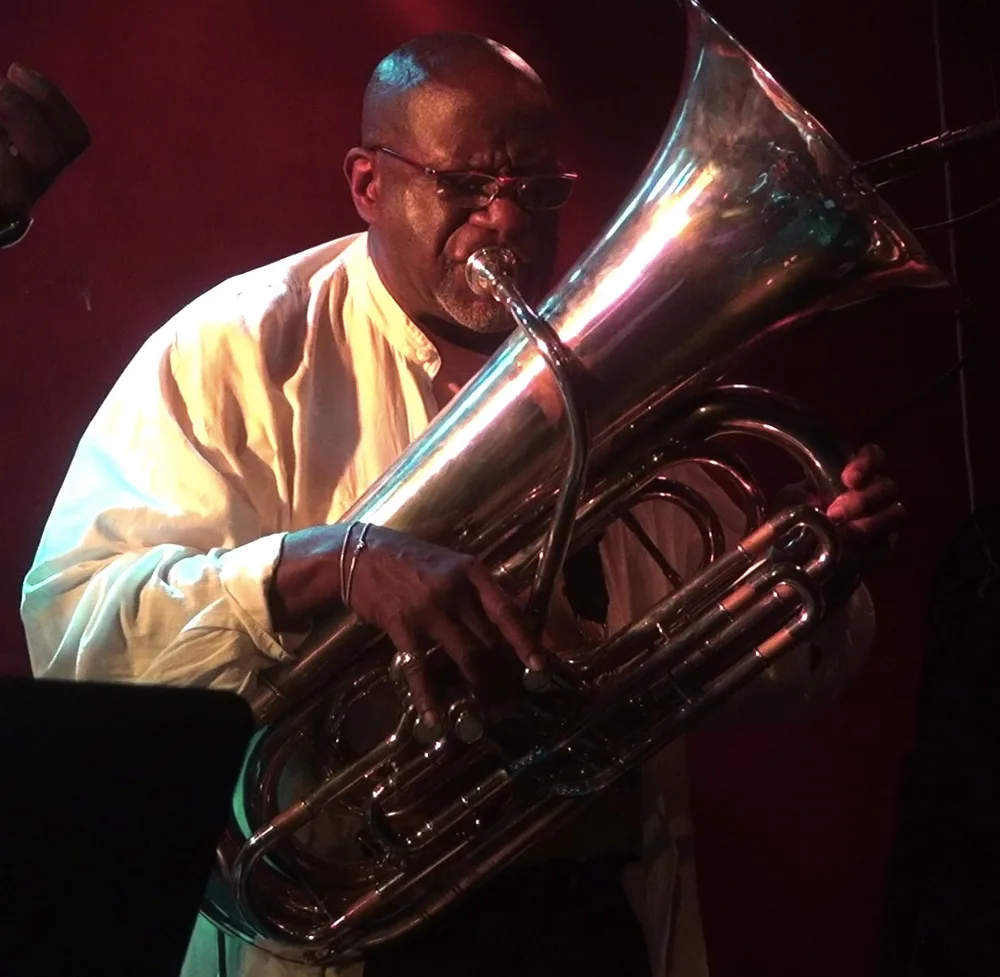
Bob Stewart playing tuba at Pianos, New York City, January 14, 2012, on a night with the pianist Eli Yamin. Photograph by Alex Lozupone, licensed CC BY-SA 3.0 via Wikimedia Commons. CC BY-SA 3.0 (Creative Commons Attribution-ShareAlike 3.0 Unported) — Wikimedia Commons — https://commons.wikimedia.org/wiki/File:Loz_tuba.png

Bob Stewart was born in Sioux Falls, South Dakota, on February 3, 1945, while his father, Riley Stewart, was stationed at the Army Air Force base there. Riley Stewart had been a pitcher in the Negro Leagues, with the Chicago American Giants and the New York Cubans. When the base closed the family moved east, to New York and then to Newport, Rhode Island, in 1953, where Stewart spent part of his childhood with his grandparents and first heard jazz. He picked up the trumpet around 1955, at about ten years old, and the family moved again to Philadelphia in 1960. At West Philadelphia High School he studied under Wendell Pritchett, and he went on to the Philadelphia College of the Performing Arts, a conservatory so hostile to the music that jazz was not permitted in the practice rooms. Stewart remembers a student trio playing a jazz piece at a performance hour and the head of the school setting off the fire alarm from the back of the room.
The switch to tuba was forced on him. Embouchure trouble ended his trumpet playing at the close of his second year, and rather than lose a year he moved to the low brass, trained new muscles, and took his graduation recital on the tuba. He later described it as a blessing in disguise. His first steady work came in 1967 in Dixieland bands at Your Father's Mustache and the Red Garter, then close to the only rooms in which a tuba player could get hired, and it was at the Red Garter that he met Howard Johnson. Through that winter and the following spring he taught public school in Philadelphia and drove to New York at weekends to work the club, sit in with Johnson's tuba ensemble Substructure, which later became Gravity, and hang around Slugs'. In June 1968 he moved to New York for good. Carla Bley was assembling the Jazz Composer's Orchestra and hired him or Johnson as the chair required, and when Johnson could not make a date with Gil Evans, Stewart subbed. Those were his first jobs in contemporary jazz.
His earliest recordings put him at the centre of a specific experiment: the tuba section that Howard Johnson wrote for Taj Mahal. On The Real Thing (Columbia, 1971), cut live at the Fillmore East, Johnson's brass arrangements are scored for four low brass players. Johnson took double B-flat and F tuba plus flugelhorn and baritone saxophone, Joe Daley took double B-flat tuba and valve trombone, Earl McIntyre took E-flat tuba and bass trombone, and Stewart is credited on double-C tuba, flugelhorn and trumpet, the only session on which his first instrument shows up next to his second. The same year he sang in the chorus of Carla Bley and Paul Haines's Escalator Over the Hill on JCOA, a credit for voice rather than tuba, and played in the Brass Company, a brass group led by Bill Lee that also carried Billy Higgins and Clifford Jordan and issued Colors on Strata-East.
Charles Mingus came next, and again through Howard Johnson. Stewart was subbing on the tuba chair, Mingus liked both players, and turned it into a double chair: Johnson on baritone saxophone and Stewart on tuba, or the two of them the other way around. The studio result was Let My Children Hear Music (Columbia, 1972). The live one was the concert of February 4, 1972 at Philharmonic Hall, issued the following year as Charles Mingus and Friends in Concert, where Stewart's tuba sits in a horn section that also holds Gerry Mulligan, Lee Konitz, James Moody, Gene Ammons, Charles McPherson, Jon Faddis and Milt Hinton, with Dizzy Gillespie singing. "I didn't know it at the time," Stewart said later, "but I was a part of a certain kind of history."
The question that shaped the rest of his career was asked in 1976. Stewart and the alto saxophonist Arthur Blythe were both playing in Gil Evans's orchestra, and Blythe asked him whether he could play bass on the tuba. Stewart said yes and then spent a year working out how. The problem was not which notes to choose. A bassist does not have to breathe to make a sound, and a tuba player does, so Stewart had to build a breathing technique that would not disturb the pulse, along with the endurance to hold a bass chair for a whole evening and a harmonic vocabulary the instrument did not have. Nobody could tell him which microphone to use or where to put it on the horn. Blythe wrote his own material, so there were no other bassists' versions to study. The results are on record from February 26, 1977, when a single night at the Brook on West 17th Street produced both The Grip and Metamorphosis for India Navigation, and on Bush Baby (Adelphi, 1978), a trio of alto saxophone, tuba and congas with no other instrument at all. Lenox Avenue Breakdown (Columbia, 1979), with Cecil McBee, Jack DeJohnette, James Newton and James Blood Ulmer, carries the solo that made his reputation; the editors of The Penguin Guide to Jazz called it "one of the few genuinely important tuba statements in jazz." The partnership ran more than thirty years, through Illusions, Blythe Spirit, Elaborations, Light Blue, Da-Da, Hipmotism, Night Song and the three Savant records of 2000 to 2003, and ended with Exalted Conversation, a duo concert recorded in 2003 at St. Paul's Chapel, Columbia University, presented by the Center for Jazz Studies under Robert O'Meally.
Two other long associations ran alongside it. Stewart held the tuba chair in Gil Evans's orchestra from the mid-1970s, on There Comes a Time (RCA, 1976), the live Priestess recorded at St. George's Church in May 1977, Little Wing from Germany in 1978, the Royal Festival Hall concerts of 1978 and the Tokyo dates of 1976, and he worked in the Carla Bley Band on Dinner Music, European Tour 1977, Musique Mecanique and Fleur Carnivore. In 1984 Lester Bowie put together Brass Fantasy, a band of brass and drums with no bass and no chordal instrument, and Stewart was in it from the first tour to Bowie's death: I Only Have Eyes for You was recorded in February 1985 at Rawlston Recording in Brooklyn and issued by ECM, and Avant Pop, Twilight Dreams, My Way, The Fire This Time and The Odyssey of Funk and Popular Music followed. He also recorded with McCoy Tyner on Song of the New World and 13th House, with Dizzy Gillespie and Machito on Afro-Cuban Jazz Moods for Pablo, with the Globe Unity Orchestra, with Muhal Richard Abrams, with David Murray's big band at Sweet Basil, and with Sonny Rollins, Don Cherry, Sam Rivers, Uri Caine and Howard Johnson's all-tuba Gravity. The pop credits are real and specific rather than decorative: two tracks of Chaka Khan's Naughty in 1980, one track of David Byrne and St. Vincent's Love This Giant in 2012.
His own catalogue is small and deliberate. First Line was cut at RPM Sound Studios in November 1987 and mixed the following January, a band of tuba, trumpet, trombone, guitar and drums with no bass, and Goin' Home followed from the same room in December 1988 under the name Bob Stewart's First Line Band, with Steve Turre, James Zollar, Jerome Harris and Buddy Williams, guest appearances by Ed Blackwell, Earl Gardner, John Clark and Frank Colon, and tunes by Kelvyn Bell, Don Cherry, Olu Dara and Billy Harper alongside his own. Then and Now (Postcards, 1996) drew on sessions from October 1995 and March 1996 and brought in Taj Mahal on two tracks and Carlos Ward with Graham Haynes on four. A duo record with the trombonist Ray Anderson, Heavy Metal Duo: Work Songs and Other Spirituals, came out in 2004, and Rainbow Country, co-led with the Belgian percussionist Chris Joris, was recorded in May 2006. A live duo with the pianist Dave Burrell, taped at the Kölner Stadtgarten on June 13, 1994, sat unreleased for twenty-two years until NoBusiness issued it as The Crave on LP in 2016 in an edition of four hundred.
Connections: Mind the Gap (Sunnyside, August 5, 2014) is the fullest statement of the idea. Stewart called the band the Double Quartet: the First Line Band, with Jerome Harris on guitar and Matt Wilson on drums, joined by the strings of PUBLIQuartet, whose violinist is his son Curtis Stewart. He commissioned a five-part suite, In Color, from the violinist and composer Jessie Montgomery, built on multiphonic techniques of his own, then broke the suite apart and interleaved its movements with arrangements of pieces by the people who had hired him: Arthur Blythe's "Bush Baby" and "Odessa," Frank Foster's "Simone," Thelonious Monk's "Monk's Mood," Mingus's "Jump Monk," Piazzolla's "Libertango" and Harris's "Hand by Hand," with Nick Finzer on trombone and Randall Haywood on trumpet added for the last two.
Teaching has run in parallel with all of it and was never a fallback. Stewart taught in Pennsylvania public schools, then at Fiorello H. LaGuardia High School in New York, where the jazz ensemble he directed won the Essentially Ellington national competition. He took a bachelor's degree in music education from the Philadelphia College of the Performing Arts and a master's in education from Lehman College, where he is a distinguished lecturer, and he has been on the faculty of the Juilliard School since 2001 as a professor of jazz history. He works with Jazz at Lincoln Center as an educational consultant and an adviser to its Rhythm Road project, helped write the curriculum for its Middle School Jazz Academy, has served on a New York State Council on the Arts panel, consulted for JazzMobile and taught at the Louis Armstrong Summer Jazz Camp in New Orleans. He has run brass clinics in Austria built around the Brass Fantasy repertoire, and in 2012 he founded the Annual Bob Stewart Tuba Competition, whose stated purpose is to push tuba players to lead their own ensembles and build a repertoire for the instrument. He appears in Ken Burns's Jazz and is the subject of the feature documentary Jazz on a Winter's Day. He has kept recording: Michael Blake's Combobulate (Newvelle, 2022) is a brass sextet with two tuba players, Stewart and Marcus Rojas, and Alex Harding and Lucian Ban's Blutopia (Sunnyside, 2024) features him by name.
Stewart's contribution is easy to state and was hard to make: he took an instrument that had been retired from jazz in the 1930s and put it back in the rhythm section as the bass, not as a novelty and not as a front-line horn. Howard Johnson had already shown what a tuba could do as a melody instrument, playing high and fast in a way Stewart flatly says nobody else could match, so Stewart went the other way and worked the bottom of the horn. What that required was a set of solutions with no precedent: circular and staggered breathing that keeps a walking line from lurching every four bars, an embouchure that survives three hours of it, amplification and microphone placement worked out from scratch, and a harmonic approach that lets a single-line instrument imply changes the way a bass does. The models he reached for were not tuba players. He has said the singer Johnny Hartman has the same range as the tuba and taught him how to shape a melody and how to write brass parts that leave the tuba room; and that his time feel and his comping come from left hands, from the organist Big John Patton and from Thelonious Monk, whose stride-derived two-beat pattern under his own right-hand figures Stewart identified with directly.
The playing is warm, breathy and physical, with a big attack and a soloist's line rather than a section player's, and it does its most characteristic work in bands built with a hole where the bass usually goes. That is not a coincidence: Blythe's Bush Baby is a trio of alto, tuba and congas, Brass Fantasy is brass and drums, and both of Stewart's own First Line records leave the bass chair empty and hand the job to him. The influence has been wide and is acknowledged by name. Writing after Arthur Blythe's death, Stewart pointed out that the question Blythe asked him in 1976 has since been put to at least three generations of tuba players, and that Henry Threadgill, Carla Bley, Steven Bernstein and Charlie Haden all went on to build tubas into their ensembles. Reviewers have treated the Lenox Avenue Breakdown title-track solo as the single document that settled the argument.
- Lenox Avenue Breakdown (1979, Columbia) - Arthur Blythe's quintet with Stewart in the bass chair and a title-track solo that The Penguin Guide to Jazz rates among the few genuinely important tuba statements in the music. Spotify - Lenox Avenue Breakdown Listen
- Connections: Mind the Gap (2014, Sunnyside) - His Double Quartet, the First Line Band plus PUBLIQuartet, wrapped around Jessie Montgomery's commissioned suite In Color and arrangements of the leaders who taught him the job. Spotify - Connections-Mind the Gap Listen
- Bush Baby (1978, Adelphi) - Blythe, Stewart and Ahmed Abdullah on congas, recorded in December 1977. Alto saxophone, tuba and hand drums, and nothing else, which is as exposed as a tuba bass chair gets.
- I Only Have Eyes for You (1985, ECM) - The first Lester Bowie's Brass Fantasy record, cut in Brooklyn in February 1985 by a band of five brass and drums with no bass and no chords.
- Goin' Home (1989, JMT) - Bob Stewart's First Line Band, recorded December 1988, with Steve Turre and James Zollar, guest spots for Ed Blackwell and Earl Gardner, and material by Don Cherry, Olu Dara and Billy Harper.
- Then and Now (1996, Postcards) - His third leader date, with Taj Mahal singing on two tracks, Carlos Ward and Graham Haynes on a second band, and Jelly Roll Morton's "King Porter Stomp" beside his own writing. Spotify - Then & Now Listen
- The Real Thing (1971, Columbia) - Taj Mahal live at the Fillmore East with Howard Johnson's four-tuba brass section, Stewart's first significant record and the only one that also credits him on trumpet and flugelhorn.
- Charles Mingus and Friends in Concert (1973, Columbia) - The Philharmonic Hall concert of February 4, 1972, Stewart's tuba in a horn section running from Gerry Mulligan and Lee Konitz to Gene Ammons.
Bob Stewart: Full Discography
Bob Stewart's own catalogue is small, eleven titles across nearly forty years, but his sideman log is very large: the Discogs listing under artist ID 267708 runs to just over two hundred entries, and his own biography puts him on more than eighty recordings. The leader and co-leader table below is intended to be complete. The sideman table that follows it is a representative selection of the significant credits, weighted toward the associations that defined his career (Arthur Blythe, Gil Evans, Carla Bley, Lester Bowie's Brass Fantasy, Charles Mingus, McCoy Tyner, Howard Johnson's Gravity), and is not exhaustive.
Everything here was verified against the live Discogs API, release by release rather than from the artist listing, because the coarse role tag in that listing distinguishes neither a whole-album chair from a two-track cameo nor, on a name this common, one musician from another. Where a track restriction is quoted it comes from a populated tracks field on the release itself or from the track-level credits; where no restriction is quoted, none was recorded. The Buy column is uniformly empty because no affiliate programme is in place.
As Leader / Co-Leader
| Album Title | Recording Date(s) | Release Date | Label | Catalog Number | Format(s) | Personnel | Role | Reissue History | Spotify | Buy | Notes |
|---|---|---|---|---|---|---|---|---|---|---|---|
| First Line | November 1987, RPM Sound Studios, New York City; mixed January 1988 | 1988 | JMT | JMT 834 414-2 (also JMT 882 014) | CD, Album | Bob Stewart (tuba), Stanton Davis (trumpet), Steve Turre (trombone, Haitian conch shell), Kelvyn Bell (electric guitar), Idris Muhammad (drums), Arto Tuncboyaciyan (special guest, percussion); produced by Stefan F. Winter | Leader, composer of three of the eight pieces | Reissued on CD in 2003 | — | — | His debut as a leader. No bass player: the tuba holds the bottom for the whole record. Two Arthur Blythe tunes, "Metamorphosis" and "Bush Baby," and two traditional pieces. His own site dates this album 1987, which is its recording year; the pressing carries a 1988 production line |
| Goin' Home | December 1988, RPM Sound Studios, New York City; mixed the same month at Platinum Island | 1989 | JMT | JMT 834 427-2 | CD, Album, Stereo | Billed to Bob Stewart's First Line Band. Bob Stewart (tuba), Steve Turre (trombone), James Zollar (trumpet), Jerome Harris (electric guitar), Buddy Williams (drums, tracks 1, 3, 5 to 7); guests Ed Blackwell (drums, tracks 2 and 4), Earl Gardner (lead trumpet, tracks 1 and 7), John Clark (French horn, track 7), Frank Colon (percussion, tracks 1 and 5); produced by Stefan F. Winter | Leader, composer of "Tunk" | Reissued 2003 | — | — | Seven pieces, written by Kelvyn Bell, Don Cherry, Olu Dara, Billy Harper and Stewart, plus a "Sweet Georgia Brown" medley. The guest credits carry explicit track lists, so the restrictions are printed rather than inferred |
| Suite Noire | January 1990, Sound On Sound Studios, New York City; additional recording and mixing August 1990, Tonstudio Bauer, Ludwigsburg | 1990 | NABEL | NABEL CD 4649 | CD, Album | Billed to Gebhard Ullmann and Andreas Willers with Marvin "Smitty" Smith and Bob Stewart. Gebhard Ullmann (bass clarinet, flutes, soprano and tenor saxophone), Andreas Willers (guitars, guitar synthesiser), Marvin "Smitty" Smith (drums, percussion), Bob Stewart (tuba); liner notes by Paul Bley | Co-billed member of a four-way collective | None found | — | — | Eight pieces. A quartet with no bass and no keyboard |
| Bluebells | April 1992, Ztudio Zerkall, Germany | 1992 | CMP Records | CMP CD 56 | CD, Album, Stereo | Billed to Christof Lauer, Wolfgang Puschnig, Bob Stewart and Thomas Alkier. Christof Lauer (tenor and soprano saxophone), Wolfgang Puschnig (alto saxophone), Bob Stewart (tuba), Thomas Alkier (drums); produced by Kurt Renker and Walter Quintus | Co-leader | None found | Spotify - Bluebells | — | Two saxophones, tuba and drums. Streaming metadata dates this 1978, which is wrong; the pressing carries a 1992 production line and an April 1992 session note |
| The Crave | Live at the Kölner Stadtgarten, Cologne, June 13, 1994 | 2016 | NoBusiness Records | NBLP 100 | Vinyl, LP, Album, Limited Edition | Billed to Dave Burrell and Bob Stewart. Dave Burrell (piano), Bob Stewart (tuba); produced by Ed Hazell and Danas Mikailionis | Co-leader | None found | — | — | Subtitled Play the Music of Jelly Roll Morton and Dave Burrell. Six pieces, four by Morton. Recorded in 1994 and unreleased for twenty-two years; the LP was pressed in an edition of four hundred |
| Then and Now | October 30, 1995 and March 11, 13 and 20, 1996 | 1996 | Postcards | POST1014 | CD, Album | Bob Stewart (tuba, all tracks), Steve Turre (trombone, 1, 3, 5), Stanton Davis and James Zollar (trumpets, 1, 3, 5), John Clark (French horn, 1, 3, 5), Fred Griffin and Marshall Sealy (French horns, 2), Taj Mahal (guitar, vocals, 2 and 6), Dave Burrell (piano, 4), Aaron Scott (drums, 4), Carlos Ward (alto saxophone, 7 to 10), Graham Haynes (cornet, trumpet, 7 to 10), Jerome Harris (guitar, 7 to 10), Buddy Williams (drums, 1, 3, 5, 7 to 10); produced by Ralph Simon | Leader, composer of three pieces | Reissued digitally 2020 | Spotify - Then & Now | — | Three distinct bands on one disc, and every credit carries an explicit track list. Ten pieces, including Jelly Roll Morton's "King Porter Stomp" and Ornette Coleman's "Law Years" |
| Exalted Conversation | 2003, live at St. Paul's Chapel, Columbia University, New York | 2004 | Not established | Not established | CD | Bob Stewart (tuba), Arthur Blythe (alto saxophone) | Co-leader | None found | — | — | A duo concert presented by Columbia's Center for Jazz Studies under Robert O'Meally, who wrote the liner notes. Listed on Stewart's own discography page and described at length by him in print, but absent from Discogs, so its label and catalogue number could not be confirmed |
| Heavy Metal Duo: Work Songs and Other Spirituals | Not established | 2004 | Self-released through the two artists' own sites | None | CDr | Billed to Ray Anderson and Bob Stewart. Ray Anderson (trombone), Bob Stewart (tuba) | Co-leader | None found | — | — | Nine pieces. Trombone and tuba, unaccompanied. Wikipedia dates this 2008; the Discogs pressing and the album's streaming release both give 2004, which is also the year on Stewart's own site |
| Rainbow Country | May 24 and 25, 2006 | 2006 | W.E.R.F. | W.E.R.F. 057 | CD, Album, 3-panel digipak | Billed to Chris Joris and Bob Stewart. Chris Joris (djembe, congas, ashiko, steel drums, likembé, jew's harp, metal percussion), Bob Stewart (tuba), Eric Person (alto and soprano saxophone, flute), Fabian Fiorini (piano), Chris Mentens (double bass), Reggie Washington (electric bass), Baba Sissoko (tamani, ngoni, vocals), Junior Mthombeni (congas, udu, voice) | Co-leader | None found | — | — | Fifteen pieces. A Belgian and West African percussion group built around the tuba |
| Cutting Through | Not established | 2010 | Milo Records | MR119 | CD | Billed to Elektra Kurtis and Ensemble Elektra featuring Bob Stewart | Featured soloist on a co-billed date | None found | — | — | Eleven pieces. Discogs carries no credit block for this release, so the full personnel could not be confirmed |
| Connections: Mind the Gap | Not established | August 5, 2014 | Sunnyside | SSC 1394 | CD, Album | Billed to the Double Quartet: the First Line Band and PUBLIQuartet. Bob Stewart (tuba, arranger on 2, 4, 5, 7, 8, 10, 11), Jerome Harris (guitar), Matt Wilson (drums), Curtis Stewart (violin), Jannina Norpoth (violin, 1, 3, 6, 9, 12), Nick Revel (viola, 1, 3, 6, 9, 12), Amanda Goekin (cello, 1, 3, 6, 9, 12); featuring Randall Haywood (trumpet, 13 and 14) and Nick Finzer (trombone, 13 and 14) | Leader, arranger, composer of "Nothing to Say" | None found | Spotify - Connections-Mind the Gap | — | Fifteen tracks. Five of them are the movements of Jessie Montgomery's commissioned suite In Color ("Red," "Aqua," "The Poet," "Purple," "Makina," plus a "Red 2" reprise), broken up and interleaved with arrangements of Arthur Blythe, Frank Foster, Thelonious Monk, Charles Mingus, Astor Piazzolla, Henry Thomas and Jerome Harris. Also on Bandcamp |
One entry excluded. The Discogs artist listing for 267708 carries a 1982 seven-inch single, I've Got Your Love All Over Me backed with "Masters of Our Fate" on the Chain label (CR 109), as a leader credit. It is filed under the genre "Folk, World, & Country," it has no credit block, and the same label issued two further country singles under the separate Discogs entity "Bob Stewart (10)." It is a country record misfiled under the tuba player and is not part of this discography.
As Sideman (selected major credits)
| Year | Project (Leader) | Title | Label | Catalog | Role | Notes |
|---|---|---|---|---|---|---|
| 1971 | Taj Mahal | The Real Thing | Columbia | G 30619 | Double-C tuba, flugelhorn, trumpet | Recorded live at Bill Graham's Fillmore East. Howard Johnson's four-tuba brass section: Johnson (double B-flat and F tuba, flugelhorn, baritone saxophone), Joe Daley (double B-flat tuba, valve trombone), Earl McIntyre (E-flat tuba, bass trombone) and Stewart. His only recorded credit on his first instrument |
| 1971 | Carla Bley and Paul Haines | Escalator Over the Hill | JCOA Records | 3LP-EOTH | Voice | The credit is for the chorus, not the tuba chair, which John Buckingham holds. Worth stating plainly because a Carla Bley credit of this period is otherwise assumed to be a tuba credit |
| 1972 | Charles Mingus | Let My Children Hear Music | Columbia | KC 31039 | Tuba | Recorded 1971 at Columbia's New York studio. Stewart described the session in detail in a 2008 interview; the Discogs credit block for this release lists soloists only and names no tuba player, so the credit rests on his own account rather than on the sleeve data |
| 1972 | Paul Jeffrey | Family | Mainstream Records | MRL 376 | Tuba | An early large-ensemble date under the tenor saxophonist who was also working with Mingus at the time |
| 1973 | McCoy Tyner | Song of the New World | Milestone | MSP 9049 | Tuba (tracks A1, A2, B2) | Recorded April 1973. Brass and strings behind the Tyner quartet, with Julius Watkins, Jon Faddis, Garnett Brown and Bernard McKinney also in the section |
| 1973 | Charles Mingus | Charles Mingus and Friends in Concert | Columbia | KG 31614 | Tuba | The concert of February 4, 1972 at Philharmonic Hall. Horn section including Gerry Mulligan, Lee Konitz, James Moody, Gene Ammons, Charles McPherson, Howard Johnson, Jon Faddis and Milt Hinton, with Dizzy Gillespie on vocals and Bill Cosby hosting |
| 1975 | The Brass Company | Colors | Strata-East | SES-19752 | Tuba | Bill Lee's brass group, with Billy Higgins and Clifford Jordan. Stewart dates his involvement with the band to 1971 |
| 1975 | Clifford Thornton and the Jazz Composer's Orchestra | The Gardens of Harlem | JCOA Records | LP 1008 | Tuba | The JCOA at full size |
| 1976 | Dizzy Gillespie and Machito | Afro-Cuban Jazz Moods | Pablo Records | 2310-771 | Bass tuba (side A) | The restriction is a printed one: side A is Chico O'Farrill's "Oro, Incienso y Mirra" |
| 1976 | Gil Evans and His Orchestra | There Comes a Time | RCA | APL1-1057 | Tuba (tracks A1 to B1, B4) | Recorded March to June 1975. Two tuba players, Stewart and Joe Daley, with Howard Johnson on baritone saxophone, bass clarinet and a third tuba, and David Sanborn on alto |
| 1976 | Gil Evans Orchestra | Synthetic Evans | PolJazz | Z-SX-0636 | Tuba | |
| 1977 | Arthur Blythe | The Grip | India Navigation | IN-1029 | Tuba | Recorded live at the Brook, 40 West 17th Street, New York City, February 26, 1977. A quintet of alto saxophone, trumpet, cello, tuba and drums, with Abdul Wadud, Ahmed Abdullah and Steve Reid. No bass player |
| 1977 | Carla Bley | Dinner Music | WATT | WATT/6 | Tuba | |
| 1978 | Arthur Blythe | Bush Baby | Adelphi Records | AD 5008 | Tuba | Recorded at Blank Tapes, New York City, December 1977. A trio of Blythe's alto, Stewart's tuba and Ahkmed Abdullah's congas |
| 1978 | The Carla Bley Band | European Tour 1977 | WATT | WATT/8 | Tuba | |
| 1978 | The Gil Evans Orchestra | Little Wing (Live in Germany) | Circle Records | F 666.531 | Tuba | Recorded live October 19, 1978, with George Adams, Lew Soloff and Terumasa Hino |
| 1979 | Arthur Blythe | Lenox Avenue Breakdown | Columbia | JC 35638 | Tuba | Recorded at Mediasound Studios, New York. With Cecil McBee, Jack DeJohnette, James Newton, James Blood Ulmer and Guilherme Franco; produced by Bob Thiele, liner notes by Stanley Crouch. The title-track solo is the one his reputation rests on |
| 1979 | Arthur Blythe | Metamorphosis | India Navigation | IN 1038 | Tuba | The second album from the same February 26, 1977 concert that produced The Grip, issued two years later |
| 1979 | The Carla Bley Band | Musique Mecanique | WATT | WATT/9 | Tuba | |
| 1979 | Gil Evans | Live at the Royal Festival Hall London 1978 | RCA Victor | PL 25209 | Tuba, flugelhorn | One of two Evans releases on which he doubles |
| 1979 | John Carter Quintet | Variations | Moers Music | momu 01056 | Tuba | |
| 1980 | Muhal Richard Abrams | Mama and Daddy | Black Saint | BSR 0041 | Tuba | |
| 1980 | Globe Unity Orchestra | Compositions | Japo Records | JAPO 60027 | Tuba | The European free-jazz orchestra, one of two records he made with it |
| 1980 | Chaka Khan | Naughty | Warner Bros. Records | BSK 3385 | Tuba (tracks A3 and B3) | Absent from the release-level credit block; the credit exists only at track level, on two of ten pieces |
| 1980 | Arthur Blythe | Illusions | Columbia | JC 36583 | Tuba (tracks A1, A3, B2) | The album alternates two bands. Stewart plays in the electric quartet with James Blood Ulmer and Abdul Wadud; the other half is an acoustic trio with John Hicks |
| 1981 | Arthur Blythe | Blythe Spirit | Columbia | FC 37427 | Tuba (tracks A1 to B1, B3, B4) | |
| 1981 | Charlie Persip and Gerry LaFurn | 17-Piece Superband | Stash Records | ST 209 | Tuba | Liner notes by Max Roach. Also in the band: Gary Smulyan, Bill Saxton and Jack Walrath |
| 1982 | Arthur Blythe | Elaborations | Columbia | FC 38163 | Tuba | |
| 1982 | McCoy Tyner | 13th House | Milestone | M-9102 | Tuba | Tyner's large-ensemble writing of the early 1980s |
| 1983 | Arthur Blythe | Light Blue: Arthur Blythe Plays Thelonious Monk | Columbia | FC 38661 | Tuba | |
| 1983 | Gil Evans | Priestess | Antilles | AN 1010 | Tuba | Recorded live at St. George's Church, New York, May 13, 1977, and held back six years. Two tubas, Stewart and Howard Johnson, with Blythe and David Sanborn on altos, George Adams on tenor and Jimmy Knepper on trombone |
| 1983 | The Globe Unity Orchestra | Intergalactic Blow | Japo Records | JAPO 60039 | Tuba | |
| 1984 | John Barry | The Cotton Club (soundtrack) | Geffen Records | GEF 70260 | Additional tuba | |
| 1985 | Lester Bowie's Brass Fantasy | I Only Have Eyes for You | ECM Records | ECM 1296 | Tuba | Recorded February 1985 at Rawlston Recording Studios, Brooklyn. The band's first record: Bowie, Stanton Davis, Bruce Purse and Malachi Thompson (trumpets), Steve Turre and Craig Harris (trombones), Vincent Chancey (French horn), Stewart (tuba) and Phillip Wilson (drums) |
| 1985 | Bill Frisell | Rambler | ECM Records | ECM 1287 | Tuba | With Kenny Wheeler, Jerome Harris and Paul Motian. Stewart later recorded a piece called "Rambler" of his own on Then and Now |
| 1985 | David Murray Big Band | Live at "Sweet Basil" Vol. 1 | Black Saint | BSR 0085 | Tuba | Conducted by Lawrence "Butch" Morris. Volume 2 followed in 1986 |
| 1985 | Gunter Hampel New York Orchestra | Fresh Heat: Live at Sweet Basil | Birth Records | Birth 0039 | Tuba | |
| 1986 | Lester Bowie's Brass Fantasy | Avant Pop | ECM Records | ECM 1326 | Tuba | |
| 1986 | Arthur Blythe | Da-Da | Columbia | FC 40237 | Tuba (tracks A2 and B2) | His last Columbia date with Blythe, and a partial one |
| 1987 | Lester Bowie's Brass Fantasy | Twilight Dreams | Venture | VE 2 | Tuba | |
| 1987 | Ray Anderson | It Just So Happens | Enja Records | Enja CD 5037-21 | Tuba | The trombonist with whom he would later form the Heavy Metal Duo |
| 1987 | Henry Butler | The Village | MCA / Impulse! | MCA2-8023 | Tuba | |
| 1988 | The Herb Robertson Brass Ensemble | Shades of Bud Powell | JMT | JMT 834 420-2 | Tuba | Recorded for the same label, in the same period, as his own two First Line albums |
| 1989 | Carla Bley | Fleur Carnivore | WATT | WATT/21 | Tuba | |
| 1990 | Don Cherry | Multikulti | A&M Records | 395 323-2 | Tuba (tracks 6 and 7) | Stewart is absent from the release-level credit block on every pressing checked and appears only in the track-level credits, on two of twelve pieces. Cherry's "Art Deco" is one of the tunes on Goin' Home |
| 1990 | Lester Bowie's Brass Fantasy | My Way | DIW | DIW-835 | Tuba | |
| 1991 | Arthur Blythe | Hipmotism | Enja Records | 6088 2 | Tuba (tracks 2 to 8) | |
| 1992 | Lester Bowie's Brass Fantasy | The Fire This Time | In+Out Records | IOR 7019-1 | Tuba | |
| 1993 | Sonny Rollins | Old Flames | Milestone | MCD-9215-2 | Tuba (tracks 1 and 7) | Two of seven pieces, the ones carrying the brass-choir arrangement |
| 1993 | Stephen Scott | Aminah's Dream | Verve Records | 314 517 996-2 | Tuba (track 1) | |
| 1996 | Howard Johnson and Gravity | Gravity!!! | Verve Records | 314 531 021-2 | Tuba (tracks 1, 4 to 6) | The commercial debut of the all-tuba ensemble Stewart had been playing in, under one name or another, since 1967 |
| 1997 | Howard Johnson and Gravity featuring Taj Mahal | Right Now! | Verve Records | 314 537 801-2 | Tuba | |
| 1997 | Arthur Blythe | Night Song | Clarity Recordings | CCD-1016 | Tuba | |
| 1999 | Sam Rivers' Rivbea All-Star Orchestra | Inspiration | RCA Victor / BMG France | 74321647172 | Tuba | Produced by Steve Coleman, with Joe Daley on baritone horn. Grammy-nominated |
| 1999 | Sam Rivers' Rivbea All-Star Orchestra | Culmination | BMG France | 74321-68311-2 | Tuba | The companion release to Inspiration |
| 1999 | Gary Smulyan and Brass | Blue Suite | Criss Cross Jazz | Criss 1189 CD | Tuba | Recorded December 9, 1999, Systems Two, Brooklyn. A nine-piece brass choir behind a baritone saxophone, arranged by Bob Belden, with Earl Gardner and John Clark |
| 2000 | Uri Caine Ensemble | The Goldberg Variations | Winter & Winter | 910 054-2 | Tuba (tracks 1-7, 1-9, 2-2) | A double album marking the 250th anniversary of Bach's death, with Don Byron, Greg Osby, Ralph Alessi and Joshua Roseman. Stewart had already appeared on Caine's Tin Pan Alley project the year before |
| 2000 | Arthur Blythe Trio | Spirits in the Field | Savant | SCD 2024 | Tuba | The first of three Savant records that closed the Blythe partnership |
| 2002 | Arthur Blythe | Focus | Savant | SCD 2044 | Tuba | |
| 2003 | Arthur Blythe | Exhale | Savant | SCD 2050 | Tuba | The last Blythe studio album, with John Hicks on piano |
| 2009 | Roswell Rudd | Trombone Tribe | Sunnyside | SSC 1207 | Tuba | |
| 2010 | Joe Daley and the Earth Tones Ensemble | The Seven Deadly Sins | Jaro Medien | 4303-2 | Tuba | Recorded November 2 and 3, 2009, MSR Studios, New York. Daley's large-ensemble suite, with Howard Johnson, Scott Robinson, Craig Harris and Bill Saxton |
| 2012 | David Byrne and St. Vincent | Love This Giant | 4AD | CAD3231CD | Tuba (track 11) | Absent from the fifty-seven-entry release-level block; the credit exists only at track level, on one of twelve pieces |
| 2013 | Earl McIntyre | Brass Carnival and Tribute! | Not On Label | none | Tuba | The Brass Carnival session was recorded at Bennett Studios on October 2, 2010 with David Amram conducting. Also present: Howard Johnson, Joe Daley, Dave Bargeron, Lew Soloff and Andy Hunter |
| 2017 | Howard Johnson and Gravity | Testimony | Tuscarora Records | 17-001 | CC tuba | Johnson's last Gravity record, fifty years after the two men met |
| 2020 | Kirk Knuffke | Tight Like This | SteepleChase | SCCD 31896 | Tuba | |
| 2020 | Steven Terry | Compositions Jazz | Not On Label | none | Tuba | A self-released septet date, with Yoav Eshed on guitar, Paul West on bass and Ken Aihara on keyboards |
| 2022 | Michael Blake | Combobulate | Newvelle Records | NV032 | Tuba | Recorded January 12 and 13, 2022. A brass sextet with two tuba players, Stewart and Marcus Rojas, plus Steven Bernstein, Clark Gayton and Allan Mednard. No chordal instrument. Four stars in DownBeat |
| 2024 | Alex Harding and Lucian Ban, Blutopia | Blutopia | Sunnyside | SSC1736 | Tuba, featured |
Credits checked and not asserted
Three credits that appear in secondary listings could not be confirmed and are therefore not claimed above. Nicholas Payton's Dear Louis (Verve, 2001) carries no Stewart credit at either release or track level. Taj Mahal's Happy Just to Be Like I Am (Columbia, 1971) has no credit block at all on Discogs, so neither presence nor absence can be established from that source. And no Charlie Haden Liberation Music Orchestra album uses him: the tuba chair belongs to Howard Johnson on the 1969 record, to Jack Jeffers on The Ballad of the Fallen (1983), and to Joe Daley on Dream Keeper (1990), Not in Our Name (2005) and Time/Life (2016). Stewart's own biography lists Charlie Haden among the musicians he has worked with, and he has written about Haden adopting the tuba into his ensembles, but no shared recording was found.
- Arthur Blythe - alto saxophonist, from Gil Evans's orchestra in 1976 until Blythe's retirement, the longest and most consequential association of Stewart's career and the one that made him a bass player. Fourteen albums together, from The Grip (1977) to Exhale (2003), plus the 2003 duo concert Exalted Conversation.
- Howard Johnson - the tuba player Stewart met at the Red Garter in the winter of 1967, whose ensemble Substructure (later Gravity) he joined, whose chairs with Charles Mingus, Gil Evans and Carla Bley he first took as a sub, and whose Taj Mahal brass arrangements gave him his first major recording. He was still in Gravity for Gravity!!! (1996), Right Now! (1997) and Testimony (2017).
- Gil Evans - tuba in the orchestra from the mid-1970s, on There Comes a Time, Priestess, Little Wing, the Royal Festival Hall recordings and the Tokyo concerts.
- Lester Bowie - trumpeter; first called Stewart in for an Art Ensemble of Chicago overdub, then made him the tuba player of Brass Fantasy from the band's formation in 1984 until Bowie's death, across seven albums.
- Carla Bley - hired him into the Jazz Composer's Orchestra at the very start, used him in the Carla Bley Band through the 1970s and 1980s, and later built tubas into her own writing.
- Charles Mingus - made the tuba chair a double chair for Stewart and Howard Johnson in 1971 and 1972, on Let My Children Hear Music and the Philharmonic Hall concert.
- McCoy Tyner - brass sections on Song of the New World (April 1973) and 13th House (1981).
- Steve Turre - trombone and conch on First Line, Goin' Home and Then and Now, the most frequent horn partner in Stewart's own bands.
- Jerome Harris - guitar and electric bass on Goin' Home, Then and Now and Connections: Mind the Gap, and the composer of "Hand by Hand" on the last of those.
- Curtis Stewart - violinist, his son, a founding member of PUBLIQuartet and half of the Double Quartet on Connections: Mind the Gap.
- Jessie Montgomery - the composer he commissioned to write In Color for tuba and string quartet, built on multiphonic techniques he developed.
- Matt Wilson and Nick Finzer - drums throughout and trombone on the last two pieces of Connections: Mind the Gap.
- Ray Anderson - trombonist, the other half of the Heavy Metal Duo, and the leader of It Just So Happens (Enja, 1987).
- Dave Burrell - pianist, on Then and Now and in the Cologne duo of June 1994 released as The Crave.
- Chris Joris - Belgian percussionist, co-leader of Rainbow Country (2006) and earlier of Songs for Mbizo.
- Sonny Rollins - tuba on two of the seven pieces of Old Flames (Milestone, 1993).
- Sam Rivers - the Rivbea All-Star Orchestra on Inspiration and Culmination (1999).
- Uri Caine - three movements of The Goldberg Variations (Winter & Winter, 2000) and the Tin Pan Alley project the year before.
- Michael Blake - Combobulate (Newvelle, 2022), a brass sextet in which Stewart is one of two tubas alongside Marcus Rojas.
- Earl Gardner - guest lead trumpet on Goin' Home, and later a colleague in the brass choirs of Jimmy Heath's Jazz Family and Gary Smulyan's Blue Suite.
- Spotify artist page
- Discogs
- Official site
- All About Jazz
- AllMusic
- Bandcamp: Connections - Mind The Gap
- Wikipedia: Bob Stewart (musician), source for the February 3, 1945 Sioux Falls birth, the Philadelphia College of the Performing Arts and Lehman College degrees, the LaGuardia High School post and the Penguin Guide to Jazz assessment of the Lenox Avenue Breakdown solo
- Matthew Miller, "Bob Stewart: Brassy Bass Lines," All About Jazz, October 9, 2008, a long interview and the primary first-person source for the Newport and Philadelphia years, the switch from trumpet to tuba, the Red Garter and Your Father's Mustache gigs of 1967, meeting Howard Johnson, the Mingus double chair, the Blythe question and the founding of Brass Fantasy in 1984
- Bob Stewart, "Bob Stewart Remembers Arthur Blythe," JazzTimes, his own account of meeting Blythe in Gil Evans's orchestra in 1976, the "can you play bass on the tuba" question, the personnel of Blythe's two working bands and the Exalted Conversation concert at St. Paul's Chapel
- "Bob Stewart: Brass Tact," JazzTimes, source for the Johnny Hartman, Big John Patton and Thelonious Monk models, the Jessie Montgomery commission and the structure of Connections: Mind the Gap
- "Heavy Metal Rebel: Bob Stewart is Still Taking Tuba to New Lows," South Dakota Public Broadcasting, February 12, 2016, source for his father Riley Stewart's Negro Leagues career and the Sioux Falls air base, the Newport and Philadelphia moves and the Wendell Pritchett tuition at West Philadelphia High School
- Bob Stewart's official biography and discography pages, recovered through the Internet Archive because the live pages sit behind a redirect loop; source for the leader-date list including Exalted Conversation, the Jazz at Lincoln Center and Essentially Ellington details, the Juilliard post and the founding of the tuba competition in 2012
- Ron Wynn, "Bob Stewart," AllMusic, source for the Substructure membership and the Frank Foster Loud Minority credit
- Discogs: Bob Stewart, artist 267708, read release by release through the API for labels, catalogue numbers, recording dates, personnel and track-level credits
- Spotify: Bob Stewart, used to confirm the album identifiers asserted above and to separate this Bob Stewart from a same-named singer-songwriter with a separate Spotify page
- Bandcamp: Connections - Mind The Gap, source for the Double Quartet billing and the August 5, 2014 release date