 JAZZPROFILES lives in the music 1,002 Jazz Artists fully Profiled!
 John Hicks
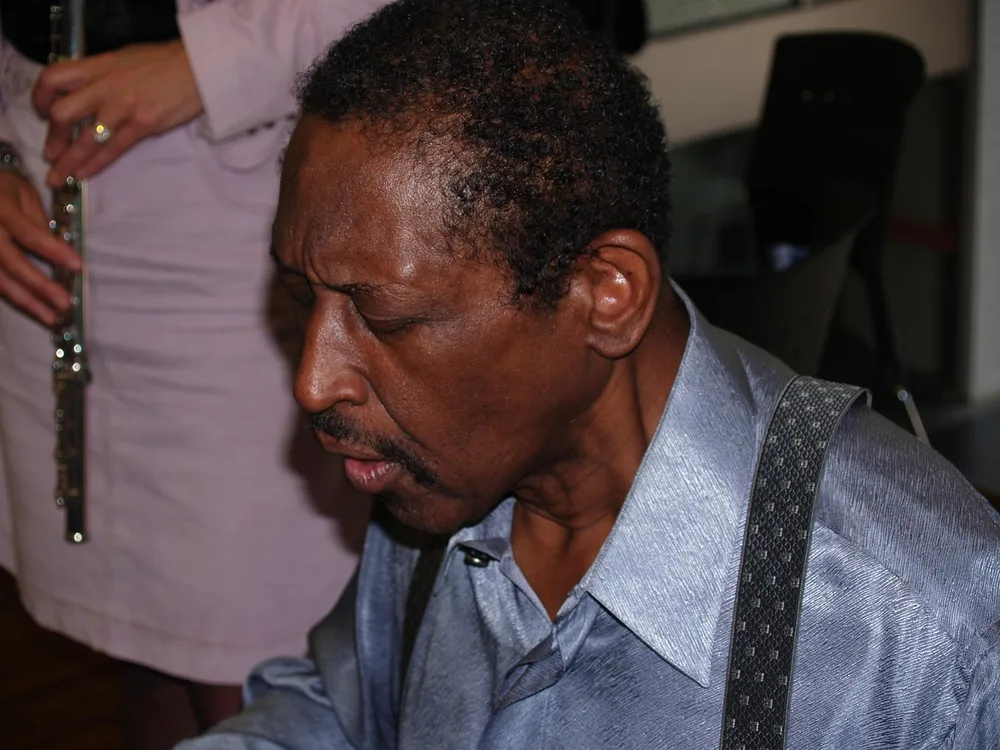
John Hicks in close-up at the keyboard, a flutist standing behind him. Photographed by Daniel Shen of Taipei, Taiwan, and uploaded to Flickr as "Hicks-4." The Wikimedia Commons file record carries no date field; the English Wikipedia article, which uses this same photograph, captions it "Hicks in 2006," the last year of his life. CC BY-SA 2.0 (Creative Commons Attribution-ShareAlike 2.0 Generic, https://creativecommons.org/licenses/by-sa/2.0). Verified on the Commons file record itself, which carries the cc-by-sa-2.0 template and a passed FlickreviewR check against the original Flickr posting (reviewed April 21, 2008). Attribution: Daniel Shen, Taipei, Taiwan. — Wikimedia Commons, File:John Hicks.jpg — https://commons.wikimedia.org/wiki/File:John_Hicks.jpg (original at https://upload.wikimedia.org/wikipedia/commons/6/6a/John_Hicks.jpg; Flickr source https://www.flickr.com/photos/danielshen/156613548/)


John Josephus Hicks Jr. was born in Atlanta on December 21, 1941, the eldest of five children of the Rev. John Hicks Sr. and his wife Pollie. Both parents held university degrees, and Hicks described the household as middle-class and expectant: "I was brought up as a decent human being, where you had aspirations and there were expectations." His father's rising posts in the Methodist church moved the family from city to city. In Los Angeles his mother started him at the piano when he was about seven; organ lessons and church choirs followed, along with brief attempts at the violin and the trombone. By eleven he could read well enough to play in his father's services. His father also made sure the boy met Duke Ellington and heard the Count Basie and Jimmie Lunceford orchestras in person.
The family settled in St. Louis when Hicks was fourteen, and that is where the piano stopped competing with anything else. At Sumner High School his classmates included the trumpeter Lester Bowie, in whose band the Continentals he played; he began sitting in with the city's older musicians, and named the local pianist John Chapman as an early model. His listening ran from Fats Waller to Thelonious Monk by way of Methodist hymnody, and he gravitated early to Horace Silver's blues-rooted writing. When Eddie "Lockjaw" Davis and Johnny Griffin came through town without a pianist he was pushed onto the stand and held his own. Summers he spent on the road across the South with the blues singers Little Milton and Albert King, sometimes playing four jobs in eighteen hours. His first professional work, with Little Milton in 1958, doubled as an ear-training course: the house piano was so badly out of tune that he had to transpose every number. He took a course at Lincoln University in Chester County, Pennsylvania, where he roomed with the drummer Ronald Shannon Jackson, and spent a short time at the Berklee School of Music in Boston.
At Clark Terry's urging he moved to New York in 1963. The Guardian's obituary has him hired within hours of arriving by the blues singer Big Maybelle; The New York Times gives his first New York job as accompanying the singer Della Reese. Either way the work came fast: Joe Farrell's group, a road tour with the ex-Basie men Al Grey and Billy Mitchell, an appearance on CBC Television behind Jimmy Witherspoon, and a place in Pharoah Sanders's first band. Then Cedar Walton recommended him to Art Blakey, and in 1964 Hicks took the piano chair in the Jazz Messengers. His recording debut came that November on 'S Make It, with Lee Morgan, John Gilmore and Curtis Fuller in the front line, and early in 1965 he toured Japan, France, Switzerland and England with the band. Blakey pressed his sidemen to write, and locked the parts in his drum case after a single run-through. Hicks stayed two years. He then worked on and off with Betty Carter from 1965 to 1967, whose taste for extreme slow tempos he credited with rebuilding his sense of time, and spent 1968 to 1970 in Woody Herman's big band, writing arrangements as well as playing. He taught jazz history and improvisation at Southern Illinois University from 1972 to 1973.
The 1970s pulled him toward the music's open edge without ever detaching him from its center. He recorded with Oliver Lake, played and recorded in the Netherlands with Charles Tolliver's Music Inc, and appeared on Lester Bowie's Fast Last! alongside Julius Hemphill and Joseph Bowie. His own first session as a leader was cut in London on May 21, 1975 and yielded two albums, the trio Hells Bells and the solo Steadfast, both of which Strata-East held back until 1980. That same year he rejoined Betty Carter, and the five years that followed did more for his name than anything before them; The Audience with Betty Carter, recorded live in San Francisco in December 1979, is the record most listeners met him on. Carter dismissed him in 1980 over his drinking, but by then he was launched. Some Other Time (Theresa, 1981), a trio with Walter Booker and Idris Muhammad, put his composing on record, including "Naima's Love Song," written for his daughter and the piece that follows him everywhere.
From then until his death he was one of the most heavily recorded pianists in American jazz, credited on close to 400 releases and leading more than thirty of them. He held long chairs with three saxophonists at once: Arthur Blythe, on whose Columbia albums Illusions (1980) and Blythe Spirit (1981) he plays the acoustic-band tracks against James Blood Ulmer's electric ones; David Murray, across a dozen records from Morning Song (Black Saint, 1984) onward; and Pharoah Sanders, from Rejoice (1981) through the Frankfurt duo concert of February 1986 that went unreleased for thirty-seven years. From 1983 the flutist Elise Wood was a regular member of his groups; the two formed a company, John Hicks-Elise Wood, Inc., toured the United States, Europe and Japan, and married in June 2001. He led a quartet with Sonny Fortune, Walter Booker and Jimmy Cobb, assembled a big band in the autumn of 1982 and revived it from time to time, and played with the Mingus Dynasty and the Mingus Big Band, including the 1989 performances of Epitaph under Gunther Schuller. Working trios followed one after another: the New York Unit with Richard Davis and Tatsuya Nakamura for Japanese labels, the New York Rhythm Machine with Marcus McLaurine and Victor Lewis, the Keystone Trio with George Mraz and Idris Muhammad for Milestone, and from 1997 the HighNote group with Dwayne Dolphin and Cecil Brooks III.
That last band made the records he sold most of. Between 1997 and 2003 Hicks cut five HighNote songbook albums devoted to composer-pianists, four of them tied to Pittsburgh: Something to Live For (Billy Strayhorn), Nightwind (Erroll Garner), Impressions of Mary Lou (Mary Lou Williams), Music in the Key of Clark (Sonny Clark) and Fatha's Day (Earl Hines). He was called the label's house pianist, and played on five of David "Fathead" Newman's HighNote albums as well. He joined Joe Lovano's quartet in 1998 and his nonet the year after. In his last decade he taught at New York University and The New School, and told an interviewer in January 2006, "I don't care how advanced my students are, I always start them off with the blues. It all comes from there." Early that year he played in a big band led by Charles Tolliver and toured Israel with a Monk program. His final studio date, On the Wings of an Eagle, was recorded for Chesky on March 10, 2006 with Buster Williams and Louis Hayes; he had a Polish tour with Eddie Henderson in the book. His last performance was at St. Mark's United Methodist Church on 118th Street, his late father's church, the Sunday before he passed away from internal bleeding on May 10, 2006, aged 64. He is buried at South-View Cemetery in Atlanta, and his papers, scores and recordings are held by Duke University.
Hicks was hired for drive. Fellow pianist George Cables compared his energy and his interval choices to McCoy Tyner's and called him "a very strong and energetic player, and a very warm player, very much part of the tradition"; The Guardian's John Fordham singled out his "alacrity of thought and execution"; Betty Carter, who heard more of him than most, said simply that nobody sounded like him and that the energy was always there. What made him a first call across such different bandstands, from Woody Herman's big band to Arthur Blythe's electric quartets, was that the drive never came at the cost of the song. The Penguin Guide to Jazz, answering the charge that his playing could seem insubstantial, argued the opposite: he was more concerned to work inside a tune's dimensions than to leave them behind. Reviewers kept returning to two things, the shading in his left hand and a "reverence for melody" that gave his improvising a destination, and to the way he could shape a chord so that it rose and fell like a breath. Behind all of it sat the church organ, the blues jobs with Little Milton and Albert King, and a stated line of descent running from Fats Waller through Thelonious Monk. As a writer he tailored parts to particular players, which is why his sextet and quintet charts read as portraits of the people on them, and his best-known tune, "Naima's Love Song," has outlived most of the records it appears on.
- 'S Make It (1965, Limelight) - As a sideman: his recording debut, cut with Art Blakey's Jazz Messengers in November 1964, three weeks or so after he joined, with Lee Morgan, John Gilmore and Curtis Fuller.
- The Audience with Betty Carter (1980, Bet-Car) - As a sideman: the double album from the Great American Music Hall in December 1979 that made his name outside the trade, with Curtis Lundy and Kenny Washington completing Betty Carter's trio.
- After the Morning (1979, West 54) - His first album issued under his own name, mostly solo piano with Walter Booker on bass, released while the 1975 Strata-East tapes were still on the shelf.
- Some Other Time (1981, Theresa) - The trio with Booker and Idris Muhammad that introduced Hicks the composer, and the first appearance of "Naima's Love Song."
- Naima's Love Song (1988, DIW) - The quartet date with Bobby Watson, Curtis Lundy and Victor Lewis, recorded in Tokyo, that gave the tune its definitive reading.
- Something to Live For: A Billy Strayhorn Songbook (1998, HighNote) - The first and best-known of the five composer songbooks with Dwayne Dolphin and Cecil Brooks III, and the start of his most commercially successful run.
- On the Wings of an Eagle (2006, Chesky) - His last studio recording, made on March 10, 2006 with Buster Williams and Louis Hayes, two months before his death.
- Hells Bells (rec. 1975, rel. 1980, Strata-East) - The London trio session with Clint Houston and Cliff Barbaro that was his first date as a leader, held back by the label for five years. Spotify - Hells Bells Listen
John Hicks: Full Discography
Identity confirmed via the live Discogs API, artist ID 294393 ("John Hicks," real name John Josephus Hicks, Jr., American jazz pianist, born December 21, 1941 in Atlanta, died May 10, 2006 in New York City), cross-referenced against MusicBrainz artist 8b7b131b-4917-4401-a5a7-840fffd4361c and Wikidata Q1700460. Several other people share the name, including an English footballer, a British politician and an American animator; none of them appears here. Six further Discogs entities are band names for the same pianist and hold releases that do not sit on his main artist page. All six were pulled and folded into the tables below: John Hicks Trio (3918358), John Hicks Quartet (2924515), New York Unit (3070179), Keystone Trio (3516990), New York Rhythm Machine (13729891) and Kenny Barron-John Hicks Quartet (12678164).
Discogs credits Hicks on 394 releases. The figure repeated in his obituaries is more than 30 albums as a leader and more than 300 as a sideman. The leader and co-leader table below aims to be complete for albums issued under his own name or under a band he led; the sideman table is a curated selection of the most significant and best-documented credits rather than an exhaustive list.
Every release described below was fetched at the individual release level and its credit block read directly, rather than characterised from the coarser per-artist credit list, which carries no track data at all. That distinction matters here: two of Hicks's best-known early sideman credits, Art Blakey's Hold On, I'm Coming and Child's Dance, are single-track appearances on albums whose piano chair otherwise belongs to somebody else. Where Discogs, Wikipedia, MusicBrainz and Apple Music disagree on a year, a label or a title, the disagreement is stated rather than silently resolved. Apple Music entries were checked one by one against the keyless iTunes Lookup API. Only one Spotify album ID could be independently confirmed, so a Spotify link appears in a single row and every other cell reads —. AllMusic and All About Jazz refuse automated fetches and contributed nothing.
As Leader / Co-Leader
| Album Title | Recording Date(s) | Release Date | Label | Catalog Number | Format(s) | Personnel | Role | Reissue History | Spotify | Buy | Notes |
|---|---|---|---|---|---|---|---|---|---|---|---|
| Hells Bells | May 21, 1975, London, England | 1980 | Strata-East | SES-8002 | Vinyl, LP, Album | John Hicks (piano), Clint Houston (bass), Clifford Barbaro (drums) | Leader (John Hicks Trio) | None found | Spotify - Hells Bells | — | His first date as a leader, held back by the label for five years and therefore usually listed under 1975, the recording year. Hicks's own piano credit is marked uncredited on the sleeve |
| Steadfast | May 21, 1975, London, England | 1980 (Discogs main entry is the 1991 CD) | Strata-East | SECD 9008 (CD); Bellaphon 660·51·010 | CD, Album | John Hicks (solo piano) | Leader | The CD is a digital transfer by Duncan Stanbury, mastered by Malcolm Addey | — | — | The solo half of the same London session that produced Hells Bells. Track 3 is misspelled "Pensitiva" on the tray card; it was published as "Pensativa" |
| After The Morning | Not stated on the release (Apple Music dates the album March 1, 1979) | 1979 | West 54 | WLW 8004 | Vinyl, LP, Album, Stereo | John Hicks (piano), Walter Booker (bass), Clifford Barbaro (drums, B1 only) | Leader | None found | — | — | The first album issued under his own name. Mostly solo and duo, with a single trio track. A different, solo live album also called After the Morning was recorded in 1992 (see below) |
| Some Other Time | The Automatt, San Francisco (date not stated on the release) | 1981 | Theresa Records | TR 115 | Vinyl, LP, Album, Stereo | John Hicks (piano, producer), Walter Booker (bass, A1 to A3, B2, B3), Idris Muhammad (drums, same tracks); A4 and B1 solo piano | Leader | None found | — | — | The album that put his writing on record, including "Naima's Love Song." Mixed at Different Fur Music, San Francisco |
| John Hicks | Not stated on the release | 1984 | Theresa Records | TR 119 | Vinyl, LP, Album | John Hicks (piano, producer), Walter Booker (bass), Bobby Hutcherson (vibraphone), Olympia Hicks (piano) | Leader | Reissued by Evidence with an added trio track | — | — | Part solo piano, part trio with vibraphone, plus a two-piano duo with his first wife, Olympia Hicks |
| Inc. 1 | April 4, 1984 | 1985 | DIW | DIW-8004 | Vinyl, LP, Album, Stereo | John Hicks (piano, producer), Walter Booker (bass), Idris Muhammad (drums) | Leader (John Hicks Trio) | None found | — | — | A digital recording issued in Japan with obi and insert. MusicBrainz dates the release group 1988 |
| Sketches Of Tokyo | April 11, 1985, Avaco Studio, Tokyo | 1985 | DIW | DIW-8006 | Vinyl, LP, Album | John Hicks (piano, producer), David Murray (tenor saxophone, bass clarinet) | Co-leader (piano and saxophone duo, billed "John Hicks With David Murray") | None found | — | — | Sleeve photograph and layout by Ming Murray |
| Luminous | 1985 to 1988 | 1986 | Nilva Records | NQ 3419 | Vinyl, LP, Album, Stereo | John Hicks (piano), Elise Wood (flute); on some tracks Walter Booker (bass) with Jimmy Cobb or Alvin Queen (drums); on some tracks Clifford Jordan (tenor saxophone) added | Co-leader (billed to John Hicks / Elise Wood, Inc.) | Paired with Chico Freeman and Arthur Blythe's The Unspoken Word on a 1996 twofer | — | — | The Discogs release carries no credit block at all; the personnel above comes from Wikipedia's discography and the sleeve billing. Recording dates spread across three years |
| In Concert | Not stated on the release; Wikipedia gives 1984 | 1986 | Theresa Records | TR 123 | Vinyl, LP, Album | John Hicks (piano, producer), Walter Booker (bass), Idris Muhammad (drums), Elise Wood (flute), Bobby Hutcherson (vibraphone) | Leader | None found | — | — | A live album. MusicBrainz dates the release group May 4, 1993, which is a later CD edition rather than the original |
| Two Of A Kind | Bear West Studios, San Francisco, June 14, 1986 and August 4, 1987 | 1988 | Theresa Records | TR128CD | CD, Album | John Hicks (piano, liner notes, producer), Ray Drummond (bass, producer) | Co-leader (piano and bass duo, billed "John Hicks And Ray Drummond") | None found | — | — | Recorded digitally direct to two-track. Tracks 9 to 11 appear only on the CD. Wikipedia dates the sessions 1986 to 1987 and the release 1987; the disc carries a 1988 copyright, and MusicBrainz says 1992 |
| I'll Give You Something To Remember Me By... | March 12, 1987, Studio 44, Monster, The Netherlands | 1988 | Limetree Records | MLP 0023 | Vinyl, LP, Album, Stereo | John Hicks (piano), Curtis Lundy (bass), Idris Muhammad (drums) | Leader (John Hicks Trio) | None found | — | — | Wikipedia dates the recording 1987; Apple Music dates the album November 1, 1988 |
| East Side Blues | April 8, 1988, Big Box Studio, Tokyo | 1988 | DIW | DIW-828 | CD, Album | John Hicks (piano, producer), Curtis Lundy (bass), Victor Lewis (drums) | Leader (John Hicks Trio) | None found | — | — | Co-produced by Bobby Watson. Track 8 is credited to Hicks on the sleeve in error; it is Jule Styne and Sammy Cahn's "A Beautiful Friendship" |
| Naima's Love Song | Tokyo, April 1988 | 1988 | DIW | DIW-8023 | Vinyl, LP, Album | John Hicks (piano), Bobby Watson (alto saxophone), Curtis Lundy (bass), Victor Lewis (drums) | Leader (John Hicks Quartet featuring Bobby Watson) | None found | — | — | The same Tokyo trip as East Side Blues, with Watson added. The title tune, written for Hicks's daughter, is his best-known composition |
| Rhythm-a-Ning | Live at the 5th Annual Riverside Park Arts Festival, New York City, September 3, 1989 | September 1990 | Candid | CCD 79044 | CD, Album | Kenny Barron (grand piano), John Hicks (grand piano), Walter Booker (bass), Jimmy Cobb (drums) | Co-leader (Kenny Barron-John Hicks Quartet) | None found | — | — | Two pianos in one quartet. Wikipedia dates the recording 1989; Apple Music files it under Kenny Barron as "Rythm-A-Ning (feat. John Hicks)," with the title misspelled |
| Power Trio | Soundtracks, New York, May 10, 1990 | 1991 | Novus | PD90547 | CD, Album | John Hicks (piano), Cecil McBee (acoustic bass), Elvin Jones (drums) | Leader | None found | — | — | Cut in a single day and mastered that November. Produced by Bob Thiele. Wikipedia dates the recording 1990 |
| Is That So? | July 10, 1990, Studio 44, Monster, The Netherlands | 1991 | Timeless Records | CD SJP 357 | CD, Album | John Hicks (piano, producer), Ray Drummond (bass), Idris Muhammad (drums) | Leader (John Hicks Trio) | None found | — | — | Apple Music dates the album July 10, 1990, which is the recording date, not the release; the disc carries a 1991 copyright |
| Blue Bossa | December 16, 1990 | 1991 | Paddle Wheel | KICJ 55 | CD, Album | John Hicks (piano), George Adams (tenor saxophone), Richard Davis (bass), Tatsuya Nakamura (drums) | Leader (New York Unit) | Also issued in Korea by SKC | — | — | The first New York Unit album. Wikipedia dates the recording 1990 |
| Live At Maybeck Recital Hall, Volume Seven | Maybeck Recital Hall, Berkeley, California | 1991 | Concord Jazz | CCD-4442 | CD, Album | John Hicks (solo piano) | Leader | None found | — | — | His entry in Concord's solo-piano concert series. MusicBrainz dates it July 1, 1991; Wikipedia gives the recording year as 1990 |
| Tribute To Great Tenors | June 25, 1991 | 1991 | Paddle Wheel | KICJ 68 | CD, Album, Stereo | John Hicks (piano), Richard Davis (bass), Tatsuya Nakamura (drums) | Leader (New York Unit) | None found | — | — | Wikipedia titles this St. Thomas: Tribute to Great Tenors; the disc itself carries only the subtitle |
| Now's The Time | King Studio No. 1, Tokyo, March 15, 1992 | 1992 | Paddle Wheel, issued in Europe by Bellaphon | KICJ-108 | CD, Album | John Hicks (piano), Hannibal Marvin Peterson (trumpet), Richard Davis (bass), Tatsuya Nakamura (drums) | Leader (New York Unit) | None found | — | — | |
| Plays Selections From Crazy For You: George & Ira Gershwin | April 3, 1992 | 1992 | Red Baron | AK 52761 | CD, Album | John Hicks (piano), Wilbur Bascomb (bass), Kenny Washington (drums) | Leader | None found | — | — | Usually listed simply as Crazy for You. Produced by Bob Thiele, liner notes by Nat Hentoff |
| Over The Rainbow | Sear Sound, New York, June 15, 1992 | 1993 | King Records | KICJ 136 | CD, Album | John Hicks (piano), Pharoah Sanders (tenor saxophone, tracks 1 to 3, 7, 8), Richard Davis (bass, tracks 1 to 7), Tatsuya Nakamura (drums, tracks 1 to 5, 7) | Leader (New York Unit) | Reissued by Evidence under the title Naima | — | — | The only New York Unit album with Pharoah Sanders. Wikipedia dates the recording 1992 and the Bellaphon edition 1993 |
| Blues March: Portrait Of Art Blakey | Sear Sound Studio, New York, October 19, 1992 | 1993 | Venus Records | TKCV-79007 | CD, Album | John Hicks (piano), Marcus McLaurine (bass), Victor Lewis (drums) | Leader (New York Rhythm Machine) | None found | — | — | Mastered with Venus's 24-bit Hyper Magnum Sound process |
| Moanin': Portrait Of Art Blakey | Sear Sound Studio, New York, October 19, 1992 | April 25, 1993 | Venus Records | TKCV-79008 | CD, Album | John Hicks (piano), Marcus McLaurine (bass), Victor Lewis (drums) | Leader (New York Rhythm Machine) | None found | — | — | The companion volume from the same session. Only two tracks overlap with Blues March; one is an alternate take and three appear nowhere else. The subtitle is misspelled "Portrait Of Art Brakey" on the spines |
| Single Petal Of A Rose | Mapleshade Studio, Upper Marlboro, Maryland, June 1992 | 1994 | Mapleshade Records | 02532 | CD, Album | John Hicks (piano, producer), Elise Wood (flute, producer), Walter Booker (bass), Jack Walrath (guest trumpet, tracks 4 and 11) | Co-leader (John Hicks / Elise Wood) | None found | — | — | The disc lists no recording date; the June 1992 date comes from jazzdisco.org. Two track titles are misprinted on the sleeve, and the composer credit for "Ghost of Yesterday" names the wrong writer |
| The Missouri Connection | Van Gelder Recording Studio, Englewood Cliffs, New Jersey, September 14 and 15, 1992 | 1993 | Reservoir | RSR CD 124 | CD, Album | Jay McShann (piano, vocals), John Hicks (piano) | Co-leader (two-piano duo) | None found | — | — | Recorded by Rudy Van Gelder, with McShann placed in the left channel and Hicks in the right. One track is solo piano |
| Lover Man: A Tribute To Billie Holiday | Not stated on the release | May 4, 1993 | Red Baron | JK 53748 | CD, Album | John Hicks (piano), Ray Drummond (bass), Victor Lewis (drums) | Leader | None found | — | — | Produced by Bob Thiele with liner notes by Nat Hentoff, the third of four Red Baron dates |
| Tribute To George Adams | New York City, November 17, 1992 (tracks 1 to 7) and June 15, 1992 (tracks 8 and 9) | May 21, 1993 | King Records | KICJ 156 | CD, Album | John Hicks (piano), Tatsuya Nakamura (drums); Javon Jackson (tenor saxophone, 1, 2, 4 to 7), Dan Faulk (tenor saxophone, 8, 9), George Adams (tenor saxophone, 10); Santi Debriano (bass, 1 to 7), Richard Davis (bass, 8 to 10) | Leader (New York Unit) | None found | — | — | Wikipedia dates the sessions 1991 to 1992; the release itself gives two 1992 dates |
| Beyond Expectations | Van Gelder Recording Studio, Englewood Cliffs, New Jersey, September 1, 1993 | 1994 | Reservoir | RSR CD 130 | CD, Album | John Hicks (piano), Ray Drummond (bass, producer), Marvin "Smitty" Smith (drums) | Leader | None found | — | — | Liner notes by Peter Leitch. Wikipedia dates the album 1993, the recording year |
| Duality | Van Gelder Recording Studio, Englewood Cliffs, New Jersey, June 1 and 2, 1994 | 1994 | Reservoir | RSR CD 134 | CD, Album, Stereo | Peter Leitch (guitar), John Hicks (piano) | Co-leader (guitar and piano duo) | None found | — | — | |
| Akari | Not stated on the release | 1995 | What'sNew Records | WNCJ-2108 | CD, Album | John Hicks (piano), Hannibal Marvin Peterson (trumpet), Richard Davis (bass), Tatsuya Nakamura (drums) | Leader (New York Unit) | None found | — | — | Wikipedia gives the recording year as 1994 and the label as Apollon; the copy checked here is the What'sNew edition, whose Japanese title is written 灯 |
| Gentle Rain | Acoustic Recording Studio, New York, May 10 and 11, 1994 | September 25, 1995 | Sound Hills Records | SSCD-8062 | CD, Album | John Hicks (piano), Walter Booker (bass), Louis Hayes (drums) | Leader | None found | — | — | Produced by David Murray, who also wrote the English liner notes. Wikipedia dates the album 1994, the recording year |
| In The Mix | Systems II, Brooklyn, New York, November 13, 1994 | 1995 | Landmark Records | LCD-1542-2 | CD, Album | John Hicks (piano), Vincent Herring (alto and soprano saxophone), Elise Wood (flute, tracks 5 and 7), Curtis Lundy (bass), Cecil Brooks III (drums, producer) | Leader | None found | — | — | Wikipedia gives Wood on the whole album; the release restricts her to two tracks. Track 8's composer credit on the sleeve is wrong |
| Piece For My Peace | Not stated on the release | 1996 | Landmark Records | LCD 1545-2 | CD, Album | John Hicks (piano), Bobby Watson (alto saxophone, 1, 2, 5, 6, 8, 9), Vincent Herring (tenor saxophone on 1, 2, 5, 6, 8 and alto on 9), Elise Wood (flute, 1, 2, 5, 6, 8, 10), Curtis Lundy (bass), Cecil Brooks III (drums) | Leader | None found | — | — | Wikipedia dates the recording 1995 and titles it Piece for My Peace; MusicBrainz has A Piece for My Peace |
| Heart Beats | Not stated on the release | 1996 | Milestone | MCD 9256-2 | CD, Album | John Hicks (piano), George Mraz (bass), Idris Muhammad (drums), Freddy Cole (vocals, track 4) | Leader (Keystone Trio) | None found | — | — | The first Keystone Trio album. Produced by Todd Barkan. Wikipedia dates the recording 1995; Apple Music dates the album January 13, 1995 |
| Newklear Music: The Songs Of Sonny Rollins | Clinton Recording Studios, New York City, February 19, 1997 | 1997 | Milestone | MCD-9270-2 | CD, Album | John Hicks (piano), George Mraz (bass), Idris Muhammad (drums) | Leader (Keystone Trio) | None found | — | — | Eight Sonny Rollins compositions plus one by Hicks. Rollins himself is credited on the transcriptions, alongside Elise Wood and David Weiss |
| Cry Me A River | Clinton Studio A, New York, June 27, 1997 | December 26, 1997 | Venus Records | TKCV-35035 | CD, Album | John Hicks (piano), Dwayne Burno (bass), Victor Lewis (drums) | Leader | None found | — | — | Produced by Todd Barkan and Tetsuo Hara |
| Something To Live For: A Billy Strayhorn Songbook | Audiomation Studio, Pittsburgh, June 17, 1997 | 1998 | HighNote Records | HCD 7019 | CD, Album | John Hicks (piano), Dwayne Dolphin (bass), Cecil Brooks III (drums, producer) | Leader | None found | — | — | The first of five composer songbooks, and the start of his most commercially successful run. Track 3 is Strayhorn's "Lotus Blossom," listed on the disc as a medley in error |
| Trio + Strings | September 23, 24 and 27, 1997 | July 7, 1998 | Mapleshade Records | 05532 | CD, Album | John Hicks (piano, composer of tracks 1 to 6 and 8 to 10), Elise Wood (flute), Steve Novosel (bass), Ronnie Burrage (drums, tracks 1, 3, 5 to 10), Rick Schmidt (cello), Debbie Baker (viola), Charles Olive and Tom Ginsberg (violin) | Leader | None found | — | — | Larry Willis arranged the strings on three tracks and produced. Wikipedia adds Steve Williams on drums; the release credits only Burrage |
| Hicks Time: Solo Piano | Not stated on the release | 1998 | Passin' Thru Records | 41211 | CD, Album | John Hicks (solo piano) | Leader | None found | — | — | Produced by Oliver Lake and Richard Franklin. The booklet misspells "Naima's Love Song" as "Naimi's," and the sleeve and booklet give two different durations for "After the Morning." MusicBrainz dates the release group 2000 |
| Nightwind: An Erroll Garner Songbook | Audiomation Studio, Pittsburgh, June 21, 1997 | 1999 | HighNote Records | HCD 7035 | CD, Album | John Hicks (piano), Dwayne Dolphin (bass), Cecil Brooks III (drums, producer) | Leader | None found | — | — | Recorded four days after the Strayhorn album and held back two years. Wikipedia dates the recording 1997 |
| Impressions Of Mary Lou | Audiomation Studio, Pittsburgh, June 19, 1998 | 2000 (Apple Music: April 14, 2000) | HighNote Records | HCD 7046 | CD, Album | John Hicks (piano), Dwayne Dolphin (bass), Cecil Brooks III (drums, producer) | Leader | None found | — | — | Dedicated to Mary Lou Williams, with liner notes by her biographer Peter O'Brien |
| Beautiful Friendship | November 15 and February 20, 2000 | Not dated on the release (Apple Music: April 1, 2003) | Hi Wood | 46212 | CD, Album | John Hicks (piano, producer), Elise Wood (flute, producer) | Co-leader (flute and piano duo) | None found | — | — | Issued on the couple's own HiWood imprint. Wikipedia dates the recording 2000 and the album 2000; Apple Music dates it 2003 |
| Music In The Key Of Clark: Remembering Sonny Clark | Tedesco Studios, Paramus, New Jersey, March 18, 2001 | 2002 (Apple Music: January 11, 2002) | HighNote Records | HCD 7083 | CD, Album | John Hicks (piano), Dwayne Dolphin (bass), Cecil Brooks III (drums, producer) | Leader | None found | — | — | The Sonny Clark cover photograph is by Francis Wolff. Wikipedia dates the recording 2001 |
| Besame Mucho | Not stated on the release | 2003 | IJE, Inc. | IJE-003 | CD, Album, Stereo | John Hicks (piano), Santi Debriano (bass), Tatsuya Nakamura (drums) | Leader (New York Unit) | None found | — | — | The Discogs release carries no credit block; the trio personnel is Wikipedia's, which marks 2003 as a release year rather than a recording year |
| Fatha's Day: An Earl Hines Songbook | May 20, 2003 | September 9, 2003 (Apple Music gives September 15 and September 20 for two different editions) | HighNote Records | HCD 7110 | CD, Album | John Hicks (piano), Dwayne Dolphin (bass), Cecil Brooks III (drums, producer) | Leader | None found | — | — | The last of the five songbooks. The cover portrait of Hicks is by Fernando Natalici, the Earl Hines photographs by Jack Bradley |
| Sunshower | Live at the Adobe House, Mountain View, California, September 2004 | 2004 | BluePort Jazz | BP-J014 | CD, Album | John Hicks (piano), Bob Magnusson (bass), Roy McCurdy (drums) | Leader (John Hicks Trio) | None found | — | — | A West Coast concert recording that does not appear in Wikipedia's discography. Track 2, "Melody for C," is listed on the disc as "Melody in C" |
| Sweet Love Of Mine | April 5, 2006 | 2006 | HighNote Records | HCD 7142 | CD, Album | John Hicks (piano, producer), Javon Jackson (tenor saxophone), Curtis Lundy (bass), Victor Jones (drums), Elise Wood (flute, tracks 3, 7 to 9), Ray Mantilla (percussion, tracks 3, 5, 7, 9) | Leader | None found | — | — | Recorded by Rudy Van Gelder five weeks before Hicks's death, and co-produced by Don Sickler. Apple Music lists two editions, dated June 14, 2005 and September 26, 2006; the earlier date cannot be right, since the session is dated April 2006 |
| On The Wings Of An Eagle | March 10, 2006 | 2006 (Apple Music: February 27, 2007) | Chesky Records | SACD318 | SACD, Hybrid, Multichannel, Album | John Hicks (piano), Buster Williams (bass), Louis Hayes (drums) | Co-leader (billed to all three) | None found | — | — | His final studio recording. Apple Music bills it "Louis Hayes, John Hicks & Buster Williams" |
| Twogether | The Jazz Bakery, November 2005 (tracks 2, 3, 5, 6); New Hope, Pennsylvania, 2006 (solo tracks 1, 4, 7) | 2010 | HighNote Records | HCD 7209 | CD, Album | John Hicks (piano), Frank Morgan (alto saxophone, tracks 2, 3, 5, 6) | Co-leader (billed "John Hicks & Frank Morgan") | None found | — | — | Issued four years after Hicks's death and produced by Elise Wood-Hicks. Wikipedia dates the material 2005 to 2006 |
| I Remember You | Recorded live in concert, 2006 | 2009 (Apple Music: July 28, 2009) | HighNote Records | HCD 7191 | CD, Album | John Hicks (solo piano) | Leader | None found | — | — | A posthumous solo concert release |
| Passion Flower: Solos, Trios and Septets | Mapleshade Studio sessions of the 1990s | 2009 | Mapleshade Records | Not stated | 2xCD, Compilation | John Hicks (piano) with the Mapleshade personnel of the source albums | Leader (compilation) | Draws on the Mapleshade catalogue | — | — | A two-disc anthology of his Mapleshade recordings, issued posthumously |
| Duo Concert In Frankfurt 1986 Vol. 1 | February 15, 1986, Frankfurt | November 15, 2023 | Solid Records, Timeless, Ultra-Vybe | CDSOL-47901 | CD, Album | Pharoah Sanders (tenor saxophone), John Hicks (piano) | Co-leader (duo, billed to both) | Volume 2 followed on March 20, 2024; both were combined on a Music On Vinyl double LP in 2026 | — | — | A saxophone and piano duo concert that sat unissued for thirty-seven years |
| Live In Tokyo | Session House, Tokyo, March 13, 1992 | March 6, 2024 | Somethin' Cool | SCOL-4032/4033 | 2xCD, Album | John Hicks (solo piano) | Leader | None found | — | — | Restored and mastered from the original analogue tape by Shinya Matsushita. Booklet and track titles in Japanese |
Listed by Wikipedia but not found on Discogs
Two albums appear in Wikipedia's leader discography and could not be located in the Discogs database at any release level: the New York Unit's Oleo (CBS/Sony, recorded 1989, a quartet with George Adams, Richard Davis and Tatsuya Nakamura) and the New York Unit's Ow! (Paddle Wheel, recorded 1998, a quartet with Javon Jackson, Richard Davis and Nakamura). They are listed here for completeness and are not otherwise described.
As Sideman (selected major credits)
| Year | Project (Leader) | Title | Label | Catalog | Role | Notes |
|---|---|---|---|---|---|---|
| 1965 | Art Blakey & The Jazz Messengers | 'S Make It | Limelight | LS 86001 | Piano | Recorded November 15, 16 and 26, 1964. Hicks's recording debut, weeks after joining the band, with Lee Morgan (trumpet), John Gilmore (tenor saxophone), Curtis Fuller (trombone) and Victor Sproles (bass). Issued in a die-cut book cover |
| 1965 | Art Blakey & The Jazz Messengers | Soul Finger | Limelight | LS 86018 | Piano | One track recorded April 21, 1965, the rest May 12 and 13, in New York. Two trumpets, Lee Morgan and Freddie Hubbard, with Gary Bartz and Lucky Thompson |
| 1966 | Art Blakey | Hold On, I'm Coming | Limelight | LS 86038 | Piano (track B5 only) | A track-restricted credit that the per-artist listing gives no way of seeing. Most of the album is a 1966 date arranged by Melba Liston and Tom McIntosh with Malcom Bass on organ, Grant Green on guitar and Chuck Mangione on trumpet. Hicks plays only the one leftover from May 12, 1965, with Hubbard and Morgan |
| 1966 | Sonny Simmons | Staying On The Watch | ESP-Disk' | 1030 | Piano | The altoist's first album as a leader, with Barbara Donald on trumpet |
| 1967 | Booker Ervin | Structurally Sound | Pacific Jazz | ST-20119 | Piano | Recorded in Los Angeles on December 14, 15 and 16, 1966, with Charles Tolliver on trumpet, Red Mitchell on bass and Lenny McBrowne on drums |
| 1967 | Hank Mobley | Hi Voltage | Blue Note | BST 84273 | Piano | Recorded October 9, 1967 at Van Gelder's studio, with Jackie McLean, Blue Mitchell, Bob Cranshaw and Billy Higgins. The spine and label print the title as High Voltage |
| 1969 | Woody Herman | Light My Fire | Cadet | LPS-819 | Piano | Recorded at Ter Mar Studios, Chicago, October 1968, arranged and produced by Richard Evans. Hicks also wrote arrangements for the band, though not on this release |
| 1972 | Art Blakey & The Jazz Messengers | Child's Dance | Prestige | PR10047 | Electric piano (track B1 only) | Another single-track credit. George Cables plays acoustic piano on the other three titles, and Woody Shaw appears on those same three, so Hicks and Shaw do not in fact play together here. B1 was recorded May 23, 1972 at Van Gelder's studio; the rest on July 28 |
| 1973 | Charles Tolliver's Music Inc | Live At The Loosdrecht Jazz Festival | Strata-East | SES-19740/1 | Piano | Recorded at the Loosdrecht Jazz Festival, the Netherlands, August 9, 1972, with Reggie Workman (bass) and Alvin Queen (drums) |
| 1974 | Lester Bowie | Fast Last! | Muse Records | MR 5055 | Piano (tracks A1 to B1) | Recorded September 1974 with Julius Hemphill, John Stubblefield, Joseph Bowie, Cecil McBee and Phillip Wilson. Produced by Michael Cuscuna. Hicks sits out the closing track |
| 1975 | Sonny Fortune | Awakening | Horizon / A&M | SP-704 | Piano | Recorded in New York in August and September 1975. The release carries no personnel credits in its own credit block, only session dates and publishing detail; Wikipedia and the standard discographies place Hicks on the date |
| 1976 | Betty Carter | Now It's My Turn | Roulette | SR-5005 | Piano | Recorded March 9 and 10 and June 21 and 22, 1976 at Sound Ideas, with Walter Booker on bass. Eddie Moore's drum credit is missing from the sleeve. The album that brought Hicks back into Carter's band full-time |
| 1976 | Oliver Lake | NTU: Point From Which Creation Begins | Arista / Freedom | AL 1024 | Piano, producer | Recorded in St. Louis in 1971 and shelved for five years. Hicks produced as well as played, alongside Baikida Carroll, Joseph Bowie and Famoudou Don Moye |
| 1979 | Chico Freeman | Spirit Sensitive | India Navigation | IN 1045 | Piano | With Cecil McBee, Billy Hart on most tracks and Famoudou Don Moye on one. The first of several Freeman records Hicks appeared on |
| 1979 | Carter Jefferson | The Rise Of Atlantis | Timeless Records | SJP 126 | Piano (tracks B1 to B3 only) | Two sessions at CI Recording Studio, New York, December 23 and 27, 1978, with different bands. Hicks plays the second; Harry Whitaker plays the first. Woody Shaw produced but does not play. Victor Lewis and Clint Houston are on both |
| 1980 | Betty Carter | The Audience With Betty Carter | Bet-Car Records | MK 1003 | Piano | Recorded live at the Great American Music Hall, San Francisco, December 6, 7 and 8, 1979, with Curtis Lundy and Kenny Washington. The record that made his name outside the trade. Two track titles are transposed between the sleeve and the label |
| 1980 | Lee Morgan | Taru | Blue Note | LT-1031 | Piano | Recorded February 15, 1968 at Van Gelder's studio and unissued for twelve years. With Bennie Maupin, George Benson, Reggie Workman and Billy Higgins; the original session was produced by Duke Pearson and Francis Wolff |
| 1980 | Arthur Blythe | Illusions | Columbia | JC 36583 | Piano (tracks A2, B1, B3) | The album alternates two bands: an electric quartet with James Blood Ulmer, Abdul Wadud and Bob Stewart, and an acoustic trio of Hicks, Fred Hopkins and Steve McCall. Hicks plays the acoustic half |
| 1980 | Pharoah Sanders | Journey To The One | Theresa Records | TR108/109 | Piano | The Discogs release lists no musicians at all in its credit block, only production and design staff, which is a gap in the data rather than evidence of absence. Wikipedia and the standard Sanders discographies place Hicks on the date |
| 1981 | Pharoah Sanders | Rejoice | Theresa Records | TR 112/113 | Piano (sides C and D) | A double album with two pianists: Joe Bonner on most of sides A, B and D, Hicks on the large-group tracks with Art Davis, Billy Higgins, Steve Turre, Danny Moore and Bobby Hutcherson |
| 1981 | Arthur Blythe | Blythe Spirit | Columbia | FC 37427 | Acoustic piano (track B2 only) | The follow-up to Illusions, on which Hicks appears on a single acoustic track with Fred Hopkins and Steve McCall |
| 1984 | David Murray Quartet | Morning Song | Black Saint | BSR 0075 | Piano | Recorded at Vanguard Studios, New York, September 25, 26 and 30, 1983, with Reggie Workman and Ed Blackwell. The start of the longest partnership in Hicks's sideman catalogue |
| 1985 | Peter Leitch | Exhilaration | Uptown Records | UP 27.24 | Piano | Recorded by Rudy Van Gelder, with Pepper Adams on baritone saxophone, Ray Drummond on bass and Billy Hart on drums. Wikipedia lists this album on Reservoir with recording dates of 1984 to 1988; the release itself is a 1985 Uptown issue. The first of seven Leitch albums Hicks appears on |
| 1986 | Bobby Watson Quartet | Love Remains | Red Record | RR 123212-2 | Piano | With Curtis Lundy and Marvin "Smitty" Smith. The Discogs release carries no credit block; the personnel is Wikipedia's and the sleeve billing |
| 1987 | Pharoah Sanders | Africa | Timeless | SJP 253 | Piano | Recorded March 11, 1987 at Studio 44, Monster, the Netherlands. Co-billed on the sleeve to Sanders, Hicks, Curtis Lundy and Idris Muhammad |
| 1988 | Bobby Watson & Horizon | No Question About It | Blue Note | CDP 7 90262 2 | Piano | Recorded direct to digital two-track at Skyline Studios, New York, May 1, 1988, with Frank Lacy, a young Roy Hargrove, Curtis Lundy and Victor Lewis |
| 1989 | David Murray | Ming's Samba | Portrait | OR 44432 | Piano | Recorded July 20, 1988 with Ray Drummond and Ed Blackwell, produced by Bob Thiele |
| 1990 | Charles Mingus | Epitaph | Columbia | C2K 45428 | Piano | The 1989 concert reconstruction of Mingus's two-hour work, conducted and edited by Gunther Schuller. Hicks shares the piano chair with Roland Hanna in a thirty-piece orchestra that also holds Bobby Watson, George Adams, Victor Lewis, Randy Brecker and Wynton Marsalis |
| 1995 | Roy Hargrove | Family | Verve | 314 527 630-2 | Piano | Recorded live to two-track, January 26 to 29, 1995. The Discogs release carries no credit block; Wikipedia places Hicks on the date |
| 1996 | Archie Shepp Quartet | Blue Ballads | Venus Records | TKJV-19002 | Piano | Recorded at Clinton Studio A, New York, November 24 and 25, 1995, with George Mraz and Idris Muhammad. The first of four Shepp records in three years |
| 1998 | Eric Alexander | Solid! | Milestone | MCD-9283-2 | Piano | Recorded April 25 and May 1, 1998. Co-billed to Alexander, Hicks, George Mraz and Idris Muhammad, which is to say the Keystone Trio behind a tenor player |
| 1999 | David "Fathead" Newman | Chillin' | HighNote Records | HCD 7036 | Piano | Recorded December 16, 1998 by Rudy Van Gelder. The first of five Newman albums for HighNote with Hicks at the piano |
| 1999 | Mingus Big Band | Blues & Politics | Dreyfus Jazz | FDM 36603-2 | Piano | Produced by Sue Mingus. Hicks alternates with David Kikoski in an eighteen-piece band |
| 2000 | Joe Lovano Nonet | 52nd Street Themes | Blue Note | 7243 4 96667 2 6 | Piano | Recorded live to two-track analogue tape at Avatar Studio A, November 3 and 4, 1999, and released April 25, 2000, with Lewis Nash on drums. It won the Grammy Award for Best Large Jazz Ensemble Album |
| 2001 | Billy Bang | Vietnam: The Aftermath | Justin Time | JUST 165-2 | Piano | Recorded April 13 and 14, 2001, with Sonny Fortune, Frank Lowe, Curtis Lundy, Michael Carvin and Butch Morris conducting. Hicks returned for the 2005 sequel Vietnam: Reflections |
| 2003 | Arthur Blythe | Exhale | Savant | SCD 2050 | Piano, Hammond B3 organ (tracks 3 and 6) | Recorded October 14, 2002. The only documented occasion on which Hicks recorded on organ |
| 2003 | James Carter | Gardenias For Lady Day | Columbia | 514879 6 | Piano | Recorded at Avatar Studio C and Sony Studio B, New York, with Peter Washington, Victor Lewis and a string section conducted by Greg Cohen |
| 2005 | Roni Ben-Hur | Signature | Reservoir | RSR CD 181 | Piano (full album) | Recorded September 12, 2004 at Avatar Studios, New York. A quartet of Ben-Hur (guitar), Hicks, Rufus Reid (bass) and Leroy Williams (drums), with Steve Kroon adding percussion on four of the nine tracks. Hicks's credit carries no track restriction: he plays the whole record. Track 5, "Slowly But Surely," is a Hicks composition |
| 2006 | Joe Lovano Ensemble | Streams Of Expression | Blue Note | 0946 3 41092 2 2 | Piano (tracks 1, 2 and 8 to 10) | Recorded at Avatar Studios, New York, December 13 and 14, 2005. James Weidman takes the piano chair on the rest of the album. Issued the year Hicks died, and among the last of his recorded work to appear in his lifetime |
Also documented, not itemised above
Hicks recorded repeatedly through the 1980s and 1990s with Hamiet Bluiett, Art Davis, Ricky Ford, Richie Cole, Alvin Queen, Chico Freeman, Gary Bartz, Vincent Herring, Larry Coryell, Jimmy Ponder, James Spaulding, Kevin Mahogany, Russell Gunn, Nick Brignola, Valery Ponomarev, Michael Rabinowitz, Jeri Brown, Curtis Lundy, Cecil Brooks III, Richard Davis, Dave Young, Barry Wallenstein and the Mingus Dynasty, and appeared on Woody Herman's Heavy Exposure (Cadet, 1969), Paquito D'Rivera's Manhattan Burn (Columbia, 1987), Teresa Brewer's Memories of Louis (Red Baron, 1991) and Blue Mitchell and Sonny Red's Baltimore 1966 (Uptown, 2016). His last-decade credits include five David "Fathead" Newman albums, three Joe Lovano dates and two Billy Bang Vietnam suites.
- Art Blakey - pianist in the Jazz Messengers from 1964 to 1966 and again in 1973. On 'S Make It (1964), Soul Finger (1965) and one track of Hold On, I'm Coming (1965), and back for Child's Dance (1972).
- Betty Carter - her pianist on and off from 1965 to 1967 and full-time from 1975 to 1980, including the musical play Don't Call Me Man, the studio album Now It's My Turn (1976) and the live double The Audience with Betty Carter (1980).
- Woody Herman - pianist and staff arranger in the big band from 1968 to 1970, on the Cadet albums Light My Fire (1969) and Heavy Exposure (1969).
- Pharoah Sanders - a connection that ran from Sanders's first band in 1963 to the 1990s: Rejoice (1981), A Prayer Before Dawn (1987), Africa (1987), the New York Unit's Over the Rainbow (1993) and a duo concert in Frankfurt on February 15, 1986 first issued in 2023.
- Arthur Blythe - on seven of the saxophonist's albums between 1980 and 2003, from the Columbia pair Illusions and Blythe Spirit to Exhale (Savant, 2003), where Hicks made a rare appearance on Hammond B3 organ.
- David Murray - one of the longest partnerships in either man's discography, from Morning Song (1984) through the duo album Sketches of Tokyo (1985), Ming's Samba (1989) and a run of Red Baron and DIW dates in the early 1990s. Murray also produced Hicks's Gentle Rain (1995).
- Elise Wood - flutist, business partner and, from June 2001, his wife. In his groups from 1983, and co-billed on Luminous, Single Petal of a Rose, Trio + Strings and Beautiful Friendship.
- Walter Booker and Idris Muhammad - his most durable rhythm section, on After the Morning (1979), Some Other Time (1981), In Concert (1984) and Inc. 1 (1985). Muhammad returned for the Keystone Trio a decade later.
- Bobby Watson - on Watson's Love Remains (1986) and No Question About It (1988), and on Hicks's own Naima's Love Song (1988), which Watson produced.
- Curtis Lundy and Victor Lewis - the trio behind East Side Blues and Naima's Love Song, both cut in Tokyo in April 1988. Lundy was still on hand for Hicks's last HighNote album in 2006.
- Richard Davis and Tatsuya Nakamura - the New York Unit, a Japanese-label band that made eight albums between 1990 and 2003 with a rotating guest horn (George Adams, Pharoah Sanders, Javon Jackson, Hannibal Peterson).
- George Mraz and Idris Muhammad - the Keystone Trio, on Heart Beats (1995) and Newklear Music (1997) for Milestone, and behind Eric Alexander on Solid! (1998).
- Cecil McBee and Elvin Jones - the rhythm section on Power Trio (Novus, 1991), cut in a single day at Soundtracks, New York, on May 10, 1990 and produced by Bob Thiele.
- Dwayne Dolphin and Cecil Brooks III - the HighNote trio from 1997, on all five composer songbooks.
- David "Fathead" Newman - on five HighNote albums between 1998 and 2004, from Chillin' to I Remember Brother Ray.
- Peter Leitch - the guitarist recorded with Hicks more than almost anyone else, across seven albums from Exhilaration (1985), which also carries Pepper Adams, to the duo record Duality (Reservoir, 1994).
- Joe Lovano - quartet member from 1998 and a founding member of the nonet, on 52nd Street Themes (2000), On This Day at the Vanguard (2003) and Streams of Expression (2006).
- Kenny Barron - the two pianists shared a quartet with Walter Booker and Jimmy Cobb at the Riverside Park Arts Festival on September 3, 1989, issued by Candid as Rhythm-a-Ning.
- Jay McShann - a two-piano album, The Missouri Connection (Reservoir, 1993), cut at Rudy Van Gelder's studio with McShann in the left channel and Hicks in the right.
- Roni Ben-Hur - pianist on the guitarist's Signature (Reservoir, 2005), a quartet with Rufus Reid and Leroy Williams recorded at Avatar Studios on September 12, 2004. Ben-Hur's "Slowly But Surely" set is a Hicks composition.
- Also recorded with: Sonny Fortune, Joe Henderson, Kenny Dorham, Hank Mobley, Booker Ervin, Lee Morgan, Chico Freeman, Hamiet Bluiett, Oliver Lake, Charles Tolliver, Archie Shepp, Roy Hargrove, Gary Bartz, Vincent Herring, Eric Alexander, Larry Coryell, Jimmy Ponder, James Spaulding, Billy Bang, James Carter, Ricky Ford, Alvin Queen, Michael Carvin, Sonny Simmons, Frank Morgan, Buster Williams and Louis Hayes.
- John Hicks on Spotify
- John Hicks on Discogs
- John Hicks on Wikipedia
- Hicks Time on Bandcamp
- Guide to the John Hicks Papers, 1950-2006, Duke University Libraries
- Wikipedia: John Hicks (pianist) (dates, family, schooling, band chronology, discography structure, critical reception, Duke University papers).
- Peter Vacher, "John Hicks," The Guardian, May 12, 2006 (fetched and read in full: the Atlanta upbringing and the family's moves, Lincoln University in Chester County, Pennsylvania, the Little Milton and Albert King summers, Clark Terry's role in the 1963 move to New York, Big Maybelle, Cedar Walton's recommendation to Art Blakey, the Betty Carter and John Fordham quotations, the last performance at St. Mark's United Methodist Church and the planned Polish tour with Eddie Henderson).
- Discogs API, artist 294393, plus the entities John Hicks Trio (3918358), John Hicks Quartet (2924515), New York Unit (3070179), Keystone Trio (3516990), New York Rhythm Machine (13729891) and Kenny Barron-John Hicks Quartet (12678164). Every release described here was fetched at the individual release level and its credit block read directly.
- MusicBrainz, artist 8b7b131b-4917-4401-a5a7-840fffd4361c (identity cross-reference, the confirmed Spotify artist page, release-group list).
- Wikidata Q1700460 (birth and death dates, birthplace).
- iTunes Lookup and Search API (Apple Music release dates and billing for Impressions of Mary Lou, Fatha's Day, Music in the Key of Clark, Sweet Love of Mine, After the Morning, I Remember You, Twogether, Heart Beats, Is That So? and On the Wings of an Eagle).
- Ben Ratliff, "John Hicks, 64, Jazz Pianist Active on New York Scene, Is Dead," The New York Times, May 13, 2006, and Matt Schudel, "John Hicks, 64; Pianist Played Jazz with Blakey," The Washington Post, May 19, 2006, both by way of the citations in the Wikipedia article.
- Release notes and credit blocks for 'S Make It and Hold On, I'm Coming (Limelight), Child's Dance (Prestige), Structurally Sound (Pacific Jazz), Taru (Blue Note), The Audience with Betty Carter (Bet-Car), Illusions and Blythe Spirit (Columbia), Rejoice and Journey to the One (Theresa), The Rise of Atlantis (Timeless), Epitaph (Columbia) and Signature (Reservoir).
- AllMusic and All About Jazz refuse automated fetches and contributed nothing to this profile.