 JAZZPROFILES lives in the music 1,146 Jazz Artists fully Profiled!
 Eli Degibri
Last updated September 6, 2026
Listen on Spotify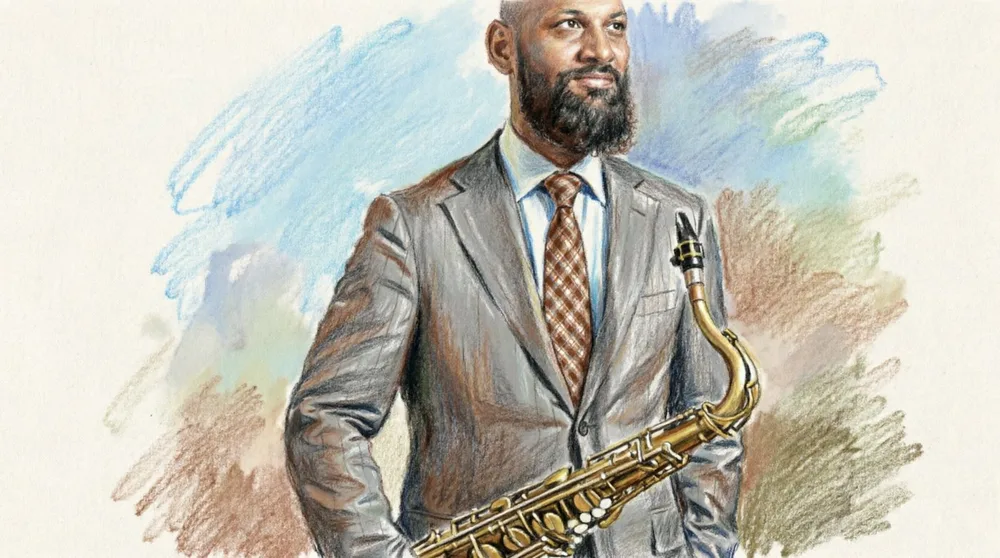
Original illustrated portrait of Eli Degibri, created for JazzProfiles.com — not a photograph. Provided directly by Erik as a stand-in for a free-licensed photo. Original artwork — created for JazzProfiles.com, not Creative Commons–licensed source material — Commissioned/created directly for this profile
Eli Degibri started on mandolin at seven, through the Jaffa Conservatory of Music's after-school program. Three years later he heard a live jazz concert and switched to saxophone. He picked up back-to-back full scholarships to Berklee College of Music's summer performance program in 1994 and 1995, then a full scholarship to Berklee itself in 1997, at eighteen. After a year there, he was one of six musicians selected nationally for a fellowship at the Thelonious Monk Institute of Jazz, where he studied under Ron Carter, Benny Golson, Jimmy Heath, and Clark Terry, graduating in 1999.
It worked immediately. Straight out of the Institute in 1999, Herbie Hancock brought the twenty-one-year-old into his sextet, and Degibri spent the next two and a half years touring the world playing the Gershwin's World repertoire — a stretch of his career later documented on the 2001 DVD The Jazz Channel Presents Herbie Hancock. That same year, he also turned up on Alon Oleartchik's double live album אולארצ'יק ג'אז (Olarchik Jazz), recorded over three nights, April 13–15, 1999, at Tel Aviv's Camelot Club, sharing the bandstand with pianist Yonathan Avishai and trumpeter Avishai E. Cohen — the trumpeter, not the bassist of the same name who was still years from his own international career — years before either Degibri's or that Cohen's careers took off.
By 2002 he had moved to New York and formed his own quintet with guitarist Kurt Rosenwinkel, pianist Aaron Goldberg, bassist Ben Street, and drummer Jeff Ballard, playing rooms like the Blue Note and the Jazz Standard. That same year he joined drummer Al Foster's band, a chair he held for nearly a decade, through 2011; Foster later singled him out as the only young saxophonist whose playing gave him real joy, not just competence. His debut as a leader, In the Beginning (2003, Fresh Sound New Talent), drew on that same quintet's rhythm section and carried liner notes from Herbie Hancock himself. A duo record with pianist Kevin Hays, One Little Song, followed in 2005, then Emotionally Available (2006, Fresh Sound New Talent) — its nine tracks include a run at Coltrane's "Giant Steps" — and Live at Louis 649 (2008, Anzic Records), a organ trio session with Gary Versace and Obed Calvaire.
2010's Israeli Song (Anzic Records) is the record that put him in a room with Ron Carter on bass, Al Foster on drums, and Brad Mehldau on piano — three of the most recorded names in jazz history, backing an Israeli saxophonist on his own tune. Twelve followed in 2013 on Plus Loin Music, built around his working band with pianist Gadi Lehavi, bassist Barak Mori, drummer Ofri Nehemya, and vocalist/guitarist Shlomo Ydov. That same quartet carried Cliff Hangin' (2015), released on Degibri's own Degibri Records imprint, which earned a five-star review from DownBeat magazine — a score the trade publication, reviewing jazz since 1934, hands out rarely. In 2011, Degibri had also headlined the Red Sea Jazz Festival, Israel's largest annual jazz festival, and that year was named the festival's co-Artistic Director, succeeding bassist Avishai Cohen in the role — a post he held into 2021.
He returned to Hebrew-language material in 2015 with Tea for Two (תה בשניים), a second collaboration with Alon Oleartchik recorded at Pluto Studios, again alongside trumpeter Avishai E. Cohen on one track, this time also featuring singer Achinoam Nini (Noa). In 2018 he released Soul Station, a tribute to saxophonist Hank Mobley built around Mobley's own 1960 Blue Note album of the same name, with a new quartet of pianist Tom Oren, bassist Tamir Shmerling, and drummer Eviatar Slivnik. That same year, he became head of Jazz Studies at the Jerusalem Academy of Music and Dance, meaning the players training there now are learning from him directly.
His most recent album, Henri and Rachel (2020, Degibri Records), is named for his parents. His father Henri died in the fall of 2020; his mother Rachel lives with Parkinson's disease and dementia. Degibri has described the years of piano lessons and counterpoint study behind the record as having opened up how he hears and writes music. Along the way he has also played the UN General Assembly for UNESCO's first International Jazz Day in 2012 and performed at the White House for President Obama in 2016, and has picked up Israel's Prime Minister's Award for Jazz Composition and the Landau Award for Jazz Performance.
Eight albums as a leader since 2003, a decade-long apprenticeship split between Herbie Hancock's sextet and Al Foster's band, and, since 2018, a faculty post training the next generation of Israeli jazz musicians — Degibri's career runs from sideman-to-legends to institution-builder without ever really pausing as a working saxophonist.
Degibri has named his three primary tenor saxophone influences directly: Stan Getz, John Coltrane, and Sonny Rollins, describing them as musicians who "accompany" him, present in his playing the way his parents are present in his life. Hank Mobley sits alongside them as a specific, career-defining influence — Mobley's 1960 album Soul Station was enough of a touchstone that Degibri built an entire 2018 record around it. Reviewers describe him as an exceptionally melodic improviser with a big, bold tenor tone (Bill Milkowski, JazzTimes), and on the Soul Station tribute itself, critics noted his tone runs slighter and more pointed than Mobley's round, warm original, with a more forceful, insistent attack across the record.
That combination — a hard-bop and post-bop vocabulary built on Getz, Coltrane, Rollins, and Mobley, delivered with a compositional streak that has drawn praise from Herbie Hancock himself — sits at the center of his own catalog, whether he's fronting a working quartet of young Israeli musicians or sitting in with Ron Carter and Brad Mehldau. Four years of classical piano and counterpoint study, referenced around Henri and Rachel, also feeds his writing directly.
- אולארצ'יק ג'אז / Olarchik Jazz (1999, Alon Oleartchik, NMC) - Recorded live over three nights at Tel Aviv's Camelot Club, this is Degibri's earliest issued recording, made the same year Herbie Hancock recruited him — and it shares a bandstand with trumpeter Avishai E. Cohen years before either musician's international career began. Spotify - Olarchik Jazz
- Emotionally Available (2006, Fresh Sound New Talent) - His third leader date, with Aaron Goldberg, Ben Street, and Jeff Ballard; includes a run at Coltrane's "Giant Steps." Spotify - Emotionally Available Listen · Buy
- Israeli Song (2010, Anzic Records) - His own composition, backed by Ron Carter, Al Foster, and Brad Mehldau; the clearest evidence of the company his playing keeps. Listen · Buy
- Cliff Hangin' (2015, Degibri Records) - A rare five-star DownBeat review, with his longtime working quartet of Gadi Lehavi, Barak Mori, Ofri Nehemya, and Shlomo Ydov. Spotify - Cliff Hangin' Listen · Buy
- Soul Station (2018, self-released) - A direct tribute to Hank Mobley's 1960 Blue Note album of the same name, and the clearest single statement of his own influences on record. Spotify - Soul Station Listen
- Henri and Rachel (2020, Degibri Records) - Named for his parents, and his most personal record; a good entry point into the composer behind the saxophonist. Spotify - Henri and Rachel Listen · Buy
Eli Degibri: Full Discography
As Leader / Co-Leader
| Album Title | Recording / Release Info | Label | Catalog Number | Format | Personnel | Role | Notes | Listen | Buy |
|---|---|---|---|---|---|---|---|---|---|
| In the Beginning | Released 2003 | Fresh Sound New Talent | FSNT 170 | CD, Album | Eli Degibri (tenor saxophone); Kurt Rosenwinkel (guitar); Aaron Goldberg (piano, liner notes); Ben Street (bass); Jeff Ballard (drums); liner notes also by Herbie Hancock | Leader (credited to group "Eli Degibri Quintet," Discogs id 5571125) | His debut as leader. 11 tracks, including "Cherokee" and "All the Things You Are" | not found | Amazon |
| One Little Song | Released 2005 | Not On Label | none | CD, Stereo | Eli Degibri (tenor/soprano saxophone, vocals); Kevin Hays (piano, vocals) | Leader/Co-leader (duo) | 10 tracks | YouTube | not found |
| Emotionally Available | Released 2006 | Fresh Sound New Talent | FSNT 262 | CD, Album | Eli Degibri (tenor/soprano saxophone, arranged by, composed by); Aaron Goldberg (piano, keyboards); Ben Street (bass); Jeff Ballard (drums); Ze Mauricio (pandeiro); Kevin Hays (arranged by) | Leader | 9 tracks, includes Coltrane's "Giant Steps" and a Jimmy Van Heusen/Johnny Burke standard | Spotify | Amazon |
| Live at Louis 649 | Released 2008 | Anzic Records | ANZ-3001 | CD, Album (digipak) | Eli Degibri (tenor/soprano saxophone); Gary Versace (Hammond B3 organ); Obed Calvaire (drums) | Leader (credited to group "Eli Degibri Trio," Discogs id 5507591) | 7 tracks | Spotify | Amazon (FR) |
| Israeli Song | Released 7 July 2010 | Anzic Records | ANZ-3002 | CD, Album, Stereo | Eli Degibri (tenor/soprano saxophone, producer); Ron Carter (bass); Al Foster (drums); Brad Mehldau (piano); recorded/mixed by James Farber; mastered by Mark Wilder | Leader | 11 tracks, title track "Israeli Song." His fifth album as leader | Spotify | Amazon |
| Twelve | Released 2013-08-29 | Plus Loin Music | PL4563 | CD | Eli Degibri (tenor/soprano saxophone, mandolin, composer, lyricist, producer, choir); Gadi Lehavi (piano, choir); Barak Mori (bass, choir); Ofri Nehemya (drums); Shlomo Ydov (vocals, lyricist); choir also with Pini Shavit, Yael Shapira, Yaron Mohar; mixed by Michael Brorby; mastered by Michael Perez-Cisneros | Leader | 9 tracks, includes Vernon Duke's "Autumn in New York" | Spotify | Amazon |
| Cliff Hangin' | Released 2015 | Degibri Records | DR1007 | CD, Album (printed in Israel) | Eli Degibri (tenor & sopranino saxophone, composer); Gadi Lehavi (piano); Barak Mori (bass); Ofri Nehemya (drums); Shlomo Ydov (vocals, guitar, lyricist) | Leader | 11 tracks. Received a five-star review from DownBeat magazine | Spotify | Amazon (CA) |
| Soul Station | Released 2018 | Not On Label (self-released) | none | CD, Album | Eli Degibri (tenor/soprano saxophone, executive producer); Tom Oren (piano); Tamir Shmerling (bass); Eviatar Slivnik (drums); recorded July 5-6, 2017 | Leader | 7 tracks. Tribute to saxophonist Hank Mobley, whose own 1960 Blue Note album was also titled "Soul Station" | Spotify | not found (Amazon search results for this title are dominated by Hank Mobley's original 1960 album; no distinct Eli Degibri listing could be confirmed) |
| Henri and Rachel | Released 2020 | Degibri Records | DR1009 | CD | Not listed in Discogs's extraartists data for this release (flagged as unresolved; personnel not independently confirmed via the API) | Leader | 10 tracks, named for Degibri's grandparents. Includes a "(Due Version)" of the title track (likely a "Duo Version," possible Discogs typo, unresolved) | Spotify | Amazon (UK) |
Co-Leader (Israeli-language collaborations with Alon Oleartchik)
| Album Title | Recording / Release Info | Label | Catalog Number | Format | Personnel | Notes | Listen | Buy |
|---|---|---|---|---|---|---|---|---|
| אולארצ'יק ג'אז (Olarchik Jazz) | Recorded live, Camelot Club, Tel Aviv, April 13-15 1999. Released 1999-06-29 | NMC | 20431-2 | CD, Album (2 discs) | Eli Degibri (saxophone, vocals); Alon Oleartchik (vocals, musical production); Yonathan Avishai (piano); Ofer Schneider [עופר שניידר] (contrabass); Shai Zalman [שי זלמן] (drums); Avishai E. Cohen, Discogs id 542342, the trumpeter (trumpet) | 19 tracks across 2 discs (several as alternate takes), including "Cherokee," "Body & Soul," "One Note Samba." Named-artist credit line reads "Eli Degibri, Avishai E. Cohen, Yonathan Avishai..." plus others | Spotify | not found |
| תה בשניים (Tea for Two) | Recorded at Pluto Studios, December 14-15, 2012. Released 2015 | NMC | 03307592 | CD | Eli Degibri (alto/sopranino/tenor saxophone, arranger, producer, vocals); Alon Oleartchik (vocals, translator); Avishai E. Cohen, Discogs id 542342, the trumpeter (trumpet, track 4 only); Achinoam Nini [i.e. Noa] (vocals); Ofer Ganor (guitar); Barak Mori (double bass); Ofri Nehamia (drums); Gady Lahavy (piano, spelled differently from "Gadi Lehavi" elsewhere in Degibri's catalog, possibly the same person, unresolved); plus סלעית להב (accordion), דורון מזרחי (acoustic guitar), Yael Shapira (cello), אביהי אור-נוי (flute), שחר פוייאי (violin), Paula Valshtein (vocals) | 9 tracks, Hebrew-language versions of jazz standards, e.g. "תה בשניים" = "Tea for Two," "כל כולי" = "All of Me" | YouTube | not found |
As Sideman / Guest / Compilation Appearance
Confirmed sideman credit (extraartists checked directly):
| Year | Project | Title | Label | Role | Notes | Listen | Buy |
|---|---|---|---|---|---|---|---|
| 2001 | Herbie Hancock | The Jazz Channel Presents Herbie Hancock (DVD) | Image Entertainment (ID0695BJDVD) | Tenor Saxophone | Confirms his Hancock sextet tenure; DVD-Video, NTSC | not found | Amazon |
| 2008 | Al Foster Quartet | Love, Peace And Jazz! | (label per Discogs release 8088051) | Sideman, per Al Foster Quartet group credit | Also appears on Degibri's own artist release list | Spotify | Amazon |
Listed chronologically (title, year, Discogs release ID) per Degibri's own artist release page:
- 1995: Eden (release id 11916038)
- 1996: שרים עם יפה ירקוני / "Singing with Yaffa Yarkoni" (id 13847145)
- 1997: מיקה קרני / Mika Karni (id 7517997)
- 1997: שירים מלילה גוֹב: האוסף השני (id 9184314)
- 2000: געגוע = Longing (id 7108241)
- 2001: צוללת (id 32466870 / master 3169263)
- 2002: עוד סיפור (id 10822788)
- 2003: ריקוד ירח = Moon Dance (id 566848)
- 2003: תוך כדי תנועה = In Motion (id 5257865)
- 2003: Gospel Jazz Live (id 10750289)
- 2004: The Sound Of New York Jazz Underground (id 10896594) and its companion DVD The Documentary (id 10976859), both credited to The New Talent Jazz Orchestra (Discogs group id 6021315)
- 2004: A Sonny Day (id 29641768), credited to Yakir Ben-Hur Quintet (Discogs group id 14102854)
- 2005: עומד על נייר (id 7250366)
- 2006: Some Other Day (id 10715492)
- 2007: סיפור בהמשכים (id 10801249)
- 2007: הסליל (master 1451612, main release 12781705)
- 2008: New Morning (id 12274016)
- 2008: בוּסה (id 13601415)
- 2009: Breathing (id 16297281)
- 2011: For The First Time (In A Long Time) (id 4691202)
- 2011: 4 תחנות (id 5395762)
- 2011: חתונה לבנה / לך לפסיכיאטר (id 36667471)
- 2012: העיקר זה המוסיקה (בהופעה חיה) (id 6028446)
- 2012: Zembla Variations (id 7433105)
- 2013: Something Beautiful 1709-2110 (id 8879949)
- Year unspecified in Discogs: International Jazz Festival Varna Summer (id 2815091)
- Herbie Hancock - recruited Degibri into his sextet straight out of the Thelonious Monk Institute in 1999; Degibri toured the Gershwin's World repertoire with the group for two and a half years, and Hancock later wrote the liner notes for In the Beginning (2003).
- Al Foster - bandleader Degibri played for from 2002 to 2011, nearly a decade; Foster has called him the only young saxophonist whose playing gave him real joy.
- Ron Carter and Brad Mehldau - his rhythm section on Israeli Song (2010, Anzic Records), alongside Al Foster.
- Kurt Rosenwinkel, Aaron Goldberg, Ben Street, Jeff Ballard - his New York quintet, formed in 2002; the same rhythm section (minus Rosenwinkel) anchors his 2003 leader debut In the Beginning.
- Kevin Hays - co-leader/duo partner on One Little Song (2005).
- Alon Oleartchik - co-leader on two Hebrew-language standards albums, Olarchik Jazz (1999) and Tea for Two (2015).
- Avishai E. Cohen (trumpet) - co-billed alongside Degibri on both Oleartchik collaborations (1999, 2015); this is the trumpeter, not the bassist of the same name, who is a distinct artist.
- Achinoam Nini (Noa) - featured vocalist on Tea for Two (2015).
- Gadi Lehavi, Barak Mori, Ofri Nehemya, Shlomo Ydov - his working quartet across Twelve (2013) and Cliff Hangin' (2015).
- Tom Oren, Tamir Shmerling, Eviatar Slivnik - his quartet on Soul Station (2018).
- Anzic Records - released Live at Louis 649 (2008) and Israeli Song (2010); the label was co-founded around the same period by clarinetist Anat Cohen.

More Hard Bop Artists
See all 248 Hard Bop artists →More Israeli Jazz Artists
See all 228 Israeli artists →- Wikipedia: Eli Degibri
- Eli Degibri: official biography
- DownBeat: Eli Degibri Offers an Ode to His Parents
- JazzTimes: Eli Degibri — Soul Station review
- Henri SELMER Paris: Eli Degibri artist page
- Haaretz: Red Sea Jazz Festival artistic director Avishai Cohen
- Full discography independently verified against the Discogs API, artist ID 2193301; the complete release-by-release breakdown is published with the discography