 JAZZPROFILES lives in the music 2,059 Jazz Artists fully Profiled!
Tommy Dorsey
Last updated October 29, 2026
Listen on Spotify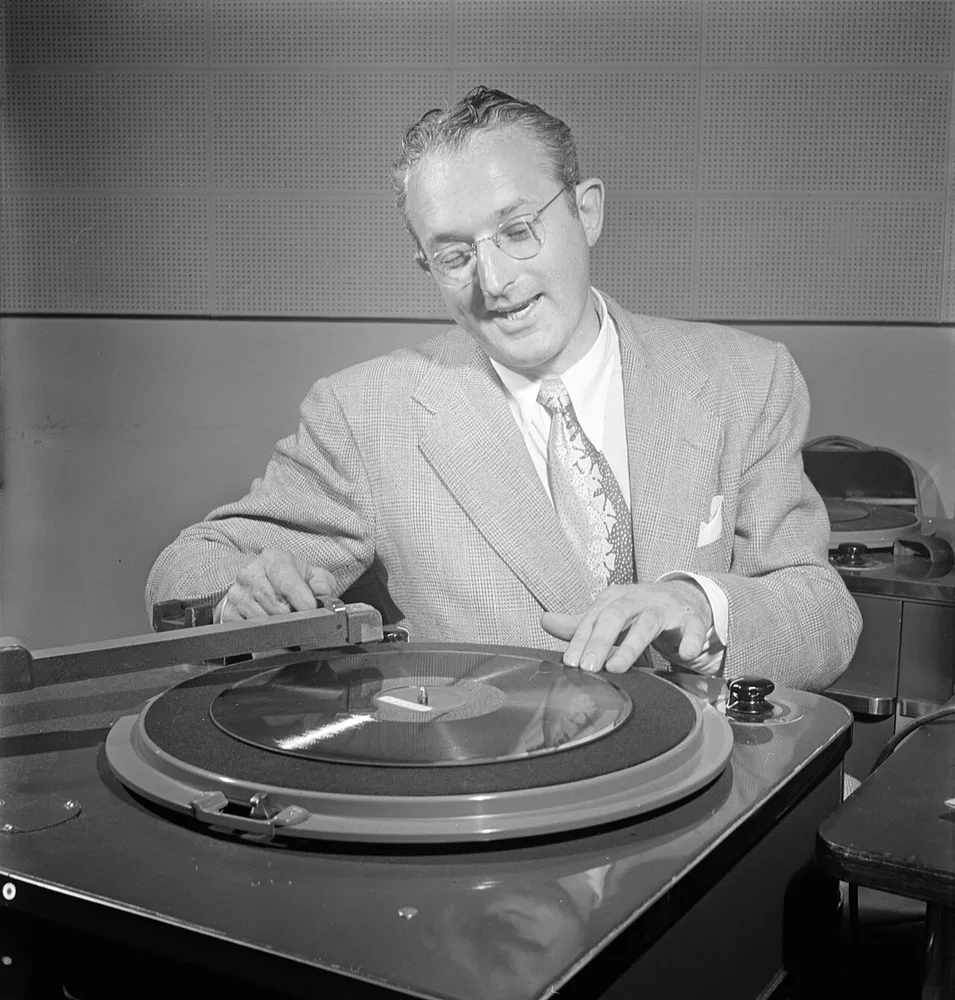
Tommy Dorsey at a turntable at radio station WMCA, New York, October 1947, photographed by William P. Gottlieb Public Domain (William P. Gottlieb collection, released by the photographer; Library of Congress: no known copyright restrictions) — Wikimedia Commons: https://commons.wikimedia.org/wiki/File:Tommy_Dorsey,_WMCA,_New_York,_ca._Oct._1947_(William_P._Gottlieb_02111).jpg

Thomas Francis Dorsey Jr. was born on November 19, 1905, in Mahanoy Plane, Pennsylvania, the second of four children of Thomas Francis Dorsey Sr., a bandleader, and Theresa (Langton) Dorsey. He and his older brother Jimmy, who was born less than two years before him, came up together and became known as the Dorsey Brothers. Tommy studied trumpet with his father before switching to trombone, and in his early years he was known on both horns; he recorded hot trumpet solos in the late 1920s, among them "The Spell of the Blues" with the Dorsey Brothers Orchestra for OKeh on January 26, 1929. At 15, on Jimmy's recommendation, he replaced Russ Morgan in the Scranton Sirens, a territory band. The brothers then worked in bands led by Tal Henry, Rudy Vallee, Vincent Lopez, and Nathaniel Shilkret. In 1923 Tommy followed Jimmy to Detroit to join Jean Goldkette's band, in 1925 he returned to New York to play with the California Ramblers, and in 1927 he joined Paul Whiteman. By 1930 he was one of New York's most successful freelance radio and recording trombonists, heard on sessions with Bix Beiderbecke's Rhythm Jugglers, Joe Venuti and Eddie Lang, and Red Nichols, and on the March 1928 all-star Victor session under Shilkret that also included Benny Goodman, Glenn Miller, and Venuti.
The brothers began recording as the Dorsey Brothers for OKeh in 1928 and had their first hit with "Coquette" in 1929. In 1934 the Dorsey Brothers Orchestra signed with Decca and became a touring band with Tommy as front man, built on an unusual lineup of one trumpet, three trombones, three saxophones, and four rhythm. Miller was a member in 1934 and 1935 and wrote four tunes for it, and in 1935 the orchestra had two number-one records, "Lullaby of Broadway" and "Chasing Shadows." The brothers' quarrels reached a breaking point in May 1935 over the tempo of "I'll Never Say Never Again Again": Tommy walked off the bandstand during an engagement at the Glen Island Casino and left for good. He took over Joe Haymes's band, signed it to RCA Victor, and turned it into Tommy Dorsey and His Orchestra. "On Treasure Island" was the first of four hits for the new band in 1935, and the theme he adopted, "I'm Getting Sentimental Over You," had been recorded by the Dorsey Brothers in 1932 and 1934 before Tommy recorded it for Victor in September and October 1935. Jimmy kept the Dorsey Brothers Orchestra.
The new band was known mainly for ballads at dance tempos and for vocal numbers, and after the 1935 sessions Dorsey's manager steered him away from the hot jazz he had mixed with his lyrical playing. He kept a small Dixieland group drawn from the band, the Clambake Seven, to play during performances, and he became co-host and then host of radio's Raleigh-Kool Program. Jazz players still passed through: Bud Freeman sat in the saxophone section from 1936 to 1938, and the trumpeter Bunny Berigan worked as a jazz soloist on Dorsey's radio program and records in late 1936 and early 1937, where his solo on the hit "Marie" became a signature performance. On March 31, 1937, Dorsey joined Berigan, Fats Waller, guitarist Dick McDonough, and drummer George Wettling for A Jam Session at Victor, an improvised date built on "Honeysuckle Rose" and a blues that reached number four on the pop charts. In 1938 he recorded a big-band arrangement of Pine Top Smith's "Boogie Woogie," which became a hit in 1943 and 1945 and the best-selling record of his career. By 1939 he knew the band was criticized for lacking jazz feeling, and in response he hired the arranger Sy Oliver away from Jimmie Lunceford. Oliver, who became one of the first Black musicians with a prominent role in a white band, wrote up-tempo charts including "On the Sunny Side of the Street" and "T.D.'s Boogie Woogie," and composed two of the band's signature instrumentals, "Well, Git It!" and "Opus One." His arrival helped draw jazz players such as the drummer Buddy Rich, who joined in 1939.
In November 1939 Dorsey hired Frank Sinatra away from Harry James. Sinatra's first appearance with the band came on January 26, 1940, in Rockford, Illinois, and he made about eighty recordings with it through 1942. "I'll Never Smile Again," with Sinatra and the Pied Pipers, topped Billboard's first national best-selling retail records chart on July 27, 1940, and stayed at number one for twelve weeks; Dorsey takes the trombone solo in the break and again near the end. The Pipers' lead singer Jo Stafford had joined the band in 1939 and Connie Haines followed in 1940, while the arrangers Axel Stordahl and Paul Weston, both with the band from 1936, shared the book with Oliver, who took the up-tempo numbers while Stordahl wrote the ballads. Sinatra later said he learned breath control by watching Dorsey play. A contract dispute was settled in August 1942, and Dorsey said goodbye to Sinatra on September 3. The band's later years brought in the trombonist Nelson Riddle (1944 to 1945), the arranger Bill Finegan (1942 to 1950), the trumpeter Charlie Shavers (from 1945, off and on until Dorsey's death), and, after his 1943 marijuana arrest, the drummer Gene Krupa; Rich returned in 1945. When Artie Shaw broke up his band in 1942, Dorsey hired Shaw's string section. He also lent Miller money in 1938 to start his own band, owned two music publishing companies and, from about 1944, a Los Angeles ballroom, the Casino Gardens, and appeared in films including Ship Ahoy (1942), Girl Crazy (1943), and Du Barry Was a Lady (1943).
Dorsey disbanded the orchestra at the end of 1946, but the RCA Victor album All Time Hits reached the top ten in February 1947 and "How Are Things in Glocca Morra?" followed in March, and he reorganized a big band in early 1947. The biographical film The Fabulous Dorseys (1947) had the brothers playing themselves. Tommy returned to Decca in the early 1950s, and after Jimmy gave up his own band the two led a combined Dorsey Brothers Orchestra, with Tommy as leader and Jimmy as co-leader and featured soloist. The brothers appeared on Jackie Gleason's CBS show on December 26, 1953, and then hosted the CBS series Stage Show from 1954 to 1956, on which Elvis Presley made his first national television appearances in January 1956. Tommy passed away on November 26, 1956, at his home in Greenwich, Connecticut, a week after his 51st birthday; he had been taking sleeping pills and choked in his sleep after a large meal. Jimmy led the band until his own death the next year, and the Tommy Dorsey Orchestra has continued under other leaders, among them Warren Covington, Sam Donahue, and the trombonist Buddy Morrow, who led it from 1977 until his death in 2010. In 1982 "I'll Never Smile Again" became the first of three Dorsey recordings in the Grammy Hall of Fame; "I'm Getting Sentimental Over You" and "Marie" followed in 1998, and the U.S. Postal Service issued a stamp honoring Tommy and Jimmy in 1996.
Dorsey was a trombonist of unusual technical control, with a smooth, singing tone and long legato phrasing that earned him the nickname "Sentimental Gentleman of Swing," and he said his trombone style was heavily influenced by Jack Teagarden. His best-known playing is on ballads, where his breath control and sustained line were models for other players and, as Frank Sinatra said, for singers; he was also a precise, demanding leader who, in the recollection of the clarinetist Buddy DeFranco, wanted every part played exactly. The jazz case for him rests on several things: the hot solos he recorded in the 1920s, the Clambake Seven's Dixieland sets, the Jam Session at Victor date, the swing arrangements of Sy Oliver, and a band that over the years carried the soloists Bunny Berigan, Bud Freeman, Ziggy Elman, Charlie Shavers, Buddy DeFranco, and Buddy Rich. Against that stands the commercial core of his output: seventeen number-one records and more than 280 chart entries, most of them dance-band ballads and vocal features, which is why his reputation sits between hot jazz and sweet-band pop. His own band took the criticism seriously enough in 1939 to hire Oliver, and the records from the early 1940s, "Well, Git It!" and "Opus One" among them, are the ones most often cited for the band's swing. He is also remembered as a talent finder: Sinatra, Rich, and Nelson Riddle all passed through his orchestra before their larger careers, and Stordahl, Weston, and Oliver were arrangers he kept on staff.
- "On Treasure Island" (1935, Victor) - The first of four hits in the new orchestra's first year, recorded soon after Dorsey left his brother's band.
- "I'm Getting Sentimental Over You" (1935, Victor) - His theme song, first recorded by the Dorsey Brothers in 1932; his October 18, 1935 version became the arrangement he featured for the rest of his career, with his trombone out front. It entered the Grammy Hall of Fame in 1998.
- "Marie" (1937, Victor) - Irving Berlin's song, with Bunny Berigan's trumpet solo; a number-one record and, with its flip side "Song of India," one of his best-known 78s. It entered the Grammy Hall of Fame in 1998.
- A Jam Session at Victor (1937, Victor) - Dorsey, Berigan, Fats Waller, Dick McDonough, and George Wettling improvise on "Honeysuckle Rose" and a blues in the Dixieland and swing idioms.
- "Boogie Woogie" (1938, Victor) - His big-band treatment of Pine Top Smith's piano piece, a hit again in 1943 and 1945 and his best-selling record.
- "I'll Never Smile Again" (1940, Victor) - With Frank Sinatra and the Pied Pipers, twelve weeks at number one in 1940; Dorsey's trombone plays the break. Spotify - I'll Never Smile Again
- "Well, Git It!" (1942, Victor) - A Sy Oliver riff number and one of the band's hottest recordings, performed with Buddy Rich on drums in the 1943 film Du Barry Was a Lady.
- "Opus One" (1944, Victor) - Sy Oliver's best-known chart for the band, a swing standard played by dance bands and big bands since. Spotify - Opus One Listen
Tommy Dorsey: Full Discography
Discogs artist ID 229639 ("Tommy Dorsey," real name Thomas Francis Dorsey, Jr., born November 19, 1905, in Mahanoy Plane, Pennsylvania, died November 26, 1956, in Greenwich, Connecticut) lists about 2,700 entries, most of them compilations, reissues, and appearances on other artists' records. Discogs files his orchestra and small groups under separate entities, which were checked: Tommy Dorsey And His Orchestra (artist ID 253855, about 2,600 entries), The Dorsey Brothers Orchestra (1181345, about 420), The Dorsey Brothers (2220093, about 230), Tommy Dorsey And His Clambake Seven (312960, about 220), Tommy Dorsey And His Sentimentalists (369535, about 40), and Tommy Dorsey And His Dixielanders (5116158, 1 entry). Three namesakes, Tommy Dorsey (2) (a mastering engineer), Tommy Dorsey (3), and Tommy Dorsey (4), are different people and were not merged. Because his catalog is among the largest of the swing era and almost all of it was issued as 78 rpm singles that were later compiled, the leader table is a curated selection of 20 releases rather than an exhaustive list: the first Victor hits, the 1937 jam session, the boogie-woogie and Clambake-era sides, the Sinatra and Sy Oliver recordings, and the principal album and box-set compilations. Catalog numbers are those of the first or best-documented US pressing found; recording dates come from Discogs release notes and Wikipedia, and where a date is not documented the cell says so.
As Leader / Co-Leader
| Album Title | Recording Date(s) | Release Date | Label | Catalog Number | Format(s) | Personnel | Role | Reissue History | Spotify | Buy | Notes |
|---|---|---|---|---|---|---|---|---|---|---|---|
| I'm Gettin' Sentimental Over You / Long May We Love (The Dorsey Brothers Orchestra) | August 15, 1934, New York | 1934 | Decca | 115 | 10-inch 78 rpm single | The Dorsey Brothers Orchestra with Tommy Dorsey (trombone) as front man; Discogs notes that either King or Ray McKinley plays drums but not both, and that a trumpet and an alto saxophone player are unidentified | Co-leader (Dorsey Brothers) | Not confirmed | — | — | The second recording of what became his theme; the first was made by the Dorsey Brothers for Brunswick in 1932. |
| On Treasure Island / Take Me Back to My Boots and Saddle | Not specified in Discogs data | October 1935 | Victor | 25144 | 10-inch 78 rpm single | Tommy Dorsey and His Orchestra (lineup not itemized on the release) | Leader | Not confirmed | — | — | The first of four hits for the new orchestra in 1935. |
| I'm Gettin' Sentimental Over You / I've Got a Note | October 18, 1935 (A side) and October 14, 1935 (B side), New York | February 5, 1936 | Victor | 25236 | 10-inch 78 rpm single | Tommy Dorsey and His Orchestra (lineup not itemized on the release) | Leader | Not confirmed | — | — | The October 18 take became the arrangement he featured for the rest of his career; Grammy Hall of Fame, 1998. |
| Song of India / Marie | January 29, 1937, New York | 1937 | Victor | 25523 | 10-inch 78 rpm single | Tommy Dorsey (trombone), Bunny Berigan, Jimmy Welch, Joe Bauer, Robert Cusumano (trumpets), Les Jenkins, Red Bone (trombones), Bud Freeman, Clyde Rounds, Fred Stulce, Joe Dixon (saxophones), Dick Jones (piano), Carmen Mastren (guitar), Gene Traxler (bass), Dave Tough (drums), as credited for the A side; the B side is not itemized separately | Leader | Not confirmed | — | — | Berigan's trumpet solo on "Marie" is the best-known part of the pairing; "Marie" entered the Grammy Hall of Fame in 1998. |
| A Jam Session at Victor | March 31, 1937, New York | 1937 | Victor | 25559 | 10-inch 78 rpm single | Tommy Dorsey (trombone), Bunny Berigan (trumpet), Fats Waller (piano), Dick McDonough (guitar), George Wettling (drums) | Co-leader (five-man pickup group) | Reissued many times, per Wikipedia; British and Australian issue on His Master's Voice B8580 | — | — | Two sides, "Honeysuckle Rose" and "Blues," improvised without rehearsal; it reached number four on the pop charts. |
| Dipsy Doodle / Who? | October 14, 1937, New York | 1937 | Victor | 25693 | 10-inch 78 rpm single | Tommy Dorsey and His Orchestra (lineup not itemized on the release) | Leader | Not confirmed | — | — | "The Dipsy Doodle" was one of the band's number-one records of 1937. |
| Boogie Woogie / Weary Blues | September 16, 1938 (A side); the B side is a 1935 recording, September 26, 1935 | 1938 | Victor | 26054 | 10-inch 78 rpm single | A side: Tommy Dorsey (trombone), Charlie Spivak, Lee Castaldo, Yank Lawson (trumpets), Les Jenkins (trombone), Deane Kincaide, Johnny Mince, Hymie Schertzer, Skeets Herfurt (saxophones), Howard Smith (piano), Carmen Mastren (guitar), Maurice Purtill (drums), Gene Traxler (bass), as credited on Discogs | Leader | Reissued on RCA Victor 20-1715 (1945, with "There You Go") and 44-0008 (1945); the 1951 collector's reissue Victor 27-0025 pairs it with "Opus No. 1" | — | — | His arrangement of Pine Top Smith's piano piece; it became a hit in 1943 and 1945 and the best-selling record of his career. |
| Midnight on the Trail / Hawaiian War Chant | November 29, 1938, New York | December 28, 1938 | Victor | 26126 | 10-inch 78 rpm single | Tommy Dorsey and His Orchestra (lineup not itemized on the release) | Leader | "Hawaiian War Chant" was reissued on RCA Victor 20-2006 (1946) and 420-0124 (1955) | — | — | The B side is billed as "Tommy Dorsey and His Orch." on the label. |
| I'll Never Smile Again / Marcheta | May 23, 1940, New York (A side); the B side was recorded May 1, 1939 | 1940 | Victor | 26628 | 10-inch 78 rpm single | A side: Tommy Dorsey (trombone), vocals by Frank Sinatra and the Pied Pipers; Discogs credits Bunny Berigan, Ray Linn, Leon Dubrow (trumpets), George Arus, Les Jenkins, Lowell Martin (trombones), Fred Stulce, Hymie Schertzer (alto saxophones), Don Lodice, Paul Mason (tenor saxophones), Joe Bushkin (piano), Clark Yocum (guitar), Sid Weiss (bass), Buddy Rich (drums) without individual credit on the label | Leader | Issued in Britain on His Master's Voice B.9102 | Spotify - I'll Never Smile Again | — | Number one on Billboard's first national best-selling records chart for twelve weeks from July 27, 1940; Grammy Hall of Fame, 1982. |
| Will You Still Be Mine? / Yes Indeed! | February 17, 1941 | May 23, 1941 | Victor | 27421 | 10-inch 78 rpm single | Tommy Dorsey and His Orchestra; Sy Oliver and Jo Stafford share the vocal on "Yes Indeed!" per Wikipedia | Leader | Not confirmed | — | — | "Yes Indeed!" is a Sy Oliver composition; Discogs does not itemize the instrumentalists. |
| Somewhere a Voice Is Calling / Well, Git It! | March 9, 1942, Hollywood (the date Discogs gives for the A side; the B side's date is not stated) | May 22, 1942 | Victor | 27887 | 10-inch 78 rpm single | Tommy Dorsey and His Orchestra (lineup not itemized on the release) | Leader | "Well, Git It!" was reissued on RCA Victor 20-2508 (1947, with "I'll Be Seeing You") | — | — | Sy Oliver's riff number; Buddy Rich plays drums in the orchestra's 1943 film performance of it. |
| A Boy in Khaki, a Girl in Lace / In the Blue of the Evening | July 2, 1942 (A side) and June 17, 1942 (B side), New York | July 31, 1942 | Victor | 27947 | 10-inch 78 rpm single | Tommy Dorsey and His Orchestra with vocals by Frank Sinatra on the Sinatra sides (lineup not itemized on the release) | Leader | "In the Blue of the Evening" was reissued on RCA Victor 20-1530 (1943, with "It's Always You") | — | — | "In the Blue of the Evening" reached number one in 1943, per Wikipedia. |
| There Are Such Things / Daybreak | July 1, 1942, New York | September 25, 1942 | Victor | 27974 | 10-inch 78 rpm single | Tommy Dorsey and His Orchestra with vocals by Frank Sinatra on "There Are Such Things" (lineup not itemized on the release) | Leader | Not confirmed | — | — | "There Are Such Things" reached number one in January 1943, per Wikipedia; "Daybreak" is based on the "Mardi Gras" theme in the Mississippi Suite. |
| I Dream of You / Opus No. 1 | November 14, 1944, RCA Victor Studios, Hollywood | December 4, 1944 | Victor | 20-1608 | 10-inch 78 rpm single | Tommy Dorsey and His Orchestra (lineup not itemized on the release) | Leader | "Opus No. 1" was reissued on RCA Victor 20-2008 (1946, with "Chicago") and 27-0025 (1951) | Spotify - Opus One | — | Sy Oliver's "Opus No. 1," later retitled "Opus One" for the lyric added to it. |
| All Time Hits | Not specified in Discogs data | 1946 | RCA Victor (Musical Smart Set) | P-163 | 4 x 10-inch 78 rpm, album set, compilation | Tommy Dorsey and His Orchestra with Frank Sinatra, Jo Stafford, and the Pied Pipers | Leader | Reissued on 7-inch 45 rpm discs (RCA EPBT 3030) | — | — | Contains "Boogie Woogie," "On the Sunny Side of the Street," "Somewhere a Voice Is Calling," "Hawaiian War Chant," "Embraceable You," "After You've Gone," "Chicago," and "Opus No. 1"; Wikipedia reports that it reached the top ten in February 1947. |
| Marie / Green Eyes | Not specified in Discogs data | 1954 | Bell Records | 1028 | 7-inch 78 rpm single | Tommy Dorsey and His Orchestra featuring Jimmy Dorsey (further personnel not itemized) | Leader (with Jimmy Dorsey featured) | Not confirmed | — | — | A release from the brothers' combined-band years. |
| Tribute to Dorsey, Volume 1 | Not specified in Discogs data | 1956 | RCA Victor (Down Beat: A Jazz Milestone) | LPM-1432 | LP, mono, compilation | Tommy Dorsey and His Orchestra and Tommy Dorsey and His Clambake Seven | Leader | Not confirmed | — | — | Issued in an RCA Victor series billed as a jazz milestone; tracks include "Satan Takes a Holiday," "Liebestraum," "Washboard Blues," "Music, Maestro, Please," and "Swanee River." |
| Tribute to Dorsey, Volume 2 | Not specified in Discogs data | 1957 | RCA Victor (Down Beat: A Jazz Milestone) | LPM-1433 | LP, mono, compilation | Tommy Dorsey and His Orchestra (lineup not itemized on the release) | Leader | Not confirmed | — | — | Tracks include "March of the Toys," "Milenberg Joys," "Tea for Two," "Chloe," and "Come Rain or Come Shine." |
| The Dorsey / Sinatra Sessions, Volumes 1 to 3 | February 1, 1940 to July 2, 1942 | 1982 | RCA | CPL2-4334; CPL2-4335; CPL2-4336-1 | 3 x 2-LP sets, compilation | Tommy Dorsey and His Orchestra with Frank Sinatra (vocals); Volume 1 covers February 1 to July 17, 1940, Volume 2 July 17, 1940 to May 28, 1941, and Volume 3 June 27, 1941 to July 2, 1942 | Leader (billed with Frank Sinatra) | Superseded by the 1994 box set listed below | — | — | Sinatra's recordings with the orchestra in chronological order, February 1940 to July 1942. |
| The Song Is You | 1940 to 1942 | 1994 | RCA | 07863 66353-2 | 5 x CD, box set, compilation, remastered | Tommy Dorsey and His Orchestra with Frank Sinatra (vocals) | Leader (billed with Frank Sinatra) | Not confirmed | — | — | The complete studio masters of the Dorsey and Sinatra recordings. |
As Sideman (selected major credits)
Dorsey became a leader in the mid-1930s, so his sideman and studio credits fall in the 1920s and early 1930s. This is a representative selection of what is documented; catalog numbers are not given where the session is known only from other sources.
| Year | Project (Leader) | Title | Label | Catalog | Role | Notes |
|---|---|---|---|---|---|---|
| 1920s | The California Ramblers | Dance and jazz sides for many labels | Various | Not specified | Member | Wikipedia lists Dorsey with Jimmy Dorsey, Red Nichols, and Adrian Rollini among the members who later led big bands; he played with the group from 1925. |
| 1927 | Bix and His Rhythm Jugglers (Bix Beiderbecke) | Session sides | Not specified | Not specified | Member | Discogs lists Dorsey among the members of this Beiderbecke group. |
| 1927 to 1928 | Paul Whiteman and His Orchestra | Whiteman orchestra recordings | Not specified | Not specified | Trombone | Dorsey joined Whiteman in 1927; how long he stayed and the individual sessions are not itemized here. |
| 1928 | Nathaniel Shilkret's All-Star Orchestra | Victor session of March 21, 1928 | Victor | Not specified | Trombone | Played alongside Benny Goodman, Glenn Miller, and Joe Venuti. |
| 1929 | The Dorsey Brothers Orchestra with Bing Crosby | "Let's Do It," "My Kinda Love," and "The Spell of the Blues" | OKeh | Not specified | Co-leader (Dorsey Brothers) | Crosby sang on the OKeh dates, with Miller writing arrangements and playing trombone, per Miller's profile; Dorsey's hot trumpet solo on "The Spell of the Blues" was recorded January 26, 1929. |
| 1929 to 1934 | Ethel Waters | Studio sides with players credited as the Dorsey brothers, Benny Goodman, and others | Various | Not specified | Trombone | The sides credit Jimmy and Tommy Dorsey among the studio players, per her profile. |
| 1933 | Mildred Bailey | Brunswick sides with the Dorsey Brothers Orchestra | Brunswick | Not specified | Trombone (Dorsey Brothers Orchestra) | Mildred Bailey recorded Brunswick sides in 1933 with the Dorsey Brothers Orchestra behind her, per her profile. |
Recordings made after Dorsey's death under his name, including the orchestra's releases under Warren Covington, Sam Donahue, and Buddy Morrow, are separate from his own discography and are not listed here.
- Frank Sinatra - vocalist with the orchestra from January 1940 to September 1942, about eighty recordings including "I'll Never Smile Again" and "This Love of Mine"; he later recorded a tribute, I Remember Tommy (1961), arranged by Sy Oliver.
- Glenn Miller - played trombone and wrote four arrangements for the Dorsey Brothers Orchestra in 1934 and 1935; Dorsey lent him money in 1938 to start his own band.
- Jimmie Lunceford - bandleader whose arranger Sy Oliver left for Dorsey's orchestra in 1939, according to Lunceford's profile.
- Harry James - the bandleader Sinatra left in November 1939 to join Dorsey, according to James's profile.
- Eddie Sauter - arranger whose freelance clients included Dorsey, per his profile.
- Benny Goodman - fellow member of the March 1928 Nathaniel Shilkret all-star Victor session with Dorsey, Miller, and Joe Venuti.
- Mildred Bailey - recorded Brunswick sides in 1933 with the Dorsey Brothers Orchestra behind her, per her profile.
- Ethel Waters - her studio sides of 1929 to 1934 credit Jimmy and Tommy Dorsey among the players, per her profile.
- Jimmy Dorsey - older brother and partner in the Dorsey Brothers from the 1920s, rival bandleader from 1935, and co-leader of the Dorsey Brothers Orchestra and Stage Show host from 1953 until Tommy's death.
- Sy Oliver - arranger hired from Lunceford in 1939; wrote "Well, Git It!," "Opus One," and "T.D.'s Boogie Woogie."
- Buddy Rich - drummer with the orchestra in 1939 to 1942, in 1945, and again in 1954 and 1955.
- Bunny Berigan - trumpet soloist on the 1937 "Marie" and the Jam Session at Victor.
- Charlie Shavers, Ziggy Elman, Bud Freeman, Buddy DeFranco - trumpet, trumpet, tenor saxophone, and clarinet soloists with the orchestra in the 1930s and 1940s.
- Axel Stordahl, Paul Weston, Bill Finegan, Nelson Riddle - the band's principal arrangers and writers beyond Oliver.
- Jo Stafford, the Pied Pipers, Connie Haines, Dick Haymes - the vocalists who worked with the orchestra in the late 1930s and 1940s, alongside Jack Leonard and Edythe Wright.
- Bing Crosby - sang with the Dorsey Brothers Orchestra on 1929 OKeh dates.
- Later Dorsey orchestras - alumni of the touring orchestra under Sam Donahue and Buddy Morrow include Helen Forrest, who sang with the Donahue-led band in the early 1960s, Ken Peplowski, who was hired by Morrow, and Tim Horner, who toured with a Dorsey edition in 1978, per their profiles.
- Jimmy Rowles - pianist who recorded with Dorsey among other bandleaders, per his profile.
More Swing Artists
See all 179 Swing artists →More American Jazz Artists
See all 646 American artists →- Wikipedia: Tommy Dorsey
- Wikipedia: The Dorsey Brothers
- Wikipedia: A Jam Session at Victor
- Wikipedia: I'll Never Smile Again
- Wikipedia: Sy Oliver
- Wikipedia: Stage Show (TV series)
- All About Jazz: Tommy Dorsey
- Discogs: Tommy Dorsey (artist 229639)
- MusicBrainz: Tommy Dorsey
- JazzProfiles.com: Jimmie Lunceford
- JazzProfiles.com: Harry James
- JazzProfiles.com: Eddie Sauter
- JazzProfiles.com: Mildred Bailey
- JazzProfiles.com: Ethel Waters
- JazzProfiles.com: Jimmy Rowles