 JAZZPROFILES lives in the music 2,059 Jazz Artists fully Profiled!
Bessie Smith
Last updated October 29, 2026
Listen on Spotify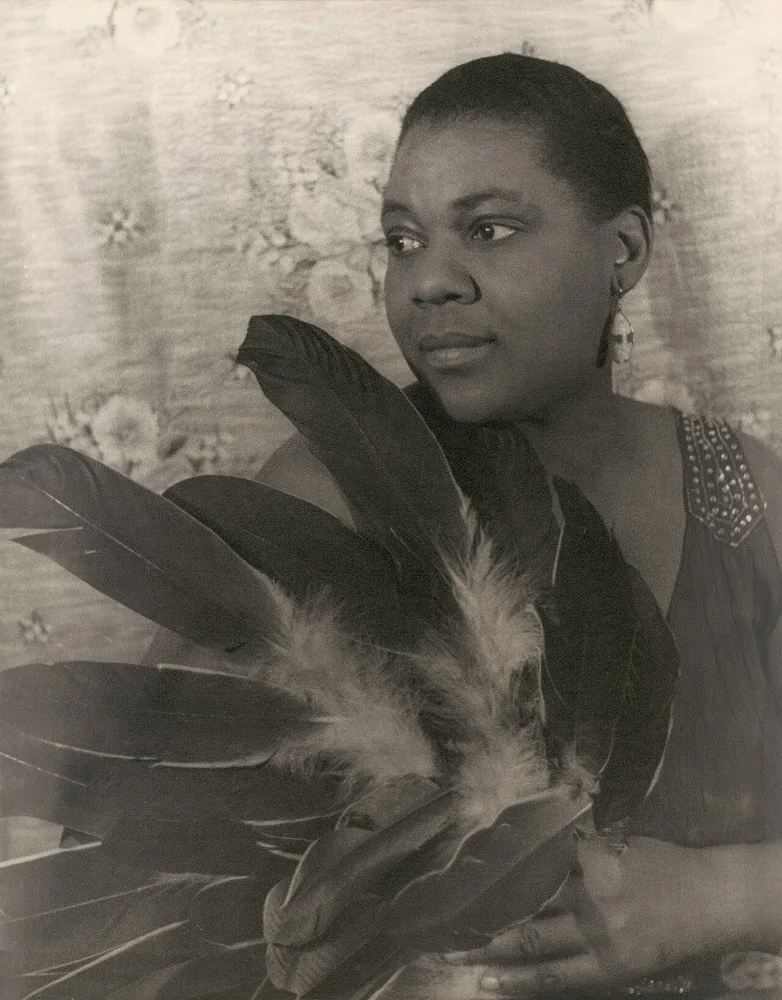
Bessie Smith, portrait photograph by Carl Van Vechten, February 3, 1936 (restored by Adam Cuerden) Public domain. Basis: the Library of Congress holds the Van Vechten photographs with no known copyright restrictions (the restrictions on the collection expired in 1986), and Wikimedia Commons tags the file with its public domain Van Vechten license. The Van Vechten estate asks only that the photograph not be cropped or colorized and that the photographer be credited. — Wikimedia Commons: https://commons.wikimedia.org/wiki/File:Bessie_Smith_(1936)_by_Carl_Van_Vechten.jpg (original at the Library of Congress Prints and Photographs Division, digital ID ppmsca.09571)

Bessie Smith was born in Chattanooga, Tennessee, on April 15, 1892, though the record is untidy: the 1900 census has her family reporting July 1892, while the 1910 census gives a birth date of April 15, 1894, the day her family observed as her birthday. Her father, William, was a laborer and part-time Baptist preacher who died before she could remember him. By the time she was nine her mother and a brother had also died, and her older sister Viola took charge of the children. Bessie and her brother Andrew busked on the streets of Chattanooga, she singing and dancing while he played guitar, usually in front of the White Elephant Saloon at Thirteenth and Elm. In 1912 her brother Clarence, who had left in 1904 with a traveling troupe, brought her to audition for the managers of the Moses Stokes company, Lonnie and Cora Fisher. She was hired as a dancer, because the troupe already had a star singer in Ma Rainey, who is thought to have helped her develop stage presence without teaching her to sing. By about 1913 she was building her own act at the "81" Theater in Atlanta, and she rose to become the top attraction on the Theatre Owners Booking Association circuit, the Black vaudeville and tent-show network of the South and East Coast.
The recording business came to her after Mamie Smith's "Crazy Blues" (Okeh, 1920) sold more than 100,000 copies and showed record companies a Black audience. Frank Walker signed Bessie Smith to Columbia in 1923, and her first session took place on February 15, 1923. Her first record paired "Down Hearted Blues," with Clarence Williams at the piano, and "Gulf Coast Blues." Both sides were hits, and "Down Hearted Blues" is credited with 780,000 copies sold in its first six months. On September 26, 1923 she cut "Cemetery Blues," the first record issued when Columbia opened its "race records" series. She married Jack Gee on June 7, 1923, and over the next several years she became the highest-paid Black entertainer of her day, heading shows of as many as forty performers and traveling in her own 72-foot railroad car. Columbia's publicity department called her the Queen of the Blues; the national press upgraded the title to Empress of the Blues. Her electrical recording debut came on May 5, 1925 with "Cake Walking Babies (From Home)."
Her jazz connection is documented in the musicians who stood behind her. Fletcher Henderson was her pianist on dozens of sides between 1923 and 1927. On January 14, 1925, in Columbia's New York studio, she recorded five numbers with Louis Armstrong on cornet and Fred Longshaw on organ: "St. Louis Blues," "Reckless Blues," "Sobbin' Hearted Blues," "Cold in Hand Blues" and "You've Been a Good Ole Wagon." The "St. Louis Blues" is the recording most often cited from the meeting, and it was inducted into the Grammy Hall of Fame in 1993 in the jazz category. Over the following years her Columbia sessions drew in Joe Smith, Tommy Ladnier and Demas Dean on cornet, Charlie Green and Jimmy Harrison on trombone, Don Redman and Buster Bailey on clarinet. At a band session on March 2, 1927 she recorded "After You've Gone," "Alexander's Ragtime Band," "Muddy Water (A Mississippi Moan)" and "There'll Be a Hot Time in the Old Town Tonight" with Fletcher Henderson, Joe Smith, Jimmy Harrison, Charlie Dixon, Buster Bailey and Coleman Hawkins on clarinet. On February 17, 1927 she recorded "Back-Water Blues" and "Preachin' the Blues" with only James P. Johnson at the piano, and Johnson returned for a run of sessions through 1929. "Empty Bed Blues," cut on March 20, 1928 with Porter Grainger on piano and Charlie Green on trombone, became the most notorious record of her career and entered the Grammy Hall of Fame in 1983. In all she recorded 156 tracks for Columbia and four for Okeh between 1923 and 1933.
The Depression and the arrival of sound film cut into her work, and she never stopped performing. In 1929 she appeared in the Broadway musical Pansy, which failed, though critics singled her out as its one asset. That year she also made her only film, the two-reel St. Louis Blues, directed by Dudley Murphy and shot in Astoria, Queens, with W. C. Handy as co-author and musical director. She sings the title song in a speakeasy scene backed by James P. Johnson at the piano, the cornetists Thomas Morris and Joe Smith, Bernard Addison on guitar and banjo, and the Hall Johnson Choir. The film was selected for the National Film Registry in 2006.
Her last recordings came on November 24, 1933, when John Hammond arranged four sides for Okeh, paying a flat $37.50 for each. The band was the swing-era New York pool: trombonist Jack Teagarden, trumpeter Frankie Newton, tenor saxophonist Chu Berry, pianist Buck Washington, guitarist Bobby Johnson and bassist Billy Taylor. Benny Goodman, recording with Ethel Waters in the neighboring studio, dropped in and can barely be heard on one selection. The session produced "Take Me for a Buggy Ride" and "Gimme a Pigfoot," both by Wesley Wilson, and a version of her blues that fit the swing era; Hammond, who had wanted the older sound, was not entirely pleased.
On September 26, 1937, she was badly hurt in a car crash on U.S. Route 61 between Memphis and Clarksdale, Mississippi. Her partner Richard Morgan, an uncle of Lionel Hampton, was driving and hit the back of a slow-moving truck. Dr. Hugh Smith, a Memphis surgeon who reached the scene first, found her right arm nearly severed at the elbow and later attributed her death to crushing injuries along that whole side of her body. She was taken to the G. T. Thomas Afro-American Hospital in Clarksdale, where the arm was amputated, and she passed away that morning without regaining consciousness. She was 45. The story that a whites-only hospital turned her away, which John Hammond put into print in DownBeat that November and which Edward Albee used in his 1959 play The Death of Bessie Smith, has been discredited: Dr. Smith told her biographer Chris Albertson that an ambulance carrying a Black patient would not have gone to a white hospital in that part of Mississippi. Her funeral in Philadelphia on October 4, 1937 drew thousands, and her grave stayed unmarked until August 7, 1970, when a headstone paid for by the singer Janis Joplin and by Juanita Green, who had done housework for her as a child, was erected.
Recognition followed, much of it posthumous: the Blues Hall of Fame (1980), the Big Band and Jazz Hall of Fame (1981), the National Women's Hall of Fame (1984), a Grammy Lifetime Achievement Award and an "early influences" induction into the Rock and Roll Hall of Fame (both 1989), a U.S. postage stamp (1994), the Library of Congress National Recording Registry for "Down Hearted Blues" (2002), and the Nesuhi Ertegun Jazz Hall of Fame at Jazz at Lincoln Center (2008). Rolling Stone ranked her No. 33 on its 2023 list of the 200 greatest singers. In 2015 HBO's Bessie, with Queen Latifah in the title role, won four Primetime Emmy Awards.
Smith's genre is classic blues, sung in the vaudeville and tent-show tradition, and the jazz label fits her through company and repertoire more than through improvisation: the cornetists, trombonists and pianists who accompanied her were the leading jazz players of the 1920s, and her songbook ran through "St. Louis Blues," "After You've Gone" and "Alexander's Ragtime Band." The nearest canonical tags are Jazz Blues and Vocal Jazz. She sang as a powerful contralto whose force was obvious from her first session, made in the acoustic era, and became more striking once electrical recording arrived in 1925. Danny Barker and Tommy Dorsey both compared her hold on an audience to that of a preacher. Her lyrics spoke about poverty, prison and the chain gang ("Jail House Blues," "Sing Sing Prison Blues," "Poor Man's Blues," "Washwoman's Blues"), jealousy and drink, and a woman's right to desire and independence, subjects that critics outside her audience found coarse and that scholars now read as an early strand of African American protest song.
Her influence runs through the jazz singers who followed. Billie Holiday named her among the records that first mattered to her, and Dinah Washington recorded the tribute album Dinah Sings Bessie Smith in 1958, the same year LaVern Baker released a tribute of her own. Technical faults in the original masters, including speed variations and off-center spindle holes, distorted pitch and phrasing on many reissues, and the transfers John R. T. Davies made for Frog Records are widely preferred to the first Columbia compact discs.
- "Down Hearted Blues" / "Gulf Coast Blues" (1923, Columbia) - Her first record, with Clarence Williams at the piano; it opened the Columbia race-records run and made her name. Collected on The Complete Recordings, Vol. 1. Spotify - The Complete Recordings, Vol. 1 Listen
- "St. Louis Blues" and four other sides with Louis Armstrong (January 14, 1925, Columbia) - The meeting of the Empress with the most important jazz cornetist of the day, Fred Longshaw on organ. Collected on The Complete Recordings, Vol. 2. Spotify - The Complete Recordings, Vol. 2 Listen
- The Fletcher Henderson and James P. Johnson sessions (1925 to 1928, Columbia) - Band sides with Joe Smith, Charlie Green, Buster Bailey and Coleman Hawkins, and the voice-and-piano "Back-Water Blues" with James P. Johnson. Collected on The Complete Recordings, Vol. 3. Spotify - The Complete Recordings of Bessie Smith, Vol. 3 Listen
- "Empty Bed Blues" (1928, Columbia) - Two sides with Porter Grainger on piano and Charlie Green on trombone, the most notorious record of her career. Collected on The Complete Recordings, Vol. 4. Spotify - The Complete Recordings, Vol. 4 Listen
- "Nobody Knows You When You're Down and Out" (1929, Columbia) - Her reading of the Jimmie Cox song became a Depression-era standard. Also on The Complete Recordings, Vol. 4. Spotify - The Complete Recordings, Vol. 4 Listen
- "Gimme a Pigfoot" and "Take Me for a Buggy Ride" (1933, Okeh) - Her final session, with Jack Teagarden, Frankie Newton and Chu Berry, produced by John Hammond. Collected on The Complete Recordings, Vol. 5: The Final Chapter. Spotify - The Complete Recordings, Vol. 5 Listen
Bessie Smith: Full Discography
Discogs artist: Bessie Smith (288268) · Born April 15, 1892, Chattanooga, Tennessee · Died September 26, 1937, Clarksdale, Mississippi
Bessie Smith recorded between 1923 and 1933: 156 tracks for Columbia and four for Okeh. She made no albums in her lifetime. Her work came out as double-sided 78 rpm singles, and the long-playing catalogue is entirely reissue, first in the five two-record Columbia sets of 1970 to 1972 and then in the five-volume compact disc series that followed. Releases billed under her band names (Bessie Smith and Her Band, Her Blue Boys, Her Down Home Trio) are filed by Discogs under separate entries linked to the main artist page. The tables below follow the Columbia reissue series, then the landmark singles with their original catalog numbers.
The Complete Recordings (Columbia / Legacy, 1991 to 1996)
The standard edition of her Columbia and Okeh output, in chronological order. Accompanist names are the track-level credits Discogs carries; Volume 2 has no track credits there, and the January 1925 session with Louis Armstrong is documented from the original singles listed further down.
| Volume | Recorded | Label and catalog | Accompanists and notes | Listen | Buy |
|---|---|---|---|---|---|
| The Complete Recordings, Vol. 1 | February 15, 1923 to 1924 | Columbia / Legacy C2K 47091 (1991, 2 CD) | 38 tracks from "Down Hearted Blues" to "Hateful Blues." Clarence Williams, Fletcher Henderson, Irving Johns and Jimmy Jones on piano; Don Redman, Ernest Elliott and George Baquet on clarinet; the Down Home Trio; Clara Smith on two duets | Spotify | — |
| The Complete Recordings, Vol. 2 | 1924 to 1925 | Columbia / Legacy C2K 47471 (1991, 2 CD) | 37 tracks, including the five sides recorded with Louis Armstrong on January 14, 1925 ("St. Louis Blues," "Reckless Blues," "Sobbin' Hearted Blues," "Cold in Hand Blues," "You've Been a Good Ole Wagon") | Spotify | — |
| The Complete Recordings, Vol. 3 | November 20, 1925 to February 16, 1928 | Columbia / Legacy 472189 2 (1992) | 39 tracks. Fletcher Henderson on piano for most of the first disc, with Joe Smith, Buster Bailey, Don Redman, Tommy Ladnier and June Cole; the March 2, 1927 band session with Jimmy Harrison, Charlie Dixon and Coleman Hawkins; "Back-Water Blues" and "Preachin' the Blues" with James P. Johnson; Charlie Green on trombone for "Trombone Cholly" and "Send Me to the 'Lectric Chair"; Porter Grainger and Fred Longshaw on later sides | Spotify | — |
| The Complete Recordings, Vol. 4 | February 21, 1928 to June 11, 1931 | Columbia / Legacy 472934 2 (1993) | 40 tracks. "Empty Bed Blues" (Porter Grainger, Charlie Green); "Nobody Knows You When You're Down and Out" (Clarence Williams, Garvin Bushell, Ed Allen); James P. Johnson on most of the second disc; Eddie Lang on guitar for three 1929 duets with Clarence Williams; Louis Metcalf, Charlie Green and Floyd Casey on the 1931 sessions | Spotify | — |
| The Complete Recordings, Vol. 5: The Final Chapter | 1933 | Columbia / Legacy 483585 2 (1996, 2 CD) | The four Okeh sides of November 24, 1933 with a band including Jack Teagarden, Frankie Newton, Chu Berry and Buck Washington; previously unissued alternate takes of 1925 sides; the soundtrack of the 1929 film St. Louis Blues; a second disc of interview material with Ruby Smith conducted by Chris Albertson | Spotify | — |
Landmark singles
Original double-sided 78 rpm releases, with recording dates and catalog numbers as given in Discogs release notes.
| Recorded | Title | Label and catalog | Accompaniment | Notes |
|---|---|---|---|---|
| February 15, 1923 | "Down Hearted Blues" / "Gulf Coast Blues" | Columbia A3844 | Clarence Williams, piano | Her first record, issued on Columbia's Gold Band label |
| September 26 and October 16, 1923 | "Cemetery Blues" / "Any Woman's Blues" | Columbia 13001-D | Jimmy Jones and Fletcher Henderson, piano | "Cemetery Blues" was the first record issued in Columbia's race series |
| January 14, 1925 | "St. Louis Blues" / "Cold in Hand Blues" | Columbia 14064-D | Louis Armstrong, cornet; Fred Longshaw, organ and piano | The "St. Louis Blues" side was inducted into the Grammy Hall of Fame in 1993 |
| January 14, 1925 | "Reckless Blues" / "Sobbin' Hearted Blues" | Columbia 14056-D | Louis Armstrong, cornet; Fred Longshaw, organ and piano | Same session |
| February 17, 1927 | "Preachin' the Blues" / "Back-Water Blues" | Columbia 14195-D | James P. Johnson, piano | Voice and piano only |
| March 2, 1927 | "After You've Gone" / "Muddy Water (A Mississippi Moan)" | Columbia 14197-D | Fletcher Henderson, piano; Joe Smith, cornet; Jimmy Harrison, trombone; Charlie Dixon, banjo; Buster Bailey and Coleman Hawkins, clarinets | Band session |
| March 2, 1927 | "Alexander's Ragtime Band" / "There'll Be a Hot Time in the Old Town Tonight" | Columbia 14219-D | Same band | Same session |
| March 20, 1928 | "Empty Bed Blues," Parts 1 and 2 | Columbia 14312-D | Porter Grainger, piano; Charlie Green, trombone | Grammy Hall of Fame, 1983 |
| May 15 and July 25, 1929 | "Nobody Knows You When You're Down and Out" / "Take It Right Back ('Cause I Don't Want It Here)" | Columbia 14451-D | Clarence Williams, piano, with Ed Allen, Garvin Bushell and others on the A side | A side recorded May 15, B side July 25 |
| November 24, 1933 | "Gimme a Pigfoot" / "Take Me for a Buggy Ride" | Okeh 8949 | Jack Teagarden, Frankie Newton, Chu Berry, Buck Washington, Bobby Johnson, Billy Taylor; Benny Goodman is also credited | Final session, produced by John Hammond |
| November 24, 1933 | "Do Your Duty" / "I'm Down in the Dumps" | Okeh 8945 | Same band | Same session |
Film
St. Louis Blues (1929), a two-reel short directed by Dudley Murphy, shot in Astoria, Queens, with W. C. Handy as co-author and musical director. Her only film appearance, with James P. Johnson at the piano, the cornetists Thomas Morris and Joe Smith, Bernard Addison on guitar and banjo, and the Hall Johnson Choir. Its soundtrack is her only recording not controlled by Columbia, and it appears on The Complete Recordings, Vol. 5. Selected for the National Film Registry in 2006.
Long-playing reissues
| Year | Title | Label and catalog | Notes |
|---|---|---|---|
| 1951 | The Bessie Smith Story, Vol. 1 to Vol. 4 | Columbia GL 503, GL 504, GL 505, GL 506 | Four-LP survey produced by George Avakian; Vol. 1 carries the Armstrong sides of January 1925 |
| 1970 | The World's Greatest Blues Singer | Columbia GP 33 | First of five two-record sets issued chronologically |
| 1970 | Any Woman's Blues | Columbia G 30126 | Second set |
| 1971 | Empty Bed Blues | Columbia G 30450 | Third set |
| 1971 | The Empress | Columbia G 30818 | Fourth set; Chris Albertson as producer and liner-note writer |
| 1972 | Nobody's Blues But Mine | Columbia G 31093 | Fifth set, completing the Columbia catalogue |
The five sets were later reissued on compact disc as The Complete Recordings, Vol. 1 to Vol. 5 (above). Other compact disc editions include the chronological series on Classics (1994 to 1997), covering 1923-1924, 1924-1925, 1925-1927, 1927-1928, 1928-1929 and 1929-1933, and Volumes 1 and 2 of a remastered Complete Recordings on Frog (2001).
Tributes by other singers
Dinah Washington recorded Dinah Sings Bessie Smith (EmArcy, 1958), and LaVern Baker released a Bessie Smith tribute album the same year. Billie Holiday named Smith among the first voices that mattered to her.
Awards and honors
| Year | Honor |
|---|---|
| 1980 | Blues Hall of Fame |
| 1981 | Big Band and Jazz Hall of Fame |
| 1983 | Grammy Hall of Fame: "Empty Bed Blues" (recorded 1928) |
| 1984 | National Women's Hall of Fame |
| 1989 | Grammy Lifetime Achievement Award; Rock and Roll Hall of Fame ("early influences") |
| 1993 | Grammy Hall of Fame: "St. Louis Blues" with Louis Armstrong (recorded 1925, jazz category) |
| 1994 | U.S. Postal Service commemorative stamp |
| 2002 | Library of Congress National Recording Registry: "Down Hearted Blues" |
| 2006 | Grammy Hall of Fame: "Down Hearted Blues" (recorded 1923); National Film Registry: St. Louis Blues |
| 2008 | Nesuhi Ertegun Jazz Hall of Fame, Jazz at Lincoln Center |
- Louis Armstrong - cornet on the five sides of January 14, 1925, including "St. Louis Blues."
- Fletcher Henderson - pianist and bandleader behind her on dozens of sides from 1923 to 1927.
- Coleman Hawkins - clarinet at the March 2, 1927 band session that produced "After You've Gone," "Alexander's Ragtime Band" and "Muddy Water (A Mississippi Moan)."
- James P. Johnson - her pianist on the 1927 duo sides "Back-Water Blues" and "Preachin' the Blues," on later Columbia sessions through 1929, and in the 1929 film.
- Charlie Green - trombonist on "Trombone Cholly," "Empty Bed Blues" and some twenty other Columbia sides.
- Joe Smith - cornetist on her mid-1920s Columbia sessions and in the 1929 film.
- Clarence Williams - pianist on her first record and on many later sessions, including "Nobody Knows You When You're Down and Out."
- Porter Grainger - pianist and songwriter, her accompanist from 1924 to 1928.
- Fred Longshaw - her musical director and accompanist, who played on the 1925 Armstrong session.
- Tommy Ladnier, Demas Dean, Don Redman, Buster Bailey, Jimmy Harrison, Charlie Dixon, Louis Metcalf, Garvin Bushell, Eddie Lang - horn, reed and guitar players credited on her Columbia sides.
- Ma Rainey - the established singer of the Moses Stokes troupe when Smith joined it in 1912.
- John Hammond - producer of her last session in 1933.
- Jack Teagarden, Frankie Newton, Chu Berry, Buck Washington, Bobby Johnson, Billy Taylor - the band on that 1933 session.
- Benny Goodman - dropped in from the neighboring studio during the same 1933 session.
- W. C. Handy - composer of "St. Louis Blues" and co-author and musical director of the 1929 film.
- Lionel Hampton - the vibraphonist and bandleader whose uncle, Richard Morgan, was her partner at the time of her death.
More Jazz Blues Artists
See all 46 Jazz Blues artists →More American Jazz Artists
See all 646 American artists →- Wikipedia: Bessie Smith
- Wikipedia: Down Hearted Blues
- Wikipedia: St. Louis Blues (song)
- Wikipedia: St. Louis Blues (1929 film)
- Wikipedia: Empty Bed Blues
- Wikipedia: Backwater Blues
- Wikipedia: Gimme a Pigfoot
- Wikipedia: Charlie Green (trombonist)
- Wikipedia: Porter Grainger
- Wikipedia: Frankie Newton
- Wikipedia: Chu Berry
- Discogs: Bessie Smith
- Discogs: The Complete Recordings, Vol. 1
- Discogs: The Complete Recordings, Vol. 2
- Discogs: The Complete Recordings, Vol. 3
- Discogs: The Complete Recordings, Vol. 4
- Discogs: The Complete Recordings, Vol. 5
- Jazz Advice and Analysis Histories: "St. Louis Blues," Bessie Smith featuring Louis Armstrong, 1925
- Dippermouth Blog: Bessie Smith Meets Louis Armstrong, 90 Years Later
- Wikimedia Commons: Bessie Smith (1936) by Carl Van Vechten
- jazzprofiles.com: James P. Johnson
- jazzprofiles.com: Billie Holiday
- jazzprofiles.com: Dinah Washington
