 JAZZPROFILES lives in the music 1,572 Jazz Artists fully Profiled!
 Muhammad Ali (drummer)
Last updated September 5, 2026
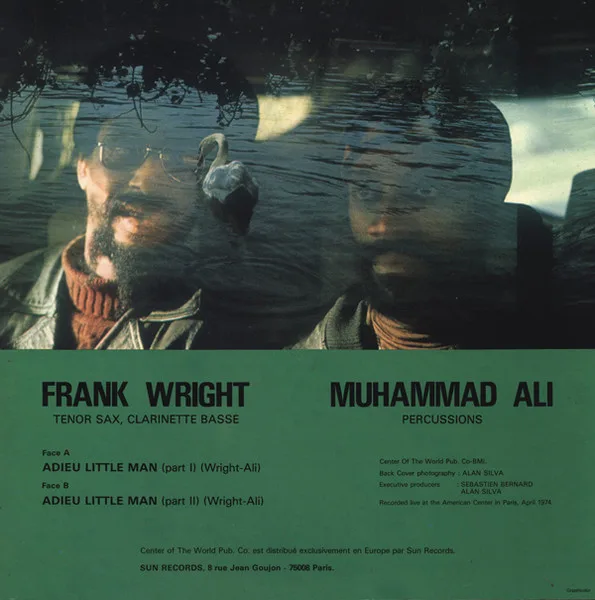
Frank Wright (left) and Muhammad Ali (right), a double-exposure photograph on the back cover of *Adieu Little Man* (Muhammad Ali Duo Frank Wright, Center of the World CW 004), recorded live at the American Center in Paris, April 1974. The sleeve captions each man by name directly beneath his image ("FRANK WRIGHT / TENOR SAX, CLARINETTE BASSE" and "MUHAMMAD ALI / PERCUSSIONS"). Album cover art (not a CC-licensed artist photo) - used as the only available image showing the artist — Discogs release page - https://www.discogs.com/release/3146529 (back-cover scan; photography by Alan Silva)
Muhammad Ali was born Raymond Patterson on December 23, 1936, in Philadelphia, Pennsylvania, three years after his older brother Robert, who would grow up to become the drummer Rashied Ali. Their father and his sons converted to Islam together, and both Patterson brothers took new names and drum kits into Philadelphia's jazz scene: Robert as Rashied Ali, Raymond as Muhammad Ali. A third brother, Umar Ali (also known as Omar Ali), became a jazz percussionist as well, making theirs a rare family of three working drummers. Muhammad Ali is not related to the world heavyweight boxing champion of the same name; reference sources on him take pains to note the distinction, and this profile is exclusively about the drummer.
His first significant recording date was Your Prayer (ESP-Disk, 1967), cut in New York with saxophonist Frank Wright's quintet alongside altoist Arthur Jones, trumpeter Jacques Coursil, and bassist Steve Tintweiss. That session began a partnership with Wright that would define most of Ali's career. In 1969, like a number of American free-jazz players facing a contracting New York scene, Ali relocated to Europe alongside Wright, saxophonist Noah Howard, and pianist Bobby Few. Before leaving, he recorded two sessions with Albert Ayler at Plaza Sound Studios in New York, August 26-29, 1969, issued as Music Is the Healing Force of the Universe (Impulse!, 1970) and The Last Album (Impulse!, 1971); Discogs credits list Muhammad Ali, not his brother Rashied, as the drummer on both records, a mix-up that recurs often enough in secondary sources that it is worth stating plainly. That same period also produced a rarer overlap: Alan Shorter's Orgasm (Verve, 1969), recorded across three 1968 sessions, credits both Ali brothers as drummers, though Discogs does not specify which sessions belong to which brother.
In Europe, Ali, Wright, Few, and bassist Alan Silva formed the Center of the World Quartet, a cooperative unit that became one of the signature bands of the Paris-based free-jazz diaspora of the early 1970s, releasing its own records on the Center of the World label: Center of the World. Volume I (1972, recorded live in Rotterdam), Last Polka in Nancy? (1973, recorded live at the Nancy Jazz Pulsations festival), and More or Less Few (1973), the latter billed to Few. In 1974 Ali and Wright cut Adieu Little Man, recorded live at the American Center in Paris and billed as a duo, "Muhammad Ali Duo Frank Wright" - his only outing as a credited co-leader from this era, and the source of one of the few surviving photographs of him, a double-exposure portrait of the two musicians on the album's back cover. Alongside the Center of the World records, Ali also drummed on a run of Paris sessions for Archie Shepp (Pitchin' Can and Coral Rock, both recorded July 23, 1970, with a large ensemble including Alan Shorter, Lester Bowie, and violinist Leroy Jenkins) and for Noah Howard (The Black Ark, Space Dimension), and appeared on Dutch saxophonist Hans Dulfer's El Saxofón (1972).
Work slowed through the later 1970s and 1980s, with scattered dates for Few (Rhapsody in Few, 1983) and German reedman Michel Pilz (Jamabiko, 1984). In October 2006, Ali took part in a concert marking John Coltrane's 80th birthday in Philadelphia, appearing alongside his brother Rashied Ali, pianist Dave Burrell, and bassist Reggie Workman; he played again with Noah Howard in the summer of 2008. His most consequential late-career turn came in 2010, when saxophonist David S. Ware brought him into a quartet with pianist Cooper-Moore and bassist William Parker - Ali's first recording in nearly thirty years. The quartet, billed simply as "David S. Ware / Cooper-Moore / William Parker / Muhammad Ali," recorded Planetary Unknown on November 23, 2010, at Systems Two Studio in Brooklyn, released by AUM Fidelity in June 2011, and documented a further live set at the Jazzfestival Saalfelden in Austria on August 27, 2011 - Ware's final public performance - issued in 2012 as Live at Jazzfestival Saalfelden 2011.
A further archival release surfaced in 2014: Ascent of the Nether Creatures (NoBusiness Records), recorded in the Netherlands on July 12, 1980, with saxophonist Idris Ackamoor, bassist Rashied Al Akbar, and trumpeter Earl Cross, and left unissued for thirty-four years. Ali's most recent documented recording is a 2017 date with Bobby Zankel's septet, Celebrating William Parker @ 65 (Not Two Records). No death has been reported for him in any source consulted for this profile; Wikipedia's own article on him remains in present tense with no death date, and he would be about 89 as of 2026.
Ali's playing across the Frank Wright and Center of the World records is a driving, high-energy free pulse built to match Wright's raw, gospel- and blues-inflected tenor sound - closer in spirit to the "energy music" wing of the free-jazz scene than to the more abstracted, texture-based drumming some of his contemporaries favored. He belongs to the generation of American free players who found steadier work and a more receptive audience in Europe after 1969 than at home, alongside Wright, Noah Howard, and Bobby Few. His career has been persistently overshadowed by two namesakes: his own older brother Rashied Ali, far better documented as John Coltrane's last drummer, and, inescapably, the boxer who shares his adopted name. His unexpected late-career turn in David S. Ware's Planetary Unknown quartet, arriving four decades after his ESP-Disk debut, drew renewed critical attention and stands as one of the more notable comeback stories in the free-jazz generation of the 1960s and '70s.
- Music Is the Healing Force of the Universe (1970, Albert Ayler, Impulse!) - Recorded August 1969; Discogs credits Muhammad Ali, not Rashied Ali, as the drummer. Spotify - Music Is The Healing Force Of The Universe
- The Last Album (1971, Albert Ayler, Impulse!) - Drawn from the same August 1969 sessions as the album above. Spotify - The Last Album Listen
- Your Prayer (1967, The Frank Wright Quintet, ESP-Disk) - Ali's first significant recording date, and the start of his long partnership with Frank Wright. Spotify - Your Prayer
- Center of the World. Volume I (1972, Frank Wright / Center of the World, Center of the World) - Live document of the Paris-based cooperative quartet Ali co-anchored for much of the 1970s. Not currently available on Spotify.
- Adieu Little Man (1974, Muhammad Ali Duo Frank Wright, Center of the World) - Ali's only outing as a credited co-leader; the back cover carries a rare photograph of him. Not currently available on Spotify.
- Planetary Unknown (2011, David S. Ware / Cooper-Moore / William Parker / Muhammad Ali, AUM Fidelity) - Ali's first recording in nearly thirty years, recorded November 23, 2010. Spotify - Planetary Unknown Listen
- Planetary Unknown: Live at Jazzfestival Saalfelden 2011 (2012, David S. Ware / Cooper-Moore / William Parker / Muhammad Ali, AUM Fidelity) - David S. Ware's final public performance. Spotify - Live at Jazzfestival Saalfelden 2011 Listen
- Ascent of the Nether Creatures (recorded 1980, released 2014, NoBusiness Records) - Archival quartet session with Idris Ackamoor, Rashied Al Akbar, and Earl Cross, unissued for 34 years. Not currently available on Spotify.
Muhammad Ali: Full Discography
Identity confirmed via the live Discogs API - artist ID 369294 ("Muhammad Ali," free jazz drummer, born Raymond Patterson, December 23, 1936, Philadelphia; profile text names both brothers Rashied Ali and Umar Ali). This entity was disambiguated directly against Muhammad Ali (2), Discogs artist 669210, which is the boxer (realname Cassius Clay); the two are entirely separate Discogs entities and none of the boxer's credits appear below. Discogs credits the drummer on 57 releases: 4 in a "Main"/leader-or-co-leader role and 53 sideman "Appearance," "TrackAppearance," and unofficial/reissue credits. He is primarily a sideman - Wikipedia states he took part in 26 recording sessions between 1967 and 1983, plus a smaller run of dates from 2010 on - but he does hold four co-billed leader credits, tabulated below. The sideman table curates his most significant and best-documented dates rather than itemizing all 53 Appearance-type credits, many of which are overlapping reissues and compilations of the same handful of sessions.
As Leader / Co-Leader
| Album Title | Recording Date(s) | Release Date | Label | Catalog Number | Format(s) | Personnel | Role | Reissue History | Spotify | Buy | Notes |
|---|---|---|---|---|---|---|---|---|---|---|---|
| Adieu Little Man | Recorded live, American Center, Paris, April 1974 | 1974 | Center of the World | CW 004 | Vinyl, LP, Album | Muhammad Ali (percussion), Frank Wright (tenor sax, bass clarinet) | Co-leader (billed "Muhammad Ali Duo Frank Wright") | None found | Not confirmed on Spotify | — | His only outing as a credited co-leader; the back cover is a double-exposure photograph of both musicians, captioned with their names and instruments |
| Planetary Unknown | Recorded November 23, 2010, Systems Two Studio, Brooklyn, NY | 2011-06-14 | AUM Fidelity | AUM068 | CD, Album | David S. Ware (tenor, stritch, sopranino sax), Cooper-Moore (piano), William Parker (bass), Muhammad Ali (drums) | Co-leader (quartet billing) | None found | Spotify - Planetary Unknown | — | Ali's first recording in nearly 30 years |
| Planetary Unknown: Live at Jazzfestival Saalfelden 2011 | Recorded live August 27, 2011, Jazzfestival Saalfelden, Austria | 2012 | AUM Fidelity | AUM074 | CD, Album | Same quartet as above | Co-leader (quartet billing) | None found | Spotify - Live at Jazzfestival Saalfelden 2011 | — | David S. Ware's last public performance |
| Ascent of the Nether Creatures | Recorded July 12, 1980, the Netherlands (city not specified in Discogs data) | 2014-09 | NoBusiness Records | NBLP 78 | Vinyl, LP, Album, Limited Edition of 300 | Idris Ackamoor (alto/tenor sax), Rashied Al Akbar (bass), Earl Cross (trumpet), Muhammad Ali (drums) | Co-leader (quartet billing) | None found | Not confirmed on Spotify | — | Archival release, issued 34 years after recording |
As Sideman (selected major credits)
| Year | Project (Leader) | Title | Label | Catalog | Role | Notes |
|---|---|---|---|---|---|---|
| 1967 | The Frank Wright Quintet | Your Prayer | ESP-Disk' | ESP 1053 | Drums | Recorded New York City, 1967; Ali's first significant recording date |
| 1969 | Alan Shorter | Orgasm | Verve | V6-8768 | Drums | Recorded across three 1968 sessions (Sept. 23, Sept. 25, Nov. 6); both Muhammad Ali and his brother Rashied Ali are credited as drummers on the release, but Discogs does not specify which sessions belong to which brother |
| 1969-70 | Albert Ayler | Music Is the Healing Force of the Universe | Impulse! | AS-9191 | Drums | Recorded Aug. 26-29, 1969, Plaza Sound Studios, NYC; released April 1970; Discogs credits Muhammad Ali, not Rashied Ali |
| 1969-71 | Albert Ayler | The Last Album | Impulse! | AS-9208 | Drums | Same August 1969 sessions as above; released 1971; same Ali-brothers attribution note applies |
| 1970 | Frank Wright | One for John | BYG Records | 529.336 | Drums | Recorded Dec. 5, 1969, Studio Saravah, Paris; with Noah Howard and Bobby Few |
| 1970 | Archie Shepp | Pitchin' Can | America Records | 30 AM 6106 | Drums | Recorded Paris, July 23, 1970 (and Nov. 9, 1969); large ensemble incl. Alan Shorter, Lester Bowie, Clifford Thornton, Leroy Jenkins, Dave Burrell |
| 1970 | Archie Shepp | Coral Rock | America Records | 30 AM 6103 | Drums | Recorded the same July 23, 1970 Paris session as Pitchin' Can |
| 1971 | The Frank Wright Quartet | Church Number Nine | Odeon (Japan) | OP-88019 | Drums | Recorded Paris, March 7, 1970; first released in Japan, 1971 |
| 1971 | Noah Howard | Space Dimension | America Records | 30 AM 6108 | Drums | Co-credited with Art Taylor; likely recorded 1970 |
| 1972 | Noah Howard | The Black Ark | Freedom / Polydor | FLP 40105 / 2383 093 | Drums | Recorded Bell Sound Studios, NYC, 1969; issued 1971-72 |
| 1972 | Frank Wright / Center of the World | Center of the World. Volume I | Center of the World | CW 001 | Drums | Recorded live, Rotterdam, 1972 |
| 1972 | Hans Dulfer | El Saxofón | Catfish | 5C 054-24515 | Drums | Recorded Bovema Studios, Heemstede, Netherlands, Oct. 16, 1971 |
| 1973 | Bobby Few | More or Less Few | Center of the World | CW 003 | Drums | Recorded Paris, Nov. 1973 |
| 1973 | The Frank Wright Quartet | Last Polka in Nancy? | Center of the World | CW 002 | Drums | Recorded live, Nancy Jazz Pulsations Festival, Oct. 10, 1973 |
| 1976 | Archie Shepp | Doodlin' | Inner City Records | IC 1001 | Drums | Per sleeve notes, recorded in France in the late 1960s; issued 1976 |
| 1983 | Bobby Few | Rhapsody in Few (Discogs title: "Bobby Few") | Black Lion Records | Not specified in Discogs data | Drums | |
| 1984 | Michel Pilz Quartett | Jamabiko | M.P. | Not specified in Discogs data | Drums | |
| 2017 | Bobby Zankel & The Wonderful Sound 6 | Celebrating William Parker @ 65 | Not Two Records | Not specified in Discogs data | Drums | Ali's most recently documented recording |
Not itemized above: roughly two dozen further reissues, compilations, and repackagings of the same core Ayler, Shepp, Howard, and Frank Wright sessions (e.g., Reevaluations: The Impulse Years, The Impulse Story, Holy Ghost, The Complete ESP-Disk' Recordings, Unity), plus a handful of one-track compilation appearances (For Example - Workshop Freie Musik 1969-1978; Alan Silva's The Shout - Portrait for a Small Woman) and Saheb Sarbib's two Live in Europe volumes (1976), all of which are genuine but secondary to the sessions listed above.
- Frank Wright - Ali's most important and longest-running collaborator, from Your Prayer (1967) through the Center of the World Quartet's records of the 1970s, culminating in their 1974 duo album Adieu Little Man; profiled separately on JazzProfiles.com.
- Bobby Few and Alan Silva - pianist and bassist, respectively, of the Center of the World Quartet alongside Ali and Wright.
- Albert Ayler - drummer on Music Is the Healing Force of the Universe and The Last Album (1969-70), sessions sometimes wrongly attributed to his brother Rashied.
- Rashied Ali - older brother, also a free-jazz drummer; the two are both credited as drummers on Alan Shorter's Orgasm (1969), and appeared together at a 2006 concert marking John Coltrane's 80th birthday in Philadelphia; his own career is covered in full in his JazzProfiles.com profile.
- Archie Shepp - leader on the Paris sessions issued as Pitchin' Can and Coral Rock (1970) and Doodlin' (1976).
- Noah Howard - saxophonist and fellow member of the 1969 wave of American free players who relocated to Europe; Ali recorded on Howard's The Black Ark and Space Dimension.
- David S. Ware, Cooper-Moore, and William Parker - quartet partners on Planetary Unknown (2011) and its live follow-up, Ali's first recording after a near-thirty-year gap.
- Leroy Jenkins - violinist on the 1970 Archie Shepp sessions Pitchin' Can.
- Charlie Haden and Gato Barbieri - fellow sidemen on Alan Shorter's Orgasm (1969).
- Steve Lacy - material featuring Ali appears on the 1996 compilation Duets/Associates.
More Avant-Garde Jazz Artists
See all 343 Avant-Garde Jazz artists →More American Jazz Artists
See all 567 American artists →- Discogs: Muhammad Ali
- No confident Spotify artist page is linked: searches for "Muhammad Ali" on Spotify are dominated by content related to the boxer and by other same-named artists, and no page could be confirmed as a correct, uncontaminated match for the drummer.
- Wikipedia: Muhammad Ali (drummer)
- Discogs: Muhammad Ali
- Wikidata: Muhammad Ali (Q1951824)
- Val Wilmer, As Serious As Your Life: The Story of the New Jazz (Quartet, 1977), p. 259 - cited by Wikipedia for Ali's early life and 1969 move to Europe
- Wikipedia: Rashied Ali
- Wikipedia: Albert Ayler
- All About Jazz: Planetary Unknown review