 JAZZPROFILES lives in the music 1,002 Jazz Artists fully Profiled!
 J.J. Johnson
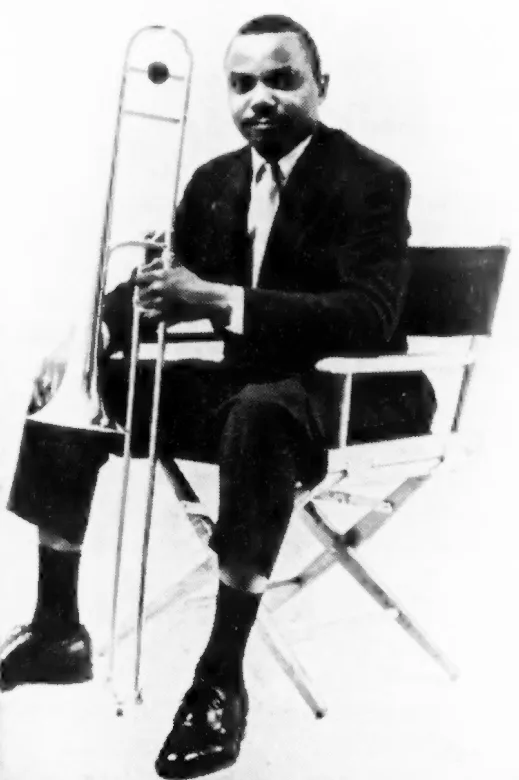
Trombonist J.J. Johnson, as pictured in a January 1961 DownBeat magazine advertisement for King trombones. Public domain (US publication without a copyright notice) — Wikimedia Commons - https://commons.wikimedia.org/wiki/File:J._J._Johnson.jpg

James Louis "J.J." Johnson was born January 22, 1924, in Indianapolis, Indiana. He started on piano at nine before switching to trombone at fourteen, launching his professional career in 1941 with Clarence Love's territory band. In 1942 he worked briefly with Snookum Russell's band, where he met trumpeter Fats Navarro, an early influence on his emerging bebop vocabulary, before joining Benny Carter's orchestra later that year. With Carter he made his recording debut, soloing on "Love for Sale" in 1943, and in July 1944 he appeared at the first Jazz at the Philharmonic concert in Los Angeles. He toured and recorded with the Count Basie Orchestra from 1945 to 1946.
Leaving Basie, Johnson quickly became one of the trombonists most closely identified with the new bebop movement, recording with Charlie Parker at a Dial Records session on December 17, 1947, and working with Illinois Jacquet's band from 1947 to 1949. He played trombone on two of the three recording dates, April 1949 and March 1950, that made up Miles Davis's Birth of the Cool nonet sessions, later collected on Capitol; trombonist Kai Winding, who would soon become his most important musical partner, played the earlier January 1949 date. Johnson also led his own small recording sessions in these years, using sidemen including Bud Powell and a young Sonny Rollins. He worked with bassist Oscar Pettiford in 1951 and again briefly with Miles Davis, then spent roughly 1952 to 1954 largely outside music, supporting himself as a blueprint inspector.
In August 1954, producer Ozzie Cadena brought Johnson together with Kai Winding to form a two-trombone quintet that became known as Jay and Kai. The unusual all-trombone frontline was an immediate success: the group recorded for Savoy (Jay & Kai, 1954) and then Columbia (Trombone for Two, 1955; Jay and Kai, 1957) before splitting up in August 1956 so each leader could pursue his own working group. The two reunited periodically for the rest of their careers.
Johnson spent the years after the breakup leading his own quintets and sextets, drawing on a rotating group of sidemen that included saxophonists Bobby Jaspar and Clifford Jordan, cornetist Nat Adderley, trumpeter Freddie Hubbard, pianists Tommy Flanagan and Cedar Walton, and drummers Max Roach, Elvin Jones, and Albert "Tootie" Heath. The 1957-59 quartet dates First Place and Blue Trombone, cut with Flanagan, bassist Paul Chambers, and Roach, and 1958's Dial J.J. 5, with Jaspar, are among the best-documented records of this period. He increasingly devoted himself to composition and arranging in the Third Stream idiom pursued alongside John Lewis and Gunther Schuller, beginning with 1956's "Poem for Brass" and continuing through pieces including "El Camino Real" and the six-movement 1961 suite Perceptions, written as a feature for Dizzy Gillespie and recorded for Verve; his composition "Lament" went on to become a jazz standard. He toured again with Miles Davis in 1961-62, led further working bands documented on RCA Victor (J.J.!, 1965; Broadway Express, 1966; The Total J.J. Johnson, 1967) and Impulse! (Proof Positive, 1965, by most accounts his last studio recording with a regularly working band for roughly two decades), and reunited with Winding for an Impulse! session (The Great Kai & J.J., 1961, with pianist Bill Evans) and two CTI/A&M albums, Israel (1968, featuring pianist Herbie Hancock) and Betwixt & Between (1969). In January 1967 the pair also backed vocalist Sarah Vaughan on what proved to be her final sessions for Mercury Records.
By the late 1960s Johnson had shifted most of his working time to composing for film and television, and around 1970 he moved to the Los Angeles area to pursue that work more or less full time, contributing scores and cues to series including Mayberry R.F.D. and The Six Million Dollar Man. He performed only occasionally through most of the 1970s (he also played in Sammy Davis Jr.'s Cocoanut Grove show orchestra and in the band for Carol Burnett's television program during this stretch) yet remained popular enough with critics to keep winning DownBeat's trombone polls despite his near-total absence from touring and recording. A 1977 tour of Japan with Nat Adderley, documented on The Yokohama Concert and Chain Reaction: Yokohama Concert, Vol. 2, marked a partial return to performing, followed by further Japanese dates in the early 1980s (some again with Winding) and the leader albums Concepts in Blue (1981, Pablo) and, with fellow trombonist Al Grey, Things Are Getting Better All the Time (1984, Pablo).
Johnson's fullest return to active performing began with engagements at New York's Village Vanguard in November 1987 and July 1988, which supplied the material for two later live albums, Quintergy: Live at the Village Vanguard and Standards: Live at the Village Vanguard (both released 1991 on Antilles). While on tour in Japan in December 1988 he learned that his wife, Vivian, had suffered a stroke; he stopped performing for nearly three years to care for her until her death in 1991, and dedicated his 1992 Concord Jazz album Vivian to her memory. He married Carolyn Reid in 1992 and resumed a busy touring and recording schedule, releasing Let's Hang Out (1993), the string-orchestra album Tangence (1995, arranged and conducted by Robert Farnon, with a guest appearance by trumpeter Wynton Marsalis), the all-trombone summit The Brass Orchestra (1997, whose personnel included fellow trombonists Steve Turre, Slide Hampton, Robin Eubanks, and Jim Pugh), and Heroes (1998, featuring saxophonist Wayne Shorter). Johnson was voted into the DownBeat Hall of Fame in 1995 and named an NEA Jazz Master in 1996. He gave his final concert on November 10, 1996, at William Paterson College in New Jersey, then retired from touring and returned to his native Indianapolis, where he continued composing and arranging using computer notation software and wrote instructional trombone études later published by Hal Leonard. Diagnosed with prostate cancer in his final years, Johnson took his own life at his Indianapolis home on February 4, 2001, at age 77.
J.J. Johnson is widely credited as the trombonist who did for his instrument what Charlie Parker and Dizzy Gillespie did for saxophone and trumpet: he transferred bebop's rapid eighth-note lines and harmonic vocabulary onto the slide trombone with a speed and clean articulation so unusual for the instrument that some listeners assumed he was playing a valve trombone rather than a slide one. Where earlier trombonists had leaned on the instrument's natural glissando and "tailgate" effects, Johnson favored a light, precise, almost horn-like attack, and he paired that technical command with a serious compositional and arranging voice that produced Third Stream concert works and the enduring standard "Lament." Trombonist Steve Turre has said that Johnson did for the trombone what Parker did for the saxophone, and that every trombonist playing today owes something to what Johnson accomplished. Critics and fellow musicians generally credit him with making the trombone a viable frontline bebop voice for the first time and with shaping the playing of virtually every major jazz trombonist who came after him.
- The Eminent Jay Jay Johnson, Volume 1 (1955, Blue Note) - his early-1950s Blue Note sessions, with a band including trumpeter Clifford Brown and pianist John Lewis. Spotify - The Eminent J.J. Johnson Listen
- Jay & Kai (1954, Savoy) - the founding document of the Jay and Kai partnership with fellow trombonist Kai Winding. Spotify - Jay & Kai Listen
- First Place (1957, Columbia) - a quartet date with Tommy Flanagan, Paul Chambers, and Max Roach, showcasing his fast, clean small-group style. Spotify - First Place (Expanded) Listen
- The Great Kai & J.J. (1961, Impulse!) - a Jay and Kai reunion session featuring pianist Bill Evans. Spotify - The Great Kai And J.J. Listen
- Proof Positive (1965, Impulse!) - a hard-driving quintet date with McCoy Tyner, Elvin Jones, and guitarist Toots Thielemans. Spotify - Proof Positive Listen
- Israel (1968, A&M/CTI) - a late-1960s Jay and Kai reunion with an expanded studio orchestra including Herbie Hancock on piano. Spotify - Israel Listen
- The Brass Orchestra (1997, Verve) - his final studio album, an all-star, all-trombone big band featuring Steve Turre, Slide Hampton, and Robin Eubanks. Spotify - The Brass Orchestra Listen
- Birth of the Cool (rec. 1949-50, Capitol) - as a sideman: Miles Davis's landmark cool-jazz nonet sessions, with Johnson on trombone for two of the three dates. Spotify - Birth Of The Cool
J.J. Johnson: Full Discography
Identity confirmed via the live Discogs API - artist ID 251778 ("J.J. Johnson," realname James Louis Johnson, born January 22, 1924, Indianapolis, Indiana, died February 4, 2001, Indianapolis, Indiana, matching Wikipedia, AllMusic, and the NEA Jazz Masters biography exactly). Johnson is a hugely prolific bandleader whose catalog spans roughly five decades and includes numerous compilations and reissues; the table below does not attempt exhaustive coverage. It curates his most significant leader and co-led releases (roughly 25 titles, prioritizing original studio and live sessions over later reissues and compilations) plus a representative set of historically important sideman dates. His "Jay and Kai" duo work with Kai Winding is filed on Discogs under several separate group entities (The Jay And Kai Quintet, The J.J. Johnson And Kai Winding Trombone Octet, Jay And Kai Trombone Octet) rather than cross-referenced from his main artist page; those entities were checked and reconciled into the table below rather than treated as separate discographies.
As Leader / Co-Leader
| Album Title | Recording Date(s) | Release Date | Label | Catalog Number | Format(s) | Personnel | Role | Reissue History | Spotify | Buy | Notes |
|---|---|---|---|---|---|---|---|---|---|---|---|
| Jay & Kai | Not specified in Discogs data | 1954 | Savoy Records | MG 15038 | Vinyl, LP, 10", Album | J.J. Johnson, Kai Winding (trombone); Hank Jones, Lou Stein, Wally Cirillo (piano); Billy Bauer (guitar); Al Lucas, Charles Mingus, Eddie Safranski (bass); Kenny Clarke, Shadow Wilson, Tiny Kahn (drums); Leo Parker (baritone sax) | Co-leader (The Jay And Kai Quintet) | Expanded to 12" LP on Savoy MG 12010 (1955); reissued on CD (Savoy, 2003; Musica Jazz, 2007) | Spotify - Jay & Kai | — | Founding document of the Jay and Kai partnership, formed August 1954 |
| The Eminent Jay Jay Johnson, Volume 1 | Sessions from 1953 | 1955 | Blue Note | BLP 1505 | Vinyl, LP, Mono | J.J. Johnson (trombone); Clifford Brown (trumpet); John Lewis, Wynton Kelly (piano); Jimmy Heath (tenor/baritone sax); Percy Heath, Charles Mingus (bass); Kenny Clarke (drums); Sabu Martinez (congas) | Leader | Reissued on CD (Blue Note); also issued as a Rudy Van Gelder remaster | Spotify - The Eminent J.J. Johnson | — | First volume of Johnson's Blue Note leader series |
| Trombone for Two | Not specified in Discogs data | 1955 | Columbia | CL 742 | Vinyl, LP, Album | J.J. Johnson, Kai Winding (trombone); rhythm section per Discogs not fully itemized | Co-leader (with Kai Winding) | Reissued on CD, expanded edition | Spotify - Trombone for Two (Expanded Edition) | — | First Jay and Kai album for Columbia |
| The Eminent Jay Jay Johnson, Volume 2 | Sessions from 1953 and 1955 | 1956 | Blue Note | BLP 1506 | Vinyl, LP, Mono | J.J. Johnson (trombone); Clifford Brown (trumpet); John Lewis, Wynton Kelly, Horace Silver (piano); Jimmy Heath, Hank Mobley (tenor sax); Percy Heath, Charles Mingus, Paul Chambers (bass); Kenny Clarke (drums); Sabu Martinez (congas) | Leader | Remastered CD reissue | Spotify - The Eminent J.J. Johnson, Vol. 2 | — | Second volume of the Blue Note leader series |
| Jay and Kai | Not specified in Discogs data | 1957 | Columbia | CL 973 | Vinyl, LP | J.J. Johnson, Kai Winding (trombone, trombonium); Bobby Jaspar (tenor sax); Hank Jones, Dick Katz, Roy Frazee (piano); Milt Hinton, Percy Heath, Bill Crow, Kenny O'Brien (bass); Kenny Clarke, Elvin Jones, Shadow Wilson, Jack Franklin (drums); Candido (bongos); trombone section including Carl Fontana, Wayne Andre, Dick Lieb | Co-leader (with Kai Winding) | None found | — | — | Not found on Spotify under this exact title/catalog; a 1957 Columbia session distinct from the 1954 Savoy album of the same name |
| First Place | Not specified in Discogs data | 1957 | Columbia | CL 1030 | Vinyl, LP, Mono | J.J. Johnson (trombone); Tommy Flanagan (piano); Paul Chambers (bass); Max Roach (drums) | Leader | Reissued as an expanded CD edition | Spotify - First Place (Expanded) | — | Quartet date cited by multiple sources as a high point of Johnson's mid-1950s work |
| Dial J.J. 5 | Not specified in Discogs data | 1958 | Columbia | CL 1084 | Vinyl, LP, Mono | J.J. Johnson (trombone, leader); Bobby Jaspar (tenor sax, flute, clarinet); Tommy Flanagan (piano); Wilbur Little (bass); Elvin Jones (drums) | Leader | None found | Spotify - Dial J.J. 5 | — | |
| Blue Trombone | Not specified in Discogs data | 1959 | Columbia | CS 8109 | Vinyl, LP, Stereo | J.J. Johnson (trombone); Tommy Flanagan (piano); Paul Chambers (bass); Max Roach (drums) | Leader | None found | — | — | Not found on Spotify; same core rhythm section as First Place |
| The Great Kai & J.J. | Not specified in Discogs data | 1961 | Impulse! | A-1 | Vinyl, LP, Mono | J.J. Johnson, Kai Winding (trombone); Bill Evans (piano); Paul Chambers, Tommy Williams (bass); Art Taylor, Roy Haynes (drums) | Co-leader (with Kai Winding) | Reissued on CD; 2025 remaster | Spotify - The Great Kai And J.J. | — | Jay and Kai reunion session, notable for Bill Evans's presence |
| J.J.'s Broadway | Not specified in Discogs data | 1963 | Verve | V6-8530 | Vinyl, LP, Stereo | J.J. Johnson, Urbie Green, Paul Faulise, Thomas Mitchell (trombone); Hank Jones (piano); Chuck Israels, Richard Davis (bass); Walter Perkins (drums) | Leader | None found | Spotify - J.J.'s Broadway | — | Trombone-choir arrangements of Broadway show tunes |
| J.J.! | Not specified in Discogs data | 1965 | RCA Victor | LSP-3350 | Vinyl, LP, Stereo | J.J. Johnson, Jimmy Cleveland (trombone); Clark Terry, Ernie Royal, Jimmy Maxwell, Joe Wilder, Thad Jones (trumpet); Hank Jones (piano); Bob Cranshaw (bass); Grady Tate (drums); reed section including Budd Johnson, Jerome Richardson, Jerry Dodgion, Oliver Nelson | Leader | None found | — | — | Big-band date; not found on Spotify |
| Proof Positive | Not specified in Discogs data | 1965 | Impulse! | A-68 | Vinyl, LP, Mono | J.J. Johnson (trombone); McCoy Tyner, Harold Mabern (piano); Toots Thielemans (guitar); Arthur Harper, Richard Davis (bass); Elvin Jones, Frank Gant (drums) | Leader | None found | Spotify - Proof Positive | — | By most accounts his last studio date with a regularly working band for roughly two decades |
| Broadway Express | Not specified in Discogs data | 1966 | RCA Victor | LSP-3544 | Vinyl, LP, Stereo | J.J. Johnson (trombone); arranged and conducted by Mundell Lowe; full personnel not itemized in the Discogs credit block | Leader | None found | — | — | Not found on Spotify |
| The Total J.J. Johnson | Not specified in Discogs data | 1967 | RCA Victor | LSP-3833 | Vinyl, LP, Stereo | J.J. Johnson (trombone); full personnel not itemized in the Discogs credit block | Leader | None found | — | — | Not found on Spotify |
| Israel | Not specified in Discogs data | 1968 | A&M / CTI | SP 3008 | Vinyl, LP | J.J. Johnson, Kai Winding (trombone, arranged/conducted with Don Sebesky); Herbie Hancock, Ross Tompkins (piano, electric piano, harpsichord); Ron Carter, Richard Davis (bass); Grady Tate (drums); Bucky Pizzarelli, Eric Gale (guitar); plus a studio string and woodwind section | Co-leader (with Kai Winding) | None found | Spotify - Israel | — | Late-1960s Jay and Kai reunion for CTI/A&M with a full orchestral arrangement |
| Betwixt & Between | Not specified in Discogs data | 1969 | A&M / CTI | SP 3016 | Vinyl, LP, Stereo | J.J. Johnson, Kai Winding (trombone); string section including Aaron Rosand (violin); produced by Creed Taylor | Co-leader (with Kai Winding) | None found | — | — | Not found on Spotify; second and final CTI/A&M Jay and Kai album |
| The Yokohama Concert | Recorded live, Japan, 1977 | 1978 | Pablo Live | 2620 109 | Vinyl, LP | J.J. Johnson (trombone, producer); Nat Adderley (trumpet); Billy Childs (keyboards); Tony Dumas (bass); Kevin Johnson (drums) | Co-leader (with Nat Adderley) | Companion volume Chain Reaction: Yokohama Concert, Vol. 2 released later from the same date | — | — | Not found on Spotify; documents Johnson's 1977 return to touring |
| Concepts in Blue | Not specified in Discogs data | 1981 | Pablo Today | 2312-123 | Vinyl, LP | J.J. Johnson (trombone); Clark Terry (trumpet, flugelhorn); Ernie Watts (tenor/alto sax); Victor Feldman (vibraphone, keyboards); Pete Jolly, Billy Childs (keyboards); Ray Brown, Tony Dumas (bass); Kevin Johnson (drums) | Leader | None found | — | — | Not found on Spotify |
| Things Are Getting Better All the Time | Not specified in Discogs data | 1984 | Pablo | 2312-141 | Vinyl, LP | J.J. Johnson, Al Grey (trombone); Kenny Barron (piano, electric piano); Ray Brown (bass, co-producer); Mickey Roker (drums) | Co-leader (with Al Grey) | None found | — | — | Trombone-duo album; not found on Spotify |
| Quintergy: Live at the Village Vanguard | Recorded live, Village Vanguard, NYC, 1987-88 | 1991 | Antilles | 422-848 214-2 | CD, Album | J.J. Johnson (trombone, producer); Ralph Moore (tenor/soprano sax); Stanley Cowell (piano); Rufus Reid (bass); Victor Lewis (drums) | Leader | None found | — | — | Drawn from Johnson's 1987-88 Village Vanguard comeback engagements; not found on Spotify |
| Standards: Live at the Village Vanguard | Recorded live, Village Vanguard, NYC, 1987-88 | 1991 | Antilles | 314-510059-2 | CD, Album | J.J. Johnson (trombone, producer); Ralph Moore (saxophone); Stanley Cowell (piano); Rufus Reid (bass); Victor Lewis (drums) | Leader | None found | — | — | Companion volume to Quintergy, same engagements; not found on Spotify |
| Vivian | Not specified in Discogs data | 1992 | Concord Jazz | CCD-4523 | CD, Album | J.J. Johnson (trombone); Rob Schneiderman (piano); Ted Dunbar (guitar); Rufus Reid (bass); Akira Tana (drums) | Leader | None found | — | — | Dedicated to Johnson's first wife, Vivian, who died in 1991; not found on Spotify |
| Let's Hang Out | Not specified in Discogs data | 1993 | Verve | 314 514 454-2 | CD, Album | J.J. Johnson (trombone, producer); full personnel not itemized in the Discogs credit block | Leader | None found | — | — | Not found on Spotify |
| Tangence | Not specified in Discogs data | 1995 | Gitanes Jazz Productions | 314 526 588-2 | CD, Album | J.J. Johnson (trombone) with Robert Farnon and His Orchestra (arranged and conducted by Farnon); guest appearances including Wynton Marsalis (trumpet) and Louis Stewart (guitar) | Leader | None found | Spotify - Tangence | — | String-orchestra date recorded in the UK |
| The Brass Orchestra | Not specified in Discogs data | 1997 | Verve | 314 537 321-2 | CD, Album | J.J. Johnson (trombone, producer); Steve Turre, David Taylor, Doug Purviance, Jim Pugh, Joseph Alessi, Robin Eubanks (trombone); Slide Hampton, Tom Everett (conductor); Renee Rosnes (piano); Rufus Reid (bass); Victor Lewis (drums); Jon Faddis, Lew Soloff, Joe Wilder, Byron Stripling (trumpet/flugelhorn) | Leader | None found | Spotify - The Brass Orchestra | — | Final studio album; an all-star, all-trombone big band |
| Heroes | Not specified in Discogs data | 1998 | Verve | 314 528 864-2 | CD, Album | J.J. Johnson (trombone, composer, arranger, producer); Wayne Shorter (tenor sax, soloist); Renee Rosnes (piano); Rufus Reid (bass); Victor Lewis (drums); Dan Faulk (soprano/tenor sax); Don Sickler (flugelhorn) | Leader | None found | — | — | Not found on Spotify |
As Sideman (selected major credits)
| Year | Project (Leader) | Title | Label | Catalog | Role | Notes |
|---|---|---|---|---|---|---|
| 1947 | Charlie Parker | (Dial Records session, December 17, 1947) | Dial | Various reissues | Trombone | Compiled on numerous later Dial/Savoy compilation reissues rather than one single original catalog number |
| 1949-1950 | Miles Davis | Birth of the Cool | Capitol | (compilation, various catalog numbers) | Trombone (April 1949 and March 1950 sessions only; Kai Winding played the January 1949 session) | Spotify - Birth Of The Cool |
| 1954 | Miles Davis All Stars | Walkin' | Prestige | (compilation) | Trombone | Recorded 1954, issued 1957; personnel also includes Lucky Thompson, Horace Silver, Percy Heath, Kenny Clarke |
| 1965 | The Horace Silver Quintet Plus J.J. Johnson | The Cape Verdean Blues | Blue Note | BLP 4220 | Trombone (side one only) | Billed group name includes Johnson, but the album is a Horace Silver leader date |
Discogs credits Johnson on hundreds of additional releases across his career (large bands, JATP tours, tribute and reissue compilations, and studio work as a composer/arranger rather than performer, including 1961's Perceptions, billed to Dizzy Gillespie and built from Johnson's own compositions and arrangements) - not itemized exhaustively here.
- Kai Winding - trombone partner in the Jay and Kai Quintet, 1954-1956, with reunions in 1958, 1960-61, 1967 (backing Sarah Vaughan), 1968-69 (Israel, Betwixt & Between), and into the early 1980s.
- Miles Davis - sideman on the Birth of the Cool nonet sessions (1949-50) and on Davis's mid-1950s Prestige dates, including Walkin' (1954); also toured briefly with Davis's working group in 1961-62.
- Charlie Parker - recorded together at a Dial Records session on December 17, 1947, at the height of the bebop movement.
- Bobby Jaspar - Belgian-American tenor saxophonist and flutist in Johnson's working quintet through the late 1950s, including on Dial J.J. 5 (1958).
- Nat Adderley - trumpet/cornet partner on the 1977 Japan tour and the resulting live albums The Yokohama Concert and Chain Reaction.
- Dizzy Gillespie - fellow bebop pioneer; Johnson composed and arranged the six-movement suite Perceptions (1961, Verve) as a feature for Gillespie.
- Al Grey - co-led the trombone-duo album Things Are Getting Better All the Time (1984, Pablo).
- Steve Turre, Slide Hampton, Robin Eubanks, Jim Pugh - among the trombonists assembled for Johnson's all-trombone big-band album The Brass Orchestra (1997).