 JAZZPROFILES lives in the music 1,002 Jazz Artists fully Profiled!
 Hank Mobley
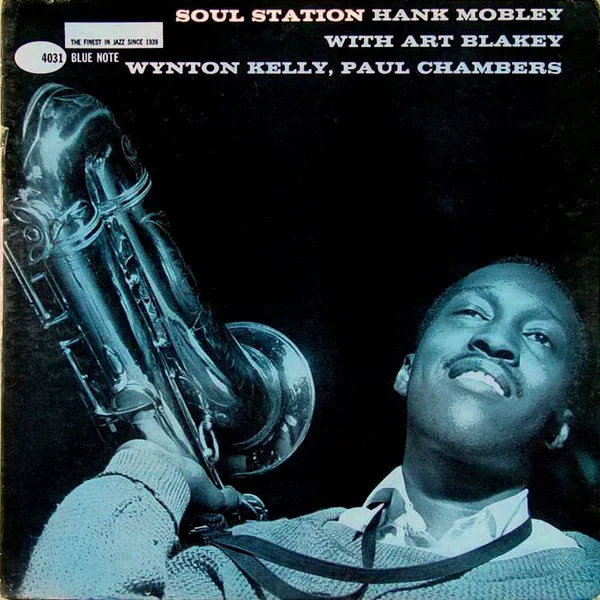
Hank Mobley on the cover of his 1960 Blue Note album *Soul Station* (BLP 4031), the record generally considered his finest Album cover art (not a CC-licensed artist photo). Used as the only available image showing the artist: no free photo of Hank Mobley exists on Wikimedia Commons under either his full name or bare surname, and the English Wikipedia infobox photo is a non-free/fair-use file, not CC-licensed — Discogs release page for Soul Station (Blue Note BLP 4031) - https://www.discogs.com/release/1249135
Henry "Hank" Mobley was born July 7, 1930, in Eastman, Georgia, and raised in Elizabeth, New Jersey, near Newark, in a musical family; he began on piano as a child. At sixteen an illness kept him housebound for several months, and his grandmother bought him a saxophone to occupy the time. Turned away from a Newark music school because he wasn't a resident, he taught himself theory and harmony from books she bought him while teaching himself tenor saxophone at the same time.
He started playing with local bands at nineteen, and within months was working with musicians including Dizzy Gillespie and Max Roach. Roach brought him into the New York jazz scene in 1951, and over the next two years Mobley began composing and recording his own tunes, working through several R&B bands and filling in for two weeks in 1953 with the Duke Ellington Orchestra while saxophonist Jimmy Hamilton recovered from dental surgery. Charlie Parker, on hearing him play, advised him to lean harder into the blues. In April 1953, Roach hired him for The Max Roach Quartet Featuring Hank Mobley (Debut Records DLP-13); Mobley later appeared on two more Roach-led sessions for EmArcy in 1957 and 1958. Around the same period he began working regularly with drummer Art Blakey, and together with pianist Horace Silver, bassist Doug Watkins, and trumpeter Kenny Dorham took part in one of the earliest hard bop recording sessions, released as Horace Silver and the Jazz Messengers (1956, Blue Note). That same Messengers rhythm section backed Mobley on his own 1955 Blue Note debut as a leader, Hank Mobley Quartet.
He recorded steadily through the second half of the 1950s for Blue Note, appearing alongside Lee Morgan, Donald Byrd, Art Farmer, Kenny Dorham, Jackie McLean, Pepper Adams, and pianists Sonny Clark, Bobby Timmons, Herbie Hancock, and Wynton Kelly. He rejoined Blakey's Jazz Messengers in March 1959, recording At the Jazz Corner of the World and a studio session first released decades later as Just Coolin', before leaving that summer; Wayne Shorter took his chair. The 1960s brought his most celebrated work as a leader: Soul Station (1960), generally considered his finest recording, and Roll Call (1960), both with Blakey on drums and the final records the two men made together. The Guardian later gave four of his Blue Note albums from this run, Peckin' Time, Soul Station, Roll Call, and Workout, five stars apiece.
In 1961, while Miles Davis was searching for a permanent replacement for John Coltrane, Mobley spent a brief stint in his band, appearing on Someday My Prince Will Come (on two tracks, playing alongside Coltrane himself), the live In Person: Live at the Blackhawk, and At Carnegie Hall. That year he also cut Workout and Another Workout with a rhythm section of Wynton Kelly, Paul Chambers, and Philly Joe Jones, all Davis band alumni; Another Workout wasn't released until 1985. No Room for Squares (1964) paired him again with Donald Byrd and Lee Morgan, and Dippin' (1965) teamed him with Morgan and pianist Harold Mabern. While serving a prison sentence for narcotics possession in 1964, Mobley wrote the material later recorded as A Slice of the Top, cut in 1966 but not released until 1979. A Caddy for Daddy, Hi Voltage, and The Flip, recorded across the mid-to-late 1960s, drew consistent critical praise, and Reach Out! (1968), featuring guitarist George Benson, was one of his rare accommodations of a more contemporary sound.
A longtime smoker, Mobley was forced into retirement in the mid-1970s by lung problems, and struggled afterward with homelessness and staying in touch with fellow musicians. His last engagements came at the Angry Squire in New York in November 1985 and January 1986, in a quartet with pianist Duke Jordan and guest singer Lodi Carr. He died of pneumonia on May 30, 1986, in Philadelphia, at fifty-five, having also been diagnosed with lung cancer.
Eli Degibri built his entire 2018 album Soul Station as a direct tribute to Mobley's own 1960 record of the same name, a measure of how far Mobley's influence reached into later generations of tenor players who never worked alongside him directly.
Critic Leonard Feather called Mobley the "middleweight champion of the tenor saxophone," a description aimed at a tone that was neither as aggressive as Coltrane's nor as mellow as Lester Young's, and a playing style that stayed laid-back, subtle, and melodic even next to contemporaries like Coltrane and Sonny Rollins. Jazz radio host Bob Perkins later described that sound as "round, throaty, and distinctive." Around the time of his stint with Miles Davis, JazzTimes noted Mobley "retooled his sound" toward a harder edge, a shift some critics trace through his mid-1960s Blue Note run. Critic Stacia Proefrock called him "one of the most underrated musicians of the bop era," and The Guardian's five-star treatment of his four "classic" Blue Note albums praised his "infinite subtlety" and skill as "an ingenious composer." That combination of melodic restraint and compositional craft, played out across dozens of sessions with the era's defining rhythm sections, is what later drew a saxophonist as far removed in time and place as Eli Degibri to build an entire tribute record around Mobley's own Soul Station.
- Soul Station (1960, Blue Note) - Widely regarded as Mobley's finest record, with Art Blakey, Wynton Kelly, and Paul Chambers; the record Eli Degibri later built a full tribute album around. Apple Music - Soul Station Listen
- Roll Call (1960, Blue Note) - The last studio date Mobley and Art Blakey made together, with Wynton Kelly, Paul Chambers, and Freddie Hubbard. Apple Music - Roll Call Listen
- Workout (1961, Blue Note) - A rhythm section of Wynton Kelly, Paul Chambers, and Philly Joe Jones, all recent Miles Davis sidemen, plus guitarist Grant Green. Apple Music - Workout Listen
- Someday My Prince Will Come (1961, Miles Davis, Columbia) - As a sideman: Mobley's brief tenure in the Davis band, heard on two tracks alongside John Coltrane. Apple Music - Someday My Prince Will Come
- No Room for Squares (1964, Blue Note) - With Donald Byrd and Lee Morgan on trumpets; DownBeat praised its "quiet authority."
- The Turnaround (1965, Blue Note) - A two-session record split between Donald Byrd/Barry Harris and Freddie Hubbard/Herbie Hancock rhythm sections.
- Dippin' (1965, Blue Note) - Cut in a single day with Lee Morgan and pianist Harold Mabern.
Hank Mobley: Full Discography
Identity confirmed via the live Discogs API: artist ID 135872 ("Hank Mobley," Henry Mobley, born July 7, 1930 in Eastman, Georgia, died May 30, 1986 in Philadelphia, matching Wikipedia's biography exactly). Discogs lists more than 1,200 credited entries against this artist ID once reissues, compilations, and box sets are included, and Wikipedia's own account puts his leader catalog at "more than two dozen albums... from 1955 to 1972." Itemizing the full catalog is impractical; the table below curates his 16 most significant leader dates plus a representative set of major sideman credits, matching the approach this site takes for other hugely prolific bandleaders.
As Leader / Co-Leader
| Album Title | Recording Date(s) | Release Date | Label | Catalog Number | Format(s) | Personnel | Role | Reissue History | Spotify | Buy | Notes |
|---|---|---|---|---|---|---|---|---|---|---|---|
| Hank Mobley Quartet | Not specified in Discogs data | 1955 | Blue Note | BLP 5066 | Vinyl, LP, 10", Album, Mono | Hank Mobley (tenor saxophone), Horace Silver (piano), Doug Watkins (bass), Art Blakey (drums) | Leader | None found on Discogs | — | — | His recorded debut as a leader, using the Jazz Messengers' own rhythm section |
| Hank Mobley And His All Stars | Not specified in Discogs data | 1957 | Blue Note | BLP 1544 | Vinyl, LP, Album, Mono | Hank Mobley (tenor saxophone), Horace Silver (piano), Doug Watkins (bass), Art Blakey (drums), Milt Jackson (vibraphone) | Leader | None found on Discogs | — | — | Same working rhythm section as the 1955 debut, with Milt Jackson added on vibes |
| Hank Mobley | Not specified in Discogs data | 1957 | Blue Note | BLP 1568 | Vinyl, LP, Album, Mono | Hank Mobley (tenor saxophone), Curtis Porter [Sahib Shihab] (alto/tenor saxophone), Bill Hardman (trumpet), Sonny Clark (piano), Paul Chambers (bass), Art Taylor (drums) | Leader | None found on Discogs | — | — | Self-titled 1957 date, sometimes referenced by catalog number as "1568" |
| Peckin' Time | Not specified in Discogs data | 1959 (recorded 1958) | Blue Note | BLP 1574 | Vinyl, LP, Album, Mono | Hank Mobley (tenor saxophone), Lee Morgan (trumpet), Wynton Kelly (piano), Paul Chambers (bass), Charlie Persip (drums) | Leader | None found on Discogs | — | — | One of the four Blue Note albums The Guardian later rated five stars as a set |
| Soul Station | Not specified in Discogs data | 1960 | Blue Note | BLP 4031 | Vinyl, LP, Album, Mono | Hank Mobley (tenor saxophone), Wynton Kelly (piano), Paul Chambers (bass), Art Blakey (drums) | Leader | None found on Discogs | Apple Music - Soul Station | — | Generally considered Mobley's finest recording; the album Eli Degibri's 2018 record pays direct tribute to |
| Roll Call | Not specified in Discogs data | 1961 (recorded 1960) | Blue Note | BLP 4058 | Vinyl, LP, Album, Mono | Hank Mobley (tenor saxophone), Freddie Hubbard (trumpet), Wynton Kelly (piano), Paul Chambers (bass), Art Blakey (drums) | Leader | None found on Discogs | Apple Music - Roll Call | — | The last studio date Mobley and Art Blakey made together |
| Workout | Not specified in Discogs data | 1962 (recorded 1961) | Blue Note | BLP 4080 | Vinyl, LP, Album, Mono | Hank Mobley (tenor saxophone), Grant Green (guitar), Wynton Kelly (piano), Paul Chambers (bass), "Philly" Joe Jones (drums) | Leader | None found on Discogs | Apple Music - Workout | — | Rhythm section of Kelly, Chambers, and Jones were all recent Miles Davis sidemen |
| Another Workout | Recorded 1961 | 1985 | Blue Note | BST 84431 | Vinyl, LP, Album, Remastered | Hank Mobley (tenor saxophone), Wynton Kelly (piano), Paul Chambers (bass), "Philly" Joe Jones (drums) | Leader | First released 1985, 24 years after recording; producer Michael Cuscuna called the delay "incomprehensible" | — | — | Same session pool as Workout, minus Grant Green |
| No Room For Squares | Not specified in Discogs data | 1964 (recorded 1963) | Blue Note | BLP 4149 | Vinyl, LP, Album, Mono | Hank Mobley (tenor saxophone), Donald Byrd, Lee Morgan (trumpet), Andrew Hill, Herbie Hancock (piano), Butch Warren, John Ore (bass), "Philly" Joe Jones (drums) | Leader | None found on Discogs | — | — | DownBeat praised Mobley's "quiet authority" on this session |
| The Turnaround | Not specified in Discogs data | 1965 | Blue Note | BLP 4186 | Vinyl, LP, Album, Mono | Hank Mobley (tenor saxophone), Donald Byrd, Freddie Hubbard (trumpet), Barry Harris, Herbie Hancock (piano), Butch Warren, Paul Chambers (bass), Billy Higgins, "Philly" Joe Jones (drums) | Leader | None found on Discogs | — | — | Combines personnel from two separate sessions, per the Discogs credit block |
| Dippin' | Not specified in Discogs data | 1966 | Blue Note | BLP 4209 | Vinyl, LP, Album, Mono | Hank Mobley (tenor saxophone), Lee Morgan (trumpet), Harold Mabern (piano), Larry Ridley (bass), Billy Higgins (drums) | Leader | None found on Discogs | — | — | Recorded in a single day |
| A Caddy For Daddy | Not specified in Discogs data | 1966 (recorded 1965) | Blue Note | BLP 4230 | Vinyl, LP, Album, Mono | Hank Mobley (tenor saxophone), Lee Morgan (trumpet), Curtis Fuller (trombone), McCoy Tyner (piano), Bob Cranshaw (bass), Billy Higgins (drums) | Leader | None found on Discogs | — | — | One of three mid-1960s albums (with Hi Voltage and The Flip) singled out by Wikipedia as critically acclaimed |
| A Slice Of The Top | Recorded 1966 | 1979 | Blue Note | LT-995 | Vinyl, LP, Album, Stereo | Hank Mobley (tenor saxophone, composer), Lee Morgan (trumpet), James Spaulding (alto saxophone), Kiane Zawadi (euphonium), Howard Johnson (tuba), McCoy Tyner (piano), Bob Cranshaw (bass), Billy Higgins (drums); arranged by Duke Pearson | Leader | Recorded 1966, not released until 1979, 13 years later | — | — | Mobley wrote the material while serving a 1964 prison sentence for narcotics possession |
| Hi Voltage | Not specified in Discogs data | 1967 | Blue Note | BST 84273 | Vinyl, LP, Album, Stereo | Hank Mobley (tenor saxophone, composer), Blue Mitchell (trumpet), Jackie McLean (alto saxophone), John Hicks (piano), Bob Cranshaw (bass), Billy Higgins (drums) | Leader | None found on Discogs | — | — | |
| Reach Out! | Not specified in Discogs data | 1968 | Blue Note | BST 84288 | Vinyl, LP, Album | Hank Mobley (tenor saxophone), Woody Shaw (trumpet, flugelhorn), George Benson (guitar), LaMont Johnson (piano), Bob Cranshaw (bass), Billy Higgins (drums) | Leader | None found on Discogs | — | — | One of Mobley's few sessions to accommodate a more contemporary, guitar-forward sound |
| The Flip | Recorded 1969 | 1970 | Blue Note | BST 84329 | Vinyl, LP, Album, Stereo | Hank Mobley (tenor saxophone, composer), Dizzy Reece (trumpet), Slide Hampton (trombone), Vince Benedetti (piano), Alby Cullaz (bass), "Philly" Joe Jones (drums) | Leader | None found on Discogs | — | — | Recorded in Europe; one of his final Blue Note leader dates before his 1970s retirement |
As Sideman (selected major credits)
| Year | Project (Leader) | Title | Label | Catalog | Role | Notes |
|---|---|---|---|---|---|---|
| 1953 | Max Roach | The Max Roach Quartet Featuring Hank Mobley | Debut Records | DLP-13 | Tenor Saxophone | Mobley's first issued recording as a credited sideman; extraartists block confirmed on Discogs (release resolved from master 306773) |
| 1956 | Horace Silver | Horace Silver And The Jazz Messengers | Blue Note | BLP 1518 | Tenor Saxophone | One of the earliest hard bop sessions, with Doug Watkins and Kenny Dorham; extraartists block confirmed via Discogs |
| 1957 | Johnny Griffin | A Blowing Session | Blue Note | BLP 1559 | Tenor Saxophone | A three-tenor summit with John Coltrane and Johnny Griffin, plus Lee Morgan, Wynton Kelly, Paul Chambers, and Art Blakey; extraartists block confirmed via Discogs, no track-level restriction present on any credit |
| 1961 | Miles Davis | Someday My Prince Will Come | Columbia | CL 1656 | Tenor Saxophone (2 of 6 tracks, alongside John Coltrane) | Discogs' release-level credit block lists Mobley, Coltrane, Jimmy Cobb, Paul Chambers, and Wynton Kelly all as "Featuring," each with an empty tracks field, and no other credit on the release carries a track restriction either, so the exact 2-track split cannot be confirmed at the Discogs data level; the 2-tracks-alongside-Coltrane figure is Wikipedia's own account of the record, not a Discogs-derived count |
| 1961 | Miles Davis | In Person: Live at the Blackhawk | Columbia | (not resolved to a specific release in this pass) | Tenor Saxophone | Per Wikipedia; not independently re-verified against a specific Discogs release ID in this pass |
| 1961 | Miles Davis / Gil Evans | At Carnegie Hall | Columbia | (not resolved to a specific release in this pass) | Tenor Saxophone | Per Wikipedia; not independently re-verified against a specific Discogs release ID in this pass |
Spotify's catalogue could not be searched for Mobley in this pass; no Spotify links are asserted anywhere in this file. Apple Music links (via the keyless iTunes Lookup API) are given instead wherever a specific matching release was confirmed.
- Art Blakey - drummer on Mobley's earliest Blue Note dates and across the Jazz Messengers years; also the drummer on Soul Station and Roll Call, his final studio recordings with Mobley.
- Horace Silver and Doug Watkins - the Jazz Messengers' original rhythm section, which backed Mobley's 1955 leader debut Hank Mobley Quartet and his 1957 sessions Hank Mobley And His All Stars and Peckin' Time.
- Max Roach - introduced Mobley to the New York scene in 1951 and hired him for The Max Roach Quartet Featuring Hank Mobley (1953), Mobley's first issued recording as a credited sideman.
- Miles Davis - brief 1961 stint in his working band while Davis searched for a permanent replacement for John Coltrane; documented on Someday My Prince Will Come, In Person: Live at the Blackhawk, and At Carnegie Hall.
- Wynton Kelly, Paul Chambers, and Philly Joe Jones - the rhythm section, all Davis band alumni, on Workout and Another Workout (both 1961).
- Lee Morgan - Mobley's most frequent recording partner through the 1960s, appearing on each other's albums and on Johnny Griffin's A Blowing Session (1957) alongside Coltrane.
- Wikipedia: Hank Mobley
- Wikipedia: Soul Station
- Discogs: Hank Mobley (artist 135872)
- Full discography independently verified against the live Discogs API; see
discography-full.mdin this folder for the complete release-by-release breakdown