 JAZZPROFILES lives in the music 2,303 Jazz Artists fully Profiled!
Gene Krupa
Last updated November 6, 2026
Listen on Spotify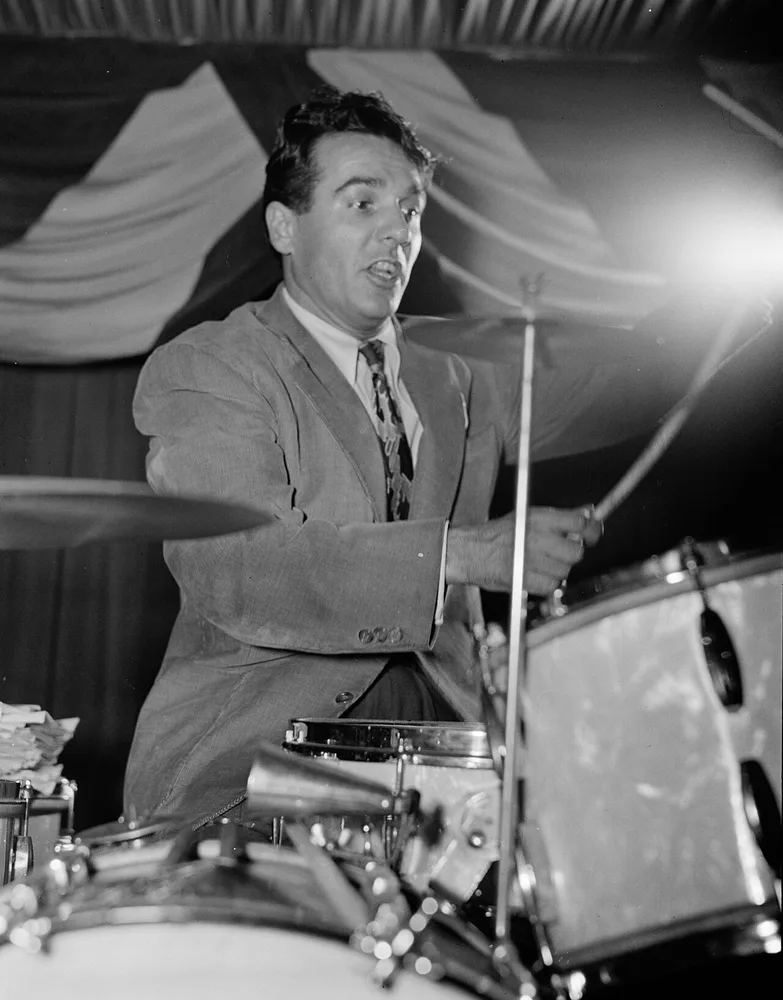
Gene Krupa at the 400 Restaurant, New York, ca. June 1946, photographed by William P. Gottlieb Public Domain (William P. Gottlieb collection, released by the photographer; Library of Congress: no known copyright restrictions) — Wikimedia Commons — https://commons.wikimedia.org/wiki/File:Gene_Krupa_crop.jpg

Eugene Bertram Krupa was born in Chicago on January 15, 1909, the youngest of nine children of a Polish immigrant father and a mother of Polish descent born in Shamokin, Pennsylvania. His Roman Catholic parents steered him toward the priesthood. After his father's death he worked from age eleven as an errand boy for a music company and chose a drum set because it was the cheapest instrument in the wholesale catalog. He graduated from James H. Bowen High School on Chicago's southeast side and spent a year at Saint Joseph's College before deciding the priesthood was not his calling. He studied with Sanford A. Moeller and Roy Knapp, learned from the Chicago drummers Baby Dodds and Zutty Singleton, and began playing professionally in the mid-1920s with bands in Wisconsin. In 1927 the booking agency MCA placed him with Thelma Terry and Her Playboys, a Chicago house band at the Golden Pumpkin nightclub that toured the eastern and central United States; he recorded six sides with the group in 1928.
Krupa's first recordings came in December 1927, when he played on four sides ("Sugar," "China Boy," "Nobody's Sweetheart," and "Liza") by McKenzie and Condon's Chicagoans, a band sponsored by the singer and comb player Red McKenzie and led by the banjoist Eddie Condon. Its front line came out of the circle around the Austin High School Gang: cornetist Jimmy McPartland, clarinetist Frank Teschemacher, and tenor saxophonist Bud Freeman, with pianist Joe Sullivan and bassist Jim Lanigan. The date is counted among the founding documents of Chicago-style jazz, and Krupa's bass drum on it is often cited as one of the first used on a jazz record; Britannica calls him the first drummer to record with a full kit. Through the early 1930s he worked with several bands, including Red Nichols's, played in the pit orchestras for two George Gershwin musicals on Broadway, and took part in McKenzie's November 14, 1929, session with Coleman Hawkins and in a 1934 all-star studio date with Mildred Bailey. By 1934 he was the most sought-after drummer in the business, and the producer John Hammond persuaded him to join Benny Goodman's new band.
Krupa joined Goodman in December 1934. When the band's first stock arrangements fell flat at the Palomar Ballroom in Los Angeles on August 21, 1935, Krupa urged Goodman to switch to the hotter charts by Fletcher Henderson and Spud Murphy, and the crowd's response is often taken as the start of the swing era. Goodman and Krupa also played in a trio with Teddy Wilson, which became the Benny Goodman Quartet when Lionel Hampton joined in 1936. On July 6, 1937, the full band recorded Jimmy Mundy's arrangement of Louis Prima's "Sing, Sing, Sing" in Hollywood; at 8 minutes 43 seconds across both sides of a 12-inch disc, it made Krupa's tom-tom drive the center of a hit record and gave listeners one of the first extended drum solos on a commercial release. The singer Helen Ward remembered that it grew on the bandstand one night when Krupa simply would not stop drumming at the end of the third chorus. Krupa was a fixture of the Goodman band's January 16, 1938, concert at Carnegie Hall, and then, less than two months later, left after clashes with Goodman, who thought his showmanship overshadowed the music.
He formed his own orchestra in 1938, at first in the Goodman mold. In 1941 it changed character. "Drum Boogie," which Krupa wrote with the trumpeter Roy Eldridge, was first recorded on January 17, 1941, in Chicago and was filmed in extended form for Ball of Fire that year, with Martha Tilton singing for Barbara Stanwyck. Eldridge joined in April 1941, one of the first Black musicians to become a permanent member of a white big band, and the singer Anita O'Day replaced Irene Daye that spring. Together they made "Let Me Off Uptown," a top-ten hit in 1941, as well as "Georgia on My Mind," "Just a Little Bit South of North Carolina," and Eldridge's showcase on "Rockin' Chair," arranged by Benny Carter. Krupa's loyalty to Eldridge made news: a Black newspaper reported in January 1942 that he had been fined after a fistfight with a Pennsylvania restaurant manager who would not seat Eldridge with the band. In 1943 Krupa was arrested on a marijuana charge that Wikipedia and other accounts describe as falsified, and he served a jail term of about three months; the orchestra broke up. He rejoined Goodman for a few months, declined Goodman's West Coast tour, and played for several months with Tommy Dorsey's band before re-forming his own in 1944.
The new band added strings and a modern vocabulary, and under arrangers George Williams and Gerry Mulligan, who joined as staff arranger in January 1946, it scored with "Leave Us Leap," "Disc Jockey Jump," and "Lemon Drop." O'Day returned in 1945 for "Chickery Chick" and "Boogie Blues." As the big-band era faded Krupa cut the group to ten pieces in 1951 and from 1952 led trios and quartets, often with the tenor saxophonist Charlie Ventura and later Eddie Shu. He toured regularly with Norman Granz's Jazz at the Philharmonic, where the staged drum battles with Buddy Rich became a signature event; the pair's September 1952 duel at Carnegie Hall was issued by Verve as The Drum Battle, and they made two studio albums together, Krupa and Rich (recorded November 1, 1955) and Burnin' Beat (January 1962). In 1954 he and Cozy Cole started a drum school whose students included Peter Criss and Jerry Nolan, and he played often at the Metropole near Times Square in Manhattan. He appeared on screen in The Glenn Miller Story and The Benny Goodman Story, and Sal Mineo played him in the 1959 biopic The Gene Krupa Story, for which Krupa recorded the drumming and Anita O'Day made a cameo appearance.
Ill health curtailed his work in the 1960s and early 1970s, though he made Together Again! (1963) with the original Benny Goodman Quartet and led a quartet with Charlie Ventura for Verve in 1964. On April 17, 1973, his quartet of Eddie Shu, John Bunch, and Nabil Totah recorded a live set at the New School in New York. Krupa passed away in Yonkers, New York, on October 16, 1973, at age 64, of heart failure; he also had leukemia and emphysema. He is buried at Holy Cross Cemetery in Calumet City, Illinois. In 1978 he became the first drummer inducted into the Modern Drummer Hall of Fame, and the 1937 Goodman recording of "Sing, Sing, Sing" entered the Grammy Hall of Fame in 1982.
Krupa made the drummer a front-line figure. Before him the drums were largely an accompanist's tool; his tom-tom features, extended solos, and flamboyant stage manner gave the instrument a public face, and Modern Drummer magazine calls him the founding father of modern drumset playing. His own models included Baby Dodds, Zutty Singleton, Tubby Hall, Dave Tough, George Wettling, Ray Bauduc, and Chick Webb, and his early playing used press rolls before his Goodman-era work settled on driving tom-tom figures. In partnership with the Slingerland drum company, for which he was the first endorser, he pushed for tom-toms with tunable top and bottom heads, and his work with the Zildjian company helped shape the modern hi-hat and the standard names and uses of the ride, crash, and splash cymbals. The New York Times called him a revolutionary on his death. Buddy Rich, who named him as one of his biggest influences, said that before Krupa the drums were just a part of the band, and later rock drummers including John Bonham, Keith Moon, Ian Paice, and Carl Palmer have credited his example. Drummers profiled on JazzProfiles.com who name him as an early model include Jeff Hamilton, who was drawn to the drums by a Krupa record at age five, Chuck Redd, who heard Krupa and Rich as a boy, Steve Gadd, whose uncle's Krupa and Louie Bellson records led him on to Philly Joe Jones, Tito Puente, and the Japanese drummers George Kawaguchi and Takeshi Inomata, the latter of whom recorded a Krupa-style big band album, Drummer Man, in 1975.
- "Sugar," "China Boy," "Nobody's Sweetheart," and "Liza" (1927, OKeh) - Krupa's first recordings, made in Chicago in December 1927 with McKenzie and Condon's Chicagoans, an early benchmark of Chicago-style jazz.
- "Sing, Sing, Sing (With a Swing)" (1937, Victor) - Benny Goodman's orchestra with Krupa's tom-tom drive at its center, recorded on July 6, 1937, and a Grammy Hall of Fame entry. Spotify - Sing, Sing, Sing Listen
- The Famous 1938 Carnegie Hall Jazz Concert (Benny Goodman, 1950, Columbia) - The live recording of the January 16, 1938, concert, with Krupa on drums in the band's most famous performance.
- "Let Me Off Uptown" (1941, OKeh) - Krupa's biggest hit, a vocal duet for Anita O'Day and Roy Eldridge over the orchestra.
- "Drum Boogie" (1941, OKeh) - The Krupa and Eldridge showpiece first recorded on January 17, 1941, built around Krupa's drum solo.
- The Drum Battle (1960, Verve) - Krupa and Buddy Rich with an all-star Jazz at the Philharmonic group, recorded at Carnegie Hall in September 1952.
- Krupa and Rich (1956, Clef) - Recorded November 1, 1955, with an Oscar Peterson rhythm section and Roy Eldridge, Dizzy Gillespie, Illinois Jacquet, and Flip Phillips; the two drummers play together only on "Bernie's Tune."
- Burnin' Beat (1962, Verve) - The sequel to Krupa and Rich, recorded in New York on January 18 and 19, 1962, with the two drummers backed by pianist John Bunch and a small group of horns.
Gene Krupa: Full Discography
Discogs artist ID 258689 ("Gene Krupa," real name Eugene Bertram Krupa, born January 15, 1909, in Chicago, Illinois, died October 16, 1973, in Yonkers, New York) lists more than 2,200 entries, nearly all of them reissues, compilations, and appearances on other leaders' records. Much of his leader work is also filed under separate Discogs entities for his orchestras and small groups, among them "Gene Krupa And His Orchestra" (artist ID 317887), "Gene Krupa Trio" (430823), "The Gene Krupa Quartet" (2183670), "Gene Krupa Jazz Trio" (262142), "The Gene Krupa Sextet" (2189930), and "Gene Krupa/Charlie Ventura Trio" (2738802); these were reviewed along with the main entry. Because the catalog is large and heavily reissued, the leader table is a curated selection of 21 releases rather than an exhaustive list: the orchestra albums of the 1940s, the trio and small-group dates for Norman Granz, the Verve albums of the 1950s and 1960s, and the two-drummer albums with Buddy Rich and Louis Bellson. The sideman table is a short selection of his landmark work with other leaders. Catalog numbers are those of the first or best-documented US pressing found on Discogs; where Discogs and Wikipedia differ on a year or label, the Notes column says so. The full list is on Discogs.
As Leader / Co-Leader
| Album Title | Recording Date(s) | Release Date | Label | Catalog Number | Format(s) | Personnel | Role | Reissue History | Spotify | Buy | Notes |
|---|---|---|---|---|---|---|---|---|---|---|---|
| Gene Krupa and His Orchestra | Not specified in the sources consulted | 1947 | Columbia | C-138 | Shellac, 10", 78 RPM, Album | Gene Krupa (drums) and his orchestra; personnel varies by track and is not itemized | Leader | Later reissued in other forms; see Discogs master 470059 | — | — | A set of eight earlier orchestra sides, among them "Let Me Off Uptown," "Drum Boogie," "Boogie Blues," and "Leave Us Leap." |
| Gene Krupa Plays "Fats" Waller for Dancing | Not specified in the sources consulted | May 1950 | RCA Victor | WP 281 | 7", 45 RPM, Album, Box Set | Gene Krupa and His Orchestra (personnel not itemized) | Leader | See Discogs master 1079321 | — | — | Six Waller tunes, among them "Honeysuckle Rose" and "Ain't Misbehavin'," in a "Designed for Dancing" box set. |
| At Jazz at the Philharmonic | 1952, Jazz at the Philharmonic concerts in New York and Los Angeles | 1952 | Mercury | MG C-500 | Vinyl, LP | Gene Krupa (drums), Teddy Napoleon (piano), Charlie Ventura (tenor saxophone) | Leader (Gene Krupa Trio) | See Discogs master 899567 | — | — | Live trio set including "Stompin' at the Savoy," "Body and Soul," and "Idaho." |
| The Gene Krupa Trio Collates | Not specified in the sources consulted | 1953 | Mercury | MGC-121 | Vinyl, 10", LP, Album | Gene Krupa (drums), Teddy Napoleon (piano), Charlie Ventura (saxophone) | Leader (Gene Krupa Trio) | See Discogs master 699395 | — | — | Six trio tracks supervised by Norman Granz, including "Perdido" and "Stardust." |
| The Exciting Gene Krupa | Not specified in the sources consulted | 1953 | Clef | MG C-687 | Vinyl, LP, Album | Gene Krupa (drums) with a small group; personnel not itemized | Leader | See Discogs master 419989 | — | — | Includes "Coronation Hop," "Jungle Drums," and "Swedish Schnapps." |
| The Rocking Mr. Krupa | Not specified in the sources consulted | 1954 | Clef | MG C-627 | Vinyl, LP | Gene Krupa (drums), Eddie Shu (clarinet, trumpet), Teddy Napoleon (piano) | Leader | Issued later under other titles; see Discogs master 1126609 | — | — | Includes a version of "Sing, Sing, Sing" and "Harmonica Shu Boogie." |
| Playing Some of the Selections They Played in the Benny Goodman Movie | July 31, 1955, Los Angeles | May 1956 | Clef | MG C-681 | Vinyl, LP, Album, Mono | Gene Krupa (drums), Lionel Hampton (vibraphone), Teddy Wilson (piano), Red Callender (bass) | Co-leader (billed with Lionel Hampton and Teddy Wilson) | See Discogs master 346858 | — | — | Reunion of three members of the Benny Goodman Quartet; also issued under the billing Krupa, Hampton, Wilson. |
| Krupa and Rich | November 1, 1955, Los Angeles | May 1956 | Clef | MG C-684 | Vinyl, LP, Album, Mono | Gene Krupa (drums), Buddy Rich (drums), Oscar Peterson (piano), Ray Brown (bass), Herb Ellis (guitar), Roy Eldridge (trumpet), Dizzy Gillespie (trumpet), Illinois Jacquet (tenor saxophone), Flip Phillips (tenor saxophone) | Co-leader (billed with Buddy Rich) | Reissued on Verve (MGV 8069) and on CD in 1994 with two bonus tracks; see Discogs master 157252 | — | — | The two drummers play together only on "Bernie's Tune"; each leads two other tracks. |
| Drummer Man: Gene Krupa in Highest-Fi | Not specified in the sources consulted | 1956 | Verve | MG V-2008 | Vinyl, LP, Album, Mono | Gene Krupa (drums), Anita O'Day (vocals), Roy Eldridge (trumpet), Eddie Shu (tenor saxophone), J. J. Johnson and Kai Winding (trombones), Dave McKenna (piano), Barry Galbraith (guitar), John Drew (bass) | Leader | See Discogs master 199947 | — | — | New recordings of his 1940s hits, including "Let Me Off Uptown," "Rockin' Chair," "Drum Boogie," and "Boogie Blues." |
| Krupa Rocks | Not specified in the sources consulted | 1957 | Verve | MG V-8276 | Vinyl, LP, Album, Mono | Gene Krupa (drums), Teddy Napoleon (piano), Gale Curtis (saxophone), Mort Herbert (bass) | Leader | See Discogs master 840401 | — | — | Small-group date with liner notes by Nat Hentoff. |
| Gene Krupa Plays Gerry Mulligan Arrangements | Not specified in the sources consulted | 1958 | Verve | MG V-8292 | Vinyl, LP, Album, Mono | Gene Krupa (drums) and orchestra; arrangements by Gerry Mulligan | Leader | See Discogs master 419988 | — | — | Includes "Disc Jockey Jump," "Bird House," and "Mulligan Stew"; Wikipedia dates the album 1959. |
| Hey... Here's Gene Krupa! | Not specified in the sources consulted | 1959 | Verve | MG V-8300 | Vinyl, LP, Album, Mono | Gene Krupa (drums), Eddie Shu (tenor saxophone, clarinet, trumpet), Dave McKenna (piano), Wendell Marshall (bass) | Leader (Gene Krupa Quartet) | See Discogs master 2932984 | — | — | Quartet date including "Chelsea Bridge," "Jumpin' at the Woodside," and "China Boy." |
| Big Noise from Winnetka: Gene Krupa at the London House | Live at the London House, Chicago; date not specified | 1959 | Verve | MG V-8310 | Vinyl, LP, Album, Mono | Gene Krupa (drums), Ed Wasserman (tenor saxophone, clarinet, flute), Ronnie Ball (piano), James Gannon (bass) | Leader | See Discogs master 492987 | — | — | Club recording of the quartet. |
| The Gene Krupa Story | Not specified in the sources consulted | 1959 | Verve | MG V-15010 | Vinyl, LP, Mono | Gene Krupa (drums) with Anita O'Day (vocals) and Red Nichols | Leader (film soundtrack) | See Discogs master 632612 | — | — | Soundtrack of the 1959 biopic, on which Krupa played the drumming for Sal Mineo. |
| The Drum Battle: Gene Krupa and Buddy Rich at JATP | September 1952, Carnegie Hall, New York | 1960 | Verve | MG V-8369 | Vinyl, LP, Album | Gene Krupa (drums), Buddy Rich (drums), Roy Eldridge and Charlie Shavers (trumpets), Benny Carter (alto saxophone), Flip Phillips and Lester Young (tenor saxophones), Hank Jones and Oscar Peterson (piano), Barney Kessel (guitar), Ray Brown (bass), Ella Fitzgerald (vocals) | Co-leader (billed with Buddy Rich) | Reissued as The Original Drum Battle; see Discogs master 167175 | — | — | Live Jazz at the Philharmonic concert produced by Norman Granz, issued eight years after it was recorded. |
| Percussion King | June 5, 12, and 16, 1961, New York | 1961 | Verve | V6-8414 | Vinyl, LP, Album, Stereo | Gene Krupa (percussion) with a studio orchestra including Hank Jones (piano), Milt Hinton (bass), Urbie Green (trombone), Doc Severinsen (trumpet); arrangements by George Williams | Leader | See Discogs master 525371 | — | — | Orchestral showpieces such as "Sabre Dance" and "Ritual Fire Dance" arranged around drums and percussion; produced by Creed Taylor. |
| Classics in Percussion! | Not specified in the sources consulted | 1962 | Verve | V-8450 (mono), V6-8450 (stereo) | Vinyl, LP, Album | Gene Krupa (drums); personnel not itemized in the sources consulted | Leader | Several pressings are listed on Discogs | — | — | Follow-up to Percussion King. |
| Burnin' Beat | January 18 and 19, 1962, New York | 1962 | Verve | V6-8471 | Vinyl, LP, Album, Stereo | Gene Krupa (drums), Buddy Rich (drums), John Bunch (piano), Danny Bank (flute), Don Goldie, Al Stewart, Nick Travis, and Joe Wilder (trumpets) | Co-leader (billed with Buddy Rich) | See Discogs master 324665 | — | — | Sequel to Krupa and Rich; produced by Creed Taylor. |
| The Mighty Two | Not specified in the sources consulted | 1963 | Roulette | SR 52098 | Vinyl, LP, Album, Stereo | Gene Krupa (drums), Louis Bellson (drums); compositions and arrangements by Fred Thompson | Co-leader (billed with Louis Bellson) | See Discogs master 362002 | — | — | Two-drummer album built on drum rudiments, produced by Teddy Reig. |
| The Great New Gene Krupa Quartet Featuring Charlie Ventura | Not specified in the sources consulted | 1964 | Verve | V6-8584 | Vinyl, LP, Album, Stereo | Gene Krupa (drums), Charlie Ventura (tenor saxophone), John Bunch (piano), Nabil Totah (bass) | Leader (Gene Krupa Quartet) | See Discogs master 738636 | — | — | Includes "Tickle-Toe," "Take the 'A' Train," and "Flying Home"; produced by Creed Taylor. |
| Jazz at the New School | Not specified in the sources consulted | 1972 | Chiaroscuro | CR 110 | Vinyl, LP, Album | Gene Krupa (drums), Eddie Condon (guitar), Wild Bill Davison (cornet), Kenny Davern (clarinet), Dick Wellstood (piano) | Featured (billed with Eddie Condon, Wild Bill Davison, Kenny Davern, and Dick Wellstood) | See Discogs master 740734 | — | — | Chicago-style standards including "Sugar," "Avalon," and "That Da Da Strain." |
As Sideman (selected major credits)
A short selection of his most important work with other leaders, covering his first Chicago recordings and the Goodman years; the many reissues and compilations of those sessions are listed on Discogs.
| Year | Project (Leader) | Title | Label | Catalog | Role | Notes |
|---|---|---|---|---|---|---|
| 1927 | McKenzie and Condon's Chicagoans (Red McKenzie, Eddie Condon) | "Sugar" / "China Boy"; "Nobody's Sweetheart" / "Liza" | OKeh | 41011 for "Sugar" / "China Boy"; the second single's number was not confirmed | Drums | Four sides recorded in Chicago in December 1927 with Jimmy McPartland, Frank Teschemacher, Bud Freeman, Joe Sullivan, and Jim Lanigan; Krupa's first recordings. |
| 1935-1939 | Benny Goodman Trio and Quartet | The Complete RCA Victor Small Group Recordings (compiled 1997) | RCA Victor | Not confirmed | Drums | Trio and quartet sides with Benny Goodman, Teddy Wilson, and, from 1936, Lionel Hampton. |
| 1937 | Benny Goodman and His Orchestra | "Sing, Sing, Sing (With a Swing)" | Victor | 36205 | Drums | Recorded July 6, 1937, in Hollywood; Jimmy Mundy arrangement of Louis Prima's song, 8 minutes 43 seconds across two sides. |
| 1938 | Benny Goodman and His Orchestra | The Famous 1938 Carnegie Hall Jazz Concert | Columbia Masterworks | SL-160 | Drums | Concert of January 16, 1938; the LP appeared in December 1950. |
| 1961 | Eddie Condon, Bud Freeman, Bob Haggart, Jimmy McPartland, Pee Wee Russell, Joe Sullivan, Jack Teagarden | Chicago and All That Jazz! | Verve | V6-8441 | Drums | Recorded October 30 and 31, 1961, in New York for a television special; a reunion of Chicago-style players. |
| 1964 | The Benny Goodman Quartet | Together Again! | RCA | LSP-2698 | Drums | Reunion of the original quartet (Benny Goodman, Teddy Wilson, Lionel Hampton, and Krupa) recorded in New York; Britannica dates the album 1963. |
- Benny Goodman - bandleader whose orchestra, trio, and quartet Krupa joined in December 1934 and left shortly after the January 1938 Carnegie Hall concert; he later returned briefly, and the two reunited with the original quartet on Together Again! (1963).
- Teddy Wilson and Lionel Hampton - pianist and vibraphonist who made the Benny Goodman Trio and Quartet recordings with Krupa from 1935 and 1936, and later recorded with him under Krupa's name.
- Anita O'Day - the orchestra's vocalist from 1941 and again from 1945, featured on "Let Me Off Uptown," "Chickery Chick," and "Boogie Blues," and a cameo performer in The Gene Krupa Story.
- Roy Eldridge - trumpeter who joined the orchestra in April 1941, co-wrote "Drum Boogie," and was featured on "Rockin' Chair" and "Let Me Off Uptown"; he later appeared with Krupa on the 1952 Carnegie Hall drum-battle recording and on Krupa and Rich.
- Buddy Rich - drum-battle rival and partner at Jazz at the Philharmonic and on Krupa and Rich and Burnin' Beat.
- Tommy Dorsey - bandleader whose orchestra Krupa joined for several months after the 1943 breakup of his own band.
- Gerry Mulligan - staff arranger for the orchestra from January 1946, writing "Disc Jockey Jump" and other charts; Krupa later recorded an album of Mulligan arrangements.
- Harry James - trumpeter in the Goodman band on the 1937 "Sing, Sing, Sing" session.
- Louis Prima - composer of "Sing, Sing, Sing," the piece most identified with Krupa.
- Ella Fitzgerald - sang "Drum Boogie" with the orchestra on tour in 1942 and performed on the 1952 Jazz at the Philharmonic Carnegie Hall concert issued as The Drum Battle.
- Oscar Peterson, Ray Brown, and Herb Ellis - the rhythm section on Krupa and Rich (1955); Peterson and Brown also played on the Carnegie Hall drum-battle recording.
- Dizzy Gillespie - trumpeter on Krupa and Rich (1955).
- Hank Jones and Lester Young - pianist and tenor saxophonist among the Jazz at the Philharmonic players on the 1952 Carnegie Hall drum-battle recording.
- Eddie Condon, Jimmy McPartland, Bud Freeman, Frank Teschemacher, Joe Sullivan, Jim Lanigan, and Red McKenzie - the 1927 Chicagoans session; Condon, McPartland, Freeman, and Sullivan joined Krupa again for the reunion album Chicago and All That Jazz (Verve), and Condon for Jazz at the New School (1972).
- Charlie Ventura, Eddie Shu, Teddy Napoleon, John Bunch, and Nabil Totah - saxophonists and rhythm players in his trios and quartets from 1952 to 1973.
- Cozy Cole - drummer with whom he started a drum school in 1954 and played drum duets.
- Louis Bellson - drummer and partner on the two-drummer album The Mighty Two (1963, Roulette).
- Norman Granz - Jazz at the Philharmonic producer who brought Krupa and Rich together on tour and on record.
- Irene Daye, Martha Tilton, and Helen Ward - singers associated with the Goodman and Krupa years.
More Swing Artists
See all 217 Swing artists →More American Jazz Artists
See all 820 American artists →- Wikipedia: Gene Krupa
- Britannica: Gene Krupa
- Wikipedia: Sing, Sing, Sing (with a Swing)
- Wikipedia: Drum Boogie
- Wikipedia: Krupa and Rich
- Wikipedia: The Drum Battle
- Wikipedia: Burnin' Beat
- Wikipedia: The Gene Krupa Story
- Wikipedia: McKenzie and Condon's Chicagoans
- Wikipedia: Roy Eldridge
- Wikipedia: Benny Goodman
- Discogs: Gene Krupa (artist 258689)
- MusicBrainz: Gene Krupa
- JazzProfiles.com: Anita O'Day
- JazzProfiles.com: Benny Goodman
- JazzProfiles.com: Gerry Mulligan
- JazzProfiles.com: Mildred Bailey
- JazzProfiles.com: Tommy Dorsey