 JAZZPROFILES lives in the music 1,572 Jazz Artists fully Profiled!
 Aretha Franklin
Last updated September 5, 2026
Listen on Spotify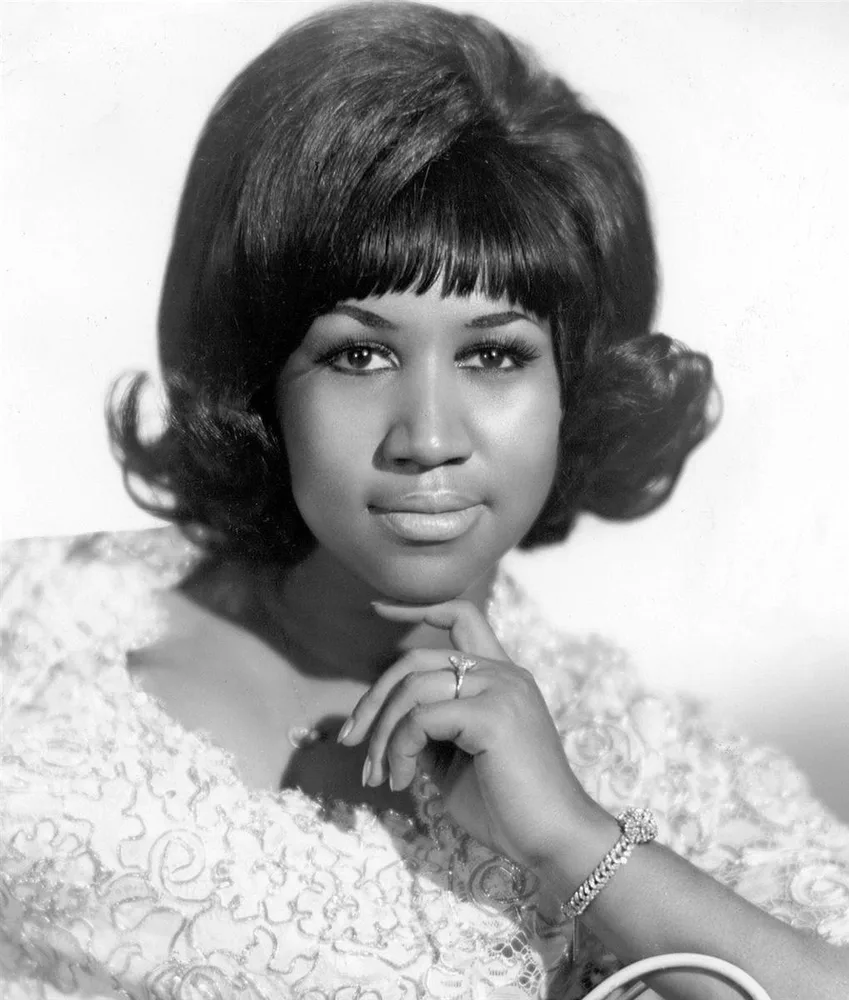
Aretha Franklin, publicity portrait, as pictured in Billboard, February 17, 1968. Public domain — Wikimedia Commons — https://commons.wikimedia.org/wiki/File:Aretha_Franklin_1968.jpg

Aretha Franklin was born March 25, 1942, in Memphis, Tennessee, and raised mostly in Detroit in a household built around music and the pulpit. Her father, Rev. C. L. Franklin, was one of the most famous Baptist preachers in the country — his recorded sermons for Joe Von Battle's label made him a national figure on the order of Sam Cooke or Mahalia Jackson, and gospel singing was the family's daily language. Franklin sang in his New Bethel Baptist Church choir as a child and toured briefly with his gospel caravan as a teenager. Family friend Sam Cooke's own move from gospel into pop stardom gave her a template for a secular career, and in 1960, at eighteen, she followed his path to New York.
Accounts differ slightly on exactly how she reached Columbia Records. In his own recollection, veteran producer John Hammond — the Columbia A&R legend already responsible for signing and shaping Billie Holiday and Count Basie, and who would later also sign Bob Dylan and Bruce Springsteen to the label — said he was brought a demo tape by songwriter Curtis Lewis; the third song on it, "Today I Sing the Blues," stopped him cold ("I screamed! I said for Chrissakes who is this?"), and he tracked her down to Detroit through her manager, Jo King. Wikipedia's own account of her debut album, sourced to Hammond's liner notes, confirms Lewis as the one who "recommended" her. Other biographical sources instead credit family friend and jazz bassist Major Holley — who had played with Oscar Peterson and Coleman Hawkins — with steering her toward Hammond and shaping the jazz-leaning material she brought in. The two stories aren't necessarily incompatible, but the better-documented one, straight from Hammond's own liner notes and later interviews, centers on Curtis Lewis's demo.
Whichever route got her there, Hammond signed her to Columbia in 1960 and produced her debut himself: Aretha, recorded between August 1960 and January 1961 and released February 27, 1961, teaming her with pianist Ray Bryant's combo. The backing band was serious jazz company — bassist Milt Hinton, drummer Osie Johnson, guitarist Skeeter Best, and Ellington trombonist Tyree Glenn all appear in the session credits. The album's sixth track, "Who Needs You?", was co-written by Billie Holiday (with Jeanne Burns) and appears to have gone unrecorded by Holiday herself; Franklin's version was its first recording. Hammond produced one more album, The Electrifying Aretha Franklin (1962), before handing the reins to staff producer/arranger Robert Mersey, whose The Tender, the Moving, the Swinging Aretha Franklin (1962) became her first Columbia album to chart at all, and whose Laughing on the Outside (1963) brought in West Coast session players Dave Grusin, Leon Russell, and Hal Blaine.
The high point of the Columbia years, by most later assessments, is Unforgettable: A Tribute to Dinah Washington (1964), cut within weeks of Washington's death and drawing on a small jazz combo — George Duvivier on bass, Gary Chester on drums, Teddy Charles on vibraphone, Ernie Royal on trumpet — with liner notes from jazz critic Leonard Feather. Later Columbia albums shifted production to Clyde Otis and arranger Belford Hendricks: Runnin' Out of Fools (1964), the live Yeah!!! In Person with Her Quartet (1965, recorded in New York with guitarist Kenny Burrell), and Soul Sister (1966), her final new Columbia album while still under contract. Columbia never found a consistent lane for her — the label mixed jazz, blues, gospel, and pop across nine studio albums and reportedly lost some $90,000 on her by 1966 — and when her contract lapsed she left for Atlantic, debuting there in January 1967. Columbia released one more LP built from Columbia-era session leftovers, Take It Like You Give It (April 1967), after "I Never Loved a Man the Way I Love You" had already made her a star elsewhere.
Franklin died August 16, 2018, in Detroit, of pancreatic cancer, at age 76. The consensus that Columbia "mismanaged" her talent has softened somewhat with reassessment of individual records like Unforgettable, but the broader jazz-industry infrastructure she passed through in these years — Hammond, Mersey, Feather, Burrell, Duvivier — remains a genuinely under-told chapter next to her Atlantic-era fame.
The material on Franklin's nine Columbia albums ranges across jazz standards, pop, blues, and gospel-inflected soul — Columbia's own uncertainty about how to market her is well documented — but the personnel around her sessions is unambiguously drawn from the jazz world: pianist Ray Bryant, bassists Milt Hinton and George Duvivier, drummer Osie Johnson, guitarists Skeeter Best and Kenny Burrell, vibraphonist Teddy Charles, and Ellington alumnus Tyree Glenn all appear in her Columbia-era session credits, and jazz critic Leonard Feather wrote the liner notes for her Dinah Washington tribute. John Hammond, the same A&R figure who shaped Billie Holiday's and Count Basie's recorded legacies, personally produced her first two albums. None of this makes Franklin's own singing "jazz" in any narrow sense — her instrument was gospel-trained and became the defining voice of soul within a few years of leaving Columbia — but the sidemen, producers, and repertoire she worked through from 1960 to 1967 place this period squarely inside the era's working jazz scene, not adjacent to it.
- Aretha (1961, Columbia) - Her Columbia debut with the Ray Bryant Combo, produced by John Hammond; backing musicians include bassist Milt Hinton, drummer Osie Johnson, and Ellington trombonist Tyree Glenn. Spotify - Aretha Listen
- "Who Needs You?" (1961, from Aretha) - Co-written by Billie Holiday (with Jeanne Burns); Franklin's recording appears to be the song's first, since Holiday herself does not appear to have recorded it. Spotify - Who Needs You? Listen
- Unforgettable: A Tribute to Dinah Washington (1964, Columbia) - Recorded within weeks of Washington's death with a small jazz combo (George Duvivier, bass; Teddy Charles, vibraphone; Ernie Royal, trumpet) and liner notes by jazz critic Leonard Feather; widely regarded as the strongest album of her Columbia tenure. Spotify - Unforgettable: A Tribute... Listen
- Yeah!!! In Person with Her Quartet (1965, Columbia) - Her only live album on Columbia, recorded in New York with jazz guitarist Kenny Burrell in her backing quartet — the closest thing in her catalog to a small-group jazz-club date. Spotify - Yeah!!! In Person...
Aretha Franklin: Discography (Jazz-Scoped Columbia Years, 1960-1967)
Identity confirmed via Discogs artist ID 38863 ("Aretha Franklin"). Per this project's scope, only her Columbia Records-era output (1960-1967, including the one LP released after her departure but drawn from Columbia-era sessions) is itemized here. Her pre-Columbia gospel recordings (e.g. the 1956 Songs of Faith, on Checker/JVB, not Columbia) and her entire Atlantic/soul catalog from 1967 onward are out of scope.
As Leader
| Album Title | Recording Date(s) | Release Date | Label | Catalog Number | Format(s) | Personnel | Role | Reissue History | Spotify | Buy | Notes |
|---|---|---|---|---|---|---|---|---|---|---|---|
| Aretha (also billed as Aretha: With The Ray Bryant Combo) | Aug 1, 1960 – Jan 10, 1961, Columbia Studios, NYC | 1961-02-27 | Columbia | CS 8412 (stereo) / CL 1612 (mono) | Vinyl, LP, Album, Stereo | Aretha Franklin (vocals, piano), Ray Bryant (piano), Milt Hinton / Bill Lee (bass), Belton Evans / Osie Johnson / Sticks Evans (drums), Chauncey Westbrook / Skeeter Best (guitar), Al Sears / Warren Luckey (tenor sax), Quentin Jackson / Tyree Glenn (trombone); arranged by Curtis Lewis, J. Leslie McFarland; produced by John Hammond | Leader | Reissued repeatedly 1989-2018 (Columbia US, CBS Europe, Columbia France, Blue Label Germany, Soul Jam UK, Hallmark UK, Oldays Japan, State Of Art Europe); a "20th-anniversary"-style Spotify Expanded Edition adds alternate takes and mono mixes | Spotify - Aretha | — | Debut single "Won't Be Long" reached #7 R&B. Track 6, "Who Needs You?", co-written by Billie Holiday and Jeanne Burns |
| The Electrifying Aretha Franklin | Jul 11, 1961 – Jan 25, 1962, Columbia Studios, NYC | 1962-03-19 | Columbia | CS 8561 | Vinyl, LP, Album, Stereo ("6-Eye" label) | Aretha Franklin (vocals, piano); produced by John Hammond; arranged by Richard Wess | Leader | 2013 RDM Edition (France, CD735); 2013 Hallmark Music & Entertainment (UK) | Spotify - The Electrifying Aretha... | — | Working title was The Incomparable Aretha Franklin; Hammond's second and last album with her as producer |
| The Tender, The Moving, The Swinging Aretha Franklin | Apr 27, May 4-5, May 11, 1962, Columbia Studio, NYC | 1962-08-13 | Columbia | CS 8676 | Vinyl, LP, Album, Stereo | Aretha Franklin (vocals, piano); produced, arranged, and conducted by Robert Mersey; Don Hunstein (cover photography) | Leader | 2011 Columbia (Europe); 2013 Hallmark Music & Entertainment (US, CD) | Spotify - The Tender, The... | — | Her first Columbia album to chart: #69 Billboard pop albums, 8 weeks on chart; no hit singles |
| Laughing On The Outside | Apr 17 & Jun 12-14, 1963, Columbia Studios, NYC and Hollywood | 1963-08-12 | Columbia | CS 8879 | Vinyl, LP, Album, Stereo (Terre Haute pressing) | Aretha Franklin (vocals); produced/arranged by Robert Mersey; session musicians include Dave Grusin and Leon Russell (piano), Hal Blaine (drums), Plas Johnson (sax) | Leader | None found | Spotify - Laughing On The... | — | Includes her own composition "I Wonder (Where Are You Tonight)" |
| Unforgettable: A Tribute To Dinah Washington | Feb 7-10, 1964, Columbia Studios, NYC/Hollywood | 1964-02-18 | Columbia | CL-2163 (mono) | Vinyl, LP, Album, Mono | Aretha Franklin (piano, backing vocals); produced/arranged/conducted by Robert Mersey; Buddy Lucas (alto sax, harmonica), George Duvivier (bass), Gary Chester (drums), Ernie Hayes / Paul Griffin (organ), Bob Ascher (trombone), Ernie Royal (trumpet), Teddy Charles (vibraphone); liner notes by Leonard Feather | Leader | 1995 Legacy (Austria); 1995 Columbia (South Africa, CDCOL 4009 H); 1995 Columbia CK 66201 (US); Brazil reissue (Columbia 2-066201) | Spotify - Unforgettable: A Tribute... | — | Recorded within weeks of Dinah Washington's death, Dec 1963; AllMusic rated it 4.5/5 — the most acclaimed album of her Columbia tenure |
| Runnin' Out Of Fools | Not specified in Discogs/Wikipedia data | 1964-11-16 | Columbia | CS 9081 | Vinyl, LP, Album, Stereo | Aretha Franklin (vocals); produced by Clyde Otis; arranged/conducted by Belford Hendricks; Dee Dee Warwick (uncredited backing vocals) | Leader | None found | Spotify - Runnin' Out Of... | — | Sixth studio album; covers include "Walk On By" and "My Guy"; marks the handoff from Robert Mersey to the Otis/Hendricks team |
| Yeah!!! (subtitled In Person With Her Quartet) | Recorded live, Feb 10, 1965, New York | 1965-05-17 | Columbia | CS 9151 | Vinyl, LP, Album, Stereo | Aretha Franklin (vocals); produced by Clyde Otis; Kenny Burrell (guitar), Teddy Harris (piano), James "Beans" Richardson (bass), Hindel Butts (drums) | Leader | 1989 CBS (Australia); 1994 Columbia (Europe); 2016 Sony Music/Columbia (Europe, remastered) | Spotify - Yeah!!! In Person... | — | Her only live Columbia album; the closest thing in her catalog to a small-group jazz-club date, anchored by jazz guitarist Kenny Burrell |
| Soul Sister | Not specified in Discogs/Wikipedia data | 1966-06-13 | Columbia | CS 9321 | Vinyl, LP, Album, Stereo (Terre Haute pressing) | Aretha Franklin (vocals); produced by Bob Johnston and Clyde Otis; arranged/conducted by Belford Hendricks and Robert Mersey | Leader | 2017 Oldays Records (Japan, CD, remastered) | Spotify - Soul Sister | — | Her final new-material Columbia album released while still under contract; Columbia did not renew her deal by the end of 1966 |
| Take It Like You Give It | Not specified — compiled from earlier Columbia-era sessions | 1967-04-04 | Columbia | CS 9429 | Vinyl, LP, Album, Stereo | Aretha Franklin (vocals); produced by Bob Johnston, Bobby Scott, Clyde Otis, and Robert Mersey | Leader | None found | Spotify - Take It Like... | — | Released two months after her Atlantic debut single "I Never Loved a Man the Way I Love You" had already broken; built from unreleased Columbia-era session material, closing out the Columbia contract |
Compilations excluded from the table above (not new studio recordings)
- Take a Look (September 5, 1967, Columbia, US; also released in Europe as Soul, Soul, Soul) — a compilation of previously recorded Columbia-era material assembled by producer Robert Mersey, released after Franklin had already moved to Atlantic; positioned in her discography between the Atlantic albums Aretha Arrives and Lady Soul, not a new studio session.
- Her broader catalog of Columbia-era greatest-hits and posthumous-to-the-relationship compilations (Aretha Franklin's Greatest Hits, Aretha Franklin's Hits, etc., mostly dated 1967 in Discogs) recombine tracks from the studio albums above and are not itemized separately.
Personnel notes
Producer John Hammond — the same Columbia A&R figure who shaped Billie Holiday's and Count Basie's recorded careers, and later signed both Bob Dylan and Bruce Springsteen to Columbia — personally produced Franklin's first two Columbia albums before handing off to staff producer/arranger Robert Mersey, who in turn gave way to the Clyde Otis/Belford Hendricks team for her final Columbia-era records. The sidemen who passed through these sessions — Ray Bryant, Milt Hinton, Osie Johnson, Skeeter Best, Tyree Glenn, George Duvivier, Teddy Charles, Kenny Burrell — are all significant names in their own right on the era's jazz scene.
- John Hammond - Columbia A&R legend who also shaped Billie Holiday's and Count Basie's careers; signed Franklin in 1960 and personally produced her first two albums, Aretha (1961) and The Electrifying Aretha Franklin (1962).
- Ray Bryant - jazz pianist who led the combo backing Franklin on her Columbia debut.
- Robert Mersey - staff producer/arranger for several mid-Columbia albums, including her first charting record, The Tender, the Moving, the Swinging Aretha Franklin (1962), and Unforgettable (1964).
- Clyde Otis and Belford Hendricks - producer/arranger team on her later Columbia albums, including Runnin' Out of Fools (1964), Yeah!!! (1965), and Soul Sister (1966).
- Kenny Burrell - jazz guitarist in her backing quartet on the live album Yeah!!! (1965).
- George Duvivier and Teddy Charles - jazz bassist and vibraphonist, respectively, on Unforgettable (1964).
- Leonard Feather - jazz critic who wrote the liner notes for Unforgettable (1964).
- Curtis Lewis - songwriter whose demo tape, by Hammond's own account, is what brought Franklin to his attention.
More Soul Jazz Artists
See all 123 Soul Jazz artists →More American Jazz Artists
See all 567 American artists →- Discogs: Aretha Franklin (artist 38863) — verified via Discogs API
- Discogs: Aretha, master 332730 / release 3989660 — personnel, catalog number, verified via Discogs API
- Discogs: The Electrifying Aretha Franklin, release 6922577 — verified via Discogs API
- Discogs: The Tender, The Moving, The Swinging Aretha Franklin, release 3002397 — verified via Discogs API
- Discogs: Laughing On The Outside, release 2545288 — verified via Discogs API
- Discogs: Unforgettable - A Tribute To Dinah Washington, release 3002339 — verified via Discogs API
- Discogs: Runnin' Out Of Fools, release 1998451 — verified via Discogs API
- Discogs: Yeah!!!, release 891836 — verified via Discogs API
- Discogs: Soul Sister, release 1751107 — verified via Discogs API
- Discogs: Take It Like You Give It, release 4140680 — verified via Discogs API
- Wikipedia: Aretha (1961 album)
- Wikipedia: The Electrifying Aretha Franklin
- Wikipedia: The Tender, the Moving, the Swinging Aretha Franklin
- Wikipedia: Laughing on the Outside
- Wikipedia: Unforgettable: A Tribute to Dinah Washington
- Wikipedia: Runnin' Out of Fools
- Wikipedia: Take It Like You Give It
- Wikipedia: Take a Look (Aretha Franklin album)
- Wikipedia: Who Needs You (Baby)
- Wikipedia: Aretha Franklin
- Best Classic Bands: John Hammond interview on signing Aretha Franklin and Bob Dylan
- Rolling Stone: How Aretha Franklin's Jazz Beginnings Predicted Her Genre-Transcending Career — cited for the Major Holley account; full text paywalled at research time, corroborated only via search-result summaries
- New World Encyclopedia: C. L. Franklin
- Spotify: Aretha Franklin artist page — verified via Spotify Web API
- Britannica: Aretha Franklin