 JAZZPROFILES lives in the music 1,002 Jazz Artists fully Profiled!
 Clark Terry
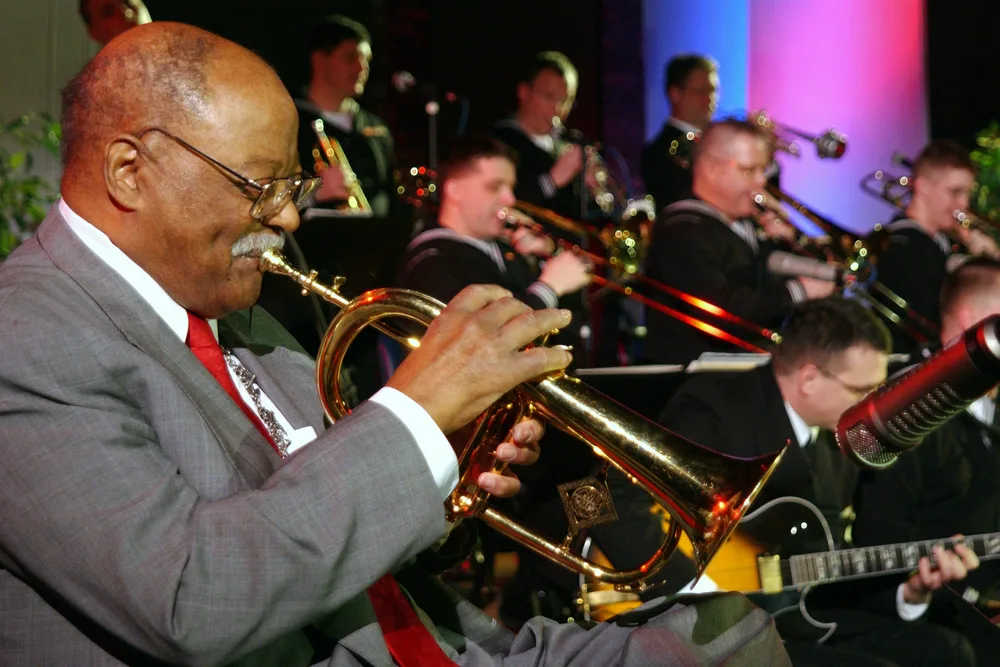
Clark Terry performing with the Great Lakes Navy Band Jazz Ensemble at the "Great Lakes Experience" concert honoring African American Navy musicians, Naval Station Great Lakes, Illinois, February 28, 2002. Public Domain (U.S. government work, U.S. Navy photo) — Wikimedia Commons, File:Clark Terry.jpg (originally published at navy.mil, photo by Photographer's Mate 1st Class Michael Worner) - https://commons.wikimedia.org/wiki/File:Clark_Terry.jpg

Clark Virgil Terry Jr. was born December 14, 1920, in St. Louis, Missouri, to Clark Virgil Terry Sr. and Mary Terry. He attended Vashon High School, took up the valve trombone before switching to trumpet, and broke into St. Louis's active club scene in the early 1940s, where he gave informal early guidance to a teenage neighborhood horn player named Miles Davis. During World War II, Terry served as a bandsman in the United States Navy, playing from 1941 to 1945 in the all-star Navy band based at Naval Station Great Lakes in Illinois, one of the first Black musicians to serve in a Navy band. After his discharge he joined bandleader Charlie Barnet's orchestra in 1947.
Terry's national reputation was built through consecutive stints inside two of the era's defining big bands. He played in the orchestra and small groups of Count Basie from 1948 to 1951, a period that included Basie's economically driven downsizing to an octet; a 1950 photograph from that stretch shows him alongside Charlie Rouse, Freddie Green, Buddy DeFranco, Jimmy Lewis, and Gus Johnson. It was also during frequent visits to Seattle with the Count Basie Sextet that Terry began mentoring a teenage Quincy Jones. In 1951, Duke Ellington, by Terry's own account in his autobiography, quietly recruited him away from Basie, and Terry remained with the Ellington Orchestra through 1959. He became one of its most valued soloists, featured across many of Ellington's extended suites, including 1957's Such Sweet Thunder, and increasingly specialized on flugelhorn, helping establish the horn as a serious modern-jazz voice years before it became common.
Terry left Ellington in 1959 to join Quincy Jones's touring orchestra for Harold Arlen's musical Free and Easy in Europe. When the production folded, he accepted a staff position with NBC in 1960, and in 1962 became a member of the Tonight Show Band, first under Skitch Henderson and later Doc Severinsen, remaining until 1972. He was the first African American musician to hold a permanent chair in a house band on a major U.S. television network, a role he later described as carrying constant pressure to be flawless: "We had to be models, because I knew we were in a test." It was during these NBC years that his "mumbling" scat-singing style, a good-humored satire of unintelligible old blues shouters, developed into a signature, eventually giving its name to his 1966 Mainstream album Mumbles.
Terry sustained a substantial leader career alongside his sideman and studio work. He debuted as a leader with Clark Terry (1955, EmArcy) and, across a run of Riverside albums, recorded Serenade to a Bus Seat and Duke With a Difference (both 1957), In Orbit (1958, co-starring Thelonious Monk), and Top and Bottom Brass (1959). He cut the septet date Color Changes for Candid in 1961, and at Impulse! recorded The Happy Horns of Clark Terry (1964) and the Chico O'Farrill-arranged Afro-Cuban date Spanish Rice (1966). In the early-to-mid 1960s he co-led a well-received quintet with valve trombonist Bob Brookmeyer, documented on The Power of Positive Swinging (1965) among other albums. He was known for two distinct technical feats: circular breathing, which let him sustain phrases without audibly pausing for air, and an ambidextrous "dialogue" technique in which he played trumpet and flugelhorn at once, one horn in each hand.
Terry remained a visible bandleader and educator through his later decades. He formed his own big band, billed as the Big B-A-D Band, around 1970, and recorded extensively for Norman Granz's Pablo label in the mid-to-late 1970s and into the 1980s, frequently paired with Oscar Peterson on albums including Oscar Peterson & Clark Terry (1975), Ain't Misbehavin' (1979), and Memories of Duke (1980). Education became his abiding cause: prompted early on by pianist Billy Taylor, he and bassist Milt Hinton bought instruments for aspiring young players, planting the seed that grew into Harlem's Jazzmobile program, and he went on to compose more than two hundred original tunes, publish instructional books on circular breathing and jazz trumpet technique, and mentor generations of musicians including Wynton Marsalis, Pat Metheny, Dianne Reeves, and Terri Lyne Carrington. He was named a National Endowment for the Arts Jazz Master in 1991 and received a Grammy Lifetime Achievement Award in 2010.
Terry kept performing and teaching into his 90s even as diabetes progressively cost him his eyesight and, eventually, both legs. His final years, including his mentorship of blind pianist Justin Kauflin, were the subject of the 2014 documentary Keep on Keepin' On. His memoir, Clark: The Autobiography of Clark Terry, appeared in 2011 with a preface by Quincy Jones. Clark Terry passed away on February 21, 2015, in Pine Bluff, Arkansas, at age 94, after an extended battle with diabetes.
Terry's playing was instantly identifiable: a bright, buoyant tone and an unfailingly good-humored sense of swing that made him equally comfortable inside a swing-era orchestra, a bebop small group, or a comedy bit built around his own "Mumbles" scat vocals. He was among the first jazz musicians to make the flugelhorn a primary solo voice rather than an occasional coloristic double, and his technical command, especially his circular breathing and simultaneous two-horn "dialogues," was without close precedent. Beyond his own recordings, his influence ran directly through the musicians he personally shaped: he gave Miles Davis informal early guidance in St. Louis and later mentored Quincy Jones as a teenager, and both men credited him throughout their careers. The Penguin Guide to Jazz Recordings noted that Terry appears on more of its listed recordings than any other artist, a reflection of a session career historians estimate at more than 900 recordings across roughly seven decades.
- Clark Terry (1955, EmArcy) - His debut as a leader, a quintet/sextet date featuring Oscar Pettiford, Horace Silver, and Art Blakey, with two originals contributed by a young Quincy Jones.
- Serenade to a Bus Seat (1957, Riverside) - A hard-swinging quintet date with Johnny Griffin and Wynton Kelly. Spotify - Serenade To A Bus Seat Listen
- In Orbit (1958, Riverside) - A quartet co-starring Thelonious Monk on piano, one of only a handful of studio dates Monk made as a sideman under another leader's name. Spotify - In Orbit Listen
- Color Changes (1961, Candid) - A septet showcase with Yusef Lateef, Jimmy Knepper, and Julius Watkins, arranged in part by Terry himself. Spotify - Color Changes Listen
- The Happy Horns of Clark Terry (1964, Impulse!) - A quintet date with Phil Woods and Ben Webster, recorded by Rudy Van Gelder. Spotify - The Happy Horns Of Clark Terry Listen
- Spanish Rice (1966, Impulse!) - An Afro-Cuban big-band date arranged by Chico O'Farrill, with a four-trumpet frontline. Spotify - Spanish Rice Listen
- Such Sweet Thunder (1957, Columbia) - As a sideman: Duke Ellington and Billy Strayhorn's Shakespeare-inspired suite, with Terry a featured soloist throughout the Ellington Orchestra's brass section. Spotify - Such Sweet Thunder (Expanded Edition)
- Oscar Peterson & Clark Terry (1975, Pablo) - A duo/quartet session with Oscar Peterson, Ray Brown, and Ed Thigpen, produced by Norman Granz. Spotify - Oscar Peterson & Clark Terry Listen
Clark Terry: Full Discography
Identity confirmed via the live Discogs API: artist ID 217242 ("Clark Terry," realname Clark Virgil Terry Jr., born/died dates matching Wikipedia and AllMusic exactly). Discogs credits Terry on more than 2,100 releases across every role from bandleader to guest soloist, spanning 1954 to well after his 2015 death in reissues and compilations, a footprint consistent with historians' widely cited estimate of more than 900 individual recording sessions. The table below curates his most significant leader/co-leader releases plus a representative set of his most historically important sideman associations; it does not attempt to itemize his full sideman log, since a catalog of this size does not admit exhaustive listing.
Every master ID used below was resolved through its main_release and checked against the requested title before any row was written; all resolved to the correct album.
As Leader / Co-Leader
| Album Title | Recording Date(s) | Release Date | Label | Catalog Number | Format(s) | Personnel | Role | Reissue History | Spotify | Buy | Notes |
|---|---|---|---|---|---|---|---|---|---|---|---|
| Clark Terry | Not specified in Discogs data | 1955 | EmArcy | MG 36007 | Vinyl, LP, Album, Mono | Clark Terry (trumpet), Jimmy Cleveland (trombone), Cecil Payne (baritone sax), Horace Silver (piano), Wendell Marshall (bass), Oscar Pettiford (cello), Art Blakey (drums) | Leader | None found | — | — | His debut as a leader; includes two originals ("Swahili," "Double Play") composed by a 22-year-old Quincy Jones |
| Serenade to a Bus Seat | Not specified in Discogs data | 1957 | Riverside Records | RLP 12-237 | Vinyl, LP, Album, Mono | Clark Terry (trumpet), Johnny Griffin (tenor sax), Wynton Kelly (piano), Paul Chambers (bass), "Philly" Joe Jones (drums) | Leader | None found | Spotify - Serenade To A Bus Seat | — | |
| Duke With a Difference | Not specified in Discogs data | 1958 | Riverside Records | RLP 12-246 | Vinyl, LP, Mono | Clark Terry (trumpet, arranger, most tracks), Johnny Hodges (alto sax), Paul Gonsalves (tenor sax), Britt Woodman / Quentin Jackson (trombone), Billy Strayhorn (piano, 2 tracks), Mercer Ellington (arranger, 2 tracks), Jimmy Woode (bass), Sam Woodyard (drums) | Leader | None found | Spotify - Duke With A Difference | — | Ellington Orchestra sidemen playing Ellington repertoire under Terry's own leadership |
| Out On A Limb | Not specified in Discogs data | 1957 | Argo | LP-620 | Vinyl, LP, Album, Mono | Clark Terry (trumpet), Mike Simpson (tenor sax, flute), Willie Jones (piano), Remo Biondi (guitar), Jimmy Woode (bass), Sam Woodyard (drums) | Leader | None found | — | — | Not found on Spotify by direct search; no link asserted |
| In Orbit | Not specified in Discogs data | 1958 | Riverside Records | RLP 12-271 | Vinyl, LP, Album, Mono | Clark Terry (flugelhorn), Thelonious Monk (piano), Sam Jones (bass), "Philly" Joe Jones (drums) | Leader (Clark Terry Quartet) | None found | Spotify - In Orbit (Reissue) | — | One of only a handful of studio dates Thelonious Monk made as a sideman under another leader's name |
| Top and Bottom Brass | Not specified in Discogs data | 1959 | Riverside Records | RLP 1137 | Vinyl, LP, Album, Stereo | Clark Terry (trumpet, flugelhorn), Don Butterfield (tuba), Jimmy Jones (piano), Sam Jones (bass), Art Taylor (drums) | Leader (Clark Terry Quintet with Don Butterfield) | None found | Spotify - Top And Bottom Brass | — | |
| Color Changes | Not specified in Discogs data | 1961-10 | Candid | CJS 9009 | Vinyl, LP, Album, Stereo | Clark Terry (trumpet, flugelhorn, leader), Yusef Lateef (tenor sax, flute, oboe, English horn), Seldon Powell (tenor sax, flute), Julius Watkins (French horn), Jimmy Knepper (trombone), Tommy Flanagan (piano), Joe Benjamin (bass), Ed Shaughnessy (drums) | Leader | None found | Spotify - Color Changes (Remastered) | — | Arrangements by Al Cohn, Budd Johnson, and Terry himself |
| Oscar Peterson Trio + One | Not specified in Discogs data | 1964 | Mercury | SR 60975 | Vinyl, LP, Album, Stereo | Oscar Peterson (piano), Clark Terry (trumpet, flugelhorn), Ray Brown (bass), Ed Thigpen (drums) | Co-leader (billed "Oscar Peterson Trio + One") | None found | Spotify - Oscar Peterson Trio + One, Clark Terry | — | |
| The Happy Horns of Clark Terry | Not specified in Discogs data | 1964 | Impulse! | AS-64 | Vinyl, LP, Album, Stereo, Gatefold | Clark Terry (trumpet, flugelhorn), Phil Woods (alto sax, clarinet), Ben Webster (tenor sax), Roger Kellaway (piano), Milt Hinton (double bass), Walter Perkins (drums) | Leader | None found | Spotify - The Happy Horns Of Clark Terry | — | Engineered by Rudy Van Gelder |
| The Power of Positive Swinging | Not specified in Discogs data | 1965 | Mainstream Records | S/6054 | Vinyl, LP | Clark Terry (trumpet, flugelhorn), Bob Brookmeyer (trombone), Roger Kellaway (piano), Bill Crow (bass), Dave Bailey (drums) | Co-leader (Clark Terry / Bob Brookmeyer Quintet) | None found | Spotify - The Power Of Positive Swinging | — | |
| Mumbles | Not specified in Discogs data | 1966 | Mainstream Records | 56066 | Vinyl, LP, Album, Mono | Clark Terry (trumpet, flugelhorn, vocals), Jerome Richardson (reeds), Frank Anderson (piano, organ), Eric Gale / Vinnie Bell (guitar), George Duvivier / Richard Davis (bass), Grady Tate (drums), Willie Bobo (congas), Jose Mangual (bongos) | Leader | None found | — | — | Not found on Spotify by direct search; no link asserted. Title track's scat-vocal novelty became Terry's signature and a minor hit |
| Spanish Rice | Not specified in Discogs data | 1966-10 | Impulse! | AS 9127 | Vinyl, LP, Album, Stereo | Clark Terry, Ernie Royal, Joe Newman, Snooky Young (trumpets), George Duvivier (bass), Barry Galbraith / Everett Barksdale (guitar), Bobby Rosengarden, Chano Pozo, Frankie Malabe, Julio Cruz (percussion) | Leader | None found | Spotify - Spanish Rice | — | Afro-Cuban big-band date arranged by Chico O'Farrill |
| Oscar Peterson & Clark Terry | Not specified in Discogs data | 1975 | Pablo Records | 2310-742 | Vinyl, LP, Album, Stereo | Clark Terry (trumpet), Oscar Peterson (piano) | Co-leader | Checked across the German, UK, Canadian, and Japanese pressings via the release's master; all carry the same duo credit, so this is a genuine duo record rather than a thin credit block | Spotify - Oscar Peterson & Clark Terry | — | Produced by Norman Granz |
| Ain't Misbehavin' | Not specified in Discogs data | 1979 | Pablo Today | 2312-105 | Vinyl, LP, Album, Stereo | Clark Terry (trumpet, flugelhorn, vocals), Johnny Hartman (vocals, 1 track), Oscar Peterson (piano), Chris Woods (alto sax, flute), Victor Sproles (bass), Billy Hart (drums) | Leader | None found | — | — | Not found on Spotify by direct search; no link asserted. An all-Fats-Waller songbook set, produced by Norman Granz |
| Memories of Duke | Not specified in Discogs data | 1980 | Pablo Today | 2312-118 | Vinyl, LP | Clark Terry (trumpet), Joe Pass (guitar), Jack Wilson (piano), Ray Brown (bass), Frank Severino (drums) | Leader (The Clark Terry Five) | None found | — | — | Not found on Spotify by direct search; no link asserted. All-Ellington repertoire tribute |
As Sideman (selected major credits)
| Year | Project (Leader) | Title | Label | Catalog | Role | Notes |
|---|---|---|---|---|---|---|
| 1950-51 | Count Basie Octet | Count Basie Vol. VI: 1946, 1950/1951 "The Orchestra And The Octet" | CBS (1986 compilation) | 88675 | Trumpet | A retrospective compilation gathering, among other sessions, Basie's 1950-51 small-group dates from the period when he had disbanded his full orchestra for economic reasons; a period photo printed on this release places Terry in the octet alongside Charlie Rouse, Freddie Green, Buddy DeFranco, Jimmy Lewis, and Gus Johnson |
| 1956 | Duke Ellington And His Orchestra | Ellington at Newport | Columbia | CL 934 | Trumpet | Discogs's own release entry for this album carries no itemized personnel credit; the full Ellington Orchestra lineup for the recording, including Terry, is documented in standard Ellington discographies and Wikipedia rather than in Discogs's data for this release |
| 1957 | Duke Ellington And His Orchestra | Such Sweet Thunder | Columbia | CL 1033 | Trumpet | A twelve-part suite inspired by Shakespeare, composed and arranged by Ellington and Billy Strayhorn; Terry is a featured soloist |
| 1959 | Quincy Jones | The Birth of a Band! | Mercury | MG 20444 | Trumpet | Big-band session arranged almost entirely by a young Quincy Jones, with liner notes contributed by Count Basie |
Terry's Discogs sideman log also documents further work across the same decades with Oscar Peterson (Jousts, 1975; the 1980 Trumpet Summit sessions), J.J. Johnson, Dizzy Gillespie, Gerry Mulligan, Johnny Hodges, Milt Jackson, Charles Mingus, Sonny Rollins, Sonny Stitt, Cal Tjader, McCoy Tyner, and Dinah Washington, among dozens of others, not itemized exhaustively here.
- Duke Ellington - orchestra member, 1951-1959; a featured soloist across many of Ellington's suites, including Such Sweet Thunder (1957).
- Count Basie - orchestra and small-group sideman, 1948-1951, immediately before Ellington recruited Terry away.
- Quincy Jones - mentored Jones as a teenager during Terry's Count Basie Sextet visits to Seattle in the late 1940s; the two stayed close for decades, with Jones leading the touring orchestra Terry joined for Free and Easy in 1959-1960 and later writing the preface to Terry's 2011 autobiography.
- Bob Brookmeyer - co-led a working quintet through the early-to-mid 1960s, documented on The Power of Positive Swinging (1965) and other Mainstream albums.
- Oscar Peterson - recurring recording partner from 1964's Oscar Peterson Trio + One through the 1975 duo album Oscar Peterson & Clark Terry, plus decades of joint touring with Jazz at the Philharmonic.
- Thelonious Monk - co-starred on Terry's own 1958 leader date In Orbit.
- Miles Davis - informally mentored Davis as a teenager in St. Louis in the early 1940s; Davis later cited Terry as a formative early influence.
- Justin Kauflin - late-career mentee, a blind piano prodigy whose bond with Terry was the subject of the 2014 documentary Keep on Keepin' On.