 JAZZPROFILES lives in the music 2,303 Jazz Artists fully Profiled!
Charlie Christian
Last updated November 7, 2026
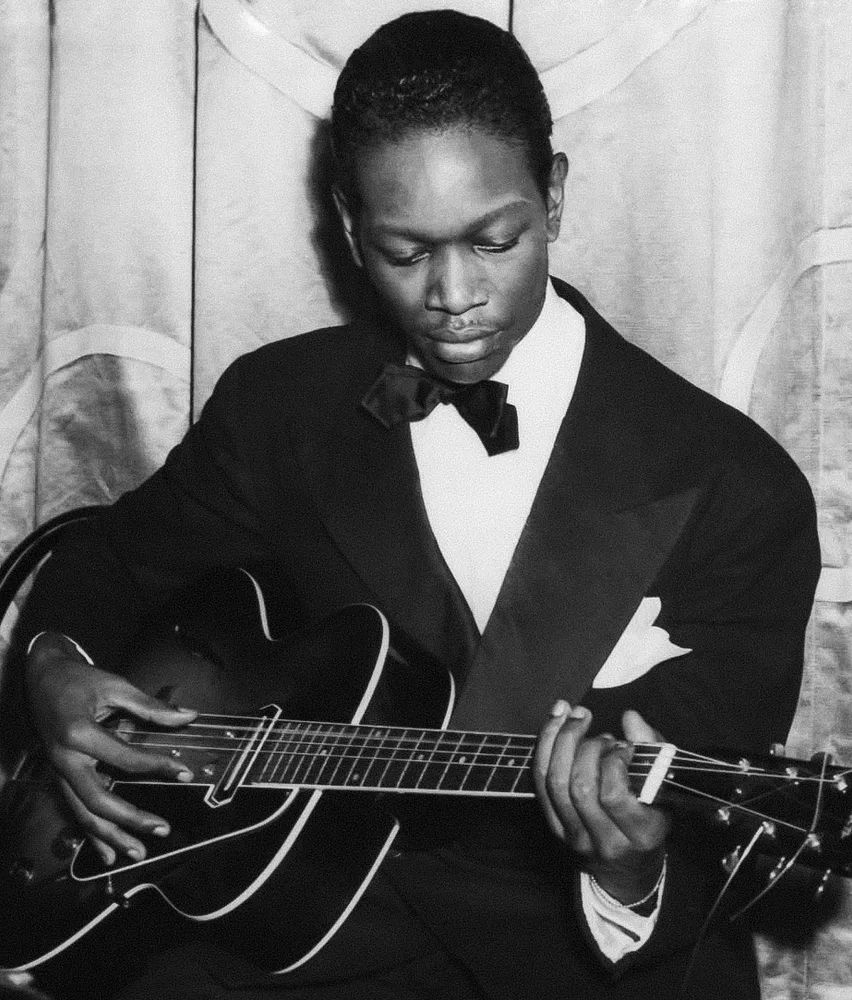
Charlie Christian playing a Gibson ES-150 guitar at the Waldorf Astoria, New York, October 1939, as published in DownBeat magazine on December 1, 1939 (photographed by Charles B. Nadell) Public Domain (published in the United States in 1939; the magazine's 1939 copyrights were not renewed, so the work entered the public domain; Wikimedia Commons tag PD-US-not renewed) — Wikimedia Commons — https://commons.wikimedia.org/wiki/File:Charlie_Christian_(1939-10_Waldorf-Astoria_portrait).jpg

Charles Henry Christian was born on July 29, 1916, in Bonham, Texas, and grew up in Oklahoma City, where the family moved when he was a small child. His parents were musicians, and his father, Clarence Henry Christian, who had been blinded by a fever, taught music to his sons Edward (born 1906), Clarence (born 1911), and Charlie. The family earned money as street buskers, with the boys leading their father into the better neighborhoods to play for cash or goods; Charlie first entertained by dancing, then learned guitar, and he inherited his father's instruments when his father died, when he was 12. At Frederick A. Douglass High School he wanted to play tenor saxophone in the band, but the music teacher Zelia N. Breaux put him on trumpet instead. He quit the instrument, worried that it would damage his lip, and turned to baseball, at which he excelled.
Around 1931 the trumpeter James Simpson had the guitarist Ralph "Bigfoot" Hamilton quietly teach the teenager to solo on "Rose Room," "Tea for Two," and "Sweet Georgia Brown." Hamilton then brought him to an after-hours jam session in Oklahoma City's Deep Deuce district, where his older brother Edward, a pianist and bandleader, was working, and the boy's command of the tunes surprised his brother. Christian soon played locally and on the road across the Midwest, as far afield as North Dakota and Minnesota, and by 1936 he was using an electric guitar and was a regional attraction. According to the record producer John Hammond, he jammed with touring stars who came through Oklahoma City, among them pianist Teddy Wilson, pianist Art Tatum, and Mary Lou Williams, then the pianist with Andy Kirk and His Clouds of Joy.
In 1939 Christian auditioned for Hammond, who recommended him to the bandleader Benny Goodman. Accounts of the first meeting differ, but the story of his first night in the band is consistent: at the Victor Hugo restaurant in Los Angeles, Goodman called "Rose Room," assuming the newcomer would not know it, and Christian took twenty choruses and was hired. His pay went from about $2.50 a night to $150 a week. He joined the newly formed Goodman Sextet in September 1939, alongside vibraphonist Lionel Hampton, pianist Fletcher Henderson, bassist Artie Bernstein, and drummer Nick Fatool. The sextet's first Columbia session was held in New York on October 2, 1939, and produced "Flying Home" and "Rose Room"; on November 22, 1939, it recorded "Seven Come Eleven," a tune credited jointly to Goodman and Christian. By February 1940 he dominated the guitar polls and had been elected to the Metronome All-Stars, and on February 7, 1940, he took part in the second Metronome All-Stars recording session at Columbia Studios alongside drummer Gene Krupa and other poll winners. The sextet also recorded that month with Count Basie at the piano. Goodman laid off most of his orchestra in spring 1940 but kept Christian, and that fall the sextet featured trumpeter Cootie Williams and tenor saxophonist Georgie Auld, with drummer Dave Tough joining later; the group dominated the 1941 polls. Christian also played with the full orchestra, notably on "Solo Flight," recorded on March 4, 1941, with a composer credit shared among Christian, arranger Jimmy Mundy, and Goodman. The record was released in early 1944 and reached number sixteen on the pop charts and number one on the Harlem Hit Parade. Though credited on few of them, he composed many of the sextet's original tunes; "Air Mail Special" is credited to Goodman, Mundy, and Christian.
The sextet was Christian's public life; Harlem after dark was his other one. Joining the late-night sessions at Minton's Playhouse, at 210 West 118th Street, he played among the musicians who were building bebop, including Dizzy Gillespie and Thelonious Monk, a regular in the club's house band. In 1941 Jerry Newman, a Columbia University student with a portable disc recorder, captured Christian at Minton's with trumpeter Joe Guy, pianist Kenny Kersey, and drummer Kenny Clarke, and at Clark Monroe's Uptown House with trumpeter Oran "Hot Lips" Page; tenor saxophonist Don Byas also appears on some of the material. Those discs have been issued under many titles, including After Hours and The Immortal Charlie Christian. Some people at Minton's credited him with the name "bebop," saying it came from phrases he hummed, and Clarke later said that "Epistrophy" and "Rhythm-a-Ning," credited to Monk, were actually Christian's, recalling that Christian first showed him the chords to "Epistrophy" on a ukulele.
Christian contracted tuberculosis in the late 1930s and was briefly hospitalized in early 1940, when Goodman's own back trouble left the band idle. He went home to Oklahoma City in late July 1940 and returned to New York in September, then kept up a punishing schedule in early 1941, working with Goodman and heading to Harlem for jam sessions afterward. In June 1941 he was admitted to Seaview Hospital, a tuberculosis sanatorium on Staten Island. He seemed to be improving, and DownBeat reported in February 1942 that he and Cootie Williams were planning a band, but after a visit from a musician friend later that month his condition worsened. He passed away of tuberculosis on March 2, 1942, at the age of 25, and was buried in an unmarked grave in Bonham. A Texas State Historical Commission marker and headstone were placed in Gates Hill Cemetery in 1994; in March 2013 Fannin County recognized that the marker stood in the wrong place and that, as his brother Clarence had said, he lies under a concrete slab.
He remained at the top of the guitar polls for up to two years after his death and was inducted into the DownBeat Jazz Hall of Fame in 1966, the Oklahoma Jazz Hall of Fame in its first class of 1989, and the Rock and Roll Hall of Fame in the Early Influence category in 1990. In 2006 Oklahoma City renamed a street in its Bricktown district Charlie Christian Avenue. He never recorded as a leader; everything he left was made as a sideman, in broadcasts and amateur recordings, or in the jam sessions that Newman and others happened to catch.
Christian is widely regarded as one of the most influential pioneers of jazz guitar. His solos are often described as horn-like: he said he wanted his guitar to sound like a tenor saxophone, and he drew more from horn players such as Lester Young and Herschel Evans than from guitarists like Eddie Lang or Lonnie Johnson. The French guitarist Django Reinhardt had little influence on him, though he knew some of Reinhardt's records. Electric guitar soloists had been recorded before 1939, among them Leonard Ware, Eddie Durham, and Floyd Smith, but Christian's single-string technique and early use of amplification moved the guitar out of the rhythm section and into the front line, and he is often credited with pioneering the lead-guitar role. The Minton's and Monroe's recordings show him taking many choruses on one tune and playing long stretches of melodic ideas, using tension and release in the manner of Lester Young and Count Basie. Ballads such as "Stardust," "Memories of You," and "On the Alamo" with the sextet, and "Profoundly Blue" with the Edmond Hall Celeste Quartet (1941), hint at what would later be called cool jazz. His influence on Dizzy Gillespie, Charlie Parker, Thelonious Monk, and Don Byas can be heard in their early bop records, and Miles Davis also cited him as an early influence. Among guitarists, Barney Kessel, Wes Montgomery, Tal Farlow, and Jim Hall each name him as a starting point, and his reach extended past jazz to T-Bone Walker, B.B. King, Chuck Berry, Carlos Santana, and Jimi Hendrix. John Hammond and the critic George T. Simon both called him the best improvising talent of the swing era. His guitars were Gibson models, first an ES-150 with its EH-150 amplifier and later custom ES-250 instruments; the bar pickup on the ES-150 and ES-250 became known as the "Charlie Christian pickup."
- "Flying Home" and "Rose Room" (1939, Columbia) - The first Columbia session by the Goodman Sextet with Christian, recorded October 2, 1939, with Benny Goodman, Lionel Hampton, and Fletcher Henderson.
- "Seven Come Eleven" (1939, Columbia 35349) - Recorded November 22, 1939, and credited to Goodman and Christian; a showcase for his single-string soloing.
- "Solo Flight" (1941, Columbia 36684) - Christian's feature with Goodman's full orchestra, recorded March 4, 1941, and a pop hit when issued in 1944.
- "A Smo-o-o-oth One" and "Air Mail Special" (1941, Columbia 36099) - Sextet sides from 1941, with "Air Mail Special" credited to Goodman, Jimmy Mundy, and Christian.
- Charlie Christian with the Benny Goodman Sextet and Orchestra (1955, Columbia CL 652) - An early LP collection of his Columbia work, including "Seven Come Eleven," "Air Mail Special," and "Solo Flight."
- Solo Flight: The Genius of Charlie Christian (1972, Columbia) - A double album long regarded as the definitive collection until the CD era, built from sextet, orchestra, and informal recordings.
- Minton's Playhouse and Monroe's Uptown House sessions (1941) - Jerry Newman's disc recordings of the after-hours sessions with Dizzy Gillespie's circle and Thelonious Monk, among the earliest documents of bebop in the making; issued under titles including After Hours and The Immortal Charlie Christian.
- The Genius of the Electric Guitar (2002, Columbia/Legacy) - A four-CD collection of his Columbia sessions.
Charlie Christian: Full Discography
Charlie Christian never recorded as a leader. Everything he made was cut between 1939 and 1941 as a sideman, chiefly with the Benny Goodman Sextet and Orchestra on Columbia, plus a few other studio dates and informal after-hours recordings made in Harlem and Minneapolis by amateur recordists. Discogs artist ID 312997 (real name Charles Henry Christian, born July 29, 1916, in Bonham, Texas, died March 2, 1942, at Seaview Hospital on Staten Island) lists more than 1,100 entries under his name, almost all of them posthumous collections and reissues of the same sessions, many billed to Christian alone or to Goodman. Discogs also files related releases under group entities such as the Metronome All Stars and the Edmond Hall Celeste Quartet. The first table below is therefore a curated selection of the main collections of his work rather than a list of leader albums, and the second table lists the original sessions on which he played. Session dates follow the Wikipedia articles on Christian and on the 1972 collection and the Discography of American Historical Recordings; collection catalog numbers are those of the first or best-documented release.
Collections of His Recordings (all issued after his death)
| Album Title | Recording Date(s) | Release Date | Label | Catalog Number | Format(s) | Personnel | Role | Reissue History | Spotify | Buy | Notes |
|---|---|---|---|---|---|---|---|---|---|---|---|
| Charlie Christian with the Benny Goodman Sextet and Orchestra | 1939-1941 | 1955 | Columbia | CL 652 | Vinyl, LP, Compilation | Charlie Christian (guitar) with the Benny Goodman Sextet and Orchestra; lineups vary by track | Featured guitarist (posthumous compilation) | Issued on CD in Japan in 1988 (CBS/Sony 25DP 5301); see Discogs master 212673 | — | — | Twelve tracks including "Blues in B," "Wholly Cats," "Till Tom Special," "Seven Come Eleven," "Air Mail Special," and "Solo Flight." |
| Dizzy Gillespie / Charley Christian 1941 (Minton's Playhouse and Monroe's Uptown, New York City) | 1941 | 1952 | Esoteric | ESJ-4 | Vinyl, 10", Compilation | Charlie Christian (guitar), Joe Guy (trumpet), Kenny Kersey (piano), Kenny Clarke (drums) and others; personnel varies by track | Featured guitarist (billed with Dizzy Gillespie) | Reissued under many titles, including After Hours and The Immortal Charlie Christian; see Discogs master 1548936 | — | — | Early issue of Jerry Newman's 1941 Harlem jam-session recordings. |
| Solo Flight: The Genius of Charlie Christian | 1939-1941, with amateur recordings from Minneapolis | 1972 | Columbia | G 30779 | Vinyl, 2xLP, Compilation | Charlie Christian (guitar) with the Benny Goodman Sextet, Benny Goodman and His Orchestra, the Metronome All Star Nine, and the Charlie Christian Jammers and Quintet | Featured guitarist (posthumous compilation) | Reissued many times on CD; see Discogs master 358210 | — | — | Twenty-eight tracks; some selections splice together alternate takes to include more of Christian's solos. |
| The Benny Goodman Sextet Featuring Charlie Christian: 1939-1941 | 1939-1941 | 1989 | Columbia | CK 45144 | CD, Compilation | Charlie Christian (guitar) with the Benny Goodman Sextet, Septet, and orchestra; lineups vary by track | Featured guitarist (billed with the Benny Goodman Sextet) | Issued in the Columbia Jazz Masterpieces series | — | — | Eighteen tracks including "Flying Home," "Soft Winds," "Breakfast Feud," "Gilly," and "A Smo-o-o-oth One." |
| Complete Studio Recordings | 1939-1941 | 2000 | Definitive | DRCD11176 | 4xCD, Compilation | Charlie Christian (guitar) with the Benny Goodman Sextet and Orchestra and other studio groups | Featured guitarist (posthumous compilation) | Not itemized | — | — | Four-CD set of his studio sessions. |
| The Genius of the Electric Guitar | 1939-1941 | 2002 | Columbia/Legacy | C4K 65564 | 4xCD, Compilation | Charlie Christian (guitar) with the Benny Goodman Sextet and Orchestra and others | Featured guitarist (posthumous compilation) | Reissued in 2012 (88697930352) | — | — | Four-CD collection of his Columbia sessions. |
As Sideman (selected sessions)
| Year | Project (Leader) | Title | Label | Catalog | Role | Notes |
|---|---|---|---|---|---|---|
| 1939 | Benny Goodman Sextet | "Flying Home," "Rose Room," "Stardust" | Columbia | Various singles | Guitar | First Columbia session with Christian, October 2, 1939, New York; the sextet included Lionel Hampton (vibraphone), Fletcher Henderson (piano), Artie Bernstein (bass), and Nick Fatool (drums). |
| 1939 | Benny Goodman Sextet | "Seven Come Eleven" | Columbia | 35349 | Guitar, co-composer | Recorded November 22, 1939, New York, with the same sextet; credited to Benny Goodman and Charlie Christian. |
| 1939 | Benny Goodman and His Orchestra | "Honeysuckle Rose" | Columbia | Not itemized | Guitar | Recorded November 22, 1939, with Henderson on piano and Jerry Jerome among the tenor saxophonists. |
| 1940 | Benny Goodman Sextet featuring Count Basie | "Wholly Cats," "Till Tom Special," "Gone with 'What' Wind" | Columbia | Various singles | Guitar | Recorded February 7, 1940, with Count Basie at the piano; Hampton, Bernstein, and Fatool also appear. |
| 1940 | Metronome All Star Nine | "All Star Strut" | Columbia | Not itemized | Guitar | Recorded February 7, 1940, with Harry James, Jack Teagarden, Benny Goodman, Benny Carter, Eddie Miller, Jess Stacy, Bob Haggart, and Gene Krupa. |
| 1941 | Benny Goodman and His Orchestra | "Solo Flight" | Columbia | 36684 | Featured soloist, co-composer | Recorded March 4, 1941; credited to Christian, Jimmy Mundy, and Goodman; released in early 1944, it reached number sixteen on the pop charts and number one on the Harlem Hit Parade. |
| 1941 | Benny Goodman Sextet | "A Smo-o-o-oth One," "Air Mail Special" (also issued as "Good Enough to Keep") | Columbia | 36099 | Guitar, co-composer of "Air Mail Special" | "A Smo-o-o-oth One" was recorded March 13, 1941; "Air Mail Special" is credited to Goodman, Mundy, and Christian. |
| 1941 | Edmond Hall Celeste Quartet | "Profoundly Blue" | Blue Note | Not itemized | Guitar | Small-group date led by clarinetist Edmond Hall; the performance shows hints of what was later called cool jazz. |
| 1941 | Jerry Newman's Minton's Playhouse recordings | Informal jam-session recordings, with Joe Guy, Kenny Kersey, and Kenny Clarke | Esoteric (first issue) | ESJ-4 | Guitar | Recorded on a portable disc machine at Minton's Playhouse, Harlem; first issued in 1952 and since under titles including After Hours and The Immortal Charlie Christian. |
| 1941 | Jerry Newman's Monroe's Uptown House recordings | Informal jam-session recordings, with Oran "Hot Lips" Page | Esoteric (first issue) | ESJ-4 | Guitar | Recorded at Clark Monroe's Uptown House, Harlem, shortly before Christian's final illness. |
| 1939 | Amateur recordings, Minneapolis | "Stardust," "Tea for Two," "I Got Rhythm" | Not issued at the time | Not applicable | Guitar | Informal club recordings made on the road with Goodman's tenor saxophonist Jerry Jerome and local bassist Oscar Pettiford; later included in collections such as Solo Flight: The Genius of Charlie Christian. |
| 1939 | Spirituals to Swing concerts | Carnegie Hall concert recording | Vanguard | Not itemized | Guitar | Christian appears on the Carnegie Hall concert collection issued by Vanguard in 1959 as From Spirituals to Swing: Carnegie Hall Concerts 1938/39. |
- Benny Goodman - bandleader whose sextet and orchestra Christian played in from late 1939 until June 1941; they co-wrote "Seven Come Eleven" and, with Jimmy Mundy, "Air Mail Special."
- Lionel Hampton - vibraphonist in the original sextet, which also featured Fletcher Henderson on piano, Artie Bernstein on bass, and Nick Fatool on drums.
- Count Basie - pianist on the sextet's February 1940 recordings.
- Cootie Williams, Georgie Auld, Dave Tough - trumpeter, tenor saxophonist, and drummer in the sextet of 1940 and 1941; Williams was also named in a 1942 report of a planned band with Christian.
- Gene Krupa - drummer at the February 7, 1940 Metronome All-Stars session.
- John Hammond - producer and critic who recommended him to Goodman.
- Oscar Pettiford, Jerry Jerome - bassist and Goodman tenor saxophonist heard on amateur recordings made in Minneapolis.
- Dizzy Gillespie, Thelonious Monk, Kenny Clarke - Minton's Playhouse regulars; Clarke is heard on the 1941 Minton's recordings.
- Joe Guy, Kenny Kersey - trumpeter and pianist on the 1941 Minton's recordings.
- Oran "Hot Lips" Page, Don Byas - trumpeter and tenor saxophonist heard on the 1941 Monroe's Uptown House and Minton's material.
- Edmond Hall - clarinetist whose Celeste Quartet recorded "Profoundly Blue" with Christian in 1941.
More Swing Artists
See all 217 Swing artists →More American Jazz Artists
See all 820 American artists →- Wikipedia: Charlie Christian
- Wikipedia: Solo Flight: The Genius of Charlie Christian
- Wikipedia: Solo Flight (composition)
- Wikipedia: Air Mail Special
- Discogs: Charlie Christian (artist 312997)
- MusicBrainz: Charlie Christian
- AllMusic: Charlie Christian
- Discography of American Historical Recordings: Charlie Christian
- JazzProfiles.com: Benny Goodman
- JazzProfiles.com: Barney Kessel
- JazzProfiles.com: Wes Montgomery
- JazzProfiles.com: Tal Farlow
- JazzProfiles.com: Jim Hall