 JAZZPROFILES lives in the music 2,303 Jazz Artists fully Profiled!
Mary Lou Williams
Last updated November 1, 2026
Listen on Spotify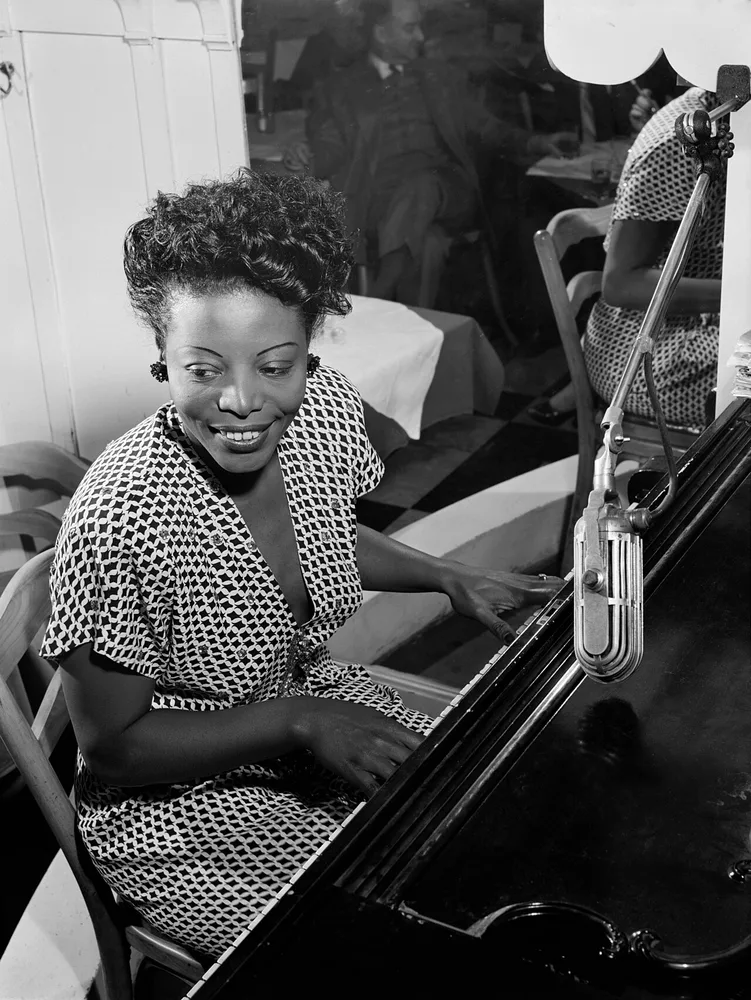
Mary Lou Williams at the piano, New York, circa 1946, photographed by William P. Gottlieb Public Domain (William P. Gottlieb collection, dedicated to the public domain by the photographer; Library of Congress digital ID gottlieb.09231) — Wikimedia Commons: https://commons.wikimedia.org/wiki/File:Mary_Lou_Williams_(Gottlieb_09231).jpg

Mary Lou Williams was born Mary Elfrieda Scruggs on May 8, 1910, in Atlanta, Georgia, the second of eleven children, and grew up in the East Liberty neighborhood of Pittsburgh. A child prodigy, she was picking out tunes at the age of two, was taught by her mother from the age of three, and at six was playing parties to help support her half-brothers and sisters. Pittsburgh knew her as "The Little Piano Girl" by the time she was seven. She named the Chicago pianist Lovie Austin as her greatest influence, toured on the theater circuit as a teenager, and in the late 1920s married the saxophonist John Overton Williams, a bandleader whose group she joined in Memphis. In 1929 she took over that band when her husband left to join Andy Kirk's Twelve Clouds of Joy.
She followed him to Oklahoma City and Tulsa, and when Kirk's band settled into a long Kansas City engagement she began sitting in, then became its arranger and composer. For the Clouds of Joy she wrote "Froggy Bottom," "Walkin' and Swingin'," "Little Joe from Chicago," "Roll 'Em," and "Mary's Idea," and she played on the band's Brunswick sessions in Kansas City in 1929 and in Chicago and New York in 1930. On a Chicago trip she recorded two piano solos, "Drag 'Em" and "Night Life," billed as "Mary Lou" at the suggestion of a Brunswick executive; the records sold quickly and made her name. She became Kirk's regular second pianist while freelancing arrangements for Earl Hines, Benny Goodman, and Tommy Dorsey. For Goodman she wrote "Camel Hop," named for his radio sponsor, and in 1937 the boogie-woogie blues "Roll 'Em." He tried to sign her to an exclusive writing contract, and she turned him down to stay independent.
In 1942, divorced from John Williams, she left the Clouds of Joy and went home to Pittsburgh, where she formed a sextet with the Kirk trumpeter Harold "Shorty" Baker and a young drummer, Art Blakey. When Baker left to join Duke Ellington, she followed him to New York, married him in Baltimore, and arranged for Ellington's orchestra, including "Trumpet No End" (1946), her take on Irving Berlin's "Blue Skies." Within a year she and Baker had separated. Back in New York she took a job at Café Society Downtown, started a weekly WNEW radio show called Mary Lou Williams' Piano Workshop, and became a mentor to the younger bebop musicians. Dizzy Gillespie and Thelonious Monk were among those who came to her apartment around four in the morning to trade ideas until noon, and she wrote "In the Land of Oo-Bla-Dee" for Gillespie in 1945.
Her most ambitious work of the period was the Zodiac Suite, twelve pieces for the signs of the zodiac, several dedicated to colleagues, among them Billie Holiday, Art Tatum, and Ben Webster. She began writing it in 1942, played it first with bassist Al Lucas and drummer Jack Parker on WNEW, and recorded it with that trio in June 1945 for Asch Records. On December 31, 1945, she presented an enlarged version at Town Hall in New York with a chamber group that included the clarinetist Edmond Hall, and in June 1946 a version for a seventy-piece symphony orchestra at Carnegie Hall, an engagement arranged through the promoter Norman Granz. Both concerts left her drained. In 1952 she accepted an engagement in England and stayed two years, making the London trio sessions issued by Vogue. In 1954, in the middle of a performance in Paris, she stepped away from the piano and stopped playing.
She returned to the United States and converted to Catholicism in 1954. For about three years she devoted herself to the Bel Canto Foundation, which she started with her own savings to turn her apartment in Hamilton Heights into a refuge for poor people and for musicians struggling with addiction, supported in part by a thrift store in Harlem. Her friend and student Charlie Parker died in 1955, and priests close to her and Gillespie urged her back to music; she returned at the 1957 Newport Jazz Festival with Gillespie's band, and in 1958 she was one of only three women in the A Great Day in Harlem photograph of New York jazz musicians. Her first major work after the hiatus, Black Christ of the Andes, a hymn to the Peruvian saint Martin de Porres together with two shorter sacred pieces, was first performed in November 1962 at St. Francis Xavier Church in Manhattan and recorded in 1963. She founded her own Mary Records label and Cecilia Music publishing company, and with the support of Bishop John Wright of Pittsburgh taught at Seton High School, where she wrote her first Mass. One of her Masses, Music for Peace, was staged by the Alvin Ailey American Dance Theater in 1971 as Mary Lou's Mass. In April 1975 she performed it with youth choirs before about three thousand people at St. Patrick's Cathedral in New York, the first time a jazz musician had played in the church.
The 1970s were among her most productive years. She played nightly at The Cookery, the Greenwich Village club run by her former Café Society boss Barney Josephson, and recorded Zoning (1974) and Free Spirits (recorded 1975) with bassists and drummers of a younger generation. She held Guggenheim Fellowships in 1972 and 1977. On April 17, 1977, she shared two pianos with Cecil Taylor at Carnegie Hall, an encounter issued as Embraced. From 1977 until her death she was artist-in-residence at Duke University, where she taught the history of jazz with her manager Father Peter O'Brien and directed the Duke Jazz Ensemble. She performed at the White House in 1978, took part in Goodman's fortieth-anniversary concert at Carnegie Hall the same year, and recorded a solo recital at the Montreux Jazz Festival. In 1980 she founded the Mary Lou Williams Foundation. She passed away from bladder cancer in Durham, North Carolina, on May 28, 1981, at the age of 71; Gillespie, Goodman, and Kirk attended her funeral, and she is buried in Calvary Catholic Cemetery in Pittsburgh.
Williams played and wrote across the entire span of jazz piano in one lifetime: the blues and boogie-woogie of her Pittsburgh youth, the riff-driven swing of Kansas City, bebop harmony, and, late in life, a spare modern manner that one critic heard as showing the influence of McCoy Tyner and, in places, hinting at free jazz. She described herself as a "soul" player, someone who stays near the melody and the blues, and she spoke of praying through her fingers; after 1954 her composing turned toward sacred music, spirituals, and hymns. Lovie Austin was her stated first model, and Art Tatum was an influence on her touch, according to his own profile. As an arranger she shaped the sound of the Kirk band and supplied the Goodman, Ellington, and Dorsey orchestras with scores, and as a mentor she gave a generation of bebop musicians a place to work out their ideas. The Zodiac Suite is regarded as an early blend of jazz and modern classical writing, and Mary Lou's Mass as her most acclaimed work. Her reputation has grown since her death: the Kennedy Center has held an annual Mary Lou Williams Women in Jazz Festival since 1996, her papers have been held by Rutgers University's Institute of Jazz Studies since 2000, and her music has been taken up by Dave Douglas, whose Soul on Soul (2000) is a tribute album, John Hicks, whose Impressions of Mary Lou (2000) recorded eight of her compositions, and Geri Allen, whose Mary Lou Williams Collective released Zodiac Suite: Revisited in 2006.
- Mary's Idea (1993, GRP) - A twenty-track collection of Andy Kirk and His Clouds of Joy recordings from 1936 to 1941, with Williams at the piano and arranging, including "Walkin' and Swingin'," "Froggy Bottom," "What's Your Story, Morning Glory?," "Mary's Idea," and "Scratchin' in the Gravel."
- Zodiac Suite (recorded 1945, issued 1946, Asch) - Her twelve-part suite for piano trio with bassist Al Lucas and drummer Jack Parker, first issued as two sets of 78s and reissued on LP by Folkways in 1975; the full Town Hall concert of December 31, 1945 appeared on CD in 1991 as The Zodiac Suite: The Complete Town Hall Concert of December 31, 1945.
- Black Christ of the Andes (1964, Mary Records) - The first major recording of her sacred jazz, built around the hymn to St. Martin de Porres and also containing "Anima Christi" and "Praise the Lord," alongside secular pieces such as "It Ain't Necessarily So."
- Giants (1971, Perception) - A quintet date with Dizzy Gillespie, trumpeter Bobby Hackett, bassist George Duvivier, and drummer Grady Tate, recorded January 31, 1971, at the Overseas Press Club in New York.
- Zoning (1974, Mary Records) - Trio and duo performances with bassists Bob Cranshaw and Milton Suggs and drummer Mickey Roker, including "Zoning Fungus II," "Gloria," and "Praise the Lord"; Gary Giddins named it one of the ten best albums of 1974.
- Free Spirits (1976, SteepleChase) - A trio session with bassist Buster Williams and drummer Mickey Roker, recorded July 8, 1975, in a modern idiom that includes "All Blues" and "Dat Dere."
- Embraced (1978, Pablo Live) - The two-piano concert with Cecil Taylor recorded live at Carnegie Hall on April 17, 1977, covering a spiritual, ragtime, boogie, and bop changes on the blues.
- Solo Recital: Montreux Jazz Festival 1978 (1979, Pablo Live) - A solo piano set that moves through spirituals, ragtime, blues, and swing, including "Offertory Meditation," "Tea for Two," and "Concerto Alone at Montreux."
Mary Lou Williams: Full Discography
Discogs artist ID 59405 ("Mary Lou Williams," born May 8, 1910, in Atlanta, Georgia, died May 28, 1981, in Durham, North Carolina) lists about 1,150 entries, most of them compilations and appearances. Her earliest recordings, made in 1927, sit under a second entry, "Mary Lou Burley" (artist ID 5033221). Her named small groups are separate Discogs entities, among them Mary Lou Williams Trio (366777), Quartet (903644), Quintet (4112878), And Her Orchestra (1957261), and Chosen Five (3799732); these hold mostly 78 rpm singles and were reviewed, and the leader table below keeps to albums. Because she recorded for more than five decades and many of the releases are reissues, the leader table is a curated selection of 21 albums and concert recordings, not an exhaustive list. Catalog numbers are those of the main release of each Discogs master; where Discogs gives no recording date, the cell says so, and where a detail could not be confirmed the Notes column says so.
As Leader / Co-Leader
| Album Title | Recording Date(s) | Release Date | Label | Catalog Number | Format(s) | Personnel | Role | Reissue History | Spotify | Buy | Notes |
|---|---|---|---|---|---|---|---|---|---|---|---|
| Signs of the Zodiac, Volume One and Volume Two (the Zodiac Suite) | June 1945 | May 1946 | Asch International (Vol. 1), Asch Records (Vol. 2) | A 620, A 621 | Shellac, 10 inch, 78 RPM, two three-disc albums | Mary Lou Williams (piano), Al Lucas (bass), Jack Parker (drums) | Leader | Compiled on LP as Zodiac Suite (Folkways, FTS 32844, 1975); see Discogs master 413480 | — | — | The original studio recording of the twelve-part suite, six pieces per album. |
| Piano Solos | Not specified in Discogs data | 1946 | Disc Records | 612 | Shellac, 10 inch, 78 RPM, album | Mary Lou Williams (piano) | Leader | Not itemized | — | — | Six solo pieces including "How High the Moon," "Cloudy," "The Man I Love," and "Lonely Moments." |
| Mary Lou Williams | March 7, 1951, New York | 1951 | Atlantic | LP 114 | Vinyl, 10 inch LP | Mary Lou Williams (piano), Carl Pruitt (bass), Bill Clark (drums) | Leader | The tracks reappear as one side of Ladies of Jazz (Atlantic, 1271, 1957), shared with Barbara Carroll; see Discogs master 556914 | — | — | Includes "Opus Z" and "Pagliacci." |
| Piano Contempo: Modern Piano Jazz | June 10 and 11, 1951, New York | 1951 | Circle | L-412 | Vinyl, 10 inch LP, album | Mary Lou Williams (piano), Billy Taylor Sr. (bass), Willie Bobo (bongos), Al Walker (drums, one track) | Leader | See Discogs master 1885839 | — | — | Includes "Handy Eyes," "Kool," and "Tishermore." |
| Mary Lou Williams Plays in London | London, 1953 | 1953 | Vogue | L.D.E. 022 | Vinyl, 10 inch LP, album | Mary Lou Williams (piano), Kenny Napper (bass), Allan Ganley (drums), Tony Scott (bongos) | Leader | Partly reissued on Mary Lou Williams in London (GNP Crescendo, GNP 9029, 1974), which also draws on a 1954 Swing LP with bassist Lennie Bush and drummer Tony Kinsey; see Discogs master 757508 | — | — | Includes "Titoros," "Perdido," and "Koolbonga." |
| Mary Lou Williams (Black Christ of the Andes) | Not specified in Discogs data | 1964 | Mary Records, Folkways Records | M-101, FJ 2843 | Vinyl, LP, album, mono | Mary Lou Williams (piano, composer); the chorus and rhythm section are not itemized in the Discogs credits | Leader | See Discogs master 108491 | — | — | Her first recording after the hiatus, with the hymn "Black Christ of the Andes (St. Martin de Porres)," "Anima Christi," and "Praise the Lord." Recorded in 1963, according to Wikipedia. |
| Praise the Lord in Many Voices | Not specified in Discogs data | 1966 | Avant Garde Records | AVS-103 | Vinyl, LP, stereo | Mary Lou Williams, with The Paul Quinlan Trio on the psalm settings; further personnel not itemized | Co-billed (shared with The Paul Quinlan Trio) | See Discogs master 1050489 | — | — | Sacred songs and "folkpsalms"; her pieces are "Praise the Lord," "Joycie," "Thank You, Jesus," and "Our Father." |
| Music for Peace | Not specified in Discogs data | 1970 | Mary Records | MG-7-202.488 | Vinyl, LP, album, stereo | Mary Lou Williams (piano, composer, arranger), Carline Ray and Chris White (bass), Al Harewood and David Parker (drums), David Amram (French horn, flute), Roger Glenn (flute), Leon Atkinson and Sonny Henry (guitar), Abdul Rahman (congas), Carl Hall, Christine Spencer, Eileen Gilbert, J.R. Bailey, Milt Grayson, and Randy Peyton (vocals), Robert Banks (arranger) | Leader | See Discogs master 367073 | — | — | The Mass she staged with the Alvin Ailey American Dance Theater in 1971 as Mary Lou's Mass; the Discogs credits assign players to tracks as two ensembles. |
| Giants | January 31, 1971, Overseas Press Club, New York | 1971 | Perception Records | PLP 19 | Vinyl, LP, album, stereo | Dizzy Gillespie (trumpet), Bobby Hackett (trumpet), Mary Lou Williams (piano), George Duvivier (bass), Grady Tate (drums) | Co-leader (billed with Dizzy Gillespie and Bobby Hackett) | See Discogs master 888954 | — | — | Includes "Love for Sale," "Caravan," and "Birks Works"; nominated for a Grammy in 1971 according to Wikipedia. |
| From the Heart | 1971 | 1971 | Chiaroscuro Records | CR 103 | Vinyl, LP, album, stereo | Mary Lou Williams (piano) | Leader | Expanded as the two-CD Nite Life (Chiaroscuro, CR(D) 103, 1998), adding nine previously unissued tracks from the 1971 sessions and an unissued solo concert of October 22, 1971; see Discogs master 1114589 | — | — | Solo piano, including "Night Life," "Cloudy," and "What's Your Story Morning Glory." |
| Zoning | Not specified in Discogs data | 1974 | Mary Records | M103 | Vinyl, LP, album, stereo | Mary Lou Williams (piano, arranger), Zita Carno (piano, two tracks), Bob Cranshaw and Milton Suggs (bass), Mickey Roker (drums), Tony Waters (congas) | Leader | Reissued on CD by Smithsonian Folkways in 1995 with a different track list; see Discogs master 267966 | — | — | Produced by Father Peter O'Brien; recording date not stated on the Discogs release. |
| Free Spirits | July 8, 1975, C.I. Recording, New York | 1976 | SteepleChase | SCS-1043 | Vinyl, LP, album, stereo | Mary Lou Williams (piano), Buster Williams (bass), Mickey Roker (drums) | Leader (billed as the Mary Lou Williams Trio) | The CD reissue adds bonus tracks; see Discogs master 375633 | — | — | Danish pressing; includes "All Blues," "Dat Dere," and "Blues for Timme." |
| Live at the Cookery | Greenwich Village, New York; date not stated | May 1976 | Chiaroscuro Records | CR 146 | Vinyl, LP, album, stereo | Mary Lou Williams (piano), Brian Torff (bass) | Leader | See Discogs master 712663 | — | — | Recorded at the club run by Barney Josephson. |
| The Asch Recordings 1944-47 | 1944 to 1947 | 1977 | Folkways Records | FA 2966 | Vinyl, LP box set, compilation | Mary Lou Williams (piano) with, across the sets, Don Byas and Coleman Hawkins (tenor saxophone), Edmond Hall and Claude Greene (clarinet), Al Lucas, Al Hall, and Eddie Robinson (bass), Jack Parker and Denzil Best (drums) | Leader | See Discogs master 1784174 | — | — | Compiled by Father Peter O'Brien; brings together her Asch small-group, trio, and Zodiac Suite orchestra sides. |
| Embraced | April 17, 1977, Carnegie Hall, New York | May 1978 | Pablo Live | 2620 108 | Vinyl, LP, album, stereo | Mary Lou Williams (piano), Cecil Taylor (piano); the Discogs credits also list Bob Cranshaw (bass) and Mickey Roker (drums) | Co-leader (billed with Cecil Taylor) | See Discogs master 327777 | — | — | A two-piano concert; the album's titles include "The Lord Is Heavy (A Spiritual)," "Fandangle (Ragtime)," and "Basic Chords (Bop Changes on the Blues)." |
| The History of Jazz | Not specified in Discogs data | 1978 | Folkways Records | FJ 2860 | Vinyl, LP | Mary Lou Williams (solo piano and narration) | Leader | See Discogs master 461966 | — | — | She plays and talks through blues, ragtime, Kansas City swing, boogie-woogie, bop, and free jazz. |
| My Mama Pinned a Rose on Me | December 27, 1977, RCA Recording Studios, New York | February 1979 | Pablo Records | 2310 819 | Vinyl, LP, album, stereo | Mary Lou Williams (piano), Buster Williams (bass), Cynthia Tyson (vocals, one track) | Leader | Side A of The Best of Mary Lou Williams (Pablo, 2310-856, 1980) is drawn from it; see Discogs master 549095 | — | — | A set of blues pieces including "Dirge Blues" and "Blues for Peter." |
| Solo Recital: Montreux Jazz Festival 1978 | July 16, 1978, Montreux, Switzerland | 1979 | Pablo Live | 2308-218 | Vinyl, LP, album | Mary Lou Williams (solo piano) | Leader | See Discogs master 364165 | — | — | Wikipedia describes it as her final recording; liner notes by Nat Hentoff. |
| The Zodiac Suite: The Complete Town Hall Concert of December 31, 1945 | December 31, 1945, Town Hall, New York | 1991 | Vintage Jazz Classics | VJC-1035 | CD | Mary Lou Williams (piano, composer), Edmond Hall and Eddie Barefield (clarinet), J.C. Heard (drums), Al Hall (bass), Henderson Chambers (trombone), Irving Randolph (trumpet), Milt Orent (conductor); billed with Ben Webster featured | Leader | See Discogs master 1157771 | — | — | Restored from the concert recording, with a string and wind ensemble that Discogs lists without names. |
| Live at the Keystone Korner | May 8, 1977, Keystone Korner, San Francisco | 2002 | HighNote Records | HCD 7097 | CD, album | Mary Lou Williams (piano, spoken commentary), Larry Gales (bass), Eddie Marshall (drums) | Leader | Posthumous release; see Discogs release 10912212 | — | — | Includes her spoken "History of Jazz" and "Mary Lou's Blues." |
| A Grand Night for Swinging | Winter 1976, Statler Hotel, Buffalo, New York | 2008 | HighNote Records | HCD 7180 | CD, album | Mary Lou Williams (piano), Ronnie Boykins (bass), Roy Haynes (drums) | Leader | Posthumous release; see Discogs release 14963873 | — | — | Live set that closes with an interview with Williams. |
As Sideman and Arranger (selected major credits)
These are selected credits; her work as an arranger and composer for other leaders runs to hundreds of pieces.
| Year | Project (Leader) | Title | Label | Catalog | Role | Notes |
|---|---|---|---|---|---|---|
| 1927 | John Williams' Synco Jazzers | "Midnight Stomp," "The Bumps," "Down in Gallion," and three other sides | Collected on The Chronological Classics: Mary Lou Williams 1927-1940 (Classics) | 630 (1992) | Pianist | Discogs files the pianist's credit on these six sides under the name Mary Lou Burley, her entry for her earliest recordings. |
| 1929 to 1930 | Andy Kirk and His Twelve Clouds of Joy | The band's first Brunswick sessions, collected as The Chronological 1929-1931 | Classics | 655 (1992) | Pianist and arranger | Listed in Wikipedia's Andy Kirk discography; the individual tracks were not itemized here. |
| 1936 to 1941 | Andy Kirk and His Twelve Clouds of Joy | Mary's Idea (compilation of Decca recordings) | GRP | GRP 16222 (1993) | Pianist and arranger | Twenty tracks including "Walkin' and Swingin'," "Froggy Bottom," and "The Lady Who Swings the Band"; see Discogs master 1010198. |
| 1936 | Mary Lou Williams (small group, billed under her name) | "Corny Rhythm," "Clean Pickin'," "Overhand," "Isabelle," "Swingin' for Joy," and "Mary's Special" | Collected on Jazz Pioneers (Prestige) | PR 7647 (1969) | Leader (piano and celesta) | Shares the LP with 1933 to 1936 Coleman Hawkins sides; Hawkins is profiled on JazzProfiles.com. |
| 1937 | Benny Goodman and His Orchestra | "Camel Hop" and "Roll 'Em" | Not confirmed | Not confirmed | Composer and arranger | She wrote both pieces for Goodman; the issue details of the recordings were not confirmed. |
| 1946 | Duke Ellington and His Orchestra | "Trumpet No End" | Not confirmed | Not confirmed | Arranger | Her arrangement of "Blue Skies," as given in Wikipedia; the issue details were not confirmed. |
| 1957 | Newport Jazz Festival performance with Dizzy Gillespie's band | At Newport | Verve | MGV-8244 (1958) | Pianist | Shared album; side A, recorded July 6, 1957, includes "Zodiac Suite (Virgo, Libra, Aries)." Discogs bills it to Count Basie, Joe Williams, Dizzy Gillespie, and Mary Lou Williams. |
| 1973 | Buddy Tate | Buddy Tate and His Buddies | Chiaroscuro | Not confirmed | Pianist | Listed in Wikipedia's discography; the catalog number was not confirmed. |
- Andy Kirk - bandleader of the Twelve Clouds of Joy, for whom she played, arranged, and composed from 1929 until she left the band in 1942.
- John Overton Williams - her first husband, a saxophonist whose Memphis band she led in 1929 and who brought her into the Kirk circle.
- Earl Hines - one of the bandleaders she wrote arrangements for as a freelancer in the 1930s.
- Benny Goodman - commissioned "Camel Hop" and "Roll 'Em" in 1937, offered her an exclusive writing contract, and later took part with her in his fortieth-anniversary Carnegie Hall concert in 1978.
- Tommy Dorsey - freelance arranging client in the 1930s.
- Duke Ellington - she arranged for his orchestra in the mid-1940s, including "Trumpet No End" (1946), and dedicated the "Taurus" movement of the Zodiac Suite to him.
- Harold "Shorty" Baker - Kirk trumpeter who co-led her 1942 Pittsburgh sextet, joined Ellington, and was briefly her second husband; "Gemini" in the Zodiac Suite is dedicated to him.
- Art Blakey - drummer in her Pittsburgh sextet of 1942, according to his own profile.
- Dizzy Gillespie - friend and student from the Café Society years, recipient of "In the Land of Oo-Bla-Dee" (1945), the person who helped bring her back to the stage in 1957, and co-leader of Giants (1971).
- Thelonious Monk, Bud Powell, Charlie Parker, Miles Davis, Tadd Dameron - younger musicians she befriended, mentored, and swapped ideas with in New York in the 1940s.
- Ben Webster - tenor saxophonist featured at the 1945 Town Hall performance of the Zodiac Suite.
- Al Lucas, Jack Parker - bassist and drummer of the original Zodiac Suite trio of 1945.
- Edmond Hall - clarinetist whose chamber group performed the Zodiac Suite at Town Hall on December 31, 1945.
- Norman Granz - promoter of the Carnegie Hall Zodiac Suite performance in 1946 and, decades later, producer of her Pablo recordings.
- Barney Josephson - owner of Café Society and later of The Cookery, where she played nightly in the 1970s.
- Father Peter O'Brien - her manager and close friend from the 1960s, producer of several of her albums and co-teacher with her at Duke University.
- Alvin Ailey - choreographer whose company staged her Mass as Mary Lou's Mass in 1971.
- Cecil Taylor - fellow pianist in the two-piano concert recorded as Embraced (1977).
- Buster Williams - bassist on Free Spirits (1975) and My Mama Pinned a Rose on Me (1977) and a member of her working groups in the 1970s.
- Bob Cranshaw, Mickey Roker, Larry Gales - bassists and drummer of her 1970s trios, heard on Zoning, Embraced, Free Spirits, and the Keystone Korner recording of 1977.
- George Duvivier, Bobby Hackett, Grady Tate - bassist, trumpeter, and drummer on Giants (1971).
- David Amram - French horn and flute on Music for Peace (1970), per the album's credits.
More American Jazz Artists
See all 820 American artists →- Spotify artist page
- Discogs
- Mary Lou Williams Collection, Institute of Jazz Studies, Rutgers University
- Wikipedia: Mary Lou Williams
- Wikipedia: Zodiac Suite
- Wikipedia: Zoning (Mary Lou Williams album)
- Wikipedia: Mary Lou Williams (album)
- Wikipedia: Free Spirits (Mary Lou Williams album)
- Wikipedia: Andy Kirk (musician)
- Rutgers University Libraries: Mary Lou Williams Collection finding aid
- Discogs: Mary Lou Williams (artist 59405)
- MusicBrainz: Mary Lou Williams
- JazzProfiles.com: Art Blakey
- JazzProfiles.com: Buster Williams
- JazzProfiles.com: Art Tatum
- JazzProfiles.com: Geri Allen