 JAZZPROFILES lives in the music 1,146 Jazz Artists fully Profiled!
 Django Reinhardt
Last updated September 13, 2026
Listen on Spotify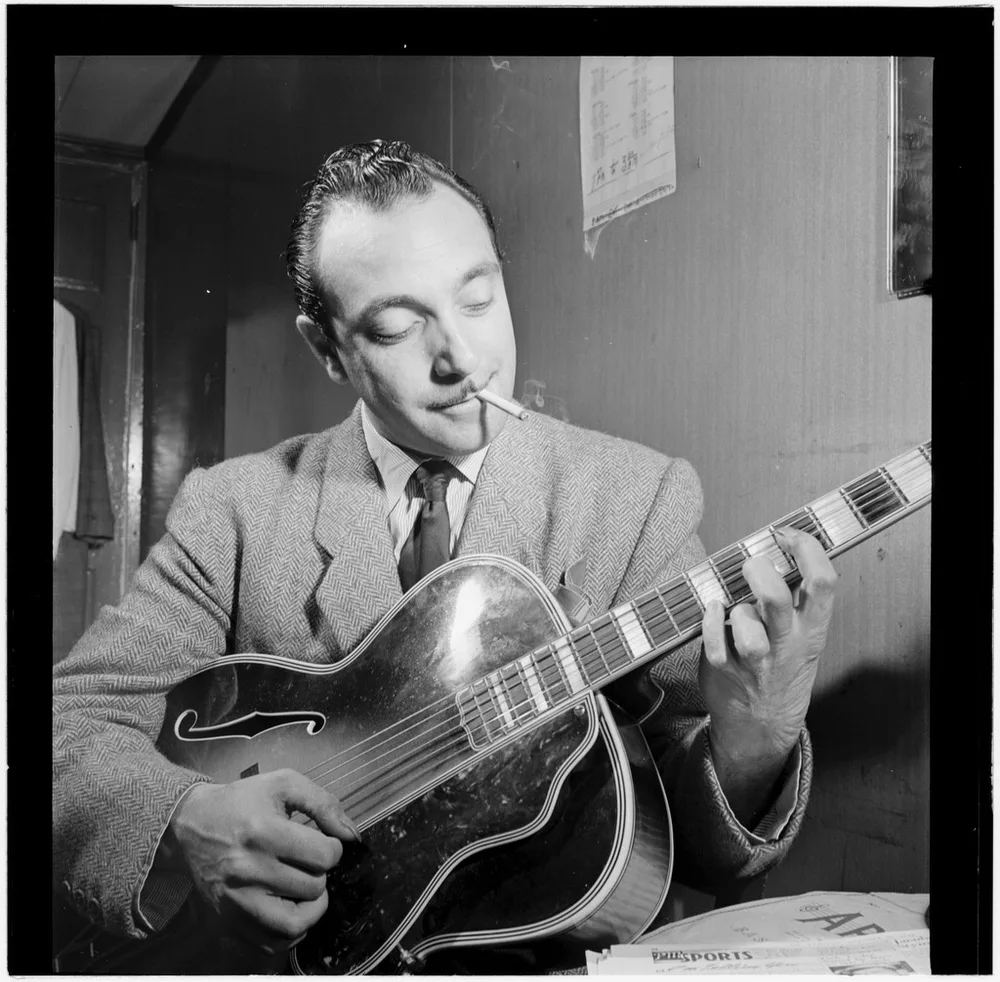
Django Reinhardt performing at the Aquarium club, New York, circa November 1946, during his tour with Duke Ellington's orchestra Public Domain (William P. Gottlieb Collection, Library of Congress; per Gottlieb's own wishes, entered the public domain on February 16, 2010) — Wikimedia Commons: https://commons.wikimedia.org/wiki/File:Django_Reinhardt,_Aquarium,_New_York,_N.Y.,_ca._Nov._1946_(William_P._Gottlieb_07311).jpg
Jean "Django" Reinhardt was born January 23, 1910, in a Romani caravan camp at Liberchies, Belgium, to Jean Eugene Weiss, an Alsatian entertainer who performed under his wife's family name, and Laurence "Negros" Reinhardt. He grew up largely in Manouche Romani encampments on the edge of Paris, taught himself banjo-guitar as a boy, and by his early teens was working the city's bal-musette dance halls alongside accordionists including Guerino and Vetese Guerino, cutting his first recordings as a sideman in 1928.
On the night of November 2, 1928, a candle set fire to a stock of celluloid flowers his wife Bella had been making for sale, and Reinhardt was badly burned escaping the family caravan. His right leg was injured and the third and fourth fingers of his left hand were left permanently curled, leaving doctors convinced he would never play guitar again. Over an eighteen-month recovery he rebuilt his technique from nothing, working out a way to solo using only his index and middle fingers while reserving the two damaged fingers for chord shapes on the top strings, a limitation that became one of the most recognizable techniques in jazz guitar.
In 1934, promoter Pierre Nourry and critic Charles Delaunay, building on informal jam sessions at the Hotel Claridge on the Champs-Elysees, pushed Reinhardt and violinist Stephane Grappelli to form a permanent group: the Quintette du Hot Club de France, with Reinhardt's brother Joseph Reinhardt and Roger Chaput on rhythm guitar and Louis Vola on bass. Built entirely from strings, with no piano, horns or drums, the group was an immediate sensation in Europe, and its sides for the Ultraphone, Decca and Swing labels, including "Djangology," "Minor Swing" (1937) and "Daphne," made Reinhardt the first major jazz musician to emerge from outside the United States. In April 1937, Reinhardt and Grappelli joined visiting Americans Coleman Hawkins, Benny Carter, Alix Combelle and Andre Ekyan for a single Paris studio date, billed to Hawkins's All-Star Jam Band, that produced "Crazy Rhythm" and "Honeysuckle Rose," one of the first meetings on record between European and visiting American jazz musicians.
War intervened in September 1939 while the Quintette was touring England. Reinhardt, uneasy with his limited English, returned to occupied France; Grappelli, judging it safer, stayed in London for the war's duration. Reinhardt spent the Occupation performing in Paris, at genuine personal risk as a Romani man under a regime that was murdering Roma elsewhere in Europe, and rebuilt the Quintette around clarinetist Hubert Rostaing in Grappelli's absence. This wartime lineup recorded roughly seventy sides, including Reinhardt's best-known composition, "Nuages," cut in December 1940 for Swing, which took on the character of an unofficial anthem of hope for Parisians awaiting liberation.
In 1946, Reinhardt toured the United States as a guest soloist with Duke Ellington's orchestra, his first sustained exposure to American audiences and his first prominent use of an amplified electric guitar. The tour drew a mixed reception, and he returned to France in 1947, resuming intermittent work with Grappelli through the late 1940s while also absorbing the new vocabulary of bebop, documented on a 1949-1950 run of Rome engagements with Italian musicians and, from January to April 1953, a series of quartet and quintet dates for Blue Star and for producer Norman Granz that paired him with younger modernists including pianist Martial Solal and vibraphonist Sadi.
Reinhardt settled in 1951 in Samois-sur-Seine, southeast of Paris on the Seine, largely retiring from touring life. His final recording session took place April 8, 1953, and included his own composition "Deccaphonie." On May 16, 1953, he collapsed from a brain hemorrhage in Fontainebleau while walking home from the Avon train station, and passed away the same day at age 43. He is buried in Samois-sur-Seine, which has hosted an annual festival in his honor since 1983.
Reinhardt's playing grew directly out of his injury: confined to two fretting fingers for single-note lines, he moved up and down the neck in wide, arcing positions that guitarists with a full set of fingers rarely used, producing long, rhythmically free phrases built from tremolo picking, chromatic runs and sudden octave leaps that had no real precedent on the instrument. He fused the harmonic language of American swing with the driving, syncopated rhythm-guitar pulse of Manouche musette playing, known as "la pompe," and effectively invented the style now called gypsy jazz or jazz manouche, still played today in essentially the vocabulary he set down, from the annual festival at Samois-sur-Seine to touring Manouche guitarists such as Biréli Lagrène and Stochelo Rosenberg. His influence reached directly into American jazz guitar: Chet Atkins named him the single most influential guitarist of the twentieth century, B.B. King cited him as a formative influence on his own phrasing, and Jim Hall, Joe Pass, Wes Montgomery and Pat Metheny have all acknowledged direct debts to his vocabulary, several recording tribute albums built entirely around his repertoire. His reach extended well past jazz as well, cited as a formative influence by rock and country guitarists including Jeff Beck, Jimmy Page and Willie Nelson.
- Minor Swing (recorded November 25, 1937, Swing) - The Quintette du Hot Club de France's most widely covered composition, and still the entry point for most listeners to gypsy jazz. Spotify - Minor Swing (1937) Listen
- Nuages (recorded December 1940, Swing) - Reinhardt's best-known original, cut with the wartime Nouvelle Quintette around Hubert Rostaing's clarinet, and an unofficial anthem of hope in occupied Paris. Spotify - Nuages Listen
- Best Djangologie (compilation, various dates 1934-1940) - A well-regarded survey of the classic pre-war Quintette du Hot Club de France era, gathering the Ultraphone, Decca and Swing label sides that made Reinhardt's international reputation. Spotify - Best Djangologie Listen
- "Crazy Rhythm" / "Honeysuckle Rose" (recorded April 28, 1937, Paris) - As a sideman: a single studio date billed to Coleman Hawkins's All-Star Jam Band, uniting Reinhardt and Grappelli with Hawkins, Benny Carter, Alix Combelle and Andre Ekyan, among the first recorded meetings of European and visiting American jazz musicians as equals.
- 1946 tour with the Duke Ellington Orchestra - Reinhardt's only sustained American engagement, as a guest soloist across the orchestra's fall 1946 tour, including a Carnegie Hall date; his first prominent use of amplified electric guitar, on broadcast recordings rather than studio sides.
- The Last Be-Bop Sessions (recorded January-April 1953, Blue Star/Vogue) - His final studio work, recorded weeks before his death with young modernists including pianist Martial Solal, showing him absorbing bebop harmony on electric guitar without losing his own voice. Spotify - The Last Be-Bop Sessions Listen
- The Essential Django Reinhardt (compilation) - A career-spanning overview for listeners wanting a single starting point across the pre-war Quintette, wartime and postwar bebop periods. Spotify - The Essential Django Reinhardt Listen
Django Reinhardt: Full Discography
Identity confirmed via the live Discogs API, artist ID 253481 ("Django Reinhardt," matching birth/death dates and the Quintette du Hot Club de France association). Note that two other Discogs entities exist for closely related names: artist 842622 ("Django Reinhardt Et Son Orchestre") and artist 10043038 ("Django Heinrich Reinhardt"), both of which appear to be alternate cataloging of the same person's work rather than a different musician; releases under those IDs are not separately itemized here. Reinhardt recorded almost entirely for the 78 rpm shellac format between 1928 and 1953, and his commercial catalog on Discogs runs past four thousand credits once every reissue, anthology, box set and posthumous compilation is counted (artist ID 253481 alone returns over 4,200 release credits). This file does not attempt exhaustive coverage. It curates the sessions and reissue packages that mark each phase of the career, from his 1928 debut as a sideman banjoist through his final 1953 studio dates, plus the handful of non-Quintette sideman credits with the most bearing on his story.
Not covered here: the great majority of the roughly 900 individual 78 rpm sides Reinhardt recorded (mostly with the various editions of the Quintette du Hot Club de France and his own Nouvelle Quintette), which are collected across dozens of overlapping reissue series (the French "Djangologie" numbered volumes, the "Integrale" box sets, and many single-label anthologies); the very large secondary market of budget and public-domain compilations drawn from the same pre-1953 recordings, most of them under royalty-free copyright in the United States and Europe; and later tribute and reissue projects by other artists, several of which are covered on their own pages elsewhere in this catalog.
As Leader / Co-Leader
| Album Title | Recording Date(s) | Release Date | Label | Catalog Number | Format(s) | Personnel | Role | Reissue History | Spotify | Buy | Notes |
|---|---|---|---|---|---|---|---|---|---|---|---|
| "Dinah" / "Tiger Rag" / "I Saw Stars" / "Lady Be Good" | Recorded December 1934, Paris | 1934 | Ultraphone | Not confirmed via Discogs (fragmented across separate master entries for this session) | Shellac, 10", 78 RPM | Django Reinhardt (guitar), Stephane Grappelli (violin), Joseph Reinhardt and Roger Chaput (rhythm guitar), Louis Vola (bass) | Leader (Quintette du Hot Club de France) | Widely anthologized on nearly every "Djangologie" and "Complete" reissue series since | Spotify - Best Djangologie | — | The Quintette's first commercial session and first released sides, cut within weeks of the group's founding |
| "Minor Swing" | Recorded November 25, 1937, Paris | 1937 | Swing | Swing No. 23 | Shellac, 10", 78 RPM | Django Reinhardt (guitar), Stephane Grappelli (violin), Joseph Reinhardt and Eugene Vees (rhythm guitar), Louis Vola (bass) | Leader (Quintette du Hot Club de France) | Reissued on the Djangologie series and on nearly every subsequent Reinhardt anthology; among the most recorded jazz standards by other artists | Spotify - Minor Swing (1937) | — | Composed jointly with Grappelli; became the foundational tune of the gypsy jazz repertoire |
| "Nuages" | Recorded December 1940, Paris | 1940 | Swing | Not confirmed via Discogs for the original pressing | Shellac, 10", 78 RPM | Django Reinhardt (guitar), Hubert Rostaing (clarinet), with the wartime Nouvelle Quintette rhythm section | Leader (Django Reinhardt et son Quintette du Hot Club de France) | Reissued continuously since; a two-clarinet arrangement from the same period is also documented | Spotify - Nuages | — | Reinhardt's most enduring original composition; described by multiple historians as an unofficial anthem of hope during the Occupation |
| Djangology (postwar Quintette reunion sides) | Recorded 1946-1947, Paris and London | Various, 1946-1948 | Decca / HMV | Various | Shellac, 10", 78 RPM | Django Reinhardt (guitar), Stephane Grappelli (violin), with postwar rhythm sections | Co-leader (with Grappelli) | Collected on "The Complete Django Reinhardt and Quintet of the Hot Club of France Swing/HMV Sessions 1936-1948" and on multiple Djangologie volumes | — | — | Documents the partial postwar reunion with Grappelli around Reinhardt's separate work with his own electric-guitar group |
| Djangology: Rome 1949 | Recorded 1949-1950, Rome | Reissued on CD | Various (reissue) | Various | CD reissue of 78 rpm masters | Django Reinhardt (guitar) with Italian rhythm musicians | Leader | Reissued as a dedicated compilation under this title | — | — | Documents an Italian engagement late in Reinhardt's career, played mostly on electric guitar |
| The Last Be-Bop Sessions | Recorded January-April 1953, Paris | Reissued on CD and LP | Blue Star / Vogue (reissue labels vary) | Various | Shellac, 10", 78 RPM (original); CD/LP reissue | Django Reinhardt (electric guitar), Martial Solal (piano), Sadi (vibraphone), plus rhythm section varying by date | Leader | Reissued under multiple titles including "The Last Be-Bop Sessions" and "Postwar Recordings 1944-1953" | Spotify - The Last Be-Bop Sessions | — | Recorded weeks before Reinhardt's death; his final studio session, April 8, 1953, closed with his own composition "Deccaphonie" |
| Quartet session for Norman Granz | Recorded March 1953, Paris | Reissued on LP/CD | Clef / Norgran (reissue lineage) | Not confirmed via Discogs | Shellac, 10", 78 RPM (original) | Django Reinhardt (electric guitar) with piano, bass and drums | Leader | Anthologized on later Norman Granz-era reissue compilations | — | — | One of Reinhardt's rare quartet dates with himself as the only soloist, produced by Norman Granz |
| The Essential Django Reinhardt | Compilation, various dates 1934-1953 | 2011 | Sony/Legacy (compilation) | Various | Digital / CD compilation | Django Reinhardt (guitar), various personnel by track | Leader (compilation) | — | Spotify - The Essential Django Reinhardt | — | A 36-track career overview spanning the pre-war Quintette, wartime and postwar bebop periods |
As Sideman (selected major credits)
| Year | Project (Leader) | Title | Label | Catalog | Role | Notes |
|---|---|---|---|---|---|---|
| 1928 | Various Paris bal-musette accordionists (Guerino, Vetese Guerino and others) | Various sides | Various French dance-hall labels | Not confirmed via Discogs | Banjo-guitar | Reinhardt's first professional recordings, made before the Quintette and before his 1928 hand injury |
| 1937 | Coleman Hawkins and His All-Star Jam Band | "Crazy Rhythm" / "Honeysuckle Rose" | Various (French issue) | Not confirmed via Discogs | Guitar | Recorded April 28, 1937, Paris, with Coleman Hawkins, Benny Carter, Alix Combelle, Andre Ekyan and Stephane Grappelli (piano on this date rather than violin) |
| 1946 | Duke Ellington Orchestra | Fall 1946 US tour, including a Carnegie Hall date | — | — | Guest soloist, guitar | Documented mainly through surviving broadcast recordings rather than studio releases; Reinhardt's only sustained American engagement |
Beyond these, Discogs credits Reinhardt on well over four thousand releases once every reissue and compilation drawing on his roughly nine hundred original 78 rpm sides is counted, spanning the full run of the Quintette du Hot Club de France (with Stephane Grappelli and, during the war, Hubert Rostaing), his own postwar electric-guitar groups, and the late-career sessions with Martial Solal; these are not itemized exhaustively here.
- Stephane Grappelli - violinist and co-founder of the Quintette du Hot Club de France in 1934, Reinhardt's primary musical partner through the 1930s, separated by the outbreak of war in 1939, and an intermittent recording partner again from the mid-1940s onward.
- Joseph Reinhardt - Django's brother and rhythm guitarist in the original Quintette du Hot Club de France from its 1934 founding.
- Louis Vola - bassist in the original Quintette du Hot Club de France lineup from 1934.
- Hubert Rostaing - clarinetist who took Grappelli's chair in the wartime Nouvelle Quintette (1940-1945), including on the "Nuages" session.
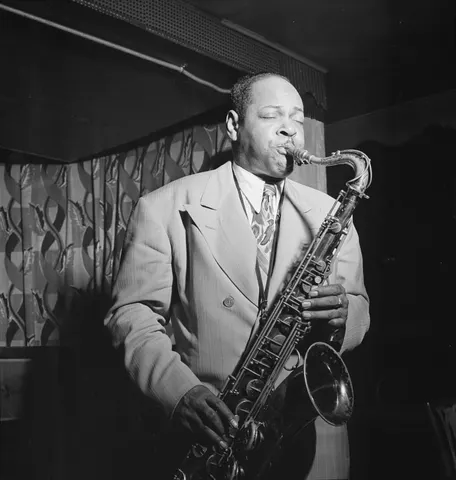
- Coleman Hawkins - fellow guest on the April 1937 Paris session billed to Hawkins's All-Star Jam Band, alongside Benny Carter, Alix Combelle and Andre Ekyan.
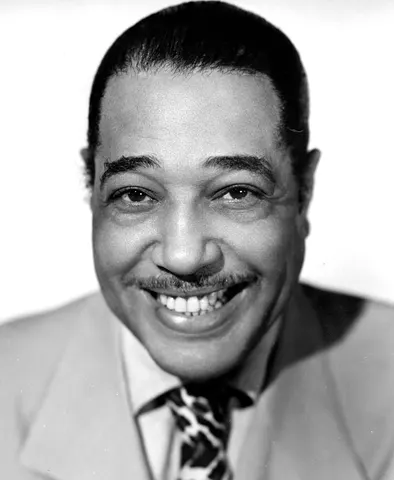
- Duke Ellington - hosted Reinhardt as a guest soloist on his orchestra's fall 1946 American tour.
- Martial Solal - pianist on Reinhardt's final studio sessions in early 1953, including the last date on April 8.
.jpg)
More Gypsy Jazz Artists
See all 10 Gypsy Jazz artists →More French Jazz Artists
See all 32 French artists →- Wikipedia: Django Reinhardt
- Wikidata: Django Reinhardt (Q44122), citizenship property (P27) sourced to the Encyclopedie Larousse
- Wikipedia: Quintette du Hot Club de France
- Wikipedia: Minor Swing (composition)
- Wikipedia: Nuages
- AllMusic: Django Reinhardt biography
- Discogs: Django Reinhardt (artist 253481)