 JAZZPROFILES lives in the music 1,002 Jazz Artists fully Profiled!
 Reggie Workman
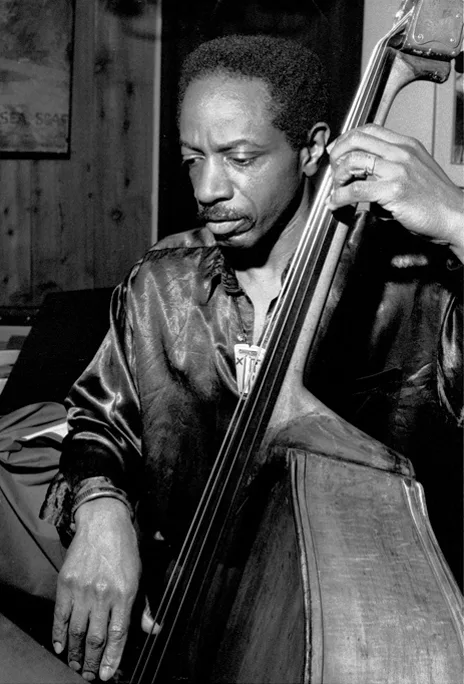
Reggie Workman performing at the Bach Dancing & Dynamite Society, Half Moon Bay, California, April 2, 1989 CC BY-SA 3.0 — Wikimedia Commons — https://commons.wikimedia.org/wiki/File:Reggie_Workman.jpg

Reginald Workman was born June 26, 1937, in Philadelphia, Pennsylvania. He played piano, tuba, and euphonium as a boy before settling on double bass in the mid-1950s. He came up working with Gigi Gryce, pianist Red Garland, and drummer Roy Haynes in the late 1950s, and also recorded during this period with Donald Byrd, Duke Jordan, and trumpeter Booker Little.
In 1961 Workman joined the John Coltrane Quartet, replacing bassist Steve Davis. He is heard on Coltrane's Olé Coltrane (Atlantic, alongside a second bassist, Art Davis) and on the core sessions of Africa/Brass (Impulse!), and he toured Europe with the group that November, documented on "Live" at the Village Vanguard. He also appeared with Coltrane and Eric Dolphy on a West German television broadcast that survives on video. Workman left the group after the European tour and was succeeded by Jimmy Garrison.
From 1962 to 1964 Workman held the bass chair in Art Blakey's Jazz Messengers, in a lineup with Freddie Hubbard, Wayne Shorter, Cedar Walton, and Curtis Fuller, recording Caravan, Ugetsu, and Free For All. He then worked in Yusef Lateef's group (1964-65) and became one of the most in-demand bassists on Blue Note's roster through the decade, recording Shorter's own Night Dreamer and Juju (both with pianist McCoy Tyner and drummer Elvin Jones), Lee Morgan's Search for the New Land, and dates for Grant Green. He was equally active on the era's freer wing, appearing on Archie Shepp's Four for Trane (1965, with John Tchicai, Roswell Rudd, and Alan Shorter reworking Coltrane compositions) and, later in the decade, on Pharoah Sanders's Karma (1969), where he and a second bassist (Richard Davis, then Ron Carter) anchored the two side-long pieces including "The Creator Has a Master Plan." He also worked in this period with Herbie Mann and Thelonious Monk.
Workman began leading his own record dates in the 1970s, starting with the Japanese-only Conversation, credited to "Reggie Workman First" (Denon, 1979) and The Works of Workman (Denon, 1979), a bass feature coordinated by Tsutomu Ueno. In 1978 he co-founded the Super Jazz Trio with pianist Tommy Flanagan and drummer Joe Chambers, and he formed the Reggie Workman Ensemble in the 1980s, recording Synthesis (1986) and beginning a long-running duo and small-group collaboration with pianist Marilyn Crispell that produced Gaia (1988, a trio with Crispell and Doug James) and continued into a reunion festival performance in 2000. He also joined a collective quintet billed with Sonny Fortune, Billy Harper, Stanley Cowell, and Billy Hart on Great Friends (1987) and Such Great Friends (1991). Workman began teaching in this period as well, joining the faculty of the University of Michigan and, from 1987, The New School for Jazz and Contemporary Music in New York, where he has remained a longtime professor.
In 1987 Workman co-founded Trio 3, a collective avant-garde trio with saxophonist Oliver Lake and drummer Andrew Cyrille that has recorded steadily for three decades (sometimes expanded with a rotating pianist, including Geri Allen and Vijay Iyer), and he continued to lead his own dates: Images (recorded live at New York's Knitting Factory, Denon/Leo, 1989-90), Altered Spaces (Leo Records, 1993), Summit Conference (Postcards, 1994, with Andrew Hill, Sam Rivers, and Julian Priester), and Cerebral Caverns (Postcards, 1995, an unusually colored sextet with Geri Allen, Sam Rivers, Julian Priester, Elizabeth Panzer on harp, and Tapan Modak on tabla). Beginning in 1984 he also collaborated on multidisciplinary performance-art works with director and choreographer Maya Milenovic Workman, including "Ophelia's Ocean" and "Guernica Continuum." His honors include the Jazz Foundation of America's Life Achievement Award and the International Association of Jazz Educators' Citation of Excellence (both 1997), the Mid Atlantic Arts Foundation's Living Legacy Award (1999), a Living Legend citation from the African American Historical and Cultural Museum in his native Philadelphia, and the Eubie Blake Award.
Workman has continued recording and performing into his ninth decade, largely in trio and quartet settings alongside Andrew Cyrille: Reflections (TUM Records, 2004, with saxophonist Juhani Aaltonen) and Witch's Scream (TUM Records, 2006, with reedman John Tchicai). In 2020 he received an NEA Jazz Masters designation and, jointly with Maya Milenovic Workman, a Guggenheim Fellowship in music composition. In 2024 he recorded the quartet album Embracing the Unknown for Mahakala Music with saxophonists Ivo Perelman and Chad Fowler and Cyrille on drums. A new group, Trio Imagination, with pianist David Virelles and Cyrille, released Creative Inspirations in September 2026, and Workman remains active on the concert stage, including a documentary-linked performance piece at that October's BRIC JazzFest and an improvised collaboration with Wadada Leo Smith, Sylvie Courvoisier, Mary Halvorson, Nicole Mitchell, and Terri Lyne Carrington at the Kennedy Center.
Workman has long been rated among the most technically accomplished bassists in jazz, and among the most versatile: a player equally convincing driving hard bop's fast tempos in the Jazz Messengers and Blue Note's mainstream, and working entirely outside metric and harmonic convention in Archie Shepp's, Pharoah Sanders's, and his own free settings. His time feel and full, resonant tone made him a first-call studio bassist through the 1960s, while his standing association with Trio 3 and his own small-group leader dates place him among the defining bassists of the post-Coltrane avant-garde. His four-decade tenure at The New School has also made him one of jazz bass's most influential teachers.
- Olé Coltrane (1961, Atlantic) - Workman's first recorded appearance with John Coltrane, a modal date with a rare two-bass frontline alongside Art Davis.
- Africa/Brass (1961, Impulse!) - Coltrane's large-ensemble Impulse! debut; Workman anchors the core sessions on a record built around massed brass arrangements. Spotify - Africa/Brass Listen
- Free For All (1964, Blue Note) - As a member of Art Blakey's Jazz Messengers, with Freddie Hubbard, Wayne Shorter, and Curtis Fuller. Spotify - Free For All
- Four for Trane (1965, Impulse!) - Archie Shepp's landmark reworking of Coltrane compositions with John Tchicai, Roswell Rudd, and Alan Shorter; a defining record of jazz's mid-1960s avant-garde. Spotify - Four For Trane
- Karma (1969, Impulse!) - Pharoah Sanders's most celebrated album; Workman is one of two bassists on "The Creator Has a Master Plan." Spotify - Karma
- Summit Conference (1994, Postcards) - A leader date pairing Workman with pianist Andrew Hill, reedman Sam Rivers, and trombonist Julian Priester. Listen
- Cerebral Caverns (1995, Postcards) - An adventurously voiced leader session adding harp and tabla to a core group with Geri Allen, Sam Rivers, and Julian Priester.
Reggie Workman: Full Discography
Identity confirmed via the live Discogs API: artist ID 135874 ("Reggie Workman," realname Reginald Workman, born June 26, 1937, Philadelphia, matching group memberships including The John Coltrane Quartet, Art Blakey & The Jazz Messengers, and Trio 3). Discogs credits this ID with 586 releases (19 "Main"/leader-billed, 509 sideman "Appearance" credits, 8 track-level credits, plus 46 unofficial/bootleg pressings). A portion of Workman's own leader catalog is filed on Discogs under two related artist entities rather than his main ID: "The Reggie Workman Ensemble" (Discogs artist 489504) and "Reggie Workman First" (Discogs artist 2582547), both resolved and folded into the table below. The table itemizes his confirmed leader/co-leader catalog plus a representative set of his most significant sideman dates; it does not attempt to itemize all ~500 sideman credits.
As Leader / Co-Leader
| Album Title | Recording Date(s) | Release Date | Label | Catalog Number | Format(s) | Personnel | Role | Reissue History | Spotify | Buy | Notes |
|---|---|---|---|---|---|---|---|---|---|---|---|
| Conversation | Not specified in Discogs data | 1979 | Denon (Nippon Columbia) | Not specified in Discogs data | Vinyl, LP, Album | Reggie Workman (bass), personnel not itemized on Discogs | Leader | None found | Spotify - Conversation | — | Filed on Discogs under the artist credit "Reggie Workman First"; some secondary sources give a 1977 recording date |
| The Works of Workman | Not specified in Discogs data | 1979 | Denon | YX-7539-ND | Vinyl, LP | Reggie Workman (bass, soloist); Tsutomu Ueno (program coordinator) | Leader | None found | — | — | A solo/featured bass recital; not found on Spotify |
| Synthesis | Not specified in Discogs data | 1986 | Not specified in Discogs data | Not specified in Discogs data | Not specified in Discogs data | Personnel not itemized on Discogs | Leader (The Reggie Workman Ensemble) | None found | — | — | Filed on Discogs under "The Reggie Workman Ensemble"; not found on Spotify |
| Great Friends | Not specified in Discogs data | 1987 | Not specified in Discogs data | Not specified in Discogs data | Not specified in Discogs data | Sonny Fortune (reeds), Billy Harper (tenor saxophone), Stanley Cowell (piano), Reggie Workman (bass), Billy Hart (drums) | Co-leader (collective billing) | None found | — | — | Collective quintet billed to all five names; not found on Spotify |
| Gaia | Not specified in Discogs data | 1988 | Leo Records | Not specified in Discogs data | Not specified in Discogs data | Marilyn Crispell (piano), Reggie Workman (bass), Doug James (2) (reeds) | Co-leader (trio) | None found | — | — | First recorded collaboration with Marilyn Crispell; not found on Spotify |
| Images (Live From New York's Knitting Factory) | Recorded live, Knitting Factory, New York | 1989-1990 | Leo Records / Denon | Not specified in Discogs data | Not specified in Discogs data | Personnel not itemized on Discogs | Leader (The Reggie Workman Ensemble) | None found | Spotify - Images: Live From New York's Knitting Factory | — | Filed on Discogs under "The Reggie Workman Ensemble" |
| Where Are You? | Not specified in Discogs data | 1991 | Il Posto Records | IPR 1120 | Vinyl, LP | Cristina Mazza (alto saxophone), Mal Waldron (piano), Reggie Workman (bass) | Co-leader (trio) | None found | — | — | Not found on Spotify |
| Such Great Friends | Not specified in Discogs data | 1991 | Not specified in Discogs data | Not specified in Discogs data | Not specified in Discogs data | Stanley Cowell (piano), Billy Harper (tenor saxophone), Reggie Workman (bass), Billy Hart (drums) | Co-leader (collective billing) | None found | — | — | Follow-up to Great Friends; not found on Spotify |
| Altered Spaces | Not specified in Discogs data | 1993 | Leo Records | Not specified in Discogs data | CD | Personnel not itemized on Discogs | Leader (The Reggie Workman Ensemble) | None found | Spotify - Altered Spaces | — | |
| Summit Conference | Recorded at Kampo Studios and 39th Street Music Studio, NYC | 1994 | Postcards | POST1003 | CD | Reggie Workman (double bass), Andrew Hill (piano), Sam Rivers (tenor saxophone, soprano saxophone, flute), Julian Priester (trombone), Pheeroan akLaff (drums) | Leader | Reissued 1999 (Arkadia Entertainment) | Spotify - Summit Conference | — | |
| Cerebral Caverns | Not specified in Discogs data | 1995 | Postcards | POST1010 | CD | Reggie Workman (bass), Geri Allen (piano), Sam Rivers (soprano, tenor saxophone, flute), Julian Priester (trombone), Al Foster & Gerry Hemingway (drums), Elizabeth Panzer (harp), Tapan Modak (tabla) | Leader | None found | — | — | Not found on Spotify |
| Clapping Music | Not specified in Discogs data | 1995 | Not specified in Discogs data | Not specified in Discogs data | Not specified in Discogs data | Aki Takase (piano), Reggie Workman (bass), Sunny Murray (drums) | Co-leader (trio) | None found | — | — | Not found on Spotify |
| A Day in Manhattan | Not specified in Discogs data | 2000 | Laika Records | 3510130.2 | CD | Ratko Zjaca (guitar, composer), Reggie Workman (acoustic bass), Al Foster (drums), Domagoj Ralašić (tenor saxophone) | Co-leader (billed to Zjaca / Workman / Foster) | None found | — | — | Not found on Spotify |
| Reflections | Not specified in Discogs data | 2004 | TUM Records | TUM CD 007 | CD | Juhani Aaltonen (tenor saxophone, flute, alto flute), Reggie Workman (bass, percussion), Andrew Cyrille (drums) | Co-leader (trio) | None found | — | — | Not found on Spotify |
| Witch's Scream | Not specified in Discogs data | 2006 | TUM Records | TUM CD 014 | CD | John Tchicai (tenor saxophone, bass clarinet, vocals), Reggie Workman (bass, percussion), Andrew Cyrille (drums) | Co-leader (trio) | None found | — | — | Not found on Spotify |
| Embracing the Unknown | Not specified in Discogs data | 2024 | Mahakala Music | MAHA-076 | CD | Ivo Perelman (tenor saxophone), Chad Fowler (alto saxophone [stritch], saxello), Reggie Workman (double bass, percussion), Andrew Cyrille (drums, percussion) | Co-leader (collective quartet) | None found | — | — | Not found on Spotify |
| A Part = A パート | Not specified in Discogs data | 1971 | Denon | Not specified in Discogs data | Vinyl, LP | Terumasa Hino (trumpet), Reggie Workman (bass), personnel otherwise not itemized on Discogs | Co-leader (with Terumasa Hino) | None found | — | — | Japanese release; not found on Spotify |
| A Tribute to Monk and Bird | Not specified in Discogs data | 1978 | Not specified in Discogs data | Not specified in Discogs data | Not specified in Discogs data | Thad Jones, George Adams, George Lewis, Stanley Cowell, Reggie Workman, Lenny White; produced by Heiner Stadler | Co-leader (collective billing) | None found | — | — | Not found on Spotify |
| Live in Osaka 1979 | Recorded live, Osaka, 1979 | Not specified in Discogs data | Couriers of Jazz | COJ-013 | 2xCD | Art Farmer (trumpet, flugelhorn), Tommy Flanagan (piano), Reggie Workman (bass), Joe Chambers (drums) | Co-leader (billed to Art Farmer, Tommy Flanagan Trio, Reggie Workman, Joe Chambers) | None found | — | — | Not found on Spotify |
Workman is also a founding member (1987-present) of the collective avant-garde trio Trio 3, with saxophonist Oliver Lake and drummer Andrew Cyrille, which has released a long run of albums under its own Discogs artist credit rather than Workman's individual one, including Time Being, Open Ideas, Encounter, Live in Willisau, and Visiting Texture (2017), not itemized separately here since they are billed to the group rather than to Workman as leader.
As Sideman (selected major credits)
| Year | Project (Leader) | Title | Label | Catalog | Role | Notes |
|---|---|---|---|---|---|---|
| 1961 | John Coltrane | Olé Coltrane | Atlantic (SD 1373) | Bass | Two-bass session with Art Davis | |
| 1961 | The John Coltrane Quartet | Africa/Brass | Impulse! (A-6) | Bass | Core-session bassist; Paul Chambers and Art Davis also appear on specific tracks per Wikipedia's sourced personnel | |
| 1962 | Coltrane* | "Live" at the Village Vanguard | Impulse! | Bass | Recorded November 1961 during Workman's European/US tour with the group | |
| 1962-1965 | Art Blakey & The Jazz Messengers | Caravan / Ugetsu / Free For All / Indestructible | Riverside / Blue Note | Bass | Working bassist through the Freddie Hubbard-Wayne Shorter-Cedar Walton edition of the Messengers | |
| 1964 | Wayne Shorter | Night Dreamer | Blue Note (BLP 4173) | Bass | With McCoy Tyner and Elvin Jones | |
| 1965 | Wayne Shorter | Juju | Blue Note (BLP 4182) | Bass | With McCoy Tyner and Elvin Jones | |
| 1964-65 | Yusef Lateef | 1984 / Psychicemotus / A Flat, G Flat and C | Impulse! | Bass | Period as a regular member of Lateef's group | |
| 1965 | Archie Shepp | Four for Trane | Impulse! (AS-71) | Bass | With John Tchicai, Roswell Rudd, and Alan Shorter reworking Coltrane compositions | |
| 1966 | Lee Morgan | Search for the New Land | Blue Note | Bass | ||
| 1969 | Grant Green | Goin' West | Blue Note | Bass | ||
| 1969 | Pharoah Sanders | Karma | Impulse! (AS-9181) | Bass | One of two bassists (with Richard Davis on side A, Ron Carter on side B) |
Workman's Discogs sideman log (509 "Appearance" credits and 8 track-level credits, spanning 1958 to the present) also includes further work with Herbie Mann, Thelonious Monk, Roy Ayers, Booker Ervin, James Moody, Gary Bartz, Freddie Hubbard, the Bill Dixon Orchestra, and The Jazz Composer's Orchestra, among many others, not itemized exhaustively here.
- John Coltrane - bassist in Coltrane's working quartet for much of 1961 (Olé Coltrane, Africa/Brass, the November 1961 European tour), succeeded by Jimmy Garrison.
- Art Blakey - Jazz Messengers bassist, 1962-1964, alongside Freddie Hubbard, Wayne Shorter, and Cedar Walton.
- Yusef Lateef - member of Lateef's group, 1964-65.
- McCoy Tyner - shared the rhythm section (with Elvin Jones) on Wayne Shorter's Blue Note dates Night Dreamer and Juju.
- Oliver Lake and Andrew Cyrille - co-founders with Workman of the collective trio Trio 3, active from 1987 to the present.
- Marilyn Crispell - duo and small-group collaborator from the late 1980s into the 2000s, including the trio album Gaia (1988).
- Maya Milenovic Workman - director/choreographer and life partner; collaborators on multidisciplinary performance works since 1984, and joint recipients of a 2020 Guggenheim Fellowship.
- Andrew Cyrille - drummer on most of Workman's 21st-century leader dates (Reflections, Witch's Scream, Embracing the Unknown) in addition to Trio 3.