 JAZZPROFILES lives in the music 1,572 Jazz Artists fully Profiled!
 Eubie Blake
Last updated September 6, 2026
Listen on Spotify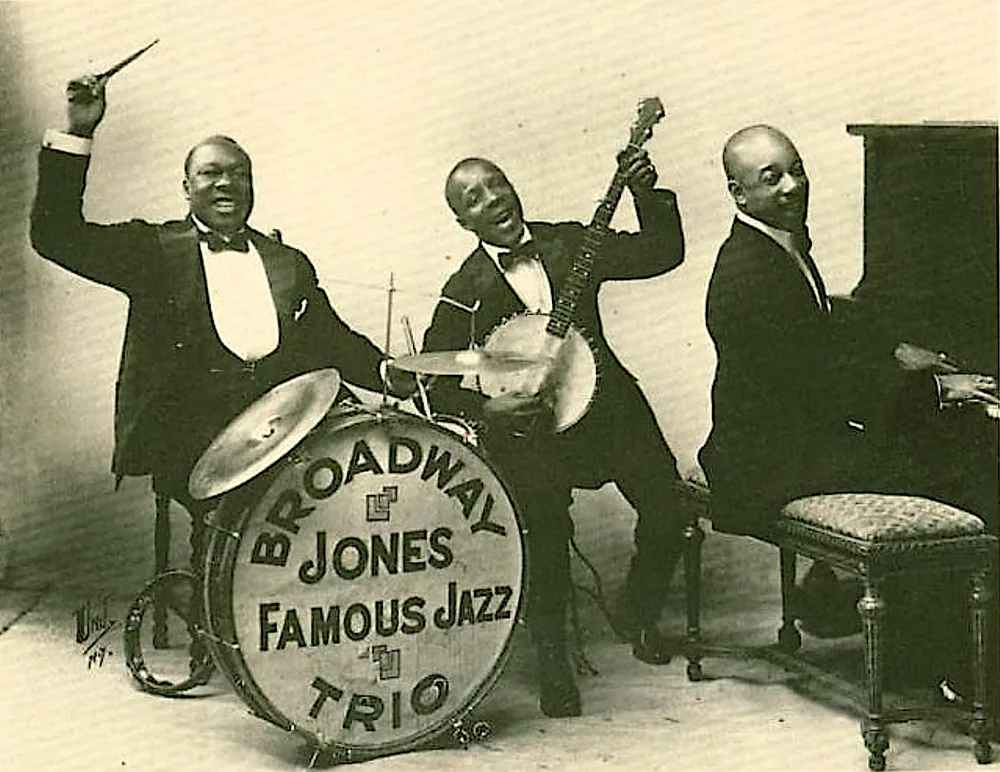
The Broadway Jones Trio, publicity photograph first published in 1918. Eubie Blake, seated at the piano at right, with Broadway Jones (drums, standing left) and banjoist Jessie Wilson (center). Blake and Jones toured together as a vaudeville act while Noble Sissle served overseas with James Reese Europe's 369th Infantry Band during World War I. Public Domain — Wikimedia Commons, https://commons.wikimedia.org/wiki/File:Broadway_Jones_Trio,_c._1918.png

James Hubert "Eubie" Blake was born February 7, 1887, in Baltimore, Maryland, the only one of his parents' children to survive infancy. Both John Sumner Blake, a dockworker, and Emily "Emma" Johnston Blake had been born enslaved. At five or six he was caught picking out melodies on an organ in a Baltimore music store; his parents bought him a $75 pump organ on a 25-cents-a-week installment plan, and at seven he began formal lessons with a neighborhood church organist, Margaret Marshall. By his teens he was playing piano professionally and illicitly, working a Baltimore bordello without his mother's knowledge, and by 1907 he had a standing winter engagement at boxer Joe Gans's Goldfield Hotel, spending summers in Atlantic City and studying composition locally with Llewellyn Wilson. He later said he composed his first rag, eventually titled "Charleston Rag" (also known as "Sounds of Africa"), around age 16, which would place it in 1903; he did not write it down until 1915 and did not record it until 1917. Sources disagree on this point, some giving 1899 at age 12, and the profile follows the later, better-documented date rather than repeating the earlier one uncritically.
Blake worked with James Reese Europe's Clef Club musicians in New York in the early 1910s and, in 1915, met the singer and lyricist Noble Sissle at a Baltimore hotel where both were performing. They formed a vaudeville act, the Dixie Duo, playing piano-and-voice on the black vaudeville circuit as one of the few such acts to work without the burnt-cork makeup still standard for Black performers at the time. World War I split them: Sissle enlisted and became drum major and a featured vocalist in Europe's 369th Infantry "Hell Fighters" Band, while Blake stayed stateside, touring the Keith circuit through 1918 and 1919 in a new act with the singer, drummer and comedian Broadway Jones. A surviving publicity photograph of "Broadway Jones' Famous Jazz Trio," Blake at the piano, dates from about 1918; the two men did not reach a recording studio together until a decade later, cutting "House Rent Lizzie" and "Dissatisfied Blues" for Victor on December 3, 1929. Blake's own first studio sides, cut in 1917 for Pathe as the Eubie Blake Trio ("Hungarian Rag"/"American Jubilee" and "Sarah From Sahara"/"Bunch of Blues"), predate both of those Broadway Jones dates.
Sissle and Blake reunited after the war, and their vaudeville act grew into a full production with the comedy team of Flournoy Miller and Aubrey Lyles, whose book and sketches became the show. Shuffle Along opened May 23, 1921, at the 63rd Street Music Hall on a shoestring budget, orchestra pit included, and ran 504 performances, an unusually long run for its era. It is generally credited as the first hit Broadway musical written, composed, directed and largely performed by Black artists, and the first to seat Black patrons in the orchestra section rather than confining them to the balcony. Its songs, above all "I'm Just Wild About Harry" and "Love Will Find a Way," became standards; "Harry" was later adopted, without permission, as Harry Truman's 1948 presidential campaign song. The chorus line launched Josephine Baker, who was turned away at her first audition as too young and too dark-skinned before joining the touring company and eventually the Broadway cast, and it featured Florence Mills and Adelaide Hall in more prominent roles. Sissle and Blake's own Victor sides as performers date mostly from this period, including "Baltimore Buzz" and "Bandana Days," cut July 15, 1921, with the show's pit band billed as the Shuffle Along Orchestra.
The partners wrote two further shows together, Elsie (1923) and The Chocolate Dandies (1924), toured England in 1926 to strong reviews, and made three short sound-on-film pieces for Lee de Forest's Phonofilm process in 1923, among the earliest surviving film footage of Black musical performers. When Sissle returned to London alone in 1927, for a solo act, the partnership lapsed (the pair had played London's Kit Kat Club together in 1926 and come back to the States that August; Sissle's own Paris band followed only in the summer of 1928); Blake resumed working with Broadway Jones through the Depression, including an extended run at the Royal Poinciana Hotel in Palm Beach, and the two split for good around 1932 or 1933 as bookings dried up. Sissle and Blake reunited once more, unsuccessfully, for the Depression-era flop Shuffle Along of 1933. Blake's most durable song from this stretch came from a different partnership: "Memories of You," written with lyricist Andy Razaf for Lew Leslie's Blackbirds of 1930, was recorded by Duke Ellington's Cotton Club Orchestra, with vocalist Dick Robertson, on October 2, 1930, alongside two more songs from the same score, "You're Lucky to Me" and "That Lindy Hop." It has been recorded by dozens of jazz artists since.
Blake married Avis Lee, a childhood acquaintance from Baltimore, in 1910; she died of tuberculosis in 1938. During World War II he toured with the USO, sometimes alongside Sissle, and met Marion Grant Tyler, a violinist's widow who became his second wife in 1945 and, afterward, his business manager. He largely retired from performing in 1946 and enrolled at New York University to study the Schillinger system of composition, graduating in about two and a half years and spending much of the next two decades transcribing, for the first time, music he had only ever played from memory. The turn came in 1969 with The Eighty-Six Years of Eubie Blake, a two-LP Columbia set produced by John Hammond from sessions recorded between December 1968 and March 1969; it returned Blake to The Tonight Show and The Merv Griffin Show, and the Library of Congress added it to the National Recording Registry in 2006. A steady run of ragtime-revival dates followed, including Golden Reunion in Ragtime (1962, with fellow veterans Joe Jordan and Charley Thompson) and Wild About Eubie (1977, with William Bolcom and Joan Morris), before the retrospective revue Eubie! opened on Broadway at the Ambassador Theatre on September 20, 1978, ran 439 performances and drew three Tony nominations, including one for Blake's own score. He made a cameo in the 1977 television movie Scott Joplin and appeared with Gregory Hines on Saturday Night Live on March 10, 1979.
Honors accumulated fast in his last decade: honorary doctorates from Rutgers, the University of Maryland, Howard University and other institutions; the George Peabody Medal from Johns Hopkins in 1980; and, on October 9, 1981, the Presidential Medal of Freedom from Ronald Reagan. In mid-December 1982 the Kennedy Center taped a televised tribute, Eubie Blake: A Century of Music, arranged by pianist Dick Hyman and featuring Rosemary Clooney, Cab Calloway, Joe Williams, Billy Taylor and Gregory Hines; it aired, and won an Emmy, after Blake's death. That distinction is worth stating precisely, because it is often blurred with the separate Kennedy Center Honors, which Blake never received. Blake had for decades claimed 1883 as his birth year, and the claim was widely repeated, including in his own obituaries; government records made public after his death (the 1900, 1910 and 1920 censuses, his 1917 draft card, and a 1920 passport application with his mother's sworn affidavit) all give 1887. He passed away at his Brooklyn home on February 12, 1983, of complications from pneumonia, five days after events billing it as his 100th birthday, which was in fact his 96th; even the New York Times obituary headline repeated the "100th birthday" claim. He was cremated and interred at Cypress Hills Cemetery in Brooklyn, under a headstone carrying the musical notation for "I'm Just Wild About Harry."
Blake's playing sat at the hinge between ragtime and stride: a hand span reported to cover a twelfth let him carry ragtime's structured, sectional left hand into looser, more syncopated territory, and pieces such as "Charleston Rag" and "Troublesome Ivories" push past strict ragtime form into the freer rhythmic feel that James P. Johnson and Fats Waller would later formalize as stride. Contemporaries and biographers describe an idiosyncratic vocabulary of "Eubieisms," rhythmic figures and voicings too particular to reduce cleanly to standard notation, which is part of why the piano rolls he cut from 1917 onward matter as much as his sheet music: they preserve interpretive detail that published scores simplified away for amateur pianists. As a songwriter his catalog runs through the vocabulary of Black musical theater into the mainstream popular song, with "I'm Just Wild About Harry" and "Memories of You" both becoming standards recorded far outside jazz, and Shuffle Along is credited with helping move syncopated, blues-inflected Black musical idioms into Broadway's mainstream at a moment when jazz itself was just beginning to be recorded. His late-career visibility, sustained from 1969 to his death, made him a direct link for younger musicians and audiences back to ragtime's first generation; pianist Ehud Asherie recorded an entire solo album, Shuffle Along (2016, Blue Heron Records), drawn from the score.
- The Eighty-Six Years of Eubie Blake (rec. Dec. 1968-March 1969, rel. 1969, Columbia C2S 847) - the John Hammond-produced comeback album that relaunched his career at 82; added to the National Recording Registry in 2006. Not confirmed as a standalone Spotify release; individual tracks circulate on compilations.
- Memories of You (compilation, Sony/Legacy) - a 15-track modern compilation of his own piano performances, a practical entry point to his solo playing. Spotify - Memories of You Listen
- "Charleston Rag" (rec. 1917, piano roll; first disc recording 1921) - his signature early rag, composed around 1903 and carried on piano rolls for years before he ever notated or recorded it.
- "Baltimore Buzz" / "Bandana Days" (rec. July 15, 1921, Victor B-25465/B-25466) - Blake and Noble Sissle with the Shuffle Along Orchestra, cut at the height of the show's Broadway run.
- Ragtime! The Fabulous Piano of Eubie Blake (1959, 20th Fox / reissued on streaming as Vol. 1) - a rare late-1950s solo studio date, before the bigger 1969 comeback. Spotify - Ragtime! The Fabulous Piano Of Eubie Blake, Vol. 1 Listen
- "Memories of You" (rec. October 2, 1930, Victor, unissued test / Cotton Club Orchestra under Duke Ellington, vocal Dick Robertson) - the best-known cover of his most enduring song, from the same session as "You're Lucky to Me" and "That Lindy Hop," all three from Blackbirds of 1930. Listen
- Eubie! (Original Cast Recording) (1978, Warner Bros.) - the Broadway revue built from his catalog, three Tony nominations, Blake's music sung by a cast including Gregory Hines and Maurice Hines. Not confirmed on Spotify.
- Wild About Eubie (1977, New World Records) - William Bolcom and Joan Morris perform Blake's songs with Blake himself as a guest artist.
Eubie Blake: Full Discography
Scope, and what "discography" means for this artist
Eubie Blake's recorded output runs from 1917 piano rolls to a 1979 studio date, a 62-year span, plus a body of compositions recorded by dozens of other artists that Discogs also files under his name as composer credits rather than performance credits. That distinction matters here more than for most artists in this sweep: most of the 1,142 "Appearance" credits on his main Discogs artist page are cover versions of his songs by other bandleaders (Victor Military Band, Pathe Dance Orchestra, Paul Whiteman, and dozens more), crediting Blake as composer, not as a performer on the record. A sample pull of the first 20 Appearance-role credits confirmed this pattern directly: entries like "Bugle Call Rag" by the Victor Military Band (1916) or "I'm Just Wild About Harry" by the Majestic Dance Orchestra (1922) are covers, not sideman dates. This table does not attempt to itemize composer-only credits; it covers his own performing discography.
Discogs fragmentation, confirmed directly rather than assumed. Blake's performing credits split across at least five Discogs artist entities:
- 758216, "Eubie Blake" - the main solo artist page, 1,257 total credits (44 Main / 1,142 Appearance / 67 TrackAppearance / 4 unofficial). Its earliest "Main"-role release is dated 1921; his actual first studio recordings, cut in 1917, are not on this page at all.
- 3403470, "Sissle & Blake" - the combined performing credit Discogs' own artist profile instructs be used "when crediting together, as well in writing as in performing." 184 total credits, 13 Main.
- 4638852, "Eubie Blake Trio" - a separate entity holding his true earliest studio recordings: two 1917 Pathe couplings, "Hungarian Rag" / "American Jubilee" and "Sarah From Sahara" / "Bunch of Blues." These do not appear anywhere on the main 758216 page.
- 3370336, "Eubie Blake & His Shuffle Along Orchestra" - the pit-band billing used on his 1921 Victor sides as a performer, including "Baltimore Buzz" / "Bandana Days."
- 1823769, "Eubie Blake And His Orchestra" - a 1922-1936 studio-band credit, including sides backing blues singer Alberta Hunter in 1931.
Session dates and matrix numbers below, where given, are drawn from the Discography of American Historical Recordings (UC Santa Barbara), the standard authority for pre-1950s American disc recordings, cross-checked against Discogs. Buy is — throughout: no affiliate program is set up for this site, and no Amazon or retailer links have been invented.
As Performer: piano rolls and 78s, 1917-1936
| Title | Recording Date | Release | Label | Catalog | Format | Personnel | Role | Notes |
|---|---|---|---|---|---|---|---|---|
| "Hungarian Rag" / "American Jubilee" | 1917 | 1917 | Pathe | not confirmed | Shellac, 10" | Eubie Blake Trio (personnel beyond Blake not documented) | Leader | His first studio recordings under any billing. Listed on Discogs only under the separate "Eubie Blake Trio" entity (4638852), absent from his main artist page |
| "Sarah From Sahara" / "Bunch of Blues" | 1917 | 1917 | Pathe | not confirmed | Shellac, 10" | Eubie Blake Trio | Leader | Same session/billing as above |
| "Baltimore Buzz" / "Bandana Days" | July 15, 1921, New York | 1921 | Victor | B-25465 / B-25466 | Shellac, 10" | Eubie Blake, Shuffle Along Orchestra | Leader, composer | Cut at the height of the Broadway run; matrix and date per DAHR |
| "Sweetheart" / "Baltimore Buzz" | 1921 | 1921 | not confirmed | not confirmed | Shellac, 10" | Eubie Blake & His Shuffle Along Orchestra | Leader | Discogs entity 3370336 |
| "Down Hearted Blues" / "Waitin' for the Evenin' Mail" | May 25, 1923, New York | 1923 | Victor | B-27975 / B-27976 | Shellac, 10" | Eubie Blake (piano), Noble Sissle (vocal) | Co-leader, performer (piano) | DAHR lists Blake as instrumentalist/piano and, on one side, composer |
| "Don't Love Me Blues" / "Dear Li'l Pal" | August 17, 1923, New York | 1923 | Victor | B-28383 / B-28387 | Shellac, 10" | Eubie Blake (piano), Noble Sissle (vocal) | Co-leader, performer | |
| "Sweet Henry (The Pride of Tennessee)" / "Old Fashioned Love" | January 8, 1924, New York | 1924 | Victor | B-29188 / B-29189 | Shellac, 10" | Eubie Blake (piano), Noble Sissle (vocal) | Co-leader, performer | |
| "Manda" / "Jassamine Lane" / "Dixie Moon" | March 7, 1924, New York | 1924 | Victor | B-29585 to B-29587 | Shellac, 10" | Eubie Blake (piano), Noble Sissle (vocal) | Co-leader, performer | Three titles from one session; Blake composer-credited on two |
| "Manda" (alt.) / "Fate Is the Slave of Love" | August 27, 1924, New York | 1924 | Victor | B-30683 / B-30684 | Shellac, 10" | Eubie Blake (piano), Noble Sissle (vocal), unidentified cornet | Co-leader, performer | Adds a cornet not present on the March session |
| "House Rent Lizzie" / "Dissatisfied Blues" | December 3, 1929, New York | 1929/1930 | Victor | BVE-57734 / BVE-57735 | Shellac, 10" | Eubie Blake (piano), Broadway Jones (vocal) | Co-leader, performer | Their only documented studio session together, a decade after their c. 1918 vaudeville partnership began |
| "Let's Get Friendly" / "It Looks Like Love" and further 1931 titles | 1931 | 1931 | not confirmed | not confirmed | Shellac, 10" (several couplings) | Eubie Blake And His Orchestra, with Dick Robertson (vocal) and others | Leader (bandleader) | At least six couplings on Discogs entity 1823769; the same orchestra also backed blues singer Alberta Hunter in sessions later reissued on 1980s-2000s compilations |
Piano rolls (selected, not comprehensively itemized)
Blake cut piano rolls from 1917 through at least the 1920s for companies including Ampico and Rythmodik, alongside the Pathe disc sessions above. Unlike James P. Johnson's roll output, no single comprehensive published roll discography for Blake was located in this pass; the two 1917 Pathe titles above are the earliest firmly dated performances on record. This is flagged as an open gap rather than filled with an unverified list.
Compositions recorded by others (representative, not a Blake performance credit)
These are included for context, since they are a large part of his historical importance, but they are not performances by Blake and are kept out of the table above to avoid the exact Discogs confusion (composer credit vs. performance credit) described above.
| Song | Recording | Date | Label | Notes | |---|---|---|---| | "The Chevy Chase" | Victor Orchestra | November 19, 1914 | Victor C-15410 | Blake's earliest identified composer credit on disc, four years before he cut a Blake-performed side | | "Bugle Call Rag" (co-written with Carey Morgan) | Victor Military Band | February 2, 1916 | Victor C-17098 | | | "Gypsy Blues" | Paul Whiteman Orchestra | October 5, 1921 | Victor B-25635 | | | "I'm Just Wild About Harry" | Paul Whiteman Orchestra | August 1, 1922 | Victor B-26707 | The song later used, without permission, as Harry Truman's 1948 campaign song | | "Memories of You" / "You're Lucky to Me" / "That Lindy Hop" | Cotton Club Orchestra, Duke Ellington directing, Dick Robertson vocal | October 2, 1930 | Victor BVE-63361 to BVE-63363 | All three from Blackbirds of 1930, lyrics by Andy Razaf; "Memories of You" became a jazz standard recorded by dozens of later artists | | "My Handy Man Ain't Handy No More" | Edith Wilson | October 6, 1930 | Victor BVE-63371 | | | "Loving You the Way I Do" | Mileage Makers, with Bubber Miley and Edith Wilson | September 11, 1930 | Victor BVE-63645 | |
Modern anthologies and reissues (selected)
| Title | Coverage | Release | Label | Catalog | Format | Spotify | Notes |
|---|---|---|---|---|---|---|---|
| Ragtime! The Fabulous Piano of Eubie Blake | Solo piano | 1959 | Top Rank | JKP 2008 (7" EP) | Vinyl, 7" | Spotify - Vol. 1 | A rare late-1950s studio date, before the bigger 1969 comeback |
| Golden Reunion in Ragtime | Reunion sessions with Joe Jordan and Charley Thompson | 1962 | Stereoddities/Stash | not confirmed | Vinyl, LP | Not confirmed | Recorded in Florida; arranged by ragtime revivalist Bob Darch |
| Volume 1, Featuring Ivan Harold Browning | Piano solos, early 1970s | 1971 | Eubie Blake Music | EBM 1 | Vinyl, LP | Not confirmed | First release on Blake's own small label, run in the early 1970s |
| Rags to Classics | Piano solos | 1972 | not confirmed | not confirmed | Vinyl, LP | Not confirmed | Discogs styles this "Ragtime, Stride" |
| The Eighty-Six Years of Eubie Blake | Studio comeback sessions, Dec. 1968-March 1969 | 1969 (Columbia's own release date; Discogs' earliest indexed pressing is dated 1973 under catalog C2S 847, a discrepancy noted in the notes file) | Columbia | C2S 847 | Vinyl, 2xLP | Not confirmed | Produced by John Hammond; added to the Library of Congress National Recording Registry in 2006 |
| Wild About Eubie | William Bolcom and Joan Morris perform Blake songs, with Blake as guest artist | 1977 | New World Records | not confirmed | Vinyl, LP | Not confirmed | |
| Eubie! A New Musical Revue (Original Cast Recording) | Broadway revue score | 1978 | Warner Bros. | not confirmed | Vinyl, LP | Not confirmed | Three Tony nominations; cast included Gregory Hines and Maurice Hines |
| Memories of You | Compilation of Blake's own piano performances | not confirmed | Sony/Legacy or similar | not confirmed | Streaming/CD | Spotify | 15 tracks; a practical entry point, though the precise physical-release history was not confirmed in this pass |
Sissle & Blake (combined performing credit, Discogs artist 3403470): as duo, 1923-1928
| Title | Year | Label | Format | Notes |
|---|---|---|---|---|
| "Down Hearted Blues" / "Waitin' for the Evenin' Mail" | 1923 | Victor | Shellac, 10" | Same session as the Blake-only listing above; Discogs splits the same Victor coupling across both artist entities |
| "If You've Never Been Vamped by a Brown Skin You've Never Been Vamped at All" / "Bandana Days" | 1924 | not confirmed | Shellac, 10" | |
| "Old Fashioned Love" / "Sweet Henry (The Pride of Tennessee)" | 1924 | not confirmed | Shellac, 10" | |
| "Manda" / "Dixie Moon" | 1925 | not confirmed | Shellac, 10" | |
| "Ukulele Baby" / "Ukulele Lullaby" | 1926 | not confirmed | Shellac, 10" | |
| "Slow River" / "Home (Cradle of Happiness)" | 1927 | not confirmed | Shellac, 10" | |
| "Sometimes I'm Happy" / "Hallelujah!" | 1927 | not confirmed | Shellac, 10" | |
| "Pickaninny Shoes" / "Sweetheart Memories" | 1927 | not confirmed | Shellac, 10" | |
| "Hallelujah!" / "Sometimes I'm Happy" (alternate pressing) | 1928 | not confirmed | Shellac, 10" | Discogs lists this as a separate release from the 1927 coupling above |
| Early Rare Recordings, Vol. 1 | 1973 | not confirmed | Vinyl, LP | Reissue compilation of the 1920s Victor sides |
| Early Rare Recordings, Vol. 2 | not confirmed | not confirmed | Vinyl, LP | |
| Shuffle Along (reissue LP of the original cast/performer sides) | 1976 | not confirmed | Vinyl, LP | Not to be confused with the 2016 Broadway revival cast album of the same name, or with Ehud Asherie's 2016 solo tribute album |
| Sissle and Blake Sing Shuffle Along | 2016 | not confirmed | CD/digital | A historical reissue, coincidentally released the same year as both the Broadway revival and Asherie's tribute album |
What is not resolved here
- No comprehensive piano-roll discography for Blake was located in this pass, unlike the well-documented Brown/Hilbert roll listing available for James P. Johnson. Only the two confirmed 1917 Pathe disc sides are itemized above with confidence; roll company names (Ampico, Rythmodik) are documented in secondary sources but without a reliable session-by-session list.
- Catalog numbers for most of the Sissle & Blake 1920s Victor and other-label sides were not individually confirmed beyond the two sessions cross-checked against DAHR. Marked "not confirmed" rather than guessed.
- The Eighty-Six Years of Eubie Blake release-year discrepancy (1969 per Columbia's own history, the Library of Congress, and contemporary press, versus 1973 as Discogs' earliest indexed pressing under catalog C2S 847) is noted but not resolved; both are stated in
eubie-blake_notes.md. - "Golden Reunion in Ragtime" label: sources split between "Stereoddities" and "Stash" for the original 1962 issue; not resolved here.
- No formal "As Sideman" table is given. Outside his own dates, the Sissle & Blake duo billing, and his studio orchestra's work backing Alberta Hunter and others, Blake has essentially no documented career as a sideman for other leaders; his enormous "Appearance" credit count on Discogs is almost entirely composer credit on other artists' cover versions, detailed in the "Compositions recorded by others" section above rather than presented as sideman work he did not actually play on.
- Noble Sissle - lyricist and vocalist; Blake's writing and performing partner from 1915 until Sissle's solo return to London in 1927, reunited briefly in the 1930s and during WWII USO work. Together they wrote Shuffle Along (1921), Elsie (1923) and The Chocolate Dandies (1924).
- Flournoy Miller and Aubrey Lyles - comedy writers and performers who supplied the book and comic leads for Shuffle Along.
- Broadway Jones - drummer, singer and comedian; Blake's vaudeville partner during and after World War I while Sissle served overseas, and again through the Depression until their split around 1932-33. Their only documented studio session together is a Victor date of December 3, 1929.
- Andy Razaf - lyricist on Blackbirds of 1930, including "Memories of You," "You're Lucky to Me" and "My Handy Man Ain't Handy No More."
- Duke Ellington - his Cotton Club Orchestra recorded three Blake/Razaf songs from Blackbirds of 1930 on a single October 2, 1930 Victor session.
- Josephine Baker, Florence Mills, Adelaide Hall - cast members whose careers were launched or advanced by Shuffle Along.
- William Bolcom and Joan Morris - classical/cabaret duo who championed Blake's songbook from the mid-1970s, culminating in Wild About Eubie (1977), with Blake himself appearing as guest artist.
- Dick Hyman - pianist who arranged and led the December 1982 Kennedy Center tribute Eubie Blake: A Century of Music.
- Ehud Asherie - contemporary stride pianist whose 2016 solo album Shuffle Along is drawn entirely from the musical's score.
More American Jazz Artists
See all 567 American artists →- Wikipedia: Eubie Blake
- Wikipedia: Shuffle Along
- Wikipedia: Eubie! (musical)
- RagPiano.com: James Hubert "Eubie" Blake, a sourced compositional and biographical summary citing U.S. Census, WWI draft, and 1920 passport records, plus research by Mike Meddings and Bob Pinsker on the 1883/1887 birth-year discrepancy
- Discography of American Historical Recordings (UCSB): Eubie Blake
- Discogs: Eubie Blake (artist 758216)
- Discogs: Sissle & Blake (artist 3403470)
- Britannica: Eubie Blake
- Library of Congress: "The Eighty-Six Years of Eubie Blake" National Recording Registry essay (PDF)
- Television Academy: Eubie Blake: A Century of Music, Kennedy Center Tonight
- Find a Grave: Eubie Blake