 JAZZPROFILES lives in the music 2,303 Jazz Artists fully Profiled!
Laurindo Almeida
Last updated November 7, 2026
Listen on Spotify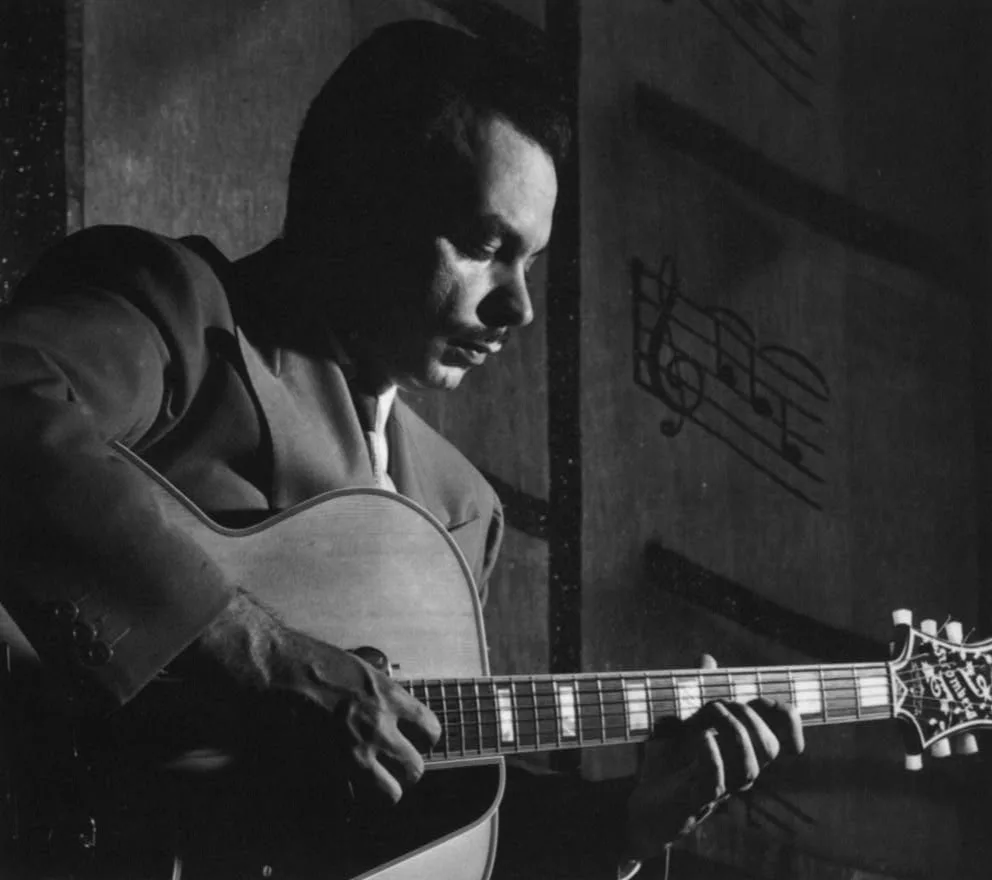
Laurindo Almeida playing guitar, c. 1947-1948, photographed by William P. Gottlieb Public Domain (William P. Gottlieb collection, released by the photographer; Library of Congress: no known copyright restrictions) — Wikimedia Commons - https://commons.wikimedia.org/wiki/File:Laurindo_Almeida_Gottlieb.jpg

Laurindo José de Araújo Almeida Nóbrega Neto was born on September 2, 1917, in the village of Prainha, in the state of São Paulo, Brazil. His mother was a classically trained pianist who loved Chopin, and he took up the guitar by borrowing his sister's instrument and teaching himself by ear, carrying over what he had heard her play at the piano. His father died of typhoid fever when he was nine. At twelve he moved to the city of São Paulo with his brother, and in the hospital after being wounded as a teenage soldier he met the guitarist Garoto, with whom he later performed and recorded. In 1935 he settled in Rio de Janeiro, worked in radio as a songwriter, arranger and multi-instrumentalist, partnered with the singer and tenor guitarist Nestor Amaral, and played the Casino da Urca. He also collected American jazz records on 78 rpm, with a particular fondness for Fats Waller. In 1936 he played banjo in the orchestra of a cruise ship that called at ports from Spain to Germany, and in Paris he heard Django Reinhardt and Stéphane Grappelli at the Hot Club de France, an experience he counted as a lifelong inspiration.
Back in Brazil he played the Casino Copacabana in 1941, toured with Carmen Miranda, and in 1947 moved to Los Angeles, a trip paid for by royalties from his song "Johnny Peddler," a hit for the Andrews Sisters. He went straight into the film-studio orchestras, and his habit of playing with the bare fingers rather than a pick set him apart on the scene. Soon after arriving he joined Stan Kenton's orchestra as featured guitarist. The Progressive Jazz band that Kenton formed in September 1947 added Almeida's classical guitar and Jack Costanzo's bongos, both firsts for a jazz orchestra, and Kenton's arranger Pete Rugolo wrote "Lament" for Almeida's quiet sound, while Almeida's own "Amazonia" was also featured. He stayed with the organization until 1952, and in 1950 Capitol issued his first album as a leader, Concert Creations for Guitar.
In 1953 and 1954 he recorded a quartet album for Pacific Jazz with the alto saxophonist Bud Shank, bassist Harry Babasin and drummer Roy Harte. First issued in 1954 as a ten-inch LP and in 1955 in expanded form as Laurindo Almeida Quartet Featuring Bud Shank, and later reissued as Brazilliance, it paired Brazilian rhythms with West Coast jazz improvisation, which Almeida called samba-jazz. The critic Leonard Feather credited Almeida and Shank with creating the bossa nova sound, although other writers note that the beat, harmony and economy of expression differ from the bossa nova of the late 1950s and are better described as a precursor. Almeida and Shank made several more Brazilian-jazz albums in the years that followed. At the same time Almeida built a second career at Capitol, where, beginning in 1954, he recorded a long series of solo-guitar and Spanish and Latin American repertoire albums, including Duets with the Spanish Guitar (1958) with the mezzo-soprano Salli Terri and flutist Martin Ruderman, often described as the first classical crossover album, and the first recordings of Heitor Villa-Lobos's Guitar Concerto and Radamés Gnattali's Concerto de Copacabana. He played guitar, lute, mandolin and other instruments on more than 800 film and television soundtracks, among them The Godfather (1972), and composed the complete scores for ten films.
The bossa nova boom of the early 1960s brought him back to jazz. Viva Bossa Nova! (1962), credited to Almeida and the Bossa Nova All Stars, reached number 9 on the Billboard album chart, and he played on records by Stan Getz, Shorty Rogers and Cal Tjader. In March 1963 he was the guest artist on a Verve album led by Getz, and in 1964 he made Collaboration, a chamber-jazz album for Atlantic with the Modern Jazz Quartet recorded on July 21, 1964, which led to tours with the quartet in the 1960s and again in the 1990s. That year his solo album Guitar from Ipanema won the Grammy for best instrumental jazz performance by a large group or soloist with a large group, presented on April 13, 1965, while Collaboration was nominated in the small-group category. Of his five Grammys, four were in classical categories; he was the first guitarist honored in both classical and jazz.
In 1974 he and Shank formed the L.A. Four with bassist Ray Brown and drummer Shelly Manne, first documented on The L.A. Four Scores!, recorded live at the Concord Summer Festival on July 27, 1974. Jeff Hamilton took over the drum chair after 1977. The group toured Australia in 1975, recorded ten albums for Concord Jazz and East Wind, and performed until 1982. In 1980 Almeida began a run of Concord albums with Charlie Byrd, including Brazilian Soul, Latin Odyssey and Tango, and in 1988 he formed the trio Guitarjam with Larry Coryell and Sharon Isbin, which played Carnegie Hall. Outra Vez (1992) is a live trio set recorded in October 1991 with bassist Bob Magnusson and drummer Jim Plank. He was teaching, recording and performing until the week before he passed away from leukemia in Los Angeles on July 26, 1995, at 77. His papers are held by the Library of Congress and California State University, Northridge, and in 2004 the Japanese producer Nujabes built "Aruarian Dance," from the Samurai Champloo soundtrack, on a sample of Almeida's recording of "The Lamp Is Low."
Almeida played nylon-string guitar with the bare fingers rather than a pick, and the same hands moved between Segovia-style classical repertoire, Brazilian choro and samba, and jazz improvisation. When asked about his favorite guitarists he named the classical virtuoso Andrés Segovia and Oscar Moore of the King Cole Trio, and Django Reinhardt, Garoto and Fats Waller were earlier influences. Writers describe his harmonic command, quiet dynamics and ornamental touch, and his arrangements carried baiao, samba and choro rhythms into American ensembles, first Stan Kenton's orchestra and then the West Coast jazz of Bud Shank. That combination made him one of the first musicians to put Brazilian rhythm and jazz improvisation on the same record, and Leonard Feather and others credited the 1953 and 1954 Pacific Jazz sessions as the root of bossa nova, a claim others qualify. His jazz standing rests on the Kenton orchestra, the Shank quartet records, the Modern Jazz Quartet album, the L.A. Four and his long association with Concord Jazz. A large part of his output sits outside jazz: a Capitol catalog dominated by classical, Spanish and Latin American guitar albums, more than 800 film and television soundtrack credits, and four of his five Grammys in classical categories. His reputation among jazz listeners rests on the jazz work, while he moved easily among all three worlds.
- Laurindo Almeida Quartet Featuring Bud Shank (1955, Pacific Jazz) - Recorded in 1953 and 1954 (a ten-inch edition appeared in 1954) with Bud Shank, Harry Babasin and Roy Harte, and later reissued as Brazilliance; the samba-jazz set that critics call a precursor of bossa nova.
- Duets with the Spanish Guitar (1958, Capitol) - Classical-crossover arrangements with the mezzo-soprano Salli Terri and the flutist Martin Ruderman, drawing on Brazilian dance forms.
- Viva Bossa Nova! (1962, Capitol) - Credited to Almeida and the Bossa Nova All Stars; it reached number 9 on the Billboard album chart.
- Stan Getz with Guest Artist Laurindo Almeida (1963, Verve) - Recorded in March 1963 under Stan Getz's leadership with Brazilian percussionists, with Almeida as the featured guest.
- Guitar from Ipanema (1964, Capitol) - The date that won the Grammy for best instrumental jazz performance by a large group or soloist with a large group.
- Collaboration (1964, Atlantic) - Almeida with the Modern Jazz Quartet, recorded July 21, 1964, with Percy Heath on bass, Connie Kay on drums, John Lewis on piano and Milt Jackson on vibraphone; a chamber-jazz album nominated for a Grammy.
- The L.A. Four Scores! (1975, Concord Jazz) - The first album by the quartet with Bud Shank, Ray Brown and Shelly Manne, recorded live at the Concord Summer Festival on July 27, 1974.
- Tango (1985, Concord Picante) - Eleven tango standards with Charlie Byrd, both guitarists on classical guitar. Spotify - Tango Listen
Laurindo Almeida: Full Discography
Discogs artist ID 255947 ("Laurindo Almeida," born September 2, 1917, in Prainha, São Paulo, Brazil, died July 26, 1995, in Los Angeles) lists more than 1,100 entries across leader, collaborative, appearance and compilation releases, most of them reissues. His leader work is split across several Discogs entities, including the Laurindo Almeida Quartet (artist ID 2569123), Laurindo Almeida & The Bossa Nova All Stars (artist ID 6960330) and the L.A. Four (artist ID 349697), which are covered in the tables below. His leader catalog mixes jazz, Brazilian and Latin dates with a long Capitol series of classical, Spanish and Latin American guitar albums, so the first table is a curated selection of 17 releases: the jazz and Brazilian-jazz sessions, the Concord albums, and the principal classical Grammy winners. His more than 100 other releases, mostly classical, Spanish-guitar and pop-instrumental albums, and his work on more than 800 film and television soundtracks, are not itemized. Catalog numbers are those of the first or best-documented US pressing, and recording dates come from Discogs release notes and Wikipedia.
As Leader / Co-Leader
| Album Title | Recording Date(s) | Release Date | Label | Catalog Number | Format(s) | Personnel | Role | Reissue History | Spotify | Buy | Notes |
|---|---|---|---|---|---|---|---|---|---|---|---|
| Concert Creations for Guitar | Not specified in Discogs data | 1950 | Capitol | H-193 | Vinyl, 10", LP | Laurindo Almeida (guitar) | Leader | Reissued on CD in 2006 with Brazilliance (FiveFour); Discogs master 970118 | — | — | His first album as a leader, issued on the label of the Kenton orchestra. |
| Laurindo Almeida Quartet Featuring Bud Shank (10-inch LP) | September 1953, Los Angeles | March 1954 | Pacific Jazz | PJLP-7 | Vinyl, LP, 10", Mono | Laurindo Almeida (guitar), Bud Shank (alto saxophone), Harry Babasin (bass), Roy Harte (drums) | Leader | A second ten-inch volume followed (Pacific Jazz PJLP-13) and the two were expanded into the 12-inch edition of 1955; see Discogs master 466564 | — | — | Six tracks including "Noctambulism" and "Tocata"; produced by Richard Bock. |
| Laurindo Almeida Quartet Featuring Bud Shank | 1953 and 1954 | 1955 | Pacific Jazz | PJ-1204 | Vinyl, LP, Album, Mono | Laurindo Almeida (guitar), Bud Shank (alto saxophone), Harry Babasin (bass), Roy Harte (drums) | Leader | Reissued as Brazilliance on World Pacific (WP-1412, 1961) and on CD in 1991 (CDP 7 96339 2); see Discogs master 466564 | — | — | The samba-jazz sessions often cited as a bossa nova precursor; fourteen tracks. |
| Duets with the Spanish Guitar | Not specified in Discogs data | 1958 | Capitol | P8406 | Vinyl, LP, Album | Laurindo Almeida (guitar), Salli Terri (mezzo-soprano), Martin Ruderman (flute) | Leader | Reissued on CD in 1990 (EMI Angel Studio CDM 7 63256 2); see Discogs master 360498 | — | — | Widely regarded as the first classical crossover album; the engineer Sherwood Hall III won a Grammy for it. Primarily classical and Brazilian art-song repertoire. |
| Conversations with the Guitar | Not specified in Discogs data | 1960 | Capitol | SP 8532 (stereo) | Vinyl, LP, Album, Stereo | Laurindo Almeida (guitar), Salli Terri (mezzo-soprano), Marty Ruderman (flute), Mitchell Lurie (clarinet), Sanford Schonbach (viola) | Leader | See Discogs master 834252 | — | — | Classical chamber repertoire; listed among his classical Grammy wins. |
| The Spanish Guitars of Laurindo Almeida | Not specified in Discogs data | 1961 | Capitol | SP-8521 | Vinyl, LP | Laurindo Almeida (guitar) | Leader | See Discogs master 464242 | — | — | Classical and Spanish repertoire plus his own "Brazilliance No. 1"; listed among his classical Grammy wins. |
| Viva Bossa Nova! | Not specified in Discogs data | 1962 | Capitol | T 1759 | Vinyl, LP, Album, Mono | Laurindo Almeida (guitar, cavaquinho), Howard Roberts and Al Viola (guitar), Jimmy Rowles (electric organ), Bob Cooper (tenor saxophone), Don Fagerquist (trumpet), Justin Gordon (flute), Max Bennett (bass), Shelly Manne, Milt Holland and Chico Guerrero (percussion) | Leader (billed with the Bossa Nova All Stars) | Combined with Ole! Bossa Nova! on a 2013 reissue (American Jazz Classics); see Discogs master 276630 | — | — | Reached number 9 on the Billboard album chart; opens with "Naked City Theme" and includes "Desafinado" and "One Note Samba." |
| It's a Bossa Nova World | Not specified in Discogs data | 1963 | Capitol | ST 1946, ST-1946 | Vinyl, Album, LP, Stereo | Laurindo Almeida (guitars, cavaquinho), Howard Roberts (electric guitar), Jimmy Rowles (electronic organ), Bob Cooper (tenor saxophone), Don Fagerquist (trumpet), Justin Gordon (flute), Max Bennett (bass), Shelly Manne, Victor Feldman and Chico Guerrero (percussion) | Leader (billed with the Bossa Nova All Stars) | See Discogs master 556641 | Spotify - It's a Bossa Nova World | — | Subtitled International Hits in Jazz Samba Arrangements; the third album of the Bossa Nova All Stars series after Viva Bossa Nova! and Ole! Bossa Nova!. Wikipedia dates it 1962. |
| Guitar from Ipanema | Not specified in Discogs data | 1964 | Capitol | ST 2197 | Vinyl, LP, Album, Stereo | Laurindo Almeida (guitar, electric guitar), Al Hendrickson (guitar), Harry Klee and Justin Gordon (flute), George Fields (harmonica), Djalma Ferreira (keyboards), Irene Kral (vocals, two tracks), Jack Marshall (whistling, occasional third guitar) | Leader | See Discogs master 526992 | — | — | Won the Grammy for best instrumental jazz performance by a large group or soloist with a large group, presented April 13, 1965. |
| Collaboration | July 21, 1964, RCA Webster Hall, New York | 1964 | Atlantic | 1429 (mono); SD 1429 (stereo) | Vinyl, LP, Album, Mono | Laurindo Almeida (guitar), John Lewis (piano), Milt Jackson (vibraphone), Percy Heath (bass), Connie Kay (drums) | Co-leader (billed with the Modern Jazz Quartet) | Reissued in Japan on Philips in 1989 (30JD-10093); see Discogs master 274202 | — | — | Nominated for the 1964 small-group jazz Grammy; liner notes by Leonard Feather. |
| Chamber Jazz | Not specified in Discogs data | 1979 | Concord Jazz | CJ-84 | Vinyl, LP, Album | Laurindo Almeida (guitar, arranger, producer), Bob Magnusson (bass), Jeff Hamilton (drums) | Leader | Reissued on CD in 1991 (CCD-4084); see Discogs master 243415 | — | — | A guitar-bass-drums set on Concord Jazz, the label he was closely associated with for the rest of his career. |
| Brazilian Soul | December 1980, Coast Recorders, San Francisco | 1981 | Concord Jazz Picante | CJP-150 | Vinyl, LP, Album, Stereo | Laurindo Almeida and Charlie Byrd (guitars), Bob Magnusson (bass), Milt Holland (percussion) | Co-leader (billed with Charlie Byrd) | Reissued on CD as CCD-4150 and on DVD-Audio by Hi-Res Music; see Discogs master 849684 | — | — | Arrangements shared between the two guitarists. |
| Latin Odyssey | December 1982, Coast Recorders, San Francisco | 1983 | Concord Jazz Picante | CJP-211 | Vinyl, LP, Album, Stereo | Laurindo Almeida and Charlie Byrd (guitars), Bob Magnusson and Joe Byrd (bass), Jeff Hamilton and Chuck Redd (drums) | Co-leader (billed with Charlie Byrd) | See Discogs master 515133 | — | — | Jeff Hamilton plays on most tracks and Chuck Redd on two. |
| Tango | Not specified in Discogs data | 1985 | Concord Jazz Picante | CJP-290 | Vinyl, LP, Album | Laurindo Almeida and Charlie Byrd (classical guitars), Joe Byrd (bass), Chuck Redd (drums) | Co-leader (billed with Charlie Byrd) | Reissued on CD as CCD-4290; see Discogs master 353062 | Spotify - Tango | — | Eleven tango standards, including "La Cumparsita" and "Blue Tango." |
| 3 Guitars 3 | Not specified in Discogs data | 1985 | Pro Arte | PAD 235 | Vinyl, LP, Album | Laurindo Almeida, Sharon Isbin and Larry Coryell (guitars) | Co-leader (billed with Sharon Isbin and Larry Coryell) | See Discogs master 1094565 | — | — | Recorded by the trio that later toured as Guitarjam; includes "Brazilliance" and the Adagio from Concierto de Aranjuez. |
| Music of the Brazilian Masters | Not specified in Discogs data | 1989 | Concord Picante | CCD-4389 | CD, Album | Laurindo Almeida, Charlie Byrd and Carlos Barbosa-Lima (guitars), Larry Grenadier (bass), Mike Shapiro (drums) | Co-leader (billed with Charlie Byrd and Carlos Barbosa-Lima) | See Discogs master 1360517 | — | — | Three-guitar program of Brazilian repertoire. |
| Outra Vez (Once Again) | October 1991, live, near San Diego | 1992 | Concord Picante | CCD-4497 | CD, Album | Laurindo Almeida (guitar), Bob Magnusson (bass), Jim Plank (percussion) | Leader | See Discogs master 1264852 | — | — | Includes a medley pairing Beethoven's "Moonlight Sonata" with Monk's "'Round Midnight" and a Jobim medley. |
With the L.A. Four
The quartet of Laurindo Almeida, Bud Shank, Ray Brown and Shelly Manne, with Jeff Hamilton in the drum chair after 1977, recorded ten albums between 1975 and 1983 (Discogs artist 349697). Drummer credits are not itemized per album.
| Year | Title | Label | Catalog | Notes |
|---|---|---|---|---|
| 1975 | The L.A. Four Scores! | Concord Jazz | CJ-8 | Recorded live at the Concord Summer Festival on July 27, 1974. |
| 1976 | The L.A. Four (Concierto de Aranjuez) | Concord Jazz | CJ-18 | |
| 1977 | Pavane pour une Infante Défunte | East Wind | EW-10003 | Wikipedia dates it 1976. |
| 1977 | Going Home | East Wind | EW-10004 | |
| 1978 | Watch What Happens | Concord Jazz | CJ-63 | |
| 1978 | Just Friends | Concord Jazz | CJD-1001 | |
| 1979 | Live at Montreux | Concord Jazz | CJ-100 | Recorded live at Montreux in summer 1979. |
| 1980 | Zaca | Concord Jazz | CJ-130 | |
| 1981 | Montage | Concord Jazz | CJ-156 | |
| 1983 | Executive Suite | Concord Jazz | CJ-215 | Wikipedia dates it 1982. |
As Sideman and Guest (selected credits)
| Year | Project (Leader) | Title | Label | Catalog | Role | Notes |
|---|---|---|---|---|---|---|
| 1947-1952 | Stan Kenton and His Orchestra | Capitol recordings of the Progressive Jazz period and after, including Pete Rugolo's "Lament," written for him, and his own "Amazonia" | Capitol | Various | Guitar | Featured guitarist; the Progressive Jazz band formed in September 1947. Individual sessions are not itemized. |
| 1959 | Bud Shank | Holiday in Brazil | World Pacific | WP-1259 (mono); STEREO-1018 | Arranger | Discogs credits Almeida as arranger; reissued in 1962 as Brazilliance Vol. 2. |
| 1959 | Bud Shank | Latin Contrasts | World Pacific | WP-1281 | Guitar, arranger | With Gary Peacock (bass) and Chuck Flores (drums); reissued in 1962 as Brazilliance Vol. 3. |
| 1963 | Stan Getz | Stan Getz with Guest Artist Laurindo Almeida | Verve | V-8665 | Guitar | Recorded at Webster Hall in March 1963; produced by Creed Taylor, with George Duvivier on bass and Dave Bailey, Edison Machado and Jose Soorez on drums. |
His session work for singers, film studios and television is not itemized.
- Stan Kenton - bandleader whose orchestra featured him from the Progressive Jazz band of 1947 until 1952; Pete Rugolo wrote "Lament" for him.
- Bud Shank - alto saxophonist and flutist on the Brazilliance sessions of 1953 and 1954 and later albums, and co-founder of the L.A. Four in 1974.
- Harry Babasin and Roy Harte - bassist and drummer in the original Pacific Jazz quartet.
- The Modern Jazz Quartet - John Lewis, Milt Jackson, Percy Heath and Connie Kay, partners on Collaboration (1964) and on tours in the 1960s and again in the 1990s.
- Stan Getz - tenor saxophonist who made a 1963 Verve album with Almeida as guest artist.
- Ray Brown and Shelly Manne - bassist and drummer of the L.A. Four; Jeff Hamilton took Manne's place after 1977, and Chuck Flores was the group's original drummer but did not record with it.
- Charlie Byrd - guitar partner on Concord albums from 1980 including Brazilian Soul (1981), Latin Odyssey (1983), Tango (1985) and Music of the Brazilian Masters (1989), the last with Carlos Barbosa-Lima; Chuck Redd played drums on dates of the series, per his profile.
- Jimmy Rowles - pianist and organist on Viva Bossa Nova! (1962), where Howard Roberts, Bob Cooper and Shelly Manne also played.
- Larry Coryell and Sharon Isbin - guitarists in the trio Guitarjam, formed in 1988, which played Carnegie Hall, and on the album 3 Guitars 3 (1985).
- Salli Terri and Martin Ruderman - mezzo-soprano and flutist on the Capitol albums Duets with the Spanish Guitar (1958) and Conversations with the Guitar (1960).
- Deltra Eamon - his second wife, a Canadian soprano with whom he performed and recorded in the 1970s and 1980s.
- Pete Rugolo, Henry Mancini, Rafael Méndez, Gerald Wilson - arranger, film composer, trumpeter and bandleader he worked with in the studios and on record.
- Herbie Mann and George Shearing - the flutist and the pianist, among the jazz musicians he collaborated with in the 1950s and 1960s.
- June Christy, Rosemary Clooney, Nat King Cole, Peggy Lee, Frank Sinatra - singers he accompanied on record or in the studios, among many others.
More Samba-Jazz Artists
See all 65 Samba-Jazz artists →More Brazilian Jazz Artists
See all 35 Brazilian artists →- Wikipedia: Laurindo Almeida
- Wikipedia: Brazilliance
- Wikipedia: The L.A. Four
- Wikipedia: 7th Annual Grammy Awards
- AllMusic: Laurindo Almeida
- Los Angeles Times: Laurindo Almeida, 77; Classical, Jazz Guitarist (August 1, 1995)
- Discogs: Laurindo Almeida (artist 255947)
- MusicBrainz: Laurindo Almeida
- JazzProfiles.com: Stan Kenton
- JazzProfiles.com: Charlie Byrd
- JazzProfiles.com: Chuck Redd