 JAZZPROFILES lives in the music 2,303 Jazz Artists fully Profiled!
Paulinho da Costa
Last updated November 5, 2026
Listen on Spotify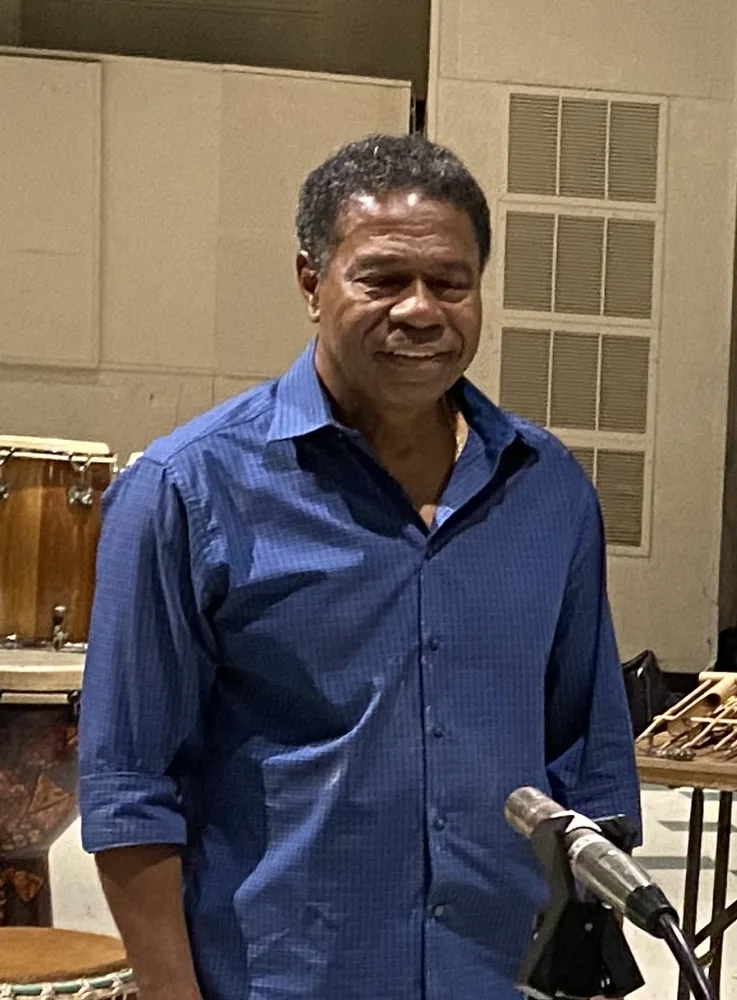
Paulinho da Costa in a recording studio, February 2020 (cropped from the original frame) CC0 1.0 (public domain dedication) — Wikimedia Commons - https://commons.wikimedia.org/wiki/File:Paulinho_da_Costa_em_est%C3%BAdio_de_grava%C3%A7%C3%A3o.jpg - uploaded by OCESUN

Paulo Roberto da Costa was born on May 31, 1948, in Irajá, a neighborhood in the north zone of Rio de Janeiro, and began on the pandeiro as a child. He paraded with the youth wing of the Portela samba school's bateria, its percussion section, and as a teenager traveled with samba trios and quartets, Brazilian ensembles and Carnaval orchestras, including a troupe led by Jorge Goulart and Nora Ney that played festivals abroad. In 1970 he toured Europe and the Middle East with a Brazilian ensemble that included Waldir Maia and Alcione, and in 1972 he took part in the Festival Internacional da Canção at Rio's Maracanãzinho, performing "Fio Maravilha" with Maria Alcina. Hearing jazz and Cuban music in those years pushed him to widen the range of instruments he played.
In 1972 he moved to Los Angeles, and from 1973 he played in Sérgio Mendes's group Brasil '77. Discogs credits him with bongos, congas and percussion on Love Music (Bell, 1973), and AllMusic gives his Brasil '77 stay as four years. His first Los Angeles album outside the band was with the Miracles, and he played on their chart-topping "Love Machine." Dizzy Gillespie introduced him to the producer Norman Granz, who signed him to Pablo Records, and the association with Granz helped him obtain permanent residency in the United States.
At Pablo he became a regular percussionist on jazz dates. He is credited on Gillespie's Bahiana (1976), Dizzy's Party (recorded 1976) and Free Ride (1977, with Lalo Schifrin composing, arranging and producing), on Milt Jackson's Feelings (1976) and on two tracks of Jackson's Big Mouth (1981). AllMusic adds Joe Pass and Freddie Hubbard to the list, and Discogs credits him on Hubbard's Bundle of Joy (1977) and Skagly (1980) and on Pass's solo date Whitestone (1985). On Ella Abraça Jobim (Pablo, 1981), Ella Fitzgerald's all-bossa-nova album of Antonio Carlos Jobim songs, he played percussion and is credited as associate producer.
His own records began on the same label. Agora (Pablo, 1977) was made with the drummer Claudio Slon and brought in Lee Ritenour on guitar, Greg Phillinganes on piano and the trombonist Frank Rosolino. He then shared the billing on Tudo Bem! (Pablo, 1978) with Joe Pass, a Brazilian songbook session of Jobim, Luiz Bonfá and Marcos Valle tunes with Oscar Castro-Neves, Don Grusin and Slon. He produced Happy People (Pablo Today, 1979), a vocal and horn-section record built on Los Angeles studio players including Larry Carlton, with Philip Bailey of Earth, Wind & Fire singing lead on the opener, and later Sunrise (Pablo Today, 1984), with George Duke, Carlton, Nathan East and Abraham Laboriel. A self-titled album appeared on Globo in Brazil in 1984. Breakdown (A&M, 1991) was produced with Erich Bulling and features Marcus Miller, Herb Alpert, Gerald Albright and Paul Jackson Jr.. He also led his own band at the Montreux Jazz Festival in 1977.
The larger part of his career has been in pop, soul and film studios, and it is a very large part. By the end of the 1970s he was one of the most in-demand session percussionists in Los Angeles, and Wikipedia counts more than 900 artists across thousands of albums. Quincy Jones used him on The Wiz, The Dude, The Color Purple, Back on the Block and other projects, and on George Benson's Give Me the Night (1980) Discogs places him on eight of the ten tracks. For Michael Jackson he played on Off the Wall (1979, six tracks on the Discogs release page), Thriller (1982), Bad, Dangerous, HIStory and Invincible. Other credits include Earth, Wind & Fire from All 'N All onward, the Pointer Sisters, Madonna's True Blue, "We Are the World," Dirty Dancing and, in a later jazz chapter, Diana Krall's live recordings from Paris and Rio de Janeiro. He also appears on Japanese records, among them Hiroshi Fukumura's Hunt Up Wind with Sadao Watanabe.
Recognition has come in volume and late. The National Academy of Recording Arts and Sciences gave him its Most Valuable Player award three years running and a Musicians Emeritus award, and DownBeat has called him one of the most talented percussionists of our time. A documentary about him, The Groove Under the Groove, premiered on Netflix in March 2026. On May 13, 2026, he received a star on the Hollywood Walk of Fame, the first Brazilian-born person to be honored with one. He turned 78 on May 31, 2026, and has lived in the United States since the early 1970s.
Da Costa's training is Brazilian, pandeiro first and then the full samba-school toolkit, with congas, bongos and timbales added through jazz and Cuban music and a collection that AllMusic puts at more than 200 instruments. His own credits on Agora run from pandeiro, cuica, reco-reco and berimbau to waterphone, bell tree, spoons and a frying pan. What he is known for is selection rather than display: AllMusic calls him an endlessly adaptable percussionist with a knack for placing precisely the right isolated beat, which suits a career spent adding color to other people's records.
Jazz is the smaller share of that output. His jazz identity rests on the Pablo years, on his own Brazilian-flavored albums for Granz and on sideman dates with Gillespie, Jackson, Fitzgerald and Pass, while the work that made him famous inside the industry is pop, R&B, disco and film music made in Los Angeles. The two halves share a method, a rhythm-section sensibility carried from samba school to jazz date to hit single, which is why he sits where crossover jazz meets studio pop.
- Agora (1977, Pablo) - His debut as a leader, a Brazilian-jazz and jazz-funk set with Claudio Slon, Lee Ritenour, Greg Phillinganes and Frank Rosolino. Spotify - Agora Listen
- Tudo Bem! (1978, Pablo) - Co-billed with Joe Pass, a bossa nova and samba songbook session that includes Jobim's "Corcovado" and "Wave." Spotify - Tudo Bem!
- Happy People (1979, Pablo Today) - The producer's record: horns, backing vocalists and a Los Angeles rhythm section around his percussion. Spotify - Happy People Listen
- Sunrise (1984, Pablo Today) - Produced by him, with George Duke, Larry Carlton, Nathan East and Abraham Laboriel.
- Breakdown (1991, A&M) - His A&M album, with Marcus Miller, Herb Alpert, Gerald Albright and Paul Jackson Jr.
- Bahiana (1976, Pablo) - On Dizzy Gillespie's Pablo album, where he is the credited percussionist.
- Ella Abraça Jobim (1981, Pablo) - Ella Fitzgerald sings Jobim; he is percussionist and associate producer.
- Off the Wall (1979, Epic) - Michael Jackson's breakthrough, produced by Quincy Jones; he is credited on six of its ten tracks.
Paulinho da Costa: Full Discography
Discogs artist: Paulinho Da Costa (46163) · Real name Paulo Roberto da Costa · Born May 31, 1948, Rio de Janeiro
Paulinho da Costa is a session percussionist first and a leader second. Discogs files more than two thousand credits under his name, most of them on compilations and soundtracks, and Wikipedia counts more than 900 artists. The first table lists his own albums and co-billed albums, which run from 1977 to 1991. The second lists a selected set of sideman credits, weighted toward the jazz dates and toward the pop and soul records he is best known for, with track restrictions given where a release page itemizes them. Labels, catalog numbers and personnel come from Discogs release pages, checked against Wikipedia, MusicBrainz and AllMusic. Discogs also lists several singles and compilations that are not itemized here.
Leader and Co-Leader Albums
| Album | Year | Label | Personnel & Notes | Listen | Buy |
|---|---|---|---|---|---|
| Agora | 1977 | Pablo (2310-785) | Six tracks: "Simbora," "Terra," "Toledo Bagel," "Berimbau Variations," "Belisco" and "Ritmo Number One." Da Costa on pandeiro, cuica, reco-reco, whistle, spoons, congas, percussion and vocals; Claudio Slon (drums, synthesizer, vocals; credited as producer on Discogs); Lee Ritenour (guitar); Greg Phillinganes (piano); Octavio Bailly Jr. (bass, vocals); Larry Williams (saxophone, flute); Frank Rosolino and Mike Julian (trombone); Gene Goe and Steve Huffsteter (trumpet, flugelhorn). | Spotify | — |
| Tudo Bem! (with Joe Pass) | 1978 | Pablo (2310 824) | Co-billed. Produced by Norman Granz, engineered by Val Valentin. Pass (guitar), Oscar Castro-Neves (guitar), Don Grusin (piano), Octavio Bailly Jr. (bass), Claudio Slon (drums), da Costa (percussion). Songs by Jobim, Luiz Bonfá, Marcos Valle and others, including "Corcovado" and "Wave." | Spotify | — |
| Happy People | 1979 | Pablo Today (2312-102) | Produced by da Costa (percussion). Nine tracks with horns and backing vocalists, including "Deja Vu," "Take It On Up" and "Happy People." Philip Bailey, Bill Champlin, Carl Carwell and Deborah Thomas sing; Larry Carlton, Al McKay and Marlo Henderson (guitar); Greg Phillinganes and John Barnes (keyboards); Nathan Watts (bass); James Gadson (drums); Michael Boddicker (synthesizer); Gary Herbig (saxophone, flute, oboe); Chuck Findley, Gary Grant and Steve Madaio (trumpet, flugelhorn). Engineered and mixed by Humberto Gatica. | Spotify | — |
| Paulinho da Costa | 1984 | Globo | Brazilian release listed on Wikipedia and MusicBrainz; no release page with personnel was found. | — | — |
| Sunrise | 1984 | Pablo Today (2312-143) | Produced by da Costa. Ten tracks including "Taj Mahal," "I'm Going to Rio," "African Sunrise" and "Carioca." Randy Waldman and George Duke (keyboards), Clarence Charles and Charles Fearing (guitar), Larry Carlton (guitar), Nathan East and Abraham Laboriel (bass), John Robinson and Leon "Ndugu" Chancler (drums), Ernie Watts (saxophone, flute); Carl Carwell sings lead on several tracks. Engineered and mixed by Allen Sides. | — | — |
| Breakdown | 1991 | A&M (75021 5356 2) | Produced by da Costa and Erich Bulling. Twelve tracks, including "Guaruja," "Sabor Latino" and "Real Love." Da Costa on drums and percussion; Marcus Miller and Nathan East (bass); Paul Jackson Jr. (guitar); George Duke (keyboards, one track); Herb Alpert (trumpet, two tracks); Gerald Albright (soprano saxophone, one track); Andy Narell (steel drums); Larry Williams (saxophone). | — | — |
Selected Singles
| Single | Year | Label | Notes |
|---|---|---|---|
| "Dreamflow" | 1979 | Polydor (7 inch) | From Happy People. |
| "Taj Mahal" / "Groove" / "I'm Going to Rio" | 1984 | Pablo (12 inch maxi-single) | From Sunrise. |
| "Real Love" | 1991 | A&M (promotional CD single) | From Breakdown. |
Sideman and Guest Appearances (selected)
Roles come from the credit string on each Discogs release page. Where a release credits him only on named tracks, the tracks are given; a blank track field is not read as album-wide.
| Year | Project (Leader) | Title | Label (Catalog) | Role | Notes |
|---|---|---|---|---|---|
| 1973 | Sérgio Mendes & Brasil '77 | Love Music | Bell (1119) | Bongos, congas, percussion | Produced by Bones Howe, with Bob Alcivar and Mendes arranging the rhythm section. |
| 1976 | Dizzy Gillespie | Bahiana | Pablo (2625 708) | Percussion | Produced by Norman Granz. |
| 1976 | Milt Jackson and Strings | Feelings | Pablo (2310 774) | Percussion (Brazilian) | Jimmy Jones arranged and conducted; Granz produced. |
| 1976 | The Dizzy Gillespie 6 | Dizzy's Party | Pablo (2310 784) | Percussion | Recorded 1976. With Ray Pizzi, Rodney Jones, Benjamin Franklin Brown and Mickey Roker on Wikipedia's personnel list. |
| 1977 | Dizzy Gillespie | Free Ride | Pablo (2310 794) | Percussion | Lalo Schifrin composed, arranged, conducted and produced. |
| 1977 | Freddie Hubbard | Bundle of Joy | Columbia (JC 34902) | Congas | Produced and arranged by Bert DeCoteaux. The release page gives no track restriction. |
| 1978 | Ahmad Jamal | One | 20th Century Fox (T-555) | Percussion | Two tracks, "Jet" and "Festival." Produced by Bones Howe. |
| 1978 | Hiroshi Fukumura with Sadao Watanabe | Hunt Up Wind | Flying Disk (VIJ-6015) | Percussion | Hiromasa Suzuki arranged most tracks. The release page gives no track restriction. See Hiroshi Fukumura and Sadao Watanabe. |
| 1978 | Lee Ritenour | The Captain's Journey | Elektra (6E-136) | Percussion | Three tracks (A3, B2, B3). Produced by Dave Grusin and Ritenour. |
| 1979 | Earth, Wind & Fire | I Am | ARC / Columbia (FC 35730) | Percussion | Produced by Maurice White. |
| 1979 | Michael Jackson | Off the Wall | Epic (FE 35745) | Percussion | Tracks: "Don't Stop 'Til You Get Enough," "Working Day and Night," "Get on the Floor," "Off the Wall," "I Can't Help It" and "Burn This Disco Out." Produced by Quincy Jones. |
| 1980 | George Benson | Give Me the Night | Qwest / Warner Bros. (HS 3453) | Percussion | Eight of ten tracks, including the title song, "Love X Love" and "Off Broadway." Produced by Quincy Jones. |
| 1980 | Freddie Hubbard | Skagly | Columbia (FC 36418) | Percussion | Two tracks, "Cascais" and "Skagly." |
| 1980 | The Jeff Lorber Fusion | Wizard Island | Arista (AL 9516) | Guest artist, percussion | Credited as a guest. Produced by Jeff Lorber. |
| 1981 | Quincy Jones | The Dude | A&M (SP-3248) | Percussion | |
| 1981 | Herbie Hancock | Magic Windows | Columbia (FC 37387) | Percussion | One track, "The Twilight Clone." |
| 1981 | Ella Fitzgerald | Ella Abraça Jobim | Pablo (2630-201) | Percussion; associate producer | Granz produced; Erich Bulling arranged and conducted. |
| 1981 | Milt Jackson | Big Mouth | Pablo (2310-867) | Percussion | Two tracks, "Bags' Groove" and "The Days of Wine and Roses." |
| 1981 | Freddie Hubbard | Mistral | Eastworld (EWJ-80194) | Percussion | The release page gives no track restriction. |
| 1981 | Lee Ritenour | Rit | Elektra (6E-331) | Percussion | Credited on "Countdown (Captain Fingers)" at track level; the album-level credit carries no track list. Produced by Ritenour, Harvey Mason and David Foster. |
| 1982 | Michael Jackson | Thriller | Epic (QE 38112) | Percussion | Credited on "Wanna Be Startin' Somethin'" and "Human Nature" on the release page. |
| 1985 | Joe Pass | Whitestone | Pablo (2310-912) | Percussion | The release page gives no track restriction. |
| 1989 | Quincy Jones | Back on the Block | Qwest (9 26020-1) | Percussion | Two tracks, "The Places You Find Love" and "Setembro (Brazilian Wedding Song)." |
| 2001 | Diana Krall | The Look of Love | Verve (314 549 846-2) | Percussion | Tracks 1, 3 and 5. Claus Ogerman arranged and conducted; Tommy LiPuma produced. |
| 2002 | Diana Krall | Live in Paris | Verve (440 065 109-2) | Percussion | Tracks 4, 6, 7 and 9. |
| 2009 | Diana Krall | Quiet Nights | Verve (B001243302) | Percussion | Tracks 1, 2, 4, 5 and 7 to 9. Ogerman arranged and conducted. |
| 2009 | Diana Krall | Live in Rio | Eagle Vision / Verve (EV 30273-9) | Percussion | Concert film on DVD; Ogerman arranged. |
- Sérgio Mendes - his first employer in the United States, in Brasil '77 from 1973.
- Dizzy Gillespie - introduced him to Norman Granz and used him on Bahiana, Dizzy's Party and Free Ride.
- Norman Granz - Pablo Records founder and producer of the Pablo dates above, including Tudo Bem!.
- Joe Pass - co-billed on Tudo Bem! (1978).
- Milt Jackson - Feelings (1976) and Big Mouth (1981).
- Ella Fitzgerald - Ella Abraça Jobim (1981), as percussionist and associate producer.
- Quincy Jones - a recurring collaborator from The Wiz and The Dude through Back on the Block.
- Michael Jackson - recorded with him from Off the Wall (1979) through Invincible (2001).
- George Benson - Give Me the Night (1980).
- Lee Ritenour, Don Grusin, Larry Carlton, George Duke, Nathan East, Marcus Miller, Herb Alpert, Gerald Albright and Paul Jackson Jr. - players on his own albums.
- Claudio Slon, Greg Phillinganes, Oscar Castro-Neves and Erich Bulling - collaborators and producers on his Pablo and A&M albums.
- Diana Krall - live recordings from Paris and Rio de Janeiro.
- Hiroshi Fukumura and Sadao Watanabe - Hunt Up Wind (1978).
- Outside jazz: Earth, Wind & Fire, Madonna, Lionel Richie, Donna Summer, the Pointer Sisters, Whitney Houston and Red Hot Chili Peppers, among others.
More Latin Jazz Artists
See all 212 Latin Jazz artists →More Brazilian Jazz Artists
See all 35 Brazilian artists →- Wikipedia: Paulinho da Costa
- Wikipedia: Agora
- Wikipedia: Tudo Bem!
- Wikipedia: Happy People
- Wikipedia: Sunrise
- Wikipedia: Breakdown
- Wikipedia: Dizzy's Party
- Wikipedia: Ella Abraça Jobim
- AllMusic: Paulinho Da Costa biography
- Discogs: Paulinho Da Costa
- MusicBrainz: Paulinho da Costa
- Paulinho Da Costa official site: About
- Agéncia Brasil: Paulinho da Costa recebe estrela na Calçada da Fama em Hollywood
- BBC Brasil via O Povo: O brasileiro admirado por Michael Jackson e desconhecido no Brasil