 JAZZPROFILES lives in the music 1,572 Jazz Artists fully Profiled!
 Lee Ritenour
Last updated September 7, 2026
Listen on Spotify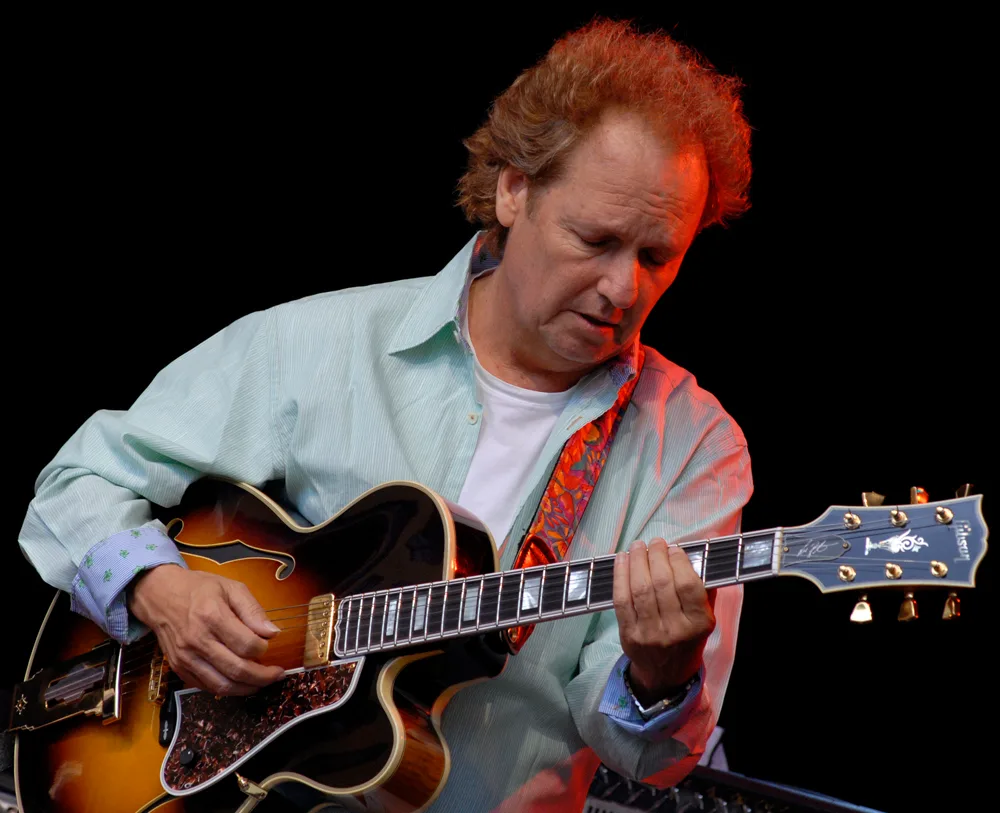
Lee Ritenour performing at Stockholm Jazz Festival, July 2009 CC BY-SA 3.0 — Wikimedia Commons — photographer Henryk Kotowski — https://commons.wikimedia.org/wiki/File:LeeRitenour_Stockholm20090715.jpg

Lee Mack Ritenour picked up the guitar at 8, decided music was the plan at 12, and studied classical guitar at USC's Thornton School of Music before session work took over. At 16 he played his first professional session backing the Mamas & the Papas; two years later he was behind Tony Bennett and Lena Horne at the Dorothy Chandler Pavilion. By his mid-20s he'd earned the nickname "Captain Fingers" for the kind of dexterity that got him called for Frank Sinatra, Barbra Streisand, Carly Simon, and Sonny Rollins sessions, and in 1979 for rhythm guitar on Pink Floyd's The Wall, playing on "Run Like Hell" and "One of My Turns."
His solo debut, First Course (1976, Epic), leaned toward straight-ahead jazz-funk, and some critics called it lightweight. Ritenour's response was to lean further into the commercial, radio-ready sound they'd dismissed: Captain Fingers (1977), The Captain's Journey (1978), and Feel the Night (1979) built a run that defined what crossover jazz could sound like on guitar. The payoff came in 1981. "Is It You," off the album Rit and sung by Eric Tagg, climbed to No. 15 on the Billboard Hot 100, while the album reached No. 26 on the Billboard 200.
After seven years on Elektra, Ritenour joined GRP Records in 1985 and recorded Harlequin with GRP co-founder Dave Grusin. "Early A.M. Attitude," off that album, won the 1986 Grammy for Best Arrangement on an Instrumental. The GRP years produced a steady run of albums, Earth Run (1986), Portrait (1987), Festival (1988), and Stolen Moments (1990) among them, that moved between fusion, Brazilian jazz, and standards.
In 1991, Ritenour co-founded Fourplay with Dave Grusin's GRP labelmate Bob James, bassist Nathan East, and drummer Harvey Mason. The band's self-titled debut sold over a million copies and held the No. 1 spot on Billboard's Contemporary Jazz chart for 33 weeks. Ritenour left in 1997, before most of that commercial run had finished paying off, and Larry Carlton took over the guitar chair. In 1993 he'd already released Wes Bound, a tribute to Wes Montgomery, the guitarist most often named as his own formative influence; the album reached No. 1 on Billboard's Contemporary Jazz chart and drew a Grammy nomination.
He kept moving into the 2000s and beyond. Two Worlds (2000), another Grusin collaboration, pushed into classical-jazz crossover with guests Renée Fleming and Gil Shaham. 6 String Theory (2010) marked 50 years of playing guitar with an all-star guest lineup (George Benson, Slash, Steve Lukather, and more). Its follow-up, Rhythm Sessions (2012), flipped the format to spotlight all-star rhythm sections, including Chick Corea, George Duke, and Stanley Clarke. In November 2018 he lost his Malibu home and recording studio in the Woolsey Fire; he kept recording anyway. His most recent album, Brasil (2024, again with Dave Grusin), extends a Brazilian-jazz thread that runs back through decades of work with Djavan and Ivan Lins.
Now in his mid-70s, Ritenour is still touring and recording, the same guitarist who decided at 12 that this was the plan and built a five-decade career, across Epic, Elektra, GRP, Concord, and Candid, without ever really deviating from it.
Ritenour names Wes Montgomery as his central influence, a debt he made explicit on 1993's Wes Bound. His own playing sits at crossover jazz's defining tension: real jazz improvisation (session-honed chops that made him a first-call studio player before he turned 25) delivered through melodic, radio-ready writing rather than technical display for its own sake. That approach runs through his own catalog and through his production/collaborative choices, most visibly his long partnership with Dave Grusin, GRP's co-founder and the producer most identified with crossover jazz's commercial sound.
His catalog also carries a consistent Brazilian-jazz thread, from Lee Ritenour in Rio (1979) through Festival (1988) and World of Brazil (2005) to Brasil (2024), reflecting decades of work with Brazilian artists including Djavan and Ivan Lins.
- Captain Fingers (1977, Epic) - the record that answered "lightweight" critics of his debut by doubling down on the commercial sound they'd dismissed; title track became the source of his nickname. Spotify - Captain Fingers Listen · Buy
- Rit (1981, Elektra) - his commercial peak as a solo artist; "Is It You" reached No. 15 on the Billboard Hot 100. Spotify - Rit Listen · Buy
- Harlequin (1985, GRP, with Dave Grusin) - "Early A.M. Attitude" won the 1986 Grammy for Best Arrangement on an Instrumental. Spotify - Harlequin Listen
- Wes Bound (1993, GRP) - his tribute to formative influence Wes Montgomery; reached No. 1 on Billboard's Contemporary Jazz chart. Spotify - Wes Bound Listen · Buy
- Brasil (2024, Candid, with Dave Grusin) - his most recent album, recorded in São Paulo with Brazilian jazz musicians. Spotify - Brasil Listen
Lee Ritenour: Full Discography (Discogs-Verified)
Discogs profile summary
- Real name: Lee Mack Ritenour
- Discogs artist ID: 37735
- Discogs bio: "American guitarist and composer (* 11 January 1952 in Los Angeles, California). With over 30 charting 'contemporary jazz' hits since 1976, Ritenour has been busy, contributing to over 3000 sessions of jazz, rock and Brazilian music... nicknamed 'Captain Fingers.' Father of [Wesley Ritenour]." Wesley Ritenour is a separate, correctly-excluded Discogs artist entity (his son, a bassist).
- Name variations on file: 30+, including phonetic misspellings (Ritenauer, Rittenour, Ritenhour) and non-Latin scripts (Cyrillic, Japanese katakana)
- Total releases credited to this artist ID across all roles: 1,475 (15 API pages), spanning 1974 to 2025
- Role breakdown: Main 106 (102 distinct titles), Appearance 747, TrackAppearance 472, Producer 26, Co-producer 1, Mixed by 2, UnofficialRelease 121 (bootlegs, excluded from all tables below)
LEADER (jazz albums): full detail
Personnel pulled directly from each correctly-resolved release's Discogs extraartists credits. One representative release per title was used, not every pressing/reissue.
| Album | Year | Label / Catalog | Personnel (selected) | Notes | Listen | Buy |
|---|---|---|---|---|---|---|
| First Course | 1976 | Epic, PE 33947 | Dave Grusin (electric piano, organ, clavinet); Harvey Mason (drums); Chuck Rainey, Louis Johnson (bass); Patrice Rushen (clavinet); Al Schmitt (engineer); Lee Ritenour (associate producer) | Debut solo album, recorded October 1975 | Spotify | Amazon search |
| Captain Fingers | 1977 | Epic, PE 34426 | Dave Grusin (clavinet, electric piano, keyboards); Harvey Mason, Jeff Porcaro (drums); Patrice Rushen, David Foster (electric piano); Anthony Jackson, Alphonso Johnson (bass) | Ritenour's answer to "lightweight" critiques of the debut; title track became his signature nickname's namesake | Spotify | Amazon search |
| The Captain's Journey | 1978 | Elektra, 6E-136 | Steve Gadd, Alex Acuña (drums); Abraham Laboriel, Anthony Jackson (bass); Dave Grusin, David Foster, Patrice Rushen (electric piano); David Nadien (concertmaster) | First album on Elektra after leaving Epic | Spotify | Amazon search |
| Feel the Night | 1979 | Elektra, 6E-192 | Steve Gadd (drums); Abraham Laboriel (bass); David Foster, Don Grusin (electric piano); Alex Acuña (congas) | Includes "You Make Me Feel Like Dancing"; recorded at Davlen Sound, North Hollywood | Spotify | Amazon search |
| Rit | 1981 | Elektra, 6E-331 | Jeff Porcaro, Alex Acuña, Rick Shlosser (drums); Abraham Laboriel, David Hungate, Louis Johnson (bass); Don Grusin, Greg Mathieson (keyboards); Johnny Mandel (string arrangement) | Single "Is It You" (Eric Tagg, lead vocal) hit No. 15 on the Billboard Hot 100 | Spotify | Amazon search |
| Rit/2 | 1982 | Elektra, 96.0186-1 | Nathan East, Abraham Laboriel, Neil Stubenhaus (bass); Harvey Mason, Carlos Vega, Jeff Porcaro (drums); Bill Champlin (backing vocals) | Ritenour's own Captain Fingers Productions credited as executive producer | Spotify | Amazon search |
| On the Line | 1983 | Elektra Musician, 96-0310-1 | Nathan East, Anthony Jackson (bass); Harvey Mason (drums); Dave Grusin, Don Grusin, Greg Mathieson (keyboards); Ernie Watts (saxophone) | Lee Ritenour credited as sole producer for the first time | Spotify | Amazon search |
| Banded Together | 1984 | Elektra, 9 60358-1 | Nathan East, Abraham Laboriel, Leland Sklar (bass); Jerry Hey (horn arrangement); Greg Mathieson (arranger, drum programming) | Recorded at Starlight Studios; Jazz Fusion/Synthpop blend per Discogs genre tags | Spotify | Amazon search |
| Harlequin (with Dave Grusin) | 1985 | GRP, GRP-A-1015 | Abraham Laboriel, Jimmy Johnson (bass); Carlos Vega, Harvey Mason (drums); Alex Acuña, Paulinho Da Costa (percussion); Dave Grusin, Lee Ritenour (co-producers, co-arrangers) | Peaked No. 2 Billboard Contemporary Jazz; "Early A.M. Attitude" won the 1986 Grammy for Best Arrangement on an Instrumental | Spotify | Amazon search |
| Earth Run | 1986 | GRP, GRP-A-1021 | Abraham Laboriel, Jimmy Johnson (bass); Carlos Vega, Harvey Mason (drums); Dave Grusin, David Foster, Greg Mathieson (keyboards); Phil Perry (lead vocals); Tom Scott (lyricon) | Reached No. 10 Billboard Jazz Albums; Grammy nomination for Best Jazz Fusion Performance | Spotify | Amazon search |
| Portrait | 1987 | GRP, GRP 95532 | Dave Grusin, Larry Rosen (executive producers); Don Murray (co-producer); Lee Ritenour (producer) | Discogs credits for this pressing are production-focused, without a large listed guest-musician roster; reached No. 7 Billboard Contemporary Jazz | Spotify | Amazon search |
| Festival | 1988 | GRP, GR-9570 | Dave Grusin, Larry Rosen (executive producers); Don Murray, Lee Ritenour (producers) | Recorded with musicians from NYC, LA, and Brazil; reached No. 3 Billboard Contemporary Jazz | Spotify | Amazon search |
| Stolen Moments | 1990 | GRP, GRD-9615 | John Patitucci (acoustic bass); Harvey Mason (drums); Alan Broadbent (piano); Ernie Watts (tenor saxophone); Lee Ritenour (producer, arranger) | Reached No. 3 on Billboard's Jazz chart; standards-leaning program including the title track and "Blue in Green" | Spotify | Amazon search |
| Wes Bound | 1993 | GRP, GRD-9697 | Dave Grusin, Larry Rosen (executive producers); Gary Herbig, Kim Hutchcroft, Steve Kujala (flutes); string section led by concertmaster Murray Adler | Wes Montgomery tribute record mixing covers and Ritenour originals in similar style; Grammy nomination for Best Jazz Instrumental Performance; reached No. 1 Billboard Contemporary Jazz | Spotify | Amazon search |
| Two Worlds (with Dave Grusin) | 2000 | Decca, 467 132-2 DH | Guests: Renée Fleming, Gil Shaham, Julian Lloyd Webber | No extraartists breakdown on file for this pressing beyond the guest list above; classical-jazz crossover, earned a Best Classical Crossover Album Grammy nomination | Spotify | Amazon search |
| 6 String Theory | 2010 | Concord Records, CRE-31911-02 | Guest guitarists include George Benson, Slash, Steve Lukather, John Scofield, Neal Schon, Mike Stern, Pat Martino, Vince Gill, Robert Cray, Joe Bonamassa; John Burk (executive producer, co-producer) | Marked 50 years playing guitar | Spotify | Amazon search |
| Rhythm Sessions | 2012 | Evosound, EVSA234A | All-star rhythm sections including Chick Corea, George Duke, Stanley Clarke, Dave Grusin, Christian McBride, Marcus Miller, Nathan East, Herbie Hancock; Lee Ritenour (producer) | Follow-up to 6 String Theory, spotlighting the rhythm section instead of guitarists; George Duke's presence here is a genuine session credit, not a repackaged compilation appearance | Spotify | Amazon search |
| Brasil (with Dave Grusin) | 2024 | Candid, 33431 | Chico Pinheiro (acoustic guitar); Bruno Migotto (bass); Edu Ribeiro (drums); Gregoire Maret (harmonica); Marcelo Costa (percussion); Dave Grusin (piano, keyboards, producer, arranger) | Recorded in São Paulo with Brazilian jazz musicians; Ritenour's most recent album | Spotify | Amazon search |
Additional Main-role titles
After the 18 titles detailed above, Discogs lists 84 further "Main"-role entries for artist ID 37735: singles, alternate-title and foreign-market pressings of albums already listed above, live archival releases, compilations, and best-of collections.
- 1974: Um Encontro (earliest-dated session credit on file, predates the First Course debut)
- 1976: A Little Bit of This and a Little Bit of That
- 1977: No Es Hermosa? = Isn't She Lovely, Gentle Thoughts, Sugar Loaf Express Featuring Lee Ritenour
- 1978: Friendship, Where Go the Boats, Concierto de Aranjuez, Morning Glory / Sugarloaf Express
- 1979: Fusion, Jazz Fever '79 (Parts 4 and 7, samplers), Lee Ritenour in Rio, Fusion Guitar Special, "Market Place" / "You Make Me Feel Like Dancing" (single)
- 1980: The Best, The Best of Lee Ritenour
- 1981: Countdown (Captain Fingers), "(Just) Tell Me Pretty Lies," Mr. Briefcase, Morning Sun, By All Means, "Is It You?" (single)
- 1982: various foreign-language/alternate-title singles from Rit/Rit 2 material (Japanese, and An Officer and a Gentleman single tie-ins)
- 1983: Lee Ritenour & His Gentle Thoughts Take-2
- 1984: "Mandela / Rit Variations II," RIT/Special - Lee Ritenour Live
- 1985: The Best of Fusion Guitar, Live from the Record Plant, American Flyers (soundtrack contribution), GRP Live in Session
- 1986: "If I'm Dreamin' (Don't Wake Me)" (single)
- 1987: Victory, Guitar Secrets, Turn the Heat Up
- 1988: The Singles, "Don't Worry Baby" / "Tequila Dreams," GRP Super Live, "Surrender to Me" / "Tequila Dreams"
- 1989: Color Rit
- 1990: Nancy Wilson Presents Great Jazz Night, Live from the Cocoanut Grove (Vols. 1 and 2)
- 1991: Collection, The Monkey People
- 1992: "Puss in Boots" / "The Monkey People"
- 1993: "Waiting in Vain"
- 1995: promo CD, Larry & Lee (duo billing)
- 1997: "Water to Drink (Agua de Beber)," selections from Dave Grusin Presents West Side Story and A Twist of Jobim, Alive in L.A.
- 1998: This Is Love
- 2001: Is This Love, A Twist of Marley (Jamming)
- 2002: Rit's House
- 2003: The Very Best Of, Live in Montreal, live-archive reissues
- 2004: Lee Ritenour Live in Montreal with Special Guests, Overtime
- 2005: Rio / On the Line (two-fer reissue), Friendship / The Captain's Journey (two-fer reissue), World of Brazil
- 2006: Smoke 'N' Mirrors
- 2008: Amparo
- 2010: "Shape of My Heart" (radio single), After the Rain / Live in Tokyo
- 2012: Live at Blue Note Tokyo, Masterpieces - Best of the GRP Years
- 2015: The Captain's Journey / Feel the Night / Rio (three-fer reissue), A Twist of Rit, Rit & Rit 2 (two-fer reissue)
- 2016: The Vinyl LP Collection
- 2020: Dreamcatcher
- Undated: further fusion-guitar samplers and live-side compilation appearances
PRODUCER credits (curated)
Discogs lists 26 raw "Producer" credits plus 1 "Co-producer" credit for artist ID 37735. Beyond his own albums (already detailed above), the genuine original-session production work for other artists includes:
- Friendship (1979) — group album, self-produced, distinct from the earlier Friendship title also on file
- An Officer and a Gentleman (1982 soundtrack) — production credit tied to the "Up Where We Belong" single era, alongside his own "Love Theme" recording of the same film's material
- Joyride (1987), That Secret Place (1994), Reach (1994), Easy Street (1997), Chameleon (1998), Sõl (2005), Act Your Age (2008), Touch (2009) — later production dates, mostly GRP/Concord-era contemporary jazz albums by other artists on file only by title, not further disambiguated here
- GRP-era various-artists samplers and tribute compilations — (I Got No Kick Against) Modern Jazz (a GRP artists' Beatles tribute, 1995), A Twist of Jobim (1997), A Twist of Marley (2001), A Twist of Motown (2003), Making Spirits Bright (A Smooth Jazz Christmas) (2001), Smooth Jazz Christmas (2007) — GRP/Concord franchise tribute albums Ritenour produced tracks for, not solo productions
APPEARANCE / TrackAppearance credits (curated, chronological)
Discogs lists 747 raw "Appearance" credits plus 472 raw "TrackAppearance" credits for artist ID 37735, overwhelmingly compilation and various-artists sampler placements. The genuine original-session or otherwise notable connections are:
- Earl Klugh — appears on Klugh's self-titled debut Earl Klugh (1976) and later best-of compilations Captain Caribe - The Best of Earl Klugh (1979) and The Best of Earl Klugh (1991)
- Al Jarreau — appearance credit on the 1980-dated Al Jarreau release
- George Benson — appears on compilations The George Benson Collection (1981), The Best of George Benson (1995), and The Essential George Benson (2006)
- Dave Grusin — beyond the co-billed Harlequin, Two Worlds, and Brasil albums and the First Course/Captain Fingers/On the Line/Earth Run session credits already detailed above, Ritenour also appears on Don Grusin (1981, Dave's brother), Dave Grusin and the N.Y./L.A. Dream Band (1982), and Dave Grusin Presents West Side Story (1997)
- Ramsey Lewis — 2006 Appearance and TrackAppearance credits tied to "Legends of Jazz with Ramsey Lewis" and its "Showcase" companion release, a TV/radio series pairing rather than a studio recording
The complete raw list is available via https://api.discogs.com/artists/37735/releases for anyone who wants the exhaustive, unfiltered version; it was not reproduced here in full because the overwhelming majority are repackaged samplers and various-artists compilations of the same handful of original recordings, not new information.
- Fourplay (1991-1997) - founding guitarist alongside Bob James (keyboards), Nathan East (bass), and Harvey Mason (drums); debut album sold over a million copies and held No. 1 on Billboard's Contemporary Jazz chart for 33 weeks. Left in 1997; Larry Carlton took over the guitar chair.
- Dave Grusin - his most frequent collaborator across five decades: session credits on First Course (1976) and Captain Fingers (1977), co-billed albums Harlequin (1985), Two Worlds (2000), and Brasil (2024), plus appearances on Grusin's own Discovered Again! (1976), Out of the Shadows (1982), and Cinemagic (1987).
- George Duke, Stanley Clarke, Christian McBride, Marcus Miller, Herbie Hancock, Chick Corea - all-star rhythm section guests on Rhythm Sessions (2012).
- George Benson, Slash, Steve Lukather, John Scofield, Neal Schon, Mike Stern and others - guest guitarists on 6 String Theory (2010).
- Earl Klugh - appears on Klugh's self-titled 1976 debut and later compilations.
- Al Jarreau - appearance credit on Jarreau's 1980-dated release.