 JAZZPROFILES lives in the music 2,303 Jazz Artists fully Profiled!
Naná Vasconcelos
Last updated November 8, 2026
Listen on Spotify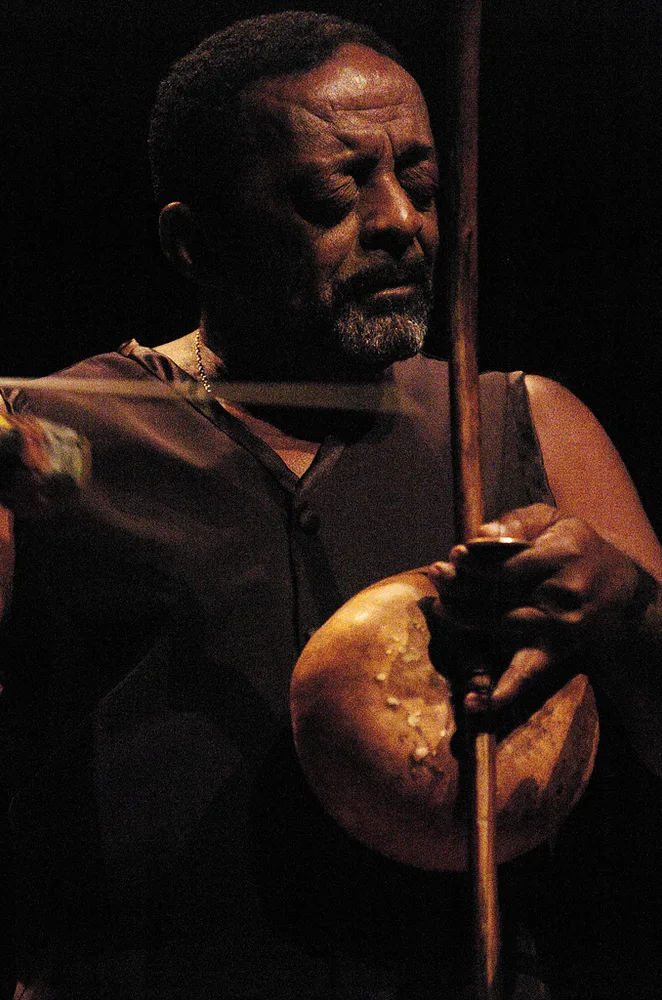
Naná Vasconcelos playing the berimbau at the inaugural concert of the Auditório Ibirapuera, São Paulo, Brazil, 2005 CC BY 2.0 — Wikimedia Commons - https://commons.wikimedia.org/wiki/File:Nan%C3%A1_Vasconcelos.jpg - photograph by Gerardo Lazzari, originally published on Flickr

Juvenal de Holanda Vasconcelos, known to everyone as Naná, was born in Recife, in the northeastern Brazilian state of Pernambuco, on August 2, 1944. His father was a working musician, and by the Brazilian accounts of his childhood the son was playing bongos and maracas in a Recife ensemble at seven or eight, teaching himself on the pots and pans at home. At twelve he was working bars with his father's marching band and sitting in with local maracatu groups, the drum-and-chant processions of the Recife carnival. He learned the drum kit first and the berimbau, the one-string gourd-resonated bow that capoeira players use, later, and in the 1960s the berimbau became the sound people identified with him.
In 1967 he moved to Rio de Janeiro and appeared on the national scene alongside the then-new singer and composer Milton Nascimento, a friendship that lasted the rest of his life. In 1968 he went to São Paulo with Geraldo Azevedo for the Quarteto Livre, the group that backed Geraldo Vandré at the third Festival Internacional da Canção. He played on Gal Costa's Legal (1970), and around the start of the 1970s he formed the Trio do Bagaço with Nélson Angelo and Maurício Maestro, which played in Mexico at the invitation of Luiz Eça. The Argentine saxophonist Gato Barbieri then took him abroad. He is on Barbieri's Fenix (Flying Dutchman, 1971) and on the live El Pampero (1972), cut at the Montreux festival, and those tours of the United States and Europe were his introduction to international audiences. Don Cherry used him on the sprawling Organic Music Society (recorded 1972), where Vasconcelos composed the twelve-minute "North Brazilian Ceremonial Hymn." His first records under his own name came out in this period: The Incredible Naná (Argentina, 1971), Africadeus (Saravah, France, 1973) and Amazonas (Philips, Brazil, 1973).
The breakthrough was a record for Manfred Eicher's ECM label. Dança das Cabeças (recorded November 1976, released 1977) is a duo with the Brazilian guitarist, pianist and flutist Egberto Gismonti, made in three days, with Vasconcelos on berimbau, percussion, body percussion and voice. It won awards in several countries and made both men known well outside Brazil. He was on Gismonti's Sol do Meio Dia the next year, played on four Jon Hassell records between 1976 and 1980, including Fourth World, Vol. 1: Possible Musics with Brian Eno, and in 1977 formed Codona with Cherry and the sitarist and tabla player Collin Walcott. Three self-titled ECM albums followed (recorded September 1978, May 1980 and September 1982, released 1979, 1981 and 1983), which critics have since called an early landmark of what came to be known as world music. The trio ended with Walcott's death in 1984. His own Saudades (ECM, recorded March 1979) set a berimbau piece of nearly nineteen minutes beside members of the Stuttgart Radio Symphony Orchestra, with Gismonti on guitar.
In 1980 he began working with Pat Metheny and Lyle Mays. As Falls Wichita, So Falls Wichita Falls (recorded September 1980, released April 1981) is a trio record with Metheny and Mays on which he plays berimbau, percussion, drums and voice. He then joined the Pat Metheny Group for Offramp (recorded October 1981, released May 1982), where his wordless singing and percussion brought South American color into the band's sound, and was the special guest on the live double album Travels (ECM, 1983). Both records won the Grammy Award for Best Jazz Fusion Performance. Alongside that came ECM sessions with Jan Garbarek, starting with Eventyr (1981, with John Abercrombie) and continuing through Legend of the Seven Dreams (1988) and I Took Up the Runes (1990). In 1981 he performed at the Woodstock Jazz Festival, held for the tenth anniversary of the Creative Music Studio, and from 1984 to 1989 he was honorary president of the London School of Samba. Rolling Stone Brasil's obituary says he lived in New York for 27 years.
The 1980s and 1990s were his busiest decades as a hired and invited musician across every kind of music. He played percussion on one track of Talking Heads' Little Creatures (1985) and on six tracks of Paul Simon's The Rhythm of the Saints (1990), and the credits run on through Laurie Anderson's Strange Angels, B.B. King, Chaka Khan, Caetano Veloso's Estrangeiro and Circuladô, Marisa Monte, Ryuichi Sakamoto and the Gipsy Kings. On the jazz side he joined Jack DeJohnette's Special Edition on Irresistible Forces (1987) and Eliane Elias's Eliane Elias Plays Jobim (1990). His own records of the period include Zumbi (1983), Duas Vozes (1985), a second Gismonti duo, Bush Dance (Antilles, 1987), Lester (Soul Note), a duo with the accordionist and pianist Antonello Salis recorded in Milan in December 1985, Rain Dance (Antilles, 1989) with the Bushdancers and the percussionist Cyro Baptista, the ECM trio record If You Look Far Enough (1993) with the bassist Arild Andersen and the guitarist Ralph Towner, Storytelling (1995) and Fragments: Modern Tradition (Tzadik, 1997), on John Zorn's label. Excerpts of his Codona piece "Trayra Boia" were used on U2's "Last Night on Earth" in 1997. The Down Beat critics poll named him best percussionist year after year through the 1980s, and obituaries in the American and Brazilian press credit him with eight Grammy Awards.
He spent his later years working from Recife again. For about fifteen consecutive years he opened the city's Carnival by bringing the rival maracatu nations together, and he ran social projects that put public-school children's choirs on stage with orchestras. His later solo albums were Chegada (2005), Trilhas (2006), Sinfonia & Batuques (2011), recorded in Recife with a chamber orchestra and a children's choir and with his daughter Luz Morena on piano on three tracks, and 4 Elementos (2013). Sinfonia & Batuques won the Latin Grammy for Best Portuguese Language Roots Album at the 12th Latin Grammy Awards. In 2013 Pernambuco made him a Grand Cross of the Order of Merit of the Guararapes, and he contributed to the soundtrack of the Oscar-nominated animated film O Menino e o Mundo. In 2015 he released Café no Bule with Zeca Baleiro and Paulo Lepetit.
Vasconcelos was diagnosed with lung cancer in mid-2015, kept working through treatment, and received an honorary doctorate from the Federal Rural University of Pernambuco on December 9, 2015. He passed away in Recife on March 9, 2016, at 71, and the state of Pernambuco declared three days of official mourning. He is survived by two daughters, Jasmin Azul and Luz Morena. Pat Metheny, remembering him, called him one of the best percussionists in this music and an amazing person, and said he made friends everywhere he went with the berimbau on his shoulder.
Vasconcelos was self-taught, and what he built from that start was a one-man percussion orchestra that could be as quiet as a rainfall. He used the voice, the body, water, and anything lying around that made a sound, and he layered his own singing over the ringing of the berimbau string in a way Brazilian critics singled out as unconventional. AllMusic notes his command of odd meters such as 5/4 and 7/4, which were common in the north of Brazil and rarely heard in the south, and Brazilian writers credit him and Airto Moreira with breaking the assumption in American jazz that percussion meant Afro-Cuban congas and bongos.
His jazz credits are substantial, but the music that made his name is jazz-adjacent rather than straight jazz. The ECM duo with Gismonti, Codona with Cherry and Walcott, and the Metheny records are jazz-world records, and AllMusic's genre tags for him run from Brazilian jazz and global jazz to Latin jazz. A large part of his own catalog, though, belongs to Brazilian folk and popular music: maracatu rhythms from Pernambuco, the capoeira berimbau, the northeastern Brazilian rhythms of his childhood, the MPB circle around Milton Nascimento and Caetano Veloso. Another large part belongs to world music and pop, from the Fourth World records with Jon Hassell to the Paul Simon, Talking Heads and Laurie Anderson sessions. Brazilian accounts name the composer Heitor Villa-Lobos as an early inspiration, and the long friendships with Nascimento, Gismonti, Cherry and Metheny shaped the rest. Rolling Stone Brasil's obituary says he followed Buddhism through Metheny's influence while remaining close to the Afro-Brazilian religion candomblé.
- Fenix (1971, Flying Dutchman) - Gato Barbieri's album recorded with Lenny White, Ron Carter and Lonnie Liston Smith, and the record that put Vasconcelos's berimbau and congas before American listeners. Spotify - Fenix Listen
- Dança das Cabeças (1977, ECM) - The duo with Egberto Gismonti made in three days, the record that turned both men into international names. Spotify - Dança das Cabeças Listen
- Codona (1979, ECM) - The first of the trio's three albums with Don Cherry and Collin Walcott, built around sitar, trumpet, berimbau and cuica and including the "Colemanwonder" medley of Ornette Coleman and Stevie Wonder. Spotify - Codona Listen
- Saudades (1980, ECM) - His own record with members of the Stuttgart Radio Symphony Orchestra and the long berimbau piece "O Berimbau"; the AllMusic reviewer calls it probably his finest. Spotify - Saudades Listen
- Offramp (1982, ECM) - The Pat Metheny Group record on which his voice and percussion first changed the band's sound, and a Grammy winner. Spotify - Offramp Listen
- Lester (1988, Soul Note) - A duo of percussion, voice, piano and accordion with Antonello Salis. Spotify - Lester Listen
- Sinfonia & Batuques (2011, Azul Music) - His late orchestral-and-percussion record with a children's choir, which won the Latin Grammy for Best Portuguese Language Roots Album.
Naná Vasconcelos: Full Discography
Discogs artist: Naná Vasconcelos (266172) · Real name Juvenal de Holanda Vasconcelos · Born August 2, 1944, Recife, Pernambuco · Died March 9, 2016, Recife
Discogs lists about 500 credited releases under his name, most of them guest appearances. The tables below give his own albums in full, the Codona records, and a selection of the sideman work that matters most, with Listen links where a release could be confirmed.
Leader and Co-Leader Albums
| Album | Year | Label | Personnel & Notes | Listen | Buy |
|---|---|---|---|---|---|
| The Incredible Naná | 1971 | Tonodisc (TON-1020) | Billed on the sleeve as El Increíble Nana con Agustín Pereyra Lucena; an Argentine release | Spotify | — |
| Africadeus | 1973 | Saravah (SH 10039) | Berimbau, voice and percussion; composed by Vasconcelos; produced by Pierre Barouh for the French label | — | — |
| Amazonas | 1973 | Philips (6349.079) | Berimbau, percussion and vocals; musical direction by Vasconcelos; a Brazilian release | Spotify | — |
| Naná, Nelson Angelo, Novelli | 1975 | Saravah (SH 10044) | A trio with Nelson Angelo (guitar, organ, voice) and Novelli (contrabass, guitar, piano, voice); produced by Pierre Barouh; cover art by Jean Michel Folon | — | — |
| Kundalini | 1978 | Improvising Artists Inc. (IAI 37.38.56) | Trio record with Perry Robinson (clarinet) and Badal Roy (tabla); produced by Paul Bley | Spotify | — |
| Saudades | 1980 | ECM (ECM 1147) | Recorded March 1979. Berimbau, percussion, gong and voice, with members of the Stuttgart Radio Symphony Orchestra conducted by Mladen Guteša; Egberto Gismonti plays guitar and wrote the string music for "Cego Aderaldo"; produced by Manfred Eicher | Spotify | — |
| Zumbi | 1983 | Europa Records (JP 2013) | Written and performed by Vasconcelos; produced by Jean-Pierre Weiller | — | — |
| Rakebra / Nanatroniko | 1984 | Bagaria (BAG-X 0190784) | A 12-inch Italian release arranged with Pino Daniele | — | — |
| Asian Journal | 1985 | Music of the World (J-101) | A cassette album billed to Badal Roy, Mike Richmond, Vasconcelos and Steve Gorn | — | — |
| Duas Vozes | 1985 | ECM (ECM 1279) | Duo with Egberto Gismonti (guitars, piano, dilruba, flutes, voice); Vasconcelos on percussion, berimbau and voice; produced by Manfred Eicher | Spotify | — |
| Bush Dance | 1987 | Antilles New Directions (90698-1) | Produced and mixed by Vasconcelos, with Arto Lindsay on guitar and Peter Scherer on keyboards | — | — |
| Lester | 1988 | Soul Note (121 157-1) | Duo with Antonello Salis (piano, accordion, voice); recorded in Milan in December 1985; produced by Giovanni Bonandrini | Spotify | — |
| Rain Dance | 1989 | Antilles New Directions (500 002 1) | Billed to Nana Vasconcelos & The Bushdancers, with Cyro Baptista on percussion and vocals, Sergio Brandao on bass and cavaquinho and Teese Gohl on keyboards; produced by Gragg Lunsford and the group | — | — |
| If You Look Far Enough | 1993 | ECM (ECM 1493) | Trio record with Arild Andersen (bass) and Ralph Towner (guitars), with Audun Kleive on snare drum; Vasconcelos on percussion | Spotify | — |
| Inclassificable | 1995 | Label Bleu | Billed to Andy Sheppard, Vasconcelos and Steve Lodder | — | — |
| Storytelling | 1995 | Hemisphere (7243 8 33444 2 0) | Berimbau, percussion and voice, with a girls' choir conducted by Vasconcelos on two tracks and keyboards by Peter Scherer and Teese Gohl | Spotify | — |
| Fragments: Modern Tradition | 1997 | Tzadik (TZ 7506) | Composed and arranged by Vasconcelos; John Zorn executive producer; players include Cyro Baptista and Romero Lubambo | Spotify | — |
| Contaminação | 1999 | M. Officer Estúdio | Brazilian release | — | — |
| Minha Lôa | 2001 | Net Records | Brazilian release | Spotify | — |
| Isso vai dar repercussão | 2004 | Elo Music (ELO 0009) | With the singer and guitarist Itamar Assumpção and the bassist Paulo Lepetit; Vasconcelos on zabumba, triangle, caxixi, cuica, cymbal and percussion | Spotify | — |
| Chegada | 2005 | Azul Music (AMCD 332) | With Lui Coimbra, César Michiles and Chiquinho Chagas among the players | Spotify | — |
| Fandango Jazz Festival Rome Italy 15th July 2004 | 2005 | Cajú Records | Live trio recording billed to Vasconcelos, Antonello Salis and Consolmagno | — | — |
| Trilhas | 2006 | Azul Music (AMCD 432) | Voice and percussion, with strings, flutes, cavaquinho and soprano saxophone | Spotify | — |
| Visions of Dawn | 2009 | Far Out Recordings (FARO 138LP) | Billed to Joyce, Vasconcelos and Mauricio Maestro; Vasconcelos on percussion | — | — |
| Sementeira: Sons da Percussão | 2010 | Baluarte Agência de Projetos Culturais | With Caito Marcondes, Marcos Suzano and Coração Quiáltera | Spotify | — |
| Sinfonia & Batuques | 2011 | Azul Music (AMCD974) | Recorded in Recife with the Orquestra Experimental de Câmara and a children's choir; his daughter Luz Morena plays piano on three tracks. Latin Grammy winner, Best Portuguese Language Roots Album | — | — |
| 4 Elementos | 2013 | Pernambuco | Released June 25, 2013 | Spotify | — |
| Café no Bule | 2015 | Selo SESC SP | With Zeca Baleiro and Paulo Lepetit | Spotify | — |
Codona
The trio of Collin Walcott, Don Cherry and Vasconcelos, billed under the group name. All three records are on ECM and produced by Manfred Eicher.
| Album | Year | Label | Personnel & Notes | Listen | Buy |
|---|---|---|---|---|---|
| Codona | 1979 | ECM (ECM 1132) | Recorded September 1978. Collin Walcott (sitar, tabla, hammered dulcimer, sanza, voice), Don Cherry (trumpet, flute, doussn'gouni, voice), Vasconcelos (berimbau, cuica, percussion, voice); produced by Manfred Eicher. Includes the "Colemanwonder" medley | Spotify | — |
| Codona 2 | 1981 | ECM (ECM 1177) | Recorded May 1980. Vasconcelos on berimbau, talking drum, percussion and voice; Cherry adds melodica; Walcott adds mbira and timpani | — | — |
| Codona 3 | 1983 | ECM (ECM-1-1243) | Recorded September 1982. Includes Vasconcelos's "Trayra Boia," excerpts of which U2 used on "Last Night on Earth" in 1997 | Spotify | — |
| The Codona Trilogy | 2008 | ECM | Compilation of the three albums | Spotify | — |
Guest and Sideman Appearances (selected)
His credit is given as Discogs lists it; where the listing names no instrument or track, the table says only that he is credited on the release.
| Album | Year | Actual leader | His credit | Listen | Buy |
|---|---|---|---|---|---|
| Fenix | 1971 | Gato Barbieri | Berimbau and congas; Flying Dutchman FD 10144, produced by Bob Thiele, with Lenny White, Ron Carter and Lonnie Liston Smith | Spotify | — |
| El Pampero | 1972 | Gato Barbieri | Percussion and berimbau; live at the Montreux festival; Flying Dutchman FD 10151 | Spotify | — |
| Swiss Suite | 1972 | Oliver Nelson | Credited on the release (Philips) | — | — |
| Organic Music Society | 1973 | Don Cherry | Berimbau and percussion; composer of "North Brazilian Ceremonial Hymn"; recorded 1972, Caprice | — | — |
| Milagre dos Peixes | 1973 | Milton Nascimento | Credited on the release (Odeon) | — | — |
| Dança das Cabeças | 1977 | Egberto Gismonti | Berimbau, percussion, body percussion and voice, in a duo with Gismonti; ECM 1089, recorded November 1976 | Spotify | — |
| Sol do Meio Dia | 1978 | Egberto Gismonti | Credited on the release (ECM 1116) | — | — |
| Earthquake Island and Vernal Equinox | 1978 | Jon Hassell | Credited on the release (Tomato and Lovely Music) | — | — |
| Journey to Dawn | 1979 | Milton Nascimento | Credited on the release (A&M) | — | — |
| City Connection | 1979 | Terumasa Hino | Credited on the release (Flying Disk) | — | — |
| For Sure! | 1980 | Woody Shaw | Credited on the release (Columbia) | — | — |
| Fourth World, Vol. 1: Possible Musics | 1980 | Jon Hassell and Brian Eno | Credited on the release (Editions EG / Polydor) | — | — |
| Naughty | 1980 | Chaka Khan | Credited on the release (Warner Bros.) | — | — |
| Now Appearing at Ole Miss | 1980 | B.B. King | Credited on the release (MCA) | — | — |
| As Falls Wichita, So Falls Wichita Falls | 1981 | Pat Metheny and Lyle Mays | Berimbau, percussion, drums and vocals; ECM 1190, recorded September 1980 | — | — |
| Eventyr | 1981 | Jan Garbarek, Vasconcelos and John Abercrombie | Berimbau, talking drum, percussion and voice, and co-composer; ECM 1200 | Spotify | — |
| Patrão | 1981 | Ron Carter | Credited on the release (Milestone) | — | — |
| Offramp | 1982 | Pat Metheny Group | Percussion, voice and berimbau; ECM 1216, recorded October 1981. Grammy winner, Best Jazz Fusion Performance | Spotify | — |
| Travels | 1983 | Pat Metheny Group | Special guest on percussion, voice and berimbau; live double album, ECM 1252/53. Grammy winner, Best Jazz Fusion Performance | Spotify | — |
| Passionfruit | 1983 | Michael Franks | Credited on the release (Warner Bros.) | — | — |
| The Search | 1983 | Chico Freeman | Credited on the release (India Navigation) | — | — |
| Singing Drums | 1984 | Pierre Favre Ensemble | Credited on the release (ECM) | — | — |
| String Band | 1984 | Enrico Rava | Credited on the release (Soul Note) | — | — |
| Little Creatures | 1985 | Talking Heads | Percussion on one track (side one, track five); Sire 9 25305-1 | — | — |
| Irresistible Forces | 1987 | Jack DeJohnette's Special Edition (Jack DeJohnette) | Credited on the release (MCA Impulse!) | — | — |
| Down by Law | 1987 | John Lurie | Credited on the release (Made to Measure / Crammed Discs) | — | — |
| Legend of the Seven Dreams | 1988 | Jan Garbarek | Credited on the release (ECM) | — | — |
| Strange Angels | 1989 | Laurie Anderson | Credited on the release (Warner Bros.) | — | — |
| Moonstone | 1989 | Toninho Horta | Credited on the release (Verve Forecast) | Spotify | — |
| Estrangeiro | 1989 | Caetano Veloso | Credited on the release (Philips) | — | — |
| Beauty | 1989 | Ryuichi Sakamoto | Credited on the release (Virgin) | — | — |
| The Rhythm of the Saints | 1990 | Paul Simon | Vocals, percussion, berimbau, gourd, triangle and congas on tracks 2, 3, 5 and 8 to 10; Warner Bros. 9 26098-2 | — | — |
| Eliane Elias Plays Jobim | 1990 | Eliane Elias | Percussion, alongside Eddie Gomez and Jack DeJohnette; Blue Note CDP 7 93089 2 | — | — |
| I Took Up the Runes | 1990 | Jan Garbarek | Credited on the release (ECM) | — | — |
| Multikulti | 1990 | Don Cherry | Credited on the release (A&M) | — | — |
| Circuladô | 1991 | Caetano Veloso | Credited on the release (Philips) | — | — |
| Upfront | 1992 | David Sanborn | Credited on the release (Elektra) | — | — |
| Secret Story | 1992 | Pat Metheny | Credited on the release (Geffen) | — | — |
| Fantasia and Paulistana | 1992 and 1993 | Eliane Elias | Credited on the release (Blue Note) | — | — |
| Like a River | 1993 | Yellowjackets | Credited on the release (GRP) | — | — |
| Union Cafe | 1993 | Penguin Cafe Orchestra | Credited on the release (Zopf) | — | — |
| Black Orpheus | 1994 | Trio da Paz (Duduka Da Fonseca) | Percussion alongside Cyro Baptista; Kokopelli | — | — |
| Arv | 1994 | Arild Andersen | Credited on the release (Kirkelig Kulturverksted) | — | — |
| Pop | 1997 | U2 | Excerpts of his "Trayra Boia" were used on "Last Night on Earth" | — | — |
| Organic Music Theatre (Festival de Jazz de Chateauvallon 1972) | 2021 | Don Cherry's New Researches | Berimbau and percussion; archival live release, Blank Forms Editions BF-023 | — | — |
| Live in Glasgow | 2021 | Don Cherry's Nu, with Ed Blackwell, Carlos Ward and Mark Helias | Berimbau, percussion and voice; archival live release, Radio Legs Music RL021 | — | — |
- Gato Barbieri - the Argentine saxophonist who took him to the United States and Europe in the early 1970s: Fenix (1971), the live El Pampero (1972) and later Bolivia (1985).
- Don Cherry and Collin Walcott - his partners in Codona (three ECM albums, 1979 to 1983); he also played on Cherry's Organic Music Society (1972) and, after Walcott's death, on Cherry's later albums such as Multikulti (1990).
- Egberto Gismonti - the Brazilian guitarist and pianist with whom he made Dança das Cabeças (1977) and Duas Vozes (1985); Vasconcelos is also on Gismonti's Sol do Meio Dia (1978).
- Pat Metheny and Lyle Mays - As Falls Wichita, So Falls Wichita Falls (1981), the Pat Metheny Group's Offramp (1982) and Travels (1983), and later Metheny's Secret Story (1992) and Mays's solo debut (1986).
- Jan Garbarek - Eventyr (1981, with John Abercrombie), Legend of the Seven Dreams (1988) and I Took Up the Runes (1990).
- Milton Nascimento - his first national collaborator, from 1967, and a recurring partner through Milagre dos Peixes (1973), Journey to Dawn (1979) and Angelus (1993).
- Jon Hassell - four albums between 1976 and 1980, including Fourth World, Vol. 1: Possible Musics with Brian Eno.
- Perry Robinson and Badal Roy - the trio record Kundalini (1978); Roy is also on Asian Journal (1985).
- Antonello Salis - the duo record Lester (1988) and a 2005 live trio release recorded at the Fandango Jazz Festival in Rome in 2004.
- Cyro Baptista - percussion and vocals on Rain Dance (1989) with the Bushdancers.
- Jack DeJohnette and Eliane Elias - on Irresistible Forces (1987) and Eliane Elias Plays Jobim (1990), where Vasconcelos plays percussion beside DeJohnette and Elias; he also appears on Elias's Fantasia (1992) and Paulistana (1993).
- Andy Sheppard - the saxophonist's Inclassificable (1995), recorded with Vasconcelos and Steve Lodder.
- Toninho Horta - percussion on Horta's Moonstone (1989).
- Arild Andersen and Ralph Towner - the ECM trio If You Look Far Enough (1993) and Andersen's Sagn (1990) and Arv (1994).
- Mauricio Maestro and Joyce - his Trio do Bagaço partner Maestro and the singer Joyce made Visions of Dawn (2009) with him, and he is also on Maestro's Upside Down (2011).
- Zeca Baleiro and Paulo Lepetit - Café no Bule (2015); Lepetit also plays on Isso vai dar repercussão (2004), his record with Itamar Assumpção.
- Woody Shaw, Ron Carter, Chico Freeman, Enrico Rava and Oliver Nelson - jazz leaders on whose records he appears as a guest, among them Shaw's For Sure! (1980), Carter's Patrão (1981), Freeman's The Search (1983), Rava's String Band (1984) and Nelson's Swiss Suite (1972).
- Terumasa Hino and Ryuichi Sakamoto - on Hino's City Connection (1979) and Sakamoto's Beauty (1989).
- David Sanborn, Michael Franks and Herb Alpert - crossover leaders on whose records he plays, among them Sanborn's Upfront (1992), Franks's Passionfruit (1983) and Alpert's You Smile - The Song Begins (1974).
- Outside jazz: Paul Simon, Talking Heads, Laurie Anderson, B.B. King, Chaka Khan, Carly Simon, Caetano Veloso, Gal Costa, Marisa Monte, Gipsy Kings, Penguin Cafe Orchestra and U2.
More Ethno Jazz Artists
See all 233 Ethno Jazz artists →More Brazilian Jazz Artists
See all 35 Brazilian artists →- Wikipedia: Naná Vasconcelos
- Wikipedia (Portuguese): Naná Vasconcelos
- AllMusic: Naná Vasconcelos
- Discogs: Naná Vasconcelos
- MusicBrainz: Naná Vasconcelos
- Rolling Stone Brasil: Todas as Línguas Dizem Naná
- Percussive Arts Society: In Memoriam, Naná Vasconcelos
- Afropop Worldwide: Genre-Defying Brazilian Percussionist Naná Vasconcelos Dies at 71
- The World (PRX): Remembering Nana Vasconcelos, renowned Brazilian percussionist
- UFMG: Naná Vasconcelos and the 2011 Latin Grammy
- Wikipedia: Codona (band)
- Wikipedia: Dança das cabeças
- Wikipedia: Saudades (Naná Vasconcelos album)
- Wikipedia: As Falls Wichita, So Falls Wichita Falls
- Wikipedia: Offramp (album)
- Wikipedia: Travels (Pat Metheny Group album)
- Wikipedia: Little Creatures