 JAZZPROFILES lives in the music 2,555 Jazz Artists fully Profiled!
Bunny Berigan
Last updated November 9, 2026
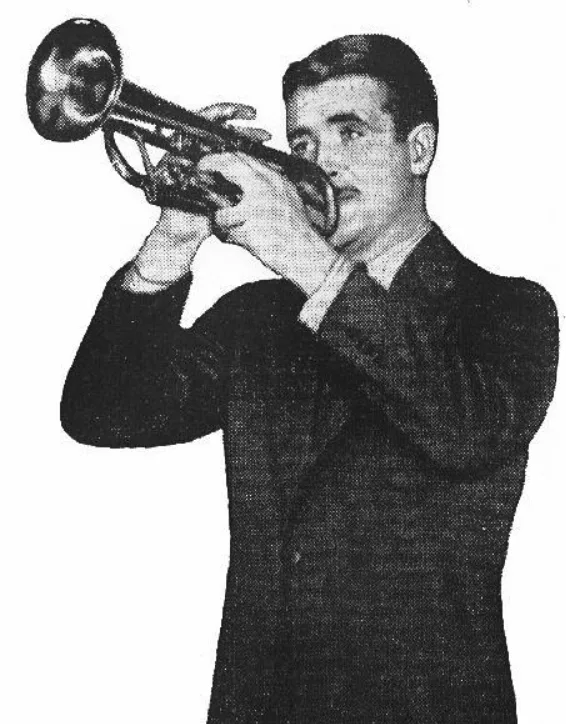
Bunny Berigan playing the trumpet, from an advertisement in the November 11, 1944 issue of Billboard (photographer unknown) Public Domain (United States advertisement published in 1944 without a copyright notice) — Wikimedia Commons — https://commons.wikimedia.org/wiki/File:Bunny_Berrigan.jpg

Roland Bernard Berigan was born on November 2, 1908, in Hilbert, Wisconsin, the son of William Patrick Berigan and Mary Catherine (Mayme) Schlitzberg, and grew up in Fox Lake. He learned violin and trumpet and played in local bands as a teenager, including the University of Wisconsin's jazz ensemble, although he never attended the university. AllMusic adds that by age 12 he was playing in a youth band organized by his grandfather. Hal Kemp's orchestra turned him down at first, and he joined it in late 1929; his first recorded trumpet solos are with that band, which toured England and a few other European countries in 1930. Back in the United States late that year, he became one of New York's busiest studio trumpeters, working for Fred Rich, Freddy Martin, and Ben Selvin, and he joined the staff of the CBS radio network in early 1931. His first recorded vocal, "At Your Command," came with Rich that year. From late 1932 through early 1934 he sat in Paul Whiteman's orchestra, and he spent a short time with Abe Lyman's band in 1934. Between those jobs he freelanced on hundreds of commercial records, most notably with the Dorsey Brothers, led by Tommy Dorsey and Jimmy Dorsey, and with the Boswell Sisters. AllMusic's biography also places him in the pit band of the Broadway show Everybody's Welcome alongside the Dorsey brothers and Jack Teagarden, and in Rich's CBS studio band with Artie Shaw.
In 1935 he played on Glenn Miller's earliest recording as a leader, "Solo Hop," and joined Benny Goodman's new swing band. The producer John Hammond later wrote that he helped persuade Gene Krupa to rejoin Goodman by pointing out that Berigan, whom Krupa admired, had already signed on. With both of them in the lineup the band made the tour that reached the Palomar Ballroom in Los Angeles, where it opened on August 21, 1935, an engagement often credited with launching the swing era. Berigan took solos on Goodman records including "King Porter Stomp," "Sometimes I'm Happy," and "Blue Skies." He left Goodman to freelance again in New York, and from late 1935 through 1936 he began to record regularly under his own name. On December 13, 1935, he led a small group billed as Bunny Berigan and His Blue Boys for Decca, a session produced by Hammond for release in Britain on Parlophone, which yielded his compositions "Chicken and Waffles" and "Blues." He also backed singers such as Bing Crosby, Mildred Bailey, and Billie Holiday; session records list him on trumpet for two 1936 Holiday dates, July 10 and September 29. On April 13, 1936, he recorded "I Can't Get Started" for Vocalion, the first of two versions that made the song his theme. In the same years he was a regular on CBS Radio's Saturday Night Swing Club, appearing from 1936 into 1937.
He worked with Tommy Dorsey's orchestra in late 1936 and early 1937 as a jazz soloist on Dorsey's radio program and records, and his solo on the hit "Marie" became one of his signature performances; AllMusic also credits him with the trumpet solo on "Song of India." On March 31, 1937, he joined Dorsey, Fats Waller, guitarist Dick McDonough, and drummer George Wettling at Victor's New York studio for A Jam Session at Victor, an unrehearsed date built on "Honeysuckle Rose" and a blues; the record reached number four on the pop chart. Meanwhile he assembled a band of his own to record and tour, and on August 7, 1937, it recorded "I Can't Get Started" for Victor, with Berigan singing. Issued on Victor 25728 in 1938, it reached number 10 on the chart, and in 1975 it was inducted into the Grammy Hall of Fame. Over the next two years his orchestra made some of its best-known records for Victor, among them "Caravan" and "A Study in Brown" (August 18, 1937), "Livery Stable Blues" and "High Society" (September 13, 1938), and the late-1938 sides "Sobbin' Blues" and "Jelly-Roll Blues." Players in the band over the years included the drummers Buddy Rich, Dave Tough, George Wettling, Johnny Blowers, and Jack Sperling; the saxophonists Georgie Auld, Gus Bivona, Joe Dixon, Andy Fitzgerald, and Don Lodice; the pianists Joe Bushkin and Joe Lipman; the trombonist Sonny Lee; the bassists Hank Wayland and Morty Stulmaker; and the singers Danny Richards, Ruth Bradley, and Kathleen Lane.
Berigan led the band full-time from early 1937 until June 1942, apart from a six-month stretch in 1940 as a sideman with Dorsey. His alcoholism and a run of business misfortunes undermined the band's finances, and he declared bankruptcy in 1939. He had an affair with the singer Lee Wiley that lasted from 1936 into 1940. By September 1940 he was leading a small group, and he then put together another touring big band that did moderately well into early 1942. On April 20, 1942, he was hospitalized in Pittsburgh with pneumonia, and doctors found that cirrhosis had badly damaged his liver. They told him to stop drinking and stop playing; he did neither, rejoined the band on tour, and returned to his room at the Van Cortlandt Hotel in New York City, where he suffered a massive hemorrhage on May 31, 1942. He passed away two days later, on June 2, at Stuyvesant Polyclinic Hospital, at 33. He was buried in St. Mary's Cemetery south of Fox Lake, after a funeral at Saint Malachy's Roman Catholic Church in New York.
As he had wished, his band stayed together under his name, with his widow, Donna Berigan, holding his financial interest and tenor saxophonist Vido Musso taking over as leader. Victor issued a posthumous compilation of his band recordings in 1944. His 1937 "I Can't Get Started" has been used in films including Martin Scorsese's short The Big Shave (1967), Save the Tiger (1973), and Chinatown (1974). Fox Lake held an annual Bunny Berigan Jazz Jubilee from 1974 to 2018, and he was inducted into the ASCAP Jazz Wall of Fame in 2008. Two full-length biographies exist: Robert Dupuis's Bunny Berigan: Elusive Legend of Jazz (1993) and Michael P. Zirpolo's Mr. Trumpet: The Trials, Tribulations and Triumph of Bunny Berigan (2011).
Berigan modeled his trumpet style in part on Louis Armstrong's and often named Armstrong as his idol; Armstrong in turn praised his playing both before and after his death. AllMusic's Scott Yanow writes that from 1935 through 1939 he was regarded as the top trumpeter in jazz, with Roy Eldridge and Armstrong his main rivals, and describes a beautiful tone, a wide range with memorable low notes as well as upper-register shouts, and a willingness to take risks in a solo even when it occasionally failed. Most of his work was done inside dance orchestras and studio bands, which is why much of the evidence is in short 78 rpm solos: "Marie" and "Song of India" with Tommy Dorsey were so well known that Dorsey later had them written out and orchestrated for his whole trumpet section, according to AllMusic. His theme song outlived him. Wikipedia's list of recordings of "I Can't Get Started" includes versions by Billie Holiday with Lester Young (1938), Dizzy Gillespie (1945), Charlie Parker (1953), Sonny Rollins (1957), Ella Fitzgerald (1962), and Maynard Ferguson (1974), and Ferguson's profile describes his version as a tribute to Berigan.
- I Can't Get Started / The Prisoner's Song (1938, Victor) - The August 7, 1937 recording by his orchestra, with Berigan on trumpet and vocal; it was first issued in September 1937 on the 12-inch Victor 36208 as part of the album A Symposium of Swing and then as the 10-inch Victor 25728, and it entered the Grammy Hall of Fame in 1975. Spotify - I Can't Get Started Listen
- I Can't Get Started / Rhythm Saved the World (1936, Vocalion) - The first recording of his signature piece, made on April 13, 1936 with a small group billed as His Boys, before the extended trumpet introduction of the later version.
- Chicken and Waffles and Blues (Bunny Berigan and His Blue Boys, recorded December 13, 1935, Decca and Parlophone) - His small-group debut on record under his own name, with two of his own compositions.
- A Jam Session at Victor (1937, Victor) - Berigan, Tommy Dorsey, Fats Waller, Dick McDonough, and George Wettling improvising on "Honeysuckle Rose" and a blues, recorded March 31, 1937.
- Caravan / A Study in Brown (1937, Victor) - Two of the orchestra's most admired instrumental sides, recorded August 18, 1937.
- Marie (1937, Victor) - Tommy Dorsey's hit, whose trumpet solo by Berigan became one of his most celebrated.
- Gangbusters (1992, Hep) - A CD of his orchestra's Victor sessions from September 13 to December 1, 1938, including "Livery Stable Blues," "High Society," "Sobbin' Blues," and four pieces associated with Bix Beiderbecke cut by a small group, Bunny Berigan and His Men.
- The Complete Brunswick, Parlophone and Vocalion Bunny Berigan Sessions (2003, Mosaic) - A seven-CD box of more than 150 recordings made from 1931 to 1935, the early studio work that preceded his own orchestra.
Bunny Berigan: Full Discography
Discogs artist ID 269601 ("Bunny Berigan," real name Roland Bernard Berigan, born November 2, 1908, in Hilbert, Wisconsin, died June 2, 1942, in New York City) lists about 900 entries, most of them reissues, compilations, and appearances on other leaders' records. His own bands are filed under separate Discogs entries, which were checked: "Bunny Berigan & His Orchestra" (artist ID 283174), "Bunny Berigan And His Boys" (349516), "Bunny Berigan And His Blue Boys" (1993777), "Bunny Berigan And His Men" (3800824), and "Bunny Berigan's Rhythm-Makers" (3594617). Nearly all of his work was issued first on 78 rpm records and reached LP and CD only as reissues, so the leader table below is a curated selection of 16 important releases: the key 78s, the early memorial and reissue albums, and the main CD collections. Recording dates for the Victor, Vocalion, and Decca sessions come from the Discography of American Historical Recordings and from the release notes on Discogs; where a date, label, or catalog number could not be confirmed, the cell says so.
As Leader / Co-Leader
| Album Title | Recording Date(s) | Release Date | Label | Catalog Number | Format(s) | Personnel | Role | Reissue History | Spotify | Buy | Notes |
|---|---|---|---|---|---|---|---|---|---|---|---|
| The Blue Boys (Bunny Berigan and His Blue Boys) | December 13, 1935, New York | 1957 (this EP); the sides were first issued on 78s in Britain | Parlophone | GEP 8582 | Vinyl, 7", 45 RPM, EP | Bunny Berigan (trumpet) leading a small group; full personnel Not confirmed | Leader | Decca issued two of the sides as 18116 and 18117; release dates Not confirmed | — | — | Four sides: "Blues," "I'm Coming, Virginia," "You Took Advantage of Me," and "Chicken and Waffles." The session was produced by John Hammond. |
| I Can't Get Started / Rhythm Saved the World | April 13, 1936, New York | 1936 | Vocalion | 3225 | Shellac, 10", 78 RPM | Bunny Berigan and His Boys; personnel Not confirmed (session records credit Chick Bullock as vocalist on "Rhythm Saved the World") | Leader (billed as Bunny Berigan and His Boys) | Reissued in 1976 in Columbia's Hall of Fame 45 series, paired with "Let's Do It (Let's Fall in Love)" | — | — | The first recording of his theme song. |
| Caravan / A Study in Brown | August 18, 1937, New York | 1937 (Discogs gives September 1937) | Victor | 25653 | Shellac, 10", 78 RPM | Bunny Berigan and His Orchestra; personnel Not confirmed | Leader | Reissued on many compilations; see the Camden and Bluebird sets below | — | — | The Discogs entry for this catalog number is a Canadian pressing. |
| I Can't Get Started / The Prisoner's Song | August 7, 1937, New York | 1938 (Discogs gives May 1938; Wikipedia says March 1938) | Victor | 25728 | Shellac, 10", 78 RPM | Bunny Berigan (trumpet, vocal) and His Orchestra; personnel Not confirmed | Leader | First issued in September 1937 on the 12-inch Victor 36208 in the album A Symposium of Swing; Wikipedia says a shortened version was made on December 4, 1937 for this 10-inch issue | — | — | Grammy Hall of Fame, 1975. Reached number 10 on the chart. |
| Bunny Berigan Memorial Album | 1937 to 1938 (session dates for the individual sides are in the notes) | October 1942 (Wikipedia describes a posthumous Victor compilation in 1944) | Victor | P 134 | Shellac, 4 x 10", 78 RPM, Album, Compilation | Bunny Berigan and His Orchestra | Leader | A reissue of eight earlier sides | — | — | Eight sides: "I Can't Get Started," "Frankie and Johnnie," "Trees," "Russian Lullaby," "Jelly-Roll Blues," "Black Bottom," "'Deed I Do," and "High Society." Session records date them June 25, 1937 ("Frankie and Johnnie"), August 7, 1937 ("I Can't Get Started"), December 23, 1937 ("Trees," "Russian Lullaby," "Black Bottom"), September 13, 1938 ("High Society"), and November 22, 1938 ("Jelly-Roll Blues," "'Deed I Do"). |
| Bunny Berigan Plays Again | 1937 to 1938 (see the Memorial Album notes for session dates) | 1952 | RCA Victor | LPT 1003 | Vinyl, 10", LP, Compilation, Mono | Bunny Berigan and His Orchestra | Leader | Reissue of earlier Victor sides | — | — | Eight tracks, including "I Can't Get Started," "Trees," "High Society," and "The Prisoner's Song." |
| Bunny Plays Bix | November 30 and December 1, 1938, New York | 1955 | RCA Victor | EPAT 434 | Vinyl, 7", 45 RPM, EP | Bunny Berigan and His Men; personnel Not confirmed | Leader (billed as Bunny Berigan and His Men) | Reissue of 1938 Victor sides | — | — | Four pieces: "In the Dark," "Candlelights," "Davenport Blues," and "Walkin' the Dog." Session records show the same small group also cut "In a Mist" and "Flashes" on November 30, 1938. The title refers to Bix Beiderbecke, several of whose compositions are among the sides. |
| Bunny Berigan's Last Recordings | Not confirmed | 1954 | Sparton | 4054 | Vinyl, 10", LP (Canadian issue) | Bunny Berigan and His Orchestra; personnel Not confirmed | Leader | Not confirmed | — | — | Seven tracks, including "The White Cliffs of Dover," "'Tis Autumn," and "Two in Love." The title is as printed on the release; recording dates are Not confirmed. |
| Bunny | 1937 to 1939 | 1960 | RCA Camden | CAL-550 | Vinyl, LP, Compilation | Bunny Berigan and His Orchestra | Leader | Reissue of Victor sides | — | — | Twelve tracks including "A Study in Brown," "Azure," "Jazz Me Blues," and "High Society." |
| The Indispensable Bunny Berigan | From March 31, 1937, dated track by track in the release notes | 1982 | RCA | PM 43689 | Vinyl, 2 x LP, Compilation, Mono | Bunny Berigan and His Orchestra, with the Victor sessions of 1937 and 1938 | Leader | French RCA double album | — | — | Thirty-five tracks, opening with the March 31, 1937 "A Jam Session at Victor" sides. |
| The Complete Bunny Berigan, Volume Two | From October 1937 (Discogs lists no session dates) | 1986 | Bluebird | 5657-1-RB | Vinyl, 2 x LP, Compilation | Bunny Berigan and His Orchestra | Leader | Part of the Bluebird LP series The Complete Bunny Berigan | — | — | Twenty-eight tracks beginning with "A Strange Loneliness" and including "Heigh-Ho," "Piano Tuner Man," and "Sophisticated Swing." |
| The Complete Bunny Berigan, Volume III | From mid-1938 (Discogs lists no session dates) | 1990 (Discogs master year 1989) | Bluebird | NL90439(2) | Vinyl, 2 x LP, Compilation, Remastered | Bunny Berigan and His Orchestra | Leader | German pressing of the Bluebird series | — | — | Thirty-one tracks beginning with "Ten Easy Lessons" and including "Livery Stable Blues" and "High Society." |
| Portrait of Bunny Berigan | Not itemized | 1989 | ASV (Living Era) | ZC AJA 5060 | Cassette, Compilation | Bunny Berigan in several settings, including "Solo Hop," "King Porter Stomp," and the Blue Boys' "Chicken and Waffles" | Leader and featured sideman | UK budget compilation | — | — | A mix of his own dates and his best-known work in other leaders' bands. |
| Gangbusters | September 13, October 14, November 22, November 30, and December 1, 1938, New York | 1992 | Hep | HEP CD 1036 | CD, Compilation, Remastered, Mono | Bunny Berigan and His Orchestra, plus the small group Bunny Berigan and His Men | Leader | UK CD | — | — | Includes "Livery Stable Blues," "High Society," "Sobbin' Blues," "Jelly Roll Blues," and "In a Mist." |
| The Pied Piper (1934-40) | 1934 to 1940, dated track by track in the release notes | 1995 | RCA Bluebird | BG2-66615 | CD, Compilation | Bunny Berigan with his own orchestra and as soloist with Benny Goodman and Tommy Dorsey | Leader and featured sideman | US CD | — | — | Includes "Sometimes I'm Happy," "King Porter Stomp," "Marie," "Song of India," "I Can't Get Started," and "The Prisoner's Song." |
| The Complete Brunswick, Parlophone and Vocalion Bunny Berigan Sessions | 1931 to 1935 | 2003 | Mosaic | MD7-219 | 7 x CD, Box Set, Limited Edition, Mono | Bunny Berigan with the studio bands, singers, and leaders of the early 1930s | Leader and sideman | Out-of-print limited edition from Mosaic Records | — | — | More than 150 recordings made between 1931 and 1935, according to AllMusic. AllMusic dates the release 2004; MusicBrainz and dealer listings give 2003. |
As Sideman (selected major credits)
Berigan was one of the busiest studio trumpeters in New York in the early 1930s and made hundreds of records behind other leaders. The table below is a representative set of the credits that matter most, not an exhaustive list.
| Year | Project (Leader) | Title | Label | Catalog | Role | Notes |
|---|---|---|---|---|---|---|
| 1933 | Roy Bargy, with the singer Ramona | Victor sessions of April 20, August 16, and October 20, 1933 | Victor | Not confirmed (matrices BS-75671 to BS-75673 for the April 20 session) | Trumpet | Female vocal sides; Berigan was then in Paul Whiteman's orchestra. |
| 1935 | Glenn Miller | Solo Hop | Columbia | Not confirmed | Trumpet | Glenn Miller's first recording under his own name. |
| 1935 | Benny Goodman and His Orchestra | King Porter Stomp; Sometimes I'm Happy | Victor | Not confirmed | Trumpet (solos) | Recorded July 1, 1935 per Goodman's profile; Berigan solos on both per AllMusic. |
| 1936 | Red McKenzie and the Mound City Blue Blowers; Red McKenzie and His Rhythm Kings | Decca sessions of January 3, 8, and 20, February 5, and April 3, 1936 | Decca | Not confirmed | Trumpet | Includes "I Can't Get Started with You" (April 3, 1936) and the Mound City Blue Blowers' "I'm Gonna Sit Right Down and Write Myself a Letter." |
| 1936 | Chick Bullock, with Bunny Berigan and His Boys | ARC sessions of February 24, April 13, and June 9, 1936 | American Record Corporation | Not confirmed | Trumpet, leader of the accompanying group | Includes "Swing, Mr. Charlie" and "Rhythm Saved the World." |
| 1936 | Billie Holiday and Her Orchestra | "Did I Remember?," "No Regrets," "Summertime," "Billie's Blues" (July 10); "A Fine Romance," "I Can't Pretend," "One, Two, Button Your Shoe," "Let's Call a Heart a Heart" (September 29) | American Record Corporation | Not confirmed | Trumpet | Session records credit Berigan on trumpet for both dates. |
| 1937 | Tommy Dorsey and His Orchestra | Marie; Song of India | Victor | Not confirmed | Trumpet (solos) | Recording dates Not confirmed; his solos made both sides famous. |
| 1937 | Fats Waller, Tommy Dorsey, Bunny Berigan, Dick McDonough, George Wettling | A Jam Session at Victor (Honeysuckle Rose; Blues) | Victor | 25559 | Trumpet | Recorded March 31, 1937; released April 21, 1937 per Discogs; reached number four on the pop chart. |
| 1940 | Tommy Dorsey and His Orchestra | Funny Little Pedro; Whispering; Quiet Please! (It's the Drummer in Me) | Victor | Not confirmed | Trumpet | Recorded June 13, 1940, during his six months in Dorsey's band; the last title features Buddy Rich. |
| 1940 | Lee Wiley | Let's Fly Away; Let's Do It; Hot-House Rose; Find Me a Primitive Man | Columbia | Not confirmed | Trumpet; accompaniment billed as Bunny Berigan's Music | Four Cole Porter songs recorded in 1940. |
The full list is on Discogs.
- Benny Goodman - 1935 sideman in his new swing band, soloist on "King Porter Stomp" and "Sometimes I'm Happy," and in the lineup for the Palomar Ballroom engagement that opened on August 21, 1935.
- Gene Krupa - drummer in Goodman's band and an admirer of Berigan, who according to John Hammond was brought back to the Goodman band partly because Berigan had already signed on.
- Tommy Dorsey - employed Berigan as a jazz soloist in late 1936 and early 1937 and again for about six months in 1940; they recorded "Marie," A Jam Session at Victor, and Victor sessions on June 13, 1940.
- Jimmy Dorsey - co-leader with Tommy of the Dorsey Brothers, on whose records Berigan appeared in the early 1930s.
- Glenn Miller - trombonist and arranger on whose first record as a leader, "Solo Hop" (1935), Berigan played.
- Billie Holiday - sang on two 1936 sessions (July 10 and September 29) with Berigan on trumpet, organized under the producer John Hammond.
- Mildred Bailey - singer whom he accompanied in the mid-1930s.
- Fats Waller - pianist and fellow participant in A Jam Session at Victor (March 31, 1937) and in a January 16, 1937 broadcast of Saturday Night Swing Club.
- Buddy Rich, Dave Tough, George Wettling, Johnny Blowers, Jack Sperling - drummers in his orchestra at various times.
- Georgie Auld, Joe Bushkin, Hank Wayland, Joe Lipman, Sonny Lee, Gus Bivona, Don Lodice - sidemen in the 1937 to 1942 orchestras.
- Red McKenzie - singer and comb player, fronting the Mound City Blue Blowers and the Rhythm Kings on Decca sessions in early 1936 with Berigan on trumpet; they also worked together at the Famous Door club.
- Chick Bullock - singer on several of Berigan's 1936 sessions with his small group.
- Lee Wiley - singer, his romantic partner from 1936 to 1940, and the vocalist on four Cole Porter songs recorded in 1940.
- Paul Whiteman, Hal Kemp, Fred Rich, Abe Lyman - bandleaders he worked for in the early 1930s.
- Vido Musso, Donna Berigan - the tenor saxophonist who took over the orchestra after Berigan's death, and the widow who kept its financial interest.
More Swing Artists
See all 273 Swing artists →More American Jazz Artists
See all 876 American artists →- Wikipedia: Bunny Berigan
- Wikipedia: I Can't Get Started
- Wikipedia: A Jam Session at Victor
- AllMusic: Bunny Berigan biography by Scott Yanow
- Discography of American Historical Recordings: Bunny Berigan
- Discogs: Bunny Berigan (artist 269601)
- MusicBrainz: Bunny Berigan
- JazzProfiles.com: Benny Goodman
- JazzProfiles.com: Tommy Dorsey
- JazzProfiles.com: Buddy Rich