 JAZZPROFILES lives in the music 2,303 Jazz Artists fully Profiled!
Bix Beiderbecke
Last updated November 3, 2026
Listen on Spotify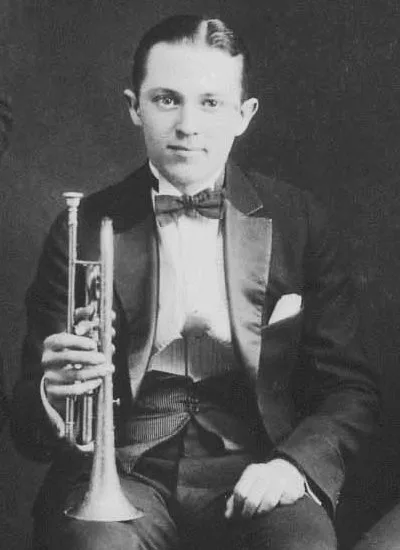
Bix Beiderbecke with his cornet at Doyle's Academy of Music in Cincinnati, Ohio, 1924, cropped from a group photograph of the Wolverine Orchestra Public Domain (1924 photograph by an unknown photographer, published without a copyright notice; tagged PD-US-no-notice on Wikimedia Commons) — Wikimedia Commons - https://commons.wikimedia.org/wiki/File:Bix_Beiderbecke_cropped.jpg

Bix Beiderbecke was born on March 10, 1903, in Davenport, Iowa, the youngest of three children of Bismark Herman Beiderbecke, a coal and lumber merchant of German descent, and Agatha Jane Hilton, a church organist whose father had captained Mississippi riverboats. Sources disagree on whether his given name was Leon Bismark or Leon Bix; his family called him Bix either way. He played piano by ear from the age of two or three. His brother Burnie came home from stateside service at the end of 1918 with a phonograph and records by the Original Dixieland Jazz Band, and the cornet lines of its leader Nick LaRocca became the model from which Bix taught himself the cornet, an approach that left him with an unorthodox fingering he kept for life. He attended Davenport High School from 1918 to 1921, played dance jobs with local bands, and in September 1921 was sent to Lake Forest Academy north of Chicago, where he spent evenings in Chicago clubs listening to the New Orleans Rhythm Kings at Friar's Inn and to King Oliver's Creole Jazz Band, with Louis Armstrong on second cornet. The school expelled him in May 1922 for poor grades and drinking.
He worked the Lake Michigan excursion boats with the Cascades Band in the summer of 1922 and joined the Wolverine Orchestra late in 1923, a seven-man group that took its name from Jelly Roll Morton's "Wolverine Blues." The Wolverines made their first records for Gennett in Richmond, Indiana, on February 18, 1924, cutting "Fidgety Feet" and "Jazz Me Blues," and recorded fifteen sides for the label that year, among them Hoagy Carmichael's "Riverboat Shuffle" on May 6, a tune Carmichael wrote for the band after inviting it to play at Indiana University. Bix left the group in the autumn of 1924 for Jean Goldkette's orchestra in Detroit, but his limited sight-reading and the objections of Victor's musical director to his modern style ended that stay within weeks. On January 26, 1925, he led his first session, as Bix and His Rhythm Jugglers, for Gennett, recording "Toddlin' Blues" and his own "Davenport Blues." A February 1925 stint at the University of Iowa also ended within weeks.
That summer he worked with the C-melody saxophonist Frankie Trumbauer in a Goldkette-run band, and for the rest of the decade the two were inseparable, with Trumbauer acting as a guardian. They played the Arcadia Ballroom in St. Louis, joined Goldkette's main orchestra in the spring of 1926 at Detroit's Graystone Ballroom, and on October 12, 1926, were declared winners of a "battle of the bands" against Fletcher Henderson's orchestra at New York's Roseland Ballroom. The year 1927 produced his most celebrated records. For OKeh he recorded "Singin' the Blues" and "Clarinet Marmalade" under Trumbauer's name on February 4, with guitarist Eddie Lang, followed in May by "I'm Coming, Virginia" and "Way Down Yonder in New Orleans," and on September 9 he recorded his piano solo "In a Mist," the only one of his compositions he put on record. In October he began making records as Bix and His Gang, including "At the Jazz Band Ball" and "Royal Garden Blues."
Goldkette dissolved his top band in September 1927, and after a brief spell with bass saxophonist Adrian Rollini's group at the Club New Yorker, Bix and Trumbauer joined Paul Whiteman's orchestra in Indianapolis on October 27, 1927. Whiteman led the best-paid and most popular dance band in the country, and Bix was featured on records such as "From Monday On," "Sugar" and "Changes," for which the arranger Bill Challis wrote scores built around his solos, and on hits including "Ol' Man River" with Bing Crosby. On October 7, 1928, he played "In a Mist" at a Whiteman concert at Carnegie Hall. His drinking had meanwhile worsened. On November 30, 1928, he suffered a breakdown on tour in Cleveland, and in 1929 he went home to Davenport, spent that summer with the band in Hollywood during preparations for the film The King of Jazz, and from October 14 to November 18 was treated at the Keeley Institute in Dwight, Illinois. Whiteman held his chair open, but Bix did not rejoin the orchestra after returning to New York in January 1930. He worked sparingly. In May 1930 he joined a Carmichael session that produced "Rockin' Chair" and "Barnacle Bill the Sailor," with a lineup that, per Discogs credits, also included Benny Goodman, Tommy Dorsey and Gene Krupa. He recorded as Bix Beiderbecke and His Orchestra for Victor on September 8, 1930, and a week later, on September 15, played on the first recording of Carmichael's "Georgia on My Mind," his last recording session. A regular spot in Nat Shilkret's orchestra on NBC's Camel Pleasure Hour was his only steady income.
He returned to New York for the last time in February 1931 and passed away on August 6, 1931, at 28, in his apartment in Sunnyside, Queens. The death certificate gave lobar pneumonia, with alcoholism and brain edema often cited as contributing causes. He was buried on August 11 in the family plot at Oakdale Cemetery in Davenport. Three of his piano pieces, "Candlelights," "Flashes" and "In the Dark," were transcribed with Challis's help and published but never recorded by him. His reputation grew after his death through memoirs by Carmichael, Mezz Mezzrow and Eddie Condon, Dorothy Baker's 1938 novel Young Man with a Horn (which Baker said drew on his music rather than his life) and the 1950 film of that name, and Richard Sudhalter and Philip Evans's 1974 biography Bix: Man and Legend. Davenport has held the Bix Beiderbecke Memorial Jazz Festival since 1971, and a museum and archive devoted to him opened there in 2017. "Singin' the Blues" and "In a Mist" are in the Grammy Hall of Fame, as is the 1930 "Georgia on My Mind," and he was elected to the Down Beat Jazz Hall of Fame in 1962.
Bix played cornet and never changed to trumpet. His tone was clear and round, his melodic approach centered on the middle register, and his technique was largely self-taught, in contrast to the bravura and upper-register command of Louis Armstrong, whom he admired; the critic Terry Teachout has called the two the most influential figures in early jazz. His solos on "Singin' the Blues" and "I'm Coming, Virginia" shaped what critics call the jazz ballad style: restrained, tightly constructed choruses in which each phrase answers the last. His chord choices came partly from the Impressionist harmonies of Debussy and Ravel and from the American composer Eastwood Lane, and they color his one recorded piano piece, "In a Mist." He learned from the Original Dixieland Jazz Band, the New Orleans Rhythm Kings and Armstrong, and Paul Mares of the Rhythm Kings held that the New Orleans cornetist Emmett Hardy was his chief influence. His own influence reached Carmichael, who reworked a Bix cornet phrase into the central theme of "Stardust," and Bing Crosby, who cited him as a model. Rex Stewart of Fletcher Henderson's band reproduced the "Singin' the Blues" solo almost note for note on a 1931 Henderson record, and the saxophonist Lester Young later named Trumbauer's solo on the same record as a formative model. Some writers hear in the laid-back feeling of "Singin' the Blues" a hint of the cool jazz of the 1950s that Chet Baker and Bill Evans came to personify. In his own time his playing drew attention from European critics, notably in Britain's Melody Maker, before it did in the United States, and the image of a doomed Romantic genius that took hold after his death has long shaped how he is remembered.
- Fidgety Feet / Jazz Me Blues (1924, Gennett) - The Wolverine Orchestra's first session, on February 18, 1924 (Gennett 5408), and the earliest recorded Bix solos; his "Jazz Me Blues" chorus is often cited as the first clear statement of his style.
- Toddlin' Blues / Davenport Blues (1925, Gennett) - His first session as a leader, as Bix and His Rhythm Jugglers on January 26, 1925 (Gennett 5654), introducing his composition "Davenport Blues."
- Singin' the Blues / Clarinet Marmalade (1927, OKeh) - Frankie Trumbauer and His Orchestra with Bix and Eddie Lang, recorded February 4, 1927 (OKeh 40772); the Library of Congress added "Singin' the Blues" to the National Recording Registry in 2006. Spotify - Singin' the Blues Listen
- I'm Coming, Virginia / Way Down Yonder in New Orleans (1927, OKeh) - Two more Trumbauer-band classics, recorded May 13, 1927 (OKeh 40843). Spotify - I'm Coming Virginia Listen
- In a Mist / Wringin' an' Twistin' (1927, OKeh) - His solo piano composition, recorded September 9, 1927 (OKeh 40916) and paired with a Trumbauer-band side; it is in the Grammy Hall of Fame.
- At the Jazz Band Ball / Jazz Me Blues (1927, OKeh) - The first Bix and His Gang session in New York, on October 5, 1927 (OKeh 40923), with a small band assembled around him.
- Georgia on My Mind (1930, Victor) - Hoagy Carmichael and His Orchestra, recorded September 15, 1930 (Victor 23013), with Bix, Eddie Lang, Joe Venuti, Jimmy Dorsey, Jack Teagarden and Bud Freeman; Carmichael sings.
- The Bix Beiderbecke Story (1952, Columbia) - The three-volume Columbia LP series (GL 507, GL 508 and GL 509) that gathered his Bix and His Gang, Trumbauer-band and Whiteman recordings, later reissued on the Columbia Jazz Masterpieces CDs Singin' the Blues (CK 45450) and At the Jazz Band Ball (CK 46175), both 1990.
Bix Beiderbecke: Full Discography
Discogs artist ID 282067 ("Bix Beiderbecke," real name Leon Bismark Beiderbecke, born March 10, 1903, in Davenport, Iowa, died August 6, 1931, in Queens, New York) was read in full on Discogs. It lists about 1,200 entries, almost all posthumous compilations and reissues, because he made no albums in his lifetime: his work was issued as 78-rpm sides, and the LP and CD era collected them. Discogs also files his band billings under separate entries, which were checked and are folded into the tables below: Bix Beiderbecke And His Gang (artist ID 326834), Bix And His Rhythm Jugglers (338447), Bix Beiderbecke And His Orchestra (338449), The Wolverine Orchestra (338451), Bix Beiderbecke And The Wolverines (2691117), and the New Orleans Lucky Seven entries (348877 and 4925293). Because the reissue catalog runs to hundreds of overlapping titles, the leader table is a curated selection: the original 78s issued under his own name, plus the landmark reissue sets. The second table lists his principal recordings as a sideman with the Wolverines, Jean Goldkette, Frankie Trumbauer, Paul Whiteman and Hoagy Carmichael. Catalog numbers for the 78s are those of the original US issue; recording dates come from Wikipedia and Discogs release notes, and where a detail could not be confirmed the Notes column says so.
As Leader / Co-Leader
| Album Title | Recording Date(s) | Release Date | Label | Catalog Number | Format(s) | Personnel | Role | Reissue History | Spotify | Buy | Notes |
|---|---|---|---|---|---|---|---|---|---|---|---|
| Toddlin' Blues / Davenport Blues | January 26, 1925, Richmond, Indiana | March 1925 | Gennett | 5654 | Shellac, 10", 78 RPM | Bix Beiderbecke (cornet) with members of the Jean Goldkette orchestra; Tommy Dorsey (trombone), per his profile; remaining lineup not confirmed | Leader (billed as Bix and His Rhythm Jugglers) | Reissued on many compilations; see Discogs master 1536764 | — | — | His first session as a leader; "Davenport Blues" is his own composition. |
| In a Mist / Wringin' an' Twistin' | September 9, 1927 ("In a Mist"); September 17, 1927 ("Wringin' an' Twistin'"), New York | December 1927 | OKeh | 40916 | Shellac, 10", 78 RPM | Bix Beiderbecke (piano) on "In a Mist"; the B side is a Frankie Trumbauer band recording on which he also plays piano | Leader (A side, solo piano) | Reissued on the Columbia, Mosaic and BX Records sets below; see Discogs master 1166700 | — | — | "In a Mist" is the only piano solo he recorded. |
| At the Jazz Band Ball / The Jazz Me Blues | October 5, 1927, New York | November 25, 1927 | OKeh | 40923 | Shellac, 10", 78 RPM | Bix Beiderbecke (cornet) leading a band; full lineup not itemized here | Leader (billed as Bix Beiderbecke and His Gang) | Reissued on Columbia GL 507 and CD CK 46175; see Discogs master 676358 | — | — | Same session as "Royal Garden Blues" / "Goose Pimples" (OKeh 8544). |
| Sorry / Since My Best Gal Turned Me Down | October 25, 1927, New York | April 5, 1928 | OKeh | 41001 | Shellac, 10", 78 RPM | Bix Beiderbecke (cornet) leading a band; full lineup not itemized here | Leader (billed as Bix Beiderbecke and His Gang) | Reissued on Columbia GL 507; see Discogs master 803581 | — | — | |
| Wa-Da-Da (Everybody's Doin' It Now) | July 7, 1928, Chicago | 1928 | OKeh | 41088 | Shellac, 10", 78 RPM | Bix Beiderbecke (cornet) leading a band; full lineup not itemized here | Leader (billed as Bix Beiderbecke and His Gang) | Reissued on compilations | — | — | Catalog number and date per Wikipedia; not separately checked on Discogs. |
| Rhythm King | September 21, 1928, New York | 1928 | OKeh | 41173 | Shellac, 10", 78 RPM | Bix Beiderbecke (cornet) leading a band; full lineup not itemized here | Leader (billed as Bix Beiderbecke and His Gang) | Reissued on compilations | — | — | Catalog number and date per Wikipedia; not separately checked on Discogs. |
| I Don't Mind Walking in the Rain / I'll Be a Friend with Pleasure | September 8, 1930, New York | 1930 | Victor | 23008 | Shellac, 10", 78 RPM | Bix Beiderbecke (cornet) leading a band; full lineup not itemized here | Leader (billed as Bix Beiderbecke and His Orchestra) | Reissued on compilations; see Discogs master 2592539 | — | — | His last session under his own name. |
| The Bix Beiderbecke Story, Volume 1: Bix and His Gang | October 1927 to 1928 | April 1952 | Columbia | GL 507 | Vinyl, LP, Compilation | Bix Beiderbecke and His Gang | Leader (compilation) | Reissued on CD as At the Jazz Band Ball (CK 46175, 1990); see Discogs master 337921 | — | — | First of three Columbia LPs of his recordings; twelve tracks including "Jazz Me Blues," "Sorry," "Thou Swell" and "Royal Garden Blues." |
| The Bix Beiderbecke Story, Volume 2: Bix and Tram | February 1927 to 1928 | April 1952 | Columbia | GL 508 | Vinyl, LP, Compilation, Mono | Bix Beiderbecke with Frankie Trumbauer and His Orchestra | Leader (compilation; Trumbauer band recordings) | Reissued on CD as Singin' the Blues (CK 45450, 1990); see Discogs master 365525 | — | — | Includes "Singin' the Blues," "Clarinet Marmalade," "I'm Coming Virginia" and "Riverboat Shuffle." |
| The Bix Beiderbecke Story, Volume 3: Whiteman Days | 1927 to 1929 | April 1952 | Columbia | GL 509 | Vinyl, LP, Compilation | Bix Beiderbecke with Paul Whiteman and His Orchestra and smaller groups | Leader (compilation) | See Discogs master 600011 | — | — | Includes "In a Mist," "Margie," "Borneo" and "China Boy." |
| Volume 1: Singin' the Blues | 1927 | 1990 | Columbia | CK 45450 | CD, Compilation, Remastered, Mono | Bix Beiderbecke with Frankie Trumbauer and His Orchestra and Eddie Lang | Leader (compilation) | Columbia Jazz Masterpieces series; see Discogs master 461959 | — | — | Twenty tracks, all recorded in New York in 1927. |
| Volume 2: At the Jazz Band Ball | October 1927 to April 1928 | 1990 | Columbia | CK 46175 | CD, Compilation, Mono, Remastered | Bix Beiderbecke and His Gang and Frankie Trumbauer and His Orchestra | Leader (compilation) | Columbia Jazz Masterpieces series; see Discogs master 813311 | — | — | Twenty tracks, including alternate takes. |
| The Complete Okeh & Brunswick Bix Beiderbecke, Frank Trumbauer & Jack Teagarden Sessions (1924-1936) | 1924 to 1936 | 2001 | Mosaic | MD7-211 | 7xCD, Box Set, Compilation, Mono, Limited Edition (7,500 numbered copies) | Bix Beiderbecke, Frankie Trumbauer, Jack Teagarden and others | Leader (compilation) | See Discogs release 7362768 | — | — | Seven-CD limited-edition box. |
| Bix Restored: The Complete Recordings and Alternates, Volumes 1 to 5 | 1924 to 1930 | 1998 to 2005 | BX Records | BXCD 1-3 (Vol. 1), BXCD 4-6 (Vol. 2); other volumes not confirmed | CD, Compilation, Remastered | Bix Beiderbecke with the Wolverines, Goldkette, Trumbauer, Whiteman and his own groups | Leader (compilation) | Volume 1 is Discogs master 1494028; Volume 2 was released in 1998, Volume 1 in 2000 | — | — | Five-volume restoration of his complete recordings with alternate takes; later volumes are dated 2001, 2002 and 2005. |
As Sideman and Ensemble Member (selected major credits)
A representative set, not an exhaustive list: his recordings with the Wolverine Orchestra, the Jean Goldkette Orchestra, Frankie Trumbauer's groups, Paul Whiteman's orchestra and Hoagy Carmichael. Catalog numbers and dates are from Wikipedia unless the Notes column says the 78 was checked on Discogs.
| Year | Project (Leader) | Title | Label | Catalog | Role | Notes |
|---|---|---|---|---|---|---|
| 1924 | The Wolverine Orchestra | Fidgety Feet / Jazz Me Blues | Gennett | 5408 | Cornet | Recorded February 18, 1924, in Richmond, Indiana; the first recordings he played on. |
| 1924 | The Wolverine Orchestra | Copenhagen | Gennett | 5453B | Cornet | Recorded May 6, 1924. |
| 1924 | The Wolverine Orchestra | Riverboat Shuffle / Susie | Gennett | 5454 | Cornet | Recorded May 6, 1924, in Richmond; checked on Discogs. The band's lineup there is not credited on the label. |
| 1924 | The Wolverine Orchestra | Big Boy | Gennett | Not confirmed | Piano | Recorded October 8, 1924; one of three ensemble recordings on which he played piano. |
| 1926 | Jean Goldkette and His Orchestra | Sunday | Victor | 20273 | Cornet | Recorded October 15, 1926, in New York. |
| 1927 | Jean Goldkette and His Orchestra | My Pretty Girl / Cover Me Up with Sunshine | Victor | 20588 | Cornet | Recorded February 1, 1927; he does not solo on most Goldkette records, and "My Pretty Girl" is an exception. |
| 1927 | Jean Goldkette and His Orchestra | Clementine | Victor | 20994 | Cornet | Recorded September 15, 1927; one of the band's last recordings. |
| 1927 | Frankie Trumbauer and His Orchestra | Clarinet Marmalade / Singin' the Blues | OKeh | 40772 | Cornet | Recorded February 4, 1927, in New York, with guitarist Eddie Lang; 78 checked on Discogs. "Singin' the Blues" is in the National Recording Registry (2006). |
| 1927 | Frankie Trumbauer and His Orchestra | Riverboat Shuffle / Ostrich Walk | OKeh | 40822 | Cornet | Recorded May 9, 1927. |
| 1927 | Frankie Trumbauer and His Orchestra | I'm Coming, Virginia / Way Down Yonder in New Orleans | OKeh | 40843 | Cornet | Recorded May 13, 1927; 78 checked on Discogs. |
| 1927 | Tram, Bix and Eddie (Three Piece Band) | For No Reason at All in C / Trumbology | OKeh | 40871 | Cornet and piano (switching) | "For No Reason at All in C" recorded May 13, 1927, and co-written with Trumbauer; "Trumbology" is from February 4, 1927; 78 checked on Discogs. |
| 1928 | Frankie Trumbauer and His Orchestra | Borneo / My Pet | OKeh | 41039 | Cornet | Recorded April 10, 1928. |
| 1927 | Paul Whiteman and His Orchestra | Washboard Blues | Victor | 35877 | Cornet | Recorded November 18, 1927, in Chicago. |
| 1927 | Paul Whiteman and His Orchestra | Changes | Victor | 25370 | Cornet | Recorded November 23, 1927, in Chicago. |
| 1928 | Paul Whiteman and His Orchestra | Lonely Melody / Mississippi Mud | Victor | 25366 | Cornet | Recorded January 4, 1928, with Bing Crosby and the Rhythm Boys. |
| 1928 | Paul Whiteman and His Orchestra | Ol' Man River | Victor | 21218-A | Cornet | Recorded January 11, 1928, with Bing Crosby on vocals; a number-one record per Wikipedia. |
| 1928 | Paul Whiteman and His Orchestra | Together | Victor | 35883-A | Cornet | Recorded January 21, 1928. |
| 1928 | Paul Whiteman and His Orchestra | My Angel | Victor | 21388-A | Cornet | Recorded April 21, 1928. |
| 1929 | Paul Whiteman and His Orchestra | China Boy / Oh! Miss Hannah | Columbia | 1945-D | Cornet | Recorded May 3 and 4, 1929. |
| 1930 | Hoagy Carmichael and His Orchestra | Barnacle Bill the Sailor / Rockin' Chair | Victor | V-38139 | Cornet | Recorded May 21, 1930, in New York; Discogs credits Benny Goodman, Tommy Dorsey and Gene Krupa on the "Rockin' Chair" side. |
| 1930 | Hoagy Carmichael and His Orchestra | Georgia on My Mind | Victor | 23013 | Cornet | Recorded September 15, 1930, with Carmichael on vocals, Eddie Lang, Joe Venuti, Jimmy Dorsey, Jack Teagarden and Bud Freeman; Grammy Hall of Fame (2014). |
A fuller list of his Whiteman sides, and the Archeophone collection The Complete Wolverines 1924-1928 (2012, ARCH OTR-03), are on Discogs.
- Frankie Trumbauer - C-melody saxophonist and bandleader with whom Bix worked from 1925; they played together at the Arcadia Ballroom, in the Goldkette orchestra, in Adrian Rollini's band and with Whiteman, and made their best-known records as Trumbauer's OKeh group, 1927-1929.
- Hoagy Carmichael - songwriter and friend; wrote "Riverboat Shuffle" for the Wolverines (1924), sang on "Georgia on My Mind" (1930), and drew his "Stardust" theme from a Bix phrase.
- Eddie Lang - guitarist on the 1927 Trumbauer sessions, including "Singin' the Blues," and in the trio billed as Tram, Bix and Eddie; also in Rollini's band and on "Georgia on My Mind."
- Joe Venuti - violinist in Rollini's New Yorker band and on the 1930 "Georgia on My Mind" session.
- Jean Goldkette - Detroit bandleader whose orchestras employed Bix in 1924 and from 1926 to 1927.
- Paul Whiteman - leader of the orchestra Bix joined in October 1927 and left in 1929.
- Bing Crosby - Whiteman vocalist heard with Bix on "Ol' Man River" and "Mississippi Mud" (both 1928).
- Bill Challis - arranger for Goldkette and Whiteman who wrote scores around Bix's solos and helped transcribe his piano pieces.
- Adrian Rollini - bass saxophonist whose Club New Yorker band briefly employed Bix, Trumbauer, Lang and Venuti in 1927.
- Pee Wee Russell - clarinetist who played beside him in St. Louis and credited him with lifting a band's playing.
- Jimmy Dorsey, Jack Teagarden, Bud Freeman - on the September 15, 1930 "Georgia on My Mind" session with Carmichael.
- Roy Bargy, Lennie Hayton - Whiteman pianists who accompanied him on "In a Mist" at Carnegie Hall, October 7, 1928.
- Louis Armstrong - the other great cornet and trumpet soloist of the 1920s; Bix heard him in Chicago, though accounts of the two meeting on a riverboat in Davenport are disputed.
- Tommy Dorsey - trombonist heard on Bix's Rhythm Jugglers sessions, per his profile, and credited on Carmichael's May 1930 "Rockin' Chair" session, per Discogs.
- Benny Goodman, Gene Krupa - clarinetist and drummer credited with Bix on Carmichael's May 1930 "Rockin' Chair" session, per Discogs.
- Fletcher Henderson - leader of the band that Goldkette's orchestra, with Bix, beat at the Roseland on October 12, 1926.



More Dixieland Artists
See all 54 Dixieland artists →More American Jazz Artists
See all 820 American artists →- Wikipedia: Bix Beiderbecke
- Wikipedia: Frankie Trumbauer
- Wikipedia: In a Mist
- Wikipedia: The Wolverines (jazz band)
- AllMusic: Bix Beiderbecke
- Discogs: Bix Beiderbecke (artist 282067)
- MusicBrainz: Bix Beiderbecke
- JazzProfiles.com: Lester Young
- JazzProfiles.com: Benny Goodman
- JazzProfiles.com: Tommy Dorsey
- JazzProfiles.com: Chet Baker
- JazzProfiles.com: Dick Hyman
- JazzProfiles.com: Kenny Werner