 JAZZPROFILES lives in the music 2,303 Jazz Artists fully Profiled!
Marty Paich
Last updated November 5, 2026
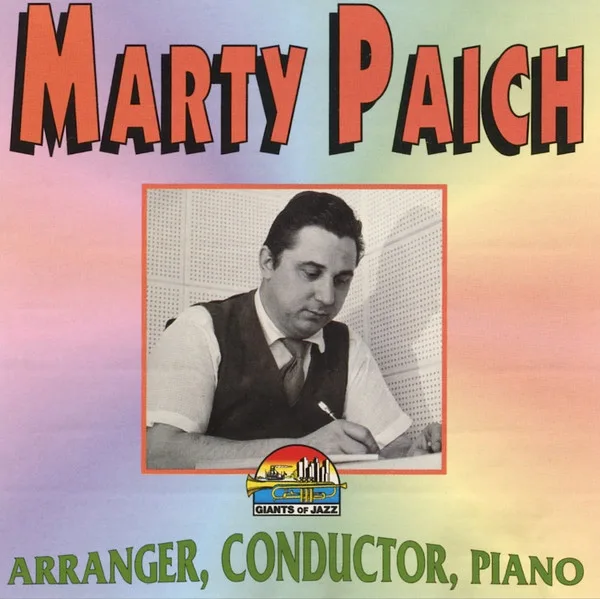
Marty Paich at work on a score, as pictured on the cover of the Giants of Jazz CD *Marty Paich: Arranger, Conductor, Piano* (1995) Album cover art (not a CC-licensed artist photo), used as the only available image showing the artist — Discogs release page for the CD: https://www.discogs.com/release/11724083
Martin Louis Paich was born on January 23, 1925, in Oakland, California. He learned accordion and piano as a child and was leading bands and playing weddings by the age of ten; by sixteen he was working professionally and writing arrangements for the local bandleader Gary Nottingham alongside Pete Rugolo. He was drafted in 1943 and led an Army Air Corps band until 1946. After the war he studied composition and arranging in Los Angeles, with teachers that included Mario Castelnuovo-Tedesco and Arnold Schoenberg, and he earned a master's degree in composition from the Los Angeles Conservatory of Music in 1951.
In the early 1950s he found work as a pianist and arranger with the bands of Jerry Gray and Dan Terry, then moved into the Los Angeles jazz scene around Shelly Manne and Shorty Rogers, playing and writing for both in 1953 and 1954 and appearing on the 1954 Decca LP Jazz Studio 2 from Hollywood. He also served a stretch as accompanist and music director for Peggy Lee. In 1955 he began recording under his own name for a run of small labels, among them Mode, Tampa and Bethlehem, and he arranged and played on the soundtrack of the Disney film Lady and the Tramp (1955). His first jazz records as a leader included the Bethlehem LP Jazz Music for the Birds and the Hep Cats, shared with the arranger Russ Garcia, and Tenors West, a session for Gene Norman's label recorded in November 1955 in which his octet backed four tenor saxophonists: Jimmy Giuffre, Bob Cooper, Harry Klee and Bob Enevoldsen. In August 1956 he cut the Tampa sessions The Marty Paich Quartet Featuring Art Pepper and Hot Piano, and in June 1957 he recorded the big-band album that Cadence issued as The Picasso of Big Band Jazz.
The partnership that made his name began when the singer Mel Tormé moved from Decca to Bethlehem in 1955 and asked to work with him. The ten-piece group that Tormé proposed, the Dek-tette, was modeled on the tentette of Gerry Mulligan and used a brass quintet of two trumpets, trombone, French horn and tuba with alto, tenor and baritone saxophones over bass and drums, and, at Tormé's urging, no piano. The first album, Mel Tormé with the Marty Paich Dek-tette (1956), opened with "Lulu's Back in Town" and featured Pete Candoli and Don Fagerquist on trumpets, Bud Shank on alto, Bob Cooper on tenor, Red Mitchell on bass and Mel Lewis on drums. Paich kept the band together for Mel Tormé Sings Fred Astaire, recorded in November 1956, and a remake of Tormé's extended work California Suite (March 1957), and he wrote for the same group behind other singers, including Jeri Southern, the Hi-Lo's and Ella Fitzgerald on Ella Swings Lightly (1958). Tormé and Paich came back together at Verve for Mel Tormé Swings Shubert Alley (1960), with Art Pepper, Bill Perkins, Frank Rosolino and Stu Williamson in the band.
Through the second half of the 1950s Paich wrote for much of the West Coast jazz community, including Dave Pell's octet, Chet Baker, Buddy Rich, Stan Kenton, Anita O'Day and Ray Brown, whose Bass Hit! he arranged and conducted. For Pepper he scored Art Pepper + Eleven: Modern Jazz Classics, recorded on March 14, March 28 and May 12, 1959, and released by Contemporary in 1960, giving the altoist a band built from Los Angeles first-call players on arrangements of bebop pieces such as "Move," "Groovin' High" and "Donna Lee." His own Warner Bros. LPs The Broadway Bit and I Get a Boot Out of You (both 1959) drew on the same pool of Los Angeles soloists, with Pepper, Jimmy Giuffre and the young bassist Scott LaFaro on the first. Two albums for RCA Victor with his Jazz Piano Quartet, Take Me Along (recorded in 1959) and Lush, Latin & Cool (recorded in June 1960), were the last of his main run as a leader; the second put four pianists on the bandstand, Paich, Jimmy Rowles, Pete Jolly and John Williams.
From around 1960 he put his recording career aside to arrange for pop and jazz singers. He wrote the string arrangements for Ray Charles's Modern Sounds in Country and Western Music (1962), arranged and conducted Lena Horne's Lena...Lovely and Alive (1962), and arranged albums for Al Hirt, Hank Crawford, Helen Humes, Sammy Davis Jr., Jack Jones, Dean Martin, Andy Williams and Barbra Streisand, returning to Fitzgerald for Whisper Not (1966). He wrote one more album under his own name in the decade, the Reprise LP The Rock-Jazz Incident (1966), and scored films including Hey There, It's Yogi Bear! (1964), The Man Called Flintstone (1966), The Swinger (1966) and Changes (1969). On television he led studio orchestras for The Glen Campbell Goodtime Hour and The Sonny & Cher Comedy Hour, took over from Nelson Riddle on The Smothers Brothers Comedy Hour, and won an Emmy in 1974 for his music for the drama series Ironside.
His output slowed after the early 1970s, but he kept working as a conductor and string arranger for George Benson, Carly Simon, Elton John, Kenny Loggins, whose "Only a Miracle" brought him a Grammy-nominated arrangement, and Toto, the band co-founded by his son, the keyboardist David Paich. With his son he arranged and produced Sarah Vaughan's Songs of the Beatles (1981), and he kept working on film scores as orchestrator and conductor into the 1990s. In 1988 he rebuilt the Dek-tette for Reunion, recorded for Concord Jazz with Tormé, and the group's last release, In Concert Tokyo, documented the band's appearance at the Fujitsu-Concord Jazz Festival in Tokyo. Paich passed away from colon cancer on August 12, 1995, at his home in Santa Ynez, California, at the age of 70.
AllMusic's Steve Huey singled out Paich's ability to make small ensembles sound as full as large orchestras, and the Dek-tette is the clearest case: ten players voiced with tuba pedal points, shout choruses that let the singer ride the horn lines like an eleventh member of the band, block scoring and a habit of quoting other songs inside an arrangement. Thomas Cunniffe, writing on the Tormé collaboration, noted that Paich enjoyed working out ideas with a singer rather than simply handing over charts, and that each Dek-tette LP was built around a single stylistic idea. His teachers included Castelnuovo-Tedesco and Schoenberg, his sound came out of the cool-school West Coast writing of Shorty Rogers and Pete Rugolo and the Mulligan tentette, and he was one of the arrangers other Los Angeles bandleaders and singers called when they wanted a jazz setting with studio polish. Huey wrote that his jazz credentials were much stronger than those of many of his peers among postwar arrangers. After 1960 most of his visible work was for pop singers, television and film, so the jazz record rests on a compact body of work from roughly 1955 to 1961 and the two Tormé reunion albums, and Mel Tormé Swings Shubert Alley made the Penguin Guide to Jazz Recordings' suggested core collection.
- Mel Tormé with the Marty Paich Dek-tette (1956, Bethlehem) - The first Dek-tette album, with "Lulu's Back in Town" and arrangements that set the template for the band's later records. Spotify - Mel Tormé with the Marty Paich Dek-Tette (Remastered 2013) Listen
- Mel Tormé Sings Fred Astaire (1957, Bethlehem) - A concept album of songs from Astaire's films, recorded in November 1956, with Paich writing long stretches of block-scored horn parts around Tormé's a cappella intros.
- Ella Swings Lightly (1958, Verve) - Ella Fitzgerald with the Dek-tette, on the Verve album that won her the 1960 Grammy for Best Improvised Jazz Solo. Spotify - Ella Swings Lightly (Special Edition)
- Art Pepper + Eleven: Modern Jazz Classics (1960, Contemporary) - Art Pepper fronting an eleven-piece band in Paich's arrangements of bebop repertoire, recorded in March to May 1959. Spotify - Art Pepper + Eleven: Modern Jazz Classics
- Mel Tormé Swings Shubert Alley (1960, Verve) - Twelve Broadway songs for the Dek-tette and a West Coast all-star band, often named the peak of the Tormé and Paich partnership. Spotify - Mel Tormé: Swings Shubert Alley Listen
- The Picasso of Big Band Jazz (1958, Cadence) - His best-known leader album, a big-band session recorded in June 1957 and later reissued under other titles.
- I Get a Boot Out of You (1959, Warner Bros.) - A big-band set of Duke Ellington pieces such as "Cottontail" and "Warm Valley" alongside Bobby Timmons's "Moanin'," with Art Pepper and Bill Perkins among the saxophonists.
- Lena...Lovely and Alive (1962, RCA Victor) - Lena Horne in Paich arrangements with Jack Sheldon among the soloists. Spotify - Lena...Lovely and Alive
Marty Paich: Full Discography
Discogs artist ID 193583 ("Marty Paich," real name Martin Louis Paich, born January 23, 1925, in Oakland, California, died August 12, 1995, in Santa Ynez, California) lists roughly 1,490 entries, most of them appearances, compilations and reissues. Discogs also files his named bands as separate entities, and these were checked and folded in below: The Marty Paich Dek-Tette (artist ID 458667), Marty Paich Orchestra (335207), The Marty Paich Quartet (1917029), Marty Paich And His Jazz Piano Quartet (2497848), The Marty Paich Octet (3417396), The Marty Paich Trio (2906564) and Marty Paich Big Band (1886852). Because much of his best work is arranging and conducting for other leaders, the first table lists albums issued under his own name or billed to him jointly with a singer or bandleader, and the second is a selected list of his arranger, conductor and pianist credits rather than an exhaustive one. Catalog numbers are those of the main Discogs pressing of each release, and recording dates come from Discogs release notes and Wikipedia; where the two disagree, or where a detail could not be confirmed, the Notes column or the cell says so.
As Leader / Co-Leader
| Album Title | Recording Date(s) | Release Date | Label | Catalog Number | Format(s) | Personnel | Role | Reissue History | Spotify | Buy | Notes |
|---|---|---|---|---|---|---|---|---|---|---|---|
| Jazz Music for the Birds and the Hep Cats | January 1955 (per Wikipedia's discography) | 1955 per Wikipedia; the Discogs pressing is dated 1958 | Bethlehem | BCP 6039 | Vinyl, LP, Album, Mono | Russ Garcia (leader), Marty Paich (piano), Conte Candoli and Pete Candoli (trumpets), Bob Enevoldsen (trombone), Charlie Mariano (alto saxophone), Russ Cheever (soprano saxophone), Bill Holman (tenor saxophone), Jimmy Giuffre (baritone saxophone), Max Bennett (6-string bass), Stan Levey (drums) | Co-leader (billed with Russ Garcia) | Not confirmed | — | — | Discogs bills the record to Russell Garcia and Marty Paich. |
| Tenors West | November 1955 (per Wikipedia's discography) | 1956 | Gene Norman Presents (GNP) | GNP-10 (10-inch original); GNP-21 (12-inch reissue with four added tracks) | Vinyl, LP, Album | Jimmy Giuffre, Bob Cooper and Harry Klee (tenor saxophones; Klee also alto saxophone and flute), Bob Enevoldsen (tenor saxophone, valve trombone), Marty Paich (piano), Jack Dulong (baritone saxophone), Joe Mondragon (bass), Art Mardigan and Frank Capp (drums), Jack Costanzo (bongos) | Leader (the Marty Paich Octet) | Reissued as GNP-21 in 1956; a later reissue as West Coast Scene (Jazz Vogue, 1977) is listed on Discogs | — | — | Four tenor saxophonists featured with Paich's octet; Discogs credits the personnel at release level without track assignments. |
| The Marty Paich Quartet Featuring Art Pepper | August to September 1956, Los Angeles | 1956 | Tampa | TP 28 | Vinyl, LP, Album, Mono | Marty Paich (piano), Art Pepper (alto saxophone), Buddy Clark (bass), Frank Capp (drums) | Leader | Reissued under other titles including Chile Pepper and in a 2008 Art Pepper twofer; the pressing history is on Discogs master 287984 | — | — | Nine tracks, including "Over the Rainbow" and "Pitfall." |
| Hot Piano | 1956, Radio Recorders, Hollywood | 1956 (Wikipedia gives 1957) | Tampa | TP 23 | Vinyl, LP, Album | Marty Paich (piano), Joe Mondragon (bass), Larry Bunker (drums, vibraphone) | Leader | Reissued as Jazz for Relaxation (Tampa, 1958), per Wikipedia | — | — | Trio album; a later reissue billed Howard Roberts as featured guitarist, per Discogs. |
| Marty Paich Trio | June 1957, Hollywood | 1957 | Mode | MOD-LP 105 | Vinyl, LP, Album, Mono | Marty Paich (piano), Red Mitchell (bass), Mel Lewis (drums) | Leader | Not confirmed | — | — | |
| A Jazz Band Ball (First Set) | July 1957, Hollywood | 1957 | Mode | MOD LP 110 | Vinyl, LP, Album, Mono | Marty Paich (piano), Stu Williamson and Jack Sheldon (billed artists), Don Fagerquist (trumpet), Bob Enevoldsen (valve trombone), Buddy Clark (bass), Mel Lewis (drums) | Leader (combo) | Reissued as Revel Without a Pause (Interlude, 1959), per Wikipedia | — | — | Discogs bills this record to Williamson and Sheldon, while Wikipedia lists it under Paich's name as a combo date. |
| The Picasso of Big Band Jazz | June 1957 (per Wikipedia's discography) | 1958 | Cadence | CLP-3010 | Vinyl, LP, Mono | Not itemized in the sources checked | Leader | Reissued as What's New (Discovery, 1982) per Wikipedia, and on CD by Candid in 1989 and 2022 | — | — | The cover carries a quote from the label's Archie Bleyer comparing Paich to Picasso. |
| The Broadway Bit | 1959 | 1959 | Warner Bros. | WS 1296 (stereo pressing) | Vinyl, LP, Album, Stereo | Marty Paich (piano, arranger, conductor), Frank Beach and Stu Williamson (trumpets), George Roberts (trombone), Bob Enevoldsen (valve trombone, tenor saxophone), Vincent DeRosa (French horn), Art Pepper (alto saxophone), Bill Perkins (tenor saxophone), Jimmy Giuffre (baritone saxophone, clarinet), Victor Feldman (vibraphone), Scott LaFaro (bass), Mel Lewis (drums) | Leader | Reissued with I Get a Boot Out of You on a 2006 compilation and in a 2014 reissue, per Discogs | — | — | Nine Broadway show tunes, including "I've Grown Accustomed to Her Face" and "Just in Time." |
| I Get a Boot Out of You | June 1959 (per Wikipedia's discography) | November 1959 | Warner Bros. | W 1349 (mono) | Vinyl, LP, Album, Mono | Marty Paich (arranger, conductor), Al Porcino, Conte Candoli and Jack Sheldon (trumpets), Bob Enevoldsen and George Roberts (trombones), Vincent DeRosa (French horn), Art Pepper, Bill Hood and Bill Perkins (saxophones), Russ Freeman (piano), Victor Feldman (vibraphone), Joe Mondragon (bass), Mel Lewis (drums) | Leader (arranger and conductor) | Later reissued under other titles; see Discogs master 304744 | — | — | Duke Ellington repertoire including "Cottontail" and "Warm Valley," plus "Moanin'." Discogs credits the piano chair to Russ Freeman, not Paich. |
| Marty Paich and His Jazz Piano Quartet Present Music from the Broadway Production Take Me Along | September 14, October 6 and 7, 1959 | 1960 | RCA Victor | LPM-2164 | Vinyl, LP, Album, Mono | Marty Paich and his Jazz Piano Quartet; individual players not itemized in the sources checked | Leader | Not confirmed | — | — | Songs from the Broadway musical Take Me Along; the Discogs title spells the composer's name Robert Merrill. |
| Lush, Latin & Cool | June 2, 7 and 14, 1960, RCA Victor studios, Hollywood | 1961 | RCA Victor | LSP-2259 | Vinyl, LP, Album, Stereo | Marty Paich, Jimmy Rowles, Pete Jolly and John Williams (four pianos) | Leader (billed to the Marty Paich Piano Quartet) | Not confirmed | — | — | Four-piano arrangements of swing, Latin and boogie-woogie material; produced by Lee Schapiro. |
| The Rock-Jazz Incident | Not specified in the sources checked | 1966 | Reprise | R-6206 | Vinyl, LP, Album, Mono | Marty Paich (arranger, conductor); players not itemized | Leader (arranger and conductor) | Not confirmed | — | — | Pop and rock songs of 1965 and 1966 such as "Yesterday" and "It's Not Unusual" in jazz-orchestra settings; produced by Jimmy Bowen. |
| Mel Tormé with the Marty Paich Dek-Tette | 1956 (exact dates not confirmed) | April 1956 | Bethlehem | BCP 52 | Vinyl, LP, Album, Mono | Mel Tormé (vocals), Marty Paich (piano, leader, arranger), Pete Candoli and Don Fagerquist (trumpets), Bob Enevoldsen (trombone), Vincent DeRosa and John Cave (French horns), Albert Pollan (tuba), Bud Shank (alto saxophone, flute), Bob Cooper and Jack Montrose (tenor saxophones), Jack Dulong (baritone saxophone), Red Mitchell (bass), Mel Lewis (drums) | Co-leader (billed with Mel Tormé) | Reissued many times, including a 2013 remaster on streaming | Spotify - Mel Tormé with the Marty Paich Dek-Tette (Remastered 2013) | — | The first Dek-tette album; it opens with "Lulu's Back in Town." |
| Mel Tormé Sings Fred Astaire | November 1956, Los Angeles | February 1957 | Bethlehem | BCP-6013 | Vinyl, LP, Album | Mel Tormé (vocals), Marty Paich (piano, leader, arranger), Pete Candoli and Don Fagerquist (trumpets), Bob Enevoldsen (valve trombone), Vincent DeRosa (French horn), Albert Pollan (tuba), Herb Geller (alto saxophone), Jack Montrose (tenor saxophone), Jack Dulong (baritone saxophone), Max Bennett (bass), Alvin Stoller (drums) | Co-leader (billed with Mel Tormé) | Not confirmed | — | — | Wikipedia dates the album 1956; the Discogs pressing is February 1957. |
| Mel Tormé Swings Shubert Alley | 1960 (exact dates not confirmed) | 1960 per Wikipedia; Discogs dates the Verve LP 1961 | Verve | MG V-2132 | Vinyl, LP, Album, Mono | Mel Tormé (vocals), Marty Paich (piano, arranger), Al Porcino and Stu Williamson (trumpets), Frank Rosolino (trombone), Vincent DeRosa (French horn), Art Pepper (alto saxophone), Bill Perkins (tenor saxophone), Bill Hood (baritone saxophone), Red Callender (tuba), Joe Mondragon (bass), Mel Lewis (drums) | Co-leader (billed with Mel Tormé) | Reissued with Back in Town on a 2012 two-on-one release, per Discogs | Spotify - Mel Tormé: Swings Shubert Alley | — | Selected for the Penguin Guide to Jazz Recordings core collection. The labels misspell the title as "Schubert Alley." |
| Reunion | 1988 | 1988 | Concord Jazz | CCD-4360 | CD, Album | Mel Tormé (vocals), Marty Paich (conductor, arranger, producer, piano, synthesizer), Gary Foster (alto saxophone), Ken Peplowski (tenor saxophone), Bob Efford (baritone saxophone), Jack Sheldon and Warren Luening (trumpets), Lew McCreary (trombone), Bob Enevoldsen (valve trombone), Jim Self (tuba), Pete Jolly (piano), Chuck Berghofer (bass), Jeff Hamilton (drums), Efrain Toro and Joe Porcaro (percussion) | Co-leader (billed with Mel Tormé) | Not confirmed | — | — | The Dek-tette reassembled with a largely new lineup. Cunniffe describes Paich adding piano and synthesizers to the instrumentation. |
| In Concert Tokyo | Fujitsu-Concord Jazz Festival, Tokyo | 1989 | Concord Jazz | CCD-4382 | CD, Album | Mel Tormé (vocals), Marty Paich (conductor, arranger) and the Dek-tette; per Cunniffe the lineup included Allen Farnham (piano) and John von Ohlen (drums) | Co-leader (billed with Mel Tormé) | Not confirmed | — | — | The band's last release. The CD carries two tracks not on the LP; sources differ on whether the concert was in 1988 or 1989. |
As Arranger, Conductor and Sideman (selected major credits)
| Year | Project (Leader) | Title | Label | Catalog | Role | Notes |
|---|---|---|---|---|---|---|
| 1953 | Shorty Rogers and His Orchestra Featuring Shelly Manne | Cool and Crazy | RCA Victor | LPM-3138 | Pianist | 10-inch LP recorded March 26 and April 2, 1953 in Hollywood; Wikipedia and AllMusic place Paich in Rogers's and Shelly Manne's West Coast work of 1953 and 1954. |
| 1954 | John Graas, Herb Geller, Milt Bernhart, Don Fagerquist, Howard Roberts, Curtis Counce, Larry Bunker and others | Jazz Studio 2 from Hollywood | Decca | Not confirmed | Participant (instrument not itemized) | Billed on Discogs to the group of West Coast players; filed as several volumes and parts. |
| 1956 | Dave Pell Octet | Swingin' in the Ol' Corral; A Pell of a Time; Swingin' School Songs; The Big Small Bands; The Old South Wails; I Remember John Kirby | RCA Victor, Coral and Capitol | Not confirmed | Arranger (per Wikipedia) | Six albums from 1957 to 1961, per Wikipedia's discography; catalog numbers were not confirmed. |
| 1956 | Ray Brown | Bass Hit! | Verve | MG V-8022 | Arranger, conductor | Recorded November 21, 1956; Verve issued it in 1957. Ten horns and rhythm including Jimmy Rowles, Herb Ellis, Jimmy Giuffre and Harry Edison. Spotify - Bass Hit |
| 1957 | Abbey Lincoln | Abbey Lincoln's Affair... A Story of a Girl in Love | Liberty | LRP 3025 | Co-director of the orchestra (with Benny Carter) | Discogs credits the arrangements to Jack Montrose; Wikipedia lists Paich as arranger. |
| 1957 | Mel Tormé | Gene Norman Presents Mel Tormé at the Crescendo | Bethlehem | BCP-6020 | Pianist, group leader | Recorded live February 22, 1957, with Don Fagerquist (trumpet), Max Bennett (bass) and Mel Lewis (drums). |
| 1957 | Mel Tormé | Mel Tormé's California Suite | Bethlehem | BCP-6016 | Conductor, arranger | Recorded March 1957; issued as one continuous work with no separate tracks. Cunniffe describes the backing as the Dek-tette with added strings. |
| 1958 | Ella Fitzgerald | Ella Swings Lightly | Verve | MG V-4021 | Arranger, conductor (the Dek-tette) | Recorded November 22 and 23, 1958, in Los Angeles. Wikipedia dates the album 1958; Discogs lists the Verve LP under 1959. Won the 1960 Grammy for Best Improvised Jazz Solo. Spotify - Ella Swings Lightly (Special Edition) |
| 1959 | The Hi-Lo's | And All That Jazz | Columbia | CL 1259 | Arranger, conductor (the Dek-tette) | Billed with the Marty Paich Dek-Tette; Clare Fischer plays piano and Bud Shank baritone saxophone. |
| 1959 | Mel Tormé | Tormé | Verve | MG VS-6015 | Arranger, conductor | Discogs credits Paich as arranger and conductor of this ballad album. |
| 1959 | Art Pepper | Art Pepper + Eleven: Modern Jazz Classics | Contemporary | M 3568 | Arranger, conductor | Recorded March 14, March 28 and May 12, 1959; released February 1960. Eleven-piece band with Russ Freeman (piano), Joe Mondragon (bass) and Mel Lewis (drums). Spotify - Art Pepper + Eleven: Modern Jazz Classics |
| 1960 | Mel Tormé and the Mel-Tones | Back in Town | Verve | MG VS 6063 | Arranger, conductor, pianist | Featured soloists Art Pepper, Jack Sheldon and Victor Feldman. Spotify - Back In Town |
| 1960 | Jesse Belvin featuring Art Pepper | Mr. Easy | RCA Victor | Not confirmed | Orchestra leader | Discogs bills the Marty Paich Orchestra; first issued in 1960 and reissued in 1963. |
| 1961 | Ray Charles and Betty Carter | Ray Charles and Betty Carter | ABC-Paramount | Not confirmed | Arranger | Recorded between August 1960 and June 1961, per the Ray Charles profile. |
| 1962 | Ray Charles | Modern Sounds in Country and Western Music | ABC-Paramount | ABC 410 | Arranger (strings) | Discogs credits Paich with the string arrangements and Gerald Wilson and Gil Fuller with the big-band arrangements. |
| 1962 | Lena Horne | Lena...Lovely and Alive | RCA Victor | LSP-2587 | Arranger, conductor | Featuring Jack Sheldon on trumpet; Grammy-nominated for Best Solo Vocal Performance, Female. Spotify - Lena...Lovely and Alive |
| 1962 | Al Hirt | Trumpet and Strings | RCA Victor | LSP-2584 | Arranger, conductor | Discogs files the album under 1962 and its master under 1964. |
| 1962 | Sammy Davis Jr. | Sammy Davis Jr. Belts the Best of Broadway | Reprise | R-2010 (promotional pressing) | Arranger | Credit per Wikipedia's discography; the Discogs credit block is empty. |
| 1963 | Lena Horne | Lena Sings Your Requests | MGM | MGM C 943 | Arranger (most tracks), conductor | Bob Florence arranged four of the twelve tracks. |
| 1963 | Hank Crawford | Soul of the Ballad | Atlantic | 1405 | Conductor (the Marty Paich Orchestra) | Billed to Crawford and the Marty Paich Orchestra. |
| 1963 | Jack Jones | Wives and Lovers | Kapp | KS-3352 | Conductor | One of four conductors credited on the album. |
| 1963 | Gloria Lynne | Gloria, Marty & Strings | Everest | Not confirmed | Orchestra leader | Billed on Discogs to Lynne with Marty Paich and his orchestra. |
| 1965 | Jack Jones | My Kind of Town | Kapp | KS 3433 | Arranger, conductor | Six of the twelve tracks; Don Costa and Glenn Osser arranged the rest. |
| 1966 | Ella Fitzgerald | Whisper Not | Verve | V6 4071 | Arranger, conductor (the Marty Paich Orchestra) | Wikipedia dates the album 1966 or 1967; the Discogs listing is 1966. |
| 1968 | Johnny Rivers | Realization | Imperial | LP 12372 | Strings and horns arranger | Credited on Discogs for strings and horns. |
| 1981 | Sarah Vaughan | Songs of the Beatles | Atlantic | SD 16037 | Arranger and producer (with David Paich) | Marty and David Paich share the arranging and production credits; Toots Thielemans plays harmonica. |
- Mel Tormé - his closest collaborator: Paich arranged the Dek-tette albums for Bethlehem (1956 to 1957), arranged and conducted Tormé's Verve albums of 1959 and 1960, and led the reunited Dek-tette on the Concord Jazz records of 1988 and 1989.
- Art Pepper - alto saxophonist on The Marty Paich Quartet Featuring Art Pepper (1956), a regular soloist in Paich bands, and the leader of Art Pepper + Eleven (1959).
- Ella Fitzgerald - sang with the Dek-tette on Ella Swings Lightly (1958) and with Paich's arrangements on Whisper Not (1966).
- Peggy Lee - singer for whom he served as accompanist and music director during the 1950s.
- Shelly Manne - drummer and bandleader with whom he played and arranged in 1953 and 1954.
- Gerry Mulligan - leader of the tentette whose instrumentation the Dek-tette borrowed.
- Ray Brown - bassist whose Bass Hit! Paich arranged and conducted.
- Ray Charles - wrote the string arrangements for Modern Sounds in Country and Western Music (1962) and arranged Ray Charles and Betty Carter (1961).
- Lena Horne - arranged and conducted Lena...Lovely and Alive (1962) and most of Lena Sings Your Requests (1963).
- Al Hirt - arranged Our Man in New Orleans (1963) and Trumpet and Strings (1962).
- Hank Crawford - saxophonist backed by the Marty Paich Orchestra on Soul of the Ballad (1963).
- Astrud Gilberto - singer whose first solo record, The Astrud Gilberto Album (1965), used his arrangements, per her profile.
- Sarah Vaughan - co-arranger and co-producer, with his son David, of her Beatles album of 1981.
- Chet Baker, Buddy Rich, Stan Kenton, Anita O'Day - leaders and singers for whom he wrote in the 1950s.
- Red Mitchell, Mel Lewis - the bassist and drummer of the first Dek-tette album; Lewis also played in the Marty Paich Trio and on the Verve Shubert Alley sessions.
- Scott LaFaro, Jimmy Rowles - bassist on The Broadway Bit (1959) and pianist in the four-piano quartet of Lush, Latin & Cool (1961).
- Ken Peplowski, Jeff Hamilton, Gary Foster - saxophonists and drummer in the reunited Dek-tette on Reunion (1988).
- Bill Perkins, Stu Williamson - saxophonist and trumpeter in the orchestra on Mel Tormé Swings Shubert Alley.
- Jimmy Giuffre - one of four tenor saxophonists featured with the Marty Paich Octet on Tenors West.
- George Benson - guitarist and singer for whom he wrote string arrangements in his later years.
- Pete Candoli, Don Fagerquist, Bud Shank, Bob Cooper, Bob Enevoldsen, Vince DeRosa, Al Pollan - members of the original Dek-tette.
- Shorty Rogers, Pete Rugolo, Dave Pell, Russ Garcia - West Coast bandleaders and arrangers with whom he worked in the 1950s.
- David Paich - his son, a keyboardist and founding member of Toto, with whom he co-arranged and co-produced the Sarah Vaughan Beatles album.
More West Coast Jazz Artists
See all 35 West Coast Jazz artists →More American Jazz Artists
See all 820 American artists →- Wikipedia: Marty Paich
- Wikipedia: Art Pepper + Eleven - Modern Jazz Classics
- Wikipedia: Mel Tormé and the Marty Paich Dek-Tette
- Wikipedia: Mel Tormé Swings Shubert Alley
- Wikipedia: Ella Swings Lightly
- AllMusic: Marty Paich, biography by Steve Huey
- Thomas Cunniffe, Jazz History Online: Mel, Marty and the Dek-tette
- Discogs: Marty Paich (artist 193583)
- MusicBrainz: Marty Paich
- JazzProfiles.com: Mel Tormé
- JazzProfiles.com: Art Pepper
- JazzProfiles.com: Ray Charles
- JazzProfiles.com: Astrud Gilberto