 JAZZPROFILES lives in the music 2,059 Jazz Artists fully Profiled!
Hugh Masekela
Last updated October 29, 2026
Listen on Spotify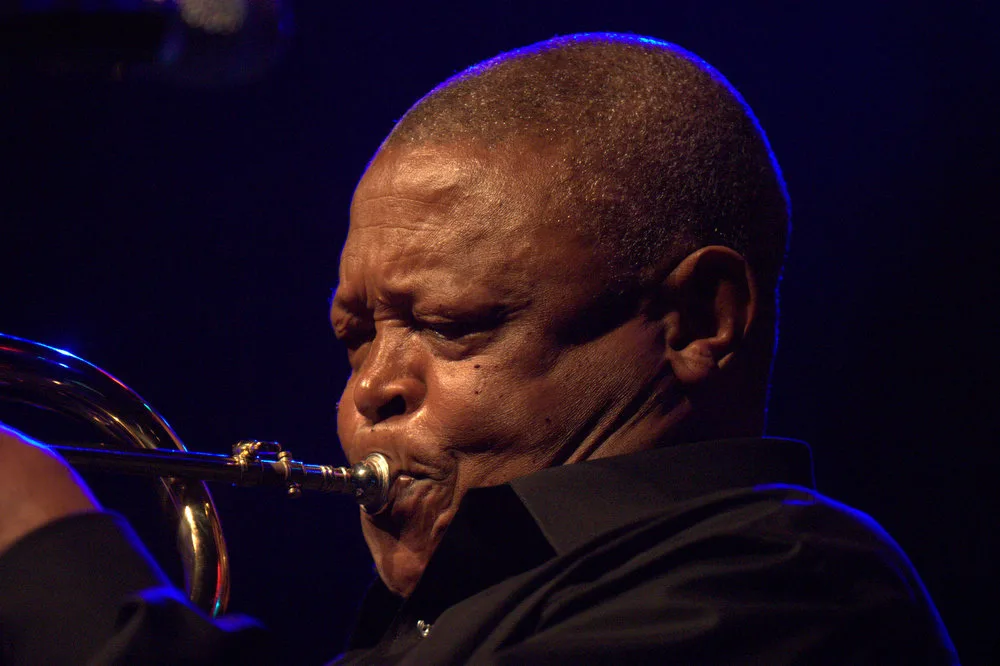
Hugh Masekela performing, 2009, photographed by Tom Beetz CC BY 2.0 (Creative Commons Attribution 2.0 Generic; credit Tom Beetz) — Wikimedia Commons — https://commons.wikimedia.org/wiki/File:Hugh_Masekela_2009.jpg

Hugh Ramapolo Masekela was born on April 4, 1939, in Witbank (now Emalahleni), South Africa, the son of Thomas Selema Masekela, a health inspector and sculptor, and Pauline Bowers Masekela, a social worker. He was raised largely by his grandmother, sang and played piano as a child, and at fourteen, after seeing the 1950 film Young Man with a Horn, decided he wanted to play the trumpet. Trevor Huddleston, the anti-apartheid chaplain at St. Peter's Secondary School in Johannesburg, bought him his first instrument and arranged lessons with the leader of the Johannesburg Native Municipal Brass Band, known as Uncle Sauda. Schoolmates soon took up instruments too, and the group became the Huddleston Jazz Band, described as South Africa's first youth orchestra; the trombonist Jonas Gwangwa was in it with him. When Louis Armstrong heard about the band from Huddleston, he sent one of his own trumpets as a gift. By 1956 Masekela had joined Alfred Herbert's African Jazz Revue, and in 1958, after a tour by the Manhattan Brothers, he joined the orchestra of King Kong, Todd Matshikiza's all-African jazz opera, which toured South Africa for a year with Miriam Makeba in the cast.
At the end of 1959 he formed the Jazz Epistles with the pianist Dollar Brand (later Abdullah Ibrahim), the alto saxophonist Kippie Moeketsi, Gwangwa, the bassist Johnny Gertze and the drummer Makaya Ntshoko. The sextet was South Africa's first important bebop band, modeled on Art Blakey's Jazz Messengers; according to Britannica, records by Dizzy Gillespie and Clifford Brown had inspired Masekela's bebop playing. The Jazz Epistles drew record-breaking crowds in Johannesburg and Cape Town and made Jazz Epistle, Verse 1 (Continental), the first LP by a Black South African jazz band. After the Sharpeville massacre of March 21, 1960, and the ban on gatherings of ten or more people, Masekela left the country; Huddleston, Yehudi Menuhin and John Dankworth helped him win a place at the Guildhall School of Music in London. He then reached the United States, where Harry Belafonte befriended him, and studied classical trumpet at the Manhattan School of Music from 1960 to 1964. In New York he heard Miles Davis, John Coltrane and Thelonious Monk, and both Gillespie and Armstrong urged him to develop an African sound of his own.
His first album, Trumpet Africaine (Mercury, August 1962), was recorded in New York with arrangements by Hugo Montenegro while he was still a student. He married Makeba in 1964; they divorced in 1966. Recording for Mercury and then MGM, where Tom Wilson produced, he made the live The Americanization of Ooga Booga (released June 1966), a piano-quartet set with Larry Willis that AllMusic credits with showing off his "township bop" style, and then moved to California, where he started the Chisa label and began working with the producer Stewart Levine. The Emancipation of Hugh Masekela put him on the cover dressed as Abraham Lincoln. He played the Monterey Pop Festival in 1967, had a modest hit with "Up, Up and Away," and in 1968 reached number one on the Billboard Hot 100 with "Grazing in the Grass," an instrumental composed by the actor and singer Philemon Hou and recorded at Gold Star Studios in Hollywood with Levine producing. It sold about four million copies and was inducted into the Grammy Hall of Fame in 2018.
The pop success sat beside more jazz-minded and more political records. Reconstruction (1970) drew on The Crusaders players Wilton Felder, Joe Sample and Wayne Henderson with Al Foster on drums, and Hugh Masekela & The Union of South Africa (1971) paired him with Gwangwa and Caiphus Semenya. In January 1972 he recorded the double album Home Is Where the Music Is at Island Studios in London with the saxophonist Dudu Pukwana, Willis, Eddie Gómez and Ntshoko, which AllMusic calls his finest jazz and African set. After twelve years in exile he travelled through West Africa in 1973, spending time in Kinshasa, Liberia, Ghana and Nigeria; in Lagos Fela Kuti introduced him to the Ghanaian band Hedzoleh Soundz, with whom he recorded Introducing Hedzoleh Soundz in July 1973. With Levine he conceived the Zaire 74 festival in Kinshasa, held September 22 to 24, 1974, around the Ali and Foreman fight. After albums for Casablanca, among them You Told Your Mama Not to Worry (recorded in Ghana, with Makeba singing and including "Soweto Blues"), he teamed up in 1978 with Herb Alpert for Herb Alpert / Hugh Masekela and the live Main Event Live.
From 1980 to 1984 he worked from Botswana, where a mobile studio let him record Techno-Bush and Waiting for the Rain for Jive; "Don't Go Lose It Baby" reached number two on the dance charts. In 1985 he founded the Botswana International School of Music, whose annual workshop continues as the Botswana Music Camp. He joined Paul Simon's Graceland tour, which began on February 1, 1987, alongside Makeba and Ladysmith Black Mambazo. His own "Bring Him Back Home" of 1987 became an unofficial anthem for the movement to free Nelson Mandela, and his song "Stimela" about migrant mineworkers was a fixture of his concerts. With Mbongeni Ngema he wrote the music and lyrics for Sarafina!, which opened at the Market Theatre in Johannesburg in June 1987 and on Broadway in January 1988, where it was nominated for the Tony Award for best original score.
After Uptownship (1989) he returned to South Africa in 1990, following Mandela's release, and kept recording and touring: Beatin' Aroun De Bush (1992), the live Hope, taped at Blues Alley in Washington, D.C., in 1993, and Almost Like Being in Jazz (2005), a flugelhorn standards date with Willis. He published the autobiography Still Grazing (2004) with D. Michael Cheers, took part in International Jazz Day events in Istanbul in 2013 and at the 2015 global concert at UNESCO in Paris, where he performed "Bring Him Back Home" alongside Marcus Miller and Lee Ritenour, and in 2016 reunited with Abdullah Ibrahim in Johannesburg, the first time the two had played together in more than half a century. His final studio album, No Borders, came out in 2016. Masekela passed away in Johannesburg on January 23, 2018, of prostate cancer, at age 78. His marriages included Makeba and Chris Calloway, daughter of Cab Calloway; his son is the television host Selema Masekela. Honors included the Order of Ikhamanga in gold (2010), three Grammy nominations, and a Google Doodle on April 4, 2019, which would have been his eightieth birthday. Rejoice, a collaboration with the Nigerian drummer Tony Allen, was completed after his death and released in March 2020.
Masekela was widely called the father of South African jazz. He learned bebop from American records and from the Jazz Epistles, a band built on the model of Art Blakey's Messengers, then spent his career folding that vocabulary into South African idioms: township jive, mbaqanga strains, and later West African highlife and Afrobeat. Early on, advice from Louis Armstrong and Dizzy Gillespie pushed him toward his own African idiom rather than imitation of American hard bop. His trumpet and flugelhorn sound is bright and singing, with short, rhythmic phrases and a vocal delivery that is part chant and part storytelling; AllMusic notes that he often simplified his playing to fit pop formats but was capable of outstanding ballad and bebop work, which the live Hope and the standards album Almost Like Being in Jazz bear out. Much of his best-known music, from "Grazing in the Grass" to the Casablanca and Jive Afrika albums, sits at the edge of jazz, pop and African popular music, so his subgenre tags reflect only the jazz and jazz-adjacent styles his records genuinely touch. His anti-apartheid songs "Soweto Blues," "Bring Him Back Home" and "Stimela" made him a symbol of resistance, and he influenced generations of South African and African jazz musicians, partly through the Botswana International School of Music he founded in 1985.
- Jazz Epistle, Verse 1 (1960, Continental) - The Jazz Epistles' only LP, with Masekela on trumpet beside Dollar Brand, Kippie Moeketsi, Jonas Gwangwa, Johnny Gertze and Makaya Ntshoko; the first album by a Black South African jazz band. Spotify - Verse 1 Listen
- Trumpet Africaine (1962, Mercury) - His debut, made in New York with arrangements by Hugo Montenegro while he was still a student. Spotify - Trumpet Africaine Listen
- The Americanization of Ooga Booga (1966, MGM) - A live quartet date with pianist Larry Willis, described by AllMusic as showing off his township bop style.
- The Promise of a Future (1968, Uni) - The album that carried "Grazing in the Grass," recorded in Los Angeles in March 1968 with a quintet; the single went to number one in the United States. Spotify - Grazing In The Grass Listen
- Home Is Where the Music Is (1972, Blue Thumb) - A double LP recorded in London with Dudu Pukwana, Larry Willis, Eddie Gómez and Ntshoko, often cited as his finest jazz and African album. Spotify - Home Is Where The Music Is Listen
- Introducing Hedzoleh Soundz (1973, Blue Thumb) - Recorded in Lagos in July 1973 with the Ghanaian band Hedzoleh Soundz, a landmark of African jazz-funk fusion.
- Hope (1994, Triloka) - Recorded live at Blues Alley in Washington, D.C., from July 30 to August 1, 1993, with his touring band, covering "Grazin' in the Grass," "Stimela" and "Mandela (Bring Him Back Home!)."
- Almost Like Being in Jazz (2005, Chissa) - Flugelhorn ballads and standards recorded live in October 2004 with Larry Willis, bassist John Heard and drummer Lorca Hart, produced by Stewart Levine.
Hugh Masekela: Full Discography
Discogs artist ID 14661 ("Hugh Masekela," real name Hugh Ramapolo Masekela, born April 4, 1939, in Witbank, South Africa; died January 23, 2018, in Johannesburg) lists nearly a thousand entries, most of them compilations, reissues, singles and track appearances. His group billings are filed under separate Discogs entities: The Jazz Epistles (artist ID 1574785), Hugh Masekela & The Union of South Africa (268036), Hugh Masekela Quintet (7674954) and Masekela and His African Beat Band (4136007); these were checked and their albums are included below. Because his catalog is large, the leader table is a curated selection of 31 releases: the jazz and Africa-facing albums, his American hits, the Herb Alpert collaborations, and the major later records, but not the many compilations and singles. Catalog numbers are those of the first or best-documented pressing on Discogs; where Discogs, Wikipedia, AllMusic or MusicBrainz differ on a date, the Notes column says so.
As Leader / Co-Leader
| Album Title | Recording Date(s) | Release Date | Label | Catalog Number | Format(s) | Personnel | Role | Reissue History | Spotify | Buy | Notes |
|---|---|---|---|---|---|---|---|---|---|---|---|
| Jazz Epistle, Verse 1 | 1959 or early 1960, Johannesburg (sources differ) | 1960 | Continental | CONT 14 | Vinyl, LP, Album | Hugh Masekela (trumpet), Jonas Gwangwa (trombone), Kippie Moeketsi (alto saxophone), Dollar Brand, later Abdullah Ibrahim (piano), Johnny Gertze (bass), Makaya Ntshoko (drums) | Co-leader (billed to The Jazz Epistles) | Included on the 1992 CD Jazz in Africa (Volume One); see Discogs master 425697 | Spotify - Verse 1 | — | Widely described as the first LP by a Black South African jazz group; Discogs files it under a separate entity for the band (artist ID 1574785). |
| Trumpet Africaine | New York (dates not given) | August 1962 | Mercury | SR 60797 | Vinyl, LP, Album, Stereo | Hugh Masekela (trumpet, flugelhorn, vocals), Hugo Montenegro (arranger, conductor) | Leader | Pressing and reissue history: see Discogs master 463542 | Spotify - Trumpet Africaine | — | His debut LP; the personnel beyond Montenegro's orchestra are not listed. |
| Grrr | May 1965, New York | 1966 | Mercury | SR 61109 | Vinyl, LP, Album, Stereo | Hugh Masekela (trumpet, arranger), Jonas Gwangwa (trombone, arranger), Morris Goldberg (saxophone), Larry Willis (piano), Eric Gale (guitar), Howard Johnson (tuba); the sleeve does not credit the players | Leader | Pressing and reissue history: see Discogs master 40415 | — | — | Produced by Ed Townsend; player credits are uncredited on the original sleeve. |
| The Americanization of Ooga Booga | Live recording from 1965 | June 1966 | MGM | SE-4372 | Vinyl, LP, Album, Stereo | Hugh Masekela (cornet, flugelhorn, vocals), Larry Willis (piano), Harold Dotson (bass), Henry Jenkins (drums) | Leader | Pressing and reissue history: see Discogs master 205571 | — | — | Produced by Tom Wilson. |
| The Emancipation of Hugh Masekela | Los Angeles (dates not given) | 1966 | Chisa | CHS-4101 | Vinyl, LP, Album | Hugh Masekela (trumpet), Charlie Small (piano), John Cartwright (bass), Chuck Carter (drums), Big Black (congas) | Leader | Reissued in June 1967 on Uni (73007); see Discogs master 40460 | — | — | Produced by Stewart Levine; Wikipedia and The Guardian date the album to 1966, and the main Discogs entry is the June 1967 Uni reissue. |
| Hugh Masekela Is Alive and Well at the Whisky | September 18-20, 1967, Whisky a Go Go, Hollywood | 1967 | Uni | 73015 | Vinyl, LP, Album, Stereo | Hugh Masekela (trumpet, vocals), Hotep Cecil Barnard (piano), Al Abreu (saxophone), Henry Franklin (bass), Chuck Carter (drums), Elmer Siegel (percussion) | Leader | Later pressings correct the "Whisky" spelling on the cover; see Discogs master 212792 | — | — | Live album; the first pressing misspells "Whisky" on the cover. |
| The Lasting Impression of Hugh Masekela | November 1965, Village Gate, New York | December 1968 | MGM | SE-4468 | Vinyl, LP, Album, Stereo | Personnel not listed | Leader | Reissued on LP by Verve in 1986; see Discogs master 143660 | — | — | Live recording issued three years after it was taped; produced by Tom Wilson. |
| The Promise of a Future | March 1968, Gold Star Studios, Los Angeles | 1968 | Uni | 73028 | Vinyl, LP, Album, Stereo | Hugh Masekela (trumpet), Al Abreu (tenor and soprano saxophones), William Henderson (piano), Henry Franklin (bass), Chuck Carter (drums) | Leader | Reissued on CD in 1993 by One Way; see Discogs master 597637 | Spotify - Grazing In The Grass (track) | — | Includes "Grazing in the Grass," the 1968 number-one single; produced by Stewart Levine. |
| Masekela | Not specified in Discogs data | 1968 | Uni | 73041 | Vinyl, LP, Album, Stereo | Personnel not listed | Leader | Pressing and reissue history: see Discogs master 413491 | — | — | Includes "Mace and Grenades," "Gafsa" and "Riot"; directed by Stewart Levine. |
| Reconstruction | Wally Heider Studio Three, Los Angeles (dates not given) | 1970 | Chisa | CS 803 | Vinyl, LP, Album, Gatefold | Hugh Masekela (trumpet, arranger), Wilton Felder and Monk Montgomery (bass), Joe Sample (electric piano), Wayne Henderson (drums, arranger), Al Foster (drums), Larry Willis (piano), Arthur Adams and Bruce Langhorne (guitar), Francisco Aguabella (congas), Caiphus Semenya, Letta Mbulu and Philemon Hou (vocals) | Leader | Pressing and reissue history: see Discogs master 223071 | — | — | Distributed by Motown; directed by Stewart Levine. |
| Hugh Masekela & The Union of South Africa | Poppi Studios, Los Angeles (dates not given) | 1971 | Chisa | CS 808 | Vinyl, LP, Album | Hugh Masekela (trumpet, vocals), Jonas Gwangwa (trombone, vocals), Caiphus Semenya (alto saxophone, vocals) | Co-leader (billed to The Union of South Africa) | Pressing and reissue history: see Discogs master 148113 | — | — | Discogs files this band billing under a separate entity (artist ID 268036); produced by Stewart Levine. |
| Home Is Where the Music Is | January 1972, Island Studios, London; remixed at Wally Heider Studios, Los Angeles | 1972 | Blue Thumb | BTS 6003 | Vinyl, 2xLP, Album, Stereo | Hugh Masekela (trumpet), Dudu Pukwana (saxophone), Larry Willis (piano), Eddie Gómez (bass), Makaya Ntshoko (drums) | Leader | Selected tracks reissued as The African Connection (MCA, 1980); see Discogs master 73425 | Spotify - Home Is Where The Music Is | — | Produced by Stewart Levine and Caiphus Semenya; often cited as his finest jazz and African album. |
| Introducing Hedzoleh Soundz | July 1973, EMI Studios, Lagos, Nigeria | 1973 | Blue Thumb | BTS 62 | Vinyl, LP, Album, Stereo | Hugh Masekela (trumpet), Richard Neesai (guitar), Stanley Todd Kwesi (electric bass, vocals), Acheampong Welbeck (drums), Okyerema Asante (talking drum, percussion, vocals), James Kwaku Morton and Nat Hammond (congas, vocals), Sammy Nortey (percussion, vocals) | Leader (billed with Hedzoleh Soundz) | Pressing and reissue history: see Discogs master 203707 | — | — | The sleeve thanks Fela Kuti for making the album possible; produced by Stewart Levine. |
| I Am Not Afraid | March 1974, Wally Heider Studios, Los Angeles | 1974 | Blue Thumb | BTS 6015 | Vinyl, LP, Album | Hugh Masekela (trumpet, flugelhorn, vocals), Hedzoleh Soundz, Joe Sample (electric piano), "Stix" Hooper (drums) | Leader | Pressing and reissue history: see Discogs master 40451 | — | — | Opens with "A Night in Tunisia"; Discogs lists Joe Sample (electric piano) and Stix Hooper (drums) as uncredited performers. |
| The Boy's Doin' It | Lagos, Nigeria (dates not given) | 1975 | Casablanca | NBLP 7017 | Vinyl, LP, Album | Hugh Masekela (horns, vocals), Orlando Julius (horns, vocals), Hedzoleh Soundz, Rocki Dzidzornu (congas), Odinga "Guy" Warren (shekere, bells, vocals), Okyerema Asante (talking drum, vocals) | Leader | Pressing and reissue history: see Discogs master 213326 | — | — | Dedicated to Fela Kuti; produced by Masekela and Stewart Levine. |
| Colonial Man | Several studios in Macon, New York and Chicago (dates not given) | 1976 | Casablanca | NBLP 7023 | Vinyl, LP, Album | Hugh Masekela (trumpet, vocals), Orlando Julius (saxophone, percussion, vocals), Richard Neesai and Stanley Todd Kwesi (guitar), Yaw Opoku (bass), Gboyega Adelaja (electric piano), Patti Austin (backing vocals) | Leader | Pressing and reissue history: see Discogs master 213324 | — | — | Includes "A Song for Brasil" and the title track. |
| You Told Your Mama Not to Worry | Kumasi, Ghana (dates not given) | 1977 | Casablanca | NBLP 7079 | Vinyl, LP, Album | Hugh Masekela (flugelhorn, piano, vocals), Miriam Makeba (vocals), Paulinho Da Costa (percussion), Stanley Todd Kwesi (guitar, vocals), Ernie Baiddoo (bass guitar), Frankie Todd (drums), the Waters family (backing vocals) | Leader | Pressing and reissue history: see Discogs master 170075 | — | — | Includes "Soweto Blues," a lament for the 1976 Soweto uprising. |
| Herb Alpert / Hugh Masekela | Hollywood (dates not given) | 1978 | A&M / Horizon | SP-728 | Vinyl, LP, Album | Herb Alpert (flugelhorn, trumpet), Hugh Masekela (flugelhorn), Lee Ritenour, Arthur Adams and Freddie Harris (guitar), Chuck Domanico (bass), James Gadson (drums), Caiphus Semenya and Hotep Cecil Barnard (piano), Paulinho Da Costa (percussion) | Co-leader (billed with Herb Alpert) | On streaming since 2020 per MusicBrainz; pressing history: see Discogs master 40443 | Spotify - Herb Alpert / Hugh Masekela | — | Includes "Skokiaan," which reached number 87 on the US R&B chart; produced by Alpert, Caiphus Semenya and Stewart Levine. |
| Main Event Live | Live at the Roxy and the A&M sound stage, Los Angeles (dates not given) | September 1978 | A&M | SP 4727 | Vinyl, LP, Album, Stereo | Herb Alpert (trumpet), Hugh Masekela (flugelhorn), Jonas Gwangwa (trombone), Larry Willis (piano, synthesizer), Arthur Adams and Jeff Sigman (guitar), David Williams (bass), Buddy Williams (drums), Manolo Badrena (percussion) | Co-leader (billed with Herb Alpert) | Pressing and reissue history: see Discogs master 40439 | Spotify - Main Event Live | — | Live follow-up with no repeats from the studio album. |
| Techno-Bush | Botswana (dates not given) | 1984 | Jive Afrika | JL8-8210 | Vinyl, LP, Album | Hugh Masekela (horns, keyboards, percussion, vocals), Banjo Mosele (rhythm guitar), John Selolwane (guitar, vocals), Zenzele Mchunu (bass), Bongani Nxele (drums), Moses Ngwenya (organ), Tsepo Tshola (vocals) | Leader | Pressing and reissue history: see Discogs master 170076 | — | — | Includes "Don't Go Lose It Baby," a number two dance-chart single; produced by Stewart Levine. |
| Waiting for the Rain | Battery Studios mobile unit, Botswana; mixed at Battery Studios, London | 1985 | Jive Afrika | HIP 25 | Vinyl, LP, Album, Stereo | Hugh Masekela (flugelhorn, trumpet, lead vocals), Bheki Mseleku (tenor saxophone, keyboards), Barney Rachabane (alto saxophone), Banjo Mosele (rhythm guitar), John Selolwane (guitar), Tsepo Tshola (vocals) | Leader | Pressing and reissue history: see Discogs master 169748 | — | — | Includes "Coal Train (Stimela)." |
| Tomorrow | London, January to September 1986 | 1987 | WEA (Europe) | 254 573-1 | Vinyl, LP, Album | Hugh Masekela (flugelhorn, vocals) with the band Kalahari, including John Selolwane (guitar) and Banjo Mosele (rhythm guitar) | Leader | Pressing and reissue history: see Discogs master 288457 | — | — | Includes "Bring Him Back Home." |
| Uptownship | October 1988 to July 1989, Evergreen Studios and other studios, New York area | 1989 | Novus | PD83070 (CD) | CD, Album | Hugh Masekela (flugelhorn, cornet, percussion), Morris Goldberg (alto saxophone, penny whistle), John Selolwane (guitar, vocals), Tony Cedras (keyboards, accordion), Damon Duewhite (drums), Francis Fuster (percussion) | Leader | Pressing and reissue history: see Discogs master 188936 | — | — | AllMusic dates it to 1990; Discogs and the recording notes to 1989. |
| Beatin' Aroun De Bush | Max Studios, Hollywood | 1992 | Novus | 63136-2 (CD) | CD, Album | Personnel not listed | Leader | Pressing and reissue history: see Discogs master 603711 | — | — | Produced by Richard Druz; AllMusic dates it to 1994. |
| Hope | July 30 to August 1, 1993, Blues Alley, Washington, D.C. | 1994 | Triloka | 7203-2 (CD) | CD, Album | Hugh Masekela (flugelhorn, trumpet), Bakithi Kumalo (bass, vocals), Damon Duewhite (drums), Lawrence Matshiza (guitar, vocals), Themba Mkhize (keyboards, vocals), Remi Kabaka (percussion, vocals), Ngenekhaya Mahlanghu (saxophone, flute, vocals, percussion) | Leader | Pressing and reissue history: see Discogs master 40431 | — | — | Live set including "Grazin' in the Grass," "Mandela (Bring Him Back Home!)" and "Stimela (The Coal Train)." |
| Almost Like Being in Jazz | October 15-17, 2004, live at Bernie's | 2005 | Chissa | CHCD01 (CD) | CD, Album | Hugh Masekela (flugelhorn), Larry Willis (piano), John Heard (bass), Lorca Hart (drums) | Leader | Pressing and reissue history: see Discogs master 548493 | — | — | A standards date including "Don't Explain," "It Never Entered My Mind" and "I Remember Clifford"; produced by Stewart Levine. |
| Live at the Market Theatre | 2006, Market Theatre, Johannesburg | 2007 | Four Quarters Entertainment | FQT-CD-1805 (CD) | CD, Album | Hugh Masekela (lead vocals, flugelhorn), John Selolwane (guitar, backing vocals), Arthur Tshabalala and Ezbie Moilwa (keyboards), Fana Zulu (bass), Sello Montwedi (drums), Francis Fuster (percussion) | Leader | Issued as CD and DVD; see Discogs master 855415 | — | — | Includes "Grazing in the Grass," "Stimela" and "Mandela." |
| Jabulani | Not specified in Discogs data | 2010 (South Africa) | Razor & Tie (US issue) | 7930183324-2 | CD, Album | Personnel not listed | Leader | See Discogs master 1203839 | — | — | AllMusic reports that it topped the South African charts in 2010; Discogs dates the US release to 2011 and MusicBrainz to 2012; Wikipedia notes a 2012 Grammy nomination for best world music album. |
| Friends | Pretoria, South Africa (dates not given) | June 15, 2012 | House of Masekela | HOM001 | CD, Album | Hugh Masekela (flugelhorn), Larry Willis (piano) | Co-leader (billed with Larry Willis) | Discogs lists only the original release | — | — | Piano and flugelhorn duets on standards and jazz pieces including "Cantaloupe Island," "Monk's Mood" and "Little Miles." |
| No Borders | Not specified in Discogs data | November 11, 2016 | Universal Music South Africa | CDRBL848 119 (CD) | CD, Album | Personnel not listed | Leader | Discogs lists only the original release | — | — | His last studio album. |
| Rejoice | Livingston Studios, London, 2010 sessions | March 20, 2020 | World Circuit | WCD094 (CD) | CD, Album, Stereo | Hugh Masekela (flugelhorn, vocals), Tony Allen (drums, percussion, vocals), Steve Williamson (tenor saxophone), Joe Armon-Jones and Elliot Galvin (keyboards), Tom Herbert and Mutale Chashi (bass), Lekan Babalola (percussion), Lewis Wright (vibraphone) | Co-leader (billed with Tony Allen) | See Discogs master 1700415 | — | — | Posthumous release completed from the 2010 sessions; produced by Nick Gold, Tony Allen and Masekela. |
As Sideman (selected major credits)
| Year | Project (Leader) | Title | Label | Catalog | Role | Notes |
|---|---|---|---|---|---|---|
| 1959 | The King Kong Cast | King Kong - All African Jazz Opera | Gallotone | GALP 1040 | Trumpet | Cast recording of Todd Matshikiza's musical, with Masekela in the orchestra; Discogs lists a large cast and band credit block. |
| 1962 | Harry Belafonte | The Many Moods of Belafonte | RCA Victor | LPM-2574 | Trumpet | Track-level detail is not given. |
| 1967 | The Byrds | Younger Than Yesterday | Columbia | CS 9442 | Trumpet | Plays the solo on the opening track, "So You Want to Be a Rock 'n' Roll Star." |
| 1969 | Monk Montgomery | It's Never Too Late | Chisa | CS 801 | Arranger | Arranged "The Lady" on the bassist's Chisa album. |
| 1987 | Mbongeni Ngema and various artists | Sarafina! (The Music of Liberation) | RCA Victor | 9307-1-RC | Composer, lyricist, horns | Credited with music and lyrics on five tracks including "Sarafina" and "Bring Back Nelson Mandela." |
| 1987 | Paul Simon | Graceland: The African Concert | Warner Music Vision | 38136-3 | Performer | Video release of the Harare, Zimbabwe, concerts that ended the Graceland tour. |
| 1989 | Dave Grusin | Migration | GRP | GRP-9592-1 | Flugelhorn (featured) | Features on "Dancing in the Township." |
| 1989 | Hamiet Bluiett | Nali Kola | Soul Note | 121 188-1 | Trumpet, flugelhorn | Track-level detail is not given. |
| 1990 | Paul Simon | The Rhythm of the Saints | Warner Bros. | 9 26098-2 | Flugelhorn | Plays on "Further to Fly" (track 5). |
Production Credits (selected)
| Year | Project (Leader) | Title | Label | Catalog | Role | Notes |
|---|---|---|---|---|---|---|
| 2017 | Various | Zaire 74: The African Artists | Wrasse | WRASS349 | Producer | Recordings from the Kinshasa festival of September 1974 that Masekela and Stewart Levine conceived; released in 2017. |
- Dollar Brand (Abdullah Ibrahim), Kippie Moeketsi, Jonas Gwangwa, Johnny Gertze - fellow members of the Jazz Epistles in 1959 and 1960; Ibrahim and Masekela played together again in Johannesburg in 2016.
- Makaya Ntshoko - Jazz Epistles drummer and the drummer on Home Is Where the Music Is (January 1972).
- Miriam Makeba - King Kong castmate, wife from 1964 to 1966, vocalist on You Told Your Mama Not to Worry (1977), and a fellow performer on the 1987 Graceland tour.
- Harry Belafonte - befriended him on his arrival in the United States; Masekela is credited on trumpet on The Many Moods of Belafonte (1962).
- Stewart Levine - producer of many of his recordings from 1967 into the 1980s and co-organizer of the 1974 Zaire 74 festival.
- Larry Willis - pianist on The Americanization of Ooga Booga, Reconstruction, Home Is Where the Music Is, Main Event Live and Almost Like Being in Jazz, and a partner on the 2012 duo album Friends.
- Dudu Pukwana, Caiphus Semenya, Letta Mbulu - South African musicians who recorded with him in exile; Pukwana played saxophone on Home Is Where the Music Is, which Semenya co-produced, and Semenya and Mbulu sang on Reconstruction.
- Eddie Gómez - bassist on Home Is Where the Music Is (1972).
- The Crusaders, Wilton Felder, Joe Sample, Wayne Henderson - Crusaders members on Reconstruction (1970), with Sample also on I Am Not Afraid (1974); Al Foster played drums on the 1970 album.
- Eric Gale - guitarist on Grrr (recorded 1965, uncredited on the original sleeve) and on Home (1982).
- Fela Kuti - hosted him in Nigeria in 1973 and introduced him to Hedzoleh Soundz; The Boy's Doin' It (1975) is dedicated to him.
- Hedzoleh Soundz - Ghanaian band that backed him on Introducing Hedzoleh Soundz (1973), I Am Not Afraid (1974) and The Boy's Doin' It (1975).
- Herb Alpert - co-leader of Herb Alpert / Hugh Masekela and Main Event Live (both 1978), with Lee Ritenour on guitar on the studio album.
- Paul Simon - employed him on the 1987 Graceland tour and on "Further to Fly" from The Rhythm of the Saints (1990).
- Marcus Miller - joined him and Lee Ritenour on "Bring Him Back Home" at the 2015 International Jazz Day global concert at UNESCO in Paris.
- Patti Austin - sang backing vocals on Colonial Man (1976).
- Dave Grusin, Hamiet Bluiett, The Byrds - Masekela played flugelhorn on Grusin's "Dancing in the Township" (Migration, 1989), trumpet and flugelhorn on Bluiett's Nali Kola (1989), and the trumpet solo on the Byrds' "So You Want to Be a Rock 'n' Roll Star" (1967).
- Mbongeni Ngema - co-writer of the musical Sarafina! (1987).
- Tony Allen - Afrobeat drummer and his partner on Rejoice (2020).
- Hugo Montenegro, Tom Wilson - arranger of Trumpet Africaine and producer of his MGM albums.
- Herbie Hancock - shared a 2016 International Jazz Day panel in Washington with him on jazz, human rights and cultural diplomacy.

More Bebop Artists
See all 186 Bebop artists →- Wikipedia: Hugh Masekela
- Wikipedia: The Jazz Epistles
- Wikipedia: Grazing in the Grass
- Wikipedia: Trumpet Africaine
- Wikipedia: The Promise of a Future
- Wikipedia: Zaire 74
- Wikipedia: Sarafina! (musical)
- Wikipedia: International Jazz Day
- The Guardian: Hugh Masekela obituary
- Encyclopaedia Britannica: Hugh Masekela
- AllMusic: Hugh Masekela biography
- Discogs: Hugh Masekela (artist 14661)
- MusicBrainz: Hugh Masekela
- JazzProfiles.com: Makaya Ntshoko
- JazzProfiles.com: Eddie Gómez
- JazzProfiles.com: Herb Alpert