 JAZZPROFILES lives in the music 3,006 Jazz Artists fully Profiled!
Emmanuel Soudieux
Last updated November 15, 2026
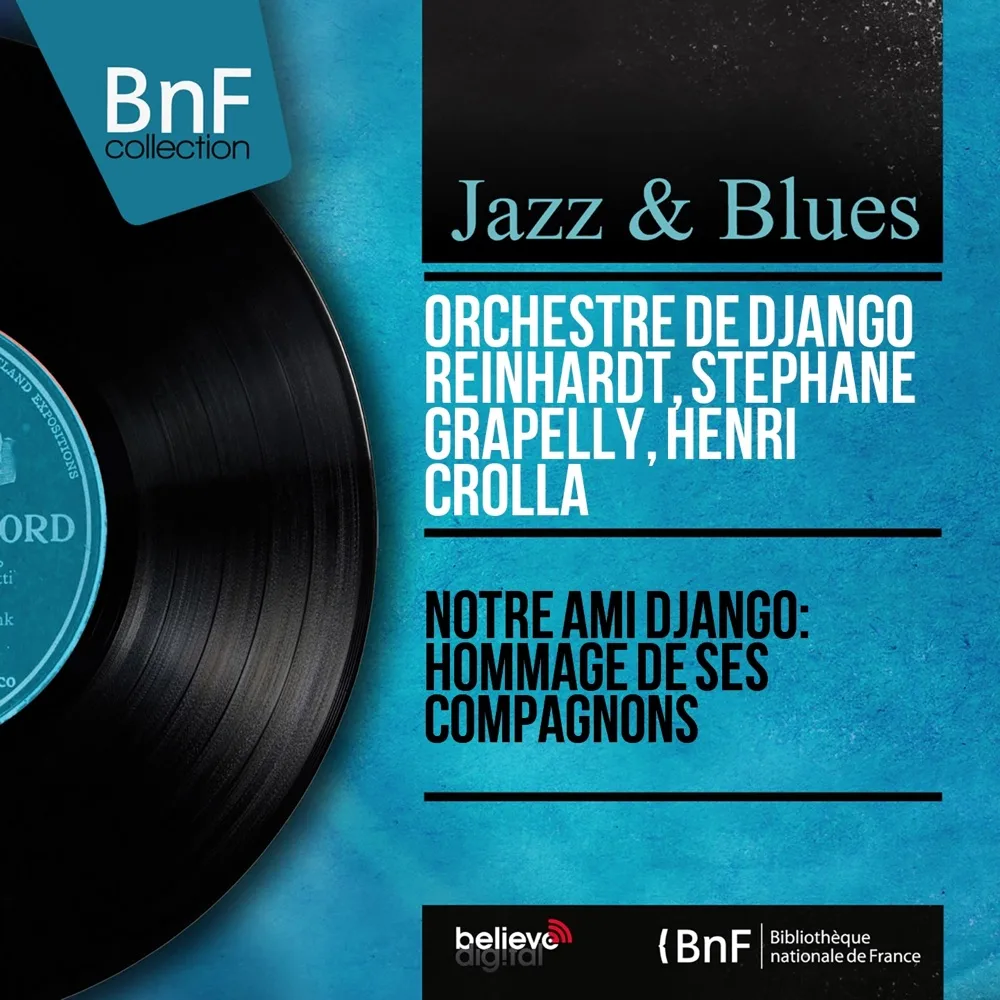
Cover of the digital edition of *Notre ami Django: Hommage de ses compagnons* (Vega, 1958; digital reissue in the BnF collection), a tribute album to Django Reinhardt on which Emmanuel Soudieux plays bass. The cover is a graphic of a vinyl record with lettering, not a photograph of the artist. Standard copyright, all rights reserved, held by the label or rights holder. This is not a Creative Commons or public-domain image; it is an album cover shown as an honestly disclosed editorial identification image. — Apple Music artwork for the album, https://music.apple.com/fr/album/swing-39/896983075?i=896983082
Emmanuel Soudieux was a double bassist who played in the Quintette du Hot Club de France in the 1940s, and whom French Wikipedia calls Django Reinhardt's favourite bassist. He was born in Liège, Belgium, on July 30, 1919, and passed away in the 15th arrondissement of Paris on October 23, 2006, at the age of 87. He is catalogued as a French musician (French Wikipedia and the Wikidata record give him French citizenship), and every document of his career that survives is French: he was in Reinhardt's band in Paris from 1938, his recordings were made in Paris from 1939 onward, and he spent the end of his life in Montparnasse. When he came to France, and how he acquired French citizenship, is not documented in the sources available.
German Wikipedia says he started out in musette and tango orchestras and that from 1938 he was in the band of Reinhardt and Stéphane Grappelli. On record he first appears with the quintet on March 21, 1939, in Paris, on "Hungaria", issued on Decca F.7198 and credited on bass beside Reinhardt, Joseph Reinhardt, Pierre "Baro" Ferret and Grappelli. A Reinhardt single on the Swing label, "I'll See You in My Dreams", records him as bass accompanist on a side cut on June 30, 1939 with Ferret on guitar. When the war separated Reinhardt from Grappelli, who stayed in London, the quintet's Paris recordings were made with the clarinettist Hubert Rostaing in Grappelli's place, and Soudieux is the bassist on "Dinette" and "Lentement Mademoiselle" (Swing SW. 146, recorded on September 11, 1941 and March 31, 1942), with Rostaing, the drummer Pierre Fouad and the guitarist Eugène Vées.
Through the war years he was one of the bassists Reinhardt used and a regular in the Swing label's sessions. Discogs credits him on a 1940s run of singles for the saxophonist André Ekyan, among them "Hungaria" / "Out of Nowhere" (SW. 127, 1941) with Reinhardt, Vées and Fouad, and "Sugar" / "Margie" (SW. 202, issued 1945) with both Django and Joseph Reinhardt; on a Dany Kane harmonica session of September 26, 1941 with Joseph Reinhardt, the vibraphonist Willy Kett and the drummer Armand Molinetti; and on an Ekyan ensemble single for Disques ABC in 1943 with Rostaing on trumpet. German Wikipedia says he played with Reinhardt intermittently until 1947, a period that includes the Blue Star sides on which Reinhardt used electric guitar, among them "Django's Blues", with Rostaing on clarinet. Boris Vian, according to the same article, ranked him with Lucien Simoens among the best bassists in France in the years just after the war.
The postwar sessions carry him into bebop. On November 19, 1946 he was the bassist on "Direct" and "Autumn Harmony", the fourth Swing "Jam Session", with Rostaing on alto saxophone, the guitarist Henri Crolla and the pianist Léo Chauliac. On July 4, 1947 he recorded with Hubert Fol's Be-Bop Minstrels, with André Persiany on piano, on "Swingin' at Lutetia" and "Lubie Loo" (SW. 260). He was still working with Grappelli: in October 1947 he is the bassist on "Oui pour vous revoir", Grappelli's Hot Four single with Roger Chaput on guitar, and Discogs credits him, uncredited on the label, on the quintet's "Mike" and "Lady Be Good" of March 10, 1948. German Wikipedia places his last Swing session with Reinhardt in November 1947.
From 1949 he was a regular partner of the pianist Jack Diéval. He is on the Rostaing sextet's "Auber Blues", cut on January 31, 1949, and, according to German Wikipedia, played with Diéval's band at the 1949 international jazz festival at the Salle Pleyel. On January 31, 1950 he joined the trumpeter Doc Cheatham and Diéval for "Embraceable You" and "Doc's Blues" (Swing SW. 336), and the same source says that trio accompanied the singer Eartha Kitt. In Paris in 1950 he was the bassist, with the drummer Richie Frost, on the Diéval quartet sides recorded with the tenor saxophonist James Moody and the trombonist Nat Peck, which Prestige issued in the United States as New Sounds From France; Annie Ross sings on "Le Vent Vert".
In the late 1950s he worked, by the same account, with Rostaing and the guitarist Henri Crolla. All three are on Notre ami Django: Hommage de ses compagnons (Vega, 1958), the tribute album to Reinhardt, who had died in 1953, which also carries Grappelli, Ekyan, the pianists Maurice Vander and René Urtreger and the vibraphonist Géo Daly. At 85 he told Reinhardt's biographer Michael Dregni about his years in the quintet. He passed away in 2006 and is listed in the French authority files of the Bibliothèque nationale de France.
Soudieux was a swing-era rhythm bassist who moved without strain into bebop, and his recorded work is almost entirely accompaniment: the bass that lets Reinhardt, Grappelli, Ekyan or Moody be heard. French Wikipedia credits him with being the first musician in Europe to play four beats to the bar in walking bass, a claim that rests on that one source and should be read as local legend rather than a documented first. What the records do show is the range of the chair he held, from the Hot Club's manouche rhythm section to the Be-Bop Minstrels and a Paris session with Moody in 1950, and Boris Vian's judgment places him among the leading French bassists of his time. No album was ever issued under his own name.
- "Hungaria" / "My Melancholy Baby" (Quintette du Hot Club de France, Decca F.7198) - "Hungaria" was recorded in Paris on March 21, 1939, his first documented session with the quintet, with Django and Joseph Reinhardt, Pierre Ferret and Grappelli. Apple Music - Hungaria Listen
- "Dinette" / "Lentement Mademoiselle" (Django Reinhardt et le Quintette du Hot Club de France, Swing SW. 146) - wartime quintet sides, with Soudieux on bass beside Rostaing, Fouad and Vées.
- "Sugar" / "Margie" (André Ekyan, Swing SW. 202, issued 1945) - Ekyan's alto in front of Django Reinhardt, Joseph Reinhardt and Soudieux; the track is billed to Reinhardt, Ekyan, Soudieux and Baro Ferret on a Dr. Jazz Collection compilation. Apple Music - Margie Listen
- The Be-Bop Minstrels, "Swingin' at Lutetia" / "Lubie Loo" (Swing SW. 260, recorded July 4, 1947) - an early French bebop session led from the alto saxophone by Hubert Fol. Apple Music - Swingin' at Lutetia Listen
- Doc Cheatham, "Embraceable You" / "Doc's Blues" (Swing SW. 336, recorded January 31, 1950) - a trio side with the American trumpeter and Jack Diéval.
- Jack Diéval and James Moody, New Sounds From France (Prestige PRLP 157, 1953) - Soudieux is the bassist on the Paris sides of 1950, with Moody, Nat Peck and Richie Frost.
- Henri Crolla, André Ekyan, Stéphane Grappelli and Hubert Rostaing, Notre ami Django: Hommage de ses compagnons (Vega V 30 S 805, 1958) - the Reinhardt tribute album, with Soudieux on bass. Apple Music - Manoir de mes rêves Listen
Emmanuel Soudieux: Full Discography
French double bassist, born in Liège, Belgium, on July 30, 1919, who passed away in Paris on October 23, 2006. Discogs files his releases under artist 460659 (https://www.discogs.com/artist/460659), which lists 269 entries, almost all of them records led by others and reissues and compilations of Django Reinhardt and the Quintette du Hot Club de France. His appearances sit under many separate band entries on Discogs, among them the Quintette du Hot Club de France (355185), Joseph Reinhardt et son ensemble (567572), André Ekyan et son ensemble (567585), Dany Kane et son ensemble (567589), Jack Diéval et son quartett (344324), Hubert Rostaing et son orchestre (698055) and The Be-Bop Minstrels (1001541). No album, EP or single is billed to him as leader. He is a sideman of the 78 rpm era, so this page has no leader table; the table below lists selected sessions, read from the individual release records, with the instrument credited on each one. Where a catalog number, date or personnel list could not be confirmed, the cell says so.
Role key: every row is a sideman credit. The Role cell gives the instrument credited on the release record, and says so where the credit covers only some tracks or is marked uncredited on the label.
As sideman (selected credits)
| Year | Project (Leader) | Title | Label | Catalog | Role | Notes |
|---|---|---|---|---|---|---|
| 1939 | Quintette du Hot Club de France (Django Reinhardt, Stéphane Grappelli) | "Hungaria" / "My Melancholy Baby" | Decca | F.7198 | Bass | "Hungaria" recorded in Paris on March 21, 1939 and "My Melancholy Baby" on May 17, 1939; Django Reinhardt, Joseph Reinhardt and Pierre Ferret (guitars) and Grappelli (violin). |
| 1939 | Django Reinhardt | "I'll See You in My Dreams" / "Tea for Two" | Swing | SW. 211 | Bass accompanist, A side only | Year is that of the A-side recording, June 30, 1939 (release year not confirmed), with Pierre Ferret (guitar); the B side, recorded on December 28, 1937, has Grappelli on piano and no Soudieux credit. |
| 1941 | André Ekyan | "Hungaria" / "Out of Nowhere" | Swing | SW. 127 | Contrabass | Ekyan (saxophone), Django Reinhardt and Eugène Vées (guitars), Pierre Fouad (drums). |
| 1941 | Dany Kane et son Swingtette | "Fantaisie en do majeur" / "Oui, c'est ça" | Swing | SW. 130 | Bass | Recorded on September 26, 1941; Dany Kane (harmonica), Joseph Reinhardt (guitar), Willy Kett (vibraphone), Armand Molinetti (drums). |
| 1942 | Django Reinhardt et le Quintette du Hot Club de France | "Dinette" / "Lentement Mademoiselle" | Swing | SW. 146 | Bass | A side recorded on September 11, 1941 and B side on March 31, 1942; Hubert Rostaing (clarinet), Pierre Fouad (drums), Eugène Vées (guitar). |
| 1943 | André Ekyan et son ensemble | "Palm Beach" / "Irène" | Disques ABC Paris | JC 1 | Bass | Aimé Barelli and Hubert Rostaing (trumpets), Coco Kiehn (saxophone, clarinet), Charlie Lewis (piano), Eugène Vées (guitar), Pierre Fouad (drums). |
| 1945 | André Ekyan | "Sugar" / "Margie" | Swing | SW. 202 | Contrabass | Ekyan (alto saxophone), Django Reinhardt and Joseph Reinhardt (guitars); recording date not confirmed on the release record. |
| 1946 | Jam Session No. 4 | "Direct" / "Autumn Harmony" | Swing | SW. 237 | Bass | Both sides recorded on November 19, 1946, issued 1947; Rostaing (alto saxophone), Harry Perret (tenor saxophone), Alex Renard (trumpet), Léo Chauliac (piano), Henri Crolla (guitar), Arthur Motta (drums). |
| 1947 | Django Reinhardt et le Quintette du Hot Club de France | "Danse norvégienne" / "Django's Blues" | Blue Star | B. S. No. 38 | Bass on "Django's Blues" | Reinhardt on electric guitar, Rostaing (clarinet), Eugène Vées (guitar), André Jourdan (drums); "Danse norvégienne" credits Ladislas Czabanick on bass. Supervised by Eddie Barclay. |
| 1947 | The Be-Bop Minstrels (Hubert Fol) | "Swingin' at Lutetia" / "Lubie Loo" | Swing | SW. 260 | Bass | Both sides recorded on July 4, 1947; Fol (alto saxophone), Alan Jeffreys (trumpet), Jack Carman (trombone), André Persiany (piano), Benny Bennet (drums). |
| 1948 | Stéphane Grappelli et son Hot Four | "Oui pour vous revoir" / "Tea for Two" | Swing | SW. 271 | Bass on "Oui pour vous revoir" | Recorded on October 7, 1947; Roger Chaput (guitar), Grappelli (violin). On "Tea for Two" Grappelli plays piano solo. |
| 1948 | Quintette du Hot Club de France (Django Reinhardt, Stéphane Grappelli) | "Mike" / "Lady Be Good" | Swing | SW. 287 | Bass (uncredited on the label) | Recorded in Paris on March 10, 1948; Django and Joseph Reinhardt and René "Challain" Ferret (guitars), Grappelli (violin). |
| 1949 | Hubert Rostaing et son sextette | "Be-Bop Tune" / "Auber Blues" | Swing | SW. 311 | Bass on "Auber Blues" (B side) | B side recorded on January 31, 1949; Jack Diéval (piano), Rostaing (clarinet), Robby Poitevin (vibraphone), Lucien Gallopain (guitar), Arthur Motta (drums). Ladislas Czabanick plays bass on the A side. |
| 1950 | Doc Cheatham | "Embraceable You" / "Doc's Blues" | Swing | SW. 336 | Bass | Recorded on January 31, 1950; Cheatham (trumpet), Jack Diéval (piano). |
| 1953 | Jack Diéval and His Quartet, with James Moody | New Sounds From France | Prestige | PRLP 157 | Bass on A1 to B2 | The Paris sides (the first dated February 10, 1950): Moody (tenor saxophone), Nat Peck (trombone), Diéval (piano), Richie Frost (drums), with Annie Ross singing on "Le Vent Vert". Tracks B3 and B4 are an April 1949 Lausanne session with Alvin Banks on bass. |
| 1958 | Henri Crolla, André Ekyan, Stéphane Grappelli, Hubert Rostaing | Notre ami Django: Hommage de ses compagnons | Vega | V 30 S 805 | Bass | Tribute album to Reinhardt; Rostaing (clarinet), Crolla (guitar), Ekyan (saxophone), Maurice Vander and René Urtreger (piano), Géo Daly (vibraphone), Al Levitt and Pierre Lemarchand (drums), Grappelli (violin). |
Other credits on Discogs
Discogs also lists him under later LP and CD collections of Django Reinhardt's recordings (the Djangologie series, Swing From Paris and others), under Rostaing and Crolla records of the 1940s and 1950s, and, among others, under a 1943 Charles Trénet single and Yves Montand's 1958 Récital 58. Those entries were not read release by release, so they are not itemized above and the nature of each credit is not confirmed. Discogs tags such credits only as appearances, without saying which tracks he plays on.
- Django Reinhardt - guitarist and leader of the Quintette du Hot Club de France; Soudieux was his bassist on sessions from 1939 into 1948.
- Stéphane Grappelli - violinist of the quintet; Soudieux is on the 1939 quintet sides and on Grappelli's Hot Four single of October 1947.
- Joseph Reinhardt - rhythm guitarist and Django's brother, on the 1939 "Hungaria", the Ekyan and Kane sessions of the 1940s.
- Hubert Rostaing - clarinettist and saxophonist, in the quintet's wartime line-up and on the 1946 Jam Session and the 1949 sextet date.
- André Ekyan - saxophonist; Soudieux is the bassist on several of his Swing singles of 1941 to 1945.
- Hubert Fol - alto saxophonist who led the Be-Bop Minstrels session of July 4, 1947.
- Jack Diéval - pianist; Soudieux played in his groups from 1949, including the Cheatham trio and the Moody quartet sides.
- James Moody - American tenor saxophonist, on the 1950 Paris sessions issued as New Sounds From France.
- Henri Crolla - guitarist, on the 1946 Jam Session and the 1958 Reinhardt tribute album.
- Roger Chaput - guitarist, on Grappelli's Hot Four single of October 1947.
- Pierre Fouad - drummer on the wartime quintet and Ekyan singles of 1941.
- Eugène Vées - guitarist on the wartime quintet singles and the Ekyan ensemble sides.
- Doc Cheatham - American trumpeter, leader of the trio single of January 31, 1950.

More Gypsy Jazz Artists
See all 67 Gypsy Jazz artists →More French Jazz Artists
See all 511 French artists →- Discogs
- AllMusic
- MusicBrainz
- Wikipedia (French)
- Wikipedia (German)
- BnF data
- Discography of American Historical Recordings
- Emmanuel Soudieux on JazzProfiles.com
- Wikipedia (French): Emmanuel Soudieux
- Wikipedia (German): Emmanuel Soudieux
- Wikidata: Emmanuel Soudieux (Q166286)
- MusicBrainz: Emmanuel Soudieux
- Discogs: Emmanuel Soudieux, artist 460659
- Discogs: Hungaria / My Melancholy Baby, Decca F.7198
- Discogs: Dinette / Lentement Mademoiselle, Swing SW. 146
- Discogs: Swingin' At Lutetia / Lubie Loo, Swing SW. 260
- Discogs: Embraceable You / Doc's Blues, Swing SW. 336
- Discogs: New Sounds From France, Prestige PRLP 157
- Discogs: Notre Ami Django Hommage De Ses Compagnons, Vega V 30 S 805
- BnF data: Emmanuel Soudieux
- Discography of American Historical Recordings: Emmanuel Soudieux
- JazzProfiles: Quintette du Hot Club de France