 JAZZPROFILES lives in the music 2,555 Jazz Artists fully Profiled!
Gus Viseur
Last updated November 14, 2026
Listen on Spotify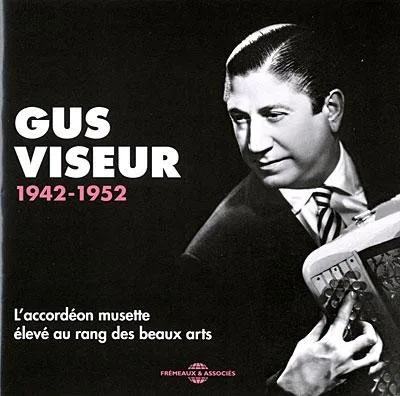
Gus Viseur holding his accordion, on the cover of the Frémeaux & Associés compilation *Gus Viseur 1942-1952 (L'accordéon musette élevé au rang des beaux arts)*, catalog FA 5380, released in 2012. Album cover art (not a CC-licensed artist photo), used as the only available image showing the artist. — Cover Art Archive, release group "Gus Viseur 1942-1952" - https://coverartarchive.org/release-group/69c100c4-5a90-4434-b29c-c286a3dc8dfd (MusicBrainz release https://musicbrainz.org/release/b2a00af8-b68e-4b07-a436-fdb7ee27bd83)
Gus Viseur (born Gustave Joseph Viseur) was a Belgian-born accordionist who spent his working life in France and is the name most often given for the start of swing musette: Paris dance-hall accordion played with jazz phrasing over the rhythm guitar of the Ferret brothers. He was born on May 17, 1915 in Lessines, in the Belgian province of Hainaut, the son of a bargeman, and the family moved from place to place until it settled in Paris in 1920, so that he grew up in the city and his documented career, from the Paris fairs of the 1930s to his death in Le Havre, was spent in France. His father taught him the accordion from the age of eight and he later took lessons from a music professor. Father and son played in an amateur band from 1929, and after his father's death he worked the fairs and markets of Paris.
In the early 1930s he played second accordion for the bandleader Médard Ferrero. In 1933 he met the accordionist René "Charley" Bazin, and the two began to improvise after hearing jazz. He led a band of his own by 1935 that recorded four titles that year, and he had the reeds of his Fratelli Crosio accordion filed down and retuned so that the usual musette vibrato gave way to a plainer, more modern sound. He played in the orchestra of the pianist Boris Sarbek and worked in France and Belgium with the trumpeter Philippe Brun, Joseph Reinhardt and his own quintet. Discogs lists the 1939 Columbia single "Honeysuckle Rose" / "Whispering" (DF 2662) under his name with the Orchestre Victor under Sarbek's direction.
His jazz records begin with the Swing label that Charles Delaunay of the Hot Club de France had started. Discogs lists "It Had to Be You" / "Wind and Strings (Andalusia)" (Swing SW. 37, October 1938) under the name Gus Viseur's Music, with the guitarists Pierre "Baro" Ferret, Jean "Matlo" Ferret and René "Challain" Ferret and the bassists Maurice Speilleux and Antonio "Tony" Rovira; the Frémeaux compilation Compositions 1934-1942 gives September 28 and October 20, 1938 as the Swing recording dates of "Andalousie" and "Automne." From 1941 to 1943 he made further Swing singles with his own orchestra (SW. 106, 116, 125, 140 and 169), usually with the clarinettist André Lluis, a bassist and two of the Ferrets or Joseph Reinhardt on guitars. French Wikipedia says he was one of only two accordionists, with Charles Verstraete, to belong to the Hot Club de France. Georg Lankester's biography adds that he played with the saxophonist André Ekyan and Django Reinhardt in Paris clubs; no record credit with Reinhardt was found, but two of his Swing sides, "Swing 39" and "Swing 42," are Reinhardt compositions, and so is "Nuages," which he recorded for Columbia on September 23, 1942.
French Wikipedia lists him at the accordion on Édith Piaf's recording of "L'Accordéoniste," made in May 1940 with Wal-Berg's orchestra, and Discogs credits him there too, uncredited on the label; English Wikipedia says that session brought him wider public attention. His "Swing valse," written with Baro Ferret and recorded on August 9, 1940 with Matelo Ferret on guitar according to Discogs, became the best known of his compositions. In 1942 he and the trumpeter Gus Deloof made "Gus & Gus" / "Harlem Swing" for Decca, with Joseph Reinhardt and Roger Chaput on guitars, Jacques Lowens on clarinet and Jacques Petitsigne on bass. A 1952 Ducretet Thomson single of "Be-bop Polka" with the accordionist Loulou Legrand carries a Grand Prix du Disque note for 1952 on Discogs, which files it as a polka.
The long middle of his career was lighter music: the Pacific records of 1949 and 1955, the Barclay 10-inch LP Chansons de Paris (1955) and similar sets. Accounts of the 1960s differ. English Wikipedia reports a United States tour in 1963, after which he stopped playing and opened a record shop in Le Havre, while Lankester has the Le Havre shop opening in 1955 and a move to Canada in 1960, with a weekly television programme in Montreal. All accounts agree that he returned to the studio around 1970: a Vogue LP of 1969 (CLVLX. 327) and the Mode Serie LP Swing Accordéon (1971) followed, and on the second he plays "Swing 39," "Swing 42" and "Djangology" with Matelo and Pierre Ferret, the clarinettist Claude Civelli, the bassist Jacques Petitsigne and the drummer Roger Paraboschi. He passed away in Le Havre on August 25, 1974.
Viseur treated the accordion as a jazz solo instrument at a time when it belonged to the dance hall. Lankester counts him with Louis Richardet and Gorni Kramer among the first to play jazz on it, calls him a strong improviser and says his playing grew out of the Manouche style of Django Reinhardt and the records of Black American jazz musicians; Discogs files the Swing label singles as jazz and swing. Retuning the reeds to drop the musette vibrato gave him a drier, quicker tone that sits comfortably beside a clarinet and rhythm guitars. His reputation rests on the dance-hall accordion repertoire as much as on jazz, and the long run of waltzes, polkas and Paris songs from the 1950s onward is musette rather than improvised jazz; the jazz case is the Hot Club years of 1938 to 1943. The musicologie.org biography compares his importance for jazz accordion with that of Reinhardt and Stéphane Grappelli, and the accordionist Richard Galliano and the guitarist Sylvain Luc built their 2015 album La Vie en rose (Rencontres avec Édith Piaf et Gus Viseur) around the repertoires of Piaf and Viseur.
- "It Had to Be You" / "Wind and Strings (Andalusia)" (Gus Viseur's Music, Swing SW. 37, 1938) - his first Swing label single, with Pierre, Jean and René Ferret on guitars. Its "Andalousie" is track 3 of Compositions 1934-1942. Apple Music - Andalousie Listen
- "Swing valse" (Columbia, recorded August 9, 1940) - the waltz with Baro Ferret that became his signature piece, with Matelo and Sarane Ferret on guitars. Apple Music - Swing valse Listen
- "Swing 39" / "Dayde Crazy Blues" (Gus Viseur et son orchestre, Swing SW. 116, 1941) - a Django Reinhardt tune and a Viseur original, with André Lluis on clarinet and Sarane and Matelo Ferret on guitars. Apple Music - Dayde Crazy Blues
- "Nuages" / "À saute-mouton" (Gus Viseur et son orchestre, Columbia DF 2915, 1943) - his version of Reinhardt's "Nuages," recorded in Paris on September 23, 1942 and included on the 2012 Frémeaux compilation listed below.
- "Swing 42" / "Sextolet Rag" (Gus Viseur et son orchestre, Swing SW. 140, 1942) - a Swing single with Joseph Reinhardt and Joseph Solero on guitars.
- "Gus & Gus" / "Harlem Swing" (Gus Viseur and Gus Deloof, Decca 10001 / 10002, 1942) - accordion and trumpet with Joseph Reinhardt and Roger Chaput on guitars.
- Swing Accordéon (Gus Viseur et son ensemble, Mode Serie SMDINT 9928, 1971) - the late LP with Matelo and Pierre Ferret, which reprises "Swing 39," "Swing 42" and "Djangology."
- L'accordéon musette élevé au rang des beaux arts, 1942-1952 (Frémeaux & Associés FA 5380, 2012) - a twenty-track compilation of his 1940s and early 1950s records, from "Swing 43" to "Be-bop Polka." Apple Music Listen
Gus Viseur: Full Discography
Belgian-born French accordionist, born in Lessines on May 17, 1915, who passed away in Le Havre on August 25, 1974. Discogs files his releases under artist 354741 (https://www.discogs.com/artist/354741-Gus-Viseur), about 380 entries, most of them compilations and records by other leaders on which he appears. His bands are separate entries on Discogs: Gus Viseur Et Son Orchestre (799324), Gus Viseur Et Son Ensemble (799322), Gus Viseur's Music (1030786), Gus Viseur & Son Sextette Swing (6540693), Accordion's Club (17312164) and the Orchestre Victor and Swing Royal bands. Almost everything he made before 1955 came out as 10-inch 78 rpm singles. The rows below were read from the release records on Discogs; where a release record was not read, the cell says so.
Role key: Leader means the record is billed to Viseur or to his own band. Co-billed rows are records billed jointly with another musician. Sideman rows give the credit as Discogs or the label lists it.
Leader releases
| Album | Recording Date(s) | Release Date | Label | Catalog Number | Format | Personnel | Role | Notes | Listen | Buy |
|---|---|---|---|---|---|---|---|---|---|---|
| "It Had to Be You" / "Wind and Strings (Andalusia)" (billed Gus Viseur's Music) | "Wind and Strings (Andalusia)": September 28, 1938, Paris (from the 1993 compilation's notes); the other side: Not confirmed | October 1938 | Swing | SW. 37 | 10-inch 78 rpm | Gus Viseur (accordion); Pierre "Baro" Ferret, Jean "Matlo" Ferret and René "Challain" Ferret (guitars); Maurice Speilleux (bass, side A); Antonio "Tony" Rovira (bass, side B) | Leader | "Wind and Strings" is credited to Viseur and Matlo Ferret. Discogs files the record as swing and gypsy jazz. | Apple Music ("Andalousie") | — |
| "Honeysuckle Rose" / "Whispering" (billed Gus Viseur et l'Orchestre Musette Victor sous la direction de Boris Sarbek) | Not confirmed | 1939 | Columbia | DF 2662 | 10-inch 78 rpm | Not documented | Leader | Discogs lists three further 1939 Columbia singles billed to Viseur and the Orchestre Victor under Sarbek: "Valse de minuit" / "L'imprévu," "Bel-Ami" / "Le Caravanier" and "Bel Ami" / "Sérénade sans espoir"; those release records were not read for catalog numbers. | — | — |
| "Fait exprès" / "Blue Guitar" (billed Gus Viseur et son orchestre) | Not confirmed | 1941 | Swing | SW. 106 | 10-inch 78 rpm | Gus Viseur (accordion), André Lluis (clarinet), Etienne "Sarane" Ferret and Jean "Matlo" Ferret (guitars), Maurice Speilleux (bass) | Leader | Both sides are Viseur compositions. | Apple Music (on the compilation Spécial Gus Viseur) | — |
| "Swing 39" / "Dayde Crazy Blues" (billed Gus Viseur et son orchestre) | Not confirmed | 1941 | Swing | SW. 116 | 10-inch 78 rpm | Same quintet as SW. 106 | Leader | "Swing 39" is credited to Django Reinhardt, "Dayde Crazy Blues" to Viseur. | Apple Music ("Dayde Crazy Blues") | — |
| "Matelotte" / "Giboulée" (billed Gus Viseur et son orchestre) | "Matelotte": April 9, 1941 (from the 1993 compilation's notes); "Giboulée": Not confirmed | 1941 | Swing | SW. 125 | 10-inch 78 rpm | Same quintet as SW. 106 | Leader | Both sides are Viseur compositions. | Apple Music (on the compilation Spécial Gus Viseur) | — |
| "Swing 42" / "Sextolet Rag" (billed Gus Viseur et son orchestre) | Not confirmed | 1942 | Swing | SW. 140 | 10-inch 78 rpm | Gus Viseur (accordion), André Lluis (clarinet), Joseph Reinhardt and Joseph Solero (guitars), Maurice Speilleux (bass) | Leader | "Swing 42" is credited to Django Reinhardt, "Sextolet Rag" to Viseur. | Apple Music ("Sextolet Rag," on Spécial Gus Viseur) | — |
| "Gus Blues" / "Partie de plaisir" (billed Gus Viseur et son orchestre) | July 8, 1943 (both sides, per Discogs) | 1943 | Swing | SW. 169 | 10-inch 78 rpm | Gus Viseur (accordion), Robert Mavounzy (clarinet, alto saxophone), André Lluis (clarinet, tenor saxophone), Gaston Durand and Jean "Matlo" Ferret (guitars), Jacques Petitsigne (double bass) | Leader | Both sides are Viseur compositions. | Apple Music (on Spécial Gus Viseur) | — |
| "Gus & Gus" / "Harlem Swing" (billed Gus Viseur and Gus Deloof) | Not confirmed | 1942 (Belgian Decca pressing) | Decca | 10001 / 10002 | 10-inch 78 rpm | Gus Viseur (accordion), Gus Deloof (trumpet), Jacques Lowens (clarinet), Joseph Reinhardt and Roger Chaput (guitars), Jacques Petitsigne (bass) | Co-leader | "Gus & Gus" is credited to Deloof and Viseur, "Harlem Swing" to Deloof. A 1943 Decca single, "Chantons ensemble" / "Gus & Gus," and a further Decca coupling, "Sur la glace" / "Chantons ensemble," carry the same billing; those records were not read. Roger Chaput is on JazzProfiles.com. | — | — |
| "Nuages" / "À saute-mouton" (billed Gus Viseur et son orchestre) | "Nuages": September 23, 1942, Paris | 1943 | Columbia | DF 2915 | 10-inch 78 rpm | Not documented | Leader | "Nuages" is credited to Django Reinhardt, "À saute-mouton" to Viseur. | — | — |
| "Be-bop Polka" / "Les Deux Copains" (billed Gus Viseur and Loulou Legrand) | Not confirmed | 1952 | Ducretet Thomson (Selmer) | X 8514 | 10-inch 78 rpm | Two accordions; no other personnel documented | Co-billed | Described on the label as a fox-polka and a polka for two accordions, with a Grand Prix du Disque note for 1952. Discogs files it as polka, not jazz. | — | — |
| Chansons de Paris (billed Gus Viseur) | Not confirmed | 1955 | Barclay | 82.009 | 10-inch LP | Gus Viseur et son ensemble; personnel not documented | Leader | Seventeen Paris songs, among them "Paris je t'aime," "Rue Lepic," "Ménilmontant" and "Revoir Paris"; sleeve by Gérard Jourdan. The catalog number reads 82.009 on the cover and 82009 on the labels. | — | — |
| Gus Viseur et son ensemble | Not confirmed | 1969 | Disques Vogue | CLVLX. 327 | LP, stereo | Gus Viseur (accordion), Michel Gésina and René Duchossoir (guitars), Fred Ermelin (bass), Roger Paraboschi (drums) | Leader | Twelve tracks, mostly his own tunes, among them "Soir de dispute," "Gracieuzette," "L'imprévu" and "15 mai." Discogs files it under pop. | — | — |
| Swing Accordéon (billed Gus Viseur et son ensemble) | Not confirmed | 1971 | Mode Serie | SMDINT 9928 | LP | Gus Viseur (accordion), Claude Civelli (clarinet), Jean "Matlo" Ferret and Pierre Ferret (guitars), Jacques Petitsigne (bass), Roger Paraboschi (drums) | Leader | Twelve tracks including "Sweet Georgia Brown," "Swing 39," "Djangology," "Swing 42" and "Cheek to Cheek." Discogs files it as jazz, swing, gypsy jazz and musette. Matelo Ferret is on JazzProfiles.com. | — | — |
Other leader and co-billed releases listed on Discogs (release records not read)
| Year | Title | Label | Format | Notes |
|---|---|---|---|---|
| 1943 | "L'Africain" / "Bois de la Cambre" (billed Gus Viseur) | Rythme | 10-inch 78 rpm | Catalog number Not confirmed. |
| 1949 | "Don't You Mammy" / "Impressions nocturnes" (billed Accordion's Club sous la direction de Gus Viseur) | Pacific | 10-inch 78 rpm | Catalog number Not confirmed. Two further Pacific singles of 1949 and one of 1955 are billed to Gus Viseur et son orchestre. |
| 1954 | Accordiana (Gus Viseur, Loulou Legrand, Jo Moutet) | Westminster | 10-inch LP | Catalog number Not confirmed. |
| 1954 | Accordéon N° 2 (Gus Viseur, Loulou Legrand, Jo Moutet) | Ducretet Thomson | LP, compilation | Catalog number Not confirmed. |
| 1955 | Les Classiques du musette accordéon (André Marc, Jacques Poubeau, Gus Viseur) | Le Chant du Monde | 7-inch EP | Catalog number Not confirmed. |
| 1966 | À la crêpe bretonne (billed Gus Viseur et son accordéon) | Fantastic | LP, mono | Catalog number Not confirmed. |
| 1966 | Petit Quinquin | Disque Saphir | 7-inch EP | Catalog number Not confirmed. |
Compilations
| Album | Release Date | Label | Catalog Number | Format | Notes | Listen | Buy |
|---|---|---|---|---|---|---|---|
| Gus Viseur: Compositions 1934-1942 | 1993 | Frémeaux & Associés | FA 010 | CD | Eighteen tracks recorded in Paris, drawn from Columbia, Swing, Polydor, Odéon and Excelsior originals dated 1934 to 1942. Guitarists on the credits are Pierre, Jean "Matlo", Etienne "Sarane" and René "Challain" Ferret, Joseph Reinhardt and Joseph Solero; Tony Murena plays on track 12 and Joseph and Tito Colombo on track 18. | Apple Music | — |
| Spécial Gus Viseur (1938-1951) | 1993 | EMI France | 781254 2 | CD | Twenty-six tracks, from "Sérénade à la mule" to "Farewell Blues." | Apple Music | — |
| De Clichy à Broadway | 2002 | Gitanes Jazz Productions | 018 430-2 | CD | Sixteen tracks: tracks 1 to 12 reissue the Barclay LP 82 309 (recorded June 1962) and tracks 13 to 16 are extracts from the Barclay LP 82 009 (recorded May 3, 1955). Roger Paraboschi is on drums; the guitarist is credited as Boulou Ferré, though the liner notes consider it more likely to have been Matelo, Baro or Sarane Ferret. | Apple Music | — |
| L'accordéon musette élevé au rang des beaux arts | 2012 | Frémeaux & Associés | FA 5380 | CD | Twenty tracks, from "Swing 43" to "Be-bop Polka"; Discogs files it as jazz and swing. | Apple Music | — |
As Sideman and Credited Appearances (selected)
| Year | Project (Leader) | Title | Label | Catalog | Role | Notes |
|---|---|---|---|---|---|---|
| 1938 | Médard Ferrero et son orchestre musette | "Dalinette" / "Polka aérodynamique" (billed M. Ferrero and Gus Viseur) | Not confirmed | Not confirmed | Credited, instrument not itemized | Listed on Discogs as a joint billing; release record not read. |
| 1939 | Orchestre Musette Victor | "J'attendrai" / "Le Gallipetant" | Columbia | Not confirmed | Credited, instrument not itemized | Release record not read. |
| May 1940 | Édith Piaf | "L'Accordéoniste" / "Escales" | Polydor | 524 669 | Accordion on "L'Accordéoniste" (uncredited on the label), per Discogs and French Wikipedia | The Discogs record lists Viseur on accordion on side A, uncredited, and Wal-Berg's orchestra as the accompaniment; French Wikipedia dates the session to May 1940 and names "Gus Viseur à l'accordéon." The song is by Michel Emer. |
| 1940 | Orchestre Musette "Swing Royal" | "Joli carillon" / "Je voudrais vous dire" and "S'aimer au clair de lune" / "Regarde-moi" | Polydor | Not confirmed | Credited, instrument not itemized | Two singles; Discogs lists the Swing Royal orchestra as one of his groups. Release records not read. |
| 1942 | Orchestre Swing Jo Reinhardt | "Zazou-Zazou" / "Ballade" | Decca | Not confirmed | Credited, instrument not itemized | Release record not read. |
| 1971 | Jo Privat | Le Grand Bal de nuit | Disc'Az | Not confirmed | Credited, instrument not itemized | Release record not read. |
| 2015 | Richard Galliano and Sylvain Luc | La Vie en rose (Rencontres avec Édith Piaf et Gus Viseur) | Milan | 399 604-2 | Subject of the album, not a performer | A tribute duo of accordion and guitar; the repertoire comes from Piaf and Viseur. Richard Galliano is on JazzProfiles.com and Sylvain Luc on JazzProfiles.com. |
Discogs also lists him on many further anthologies of musette, swing accordion and Manouche jazz, and on records by other accordionists. Those entries are not itemized here because their credit lines were not read one by one.
- Matelo Ferret - guitarist on the 1938 Swing single, the Swing singles of 1941 and 1943, the 1940 "Swing valse" and the 1971 LP Swing Accordéon, according to Discogs.
- Roger Chaput - guitarist on the 1942 Decca single "Gus & Gus" / "Harlem Swing."
- Joseph Reinhardt - Django's brother, guitarist on the 1942 Decca single, on the Swing single "Swing 42" / "Sextolet Rag" and on two tracks of Compositions 1934-1942.
- Pierre "Baro" Ferret, Etienne "Sarane" Ferret and René "Challain" Ferret - guitarists on the 1938 to 1942 Swing and Columbia sides; Baro Ferret co-wrote "Swing valse" with him.
- Maurice Speilleux - bassist on the 1938 and 1941 sides, with the clarinettist André Lluis, who is on the Swing singles of 1941 to 1943.
- André Ekyan - saxophonist and clarinettist with whom, according to Lankester, he played in Paris clubs; no shared record credit was found.
- Django Reinhardt - the guitarist whose Manouche style Lankester says drew him to jazz; "Swing 39," "Swing 42" and "Nuages" are Reinhardt compositions that Viseur recorded.
- Boris Sarbek, Philippe Brun and Médard Ferrero - the bandleaders and players he worked with in the 1930s.
- Charley Bazin - fellow accordionist with whom he began to improvise in 1933.
- Gus Deloof - the trumpeter co-billed on the 1942 and 1943 Decca singles.
- Loulou Legrand - the accordionist co-billed on "Be-bop Polka" (1952) and later records.
- Édith Piaf - the singer whose 1940 "L'Accordéoniste" he plays on, according to Discogs and French Wikipedia.
- Tony Murena and Jo Privat - fellow swing-musette accordionists; Murena is credited on the 1940 Odéon track "Swing accordéon" that Frémeaux includes in Compositions 1934-1942, and Lankester says Viseur played with Privat after returning to France.
More Swing Artists
See all 273 Swing artists →More French Jazz Artists
See all 170 French artists →- Spotify artist page
- Apple Music artist page
- Discogs
- AllMusic
- MusicBrainz
- All About Jazz
- Wikipedia (English)
- Wikipedia (French)
- BnF catalogue
- Gus Viseur on JazzProfiles.com
- Wikipedia (English): Gus Viseur
- Wikipedia (French): Gus Viseur
- Wikipedia (French): L'Accordéoniste (chanson)
- Wikidata: Gus Viseur (Q1555337)
- BnF catalogue: Gus Viseur
- MusicBrainz: Gus Viseur
- All About Jazz: Gus Viseur
- musicologie.org: Gus Viseur
- Keep (it) Swinging: Gus Viseur, Accordion Player (1915-1974), after Georg Lankester
- From the Vaults: Gus Viseur, born 15 May 1915
- Discogs: Gus Viseur, artist 354741
- Discogs: It Had To Be You / Wind And Strings (Andalusia), Swing SW. 37
- Discogs: Fait Exprès / Blue Guitar, Swing SW. 106
- Discogs: Swing 39 / Dayde Crazy Blues, Swing SW. 116
- Discogs: Matelotte / Giboulée, Swing SW. 125
- Discogs: Swing 42 / Sextolet Rag, Swing SW. 140
- Discogs: Gus Blues / Partie de Plaisir, Swing SW. 169
- Discogs: Gus & Gus / Harlem Swing, Decca 10001 / 10002
- Discogs: Nuages / A Saute-Mouton, Columbia DF 2915
- Discogs: Honeysuckle Rose / Whispering, Columbia DF 2662
- Discogs: Be-bop Polka / Les Deux Copains, Ducretet Thomson X 8514
- Discogs: Chansons De Paris, Barclay 82.009
- Discogs: Gus Viseur Et Son Ensemble, Vogue CLVLX. 327
- Discogs: Swing Accordeon, Mode Serie SMDINT 9928
- Discogs: Compositions 1934-1942, Frémeaux FA 010
- Discogs: De Clichy À Broadway, Gitanes Jazz Productions 018 430-2
- Discogs: L'accordéon Musette Élevé Au Rang Des Beaux Arts, Frémeaux FA 5380
- Discogs: Spécial Gus Viseur (1938 - 1951), EMI France 781254 2
- Discogs: L'Accordéoniste / Escales, Polydor 524 669
- Apple Music: Gus Viseur
- Spotify: Gus Viseur