 JAZZPROFILES lives in the music 2,555 Jazz Artists fully Profiled!
Roger Chaput
Last updated November 14, 2026
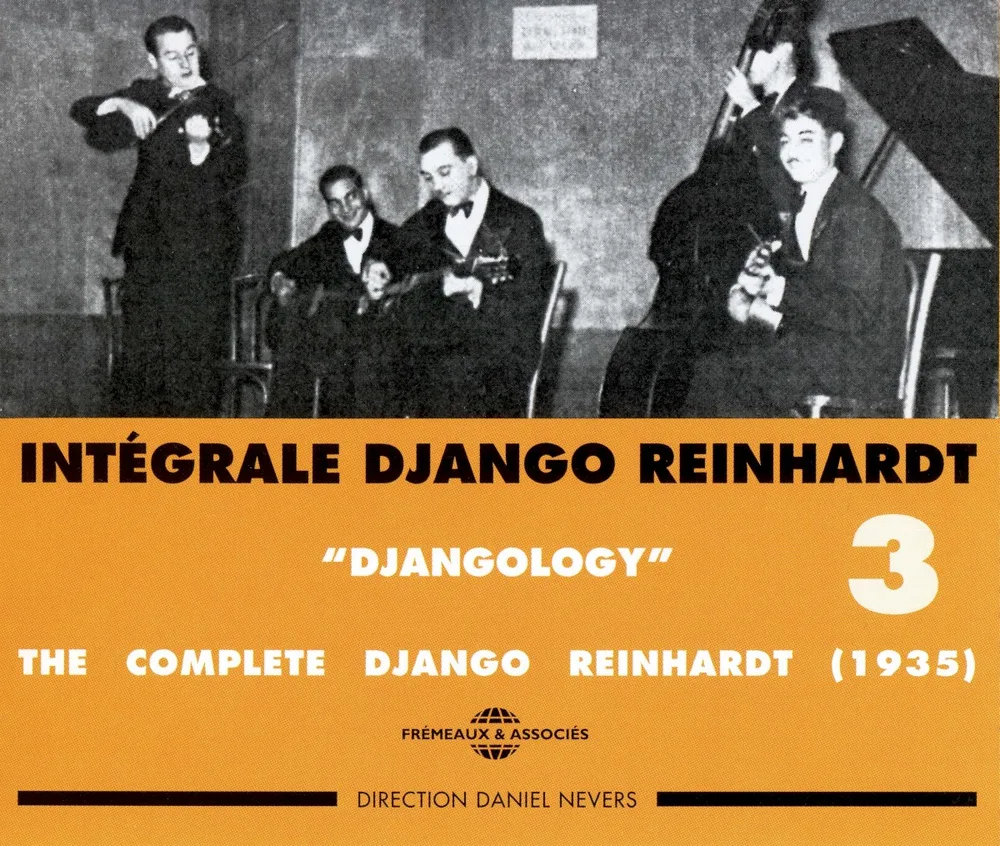
Cover of *Intégrale Django Reinhardt, Vol. 3: "Djangology" 1935* (Frémeaux & Associés FA 303, 1996), the first record in the Key Recordings list. The sleeve carries an archival photograph of a string band on stage (violin, guitars, double bass); the players are not named on the sleeve, so Roger Chaput is not individually identified. Standard copyright, all rights reserved, held by the label. This is not a Creative Commons or public-domain image; it is an album cover shown as an honestly disclosed editorial identification image. — https://coverartarchive.org/release/82412613-e7bd-4bc9-bcdf-577c690034f6/front-1200 (Cover Art Archive image for the MusicBrainz release "Intégrale Django Reinhardt, Vol. 3 : Djangology 1935", Frémeaux & Associés FA 303, France, 1996)
Roger Chaput (Roger Marcel Chaput) was a French guitarist and banjoist, the rhythm guitarist of the first line-up of the Quintette du Hot Club de France and a steady Paris studio player from the early 1930s into the 1950s. He was also a cartoonist and oil painter. He was born on May 19, 1909, in Montluçon, in the Allier, and grew up in Ménilmontant, the working-class district of northeastern Paris, where he learned guitar and mandolin. He first played in public on banjo, in the bal-musette bands of Michel Péguri and Albert Carrara. His earliest record under his own name, "Suprême étreinte" and "Je ne saurai jamais dire ça" (Tri-Ergon 6510), was billed to Roger Chaput et son orchestre musette and was recorded in Paris around February 1932, according to Discogs.
In 1931 he joined the jazz orchestra of the double bassist Louis Vola, whose band that spring was playing at the Lido in Toulon with Django Reinhardt in it. By 1934 Vola's orchestra was working at the Hôtel Claridge on the Champs-Élysées, with Reinhardt, the violinist Stéphane Grappelli and Chaput among the players, and the backstage jam sessions there turned into the Quintette du Hot Club de France. Chaput was one of its two rhythm guitarists, beside Reinhardt's brother Joseph, with Vola on bass.
The Discography of American Historical Recordings lists him on guitar for the quintet's Decca sides of 1935: "Lilly Belle" (March), "Ultrafox" (April), "Avalon" and "Clouds" (July), and "Some of These Days" and "Djangology" (September). It also lists him on the Decca session of January 31, 1938, which produced "Honeysuckle Rose", "Sweet Georgia Brown", "Night and Day", "Souvenirs", "Daphne", "Black and White" and "Stompin' at Decca", and on four Grappelli titles cut the next day. The BnF records him as a member of the quintet in 1934 to 1935 and in 1938, and he left the group in 1938.
Away from the quintet he was a regular rhythm guitarist on Swing-label and other Paris sessions. On July 12, 1937, he played in the rhythm section of the American trombonist Dicky Wells's Paris date (Swing SW. 39, "Dinah!" and "Nobody's Blues But My Own"), with Sam Allen on piano and Bill Beason on drums. On September 29, 1937, he was on the Swing single "Dinah" and "Daphne" by the violinists Eddie South and Grappelli, with Reinhardt and the bassist Wilson Myers. The saxophonist Alix Combelle used him on side A of "Exactly Like You" (Swing SW. 52, 1937), a date with the trumpeter Bill Coleman. From 1938 to 1943 he was a member of the Hot Club Swing Stars, a studio band that recorded for the Swing label "Every Tub" and "Morning Feeling" (SW. 48) in December 1938 with Combelle, Vola and the pianist Louis Richardet.
He kept working through the Occupation. Discogs credits him on Combelle's "Fariboles" and "La Da Da La La" (SW. 144, 1942, with the saxophonist Hubert Rostaing), on Noel Chiboust's "Ermitage" and "Ermenonville" (SW. 154, recorded June 25, 1942), on a Pierre Fouad session recorded July 8, 1942 with André Ekyan and Combelle, on the accordionist Gus Viseur's "Gus & Gus" and "Harlem Swing" (Decca, 1942, with Joseph Reinhardt on second guitar) and on a 1942 Pathé record by the pianist Charles-Henry's Piano Swing. After the war he is on Combelle's "Jam-Session" No. 1 (SW. 227, 1947), with the pianist Jack Diéval, and the BnF lists him in Grappelli's Hot Four in 1947. The latest credit found is Combelle's Vogue LP with the American trumpeter Buck Clayton, recorded on October 20 and 21, 1953, where he is on guitar without a label credit.
Chaput drew as well as played. English Wikipedia describes him as a cartoonist and oil painter whose work appeared in the magazine Jazz Hot, and the BnF lists a work of his titled Croquis hot jazz, dated only to the 1950s. As a leader he made two LPs for Disques du Cavalier, Tonton Guitare 1 (MG 750) and Tonton Guitare 2 (MG 850), with Jean-François Gaël on a second guitar and a bassist, and on the second album a drummer. He passed away in Toulon on December 22, 1994, at the age of 85.
Chaput's job in the quintet was to keep the time. The group had no drums and no horns, and Reinhardt had brought in a second rhythm guitarist so that he could solo over a fuller rhythm section; Chaput and Joseph Reinhardt supplied that rhythm while Grappelli and Django played the lead lines. Outside it, his credits show a swing rhythm guitarist who fitted equally well behind the American players who passed through Paris in the 1930s, such as Dicky Wells, Eddie South and Bill Coleman, and behind the French swing saxophonists and bandleaders of the Swing label. His own Tonton Guitare albums turn to lighter repertoire: the track lists include "Blaze Away", "Tico Tico", "Sonny Boy", "Caminito" and a piece titled "Ménilmontant", the district where he grew up.
- Django Reinhardt, Intégrale Django Reinhardt, Vol. 3: "Djangology" 1935 (Frémeaux & Associés FA 303, 1996) - a two-disc survey of Reinhardt's 1935 sessions in Paris on which Discogs credits Chaput on guitar for tracks 1 to 4 and 11 to 14 of the first disc, with Grappelli, Joseph Reinhardt and Vola.
- Quintette du Hot Club de France, "Ultrafox" (Decca, April 1935) - one of the quintet's early Decca sides on which the Discography of American Historical Recordings lists him on guitar. Apple Music - Ultrafox Listen
- Quintette du Hot Club de France, Decca session of January 31, 1938 ("Honeysuckle Rose", "Night and Day", "Daphne", "Stompin' at Decca") - seven titles on which he is listed on guitar, the last of his documented sessions with the group.
- Eddie South and Stéphane Grappelli, "Dinah" / "Daphne" (Swing SW. 12, recorded in Paris on September 29, 1937) - two violins over Reinhardt, Chaput and the bassist Wilson Myers. Apple Music - Dinah Listen
- Dicky Wells, "Dinah!" / "Nobody's Blues But My Own" (Swing SW. 39, recorded in Paris on July 12, 1937) - the American trombonist's Paris date, with Chaput in the rhythm section. Apple Music - Dinah (7/12/1937) Listen
- Hot Club Swing Stars, "Every Tub" / "Morning Feeling" (Swing SW. 48, December 1938) - a studio band with Alix Combelle, Danny Polo, Philippe Brun and Louis Vola. Apple Music - Every Tub Listen
- Alix Combelle et son orchestre avec Buck Clayton (Vogue L.D.182, recorded October 20 and 21, 1953) - a 10-inch LP of Combelle's big band with Clayton as soloist and arranger, with Chaput on guitar.
- Tonton Guitare 1 (Disques du Cavalier MG 750) - his first album as a leader, with Jean-François Gaël and the bassist Benoît Charvet.
Roger Chaput: Full Discography
French guitarist and banjoist, born in Montluçon on May 19, 1909, who passed away in Toulon on December 22, 1994. Discogs files his records under artist 403592 (https://www.discogs.com/artist/403592-Roger-Chaput), which lists 195 entries, almost all of them reissues and compilations of Django Reinhardt, the Quintette du Hot Club de France and Swing-label sessions led by others. His 1932 musette orchestra sits under a separate Discogs entry, Roger Chaput Et Son Orchestre Musette (1027296). He recorded two LPs as a leader, so the first table lists those and the 1932 single, and the second lists selected sideman sessions of 1935 to 1953 with the date and personnel where a release record or the Discography of American Historical Recordings gives them. The quintet's own singles were reissued many times and are not itemized beyond the rows below; they are listed in full in the discography of the Quintette du Hot Club de France. Where a date, catalog number or personnel list could not be confirmed, the cell says so.
Role key: Leader means the record is billed to Chaput or to his orchestra. Sideman rows give the instrument credited on the release record or by the Discography of American Historical Recordings.
Records billed to Chaput or his orchestra
| Album | Recording Date(s) | Release Date | Label | Catalog Number | Format | Personnel | Role | Notes | Listen | Buy |
|---|---|---|---|---|---|---|---|---|---|---|
| "Suprême étreinte" / "Je ne saurai jamais dire ça" (Roger Chaput et son orchestre musette) | About February 1932, Paris | 1932 | Tri-Ergon | 6510 | 10-inch 78 rpm | Roger Chaput (leader); other players not documented | Leader | A musette-orchestra record; both sides were recorded in Paris around February 1932. | Apple Music - Suprême étreinte | — |
| Tonton Guitare 1 (Roger Chaput, Jean-François Gaël, Benoît Charvet) | Not confirmed | Not confirmed | Disques du Cavalier | MG 750 | LP | Roger Chaput (guitar), Jean-François Gaël (guitar), Benoît Charvet (bass) | Leader | Sixteen tracks including "Blaze Away", "Sheik of Araby", "Tico Tico", "Ménilmontant" and "Sonny Boy". Engineer Georges Queyras; liner notes by Gaël. | Not found | — |
| Tonton Guitare 2 (Roger Chaput) | Not confirmed | Not confirmed | Disques du Cavalier | MG 850 | LP | Roger Chaput (guitar), Jean-François Gaël (guitar), Pierre Nicolas (bass), Serge Biondi (drums) | Leader | Fourteen tracks including "Marche des petits pierrots", "Caminito", "Jazz de papa" and "Complainte corse". Engineer Georges Queyras. | Not found | — |
As sideman (selected credits)
A representative set of the sessions on which Discogs or the Discography of American Historical Recordings credits him, in order of recording date where known.
| Year | Project (Leader) | Title | Label | Catalog | Role | Notes |
|---|---|---|---|---|---|---|
| 1935 | Quintette du Hot Club de France | "Lilly Belle" (March), "Ultrafox" (April), "Avalon" and "Clouds" (July), "Some of These Days" and "Djangology" (September) | Decca | Matrices P 77240, P 77354, P 77434, P 77440, P 77539, P 77540 | Guitar | Dates as given by the Discography of American Historical Recordings; label catalog numbers not confirmed. |
| 1935 | Stéphane Grappelli and Django Reinhardt | "St. Louis Blues" (September 30), "Limehouse Blues" (October), and "I've Found a New Baby", "China Boy", "Moonglow" and "It Don't Mean a Thing" (October 21) | Decca | Matrices 2009HPP, 2035HPP, 2079HPP, 2081HPP to 2083HPP | Guitar | Dates and matrices as given by the Discography of American Historical Recordings. |
| 1935 (CD 1996) | Django Reinhardt | Intégrale Django Reinhardt, Vol. 3: "Djangology" 1935 | Frémeaux & Associés | FA 303 | Guitar on disc 1, tracks 1 to 4 and 11 to 14 | Two-disc compilation of 1935 Paris recordings; with Stéphane Grappelli, Joseph Reinhardt and Louis Vola on the tracks credited to Chaput. |
| 1937 | Dicky Wells | "Dinah !" / "Nobody's Blues But My Own" | Swing | SW. 39 | Guitar | Recorded in Paris on July 12, 1937; Dicky Wells (trombone), Shad Collins (trumpet, with Bill Dillard on the B side), Howard Johnson (alto saxophone), Sam Allen (piano), Bill Beason (drums). |
| 1937 | Dicky Wells | "Dicky Wells Blues" and "I've Found a New Baby" | Gramophone | Matrices 0LA1899, 0LA1894 | Guitar | Same session date as above (July 12, 1937). On "Dicky Wells Blues" the group is Wells, Allen, Chaput and Beason. |
| 1937 | Eddie South and Stéphane Grappelli | "Dinah" / "Daphne" | Swing | SW. 12 | Guitar | Recorded in Paris on September 29, 1937; Eddie South and Stéphane Grappelli (violins), Django Reinhardt (guitar), Wilson Myers (bass). |
| 1937 | Alix Combelle | "Exactly Like You" / "Don't Get Tired" | Swing | SW. 52 | Guitar on side A | Side A recorded in 1937 with Bill Coleman (trumpet), David Martin (piano), Wilson Myers (bass) and Jerry Mengo (drums); side B was recorded on March 15, 1938 by a different band without Chaput. |
| 1938 | Quintette du Hot Club de France | "Honeysuckle Rose", "Sweet Georgia Brown", "Night and Day", "Souvenirs", "Daphne", "Black and White", "Stompin' at Decca" | Decca | Matrices DTB 3523 to DTB 3530 (3526 not listed) | Guitar | Recorded January 31, 1938, per the Discography of American Historical Recordings; Chaput is not named on the labels. |
| 1938 | Stéphane Grappelli | "Tornerai", "If I Had You", "It Had to Be You", "Nocturne" | Decca | Matrices DTB 3531 to DTB 3534 | Guitar | Recorded February 1, 1938, per the Discography of American Historical Recordings. |
| 1938 | Hot Club Swing Stars | "Every Tub" / "Morning Feeling" | Swing | SW. 48 | Guitar | Issued December 1938; Alix Combelle and Noel Chiboust (tenor saxophones), Danny Polo and Max Blanc (alto saxophones), Philippe Brun, Maurice Mouflard and Pierre Allier (trumpets), Louis Richardet (piano), Louis Vola (bass), Pierre Fouad (drums). |
| 1938 | Eddie Brunner / Hot Club Swing Stars | "In a Little Spanish Town" / "Swingin' at the Sugar Bowl" | Swing | SW. 55 | Guitar on side B | Issued December 1938; on "Swingin' at the Sugar Bowl" with Combelle, Chiboust, Danny Polo, Louis Richardet, Louis Vola and Pierre Fouad. Oscar Aleman is the guitarist on side A. |
| 1939 | Max Geldray | "Limehouse Blues" / "Mouth Organ Swing No. 1" | Swing | SW. 49 | Guitar | Max Geldray (harmonica), Michel Warlop and Jean-Louis Janson (violins), Henri Schaap (guitar), Louis Vola (bass). |
| 1942 | Alix Combelle et son orchestre | "Fariboles" / "La Da Da La La" | Swing | SW. 144 | Guitar | Recorded in 1942 with Hubert Rostaing among the saxophonists, Emmanuel Soudieux (bass), Pierre Fouad (drums), and Charles Suire, Christian Bellest and Roby Davis (trumpets). |
| 1942 | Noel Chiboust et son orchestre | "Ermitage" / "Ermenonville" | Swing | SW. 154 | Guitar | Both sides recorded June 25, 1942; Chiboust (clarinet, tenor saxophone), A. Lepage (piano), Jean Merlin (bass), Jean Princé (drums). |
| 1942 | Piano Swing (Charles-Henry) | "Psychose Blues", "Swing Fa", "S'en arranger", "Patrouil' Hot" | Pathé | PA 2082 | Guitar | With Francis Luca (bass) and Rod Chaillou (drums). |
| 1942 | Gus Viseur and Gus Deloof | "Gus & Gus" / "Harlem Swing" | Decca | 10001 / 10002 | Guitar | Gus Viseur (accordion), Gus Deloof (trumpet), Jacques Lowens (clarinet), Joseph Reinhardt (guitar), Jacques Petitsigne (bass). |
| 1942 (issued 1945) | Pierre Fouad et son orchestre | "Bizarre" / "Parallèles" | Swing | SW. 196 | Guitar | Both sides recorded July 8, 1942; André Ekyan (alto saxophone), Alix Combelle (tenor saxophone), Harry Cooper (trumpet), Emmanuel Soudieux (bass), Pierre Fouad (drums). |
| 1947 | Alix Combelle | "Jam-Session" N° 1: "Blues, Look Out There" / "Take That Last Note" | Swing | SW. 227 | Guitar | Combelle (tenor saxophone), Michel de Villers (alto saxophone), Christian Bellest (trumpet), Jack Diéval (piano), Jean Bouchéty (bass), Jerry Mengo (drums). Recording date not confirmed. |
| 1947 | Stéphane Grappelli and his Hot Four | "Oui pour vous revoir" / "Tea for Two" | Swing | SW. 271 | Guitar | Recorded October 7, 1947. The release record on Discogs lists no personnel; the BnF names Chaput as a member of the Hot Four in 1947. |
| 1953 | Alix Combelle et son orchestre avec Buck Clayton | Alix Combelle et son orchestre avec Buck Clayton | Vogue | L.D.182 | Guitar (uncredited on the label) | Recorded in France on October 20 and 21, 1953; Combelle and Henri Bernard (tenor saxophones), Buck Clayton (trumpet, arranger), Jean-Claude Pelletier (piano), Yvon Le Guen (bass), Christian Garros (drums) and a brass section. |
| 1984 | Bill Coleman | Tome 1 1935-1937 | Pathé | 1552571 | Guitar on tracks B6 to B8 | LP compilation of Bill Coleman's Paris recordings; Chaput plays on the three closing tracks, "Exactly Like You", "Alexander's Ragtime Band" and "Hang Over Blues", with Alix Combelle, David Martin, Wilson Myers and Jerry Mengo. |
Discogs lists many further appearances on Django Reinhardt and Quintette du Hot Club de France compilations and on Charles Trénet volumes from Frémeaux & Associés; the credit is recorded there as an appearance and is not itemized here.
- Django Reinhardt - lead guitarist of the Quintette du Hot Club de France, in Vola's orchestra with Chaput from 1931; on the Eddie South and Grappelli single of September 29, 1937.
- Joseph Reinhardt - Django's brother and the quintet's other rhythm guitarist; on Gus Viseur's 1942 Decca single with Chaput.
- Stéphane Grappelli - violinist and co-leader of the quintet; Chaput's name is attached to Grappelli's Hot Four of 1947 and to the Decca sides of 1935 and 1938.
- Louis Vola - bassist and bandleader; Chaput joined his orchestra in 1931 and played beside him in the quintet and on the Hot Club Swing Stars sides of December 1938.
- Alix Combelle - tenor saxophonist and bandleader; Chaput is on his Swing sessions of 1937 and 1942, the "Jam-Session" record of 1947 and the 1953 Vogue LP with Buck Clayton.
- Hubert Rostaing - saxophonist on Combelle's "Fariboles" / "La Da Da La La" with Chaput in 1942.
- Bill Coleman - American trumpeter on side A of Combelle's "Exactly Like You" (SW. 52).
- Jack Diéval - pianist on Combelle's "Jam-Session" No. 1 (SW. 227).
- Dicky Wells - American trombonist whose Paris date of July 12, 1937 has Chaput on guitar.
- Eddie South - American violinist, co-billed with Grappelli on the Swing single of September 29, 1937.
- Gus Viseur - accordionist; Chaput is on his 1942 Decca single "Gus & Gus" / "Harlem Swing".
- Michel Warlop - violinist on Max Geldray's "Limehouse Blues" (SW. 49, 1939) with Chaput.
- Jean-François Gaël - second guitarist on both Tonton Guitare albums.
- Pierre Nicolas and Serge Biondi - bassist and drummer on Tonton Guitare 2.

More Gypsy Jazz Artists
See all 36 Gypsy Jazz artists →More French Jazz Artists
See all 170 French artists →- Apple Music artist page
- Discogs
- AllMusic
- MusicBrainz
- Discography of American Historical Recordings
- Wikipedia (English)
- Wikipedia (French)
- BnF data
- Roger Chaput on JazzProfiles.com
- Wikipedia (English): Roger Chaput
- Wikipedia (French): Roger Chaput
- Wikipedia (German): Roger Chaput
- Wikidata: Roger Chaput (Q3940076)
- BnF data: Roger Chaput
- Discography of American Historical Recordings: Roger Chaput
- MusicBrainz: Roger Chaput
- AllMusic: Roger Chaput
- Discogs: Roger Chaput, artist 403592
- Discogs: Dinah ! / Nobody's Blues But My Own, Swing SW. 39
- Discogs: Dinah / Daphne, Swing SW. 12
- Discogs: Djangology, Frémeaux & Associés FA 303
- Discogs: Tonton Guitare 1, Disques du Cavalier MG 750
- Discogs: Tonton Guitare 2, Disques du Cavalier MG 850
- JazzProfiles: Quintette du Hot Club de France