 JAZZPROFILES lives in the music 1,002 Jazz Artists fully Profiled!
 Eddie Gómez
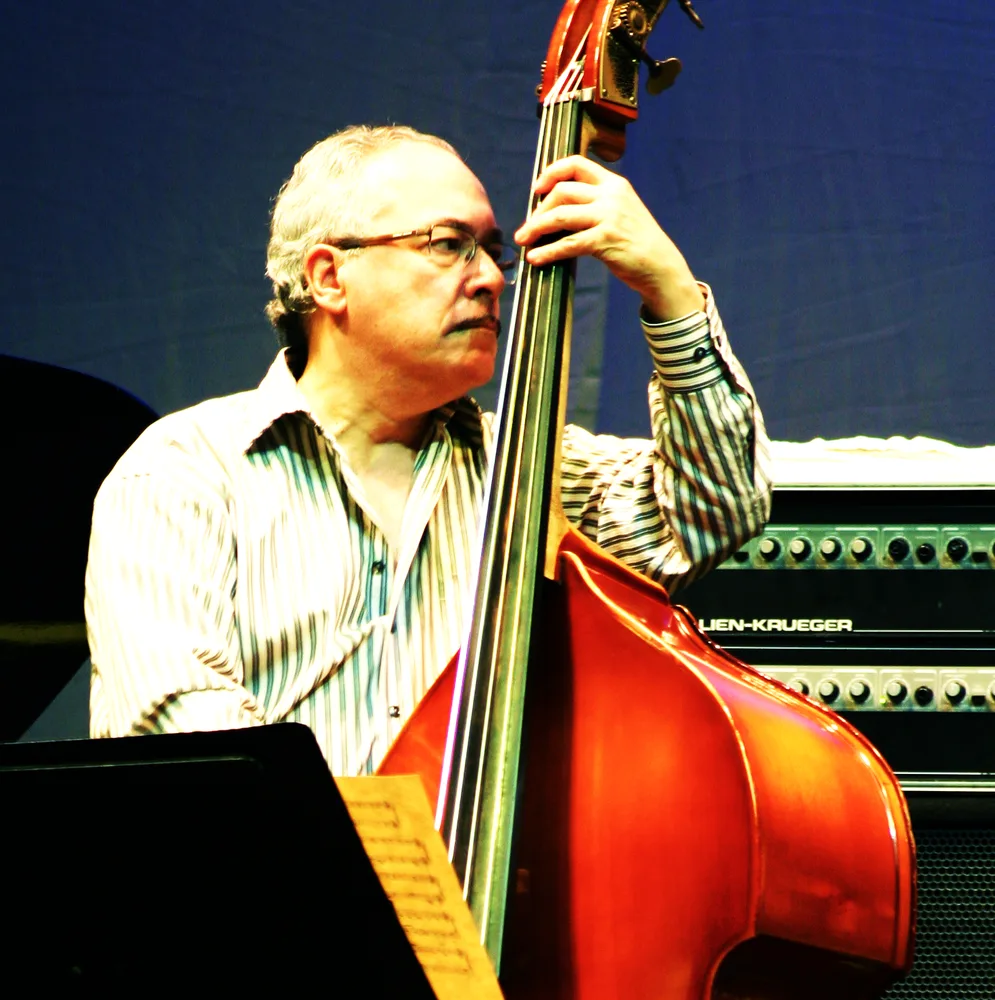
Eddie Gómez playing double bass on tour with the Chick Corea Trio in Santiago, Chile, May 31, 2010 CC BY-SA 4.0 (Creative Commons Attribution-ShareAlike 4.0 International), photographer credited on Commons as user Mborda.m, own work; this file is a 2024 crop of the same photographer's CC BY-SA 3.0 original, File:Eddie1.png — Wikimedia Commons — https://commons.wikimedia.org/wiki/File:Eddie_Gomez.png (cropped from https://commons.wikimedia.org/wiki/File:Eddie1.png)


Edgar Gómez was born on October 4, 1944, in Santurce, Puerto Rico, and moved with his family to New York while still an infant. His first musical footing was vocal rather than instrumental: his mother sang around the house, and on visits back to Puerto Rico he sang in English at his grandfather's evangelist church. A junior high school music teacher handed him a double bass at eleven, and at thirteen he entered the New York City High School of Music and Art, where he studied classical repertoire and jazz alongside classmates who included flutist Jeremy Steig, drummer Billy Cobham, and keyboardist Richard Tee. From fifteen he studied privately with Frederick Zimmermann, a New York Philharmonic bassist from 1930 to 1966 whose students also included Charles Mingus, Henry Grimes, and Red Mitchell, and whose expressive, singing conception of the instrument became the foundation of Gómez's own. Between 1959 and 1961 he played in the Newport Festival Youth Band under Marshall Brown, a group that also carried Eddie Daniels and Ronnie Cuber. At seventeen he met a twenty-year-old Juilliard student named Chick Corea at a jam session in Corea's Manhattan loft. On Zimmermann's recommendation he entered Juilliard himself in 1962, and his graduation is recorded as 1963.
He was a member of Local 802 while still a teenager, and the working life he built around his studies was unusually wide: a long engagement at a midtown steakhouse with pianist Marian McPartland, Latin dates, and downtown avant-garde sessions. Two of the latter put him on record at twenty. On October 20, 1964, at Studio 76 in New York, he played bass in Paul Bley's quintet on Barrage (ESP-Disk 1008), a program entirely of Carla Bley compositions with Marshall Allen on alto, Dewey Johnson on trumpet, and Milford Graves on drums. Weeks later, on November 11, 1964, at Bell Sound Studios, he recorded The Giuseppi Logan Quartet (ESP-Disk) with Logan, pianist Don Pullen, and Graves again, a record Elliott Sharp would later put on a list of ten essential free jazz albums. In 1965 he worked under vibraphonist and arranger Gary McFarland and saxophonist Gerry Mulligan, both of whom he has described as mentors.
The Mulligan association is what brought him to Bill Evans. In the summer of 1966 Gómez was working nights at the Copacabana behind Bobby Darin while also appearing at the Village Vanguard in Mulligan's group, opposite Evans's trio. Evans complimented him and said he hoped they would play together, then called a few weeks later with an offer of a West Coast tour. Gómez left the Darin job for it, and after a trial run that included Shelly's Manne-Hole in Los Angeles, Evans asked him to stay. He was twenty-one. His first studio session with the pianist was cut on October 4, 1966, his twenty-second birthday, at Rudy Van Gelder's studio in Englewood Cliffs, New Jersey: A Simple Matter of Conviction (Verve V6-6785), produced by Creed Taylor, with Shelly Manne on drums.
Gómez stayed eleven years, longer than any other bassist Evans employed, through a rotating cast of drummers: Manne in the studio, then Philly Joe Jones, then Jack DeJohnette, then Marty Morell from 1968 to 1974, then Eliot Zigmund. Two of those records brought Grammy Awards that Gómez shares as a member of the group. Bill Evans at the Montreux Jazz Festival, cut live at the Casino de Montreux on June 15, 1968 with DeJohnette, won the 1969 Grammy for Best Jazz Instrumental Album, Individual or Group. The Bill Evans Album (Columbia C 30855), recorded at CBS 30th Street Studio across five days in May and June 1971 with Morell, won two awards at the 1972 ceremony, one of them the group prize. In the gap after Morell's departure, Evans finally made a project he had wanted for years, a piano-and-bass duo record: Intuition (Fantasy F-9475), taped at Fantasy Studios in Berkeley on November 7 to 10, 1974, followed half a year later by the live Montreux III. The classical conductor George Cleve, who sat in on the Intuition sessions and wrote its liner notes, called Gómez one of the two greatest bassists in jazz history. The last Evans studio date Gómez played was You Must Believe in Spring, recorded at Capitol Studios in Los Angeles on August 23 to 25, 1977 and held back until February 1981, five months after Evans's death. Throughout the Evans decade Gómez also kept a parallel duo going with Jeremy Steig, documented on the live Outlaws (Enja 2098), recorded at Die Glocke in Bremen on December 15, 1976.
After 1977 he became one of the most in-demand bassists in New York, working duo engagements at Bradley's in Greenwich Village and taking on projects at both ends of the idiom. He played on Mingus's last two Atlantic records, Me, Myself and Eye (1979) and Something Like a Bird (1980), sessions Mingus composed and supervised but, disabled by ALS, did not play on. He toured and recorded with DeJohnette's New Directions band for ECM, with Corea on The Leprechaun (1976), The Mad Hatter (1978), Friends (1978), and Three Quartets (1981), and with Hank Jones's Great Jazz Trio, where he and Al Foster replaced Ron Carter and Tony Williams by 1980, with Jimmy Cobb taking the drum chair in 1982. In 1979 he was a founding member of Steps, the band that grew out of after-hours sessions at Seventh Avenue South, the club owned by Michael Brecker and Randy Brecker, with vibraphonist Mike Mainieri, Michael Brecker, pianist Don Grolnick, and drummer Steve Gadd. The group cut its first two albums in Tokyo within a single week, Step by Step on December 8 and 10, 1980 and Smokin' in the Pit live at the Pit Inn on December 14 to 16, both issued on Nippon Columbia's Better Days imprint. Renamed Steps Ahead, it moved to Elektra/Musician for Steps Ahead (1983) and Modern Times (1984). His session work in these years ran well past jazz, taking in Carly Simon's Torch, Art Garfunkel's Lefty, David Grisman's Hot Dawg, and the Kronos Quartet's Music of Bill Evans.
His own leader catalog began in Japan and largely stayed there for a decade. Down Stretch (Trio Records PA-7141) was recorded at AOI Studios in Tokyo on January 22 and 23, 1976 with pianist Takehiro Honda and Zigmund. Gomez (Interface YF-7089), taped at SEDIC Studios in Tokyo in January and February 1984 with Corea and Gadd, carries a dedication to Bill Evans and Frederick Zimmermann. Mezgo followed from CBS/Sony's Shinanomachi studio in November 1985 and was issued internationally as Discovery; Power Play (Columbia C 44214) and Street Smart came in 1988 and 1989. Next Future (Stretch GRS 00062, 1993) was co-produced by Gómez and Corea at Skyline Studios in New York. From the mid-1990s he led a working trio with pianist Stefan Karlsson and Jimmy Cobb, heard on Dedication (Evidence ECD 22208-2), recorded June 9 and 10, 1997 with liner notes by Nat Hentoff. The records since have mostly been duos and trios built around a single pianist: Forever with Cesarius Alvim (System Two, Brooklyn, January 29 and 30, 2010), Per Sempre with Teo Ciavarella (Castel Maggiore, Italy, December 2009), Live at Montmartre with Carsten Dahl (November 9, 2011), and Kind of Bill, cut live at the Casinò di Sanremo with Dado Moroni and Joe LaBarbera and released in 2017. In 2009 he and Argentine pianist and arranger Carlos Franzetti won the Latin Grammy for Best Instrumental Album for their duo record Duets (Acqua AQ203). In May 2013 Berklee College of Music awarded him an honorary doctorate of music at its Valencia campus, the first the Spanish campus granted, and he has taught at the Conservatory of Puerto Rico, where he took the post of artistic director. He remains active: Center Stage, a 2022 concert album with Gadd, baritone saxophonist Ronnie Cuber, and the WDR Big Band Köln, and pianist Bob Schlesinger's 2025 debut Falling from Earth, alongside Mike Stern and drummer Billy Drummond, are both recent.
Gómez plays the double bass as a singing instrument, and the conception is traceable to two sources that rarely meet: Frederick Zimmermann's classical pedagogy, which gave him a bow arm and an intonation discipline most jazz bassists of his generation never acquired, and the vocalists he grew up hearing at home. What he does with it is push the bass into the register and the rhythmic freedom of a horn. Where Scott LaFaro had opened the Bill Evans trio to a bass line that answered the piano instead of anchoring it, Gómez extended that opening across eleven years and a much wider range of material, working high on the fingerboard with a bright, cutting amplified tone that he later reconsidered, saying he had come to want the darker microphone sound of Paul Chambers and Ray Brown instead. He names five bassists as the ones who shaped him: Milt Hinton, Chambers, Brown, LaFaro, and Charles Mingus. Evans's own assessment was that "Eddie has the most surprising flexibility," and flexibility is the trait that defined the fifty years after Evans as well, a career that runs from ESP-Disk free jazz at twenty through mainstream piano trios, Japanese fusion dates, Steps Ahead, big band concerts, and pop sessions without settling anywhere. Gómez himself has treated that breadth as a double-edged thing, suggesting that being spread across so many idioms may have cost him a single, unmistakable stylistic signature. What it did not cost him is his standing among bassists: he is one of the small handful of players against whom the modern jazz double bass is measured, and younger bassists on several continents cite him as a model for the acoustic instrument.
- A Simple Matter of Conviction (rec. October 4, 1966, rel. 1967, Verve) - His first studio session with Bill Evans, cut on his twenty-second birthday at Van Gelder Studio with Shelly Manne on drums and Creed Taylor producing. Spotify - A Simple Matter of Conviction
- Bill Evans at the Montreux Jazz Festival (rec. June 15, 1968, rel. 1968, Verve) - The trio with Jack DeJohnette, live at the Casino de Montreux; it won the 1969 Grammy for Best Jazz Instrumental Album, Individual or Group. Spotify - At the Montreux Jazz Festival
- The Bill Evans Album (rec. May and June 1971, rel. 1971, Columbia) - All Evans originals, with the pianist splitting the date between acoustic and Fender Rhodes and Marty Morell on drums; winner of two Grammys in 1972, including the group award. Spotify - The Bill Evans Album Listen
- Intuition (rec. November 7-10, 1974, rel. 1975, Fantasy) - The piano-and-bass duo record Evans had wanted to make for years, and the clearest single document of what Gómez brought to the partnership. Spotify - Intuition Listen
- Outlaws (rec. December 15, 1976, rel. 1977, Enja) - A live flute-and-bass duo with Jeremy Steig in Bremen, the most exposed setting anywhere in his catalog and a showcase for the horn-like upper register.
- You Must Believe in Spring (rec. August 23-25, 1977, rel. 1981, Warner Bros.) - His last studio date with Evans, authorized by the pianist but issued only after his death, and widely held to be among the best-recorded albums Evans made. Spotify - You Must Believe in Spring Listen
- Gomez (rec. January and February 1984, rel. 1984, Interface) - A Tokyo leader date with Chick Corea and Steve Gadd, dedicated to Bill Evans and to his teacher Frederick Zimmermann.
- Duets (rel. 2008, Acqua) - The duo record with Carlos Franzetti that won the 2009 Latin Grammy for Best Instrumental Album. Spotify - Duets Listen
Eddie Gómez: Full Discography
Identity confirmed via the live Discogs API, artist ID 274957 ("Eddie Gomez," realname "Edgar Gómez," born October 4, 1944 in Santurce, Puerto Rico), which matches Wikipedia and every other source used here. Discogs holds at least eleven other artist entities named some variation of "Eddie Gomez," including an unrelated mid-century Latin bandleader billed as Eddie Gomez And His Latin American Orchestra and Eddie Gomez And His Rumba Band; none of their credits are included below.
Discogs credits Gómez on roughly 920 releases across six decades. The great majority of that figure is sideman work and the endlessly reissued Bill Evans catalog, so this file does not attempt to itemize it. The leader and co-leader table below is intended to be complete for studio and live albums issued under his own name or in shared billing; the sideman table is a curated selection of the credits of clearest musical and historical importance. Recording dates, catalog numbers, labels, and track-level personnel were checked one release at a time against the Discogs API rather than inferred from artist-level listings; where a detail could not be confirmed the cell says so instead of guessing. Spotify's catalogue could be searched only partially, so a Spotify cell reads "—" wherever a correctly matched album could not be verified, not as a claim that the record is unavailable.
As Leader / Co-Leader
| Album Title | Recording Date(s) | Release Date | Label | Catalog Number | Format(s) | Personnel | Role | Reissue History | Spotify | Buy | Notes |
|---|---|---|---|---|---|---|---|---|---|---|---|
| Down Stretch | January 22-23, 1976, AOI Studios, Tokyo | 1976 | Trio Records | PA-7141 | Vinyl, LP, Album (Japan, with obi) | Eddie Gómez (bass), Takehiro Honda (piano), Eliot Zigmund (percussion) | Leader | An American pressing appeared on the Blackhawk label | — | — | His first album as a leader, cut in Tokyo while he was still Bill Evans's bassist; Zigmund was the Evans trio's drummer at the time |
| Outlaws (with Jeremy Steig) | December 15, 1976, Die Glocke, Bremen, Germany | 1977 | Enja | enja 2098 | Vinyl, LP, Album | Jeremy Steig (flute), Eddie Gómez (bass) | Co-leader (produced by Steig and Gómez) | Reissued on CD by Enja | — | — | A live flute-and-bass duo concert; the program includes two Steig/Gómez originals, Gómez's "Arioso," and Miles Davis's "Nardis" |
| Music for Flute and Double-Bass (with Jeremy Steig) | Not confirmed | 1979 | CMP Records | Not confirmed | Vinyl, LP, Album | Jeremy Steig (flute), Eddie Gómez (bass) | Co-leader | Reissued 2015 by MIG / Art Of Groove on a 2xCD paired with Rain Forest | — | — | The studio companion to Outlaws |
| Rain Forest (with Jeremy Steig) | February 1980, Electric Lady Studios, and March 1980, Blank Tape Studios, New York City | 1980 | CMP Records | CMP 12 ST | Vinyl, LP, Album (Germany) | Jeremy Steig (flute, bass flute), Eddie Gómez (acoustic bass); Mike Nock (electric piano, synthesizer, A2, A3, B1, B3), Jack DeJohnette (drums, A2, A3), Steve Gadd (drums, A1, B1), Ray Barretto (congas, A3, B4), Naná Vasconcelos (percussion, A3, B1, B2, B4), Karl Ratzer (electric guitar, A1) | Co-leader (produced by Steig, Gómez, and Kurt Renker) | Reissued 2015 by MIG / Art Of Groove on a 2xCD paired with Music for Flute and Double-Bass | — | — | The guest personnel are strictly track-specific; only Steig and Gómez appear throughout |
| Gomez | January and February 1984, SEDIC Studios, Tokyo | July 1984 | Interface | YF-7089 | Vinyl, LP, Album (Japan) | Eddie Gómez (bass), Chick Corea (piano), Steve Gadd (drums) | Leader (billed with Corea and Gadd) | Not confirmed | — | — | Dedicated on the sleeve to the memory of Bill Evans and of Gómez's teacher Frederick Zimmermann; Gómez also wrote the liner notes |
| Mezgo | November 1985, CBS/Sony Shinanomachi Studios, Tokyo | 1986 | Epic/Sony | 28-3H-218 | Vinyl, LP, Album (Japan) | Eddie Gómez (bass, all tracks); Michael Brecker (tenor saxophone, A1, A2, A3, B1); Steve Gadd (drums, A1, A3, B1, B2); Masahiko Satoh (piano, keyboards, A1, B1, B2, B4) | Leader | Issued outside Japan as Discovery | Spotify - Discovery | — | Every sideman credit here is restricted to specific tracks rather than running album-wide, which leaves several pieces to Gómez alone or in duo |
| Power Play | Not confirmed | 1987 (Japan); 1988 (Columbia, US) | Columbia | C 44214 | Vinyl, LP, Album, Stereo | Eddie Gómez (bass, and composer of seven of the nine tracks), with Al Foster and Steve Gadd (drums, percussion), LeeAnn Ledgerwood and Michael Cochrane (keyboards), Michael Brecker (tenor saxophone), Jeremy Steig (flute), Dick Oatts (soprano and alto saxophone), Jim Hall (guitar, track 5), Ann Bristol and Kimiko Itoh (vocals, track 9) | Leader | Reissued on CD | Spotify - Power Play | — | Produced by Kiyoshi Itoh, who also produced Gomez and Mezgo; the Jim Hall and vocal credits are single-track appearances |
| Street Smart | Not confirmed | 1989 | Epic / Sony | 466225 1 (European pressing) | Vinyl, LP, Album | Eddie Gómez (bass) with Richard Tee (piano), Kenny Werner (keyboards), Randy Brecker (trumpet), Hugh McCracken (guitar), Jack McDuff (organ), Dick Oatts (tenor saxophone), Barry Rogers (trombone), Steve Gadd (drums, percussion), Nicky Marrero (bongos, timbales), Steve Thornton (congas, percussion) | Leader | Not confirmed | — | — | The most soul- and Latin-inflected of his leader records; the Discogs entry for the European pressing carries no credit block, so the personnel here come from the album's own listing rather than from Discogs |
| Live in Moscow | Not confirmed | 1992 | B&W Music | BW-038 | CD | Eddie Gómez (bass), Michael Okun (piano), Steve Amirault (piano), Ronnie Burrage (drums) | Leader | Not confirmed | — | — | Not located in the Discogs API during this pass; details follow the album's published listing and are unconfirmed |
| Next Future | Not confirmed (recorded and mixed at Skyline Studios, New York) | 1993 | Stretch Records / GRP | GRS 00062 | CD, Album | Eddie Gómez (bass), Chick Corea and James Williams (piano, synthesizer), Rick Margitza (tenor and soprano saxophone), Jeremy Steig (flute), Lenny White (drums) | Leader (produced by Gómez and Corea; Corea also executive producer) | Not confirmed | — | — | Made for Corea's own Stretch imprint, distributed by GRP |
| Dedication | June 9-10, 1997 | 1998 | Evidence | ECD 22208-2 | CD, Album | Eddie Gómez (bass), Stefan Karlsson (piano), Jimmy Cobb (drums), Jeremy Steig (flute, tracks 2 and 9) | Leader | Not confirmed | — | — | Liner notes by Nat Hentoff; Steig appears on two tracks only, not throughout |
| Uptown Music | Not confirmed | 1998 | Paddle Wheel (King Records, Japan) | Not confirmed | CD, Album | Eddie Gómez (bass), Stefan Karlsson (piano), Jeremy Steig (flute), Jimmy Cobb (drums) | Leader | Not confirmed | — | — | The Japanese companion release to Dedication, from the same working trio |
| Both Sides Now (with Carli Muñoz) | Spring 2003 | 2003 | Pelosenel | none | CD, Album | Carli Muñoz (piano), Eddie Gómez (bass), Joe Chambers (drums, tracks 3, 5, 6, 7, 9), Jeremy Steig (flute, track 5) | Co-leader | Not confirmed | — | — | A Puerto Rico connection: Muñoz is a San Juan pianist and club owner |
| Jazz Fiddler on the Roof (with Mark Kramer) | Not confirmed | 2002 (Mythic Jazz); reissued 2005 (Twinz Records) | Twinz Records | Not confirmed | CD | Mark Kramer (piano), Eddie Gómez (bass), John Mosemann (drums) | Co-leader | Originally issued on Mythic Jazz in 2002 | — | — | First of several albums co-led with pianist Mark Kramer |
| Art of the Heart (with Mark Kramer) | Not confirmed | 2004 (some sources) / 2006 (Discogs) | Art of Life Records | Not confirmed | CD, Album | Mark Kramer (piano), Eddie Gómez (bass) | Co-leader | Not confirmed | — | — | Sources disagree on the release year; both are recorded here rather than one being chosen |
| Palermo | Not confirmed | 2007 | Jazz Eyes | Not confirmed | CD, Album | Eddie Gómez (bass), Stefan Karlsson (piano), Nasheet Waits (drums) | Leader | Also listed on Spotify under the billing "Eddie Gomez Trio" | Spotify - Palermo | — | |
| Beautiful Love (The NYC Session) | Not confirmed | 2008 | Isol Discus Organization | Not confirmed | CD, Album | Eddie Gómez (bass), Al Di Meola (guitar), Yutaka Kobayashi (piano), Billy Drummond (drums) | Leader | Not confirmed | — | — | |
| Duets (with Carlos Franzetti) | Not confirmed | 2008 | Acqua Records | AQ203 | CD | Carlos Franzetti (piano), Eddie Gómez (bass) | Co-leader | Reissued 2011 | Spotify - Duets | — | Winner of the 2009 Latin Grammy Award for Best Instrumental Album |
| Forever (with Cesarius Alvim) | January 29-30, 2010, System Two, Brooklyn, New York | 2010 | Plus Loin Music | PL4529 | CD, Album (France) | Eddie Gómez (acoustic bass), Cesarius Alvim (piano) | Co-leader | Not confirmed | — | — | Mixed at System Two in March 2010 and mastered in Clichy, France, in May; Alvim also painted the cover |
| Per Sempre | December 2009, Groove Factory Studio, Castel Maggiore (Bologna), Italy | 2012 | BFM Jazz | BFM 24142 | CD, Album | Eddie Gómez (bass), Teo Ciavarella (piano), Matt Marvuglio (flute), Marco Pignataro (tenor and soprano saxophone), Massimo Manzi (drums) | Leader | Not confirmed | Spotify - Per Sempre | — | The pianist's name is often given as "Teo Clavarella"; the Discogs credit block spells it Ciavarella. Marco Pignataro's saxophone credit is missing from most published listings of this album |
| Live at Montmartre (with Carsten Dahl) | November 9, 2011 | 2014 | Storyville | 1018450 | CD, Album (Denmark) | Eddie Gómez (double bass), Carsten Dahl (piano) | Co-leader | Not confirmed | Spotify - Live at Montmartre | — | Recorded at the Copenhagen club Jazzhus Montmartre |
| Kind of Bill: Live at Casinò di Sanremo | Not confirmed | 2017 | Zenart Records (US); also issued by BFM Jazz | 302 062 440 2 | CD, Album | Dado Moroni (piano), Eddie Gómez (acoustic bass), Joe LaBarbera (drums) | Co-leader | Not confirmed | Spotify - Kind of Bill | — | A Bill Evans tribute trio pairing Gómez with LaBarbera, the drummer in Evans's final group |
| Center Stage (with Steve Gadd, Ronnie Cuber and the WDR Big Band Köln) | Not confirmed | 2022 | Leopard / WDR The Cologne Broadcasts | Not confirmed | CD, Album | Steve Gadd (drums), Eddie Gómez (bass), Ronnie Cuber (baritone saxophone), WDR Big Band Köln | Co-leader | Not confirmed | Spotify - Center Stage | — | A West German Radio big band concert recording, and his most prominent recent release |
As Sideman (selected major credits)
| Year | Project (Leader) | Title | Label | Catalog | Role | Notes |
|---|---|---|---|---|---|---|
| 1964 (rel. 1965) | Paul Bley Quintet | Barrage | ESP-Disk | 1008 | Bass | Recorded October 20, 1964 at Studio 76, New York, with Marshall Allen, Dewey Johnson, and Milford Graves; all compositions by Carla Bley. Gómez was twenty |
| 1964 (rel. 1965) | Giuseppi Logan | The Giuseppi Logan Quartet | ESP-Disk | 1007 | Bass | Recorded at Bell Sound Studios, New York, November 11, 1964 (one source gives October 5), with Don Pullen and Milford Graves; the musicians had reportedly never played together before the date |
| 1965-1966 | Gerry Mulligan | Something Borrowed, Something Blue | Limelight | Not confirmed | Bass | The Mulligan association led directly to the Bill Evans hire |
| 1966 | Bill Evans | A Simple Matter of Conviction | Verve | V6-6785 | Bass | Recorded October 4, 1966 at Van Gelder Studio, Englewood Cliffs, New Jersey, with Shelly Manne; Creed Taylor producing. Gómez's first record with Evans, cut on his twenty-second birthday |
| 1967 | Bill Evans | California Here I Come | Verve | Not confirmed | Bass | Live at the Village Vanguard with Philly Joe Jones |
| 1968 | Bill Evans | Bill Evans at the Montreux Jazz Festival | Verve | Not confirmed | Bass | Recorded June 15, 1968 at the Casino de Montreux with Jack DeJohnette. Winner of the 1969 Grammy for Best Jazz Instrumental Album, Individual or Group, an award shared by the trio |
| 1968 | Lee Konitz | The Lee Konitz Duets | Milestone | Not confirmed | Bass | |
| 1968-1980 | Jeremy Steig | Jeremy and the Satyrs; Legwork; Wayfaring Stranger; Energy; Monium; Lend Me Your Ears; and others | Reprise, Solid State, Blue Note, Capitol, Columbia, CMP | Various | Bass | A dozen albums across twelve years, the longest-running duo and small-group partnership of Gómez's career apart from Bill Evans |
| 1969 | Randy Brecker | Score | Solid State | Not confirmed | Bass | Brecker's debut as a leader |
| 1969 | Jack DeJohnette | The DeJohnette Complex | Milestone | Not confirmed | Bass | |
| 1971 | Bill Evans | The Bill Evans Album | Columbia | C 30855 | Bass | Recorded May 11-12, 17, 19-20 and June 9, 1971 at CBS 30th Street Studio, New York, with Marty Morell; Helen Keane producing. Winner of two Grammys at the 1972 ceremony, one of them the group award |
| 1972 | Hugh Masekela | Home Is Where the Music Is | Blue Thumb | Not confirmed | Bass | |
| 1973 | Bill Evans | The Tokyo Concert | Fantasy | Not confirmed | Bass | With Marty Morell |
| 1974 | Bill Evans | Intuition | Fantasy | F-9475 | Bass | Recorded November 7-10, 1974 at Fantasy Studios, Berkeley. A piano-and-bass duo record, Evans alternating acoustic piano and Fender Rhodes; Gómez plays acoustic bass throughout |
| 1974 | Bill Evans | Symbiosis (with the Claus Ogerman Orchestra) | MPS | Not confirmed | Bass | |
| 1975 | Bill Evans | Montreux III | Fantasy | Not confirmed | Bass | The live sequel to Intuition, again a duo |
| 1976-1981 | Chick Corea | The Leprechaun; The Mad Hatter; Friends; Three Quartets | Polydor, Warner Bros. | Various | Bass | Four of Corea's most acclaimed late-1970s records |
| 1977 | Bill Evans | I Will Say Goodbye | Fantasy | Not confirmed | Bass | With Eliot Zigmund |
| 1977 (rel. 1981) | Bill Evans | You Must Believe in Spring | Warner Bros. | HS-3504 | Bass | Recorded August 23-25, 1977 at Capitol Studios, Los Angeles, with Eliot Zigmund. Gómez's last studio session with Evans; released five months after the pianist's death, though Evans had authorized it |
| 1977 | McCoy Tyner | Supertrios | Milestone | Not confirmed | Bass | |
| 1978 | Jack DeJohnette | New Directions | ECM | Not confirmed | Bass | With John Abercrombie and Lester Bowie; followed by New Directions in Europe (ECM, 1980) |
| 1978-1979 | Ralph Towner | Batik; Old Friends, New Friends | ECM | Not confirmed | Bass | Batik is a trio with Towner and Jack DeJohnette |
| 1978-1993 | Joanne Brackeen | Prism; Keyed In; Ancient Dynasty; Special Identity; Breath of Brazil; Where Legends Dwell; Take a Chance | Choice, Tappan Zee, Antilles, Ken, Concord Picante | Various | Bass | Seven albums over fifteen years |
| 1978-2003 | Bennie Wallace | The Fourteen Bar Blues; The Free Will; Mystic Bridge; Twilight Time; Bordertown; The Nearness of You; and others | Enja, Blue Note, AudioQuest | Various | Bass | Nine albums, one of his longest sideman relationships |
| 1978 | Charles Mingus | Me, Myself and Eye (1979); Something Like a Bird (1980) | Atlantic | Various | Bass | Mingus composed and supervised these sessions but, disabled by ALS, did not play on them; both were released posthumously |
| 1979 | John Scofield | Who's Who? | Arista / Novus | Not confirmed | Bass | |
| 1979 | Mick Goodrick | In Pas(s)ing | ECM | Not confirmed | Bass | With John Surman and Jack DeJohnette |
| 1979 | Art Farmer with Joe Henderson | Yama | CTI | Not confirmed | Bass | |
| 1980-1982 | Steps (later Steps Ahead) | Step by Step; Smokin' in the Pit; Paradox: Live at Seventh Avenue South | Better Days (Nippon Columbia) | YF-7020-N; YB-7010~11-ND | Bass | Step by Step recorded December 8 and 10, 1980; Smokin' in the Pit live at the Pit Inn, Tokyo, December 14-16, 1980, with a guest appearance by Kazumi Watanabe. Band personnel: Mike Mainieri, Michael Brecker, Don Grolnick, Gómez, Steve Gadd |
| 1980-1986 | Great Jazz Trio (Hank Jones) | Moreover; Chapter II; Re-Visited (Volumes 1 and 2); Threesome; The Club New Yorker; Monk's Mood; N.Y. Sophisticate; Ambrosia; and others | East Wind, Eastworld, Interface, Denon | Various | Bass | Gómez and Al Foster took over from Ron Carter and Tony Williams by 1980; Jimmy Cobb replaced Foster in 1982 |
| 1981 | Bob James | All Around the Town | CBS | Not confirmed | Bass | |
| 1981 | Terumasa Hino | Double Rainbow | CBS | Not confirmed | Bass | |
| 1981 | Carly Simon | Torch | Warner Bros. | Not confirmed | Bass | A standards album, and one of several pop dates in these years |
| 1983-1984 | Steps Ahead | Steps Ahead; Modern Times | Elektra / Musician | Not confirmed | Bass | The band's two Elektra albums, and the last on which Gómez was a regular member |
| 1983-1985 | Emily Remler | Transitions; Catwalk | Concord | Not confirmed | Bass | |
| 1986 | Kronos Quartet | Music of Bill Evans | Landmark | Not confirmed | Bass | With Jim Hall; string-quartet readings of the Evans repertoire |
| 1986-1994 | Manhattan Jazz Quintet | My Funny Valentine; The Sidewinder; Live at Pit Inn; Manhattan Blues; Manteca; Concierto de Aranjuez; and others | Paddle Wheel, Sweet Basil | Various | Bass | A long-running Japanese-market group in which Gómez was the standing bassist |
| 1988 | Michel Petrucciani | Michel Plays Petrucciani | Blue Note | Not confirmed | Bass | |
| 1988 | Art Garfunkel | Lefty | Columbia | Not confirmed | Bass | |
| 1997 | Bill Bruford and Ralph Towner | If Summer Had Its Ghosts | Discipline Global Mobile | Not confirmed | Bass | |
| 2006 | John Abercrombie | Structures | Chesky | Not confirmed | Bass | |
| 2007-2012 | Chick Corea | The Boston Three Party; From Miles; Further Explorations | Stretch, Concord Jazz | Various | Bass | Further Explorations is a Bill Evans tribute trio with Corea and Paul Motian |
| 2017 | Eliane Elias | Music from Man of La Mancha | Concord | Not confirmed | Bass | The last of six albums with Elias going back to Illusions (Denon, 1986) |
| 2025 | Bob Schlesinger | Falling from Earth | Digmatic Music / Pathways To Jazz | Not confirmed | Bass | The pianist's debut as a leader, with Mike Stern and Billy Drummond; recorded across sessions at Sear Sound in New York and Coupe Studios in Boulder, Colorado |
Gómez's wider sideman catalog runs to hundreds of further credits, among them Warren Bernhardt, Billy Cobham, Armen Donelian, Peter Erskine, Mordy Ferber, Michael Franks, Bunky Green, David Grisman, Billy Hart, Richie Havens, Freddie Hubbard, Andy LaVerne, Dave Liebman, Joe Locke, Herbie Mann, Tania Maria, Phil Markowitz, Jay McShann, Paul McCandless, Bob Mintzer, Bob Moses, Mike Nock, Claus Ogerman, Alex Riel, Ted Rosenthal, Masahiko Satoh, Ben Sidran, Tommy Smith, Spyro Gyra, Richard Stoltzman, Ira Sullivan, Martin Taylor, The Gadd Gang, Eugenio Toussaint, Jack Wilkins, and Larry Willis. The table above covers the credits of clearest musical importance rather than the whole of it.
- Bill Evans - bassist in the pianist's trio from 1966 to 1977, an eleven-year tenure longer than that of any other Evans bassist, taking in dozens of records, two shared Grammy Awards, and two duo albums.
- Jeremy Steig - flute-and-bass duo partner from the late 1960s onward, and a High School of Music and Art classmate; the two recorded together across roughly a dozen albums from Jeremy and the Satyrs (1968) through Outlaws, Music for Flute and Double-Bass, and Rain Forest.
- Chick Corea - a friendship that began at a loft jam session when Gómez was seventeen; Corea used him on The Leprechaun, The Mad Hatter, Friends, and Three Quartets, then co-produced and played on Gómez's Next Future for his own Stretch label, and the two toured together into the 2010s.
- Mike Mainieri and Michael Brecker - co-founders with Gómez, Don Grolnick, and Steve Gadd of Steps in 1979, the band that became Steps Ahead; he played on its first five albums, from the 1980 Tokyo dates through Modern Times (1984).
- Hank Jones - bassist in the Great Jazz Trio from around 1980, with Al Foster and later Jimmy Cobb on drums, across a long run of albums for East Wind, Eastworld, Denon, and Interface.
- Jack DeJohnette - trio partner in the Evans group in 1968, then a bandmate again a decade later in DeJohnette's New Directions for ECM.
- Steve Gadd - the rhythm partnership that runs longest in Gómez's career, from Steps in 1979 through the leader dates Gomez and Mezgo to Center Stage with the WDR Big Band in 2022. No profile yet exists for him on JazzProfiles.com.
- Stefan Karlsson - pianist in Gómez's working trio from the 1990s, on Dedication, Uptown Music, and Palermo, and still his touring pianist into the 2020s.
- Charles Mingus - a fellow student of Frederick Zimmermann a generation earlier, and the composer whose final Atlantic sessions Gómez played on in 1978, released as Me, Myself and Eye and Something Like a Bird.
- Bennie Wallace - saxophonist whose Enja and Blue Note records Gómez appears on repeatedly from 1978 to 2003, one of his longest sideman relationships outside the piano-trio world.
- Joanne Brackeen - pianist he recorded with seven times between 1978 and 1993, from Prism through the Concord Picante dates.
- Carlos Franzetti - Argentine pianist, composer, and arranger; their duo album Duets won the 2009 Latin Grammy for Best Instrumental Album.
- Masahiko Satoh - Japanese pianist on Gómez's Mezgo and on his own Chagall Blue and Amorphism, part of a long working relationship with the Japanese recording industry that produced much of Gómez's leader catalog.
- Dado Moroni and Joe LaBarbera - the trio, with Evans's last drummer, behind Kind of Bill, recorded live at the Casinò di Sanremo.
- Wikipedia: Eddie Gómez
- Discogs: Eddie Gomez (artist 274957) - identity, birth details, catalog numbers, recording dates, and track-level personnel verified via the live Discogs API
- Ted Panken, "Eddie Gomez: I Love It All" (JazzTimes, republished on Today Is The Question) - the fullest first-person account of his childhood, his study with Frederick Zimmermann, the Bill Evans hire, and his own view of his sound
- Wikipedia: Bill Evans - trio chronology and drummer succession
- Wikipedia: A Simple Matter of Conviction
- Wikipedia: Bill Evans at the Montreux Jazz Festival
- Wikipedia: The Bill Evans Album
- Wikipedia: Intuition
- Wikipedia: You Must Believe in Spring
- Wikipedia: Outlaws
- Wikipedia: Barrage
- Wikipedia: The Giuseppi Logan Quartet
- Wikipedia: Steps Ahead
- Wikipedia: Hank Jones - Great Jazz Trio personnel and dates
- Wikipedia: Frederick Zimmermann
- Wikipedia: Latin Grammy Award for Best Instrumental Album - the 2009 award to Franzetti and Gómez for Duets
- Berklee College of Music: Jazz Bassist Eddie Gomez Awarded Berklee in Valencia's First Honorary Doctorate
- BFM Jazz: Eddie Gomez
- All About Jazz: Falling from Earth (Bob Schlesinger)
- Wikimedia Commons: File:Eddie Gomez.png - portrait license and provenance