 JAZZPROFILES lives in the music 1,572 Jazz Artists fully Profiled!
 Jaco Pastorius
Last updated September 13, 2026
Listen on Spotify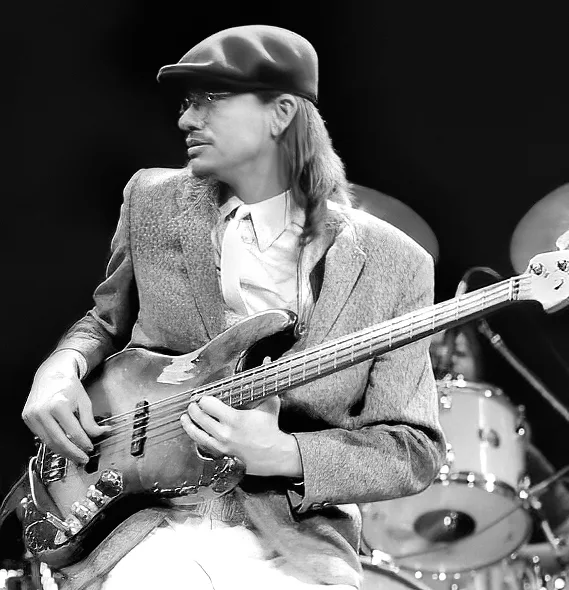
Jaco Pastorius performing at "Jazz at the Opera House," War Memorial Opera House, San Francisco, California, February 22, 1982. CC BY-SA 4.0 — Wikimedia Commons - https://commons.wikimedia.org/wiki/File:Jaco_Pastorius_1.jpg (photographer: Brian McMillen)

John Francis Anthony Pastorius III was born December 1, 1951, in Norristown, Pennsylvania, to Stephanie Haapala and big-band drummer John Francis Pastorius Jr. The family moved to Oakland Park, near Fort Lauderdale, Florida, when he was eight. He started on drums himself, but a wrist injury from a football game at thirteen forced corrective surgery and pushed him toward the bass; by seventeen he had bought an upright, which promptly cracked in the Florida humidity, so he traded it for a 1962 Fender Jazz Bass. He worked through his teens playing electric bass for R&B bandleader Wayne Cochran and the C.C. Riders, then in the early 1970s taught bass at the University of Miami, where he met guitarist Pat Metheny.
His first significant recording session came June 16, 1974, at Blue Rock Studio in New York, a quartet date led by pianist Paul Bley with Metheny and drummer Bruce Ditmas; it stayed unissued for two years, appearing in 1976 as Pastorius/Metheny/Ditmas/Bley once Pastorius had a name. He also played on Metheny's own ECM debut, Bright Size Life, a trio with drummer Bob Moses recorded in December 1975. His self-titled solo debut, Jaco Pastorius (Epic, 1976), was produced by Blood, Sweat and Tears drummer Bobby Colomby and featured Herbie Hancock (who also wrote the liner notes), Wayne Shorter, Michael Brecker, and Randy Brecker. Tracks like "Portrait of Tracy," built entirely from natural and artificial harmonics, and a virtuoso reworking of Charlie Parker's "Donna Lee" announced a genuinely new vocabulary for the electric bass; the album drew two 1977 Grammy nominations.
Pastorius introduced himself to keyboardist Joe Zawinul after a Weather Report concert in Miami with the line "I'm the greatest bass player in the world," and joined the band for Black Market (1976), sharing bass duties with outgoing member Alphonso Johnson before becoming sole bassist on Heavy Weather (1977), the platinum-selling album that produced the standard "Birdland." He stayed through Mr. Gone (1978), the Grammy-winning 8:30 (1979), Night Passage (1980), and the band's second self-titled album (1982), leaving that year as his own projects and worsening health pulled him away; full details of his tenure and the band's history are in Weather Report's own profile. In between, on March 3, 1979, he joined guitarist John McLaughlin and drummer Tony Williams for a short-lived, high-voltage group billed Trio of Doom, recorded live at the Havana Jam festival in Cuba and then, after a falling-out between Pastorius and Williams during a follow-up studio session in New York five days later, shelved for nearly three decades before Columbia/Legacy issued it in 2007.
Warner Bros. signed Pastorius to lead his own big band, Word of Mouth, whose 1981 studio album of the same name featured Wayne Shorter, Toots Thielemans, and the Brecker brothers among a rotating cast; a 21-piece version of the band toured Japan in 1982, documented on the live album Invitation (1983), recorded at Budokan, Yokohama Stadium, and Osaka's Festival Hall with Peter Erskine on drums and a guest turn from Herbie Hancock. During that Japanese tour Pastorius shaved his head, painted his face black, and threw his bass into Hiroshima Bay, alarming his bandmates; he was diagnosed with bipolar disorder later that year. The rest of the decade brought escalating substance abuse, homelessness, and only intermittent recorded work, though real moments of the old brilliance survived: a December 19, 1984 duo broadcast for French Radio with drummer Rashied Ali, later issued as Blackbird (Timeless/Alfa Jazz, 1991), and a 1986 studio pairing with young guitarist Biréli Lagrène released as Stuttgart Aria.
Pastorius passed away on September 21, 1987, in Fort Lauderdale, ten days after being severely beaten by a nightclub employee, Luc Havan, following an altercation outside the Midnight Bottle Club; he never regained consciousness after the assault fractured his skull and face. He was 35. He was inducted into the DownBeat Hall of Fame in 1988, the only electric bassist in the Hall as of the mid-2010s, and his original 1962 Jazz Bass, nicknamed the Bass of Doom, was eventually restored and returned to his family with help from Metallica's Robert Trujillo.
Pastorius did not just play the electric bass well; he changed what the instrument was understood to do. He stripped the frets from his 1962 Fender Jazz Bass, coated the fingerboard in epoxy, and used the resulting fretless voice to carry melody and countermelody the way a horn or a guitar would, layering in chordal harmonics, Motown- and James Jamerson-inflected funk syncopation, and Afro-Cuban rhythmic phrasing learned growing up in South Florida. On stage he brought a showman's instinct closer to Jimi Hendrix than to any bassist before him, playing loud and fast, singing, dancing, and performing publicly with a physicality the instrument had never invited. Bass Player magazine later ranked him second only to Jamerson among the greatest electric bassists in history, and his influence runs directly through a generation of rock, metal, and fusion players, including Flea of the Red Hot Chili Peppers, Metallica's Robert Trujillo, and Rush's Geddy Lee. Within jazz, his blend of virtuosity and compositional ambition, heard as much in his writing for the Word of Mouth big band as in his solos, made him as influential a bandleader-in-miniature as a sideman.
- Jaco Pastorius (1976, Epic) - His solo debut, produced by Bobby Colomby, with Herbie Hancock, Wayne Shorter, and the Brecker brothers; introduced "Portrait of Tracy" and a harmonics-driven "Donna Lee." Spotify - Jaco Pastorius Listen
- Heavy Weather (1977, Weather Report, Columbia) - His first album as the band's sole bassist, and the one that produced "Birdland." Platinum in the US, Grammy Hall of Fame 2011. Spotify - Heavy Weather
- Word of Mouth (1981, Warner Bros.) - His second and final studio album as a leader, built around his own big band and writing rather than his bass playing alone.
- Bright Size Life (1976, Pat Metheny, ECM) - Metheny's debut as a leader, a trio with Pastorius and drummer Bob Moses that shows his acoustic-leaning early style before Weather Report.
- Trio of Doom (recorded 1979, released 2007, Columbia/Legacy) - A short-lived group with guitarist John McLaughlin and drummer Tony Williams, recorded live at Havana's Havana Jam festival, shelved for 28 years after the trio dissolved.
- Invitation (1983, Warner Bros.) - The live document of the 1982 Word of Mouth big band's Japan tour, recorded at Budokan, Yokohama Stadium, and Osaka's Festival Hall, with Peter Erskine on drums.
- Blackbird (recorded Dec. 19, 1984; released 1991, Jaco Pastorius / Rashied Ali, Timeless/Alfa Jazz) - A duo broadcast for French Radio with drummer Rashied Ali, one of the last fully documented recordings of Pastorius's career. Not currently available on Spotify.
Jaco Pastorius: Full Discography
Identity confirmed via the live Discogs API: artist ID 10616 (realname John Francis Anthony Pastorius III). His personal artist page carries 679 credited releases: 77 in a "Main" (leader/co-leader) role, 385 "Appearance" sideman credits, 98 track-level "TrackAppearance" credits on compilations and samplers, 91 unofficial/bootleg pressings, plus a handful of producer, co-producer, mixing and remix credits.
Scope of the tables below. During his lifetime Pastorius led or co-led only a small number of genuinely distinct recordings: two studio albums as a leader (1976 and 1981), a handful of one-off co-billed dates (with Paul Bley, with the short-lived Trilogue and Trio of Doom groups, and with Rashied Ali), and one live big-band tour document (Invitation, 1983). His Discogs "Main" total of 77 is inflated almost entirely by a large posthumous glut: the same handful of 1980s Word of Mouth big band and duo tapes have been repackaged, retitled and reissued dozens of times since his 1987 death, chiefly by small Japanese and European archival labels (Sound Hills, Warehouse, JVC, Big World, Sony Music Japan, and others), often under different titles for the same or overlapping material. The table below curates the releases with real historical distinctness (first issues, the two studio albums, and the most complete or best-sourced versions of major archival tapes) rather than itemizing every repackaging; where a title is a reissue or recompilation of an entry already listed, it is folded into that entry's Reissue History column instead of given its own row.
As Leader / Co-Leader
| Album Title | Recording Date(s) | Release Date | Label | Catalog Number | Format(s) | Personnel | Role | Reissue History | Spotify | Buy | Notes |
|---|---|---|---|---|---|---|---|---|---|---|---|
| Pastorius / Metheny / Ditmas / Bley | June 16, 1974, Blue Rock Studio, New York City | 1976 | Improvising Artists Inc. | IAI 373846 | Vinyl, LP, Album, Stereo | Paul Bley (electric piano), Pat Metheny (electric guitar), Bruce Ditmas (drums), Pastorius (electric bass) | Sideman on a Paul Bley-led date, billed collectively | No CD reissue found on Discogs | Not confirmed on Spotify | — | Discogs's own release note calls this "probably Jaco's first recording session"; withheld for two years and issued only once Pastorius had a name |
| Jaco Pastorius | 1975-1976 | 1976 | Epic | PE 33949 | Vinyl, LP, Album, Stereo | Herbie Hancock, Wayne Shorter, Michael Brecker, Randy Brecker, Lenny White, Don Alias, Sam & Dave (backing vocals) | Leader | Multiple CD reissues, incl. a 2000 Legacy/Sony remaster and a 2015 Revolver Records edition | Spotify - Jaco Pastorius (2015 Revolver Records reissue, 11 tracks) | — | Produced by Blood, Sweat and Tears drummer Bobby Colomby. Two 1977 Grammy nominations: Best Jazz Performance by a Group, and Best Jazz Performance by a Soloist for "Donna Lee" |
| Trilogue: Live at the Berlin Jazz Days | November 6, 1976, Berlin Philharmonic | 1977 | MPS Records | 0068.175 / MPS 15.424 | Vinyl, LP, Album, Stereo | Alphonse Mouzon (drums), Albert Mangelsdorff (trombone) | Co-leader (trio billed collectively as "Trilogue," Discogs group entity 342145) | No CD reissue found | Not confirmed on Spotify | — | One-off trio billed under the group name "Trilogue" rather than any individual's name; Epic gave permission for Pastorius's participation while he was under contract |
| Word of Mouth | 1980-1981 | 1981 | Warner Bros. Records | BSK 3535 | Vinyl, LP, Album | Wayne Shorter, Toots Thielemans, Michael Brecker, Randy Brecker, Peter Gordon (French horn), Peter Erskine, Othello Molineaux (steel drums) | Leader | Reissued on CD by Warner Bros./Rhino | Not confirmed on Spotify as a distinct catalog entry (search surfaces the album under multiple regional pressings) | — | His second and final studio album as a leader; foundation for the Word of Mouth big band and its 1982 Japan tour |
| Twins I / Twins II (Aurex Jazz Festival '82) | Live, September 1-4, 1982: Budokan (Tokyo), Osaka Festival Hall, Yokohama | 1982 (two separate Japanese LPs) | Warner Bros. Records (Japan) | Twins I: P-11317 | Vinyl, LP, Album (x2, Japan-only) | Word of Mouth big band, incl. Peter Erskine (drums), Randy Emerick (baritone saxophone, clarinet, alto flute); arrangements by Bob Mintzer and Pastorius | Bandleader (filed under the Discogs group entity "Jaco Pastorius Big Band," 537300, not his personal artist page) | Combined and remastered as Twins I & II: Live in Japan 1982 (Warner Bros. Japan WPCR-10609~10, HDCD, 1999) | Not confirmed on Spotify under this exact title | — | Group-billing trap: these two LPs and their 1999 combined reissue live entirely under the "Jaco Pastorius Big Band" entity, invisible from a search of his personal artist page alone |
| Invitation | Live, September 1982: Nippon Budokan (Tokyo), Yokohama Stadium, Festival Hall (Osaka) | 1983 | Warner Bros. Records | 9 23876-1 / 1-23876 | Vinyl, LP, Album | Peter Erskine (drums, timpani, gong), Toots Thielemans (harmonica), Randy Emerick and Peter Graves (baritone/bass trombone), Brad Warnaar and Peter Gordon (French horn); Herbie Hancock guests on "Liberty City" | Leader (producer, arranger) | Reissued on CD | Spotify - Invitation [Live] | — | The commercially released document of the Word of Mouth big band's 1982 Japan tour |
| Holiday for Pans | 1980-1982, Power Station / KCC Studio / Jingle Studio, New York City | April 26, 1993 | Sound Hills Records (Japan) | SSCD-8001 | CD, Album | Kenwood Dennard and Bobby Economou (drums), Ted Lewand (guitar), Toots Thielemans (harmonica) | Leader | Expanded as Full Complete Session From "Holiday For Pans" Recordings (1980-82) (1999) | Not confirmed on Spotify under this exact title | — | Posthumous assembly of Word of Mouth-era studio sessions, issued first in Japan |
| Trio of Doom | Live: March 3, 1979, Karl Marx Theater, Havana, Cuba (Havana Jam festival). Studio: March 8, 1979, Columbia Studios, New York City | June 26, 2007 | Columbia / Legacy | 82796 96450 2 | CD, Album, Reissue, Remastered | John McLaughlin (guitar), Tony Williams (drums) | Co-leader (trio) | First release, 28 years after recording | Not confirmed on Spotify | — | The trio dissolved after a dispute between Pastorius and Williams broke out during the New York studio session; the material was shelved until Columbia/Legacy's archival release |
| Blackbird | Live for French Radio, December 19, 1984 | September 1, 1991 | Alfa Jazz / Timeless Records | ALCR-123 | CD, Album | Rashied Ali (drums, credited as "Rashid Ali" on the sleeve) | Co-leader (duo, billed "Jaco Pastorius & Rashid Ali") | A 2023 reissue also exists on Discogs | Not confirmed on Spotify | — | Duo program of Ornette Coleman's "Broadway Blues," Hendrix's "Purple Haze," Buster Brown's "Fannie Mae," McCartney's "Blackbird," Parker's "Donna Lee," two Pastorius originals, and Coltrane's "Naima." Also released as CD in Alfa's Japanese pressing |
| Stuttgart Aria | March 1986, Melody Tonstudio, Stuttgart | 1986 | Jazzpoint Records | JP 1019 | Vinyl, LP, Album | Biréli Lagrène (electric guitar, backing vocals), Władysław Sendecki (keyboards, synthesizer), Peter Lübke (drums), Serge Bringolf (percussion) | Co-leader (duo billing) | Combined reissue Heavy'N Jazz & Stuttgart Aria (1999) | Confirmed on Spotify (title "Stuttgart Aria") | — | Recorded roughly eighteen months before his death; one of his last studio-quality sessions |
| The Birthday Concert | Live, December 1, 1981, Sunrise Musical Theatre, Fort Lauderdale, Florida (his 30th birthday) | 1995 | Warner Bros. Records | 9 45290-2 | CD, Album | Peter Erskine (drums), Don Alias and Robert Thomas Jr. (congas), Randy Emerick (baritone saxophone), Peter Graves (bass trombone) | Leader | First release, 14 years after the concert | Not confirmed on Spotify under this exact title | — | Recorded on his own 30th birthday, four years before the Word of Mouth big band's commercially issued live document |
| Truth, Liberty & Soul - Live in NYC: The Complete 1982 NPR Jazz Alive! Recordings | Live, June 27, 1982, Avery Fisher Hall, New York City, broadcast on NPR's "Jazz Alive!" | 2017 (Record Store Day) | Resonance Records | HLP-9027 | Vinyl, LP, Album, Box Set, Limited Edition, Numbered | Peter Erskine (drums), Howard Johnson and Randy Emerick (baritone saxophone), John Clark and Peter Gordon (French horn), Bob Stein (alto saxophone) | Leader | First official release of the complete broadcast; mastered by Bernie Grundman | Not confirmed on Spotify under this exact title | — | The most complete professionally-recorded document of the Word of Mouth big band, sourced from the original broadcast masters |
As Sideman (selected major credits)
| Year | Project (Leader) | Title | Label | Catalog | Role | Notes |
|---|---|---|---|---|---|---|
| 1976 | Pat Metheny | Bright Size Life | ECM Records ECM 1073 | ECM 1073 | Electric bass | Metheny's debut as a leader, a trio with drummer Bob Moses |
| 1976 | Weather Report | Black Market | Columbia | PC 34099 | Fretless bass, two tracks | His first Weather Report studio recording, including his own composition "Barbary Coast" |
| 1977 | Weather Report | Heavy Weather | Columbia | PC 34418 | Bass, co-producer | Platinum in the US; includes "Birdland" |
| 1978 | Weather Report | Mr. Gone | ARC/Columbia | JC 35358 | Bass, drums (two tracks), co-producer | No. 1 on Billboard Jazz Albums |
| 1979 | Weather Report | 8:30 | ARC/Columbia | PC2 36030 | Fretless bass, co-producer | Grammy, Best Jazz Fusion Performance |
| 1980 | Weather Report | Night Passage | ARC/Columbia | JC 36793 | Bass, co-producer | Recorded semi-live before an invited audience |
| 1982 | Weather Report | Weather Report (self-titled) | ARC/Columbia | FC 37616 | Bass, percussion, vocals | His last studio album with the band |
| 1976 | Joni Mitchell | Hejira | Asylum Records | 7E-1087 | Electric bass | First of four Mitchell albums he played on |
| 1977 | Joni Mitchell | Don Juan's Reckless Daughter | Asylum Records | BB-701 | Electric bass | |
| 1979 | Joni Mitchell | Mingus | Asylum Records | 5E-505 | Electric bass | Mitchell's tribute album to Charles Mingus, who died the year of its release |
| 1980 | Joni Mitchell | Shadows and Light | Asylum Records | BB-704 | Electric bass (live) | Live album, also featuring Peter Erskine on drums |
| 1978 | Herbie Hancock | Sunlight | Columbia | JC 34907 | Electric bass | |
| 1980 | Herbie Hancock | Mr. Hands | Columbia | JC 36578 | Electric bass | |
| 1976 | Al Di Meola | Land of the Midnight Sun | Columbia | PC 34074 | Electric bass | |
| 1977 | Airto Moreira | I'm Fine, How Are You? | Warner Bros. Records | BS 3084 | Electric bass | |
| 1978 | Flora Purim | Everyday, Everynight | Warner Bros. Records | BSK 3168 | Electric bass | |
| 1979 | Ian Hunter | You're Never Alone with a Schizophrenic | Chrysalis | CHR 1214 | Electric bass | Mick Ronson-produced rock album; Pastorius plays on the whole record |
Group entities checked
Per the standing lesson from this sweep that Discogs hides leader albums under group-billing entities, every "groups" link on Pastorius's personal artist page (10616) was checked directly: Weather Report (10082, already covered on its own profile), Blood, Sweat and Tears (168907, all releases predate his career, 1968-69, and appear to be a generic linked entity rather than a genuine per-release credit; not asserted here, see notes), Trilogue (342145, folded in above), Jaco Pastorius Big Band (537300, folded in above, holds the Twins LPs and several more archival titles), Jaco Pastorius Band (13433392, one further live archival title, Live in Tokyo 83), Jaco Pastorius & Friends (8137023, one unofficial release only), Word Of Mouth Sextet (11632277, one unofficial release only), and Trio of Doom (1113742, folded in above).
Not itemized
The remaining ~60 Discogs "Main" entries not listed above are almost entirely repackagings and alternate-title reissues of the material already in the tables: titles including Heavy'N Jazz, Standards Zone, Jazz Street, Natural, PDB, Last Flight, Live in Italy, "Honestly" Solo Live, Live in New York City volumes one through seven, Le Demi-Dieu de la Basse, Golden Roads, The Weather Years, Broadway Blues, Rare Collection, Another Side of Jaco Pastorius, Portrait of Jaco: The Early Years 1968-1978, Punk Jazz: The Jaco Pastorius Anthology, and The Columbia Albums 1976-1982 (which reissues his Weather Report studio work, already covered on that band's own profile). No further leader album with real historical distinctness beyond those tabled above was identified among them.
- Joe Zawinul and Wayne Shorter - co-leaders of Weather Report, 1976-1982; Shorter also played in Pastorius's own Word of Mouth big band and on Invitation.
- Pat Metheny - earliest recorded collaborator, from the 1974 Paul Bley session through Metheny's 1976 debut Bright Size Life.
- Paul Bley - bandleader on Pastorius's first significant recording session, June 1974.
- Herbie Hancock - contributed liner notes and piano to the 1976 debut, and later guested on Invitation (1983).
- Michael Brecker and Randy Brecker - sidemen on the 1976 debut and later members of the Word of Mouth big band.
- Peter Erskine - drummer Pastorius brought into Weather Report for 1978, and on the Invitation tour and album.
- Joni Mitchell - bassist across four of her albums, 1976-1980: Hejira, Don Juan's Reckless Daughter, Mingus, and the live Shadows and Light.
- John McLaughlin and Tony Williams - Trio of Doom bandmates, March 1979.
- Rashied Ali - duo partner on the live Blackbird session, recorded for French Radio in December 1984.
- Airto Moreira and Flora Purim - sideman dates in the late 1970s (Moreira's I'm Fine, How Are You?, Purim's Everyday Everynight).
More Jazz Fusion Artists
See all 262 Jazz Fusion artists →More American Jazz Artists
See all 567 American artists →- Wikipedia: Jaco Pastorius
- Wikipedia: Jaco Pastorius (album)
- Wikipedia: Word of Mouth (Jaco Pastorius album)
- Wikipedia: Invitation (Jaco Pastorius album)
- Wikipedia: Trio of Doom
- Wikipedia: Jaco Pastorius discography
- Discogs: Jaco Pastorius (artist 10616)
- Discogs: Jaco Pastorius & Rashied Ali - Blackbird (master 791469)