 JAZZPROFILES lives in the music 1,002 Jazz Artists fully Profiled!
 Claudio Roditi
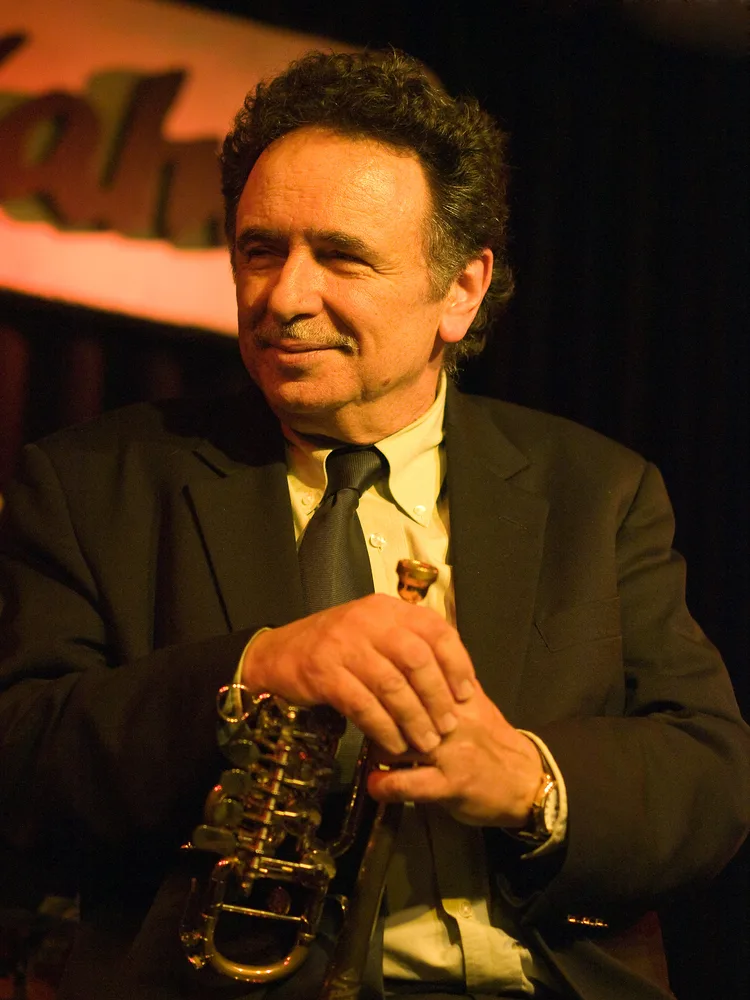
Claudio Roditi on stage at the Jazzclub Unterfahrt, Munich, March 21, 2010, holding his rotary-valve trumpet, photographed by Wikimedia Commons user OhWeh CC BY-SA 2.5 (Creative Commons Attribution-ShareAlike 2.5 Generic; own work, attribution required to OhWeh as photographer) — Wikimedia Commons - https://commons.wikimedia.org/wiki/File:Claudio_Roditi_Unterfahrt_2010-03-21-004.jpg

Claudio Roditi was born in Rio de Janeiro on May 28, 1946, an only child in a family that moved around Brazil with his father Alberto's work in the coffee trade, including spells in Santos and in Varginha, in Minas Gerais. His father put bongos in his hands first; a cousin of his mother's gave him piano lessons from the age of six. The trumpet arrived when he was around nine, and he described the encounter as love at first sight. He learned the instrument on records by Dizzy Gillespie and Miles Davis before taking formal lessons in Rio from the saxophonist Aurino Ferreira after his father's death. In 1966 he entered the International Jazz Competition in Vienna and reached the trumpet final, where a jury that included Art Farmer told him to make a career of it. Farmer became a mentor. The earliest credit indexed under his name is Brazilian: trumpet on alto saxophonist Victor Assis Brasil's Trajeto, cut in Rio for the Equipe label in 1967, when Roditi was twenty.
He came to the United States in 1970 to study at Berklee in Boston, and stayed in the city for six years, working the local scene, hanging around the J.D.S. School of Music where he gave informal trumpet lessons, and playing again with Victor Assis Brasil, who had also landed in Boston. He met Kristen Park during those years and married her there; they were together forty-five years. In 1976 he moved to New York and started turning up on records fast: Herbie Mann's Sunbelt (Atlantic, 1978) and Mellow (1981), Dom Um Romao's Hotmosphere on Pablo, Charlie Rouse's Brazilian-inflected Cinnamon Flower (Douglas, 1977), David Schnitter's Goliath, cut at Van Gelder Studio in October 1977, a Harry Belafonte album, and two records with the Harris Simon Group alongside Michael Brecker and Joe Farrell. On several of these he is credited on valve trombone as often as on trumpet.
The turn came in 1983, when he joined Paquito D'Rivera's band. He is on Live at Keystone Korner, taped in San Francisco on June 17 and 18, 1983, credited for trumpet and valve trombone, and he stayed through four more Columbia albums to Celebration in 1988, gradually dropping the trombone. Late in 1983 the producer Creed Taylor heard him in D'Rivera's group and offered him a record of his own. Red on Red, cut at Rudy Van Gelder's studio on January 24, 25 and 26, 1984 and issued on Greene Street with a Japanese CTI edition, was both Roditi's debut as a leader and, according to its own release notes, the first Creed Taylor production and the first Van Gelder session recorded digitally. Claudio! followed for Uptown almost exactly a year later, made in a single day at Van Gelder's with Slide Hampton, Mulgrew Miller, Rufus Reid and Akira Tana. Milestone then signed him for two albums, Gemini Man (1988) and Slow Fire (recorded April 17 to 19, 1989), both produced by Helen Keane, who had spent two decades producing Bill Evans.
D'Rivera also made the introduction that put Roditi in front of the largest audiences of his career. Gillespie heard him, liked the sound, and took him into the United Nation Orchestra, the multinational big band he assembled at the end of the 1980s. Roditi is in the trumpet section on the concert at London's Royal Festival Hall on June 10, 1989, alongside Arturo Sandoval, with Slide Hampton and Steve Turre on trombones, D'Rivera and James Moody on saxophones, Danilo Perez at the piano, Airto Moreira and Giovanni Hidalgo on percussion and Flora Purim singing. Enja's recording of that night won Best Large Jazz Ensemble Performance at the 34th Grammy Awards in 1992, credited to Gillespie. Roditi returned for To Diz, With Love, taped at the Blue Note over Gillespie's seventy-fifth birthday run in January and February 1992, and he was still in the alumni band twenty years on, on the Dizzy Gillespie All-Star Big Band's Dizzy's Business (2006) and I'm BeBoppin' Too (2008).
Through the 1990s he ran two parallel careers. In New York he made a run of leader albums that alternate deliberately between Brazilian and bebop material, sometimes on the same record: Two of Swords (Candid, 1991) uses two separate quartets, one of each, and Double Standards (Reservoir, 1997) does it again six years later. Milestones (Candid, 1992) is a Birdland quintet date with D'Rivera, Kenny Barron, Ray Drummond and Ben Riley from November 1990. Free Wheelin' (Reservoir, 1994) is a programme entirely of Lee Morgan compositions, recorded on July 29, 1994 at the studio where most of the originals had been made. Alongside those he was a first-call horn for other people's projects: Horace Silver's The Hardbop Grandpop (Impulse!, 1996), Jim Hall's large-ensemble Textures (Telarc, 1997), four McCoy Tyner records, Jimmy Heath's Grammy-nominated Little Man Big Band (Verve, 1992), Slide Hampton's Dedicated to Diz, cut at the Village Vanguard in February 1993, and Tito Puente's Golden Latin Jazz All Stars at the Village Gate. In Europe he kept a completely separate band going: a trio with the German pianist Klaus Ignatzek and the Belgian bassist Jean-Louis Rassinfosse that began with Eight Languages in 1989 and produced eight more albums over the next twenty-five years, ending with For a Long Time in 2014.
The last chapter belongs to Resonance Records. Brazilliance X4, a quartet date with Helio Alves, Leonardo Cioglia and Duduka Da Fonseca recorded in March 2007 and released on February 10, 2009, was nominated for Best Latin Jazz Album at the 52nd Grammy Awards. Simpatico (2010) is entirely his own compositions, including "Altitude" for Johnny Alf and "A Dream for Kristen" for his wife, and Bons Amigos (2011) closed out the leader catalog with arrangements by Tamir Hendelman. By then he was living in South Orange, New Jersey, close enough to the local studios that several records of the period were made or mixed on his doorstep: Michael Dease's Grace was cut in South Orange on December 11, 2009, and it was in that orbit that he turned up as a guest on the Israeli guitarist Yotam Silberstein's Brasil (Jazz Legacy Productions, 2011), playing flugelhorn on one track. He taught master classes, adjudicated competitions, and spent years on the faculty of the Litchfield Jazz Camp. Prostate cancer was diagnosed in 2017 and he kept performing into 2019. He passed away at his home in South Orange on January 17, 2020, at seventy-three, survived by Kristen Park. Jimmy Heath died two days later, and the jazz press ran the two obituaries together.
Roditi is the rare player who could work both sides of the Brazilian-bebop border without treating either as a costume. He had the modern trumpet vocabulary in his hands, learned off Gillespie, Miles Davis, Clifford Brown, Lee Morgan and Booker Little records, and he had samba and bossa as first-language rhythm rather than as decoration, which is why he could program a whole album of Lee Morgan tunes one year and a direct-to-digital session in Rio the next. What separates him from the harder bop trumpeters is the attack: as Bill Kirchner observed, he tended to start solos slowly and deliberately rather than at full flame, a West Coast habit closer to Chet Baker and Gerry Mulligan than to Freddie Hubbard. The tone is the other signature. During the D'Rivera years he moved from valve trombone to the rotary-valve trumpet, an orchestral instrument with rotors instead of pistons, because in his words it gets a warmer sound than a piston horn, and he later added the piccolo trumpet; the sleeve of Mark Murphy's Night Mood is one of the few that names the rotary-valve instrument outright. Writers reaching for what the playing does with that warmth almost always land on saudade, the Brazilian word for a longing that is not quite grief. Paquito D'Rivera's summary was shorter: an original without even trying.
- Red on Red (1984, Greene Street/CTI) - His debut as a leader, cut over three days at Van Gelder Studio with Kenia singing and Paquito D'Rivera guesting, and by its own account the first Creed Taylor production recorded digitally. Not confirmed on Spotify.
- Claudio! (1985, Uptown) - A single day at Van Gelder's with Slide Hampton, Mulgrew Miller, Rufus Reid and Akira Tana, and the cleanest early statement of the straight-ahead half of his playing. Not confirmed on Spotify.
- Slow Fire (1989, Milestone) - Helen Keane's second production for him, with Danilo Perez on nine of ten tracks and Roditi singing on three, recorded over three April days in New York. Not confirmed on Spotify.
- Live at the Royal Festival Hall (rec. 1989, rel. 1990, Enja) - As sideman: the Dizzy Gillespie United Nation Orchestra concert of June 10, 1989, which won Best Large Jazz Ensemble Performance at the 34th Grammy Awards. Roditi is in the trumpet section with Arturo Sandoval.
- Two of Swords (1991, Candid) - The album that states his whole premise: two alternating quartets, one Brazilian and one bebop, eleven tracks, recorded September 24 and 25, 1990. Spotify - Two of Swords Listen
- Free Wheelin': The Music of Lee Morgan (1994, Reservoir) - An all-Morgan programme with Andres Boiarsky, Mark Soskin, Buster Williams and Chip White, recorded July 29, 1994 at Van Gelder Studio. Not confirmed on Spotify.
- Samba - Manhattan Style (1995, Reservoir) - The title is the thesis; Helio Alves, John Lee and Duduka Da Fonseca, with horns added on selected tracks. Spotify - Samba Manhattan Style Listen
- Brazilliance X4 (2009, Resonance) - The quartet record with Helio Alves, Leonardo Cioglia and Duduka Da Fonseca that earned his only Grammy nomination of record, for Best Latin Jazz Album at the 52nd Grammy Awards. Spotify - Brazilliance X4 Listen
- Simpatico (2010, Resonance) - An album of nothing but his own writing, with Romero Lubambo, Helio Alves, John Lee and Michael Dease. Spotify - Simpatico Listen
Claudio Roditi: Full Discography
The leader and co-leader table below aims to be complete for first-issue albums. The sideman table is a representative selection of the most significant credits, not an exhaustive list: Discogs indexes 364 releases under Roditi's artist ID, of which 267 are sideman appearances, 48 are track-level appearances and 5 are unofficial pressings.
Identity confirmed via the live Discogs API. Claudio Roditi is artist ID 65743, whose artist record reads "NY-based Brazilian trumpeter and composer. Born: May 28, 1946 in Rio de Janeiro (Brazil). Death: January 17, 2020 in South Orange, New Jersey (USA)." Two further Discogs entities, Claudio Roditi Don Sickler Quintet (16693711) and Claudio Roditi & Roberto Sion Quinteto (10323376), are billing variants of the same player rather than separate people.
Every row's label, catalog number, format, recording date and personnel below was read off the specific Discogs release record, not the artist index, and every conflict with Wikipedia's dating is named in the Notes column. The Buy column is — throughout because no affiliate program is set up yet.
A note on the Spotify column. Spotify's catalogue could not be searched or listed for Roditi. Every link below was instead found by domain-restricted search of open.spotify.com and then checked by opening the album page and matching its billing, year and track count against the Discogs release. Rows that could not be matched that way say so rather than guessing. Roditi's Spotify artist page is 3mOGWmUQKJGWkqRGfYbnQP, confirmed by its biography text and album list.
As Leader / Co-Leader
| Album Title | Recording Date(s) | Release Date | Label | Catalog Number | Format(s) | Personnel | Role | Reissue History | Spotify | Buy | Notes |
|---|---|---|---|---|---|---|---|---|---|---|---|
| Red on Red | Recorded January 24, 25 and 26, 1984, Van Gelder Studio, Englewood Cliffs, NJ | 1984 | Greene Street Records (US) | GS 2001 | Vinyl, LP, Album | Claudio Roditi (trumpet, flugelhorn), Kenia (vocals), Paquito D'Rivera (alto sax), Alfredo Cardim (electric piano), Jorge Dalto (synthesizer), Claudio Celso (guitar), Lincoln Goines (bass), Buddy Williams and Yogi Horton (drums), Nana Vasconcelos (percussion), Peter Drake (arranger, conductor); produced by Creed Taylor, engineered by Rudy Van Gelder | Leader (billed Claudio Roditi with Kenia) | Japanese CTI LP (CTI 9011, 1984) and a 2016 Japanese remaster (King KICJ 2505) | Not confirmed on Spotify | — | His debut as a leader. The release notes call it the first Creed Taylor production recorded with digital equipment and the first digital session Rudy Van Gelder engineered. Wikipedia's "Greene Street/CTI, 1984" is correct: Greene Street was the US imprint, CTI the Japanese one |
| Claudio! | Recorded January 27, 1985, Van Gelder Studio, Englewood Cliffs, NJ | 1985 | Uptown Records (US) | UP27.27 | Vinyl, LP, Album | Claudio Roditi (trumpet, flugelhorn), Slide Hampton (trombone), Howard Kimbo (tenor sax), Mulgrew Miller (piano), Rufus Reid (bass), Akira Tana (drums), Steve Sacks (synthesizer, two tracks); liner notes by Francis Davis | Leader | None found | Not confirmed on Spotify | — | Cut in a single day at Van Gelder's, a year and three days after Red on Red |
| Gemini Man | Recorded and remixed at Counterpoint Recording, New York City | 1988 | Milestone (US) | M-9158 | Vinyl LP; CD MCD-9158-2 | Claudio Roditi (trumpet, flugelhorn, vocals), Paquito D'Rivera (saxophone), Roger Kellaway (piano), Daniel Freiberg (synthesizer, electric piano, arranger), Nilson Matta (bass), Akira Tana and Ignacio Berroa (drums), Rafael Cruz (percussion); produced by Helen Keane, sleeve notes by Bob Blumenthal | Leader | CD editions on Milestone and Fantasy | Not confirmed on Spotify | — | Produced by Helen Keane, best known as Bill Evans's producer and manager. English lyric translations are credited to Kristen Park, Roditi's wife |
| Slow Fire | Recorded and mixed at Home Base Recording Studio, New York City, April 17, 18 and 19, 1989 | 1989 | Milestone (US) | M-9175 | Vinyl LP; CD MCD-9175-2 | Claudio Roditi (trumpet, flugelhorn, piano on one track, vocals on three), Danilo Perez (piano), Daniel Freiberg (synthesizer), Ralph Moore (tenor sax), Jay Ashby (trombone), David Finck (bass), Portinho, Ignacio Berroa and Akira Tana (drums), Rafael Cruz and Thiago de Mello (percussion); produced by Helen Keane, liner notes by Arnaldo DeSouteiro | Leader | CD editions on Milestone and Fantasy | Not confirmed as an album on Spotify; a Spotify track titled "Slow Fire" belongs to Simpatico (2010), not to this record | — | The personnel above comes from the CD pressing (MCD-9175-2); the LP release sheet lists production credits only. Danilo Perez plays on nine of the ten tracks |
| Return to Ipanema | Recorded March 1 and 2, 1989, New York City | 1989 | Town Crier Recordings (US) | TCD 516 | CD, Album | Paquito D'Rivera (alto sax, clarinet), Claudio Roditi (trumpet), Ralph Moore (tenor sax), Jay Ashby (trombone), Danilo Perez (piano), Nilson Matta (bass), Portinho (drums), Rafael Cruz (percussion); liner notes by Richard M. Sudhalter | Co-leader (four-way billing) | None found | Not confirmed on Spotify | — | Wikipedia files this under "with Paquito D'Rivera." The release is billed to four co-leaders, and Roditi arranged seven of its nine tracks |
| Eight Languages | Not stated on the release | 1989 | September (Belgium) | 5108 | CD, Album | Klaus Ignatzek (piano), Claudio Roditi and Gustavo Bergalli (trumpets), Jean-Louis Rassinfosse (bass), Leroy Lowe (drums) | Co-leader (collective billing) | None found | Not confirmed on Spotify | — | Wikipedia files this under "with Klaus Ignatzek." The release bills all five players. It is the first of roughly a dozen records Roditi made with Ignatzek and Rassinfosse over the next twenty-five years |
| Two of Swords | Recorded September 24 and 25, 1990 | 1991 | Candid (UK, Europe and US) | CCD 79504 | CD, Album | Claudio Roditi (trumpet, flugelhorn); Brazilian group: Edward Simon (piano), Nilson Matta (bass), Duduka Da Fonseca (drums), Jay Ashby (trombone); bebop group: Danilo Perez (piano), David Finck (bass), Akira Tana (drums); produced by Mark Morganelli, recorded by Malcolm Addey | Leader | Japanese CD, Candid TKCB-30649, 1992 | Spotify - Two of Swords | — | The album's premise is two alternating quartets, one Brazilian and one bebop, hence the title. Eleven tracks, matching the Spotify edition |
| Day Waves | Recorded direct to two-track digital with no overdubbing at Musika Studios, Rio de Janeiro, September 19 and 20, 1991 | 1992 | JSR (Brazil) | 107.215 | CD, Album | Claudio Roditi (trumpet, flugelhorn), Mauro Senise (alto and soprano sax, flute), Idriss Boudrioua (alto sax), Osmar Milito (piano), Jota Moraes (keyboards), Sergio Barroso (acoustic bass), Arthur Maia (electric bass), Pascoal Meirelles (drums); produced and mastered by Arnaldo DeSouteiro | Leader | None found | Not confirmed on Spotify | — | An audiophile direct-to-digital session cut in Rio with a Brazilian band, unlike his New York records of the same period |
| Milestones | Recorded live at Birdland, New York City, November 13 and 14, 1990 | 1992 | Candid (Germany, Europe) | CD79515 | CD, Album | Claudio Roditi (trumpet, flugelhorn), Paquito D'Rivera (alto sax, clarinet), Kenny Barron (piano), Ray Drummond (bass), Ben Riley (drums); liner notes by Ira Gitler | Leader (billed Claudio Roditi featuring Paquito D'Rivera) | None found | Spotify - Milestones | — | Wikipedia dates it 1992 and files it as a leader album, both correct, but the music is two years older: the Birdland sets are from November 1990, two months after the Two of Swords studio dates |
| Jazz Turns Samba | Not stated on the release | 1994 | Groovin' High (Switzerland) | 521 616-2 | CD, Album | Claudio Roditi (trumpet, flugelhorn), Mark Soskin (piano), David Finck (bass), Ignacio Berroa (drums), with David Sanchez and Andres Boiarsky (tenor sax), Ed Cherry (guitar) and Hendrik Meurkens (harmonica) on selected tracks | Leader | None found | Spotify - Jazz Turns Samba | — | The Spotify edition is dated 2015, a digital reissue of the 1994 CD. Some obituaries credit this album with a Grammy nomination; the Recording Academy's own artist database does not (see the notes file) |
| Free Wheelin': The Music of Lee Morgan | Digital recording, July 29, 1994, Van Gelder Studio, Englewood Cliffs, NJ | 1994 | Reservoir (US) | RSR CD 136 | CD, Album | Claudio Roditi (trumpet), Andres Boiarsky (tenor sax), Mark Soskin (piano), Buster Williams (bass), Chip White (drums); recorded by Rudy Van Gelder, co-produced by Roditi and Mark Feldman, liner notes by Bob Bernotas | Leader | None found | Not confirmed on Spotify | — | A programme entirely of Lee Morgan compositions, cut at the studio where most of the originals were made. Wikipedia lists the title as "Free Wheelin"; the release carries the subtitle The Music of Lee Morgan |
| Samba - Manhattan Style | Recorded May 12 and 13, 1995 | 1995 | Reservoir (US) | RSR CD 139 | CD, Album | Claudio Roditi (trumpet, flugelhorn, vocals on one track), Helio Alves (piano), John Lee (bass), Duduka Da Fonseca (drums), with Andres Boiarsky (tenor and soprano sax), Greg Abate (alto and tenor sax) and Jay Ashby (trombone) on selected tracks | Leader | None found | Spotify - Samba Manhattan Style | — | Total time 61:20. The bassist is John Lee, later Roditi's frequent producer and the man who ran the Dizzy Gillespie All-Star Big Band |
| Live | Recorded live April 16, 1996 at the Bayerischer Hof, Munich, and April 20, 1996 at the A-Trane jazz club, Berlin | 1996 | Edition Collage (Germany) | 54404534 | CD, Album | Claudio Roditi (trumpet, flugelhorn) with Mind Games: Mulo Francel (tenor and soprano sax, clarinet), Ullrich Wangenheim (flute, alto sax), Andreas Binder (French horn), Bastian Pusch (piano, keyboards), D.D. Lowka (bass), Csaba Schmitz (drums), Stephan Maass (percussion), Lisa Wahlandt (vocals) | Co-leader (billed Claudio Roditi and Mind Games) | US issue on Summit Records, DCD 212, 1997 | Not confirmed on Spotify | — | Wikipedia gives the label as "GLM Musikverlag." The earliest pressing Discogs indexes is on Edition Collage; GLM is the associated Munich publisher and distributor |
| Claudio, Rio & Friends | Not stated on the release | 1996 | Groovin' High (Europe) | 529 858-2 | CD, Album | Claudio Roditi (trumpet), Mauro Senise (alto sax, flute), Jota Moraes (keyboards), Arthur Maia (bass), Pascoal Meirelles (drums), with Guinga and Rodrigo Campello (acoustic guitar), Nivaldo Ornelas (tenor sax), Guillerme Dias Gomez (trumpet, flugelhorn) and Leila Pinheiro (vocals) on selected tracks; produced by Jaques Muyal | Leader | Canadian issue, Groovin' High 1013-2, 1996 | Spotify - Claudio, Rio & Friends | — | The Spotify edition is billed "Claudio, Rio & Friends (feat. Cama de Gato Quartet)" and dated 2015; the personnel it names match the Rio band on the CD |
| Claudio Roditi - Metropole Orchestra | Recorded at Radio NOS Studios, Hilversum, Netherlands | 1996 | Mons Records (Germany) | MR 874-767 | CD, Album | Claudio Roditi (trumpet, flugelhorn, vocals) with the Metropole Orchestra; arranged and conducted by Rob Pronk, produced by Thilo Berg | Co-leader (billed with the orchestra) | None found | Spotify - Claudio Roditi | — | Wikipedia calls this "Claudio Roditi and the Metropole Orchestra (Mons, 1996)"; the disc itself reads Claudio Roditi - Metropole Orchestra. The Spotify edition is billed to Metropole Orkest |
| Double Standards | Recorded New York City, September 30 and October 1, 1996 | 1997 | Reservoir (US) | RSR 148 | CD, Album | Claudio Roditi (trumpet, flugelhorn, vocals on one track); Brazilian group: Helio Alves (piano), John Lee (electric bass), Marty Ashby (guitar), Duduka Da Fonseca (drums), Andres Boiarsky (tenor sax); standards group: Gil Goldstein or Helio Alves (piano), David Finck (bass), Chip White (drums), Jimmy Greene (tenor sax); Hendrik Meurkens (harmonica) and Jay Ashby (trombone) on one track | Leader | None found | Not confirmed on Spotify | — | The two-band structure of Two of Swords repeated six years later, hence the title. An early recorded appearance by Jimmy Greene |
| Crossworlds | Not stated on the release | 2001 | Igloo (Belgium) | IGL 156 | CD, Album | Jean-Louis Rassinfosse (double bass), Claudio Roditi and Gustavo Bergalli (trumpet, bugle), Pierre Vaiana (saxophone), Fabien Degryse (acoustic guitar), Klaus Ignatzek (piano), Bruno Castellucci (drums) | Co-leader (seven-way collective billing) | None found | Not confirmed on Spotify | — | Absent from Wikipedia's discography entirely |
| Three for One | Recorded November 6, 2002, Studio Vagnsson, Hamburg | 2002 | Nagel Heyer Records (Germany) | 2028 | CD, Album | Claudio Roditi (trumpet, vocals), Klaus Ignatzek (piano), Jean-Louis Rassinfosse (bass); produced by Frank Nagel-Heyer | Co-leader (trio, three-way billing) | None found | Spotify - Three for One | — | The first album under the standing Roditi / Ignatzek / Rassinfosse trio billing that would run to 2014 |
| Light in the Dark | Not stated on the release | 2004 | Nagel Heyer Records (Germany) | 2047 | CD, Album | Claudio Roditi (trumpet, flugelhorn, vocals), Klaus Ignatzek (piano), Jean-Louis Rassinfosse (bass); produced by Frank Nagel-Heyer | Co-leader (trio) | None found | Spotify - Light in the Dark | — | Wikipedia lists this album twice, once as a Roditi leader album and again in its separate Ignatzek/Rassinfosse trio list. It is one record |
| Reflections | Recorded and mixed August 25 to 27, 2005 in Brussels; mastered September 14, 2005 in Hamburg | 2005 | Nagel Heyer Records (Germany) | 2065 | CD, Album | Claudio Roditi (trumpet, flugelhorn), Klaus Ignatzek (piano), Jean-Louis Rassinfosse (bass), Hans Dekker (drums) | Co-leader (trio plus drums) | None found | Not confirmed as an album on Spotify; a track "Reflections" credited to Roditi, Ignatzek and Rassinfosse is present | — | The first of the trio records to add a drummer |
| Smile | Recorded live November 13, 2005 | 2005 or 2006 | Nagel Heyer Records (Germany) | 2072 / NH 2072 | CD, Album | Claudio Roditi (trumpet, flugelhorn, vocals), Klaus Ignatzek (piano), Jean-Louis Rassinfosse (bass), Hans Dekker (drums), the Bremen Philharmonic Strings; arranged and conducted by Steffen Drabek | Co-leader (trio with strings) | None found | Not confirmed on Spotify | — | Dating conflict left open. Discogs's year field says 2005 and Wikipedia says 2005, but the release carries a 2006 copyright line, the concert is November 13, 2005, and the catalog number is later than Reflections (2065) |
| Impressions | Not stated on the release | 2006 | Groovin' High (Switzerland) | 9657-0 | CD, Stereo, digipak | Claudio Roditi with Dario Galante, Idriss Boudrioua, Sergio Barroso and Pascoal Meirelles; produced by Jacques Muyal | Leader | Brazilian issue, Biscoito Fino BF 882, 2010 | Spotify - Impressions | — | Discogs's credit sheet for this release lists the sidemen only as "accompanied by," with no instruments, so the personnel above is thinner than for the other rows. Wikipedia dates it 2006, which matches the Swiss pressing; the Spotify edition reads 2007 |
| Beyond Question | Recorded August 5 to 7, 2008, DaDa Studios, Brussels | 2009 | Nagel Heyer Records (Germany) | 2086 / NH 2086 | CD, Album | Claudio Roditi (trumpet, flugelhorn, piccolo trumpet), Klaus Ignatzek (piano), Jean-Louis Rassinfosse (bass); produced by Frank Nagel-Heyer | Co-leader (trio) | None found | Not confirmed on Spotify | — | The first trio album on which the piccolo trumpet appears in the credits |
| Brazilliance X4 | Recorded in studio and live at Rising Jazz Stars, Beverly Hills, CA, March 24 and 25, 2007 | February 10, 2009 | Resonance Records (US) | HCD-2002 | CD, Album | Claudio Roditi (trumpet, flugelhorn), Helio Alves (piano), Leonardo Cioglia (bass), Duduka Da Fonseca (drums); produced by George Klabin | Leader | None found | Spotify - Brazilliance X4 | — | Nominated for Best Latin Jazz Album at the 52nd Grammy Awards (2010), his only nomination of record. Discogs files the release under the shortened title Brazilliance, as does Wikipedia; the cover, the Grammy citation, Resonance's own store and Spotify all read Brazilliance X4. Ten tracks on Spotify |
| Simpatico | Not stated on the release | February 9, 2010 | Resonance Records (US) | HCD-2008 | CD, Album | Claudio Roditi (trumpet, flugelhorn, piccolo trumpet, vocals, all compositions), Helio Alves (piano), Romero Lubambo (guitar), John Lee (bass), Duduka Da Fonseca (drums), Michael Dease (trombone); orchestral arrangement on one track by Kuno Schmid, lyric on one track by Holli Ross | Leader | None found | Spotify - Simpatico | — | An all-original programme, including "Altitude," dedicated to Johnny Alf, and "A Dream for Kristen," for his wife |
| Dedication | Recorded June 29, June 30 and July 1, 2010, DaDa Studios, Brussels | 2010 | Nagel Heyer Records (Germany) | 2095 / NH 2095 | CD, Album | Claudio Roditi (trumpet, flugelhorn, piccolo trumpet, shaker), Klaus Ignatzek (piano), Jean-Louis Rassinfosse (bass) | Co-leader (trio) | None found | Spotify - Dedication | — | Absent from Wikipedia's discography entirely, including from its separate Ignatzek/Rassinfosse trio list |
| Bons Amigos | Recorded April 18 to 20, 2011 | 2011 | Resonance Records (US) | HCD 2010 | CD, shape, Album, Stereo | Claudio Roditi (trumpet, flugelhorn, piccolo trumpet, vocals on one track), Donald Vega (piano), Romero Lubambo (acoustic and electric guitar), Marco Panascia (bass), Mauricio Zottarelli (drums); five tracks arranged by Tamir Hendelman, produced by George Klabin | Leader | None found | Spotify - Bons Amigos | — | His last studio album as a leader, and the last of the three Resonance records |
| For a Long Time | Not stated on the release | 2014 | HGBS (Germany) | 20040 CD DVD | CD, Album, Stereo, plus DVD-Video | Claudio Roditi (trumpet, flugelhorn, piccolo trumpet), Klaus Ignatzek (piano), Jean-Louis Rassinfosse (bass), with Jim Rotondi (trumpet) on two tracks | Co-leader (trio) | None found | Not confirmed on Spotify | — | The last album from the twenty-five-year trio, issued as a CD plus DVD set |
As Sideman (selected major credits)
| Year | Project (Leader) | Title | Label | Catalog | Role | Notes |
|---|---|---|---|---|---|---|
| 1967 | Victor Assis Brasil | Trajeto | Equipe (Brazil) | EJC-6004 | Trumpet | Roditi's earliest indexed credit, cut in Rio when he was twenty. Assis Brasil was the Brazilian alto saxophonist he later worked alongside again in Boston |
| 1970 | Tim Maia | Tim Maia | Polydor (Brazil) | LPNG 44.053 | String arranger, co-writer (one track) | Not a playing credit: Roditi arranged the strings on, and co-wrote, one track of the debut album by one of Brazil's biggest soul singers |
| 1970 | Luiz Eca y La Familia Sagrada | La Nueva Onda del Brasil | RVV (Mexico) | RVV-1136 | Vocals (one track) | Credited on the release only as a voice on one track, not as a trumpeter |
| 1976 | Dom Um Romao | Hotmosphere | Pablo | 2310-777 | Trumpet, flugelhorn, composer (one track) | Recorded at RCA New York in January and February 1976, for Norman Granz's Pablo label |
| 1977 | The Charlie Rouse Band | Cinnamon Flower | Douglas | NBLP 7044 | Trumpet (six of eight tracks, including a solo feature) | The Brazilian-flavoured album by Thelonious Monk's longtime tenor player. Roditi's credits here are track-level, not release-level |
| 1977 | Harry Belafonte | Turn the World Around | CBS | CBS 86045 | Trumpet | One of several New York studio dates outside jazz in this period |
| 1978 | Herbie Mann | Sunbelt | Atlantic | SD 19204 | Trumpet (four tracks), valve trombone (four tracks), percussion (one track) | Cut at Atlantic Studios, New York. The clearest surviving documentation of Roditi's valve trombone playing |
| 1978 | David Schnitter | Goliath | Muse | MR 5153 | Trumpet (two tracks), composer (one track) | Recorded October 29, 1977 at Van Gelder Studio |
| 1979 | Michael Franks | Tiger in the Rain | Warner Bros. | BSK 3294 | Horns (one track) | A track-level credit on a pop-jazz record, recorded at A&R Studios, New York |
| 1980 | Harris Simon Group | New York Connection and Swish | Inner City / Trio (Japan) | various | Trumpet, flugelhorn | Two albums with a band that also carried Michael Brecker, Joe Farrell and Michal Urbaniak. Resonance later compiled both onto The Mastery of Passion (HCD-2009, 2014) |
| 1981 | Herbie Mann | Mellow | Atlantic | SD 16046 | Flugelhorn, trumpet, valve trombone, arranger (all track-level) | Roditi appears on four tracks and arranged one; he carries no release-level credit here |
| 1983 | Paquito D'Rivera | Live at Keystone Korner | Columbia | FC 38899 | Trumpet, valve trombone; composer (one track) | Recorded June 17 and 18, 1983 in San Francisco. The start of the working relationship that defined the rest of the decade |
| 1984 | Paquito D'Rivera | Why Not! | Columbia | FC 39584 | Trumpet, flugelhorn, valve trombone | Recorded June 19 to 21, 1984 at Media Sound, New York; produced by Helen Keane with D'Rivera |
| 1986 | Paquito D'Rivera | Explosion | Columbia | FC 40156 | Trumpet, flugelhorn, trombone; composer (one track) | Recorded July 1985 at Right Track Recording, New York. Wikipedia dates it 1986, which matches the pressing, but the session is 1985 |
| 1986 | Graciela and Mario Bauza and Friends | Afro-Cuban Jazz | Caiman | CLP 9017 | Trumpet | Recorded at Mastermind Recording Studios, New York. Roditi's one documented meeting with the bandleader who helped invent the idiom |
| 1987 | Paquito D'Rivera | Manhattan Burn | Columbia | FC 40583 | Trumpet, flugelhorn (seven of eight tracks) | |
| 1987 | Chris Connor | Classic | Contemporary | CCD-14023-2 | Trumpet, flugelhorn | The first of two albums with the singer |
| 1987 | Mark Murphy | Night Mood | Milestone | M-9145 | Flugelhorn, rotary-valve trumpet (six of eight tracks) | Subtitled The Music of Ivan Lins, recorded June to August 1986 at Fantasy Studios, Berkeley. The one release sheet that spells out the rotary-valve instrument by name |
| 1987 | Buddy Montgomery | Ties of Love | Landmark | LLP-1512 | Trumpet (two tracks) | |
| 1987 | Klaus Ignatzek Group | Don't Stop It! | Timeless (Germany) | CDSJP 271 | Trumpet | The start of a twenty-seven-year association with the German pianist |
| 1988 | Klaus Ignatzek Group | Jacaranda | Timeless (Netherlands) | SJP 292 | Trumpet | |
| 1988 | Michael Carvin | First Time | Muse | MR 5352 | Trumpet | Recorded October 7, 1986 at MRC Studio, New York. Wikipedia dates it 1988, which is the release; the session is 1986 |
| 1988 | Paquito D'Rivera | Celebration | Columbia | FC 44077 | Trumpet, flugelhorn (five tracks), composer (two tracks) | |
| 1988 | Chris Connor | New Again | Contemporary | CCD-14038-2 | Trumpet, flugelhorn | Recorded at Counterpoint Studios, New York, September 17 to 19, 1987 |
| 1989 | Michael Carvin | Between Me and You | Muse | MR 5370 | Trumpet (three tracks) | Recorded direct to two-track digital at Van Gelder Studio, September 27, 1988 |
| 1989 | Manfredo Fest | Jungle Cat | DMP | CD-470 | Trumpet, flugelhorn | Recorded direct to digital at Clinton Recording, New York, June 1989 |
| 1990 | Gary Bartz Quintet | West 42nd Street | Candid (Germany) | CCD 79049 | Flugelhorn, trumpet | Recorded live at Birdland, New York, March 31, 1990 |
| 1991 | Dizzy Gillespie and the United Nation Orchestra | Live at the Royal Festival Hall | Enja | ENJ-35 | Trumpet | Recorded June 10, 1989; the Enja issue is 1990 and the Japanese pressing Discogs treats as the main release is April 21, 1991. This is the album that won Best Large Jazz Ensemble Performance at the 34th Grammy Awards in 1992; the award of record went to Gillespie. The band also included Paquito D'Rivera, Arturo Sandoval, Slide Hampton, Steve Turre, James Moody, Danilo Perez, Airto Moreira, Flora Purim, Giovanni Hidalgo, Ignacio Berroa, Ed Cherry, Mario Rivera and John Lee |
| 1991 | McCoy Tyner and Roland Hanna | Double Exposure | LRC | CDC 9040 | Trumpet, flugelhorn (three tracks), composer (two tracks) | The first three tracks come from the Clinton Recording sessions of February 11 and 12, 1991 |
| 1991 | McCoy Tyner | Blue Bossa | LRC | CDC 9033 | Trumpet, flugelhorn; composer (two tracks) | The same February 1991 Clinton Recording sessions |
| 1992 | Jimmy Heath | Little Man Big Band | Verve | 513 956-2 | Trumpet | Recorded at BMG Studios, New York, January 30 and 31 and March 3, 1992. Nominated for Best Large Jazz Ensemble Performance at the 1994 Grammy Awards. Jimmy Heath passed away two days after Roditi, on January 19, 2020 |
| 1992 | Dizzy Gillespie | To Diz, With Love (Live at the Blue Note) | Telarc | CD-83307 | Trumpet (two tracks) | Recorded at the Blue Note, New York, January 29 to February 1, 1992, at a birthday run that put a long line of trumpeters in front of Gillespie's band. Roditi's credits are track-level |
| 1992 | Paquito D'Rivera with James Moody | Who's Smoking?! | Candid | CCD79523 | Trumpet, flugelhorn | |
| 1992 | Paquito D'Rivera | La Habana-Rio-Conexion | Messidor (Austria) | 15820-2 | Trumpet | |
| 1992 | Ricky Ford | Hot Brass | Candid (Germany) | CCD 79518 | Trumpet | |
| 1992 | Tito Puente's Golden Latin Jazz All Stars | Live at the Village Gate | TropiJazz / Sony | CDZ 80879 | Trumpet, arranger (two tracks) | |
| 1993 | Slide Hampton and the Jazzmasters | Dedicated to Diz | Telarc | CD-83323 | Trumpet | Recorded at the Village Vanguard, February 6 and 7, 1993, with Jimmy Heath and Jon Faddis. Often described as a Grammy winner; it is not. The 1994 Best Large Jazz Ensemble award went to Miles & Quincy Live at Montreux |
| 1993 | Klaus Ignatzek Quintet | The Answer! | Candid | CCD79534 | Trumpet | |
| 1993 | Charlie Rouse featuring Sahib Shihab | Soul Mates | Uptown | UPCD 27.34 | Trumpet, flugelhorn | Recorded July 6 and 7, 1988 and released after Rouse's death. Wikipedia dates it 1993, which is the release; the session is 1988 |
| 1993 | New York Voices | What's Inside | GRP | GRD-9700 | Trumpet soloist (one track) | A track-level credit only |
| 1994 | Michael Carvin | Each One Teach One | Muse | MCD 5485 | Trumpet, composer (two tracks) | Recorded at M & I Studio, New York, October 7, 1992 |
| 1994 | Mark Murphy | I'll Close My Eyes | Muse | MCD 5436 | Trumpet | |
| 1994 | Nick Brignola | Like Old Times | Reservoir | RSR CD 133 | Trumpet, flugelhorn | With the baritone saxophonist Nick Brignola, on the same label as Roditi's own mid-1990s leader dates |
| 1994 | Trio da Paz | Black Orpheus | Kokopelli | KOKO 1299 | Trumpet, flugelhorn | With Romero Lubambo, Nilson Matta and Duduka Da Fonseca |
| 1994 | Paquito D'Rivera and the United Nation Orchestra | A Night in Englewood | Messidor | 15829-2 | Guest, trumpet (one track) | A one-track guest credit, not a full band membership. Wikipedia lists it without that qualification |
| 1994 | Ettore Stratta and the Royal Philharmonic Orchestra | Symphonic Bossa Nova | Teldec (Germany) | 4509-90877-2 | Guest soloist, flugelhorn and trumpet | Recorded in Los Angeles, November 1993 and January 1994, and London, April 1994. Roditi is the featured soloist on "Atras da Porta." Jorge Calandrelli's arrangement was Grammy-nominated; that nomination belongs to the arranger, not to Roditi |
| 1995 | Klaus Ignatzek Quintet | Silent Horns | Candid (Germany) | CACD 79729-2 | Trumpet, flugelhorn | |
| 1996 | Horace Silver | The Hardbop Grandpop | Impulse! | IMP 11922 | Trumpet, flugelhorn | Recorded February 29 and March 1, 1996 at the Power Station, New York |
| 1996 | Michael Hashim | Keep a Song in Your Soul | Hep (UK) | HEP CD 2068 | Rotary-valve trumpet | Recorded May 16, 1996 at Van Gelder Studio. The credit on the sleeve reads "Trumpet [Rotary-Valve]" |
| 1996 | Dave Valentin | Primitive Passions | RMM / TropiJazz | RMD 82001 | Trumpet, percussion | |
| 1997 | Jim Hall | Textures | Telarc | CD-83402 | Flugelhorn | Recorded at Clinton Recording Studio A, New York, September 17 to 19, 1996, for the guitarist's large-ensemble project |
| 1997 | Nova Bossa Nova | Jazz Influence | Arkadia Jazz | 71241 | Trumpet | Paquito D'Rivera's Brazilian repertory band. Reissued digitally in 2021 |
| 1997 | McCoy Tyner | Autumn Mood | Laserlight Digital | 17 121 | Trumpet | A Laserlight repackage drawn from the LRC catalog; the Roditi material comes from the February 1991 Clinton Recording sessions |
| 1997 | Herbie Mann | 65th Birthday Celebration: Live at the Blue Note | Lightyear Entertainment | 54185-2 | Trumpet, first soloist (two tracks) | Recorded April 25 to 30, 1995 at the Blue Note, New York; issued February 11, 1997. Wikipedia dates it 1997, which is the release, not the concerts |
| 1998 | Paul Ferguson, RIAS Big Band, conducted by Jiggs Whigham | Blue Highways | Azica | AJD-72207 | Featured soloist, trumpet | Recorded June 17 to 21, 1996 in Berlin. The trumpet section also included a young Till Bronner |
| 1998 | Chuck Israels and the Metropole Orchestra | The Eindhoven Concert | Azica | AJD-72206 | Trumpet, flugelhorn | |
| 1999 | McCoy Tyner | McCoy Tyner and the Latin All-Stars | Telarc | CD-83462 | Trumpet, flugelhorn | The most widely circulated of Roditi's four McCoy Tyner credits |
| 2000 | Roots | For Diz & Bird | In+Out (Europe) | IOR 77039-2 | Trumpet (four tracks) | The four Roditi tracks were cut in July 1996 at Klangstudio Leyh, Sandhausen, Germany, with Benny Golson, Arthur Blythe, Chico Freeman, Nathan Davis, Kirk Lightsey, Buster Williams and Ed Thigpen |
| 2002 | Paquito D'Rivera featuring New York Voices and Claudio Roditi | Brazilian Dreams | MCG Jazz | MCGJ1010 | Trumpet | Recorded live at Manchester Craftsmen's Guild, Pittsburgh, April 26 to 29, 2001. Discogs indexes this under Roditi as a "Main" credit because of the three-way cover billing; it is a D'Rivera project |
| 2002 | Duduka Da Fonseca | Samba Jazz Fantasia | Art Music (Brazil) | 241-140 | Flugelhorn (one track), trumpet (one track) | Recorded in New York between February 9 and March 6, 2000 |
| 2006 | Dizzy Gillespie All-Star Big Band | Dizzy's Business | MCG Jazz | MCGJ1023 | Trumpet, percussion | Recorded live at Manchester Craftsmen's Guild, September 29 to October 2, 2005, under Slide Hampton's direction with Roy Hargrove as special guest |
| 2008 | Dizzy Gillespie All-Star Big Band | I'm BeBoppin' Too | Half Note | 4540 | Featuring, trumpet | |
| 2009 | Thomas Barber's Janus Bloc | Snow Road | D Clef | DW0005 | Trumpet, flugelhorn | Recorded June 10, 2008 at Kaleidoscope Sound, Union City, NJ, and mixed at Alleycat Productions in South Orange, the New Jersey town where Roditi lived. Personnel included Sharel Cassity, Nasheet Waits, Linda Oh and Michael Dease |
| 2010 | Michael Dease | Grace | Jazz Legacy Productions | 1001009 | Flugelhorn (four tracks) | Recorded December 11, 2009 in South Orange, New Jersey |
| 2011 | Yotam Silberstein | Brasil | Jazz Legacy Productions | 1101016 | Guest, flugelhorn (one track) | A one-track guest spot on flugelhorn, on "Eu Te Amo," track 8 of 11. The other guests are similarly track-scoped: Roy Hargrove (flugelhorn, four tracks), Toninho Horta (guitar, two), Paquito D'Rivera (clarinet, two, including this one), Sharel Cassity (alto flute and clarinet, five). Produced, engineered and played on by John Lee |
| 2012 | Steve Turre | Woody's Delight | HighNote | HCD 7228 | Trumpet (two tracks) | The trombonist's homage to Woody Shaw, recorded June and August 2011 |
| 2013 | Kenny Barron | Kenny Barron & the Brazilian Knights | EmArcy / Universal France | 372 702-5 | Flugelhorn, muted trumpet | Recorded June 10 and 11, 2012 in Rio de Janeiro. The release note states that Roditi's parts were overdubbed in New York, so he was not in the room with the Rio band |
| 2026 | Tom Reinbrecht and Claudio Roditi | A Few More Days | GLM Music | not stated | Trumpet, flugelhorn | A three-track posthumous release, on Spotify in 2026 and not yet indexed on Discogs. Roditi had recorded with Reinbrecht's Sacred Sounds on Ten of a Kind (TCB, 2009), taped October 31, 2007. Listed here because it is verifiable on Spotify; the underlying session dates could not be confirmed |
Credits excluded as Discogs index errors, mis-scoped credits or non-playing appearances
The following appear in Discogs's artist index for Claudio Roditi (65743), or in Wikipedia's discography, but do not survive a check against the underlying release, and are excluded from the tables above.
- Mongo Santamaria, Fuego (Vaya VS 18, 1973) and Last Tango in Paris (Vaya V-5030, 1972). Roditi's only credit on Fuego is "Written-By, Arranged By" on one track; the Last Tango in Paris single carries no Roditi credit at all. Neither is a documented playing credit, so neither is listed as a sideman date. Several biographies name Santamaria among Roditi's early New York employers, and that is plausible, but the releases do not support it.
- Bobby Shew and His Sextet, Shewhorn (Pausa PR. 7198, 1986). Roditi appears only as the composer of one track. Bobby Shew leads a sextet on which Roditi does not play.
- Bill Saxton, Beneath the Surface (Nilva NQ 3408, 1984). Composer credit on one track only.
- Paquito D'Rivera, Tico! Tico! (Chesky JD34) and Havana Cafe (Chesky JD60, 1992). Tico! Tico! credits Roditi as the composer of one track and nothing else; Havana Cafe carries no Roditi credit at any level. Both sit in his Discogs index.
- Paquito D'Rivera and the United Nation Orchestra, Live at Manchester Craftsmen's Guild (MCG Jazz 1003, 1997). Roditi is credited as the composer of one track. He is not in the band on the February 14, 1997 concert.
- Ann Hampton Callaway, The Hope of Christmas (MCG Jazz MCGJ1042, 2015) and Michael Dease, Flow (Posi-Tone, 2025). Both are indexed under Roditi; neither release's credit sheet names him.
- Michael Dease, Best Next Thing (Posi-Tone PR8232, 2022). A composer credit on one track, from a session recorded September 21, 2021, more than a year and a half after Roditi's passing. Not a playing credit.
- Victor Assis Brasil, Esperanto (Tapecar LPX.37). Indexed under Roditi, but the release credit sheet does not name him. His confirmed Assis Brasil credit is Trajeto (1967).
- Mark Morganelli and the Jazz Forum All-Stars, Brasil! (Jazz Forum Records JFR004, 2019). Recorded June 13 and 14, 2018 at the Jazz Forum in Tarrytown, New York. The release sheet gives Roditi a composer credit on one track and no playing credit, so the row was pulled from the sideman table. Morganelli produced both of Roditi's Candid albums, which makes a playing appearance plausible, but the release does not document one.
- McCoy Tyner, Afro Blue (Telarc CD-83682, 2007). A compilation, not a session. Its two Roditi tracks are lifted from McCoy Tyner and the Latin All-Stars (1999), which is already in the table. Wikipedia lists Afro Blue as a separate 2007 Tyner credit.
- Five releases flagged by Discogs itself as unofficial are excluded from the leader table.
Unlike many jazz musicians, Roditi's Discogs index is not polluted by a name collision. There is no second Claudio Roditi in the database, and the two adjacent entities are his own group billings. The over-attribution here is of a different kind: composer and arranger credits filed as though they were playing credits, and one-track guest spots filed as though they were band memberships.
Also excluded from the leader table, but genuine sideman or guest work, are the many "featuring Claudio Roditi" co-billings that Discogs files under the "Main" role because his name is on the cover: James L. Dean's Mise en Scene (Cexton, 1991) and On the Run (Cexton, 1993), the Janice Friedman Jazz Quartet's Finger Paintings (JazzMania, 1993), the Aloisio Aguiar Trio's Child of the Universe (VWC, 1992), the Eddie Engels Quartet's New Beginning (Habiba, 1995), Lonnie Leibowitz's Three (Trimaster, 1995), Unterbiberger Hofmusik's Bajatto (Himpsl, 1995), Michael Hashim's Keep a Song in Your Soul (Hep, 1996), the Greg Abate Quintet's Bop Lives! (Blue Chip, 1996), Chuck Israels's The Eindhoven Concert (Azica, 1998), Paul Ferguson's Blue Highways (Azica, 1998), Roots's For Diz & Bird (In+Out, 2000), Tom Reinbrecht's Ten of a Kind (TCB, 2009) and Thomas Barber's Snow Road (D Clef, 2009). The most significant of these are in the sideman table.
Wikipedia's leader discography omits three real leader or co-leader albums: Crossworlds (Igloo IGL 156, 2001), Dedication (Nagel Heyer 2095, 2010) and Eight Languages (September 5108, 1989, which it files as an Ignatzek sideman credit). It also lists Light in the Dark twice, and gives the label for the Mind Games live album as GLM rather than Edition Collage.
- Paquito D'Rivera - the single most important relationship of his career. Roditi joined the band in 1983 and is on Live at Keystone Korner, Why Not!, Explosion, Manhattan Burn and Celebration, plus the co-billed Return to Ipanema (1989), Who's Smoking?! (1992), La Habana-Rio-Conexion, the Nova Bossa Nova project and Brazilian Dreams (2002). D'Rivera also introduced him to Dizzy Gillespie.
- Dizzy Gillespie - trumpet chair in the United Nation Orchestra from the late 1980s, on Live at the Royal Festival Hall (June 10, 1989) and To Diz, With Love (January 1992), and later in the Dizzy Gillespie All-Star Big Band on Dizzy's Business (2006) and I'm BeBoppin' Too (2008).
- Klaus Ignatzek and Jean-Louis Rassinfosse - his standing European trio, running from Eight Languages (1989) through Three for One (2002), Light in the Dark, Reflections, Smile, Beyond Question, Dedication and For a Long Time (2014). Nine albums across twenty-five years, almost entirely absent from his American press.
- John Lee - bassist on Samba - Manhattan Style, Double Standards and Simpatico, a fellow member of the United Nation Orchestra, the man who ran the Gillespie alumni big band, and the producer and engineer of Yotam Silberstein's Brasil. The thread that connects most of Roditi's late New Jersey sessions.
- Helen Keane - producer of Gemini Man and Slow Fire for Milestone, and of D'Rivera's Why Not!. Best known for two decades of Bill Evans records.
- Rudy Van Gelder - engineer on Red on Red, Claudio!, Free Wheelin', and on the Michael Carvin, David Schnitter and Michael Hashim dates Roditi played.
- Helio Alves and Duduka Da Fonseca - the Brazilian rhythm core of his later bands, together on Samba - Manhattan Style, Double Standards, Brazilliance X4 and Simpatico, and separately on Trio da Paz's Black Orpheus.
- Slide Hampton - trombone on Claudio! (1985), then Roditi's bandleader twice over: in the United Nation Orchestra's trombone chair, on Dedicated to Diz (Village Vanguard, February 1993), and directing the Gillespie All-Star Big Band on Dizzy's Business.
- Herbie Mann - three albums across two decades, Sunbelt (1978), Mellow (1981) and the 65th Birthday Celebration recorded at the Blue Note in 1995, and the employer who used his valve trombone most.
- McCoy Tyner - four credits between 1991 and 1999: Double Exposure and Blue Bossa from the February 1991 Clinton Recording sessions, the Laserlight repackage Autumn Mood, and McCoy Tyner and the Latin All-Stars (Telarc, 1999).
- Michael Carvin - three Muse albums, First Time (recorded 1986), Between Me and You (1988) and Each One Teach One (1992), with Roditi contributing compositions as well as trumpet.
- Michael Dease - the trombonist on Simpatico and on Thomas Barber's Snow Road, and the leader of Grace, recorded in Roditi's own town of South Orange in December 2009.
- Yotam Silberstein - guest flugelhorn on one track of Brasil (2011), the guitarist's first Brazilian-repertoire album, produced by John Lee.
- Wikipedia: Claudio Roditi
- Discogs: Claudio Roditi (artist 65743)
- GRAMMY.com: Claudio Roditi
- GRAMMY.com: 34th Annual Grammy Awards
- WBGO: Claudio Roditi, Brazilian Trumpet Virtuoso with a Warm and Lyrical Style, Has Died at 73
- DownBeat: In Memoriam, Jimmy Heath and Claudio Roditi
- DownBeat: Claudio Roditi's Gentle Fire
- The Arts Fuse: Arts Remembrance, Homage to Claudio Roditi
- Jacob A. Holle Funeral Home: Obituary of Claudio B. Roditi
- Wikipedia: Grammy Award for Best Large Jazz Ensemble Album
- Wikipedia: Live at the Royal Festival Hall (Dizzy Gillespie album)
- Resonance Records: Claudio Roditi, Brazilliance X4