 JAZZPROFILES lives in the music 1,002 Jazz Artists fully Profiled!
 Phil Woods
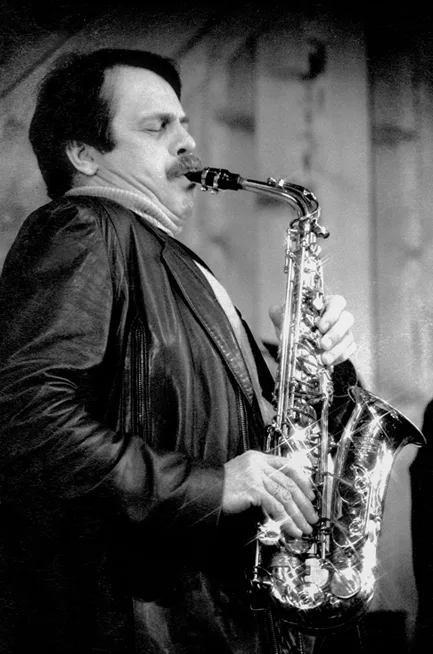
Phil Woods performing at the Bach Dancing & Dynamite Society, Half Moon Bay, California, April 17, 1983 CC BY-SA 3.0 — Wikimedia Commons — https://commons.wikimedia.org/wiki/File:Phil_Woods1983.jpg

Philip Wells Woods was born November 2, 1931, in Springfield, Massachusetts. At twelve he inherited a saxophone left behind by an uncle, and his first teacher, Harvey LaRose, pointed him toward improvisation and the records of Benny Carter and Duke Ellington. By sixteen Woods was traveling to New York to study privately with Lennie Tristano, and in 1948 he enrolled at Juilliard, majoring in clarinet while working jazz gigs at night; he briefly played in Charlie Barnet's dance band during his student years and graduated in 1952. His fast, harmonically dense alto style, indebted to Charlie Parker without copying him outright, soon earned him the nickname "the New Bird," a tag also given at various points to contemporaries Sonny Stitt and Cannonball Adderley.
Through the mid-1950s Woods worked with bandleaders George Wallington, Kenny Dorham, and Buddy Rich, and in 1956 he joined Dizzy Gillespie's big band, beginning a friendship in which Gillespie acted as mentor in both music and life for years afterward. That same year, at twenty-four, Woods took part in a State Department-sponsored tour of the Middle East and South Asia organized by Quincy Jones, and appeared on the Birdland All-Stars package tour. His recording debut as a leader, Woodlore (Prestige, 1956), paired him with bassist Teddy Kotick and drummer Nick Stabulas. The following year he co-led The Young Bloods (Prestige) with trumpeter Donald Byrd, a quintet date with pianist Al Haig, Kotick again on bass, and drummer Charlie Persip. Around this period Woods married Chan Parker, Charlie Parker's widow, and became stepfather to her daughter, singer Kim Parker; the marriage lasted seventeen years, ending in divorce in 1973. Woods's twin-alto partnership with Gene Quill later in the 1950s, documented on a run of sextet and studio dates, helped cement his reputation as one of the most in-demand altoists in New York, and in 1958 he recorded eight tracks of Michel Legrand's Legrand Jazz (Columbia), four of them alongside Miles Davis, John Coltrane, and Bill Evans in the same personnel.
The 1960s brought Woods's fullest statement as a composer and bandleader to that point, Rights of Swing (Candid, 1961), a four-part suite for a nine-piece band including Curtis Fuller, Julius Watkins, Benny Bailey, and Sahib Shihab. Alongside his own dates, he became a fixture of Quincy Jones's touring and recording orchestra through the early 1960s and of Oliver Nelson's sessions, including More Blues and the Abstract Truth (Impulse!, 1964), and he traveled to the Soviet Union in 1962 as part of Benny Goodman's state-sponsored tour. In 1968 Woods relocated to France and, after working through a shifting cast of European musicians including pianist George Gruntz, formed the European Rhythm Machine with pianist Gordon Beck, bassist Henri Texier, and drummer Daniel Humair, a trio whose freer, more exploratory book was documented on live recordings from the Frankfurt Jazz Festival (1970, released on Embryo) and the Montreux Jazz Festival. A separate 1969 studio session, Round Trip (Verve), paired Woods with an American cast, Thad Jones, Herbie Hancock, Roland Hanna, Richard Davis, and Grady Tate, apart from the touring trio.
Woods returned to the United States in 1972 and settled in the Delaware Water Gap area of Monroe County, Pennsylvania, where he lived for the rest of his life. In 1973 he formed the working band that became his defining vehicle: pianist Mike Melillo, bassist Steve Gilmore, and drummer Bill Goodwin, briefly expanded with guitarist Harry Leahey. That lineup's Live From The Showboat (RCA Victor, 1977), recorded at a Silver Spring, Maryland club in November 1976, launched the group nationally and won the Grammy Award for Best Jazz Performance by a Group at the 20th Annual Grammy Awards. Gilmore and Goodwin anchored the band for more than forty years, one of the longest unbroken rhythm-section partnerships in jazz, while the piano chair passed from Melillo (1974-1981) to Hal Galper (1981-1990), Jim McNeely (1990-1995), and Bill Charlap (1996-2008), and a horn partner was added in October 1982: trumpeter Tom Harrell stayed until 1989, succeeded by trombonist Hal Crook and then, from January 1992, trumpeter Brian Lynch. The quartet's 'More' Live (Adelphi, 1981) and At the Vanguard (Antilles, 1983) each won Grammy Awards for Best Instrumental Jazz Performance, Group, at the 25th and 26th Annual Grammy Awards, following an earlier win for Images (RCA Victor, 1975), arranged and conducted by Michel Legrand, at the 18th Annual Grammy Awards.
Woods's studio work crossed well outside jazz in the mid-1970s: his alto solo on Steely Dan's "Doctor Wu" (Katy Lied, 1975) and on Paul Simon's "Have a Good Time" (Still Crazy After All These Years, 1975) preceded his best-known recording to a general audience, the solo on Billy Joel's "Just the Way You Are" (The Stranger, 1977), which introduced his playing to millions of listeners who had never heard a jazz record. He continued composing throughout his life, more than 200 pieces in all, and in 1978 co-founded the Celebration of the Arts (COTA) festival near his Pennsylvania home. He was inducted into the American Jazz Hall of Fame in 1994 and named a National Endowment for the Arts Jazz Master in 2007, alongside Toshiko Akiyoshi, Curtis Fuller, Ramsey Lewis, Jimmy Scott, and Frank Wess, and received the Kennedy Center's Living Jazz Legend award the same year. He kept recording into his eighties, including The Gershwin Affair (Philology, 2006) with pianist Franco D'Andrea, American Songbook (Kind of Blue, 2006) with Brian Lynch and Bill Charlap, and Man With the Hat (Pazz Productions, 2011), a collaboration with the younger alto saxophonist Grace Kelly.
Woods lived with worsening emphysema through his final years, performing much of his last decade on supplemental oxygen. He gave what is generally cited as his last public performance on September 4, 2015, a tribute to Charlie Parker with strings at the Manchester Craftsmen's Guild in Pittsburgh, announcing his retirement from the stage at its close. He passed away twenty-five days later, on September 29, 2015, in East Stroudsburg, Pennsylvania, at eighty-three.
Woods built his style on Charlie Parker's vocabulary filtered through the harder tone and greater harmonic reach he absorbed from Benny Carter and Johnny Hodges, arriving at a sound fast, precise, and unmistakably his own rather than a copy of Bird's; critics and fellow players nonetheless reached for "the New Bird" for decades. He was equally serious as a writer, from the four-movement suite of Rights of Swing through the freer, more open-ended music of the European Rhythm Machine, and as a bandleader he built, in the quartet and quintet he ran from 1973 until his death, one of the most stable working units in jazz history, with bassist Steve Gilmore and drummer Bill Goodwin at his side for over forty years. His alto solos on Billy Joel's "Just the Way You Are," Steely Dan's "Doctor Wu," and Paul Simon's "Have a Good Time" carried his phrasing to a mainstream pop audience far larger than jazz reaches on its own. He won nearly thirty Down Beat magazine reader and critics' poll awards on alto saxophone across his career.
- Woodlore (1956, Prestige) - Woods's debut as a leader, a quartet date with Teddy Kotick and Nick Stabulas.
- Rights of Swing (1961, Candid) - A four-part suite for nine pieces, his most ambitious early statement as a composer-arranger.
- Round Trip (1969, Verve) - A studio session apart from his touring European Rhythm Machine, with Thad Jones, Herbie Hancock, and Roland Hanna.
- Images (1975, RCA Victor) - Arranged and conducted by Michel Legrand; won the Grammy for Best Jazz Performance by a Big Band.
- Live From The Showboat (1977, RCA Victor) - The album that launched his long-running working group nationally and won a Grammy for Best Jazz Performance by a Group. Spotify - Live From The Showboat Listen
- At the Vanguard (1983, Antilles) - A Grammy-winning quartet date with Hal Galper, Steve Gilmore, and Bill Goodwin.
- Legrand Jazz (1958, Columbia) - As a sideman: Michel Legrand's all-star session, with Woods sharing four of his eight tracks with Miles Davis, John Coltrane, and Bill Evans.
- The Stranger (1977, Columbia) - As a sideman: Billy Joel's album carrying Woods's alto solo on "Just the Way You Are," the recording that introduced his playing to a mass pop audience.
Phil Woods: Full Discography
Identity confirmed via the live Discogs API: artist ID 253777 ("Phil Woods," realname Philip Wells Woods, born 2 November 1931 in Springfield, Massachusetts, died 29 September 2015 in Stroudsburg, Pennsylvania, matching Wikipedia). Discogs' artist-releases listing for Woods runs to 1,516 entries across 1,516 distinct release and master records, with roughly 200 tagged as a "Main" (leader or co-leader) credit once reissues and duplicate master/release pairs are set aside, plus over a thousand sideman "Appearance" and track-level credits spanning 1954 to 2023. No single-artist page attempts to itemize a catalog this size. The table below curates his essential leader and co-leader catalog, centered on the long-running Phil Woods Quintet/Quartet, followed by a representative set of his most historically significant sideman and studio dates; it is not exhaustive.
As Leader / Co-Leader
| Album Title | Recording Date(s) | Release Date | Label | Catalog Number | Format(s) | Personnel | Role | Reissue History | Spotify | Buy | Notes |
|---|---|---|---|---|---|---|---|---|---|---|---|
| Woodlore | Not specified in Discogs data | 1956 | Prestige | PRLP 7018 | Vinyl, LP, Album | Phil Woods (alto sax), John Williams (piano), Teddy Kotick (bass), Nick Stabulas (drums) | Leader | Widely reissued on CD and LP over the decades | — | — | Woods's recorded debut as a leader; often dated to 1954-55 sessions in secondary sources, though the Discogs release record lists 1956 |
| The Young Bloods | Not specified in Discogs data | 1957 | Prestige | LP 7080 | Vinyl, LP, Album | Phil Woods (alto sax), Donald Byrd (trumpet), Al Haig (piano), Teddy Kotick (bass), Charlie Persip (drums) | Co-leader (with Donald Byrd) | Reissued on CD | — | — | |
| Rights of Swing | Recorded 1960 | 1961 | Candid | CJS 9016 | Vinyl, LP, Album, Stereo | Phil Woods (alto sax), Sahib Shihab (baritone sax), Julius Watkins (French horn), Curtis Fuller & Willie Dennis (trombone), Benny Bailey (trumpet), Tommy Flanagan (piano), Buddy Catlett (bass), Mickey Roker / Osie Johnson (drums) | Leader | Reissued on CD | — | — | A four-part suite for a nine-piece band, Woods's most ambitious early work as a composer-arranger |
| Round Trip | Recorded July 9-10, 1969 | 1969 | Verve Records | V6-8791 | Vinyl, LP, Album, Stereo | Phil Woods (alto sax), Thad Jones (trumpet, flugelhorn), Herbie Hancock & Roland Hanna (piano), Richard Davis (bass), Grady Tate (drums), producer Johnny Pate | Leader | None found | — | — | A studio session with an American cast, distinct from the touring European Rhythm Machine trio active the same year |
| Phil Woods and his European Rhythm Machine at the Frankfurt Jazz Festival | Recorded live March 21, 1970, Deutsches Jazzfestival, Frankfurt | 1971 | Embryo Records | SE 4695 | Vinyl, LP | Phil Woods (alto sax), Gordon Beck (piano), Henri Texier (bass), Daniel Humair (drums) | Leader (European Rhythm Machine) | Reissued on CD | — | — | Documents the freer, more open-ended book of Woods's working European trio; nominated for two Grammys |
| Musique du Bois | Recorded January 14, 1974, New York | 1974 | Muse Records | MR 5037 | Vinyl, LP, Album, Stereo | Phil Woods (alto sax), Jaki Byard (piano), Richard Davis (bass), Alan Dawson (drums) | Leader | Reissued on CD | — | — | A quartet session cut soon after Woods's return from Europe |
| Images | Recorded February 1975 | 1975 | RCA Victor | BGL1-1027 | Vinyl, LP | Phil Woods (alto sax), Michel Legrand (arranger, conductor, piano), Kenny Clarke (drums), Ron Mathewson (bass), orchestra | Leader | Reissued on CD | — | — | Won the Grammy for Best Jazz Performance by a Big Band, 18th Annual Grammy Awards (1976 ceremony) |
| Song For Sisyphus | Not specified in Discogs data | 1978 | Gryphon | G-782 | Vinyl, LP, Album, Gatefold | Phil Woods (alto/soprano sax), Mike Melillo (piano), Harry Leahey (guitar), Steve Gilmore (bass), Bill Goodwin (drums) | Leader (Phil Woods Quintet) | None found | — | — | Grammy-nominated, Best Jazz Instrumental Album |
| Live From The Showboat | Recorded live November 1976, Showboat Lounge, Silver Spring, Maryland | 1977 | RCA Victor | BGL2-2202 | Vinyl, 2xLP, Album | Phil Woods (alto/soprano sax), Mike Melillo (piano), Harry Leahey (guitar), Steve Gilmore (bass), Bill Goodwin (drums), Alyrio Lima (percussion) | Leader (Phil Woods Six) | Reissued on CD | — | — | Won the Grammy for Best Jazz Performance by a Group, 20th Annual Grammy Awards (1978 ceremony); named one of Time magazine's ten best records of 1977 |
| Three For All | Recorded 1981 | 1981 | Enja Records | 3081 | Vinyl, LP, Album, Stereo | Phil Woods (clarinet, alto sax), Tommy Flanagan (piano), Red Mitchell (bass) | Co-leader (trio) | None found | — | — | A rare trio format for Woods, without drums |
| 'More' Live | Recorded 1981 | 1981 | Adelphi Records | AD 5010 | Vinyl, LP, Album, Stereo | Phil Woods (alto sax), Mike Melillo (piano), Steve Gilmore (bass), Bill Goodwin (drums) | Leader (Phil Woods Quartet) | None found | — | — | Won the Grammy for Best Instrumental Jazz Performance, Group, 25th Annual Grammy Awards (1983 ceremony) |
| At the Vanguard | Recorded live 1982, Village Vanguard, New York | 1983 | Antilles | AN 1013 | Vinyl, LP, Album | Phil Woods (alto sax, clarinet), Hal Galper (piano), Steve Gilmore (bass), Bill Goodwin (drums) | Leader (Phil Woods Quartet) | Reissued on CD | — | — | Won the Grammy for Best Instrumental Jazz Performance, Group, 26th Annual Grammy Awards (1984 ceremony) |
| Dizzy Gillespie Meets Phil Woods Quintet | Not specified in Discogs data | 1987 | Timeless | SJP 250 | Vinyl, LP | Dizzy Gillespie (trumpet), Phil Woods (alto sax), Tom Harrell (trumpet, flugelhorn), Hal Galper (piano), Steve Gilmore (bass), Bill Goodwin (drums) | Co-leader (with Dizzy Gillespie) | None found | — | — | A studio reunion between Woods and his former mentor and bandleader |
| Bouquet | Not specified in Discogs data | 1989 | Concord Jazz | CCD-4377 | CD, Album | Phil Woods (alto sax, clarinet), Tom Harrell (trumpet, flugelhorn), Hal Galper (piano), Steve Gilmore (bass), Bill Goodwin (drums) | Leader (Phil Woods Quintet) | None found | — | — | |
| Full House | Not specified in Discogs data | 1992 | Milestone | MCD-9196-2 | CD, Album | Phil Woods (alto sax, clarinet), Hal Crook (trombone), Jim McNeely (piano), Steve Gilmore (bass), Bill Goodwin (drums) | Leader (Phil Woods Quintet) | None found | — | — | |
| The Gershwin Affair | Not specified in Discogs data | 2006 | Philology | Not specified in Discogs data | CD, Album | Phil Woods (alto sax), Franco D'Andrea (piano) | Co-leader (with Franco D'Andrea) | None found | — | — | Catalog number not confirmed against Discogs; billing and personnel confirmed via Wikipedia's Phil Woods discography |
| American Songbook | Not specified in Discogs data | 2006 | Kind Of Blue Records | KOB 10005 | CD, Album | Phil Woods (alto sax, clarinet), Brian Lynch (trumpet), Bill Charlap (piano), Steve Gilmore (bass), Bill Goodwin (drums, arranger) | Leader (Phil Woods Quintet) | None found | — | — | |
| Man With The Hat | Not specified in Discogs data | 2011 | Pazz Productions | 18-11 | CD, Album | Phil Woods and Grace Kelly (alto sax); full personnel not detailed in the Discogs release record | Co-leader (with Grace Kelly) | None found | — | — | A generational pairing of Woods with the younger alto saxophonist Grace Kelly |
| New Celebration | Not specified in Discogs data | 2013 | Chiaroscuro Records | CR(D) 401 | CD, Album | Phil Woods (alto sax, arranger, conductor), Nelson Hill, Matt Vashlishan & Jay Rattman (saxophones, woodwinds), Jim Buckley (baritone sax, bass clarinet), Skip Wilkins (piano), Evan Gregor (bass), Tom Whaley (drums), Spencer Reed (guitar) | Leader (little big band) | None found | — | — | An expanded "little big band" project beyond Woods's core working quartet |
| Songs One | Not specified in Discogs data | 2015 | Philology | W 471.2 | CD, Album | Phil Woods (alto sax), Vic Juris (electric guitar) | Co-leader (with Vic Juris) | None found | — | — | Woods's final release, issued the year of his death |
As Sideman (selected major credits)
| Year | Project (Leader) | Title | Label | Catalog | Role | Notes |
|---|---|---|---|---|---|---|
| 1956 | Dizzy Gillespie | World Statesman | Norgran (MG N-1084) | Alto Saxophone | Recorded soon after Woods joined Gillespie's big band | |
| 1958 | Michel Legrand | Legrand Jazz | Columbia (CS 8079) | Alto Saxophone (8 of 8 tracks) | Woods shares four tracks (A1, A6, B1, B3) with Miles Davis, John Coltrane, and Bill Evans in the same personnel | |
| 1962 | Quincy Jones And His Orchestra | The Quintessence | Impulse! (A-11) | Saxophone | ||
| 1965 | Oliver Nelson | More Blues and the Abstract Truth | Impulse! (A-75) | Alto Saxophone | ||
| 1975 | Steely Dan | Katy Lied | ABC Records (ABCD-846) | Alto Saxophone (track A5) | Woods's solo on "Doctor Wu" | |
| 1975 | Paul Simon | Still Crazy After All These Years | Columbia (PC 33540) | Saxophone, solo (track B3) | Woods's solo on "Have a Good Time" | |
| 1977 | Billy Joel | The Stranger | Columbia (JC 34987) | Alto Saxophone (track A3) | Woods's solo on "Just the Way You Are," his best-known recording to a mainstream pop audience |
Woods's Discogs sideman log runs to well over a thousand further "Appearance" and track-level credits from 1954 through the 2000s, including additional work with Quincy Jones's orchestra across the late 1950s and 1960s, Benny Goodman's 1962 Soviet Union tour, Clark Terry, Buddy Rich, Thelonious Monk, and Herbie Mann, among many others; not itemized exhaustively here.
- Steve Gilmore and Bill Goodwin - bassist and drummer of Woods's working band from its 1973 founding until his death in 2015, one of jazz's longest-standing unbroken rhythm sections.
- Mike Melillo, Hal Galper, Jim McNeely, and Bill Charlap - the successive pianists of the Phil Woods Quintet/Quartet, 1974 through 2008.
- Tom Harrell and Brian Lynch - successive trumpet partners in the working band, 1982-1989 and from 1992 onward respectively, bracketing a period with trombonist Hal Crook.
- Dizzy Gillespie - mentor from 1956 onward; the two reunited on record on Dizzy Gillespie Meets Phil Woods Quintet (Timeless, 1987).
- Michel Legrand - arranger and conductor of the Grammy-winning Images (1975) and a recurring studio collaborator from Legrand Jazz (1958) onward.
- Franco D'Andrea - Italian pianist and co-leader of The Gershwin Affair (Philology, 2006).
- Wikipedia: Phil Woods
- Wikipedia: Round Trip (Phil Woods album)
- Wikipedia: Phil Woods and his European Rhythm Machine at the Frankfurt Jazz Festival
- Wikipedia: 18th Annual Grammy Awards
- Wikipedia: 20th Annual Grammy Awards
- Wikipedia: 25th Annual Grammy Awards
- Wikipedia: 26th Annual Grammy Awards
- Discogs: Phil Woods (artist 253777)
- National Endowment for the Arts: Phil Woods, NEA Jazz Master 2007
- All About Jazz: Phil Woods
- Official Phil Woods website: Biography