 JAZZPROFILES lives in the music 1,765 Jazz Artists fully Profiled!
Naosuke Miyamoto
Last updated October 21, 2026
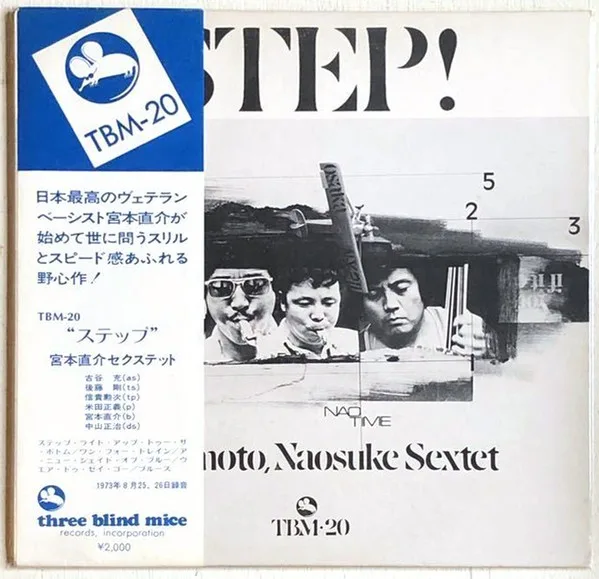
Front cover of *Step!* by the Naosuke Miyamoto Sextet (Three Blind Mice, TBM-20, 1973), shown with its original Japanese obi strip. Standard copyright, all rights reserved, held by Three Blind Mice. This is not a Creative Commons or public-domain image; it is an album cover shown as an honestly disclosed editorial identification image. — Cover Art Archive, front image 29425228929 of MusicBrainz release 7d3364e4-69b0-4053-bcbd-d06053ccd675 (https://coverartarchive.org/release/7d3364e4-69b0-4053-bcbd-d06053ccd675), 1200 px derivative as served by the archive.
Naosuke Miyamoto (宮本直介) is a double bassist from the Kansai region of western Japan. He was born in 1936 in Hyogo Prefecture, and a 2018 profile on Jazz Town Kobe places his birth in Nishinomiya. Discogs gives the date as November 13; the year and prefecture are also in Wikidata and in a 2016 festival biography. He studied commerce at Kwansei Gakuin University, in Nishinomiya, and graduated in 1961. The university years are where the written record starts: Nishinomiya's city page says he was already known as the number one young bassist while still a student.
That reputation took him to Tokyo. George Kawaguchi, whom the city page describes as sitting at the summit of Japanese jazz at the time, picked him for his Big Four Plus One. The 2016 festival biography dates the call to 1960, while the city page places it after his 1961 graduation, so the exact year is not settled. The city page says he stayed about three years in Tokyo. The festival biography lists the musicians he played with there as Sadao Watanabe, Akira Miyazawa, Masayuki Takayanagi and Masahiko Satoh. Jazz Town Kobe adds that he went home to Kansai for family business and kept playing there.
Back in the Kansai area he built a second career as a teacher and organiser alongside the playing. In 1965 he won the grand prize at the first Yamaha Light Music Contest, and the prize was a trip around the world. In 1966 he became an instructor at the Yamaha music schools in Shinsaibashi (Osaka) and Motomachi (Kobe) and opened what the city page calls Kansai's first jazz classes. The festival biography says that on the Japan tours of Wayne Shorter, Cedar Walton, Curtis Fuller and Freddie Hubbard he sat in on sessions with them, and that the bassists who shaped him most are Reggie Workman and Ron Carter, with whom he has stayed friends.
His first record as a leader came in 1973. Step! was recorded on August 25 and 26 at Aoi Studio and issued as Three Blind Mice TBM-20 under the name Naosuke Miyamoto Sextet. The front line was Kunji Shigi on trumpet and flugelhorn, Takashi Furuya on alto saxophone and Takeshi Goto on tenor and soprano saxophones, with Masayoshi Yoneda on piano and Shoji Nakayama on drums. Takeshi Fujii produced. Two of the five pieces are by the tenor saxophonist Harold Land ("Step Right Up to the Bottom" and "A New Shade of Blue"), "One For Trane" is Goto's, "Where Do They Go?" is Yoneda's and the closing "Blues" is Miyamoto's. The obi strip on the original LP calls him Japan's top veteran bassist and the record an ambitious work full of thrill and speed. It has been reissued many times: on CD in 2001, as a hybrid SACD in 2006, as a Blu-spec CD in 2013, on vinyl by the French label Le Très Jazz Club in 2019 (the label's seventh release and, by its own account, the album's first reissue of that kind), on CD in 2020, and in June 2025 as an LP and a hybrid SACD in Sony's Three Blind Mice premium reissue series.
A year later he was back at Aoi Studio for Three Blind Mice as a sideman. George Otsuka's New George Otsuka Trio recorded You Are My Sunshine at Aoi Studio, Tokyo, on October 31, 1974, with Hideo Ichikawa on piano and Miyamoto on bass.
Two private-press LPs followed in 1981 on the Bonny Panera label, both recorded live at the Bonny Panera jazz club. The first, catalogued BPL-101, carries no title and credits Miyamoto, the pianist Yoku Tamura (田村翼) and the drummer Mike Reznikoff; it was recorded on October 8 and 17 and released without a sleeve. The second, Poisonous Apple (BPL-102), was recorded on December 28 by the Naosuke Miyamoto Trio with Sadayasu Fujii on piano and Rikiya Higashihara on drums. It opens with the 13-minute title piece, co-written by Miyamoto and Shinpei Nakayama, and also includes his "Crowdy Street".
In 1988 he took a trio to New York. City Breeze, released by Break Time (Crown) as the Naosuke Miyamoto Trio, was recorded and mixed at A&R Studios with Lewis Nash on drums and Shingo Take on piano, and Discogs also credits vocals to Vanessa Rebin (German Wikipedia gives the name as Vanessa Rubin). The LP, BRP-1007, has seven tracks; the CD, BRJ-4069, issued on November 21, 1988, adds an eighth, "East of the Sun". Jim Anderson recorded and mixed it. The same A&R Studios, with Nash on drums and Anderson engineering, hosted the session for Nash's own Rhythm Is My Business on October 5, 1989, a record Discogs credits to Miyamoto as co-producer with Nash. It was issued on Evidence in 1993, and the festival biography says he produced Nash's first album in 1993. The same biography credits him with realising the Japanese franchise of the Blue Note club in 1989, and Jazz Town Kobe says he helped bring Blue Note to Osaka and arranged Dizzy Gillespie's Japan concerts. Those are statements in the biographies cited here; the arrangements themselves are not documented in the sources consulted.
Since 2004 he has been general producer of Nishinomiya Jazz 3 Days, a three-day spring festival of Kansai musicians whose third day, "Young at Heart", is devoted to young players. From 1999, for four years, he coached junior high school big bands in Nishinomiya on a Kansai TV programme with Sadao Watanabe, and from 2004 to 2009 he judged the Music Contest Koshien. He helped found the Kansai Jazz Association with fellow musicians (the city page dates this to 1999) and has been its vice-president since 2000; the pianist Zenshow Otsuka has been the association's president since 2003. In 2014 he received the Nishinomiya Citizens' Culture Award.
In 2008 he joined two older Kansai players in a new group. On September 18 of that year the Golden Senior Trio was formed, with the vibraphonist Naoteru Nabeshima (鍋島直昶), the pianist Zenshow Otsuka (大塚善章) and Miyamoto on bass: a drumless trio of long-serving Kansai players. They made their first recording in 2011 and in 2014 released Jubilee Cookin', a CD and DVD marking Otsuka's 60th anniversary as a pianist; Discogs notes that the three men's ages added up to 245 at the time of recording. In July 2015 Guinness World Records certified the group as the oldest band in any genre. Nabeshima was 89, Otsuka 81 and Miyamoto 78, and their average age was 83 years and 19 days on July 5, 2015. The previous holder, the Peace Old Jazz Band of China, had averaged 76 in 2007. The record requires at least one album on sale and more than 20 concerts of 45 minutes or longer in the previous five years. On September 22, 2016 they gave their first Tokyo concert as a trio, at the Sound Live Tokyo festival. They disbanded after a final concert at Elcelahn Hall in Osaka on October 27, 2019, with the three men aged 93, 85 and 82. Nabeshima passed away on January 6, 2021, at 94.
Miyamoto kept working with his own groups. The jazz database Jazz Shiryokan lists his club dates from September 2018 to July 2022: a quartet led under his own name, a trio billed with the singer Hiromi Toda, a long run of monthly dates with the vocalist Lorna Cifra and the pianist Toshio Takahashi (高橋俊男), evenings with the trumpeter Mirai Hirose (広瀬未来), a "Bass on Top" series at the club JAZZ ON TOP between 2019 and 2021, and several dates with Zenshow Otsuka at COMTE ROSE. The most recent dated appearance on record is a concert planned for January 13, 2025: the 22nd Kwansei Gakuin alumni jazz concert, held in memory of the Hanshin-Awaji earthquake, where he was scheduled to play with the KG All Stars. The 2016 festival biography also names two further recordings, Gotta Get Ready (Vols. 1 and 2, 2000) and Hip Bop Plays Love Standards (2005); neither appears in Discogs or the other catalogues checked, so no label, catalogue number or personnel can be given for them.
Step! is the clearest picture of his playing as a leader. Le Très Jazz Club describes it as a modal jazz LP with a spiritual-jazz high point in "One For Trane", while the notes on the 2025 Sony reissue call it a straight-ahead album by Kansai-based players; two of its five pieces are Harold Land compositions. Discogs files his 1981 trio records under Post Bop and Modal and City Breeze (1988) under Contemporary Jazz and Bop. He also wrote: "Blues" on Step!, and "Crowdy Street" and the title piece (with Shinpei Nakayama) on Poisonous Apple. The festival biography names Reggie Workman and Ron Carter as his main influences among bassists. The Golden Senior Trio had no drummer, a format that the same program says requires tight control among the three players.
- Step! (1973, Three Blind Mice TBM-20) - his debut as a leader, a sextet date recorded August 25 and 26, 1973 at Aoi Studio. Start with "One For Trane" and the Harold Land pieces. YouTube - Step!, full album Listen
- You Are My Sunshine (1974, Three Blind Mice TBM-35, The New George Otsuka Trio) - the piano trio session with George Otsuka and Hideo Ichikawa, recorded October 31, 1974. YouTube - You Are My Sunshine, full album Listen
- Poisonous Apple (1981, Bonny Panera BPL-102) - the live trio record from a club date, with Sadayasu Fujii and Rikiya Higashihara. YouTube - Poisonous Apple Listen
- City Breeze (1988, Break Time BRP-1007) - the New York trio date with Lewis Nash and Shingo Take. Discogs - City Breeze
- Jubilee Cookin' (2014, GST HJ-1005 CD and HJV-1001 DVD, Golden Senior Trio) - the trio's documented album with Zenshow Otsuka and Naoteru Nabeshima. Discogs - Jubilee Cookin'
Naosuke Miyamoto (宮本直介) - Full Discography
Japanese double bassist, bandleader and producer from the Kansai region. Born 1936 in Hyogo Prefecture (Discogs gives November 13). Discogs artist 3187515.
Name variations on record: N. Miyamoto, 宮本直介.
Group affiliations: Naosuke Miyamoto Sextet (Discogs 2580209), Naosuke Miyamoto Trio (Discogs 5100468), The New George Otsuka Trio (Discogs 3261502), Golden Senior Trio (Discogs 18054222).
Discogs lists eight releases under the personal name, so the discography below is short. Every row was read from its Discogs release record (credits, catalogue number, recording notes); where no streaming copy could be found the Listen cell says "not found".
Leader
| Album | Year | Label | Personnel | Notes | Listen | Buy |
|---|---|---|---|---|---|---|
| Step! (as Naosuke Miyamoto Sextet; sleeve title Miyamoto, Naosuke Sextet) | 1973 | Three Blind Mice, TBM-20 | Naosuke Miyamoto (bass), Kunji Shigi (trumpet, flugelhorn), Takashi Furuya (alto saxophone), Takeshi Goto (soprano and tenor saxophones), Masayoshi Yoneda (piano), Shoji Nakayama (drums) | Recorded at Aoi Studio on August 25 and 26, 1973. Five tracks: "Step Right Up to the Bottom" (11:37, Harold Land), "One For Trane" (12:21, Takeshi Goto), "A New Shade of Blue" (7:29, Harold Land), "Where Do They Go?" (5:57, Masayoshi Yoneda), "Blues" (10:29, Naosuke Miyamoto). Produced by Takeshi Fujii, mixed by Yoshihiko Kannari, cover by Tsutomu Nishizawa. The Japanese obi calls it Miyamoto's first work put before the public. Discogs master 795723; see the editions table below. | Full album on YouTube | Amazon |
| Poisonous Apple (as Naosuke Miyamoto Trio) | 1981 | Bonny Panera, BPL-102 | Naosuke Miyamoto (bass), Sadayasu Fujii (piano), Rikiya Higashihara (drums) | Private press, recorded live at the Bonny Panera jazz club on December 28, 1981. Five tracks: "Poisonous Apple" (13:10, Miyamoto and Shinpei Nakayama), "In a Sentimental Mood" (9:46, Duke Ellington), "Southern Cross" (9:39, Sadayasu Fujii), "Crowdy Street" (8:58, Miyamoto), "Matrix" (9:39, Chick Corea). Produced and mixed by Tadaaki Okumura. Discogs styles: Post Bop, Modal. | On YouTube | Amazon |
| City Breeze (as Naosuke Miyamoto Trio) | 1988 | Break Time, BRP-1007 (LP); BRJ-4069 (CD, released November 21, 1988) | Naosuke Miyamoto (bass), Lewis Nash (drums), Shingo Take (piano), Vanessa Rebin (vocals, as credited on Discogs) | Recorded and mixed at A&R Studios, New York, by Jim Anderson. Takeshi Goto is credited as director, Seijiro Osafune and Toshitaka Kurosu as co-producers, Tsuneyoshi Kasetani with art direction and design. The LP has seven tracks: "The Day It Rained", "Mr. B.T.", "Del Sasser", "You Got to My Head", "Poinciana", "Scrambling Around Chambers", "City Breeze". The CD adds "East of the Sun" as track 4. Discogs master 1350716; styles Contemporary Jazz, Bop. | not found | Amazon |
Editions of Step!
| Year | Label and catalogue | Format | Notes |
|---|---|---|---|
| 1973 | Three Blind Mice, TBM-20 | LP | Original Japanese issue with obi |
| 2001 | Three Blind Mice, TBM-CD-1820 | CD | Limited edition; digital mastering done October 11, 2001 by Tohru Kotetsu |
| 2006 | Three Blind Mice, MHCP 10028 | Hybrid SACD | Released November 22, 2006; DSD mastering from the original analogue master tapes; mini-LP style jacket |
| 2013 | Think! Records, THCD-252 (CS Record DQCP-5236) | Blu-spec CD | Released November 6, 2013; liner notes by Teruo Isono |
| 2019 | Le Très Jazz Club, LTJC 007 | LP | Released July 26, 2019 in Europe; the label's seventh release |
| 2020 | Craftman Records, CMRS-0092 (CS Record DQCP-5335) | CD | Released October 21, 2020; Disk Union listing; liner notes by Teruo Isono |
| 2025 | Three Blind Mice / Sony Music Labels, MHJL 420 | 180 g LP | Released June 25, 2025; first release of the second series of the "Three Blind Mice premium reissue collection"; remastered and cut at Warner Music Mastering |
| 2025 | Three Blind Mice / Sony Music Labels, MHCL 10182 | Hybrid SACD | Released June 25, 2025; remastered |
Co-Leader
| Album | Year | Label | Co-billed with | Personnel | Notes | Listen | Buy |
|---|---|---|---|---|---|---|---|
| Untitled (credited to Naosuke Miyamoto, Yoku Tamura and Mike Reznikoff; 宮本直介, 田村翼, マイク・レズニコフ) | 1981 | Bonny Panera, BPL-101 | Yoku Tamura, Mike Reznikoff | Naosuke Miyamoto (bass), Yoku Tamura (piano), Mike Reznikoff (drums) | Private press, released without a sleeve. Recorded live at the Bonny Panera jazz club on October 8 (side B track 2) and October 17, 1981. Five tracks: "Onow The Time" (as printed), "Willow Weep for Me", "Alone Together", "St. Thomas", "Kareha" (Autumn Leaves, printed in Japanese). Discogs carries separate accompanist credits on the closing track for Bob Bowman (bass), Mark Pulice (drums) and Marshall Otwell (piano). Discogs styles: Post Bop, Modal. | not found | Amazon |
| Jubilee Cookin' (as Golden Senior Trio) | 2014 | GST, HJ-1005 (CD) and HJV-1001 (DVD-Video) | Zenshow Otsuka, Naoteru Nabeshima | Naoteru Nabeshima (vibraphone), Zenshow Otsuka (piano), Naosuke Miyamoto (bass) | Marks the 60th anniversary of Otsuka as a pianist. Discogs notes the three members' ages added up to 245 at the time of recording (Nabeshima 88, Otsuka 80, Miyamoto 77). CD, ten tracks: "Gerry's Blues", "Jubilation", "The Man I Love", "Love Is a Many Splendored Thing", "Alone Together - Will Be Together Again", "Love Letter", "In a Mellow Tone", "My One and Only Love", "Visitation", "Come Dance with Me". DVD: "Come Dance with Me" (studio), "Red Roses for a Blue Lady", "Pathetique" and "Stardust" (live). | not found | Amazon |
Guest, sideman and compilation appearances
Chronological. These are the guest and production credits under Miyamoto's own Discogs entry, plus a compilation appearance credited through the Sextet entry.
| Year | Release | Actual leader | Label | Notes | Listen | Buy |
|---|---|---|---|---|---|---|
| 1974 | You Are My Sunshine | The New George Otsuka Trio | Three Blind Mice, TBM-35 | Naosuke Miyamoto (bass), George Ohtsuka (drums), Hideo Ichikawa (piano). Recorded October 31, 1974 at Aoi Studio, Tokyo. Four tracks: "You Are My Sunshine" (9:32), "Willow Weep for Me" (7:41), "Over the Rainbow" (8:33), "Hot Cha" (9:00). Produced by Takeshi Fujii, art direction by Ben Nishizawa. Reissued as The Trio (TBM-2535, 1978), as a TBM Super-Cut Analogue Disk (1996) and on CD (TBM-CD-1835, 2001). Discogs master 548819. | Full album on YouTube | Amazon |
| 1993 | Rhythm Is My Business | Lewis Nash | Evidence, ECD 22041-2 | Miyamoto is credited as producer, with Lewis Nash. Recorded October 5, 1989 at A&R Studios, New York, with Mulgrew Miller (piano), Steve Nelson (vibraphone), Peter Washington (bass) and Ron Carter (piccolo bass on track 6). Engineered by Jim Anderson. Discogs lists Nippon Crown as the licensor of the Evidence CD. | not found | Amazon |
| 2005 | Shibuya Jazz Classics - Nobukazu Takemura Collection - Three Blind Mice Issue | Various (compiled by Nobukazu Takemura) | Solid Records, CDSOL-1110/1 | Two CDs, released September 10, 2005. Disc 1, track 1 is "One For Trane" (12:26) by the Sextet, with the Step! personnel. | not found | Amazon |
| 2023 | Rebirth of "TBM" (The Japanese Deep Jazz) | Various (compiled by Tatsuo Sunaga) | Three Blind Mice, MHCL-3042~3 | Two CDs, released November 8, 2023. Disc 2, track 4 is "A New Shade of Blue" (7:29) by the Naosuke Miyamoto Sextet. Discogs notes the 2LP edition (MHJL-290/1), released at the same time, has different contents. | Album on YouTube | Amazon |
Recordings named in a biography but not catalogued
The 2016 Sound Live Tokyo festival biography lists Gotta Get Ready (Vols. 1 and 2, 2000) and Hip Bop Plays Love Standards (2005) among his recordings. Neither title appears under his name in Discogs, and no label, catalogue number or personnel could be found for either, so they are not tabulated above.
Sources
- Discogs: Naosuke Miyamoto, artist 3187515
- Discogs: Step!, Three Blind Mice TBM-20, 1973
- Discogs: Step! master 795723
- Discogs: Poisonous Apple, Bonny Panera BPL-102
- Discogs: City Breeze, Break Time BRP-1007
- Discogs: City Breeze, CD, Break Time BRJ-4069
- Discogs: Untitled, Bonny Panera BPL-101
- Discogs: Jubilee Cookin', GST HJ-1005
- Discogs: You Are My Sunshine, Three Blind Mice TBM-35
- Discogs: Lewis Nash, Rhythm Is My Business
- Discogs: Shibuya Jazz Classics, Solid Records CDSOL-1110/1
- Discogs: Rebirth of "TBM", Three Blind Mice MHCL-3042~3
- Le Très Jazz Club: Step! LTJC 007, track composer credits (via Forced Exposure)
- Sound Live Tokyo 2016: Golden Senior Trio program biography
- George Otsuka - drummer and leader of The New George Otsuka Trio, whose You Are My Sunshine (Three Blind Mice TBM-35, recorded October 31, 1974) has Miyamoto on bass and Hideo Ichikawa on piano.
- Lewis Nash - drummer on Miyamoto's City Breeze (Break Time, 1988), recorded at A&R Studios in New York; Discogs also credits Miyamoto as producer, with Nash, of Nash's Rhythm Is My Business (Evidence, 1993, recorded October 5, 1989 at A&R Studios).
- George Kawaguchi - the drummer who picked him for the Big Four Plus One, according to the city page and the festival biography.
- Sadao Watanabe - named among his Tokyo-era colleagues in the festival biography, and the musician beside whom Miyamoto coached junior high school big bands on a Kansai TV programme from 1999, according to the city page.
- Akira Miyazawa, Masayuki Takayanagi and Masahiko Satoh - players he worked with in Tokyo in the early 1960s, according to the festival biography.
- Wayne Shorter, Cedar Walton, Curtis Fuller and Freddie Hubbard - visiting American musicians with whom he took part in sessions on their Japan tours, according to the festival biography.
- Reggie Workman and Ron Carter - the two bassists the festival biography names as his greatest influences and long-time friends.
- Dizzy Gillespie - Jazz Town Kobe says Miyamoto arranged Gillespie's Japan concerts.
- Zenshow Otsuka and Naoteru Nabeshima - the pianist and vibraphonist of the Golden Senior Trio (2008 to 2019). Otsuka is also president of the Kansai Jazz Association, where Miyamoto is vice-president.
- The Step! sextet - Kunji Shigi (信貴勲次, trumpet, flugelhorn), Takashi Furuya (古谷充, alto saxophone), Takeshi Goto (後藤剛, tenor and soprano saxophones), Masayoshi Yoneda (米田正義, piano) and Shoji Nakayama (中山正治, drums), with Takeshi Fujii as producer.
- Hideo Ichikawa - pianist on You Are My Sunshine (1974).
- Shingo Take and Vanessa Rebin - pianist and credited vocalist on City Breeze (1988).
- Yoku Tamura, Mike Reznikoff, Sadayasu Fujii and Rikiya Higashihara - the pianists and drummers on his two 1981 Bonny Panera LPs.
- Toshio Takahashi, Lorna Cifra, Hiroshi Tanaka and Mirai Hirose - regular partners in his Kansai club dates listed between 2018 and 2022: pianist, vocalist, drummer and trumpeter respectively.

More Post-Bop Artists
See all 717 Post-Bop artists →More Japanese Jazz Artists
See all 262 Japanese artists →- Discogs: Naosuke Miyamoto
- Discogs: Naosuke Miyamoto Sextet
- Discogs: Naosuke Miyamoto Trio
- Discogs: Golden Senior Trio
- Jazz Music Archives: Naosuke Miyamoto
- Jazz Shiryokan: 宮本直介 live listings
- AllMusic: Naosuke Miyamoto
- YouTube: search for Naosuke Miyamoto
- Naosuke Miyamoto on JazzProfiles.com
- r/JapaneseJazz
- Nishinomiya City: 2014 Citizens' Culture Award, 宮本直介 (updated March 3, 2015)
- Sound Live Tokyo 2016: Golden Senior Trio program biography, September 22, 2016 (English)
- Sound Live Tokyo 2016: ゴールデン・シニア・トリオ program biography (Japanese)
- Jazz Town Kobe: 〈レジェンドの名作を楽しもう その3〉 by Ryota Kojima, June 26, 2018
- Wikipedia (German): Naosuke Miyamoto
- Wikipedia (Dutch): Naosuke Miyamoto
- Wikidata: Naosuke Miyamoto, Q37719777
- Discogs: Naosuke Miyamoto, artist 3187515
- Discogs: Step!, Three Blind Mice TBM-20, 1973
- Discogs: You Are My Sunshine, Three Blind Mice TBM-35, 1974
- Discogs: Poisonous Apple, Bonny Panera BPL-102, 1981
- Discogs: City Breeze, Break Time BRP-1007, 1988
- Discogs: Lewis Nash, Rhythm Is My Business, Evidence ECD 22041-2
- Discogs: Golden Senior Trio, Jubilee Cookin', 2014
- Guinness World Records: Golden Senior Trio, oldest band (English, July 30, 2015)
- Guinness World Records Japan: ゴールデン・シニア・トリオ (July 13, 2015)
- Maidona News: 平均年齢86歳!ギネス世界最高齢ジャズバンド、元気なうちに解散! (October 8, 2019)
- Wikipedia (Japanese): 鍋島直昶
- Wikipedia (Japanese): 大塚善章
- Kwansei Gakuin: 第22回 K.G. OB & OG JAZZ ALL DAY LONG announcement (January 13, 2025 concert)
- Le Très Jazz Club: Step! reissue listing, LTJC 007 (via Forced Exposure)
- Wikipedia: Three Blind Mice (record label)
- Cover Art Archive: Step! front cover