 JAZZPROFILES lives in the music 2,555 Jazz Artists fully Profiled!
Howard Johnson
Last updated November 9, 2026
Listen on Spotify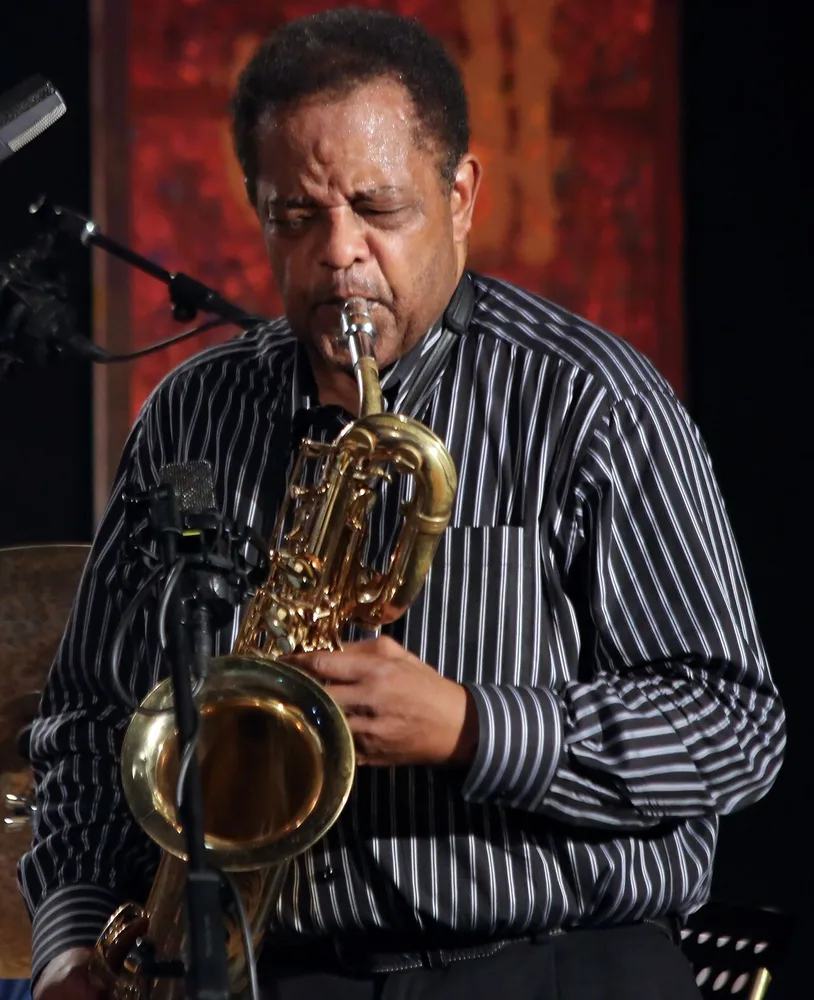
Howard Johnson playing baritone saxophone with the Mansur Scott "Harlem Quartet" at the INNtöne Jazzfestival in Diersbach, Upper Austria, May 18, 2013. Photograph by Manfred Werner (Wikimedia Commons user Tsui); cropped from a wider frame. CC BY-SA 3.0 (Creative Commons Attribution-ShareAlike 3.0) — Wikimedia Commons - https://commons.wikimedia.org/wiki/File:Mansur_Scott_Harlem_Quartet_feat_Howard_Johnson_-_INNt%C3%B6ne_Jazzfestival_2013_25_(cropped).jpg

Howard Lewis Johnson was born on August 7, 1941, in Montgomery, Alabama, and was raised from the age of two in Massillon, Ohio, where his father worked in a steel mill and his mother was a hairdresser. Neither parent played an instrument, but the household radio was always on. He was self-taught: after two lessons from a junior-high band director he took up the baritone saxophone, and in high school he learned the tuba by watching other players' fingerings during rehearsals and then working things out alone, pushing the instrument well past its customary range. After graduating in 1958 he spent three years in the Navy playing baritone saxophone in a service band. He met the drummer Tony Williams in Boston and lived for a time with the Williams family, and in Chicago he met Eric Dolphy, who urged him to move to New York. He arrived in 1963.
His first New York work was in the bands of Charles Mingus and Hank Crawford. He is credited on baritone saxophone on Crawford's Atlantic album Dig These Blues (1965) and on tuba on Mingus's Music Written for Monterey, 1965, and he went on to the orchestras and large ensembles of the avant-garde: tuba on Archie Shepp's Mama Too Tight (recorded August 19, 1966, and issued by Impulse! in 1967), tuba and baritone saxophone on Gerald Wilson's Live and Swinging (Pacific Jazz, 1967), tuba and baritone saxophone on Gary Burton's A Genuine Tong Funeral (RCA Victor, 1968), tuba on the Jazz Composer's Orchestra's double album for JCOA (1968), and tuba on Charlie Haden's Liberation Music Orchestra (recorded April 27 to 29, 1969, at Judson Hall and issued in 1970). Other sessions of those years include Andrew Hill's Passing Ships (recorded in November 1969 and not released until 2003) and, on Strata-East, Charles Tolliver's Music Inc. and Pharoah Sanders's Izipho Zam.
His longest association was with Gil Evans, which began in 1966 and ran on and off for about two decades. Evans wrote with Johnson's range in mind. The results include a tuba solo on Evans's Svengali (Atlantic, 1973), an arranging credit on the orchestra's Jimi Hendrix album (RCA Victor, 1974), There Comes a Time (RCA, 1976) and the Monday Night Orchestra's Live at Sweet Basil (released in Japan in 1985 and by Gramavision in 1986). In 1984 he was in the Gil Evans Orchestra that accompanied Jaco Pastorius at the Live Under the Sky festival in Japan. He also worked with Carla Bley: he is credited with voice on Escalator Over the Hill (JCOA, 1971) and with tuba, bass clarinet, baritone saxophone and other reeds on Tropic Appetites (WATT, 1974). Other credits include Gato Barbieri's Chapter Three: Viva Emiliano Zapata (Impulse!, 1974), Dexter Gordon's Sophisticated Giant (Columbia, 1977), George Gruntz's Concert Jazz Band on Theatre (ECM, 1984), Jack DeJohnette's Special Edition on Album Album (ECM, 1984), Hank Crawford's Night Beat (Milestone, 1989), John Scofield's Quiet (Verve, 1996), T. S. Monk's Monk on Monk (N2K, 1997), Mario Pavone's Deez to Blues (Playscape, 2006) and the Charles Tolliver Big Band's With Love (Blue Note, 2006).
A second career ran through rock and pop. In 1970 he wrote brass arrangements for Taj Mahal that put a section of low brass behind the singer, and on Mahal's live album The Real Thing (Columbia, 1971), recorded at the Fillmore East, Johnson is credited on double B-flat and F tuba, flugelhorn and baritone saxophone alongside Joe Daley, Earl McIntyre and Bob Stewart. He played on The Band's Rock of Ages (Capitol, 1972), and his obituaries credit him with leading the horn section at the group's farewell concert, filmed for The Last Waltz (1978). He is also heard on John Lennon's Walls and Bridges (Apple, 1974) and Double Fantasy (Geffen, 1980) and on The Muddy Waters Woodstock Album (Chess, 1975), and he worked with Levon Helm for decades. In 1975 he joined the house band of the new late-night program Saturday Night Live and stayed for about five years.
Johnson's own band began in the late 1960s as a tuba ensemble called Substructure, was renamed Gravity in 1972, and was revived after he left Saturday Night Live in 1980; Gravity was his best-known group. He first recorded as a leader in Hamburg, on July 4 to 9, 1994, for Arrival: A Pharoah Sanders Tribute, a Verve album credited to Howard Johnson's Nubia on which he plays baritone saxophone with a rhythm section and percussionists (issued in 1995). The Gravity albums followed on Verve: Gravity!!! (1996), recorded at Clinton Recording Studios in New York with a tuba and euphonium section of up to seven players, a piano-bass-drums rhythm section and Johnson's own arrangements, and Right Now! (recorded in December 1996 at Manhattan Center Studios and issued in 1997), with Taj Mahal as guest vocalist on three tracks. His fourth and last album as a leader, Testimony (Tuscarora, 2017), paired him with the tuba players Velvet Brown, Joe Daley, Earl McIntyre, Dave Bargeron and Bob Stewart, with Joe Exley as a guest and his daughter, the singer Nedra Johnson, singing on one track.
Howard Johnson passed away on January 11, 2021, at his home in Harlem, at the age of 79, after a long illness. His longtime partner, Nancy Olewine, announced his death. He was survived by Olewine, by his daughter Nedra Johnson, a singer and songwriter, and by two sisters, Teri Nichols and Connie Armstrong; his son, David Johnson, a musician and artist, had died earlier.
Johnson is credited with enlarging what the tuba can do in jazz: he played it as a lead voice, high and fast, rather than as a bass line or a novelty, and he wrote for groups of tubas as an ensemble in their own right. Bob Stewart says no one else could match Johnson's speed and range on the instrument, and Stewart, who sat in with Johnson's Substructure in 1967 and early 1968 before moving to New York, took the opposite route and made the tuba a rhythm-section bass. On baritone saxophone he worked as a section player and soloist for leaders as different as Charles Mingus, Hank Crawford and George Gruntz, and he doubled on bass clarinet, flugelhorn and penny whistle. His range of employers was unusually wide: the avant-garde of Archie Shepp and Pharoah Sanders, the orchestral colors of Gil Evans, the soul-jazz blues of Hank Crawford, and the roots-rock and studio world of Taj Mahal, The Band and Saturday Night Live. Reviewers praised Gravity!!! as a big step forward from his debut and noted that a band of five to seven tubas still swung and offered more variety than the instrumentation suggests; Right Now! drew comparisons to the textures of Gil Evans, and Testimony was called proof that the tuba can carry both lead and improvised lines.
- Gravity!!! (1996, Verve) - The first Gravity album on Verve, a tuba ensemble with Bob Cranshaw or Melissa Slocum on bass and Kenny Washington or Kenwood Dennard on drums, playing Don Pullen, Oliver Nelson, Wynton Kelly, Jackie McLean and Thelonious Monk. Spotify - Gravity Listen
- Right Now! (1997, Verve) - Gravity with Taj Mahal as guest vocalist, including Gil Evans's "Svengali's Summer" and Charles Tolliver's title tune. Spotify - Right Now! Listen
- Arrival: A Pharoah Sanders Tribute (1995, Verve) - His first album as a leader, recorded in Hamburg in July 1994 as Howard Johnson's Nubia, with Johnson on baritone saxophone. Spotify - Arrival Listen
- Testimony (2017, Tuscarora) - His last album as a leader, a tuba ensemble and rhythm section recorded in New York. Spotify - Testimony Listen
- The Real Thing (1971, Columbia) - Taj Mahal live at the Fillmore East, with Johnson's brass arrangements and low-brass section.
- Svengali (1973, Atlantic) - Gil Evans's orchestra, with Johnson credited as a tuba soloist on the opening track.
- Liberation Music Orchestra (1970, Impulse!) - Charlie Haden's large-band debut, recorded in April 1969, with Johnson in the tuba chair.
- Tropic Appetites (1974, WATT) - Carla Bley's album, with Johnson on tuba, bass clarinet, baritone saxophone and other reeds.
Howard Johnson: Full Discography
Discogs artist ID 290370 ("Howard Johnson (3)," real name Howard Lewis Johnson, born August 7, 1941, in Montgomery, Alabama, died January 11, 2021, in New York City) lists about 500 entries, almost all of them sideman appearances, track appearances and compilations. A different Howard Johnson, a swing alto saxophonist, is filed separately on Discogs (artist ID 1208545) and none of his credits are included here, nor are those of the soul singer and producer of the same name (artist ID 74073). His leader work is split across two group entities, Howard Johnson & Gravity (artist ID 2398285, three albums) and Howard Johnson's Nubia (artist ID 3081777, one album); both were checked and are folded into the first table. Johnson recorded on far more sessions than any list can hold, so the sideman table is a selection of 41 documented credits rather than an exhaustive list, each checked against the credit block of the individual Discogs release. Catalog numbers are those of the first or best-documented pressing.
As Leader / Co-Leader
| Album Title | Recording Date(s) | Release Date | Label | Catalog Number | Format(s) | Personnel | Role | Reissue History | Spotify | Buy | Notes |
|---|---|---|---|---|---|---|---|---|---|---|---|
| Arrival: A Pharoah Sanders Tribute | July 4-9, 1994, GaGa Studios, Hamburg; mixed at BMG Studios, New York | 1995 | Verve Records | 523 985-2 | CD, Album | Howard Johnson (baritone saxophone, voice, backing vocals), Sarah Seidel (voice, flute, alto flute, backing vocals), Johannes Bahlmann (piano), Sabine Worthmann (bass, backing vocals), Wolff Reichert (drums, wind chimes), Kojo Samuels (congas, African percussion), Dumisani Mabaso (African percussion) | Leader (billed as Howard Johnson's Nubia) | Not itemized | Spotify - Arrival | — | Brian Bacchus produced; the album is a tribute to Pharoah Sanders. |
| Gravity!!! | Recorded at Clinton Recording Studios, New York; exact dates not confirmed | 1996 | Verve Records, Motor Music | 314 531 021-2 | CD, Album | Howard Johnson (tuba, penny whistle, arranger, co-producer), Bob Stewart, Carl Kleinsteuber, Dave Bargeron, Earl McIntyre, Joe Daley, Marcus Rojas, Nedra Johnson and Tom Malone (tuba and euphonium, various tracks), Ray Chew, Paul Shaffer and James Williams (piano), Bob Cranshaw and Melissa Slocum (bass), Kenny Washington and Kenwood Dennard (drums), Georg Wadenius (guitar), Victor See Yuen (percussion) | Leader (billed Howard Johnson & Gravity) | Pressing history is on Discogs master 1113293 | Spotify - Gravity | — | Suzi Reynolds co-produced; liner notes by Nat Hentoff. Tracklist includes Don Pullen, Oliver Nelson, Wynton Kelly, Jackie McLean and Thelonious Monk tunes. |
| Right Now! | December 1996, Manhattan Center Studios, New York | 1997 | Verve Records | 314 537 801-2 | CD, Album | Howard Johnson (tuba, baritone saxophone), Bob Stewart, Carl Kleinsteuber, Dave Bargeron, Earl McIntyre and Joe Daley (tuba), Ray Chew (piano, synthesizer), James Cammack (bass), Kenwood Dennard (drums), Taj Mahal (guest vocals) | Leader (billed Howard Johnson & Gravity featuring Taj Mahal) | Pressing history is on Discogs master 275067 | Spotify - Right Now! | — | Taj Mahal sings on three tracks. |
| Testimony | Recorded at MSR Studios, New York; exact dates not confirmed | 2017 | Tuscarora Records | 17-001 | CD, Album | Howard Johnson (BB-flat and F tuba, baritone saxophone, tin whistle, arranger), Velvet Brown (F tuba, ensemble lead), Joe Daley (BB-flat tuba, producer), Bob Stewart (CC tuba), Dave Bargeron and Earl McIntyre (E-flat tuba), Joe Exley (CC tuba, guest), Carlton Holmes (piano), Melissa Slocum (bass), Buddy Williams (drums), Nedra Johnson (guest vocals), Butch Watson, CJ Wright and Mem Nahadr (guest backing vocals) | Leader (billed Howard Johnson & Gravity) | Not itemized | Spotify - Testimony | — | His last album as a leader. |
Featured-Guest Billings
Releases on which Discogs bills Johnson by name as a featured or special guest. Johnson's own instrument is given only where the release's credit block itemizes it.
| Year | Project (Billing) | Title | Label | Catalog | Role | Notes |
|---|---|---|---|---|---|---|
| 1988 | Gunther Schuller, Orange Then Blue, special guest Howard Johnson | Jumpin' in the Future | GM Recordings | GM3010D | Featured guest: tuba (A2, A4, B1), bass clarinet (A3) | LP. |
| 1995 | Juxoli featuring Howard Johnson, Michel Barbier and Lajos Dudas | Juxoli | Pannon Jazz | PJ 1009 | Featured guest; instrument not itemized on Discogs | CD. |
| 2009 | Tim Posgate Hornband featuring Howard Johnson | Banjo Hockey | Black Hen Music | BHMCD0065 | Featured guest; instrument not itemized on Discogs | CD. |
As Sideman (selected major credits)
Years are release years from the Discogs release record. Instruments are those named in the release's own credit block; a track range is given where the block gives one.
| Year | Project (Leader) | Title | Label | Catalog | Role | Notes |
|---|---|---|---|---|---|---|
| 1965 | Hank Crawford | Dig These Blues | Atlantic | SD 1436 | Baritone saxophone (A2, B2, B4) | Not itemized |
| 1966 | Charles Mingus | Music Written for Monterey, 1965 Not Heard... Played in Its Entirety, at UCLA | Charles Mingus (label name on Discogs) | JWS 0013/0014 | Tuba | Not itemized |
| 1967 | Archie Shepp | Mama Too Tight | Impulse! | A-9134 | Tuba | Recorded August 19, 1966, at Rudy Van Gelder Studio, Englewood Cliffs, New Jersey. |
| 1967 | Gerald Wilson Orchestra | Live and Swinging | Pacific Jazz | ST-20118 | Baritone saxophone, tuba | Recorded live at Marty's-on-the-Hill, Los Angeles. |
| 1968 | Gary Burton Quartet with Orchestra | A Genuine Tong Funeral | RCA Victor | LSP-3988 | Tuba, baritone saxophone | Not itemized |
| 1968 | The Jazz Composer's Orchestra | The Jazz Composer's Orchestra | JCOA Records | LP 1001/2 | Tuba | Double album. |
| 1970 | Leon Thomas | The Leon Thomas Album | Flying Dutchman | FDS-132 | Baritone saxophone (A1 to A3, side B) | Not itemized |
| 1970 | Charlie Haden | Liberation Music Orchestra | Impulse! | AS 9183 | Tuba | Recorded April 27-29, 1969, Judson Hall, New York. |
| 1971 | Music Inc. (Charles Tolliver) | Music Inc. | Strata-East | SES-1971 | Tuba, baritone saxophone | Not itemized |
| 1971 | Carla Bley and Paul Haines | Escalator Over the Hill | JCOA Records | 3LP-EOTH | Voice | Credited for voice rather than an instrument. |
| 1971 | Taj Mahal | The Real Thing | Columbia | G 30619 | Tuba (double B-flat and F), flugelhorn, baritone saxophone, brass arrangements | Live album with a four-piece low-brass section. |
| 1972 | Johnny Coles | Katumbo (Dance) | Mainstream Records | MRL 346 | Tuba | Not itemized |
| 1972 | The Band | Rock of Ages (The Band in Concert) | Capitol Records | SABB-11045 | Baritone saxophone, tuba, euphonium | Not itemized |
| 1973 | Gil Evans | Svengali | Atlantic | SD 1643 | Tuba soloist (A1), flugelhorn soloist (B1) | Not itemized |
| 1973 | Pharoah Sanders | Izipho Zam (My Gifts) | Strata-East | SES-19733 | Tuba | Recorded in 1969 and issued in 1973. |
| 1973 | Charles Mingus | Charles Mingus and Friends in Concert | Columbia | KG 31614 | Baritone saxophone | Double album from a concert at Philharmonic Hall, New York. |
| 1974 | Gato Barbieri | Chapter Three: Viva Emiliano Zapata | ABC Impulse! | ASD-9279 | Tuba, flugelhorn, bass clarinet, baritone saxophone | Not itemized |
| 1974 | Carla Bley | Tropic Appetites | WATT | WATT/1 | Voice, clarinet, bass clarinet, soprano saxophone, baritone saxophone, bass saxophone, tuba | Recorded September 1973 to February 1974, Blue Rock Studio, New York. |
| 1974 | The Gil Evans Orchestra | Plays the Music of Jimi Hendrix | RCA Victor | CPL1-0667 | Clarinet; arranger credit on one track | Recorded June 1974, RCA Studio B, New York. |
| 1974 | John Lennon | Walls and Bridges | Apple Records | PCTC 253 | Horns (A1), baritone saxophone (A6) | Not itemized |
| 1975 | Muddy Waters | The Muddy Waters Woodstock Album | Chess | CH 60035 | Saxophone | Not itemized |
| 1976 | Gil Evans and His Orchestra | There Comes a Time | RCA | APL1-1057 | Baritone saxophone, bass clarinet, tuba | Recorded March to June 1975, RCA Studio B, New York. |
| 1976 | Jaco Pastorius | Jaco Pastorius | Epic | PE 33949 | Baritone saxophone (A2) | Not itemized |
| 1977 | Dexter Gordon | Sophisticated Giant | Columbia | JC 34989 | Tuba, baritone saxophone | Not itemized |
| 1978 | The Band | The Last Waltz | Warner Bros. Records | 3WS 3146 | Tuba, baritone saxophone, flugelhorn, bass clarinet; horn arrangements (B3, D1) | Live at Winterland Arena, San Francisco. |
| 1978 | Clifford Jordan | Inward Fire | Muse Records | MR 5128 | Tuba | Recorded April 5, 1977, CI Recording, New York. |
| 1979 | Hank Mobley | A Slice of the Top | Blue Note | LT-995 | Tuba | Large-band date issued in 1979. |
| 1980 | John Lennon and Yoko Ono | Double Fantasy | Geffen Records | GHS 2001 | Horn | Not itemized |
| 1982 | David "Fathead" Newman | Still Hard Times | Muse Records | MR 5283 | Baritone saxophone (A1, A2, B1, B2) | Not itemized |
| 1984 | Jack DeJohnette's Special Edition | Album Album | ECM Records | ECM 1280 | Tuba, baritone saxophone; arranger credit on one track | Recorded June 1984, Power Station, New York. |
| 1984 | The George Gruntz Concert Jazz Band | Theatre | ECM Records | ECM 1265 | Tuba, bass clarinet, baritone saxophone | Recorded July 1983, Ludwigsburg, Germany. |
| 1985 | Gil Evans and the Monday Night Orchestra | Live at Sweet Basil | Electric Bird (Japan); Gramavision (1986) | K23P6355~56; 18-8610-1 | Tuba, baritone saxophone, bass clarinet | Credit verified on the Japanese release. |
| 1985 | Jimmy Heath | New Picture | Landmark Records | LLP-1506 | Tuba (A2, B1, B3) | Not itemized |
| 1985 | Franco Ambrosetti | Tentets | Enja Records | 4096 | Saxophone, tuba | Not itemized |
| 1989 | Hank Crawford | Night Beat | Milestone | M-9168 | Baritone saxophone | Not itemized |
| 1996 | John Scofield | Quiet | Verve Records | 533 185-2 | Tuba, baritone saxophone | Not itemized |
| 1997 | T. S. Monk (Thelonious Monk Jr.) | Monk on Monk | N2K Encoded Music | N2KE-10017 | Baritone saxophone and tuba, track by track | Recorded February 6-27, 1997. |
| 2003 | Andrew Hill | Passing Ships | Blue Note | 7243 5 90417 2 8 | Tuba, bass clarinet | Recorded November 7 and 14, 1969, Van Gelder Studio; unreleased until 2003. |
| 2006 | Mario Pavone Sextet | Deez to Blues | Playscape Recordings | PSR#J050505 | Tuba, baritone saxophone, bass clarinet | Not itemized |
| 2006 | David "Fathead" Newman | Cityscape | HighNote Records | HCD 7150 | Baritone saxophone | Not itemized |
| 2006 | Charles Tolliver Big Band | With Love | Blue Note | 0946 3 69315 2 4 | Baritone saxophone, bass clarinet | Not itemized |
Group Entries on Discogs
Discogs also files credits for Howard Johnson under a number of bands he worked in, among them Gil Evans And His Orchestra, The George Gruntz Concert Jazz Band, The Jazz Composer's Orchestra, The Saturday Night Live Band, Jack DeJohnette's Special Edition, Liberation Music Orchestra, The Levon Helm Band and The RCO All-Stars. Those entities were noted but their releases are represented above only where an individual release's credit block names him.
- Gil Evans - Johnson's longest association, from 1966, as tuba, baritone saxophone and bass clarinet in the orchestra and on its records through the Sweet Basil engagements of the 1980s.
- Charles Mingus - Mid-1960s and early 1970s work, including the tuba chair on Music Written for Monterey, 1965 and baritone saxophone on Charles Mingus and Friends in Concert (Columbia, 1973).
- Hank Crawford - Baritone saxophone on Crawford's Atlantic records from 1965 and on later Milestone dates such as Night Beat (1989).
- Charlie Haden - Tuba in the Liberation Music Orchestra's 1969 sessions.
- Carla Bley - Voice, tuba and reeds on Escalator Over the Hill (1971) and Tropic Appetites (1974).
- Bob Stewart - Tuba colleague who sat in with Substructure, shared the tuba chair on Mingus dates in 1971 and 1972, and played in Gravity on its Verve and Tuscarora recordings.
- Joe Daley, Earl McIntyre and Dave Bargeron - Tuba and euphonium players in Gravity on its Verve and Tuscarora recordings.
- Taj Mahal - Johnson wrote the brass arrangements for The Real Thing (1971), and Mahal sang on three tracks of Right Now! (1997).
- Jack DeJohnette - Johnson played in Special Edition on Album Album (ECM, 1984).
- Archie Shepp - Tuba on Mama Too Tight, recorded in August 1966.
- Andrew Hill - Tuba and bass clarinet on the November 1969 Passing Ships sessions.
- Pharoah Sanders - Tuba on Izipho Zam (Strata-East, issued 1973); Johnson's debut as a leader was a tribute to Sanders.
- Nedra Johnson - His daughter, a singer and songwriter who also plays tuba, heard on Gravity!!! and Testimony.
- The Band and Levon Helm - Brass work on Rock of Ages (1972) and The Last Waltz (1978) and decades of playing with Helm.
More Post-Bop Artists
See all 869 Post-Bop artists →More American Jazz Artists
See all 876 American artists →- Wikipedia: Howard Johnson (jazz musician)
- Wikipedia: Gravity!!!, Right Now! and Testimony
- Discogs: Howard Johnson (3) and the release pages for the four leader albums
- MusicBrainz: Howard Johnson and Wikidata: Q728013
- Amsterdam News: Howard Johnson, tuba innovator, dies at 79
- WBGO: Howard Johnson, pioneering tuba virtuoso, has died at 79
- Art Daily: Howard Johnson, 79, dies; elevated the tuba in jazz and beyond
- Jersey Jazz (NJJS) feature mentioning Substructure and Gravity
- JazzProfiles.com: Bob Stewart, for the Substructure and Taj Mahal tuba-section account