 JAZZPROFILES lives in the music 2,303 Jazz Artists fully Profiled!
Al Caiola
Last updated November 7, 2026
Listen on Spotify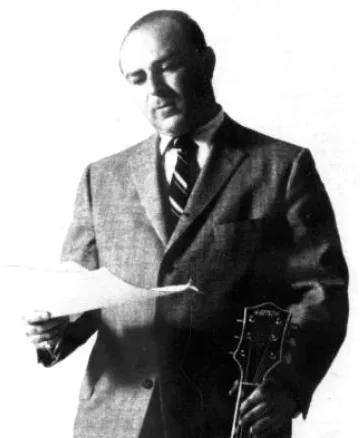
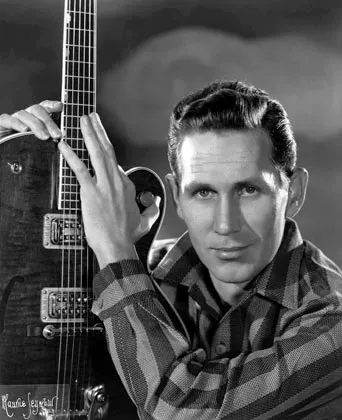
Al Caiola holding a Gretsch guitar, from a Gretsch advertisement published in DownBeat magazine, January 5, 1961 Public domain (a United States advertisement published without a copyright notice) — Wikimedia Commons - https://commons.wikimedia.org/wiki/File:Al_Caiola.jpg

Alexander Emil Caiola was born on September 7, 1920, in Jersey City, New Jersey, the son of Emil Caiola, a barber, and Genevieve Esposito. He first wanted to be a singer, and his father steered him toward instruments, first the banjo and then the guitar. By eleven he was a recognized prodigy, studying with Anthony Antone in New York and Peter Milano in Jersey City, and in later years with Harry Volpe. As a boy he worked from Eddie Lang's guitar method and admired Lang and Bing Crosby. At sixteen he sang and played on a children's radio program, Sally and Sam, alongside the guitarist Tony Mottola, who became a lifelong colleague and pushed him to master new techniques.
During World War II Caiola served in the United States Marine Corps, playing trumpet in the 5th Marine Division Band, a unit that also included Bob Crosby, and he served as a stretcher bearer at the Battle of Iwo Jima. He came home to study at the New Jersey College of Music on the GI Bill and in 1946 joined CBS in New York as a staff musician, a post he held until 1956. At the network he played on Arthur Godfrey's Talent Scouts, Ed Sullivan's Toast of the Town and The Jackie Gleason Show, under the conductor Ray Bloch.
He left CBS because freelance work paid more and offered more variety, and for the next fifteen years he was one of the first-call guitarists in New York, in a circle of studio players that Vintage Guitar's obituary calls the Manhattan Guitar Club: Mottola, Bucky Pizzarelli and Mundell Lowe. The jazz discographer's listing of Atlantic Records sessions alone puts him on at least 21 dates between January 1957 and May 1959, behind Ivory Joe Hunter, Chuck Willis, LaVern Baker, Ruth Brown, Bobby Short, Bobby Darin and King Curtis, and on banjo as well as guitar. On December 19, 1958, with Hank Jones at the piano, he was in the orchestra that recorded Darin's "Mack the Knife." His obituaries and published session listings also place him on sessions for Frank Sinatra, Tony Bennett, Barbra Streisand, Johnny Mathis, Neil Sedaka, Paul Anka, Del Shannon, Ben E. King and Simon and Garfunkel, and Vintage Guitar reports that he played on Buddy Holly's New York sessions of 1958.
The records under his own name that jazz listeners value most are the two Savoy albums of 1955 and 1956. Produced by Ozzie Cadena and recorded at Rudy Van Gelder's studio in Hackensack, New Jersey, Deep in a Dream (Savoy MG 12033) paired Caiola with the trumpeter and flugelhorn player Bernie Privin, the pianist Hank Jones, the bassist Clyde Lombardi and the drummer Kenny Clarke, and Serenade in Blue (MG 12057) kept Jones, Lombardi and Clarke, adding the reed player Romeo Penque and, on four tracks, the pianist Ronnie Ball. Both are standards and original pieces played in a quiet, chamber-sized style. His sideman work in the same years included Howard McGhee's Life Is Just a Bowl of Cherries (Bethlehem, February 1956) with Herbie Mann among the woodwinds, Morgana King's debut For You, For Me, For Evermore (EmArcy, 1956), a Willis Jackson date in February 1957 with Quincy Jones and Kenny Burrell, Ruth Brown's April 1957 session with Percy Heath and Connie Kay, Ralph Burns's Very Warm for Jazz (1958) with Al Cohn, Zoot Sims and Urbie Green, and a Don Redman album with Coleman Hawkins and Harry Edison.
In 1960 he signed with United Artists, where he recorded for the next decade, and the label turned him into a recording star. His instrumental versions of the theme from the film The Magnificent Seven and the television theme "Bonanza" reached No. 35 and No. 19 on the Billboard Hot 100 in 1961, with a large-orchestra backing arranged and produced by Don Costa. The only other chart entry was "From Russia with Love" in 1964. The success of "Bonanza" led to commercial sessions for Marlboro, and Vintage Guitar's obituary counts more than sixty albums as a leader, over fifty of them for United Artists, including western television themes, spy and film themes, Italian, Spanish, Hawaiian and country records, and an album called Tuff Guitar that covered "A Hard Day's Night" and "Tequila." Beside these sat the jazz-flavored exceptions, such as Guitars Guitars Guitars (1960), which hands swing-era standards like "A String of Pearls" and "King Porter Stomp" to a section of New York guitarists including Mottola, Pizzarelli and Barry Galbraith, and Cleopatra and All That Jazz (1962), credited to Al Caiola and the Nile River Boys, whose band included the trumpeter Clark Terry, the pianist Dick Hyman and the bassist George Duvivier. He also played for Lena Horne on her 1962 RCA album Lena on the Blue Side.
At the urging of the Ashley-Famous agency he played Las Vegas in the 1960s, and he ran his own publishing firm, Alpane Music. After leaving United Artists he continued on smaller labels through the 1970s and 1980s, with Spanish-themed and Italian instrumental albums, and he appears on guitar on Lionel Hampton Presents: Woody Herman (1977), a quintet-plus-percussion record with Woody Herman, Lionel Hampton, Roland Hanna and George Mraz. He toured with Steve Lawrence and Eydie Gormé for 28 years, living in South Palm Beach, Florida, and later moved back to New Jersey to be near family. Epiphone issued an Al Caiola Standard model in his name. Al Caiola passed away on November 9, 2016, in Allendale, New Jersey, at the age of 96. He was survived by his wife, Rosalie, a son, Alexander Jr., a daughter, Sandra Ayres, four grandchildren and four great-grandchildren.
Caiola was a studio guitarist first and a bandleader second, and the pop and television-theme side of his output is the larger part of it: the records for United Artists are arrangements of hits, film cues and national folk songs played over a lush orchestra, and AllMusic files him under easy listening with jazz as a second genre. His own sound was a light, liquid single-note line, and a pianist who worked with him remembered him as comfortable in jazz, rock and roll and classical settings. His models were Eddie Lang and Tony Mottola. The jazz side is real but narrower. The Savoy albums of 1955 and 1956 are cool and restrained and, as one reviewer of their 2016 reissue put it, closer to romantic mood music than to hard swinging, while the date sheets show him as a reliable rhythm and solo guitarist and banjoist for Atlantic, Bethlehem, EmArcy, Decca and Urania sessions led by working jazz players. He is best understood as a bridge figure between the New York jazz rhythm-section world of the 1950s and the instrumental pop of the 1960s.
- Deep in a Dream (1955, Savoy) - His leader date with Hank Jones, Kenny Clarke, Clyde Lombardi and Bernie Privin, recorded at Rudy Van Gelder's studio, and the clearest statement of his jazz side. Spotify - Deep in a Dream Listen
- Serenade in Blue (1956, Savoy) - The companion Savoy album, with Romeo Penque's flute, bass clarinet and English horn and Ronnie Ball on piano for four tracks. Spotify - Serenade in Blue Listen
- Guitars Guitars Guitars (1960, United Artists) - A section of New York guitarists playing swing-era standards, reissued as The Magnificent Seven with the hit in place of the opener. Spotify - The Magnificent Seven (Expanded Edition) Listen
- Golden Hit Instrumentals (1961, United Artists) - Includes "Bonanza," his No. 19 hit, with "Apache" and "Wheels." Spotify - Golden Hit Instrumentals Listen
- Hit Instrumentals from Western TV Themes (1961, United Artists) - The television-theme formula in full: "Laramie," "Maverick," "Rawhide" and "Bat Masterson." Spotify - Hit Instrumentals from Western TV Shows Listen
- Cleopatra and All That Jazz (1962, United Artists) - Credited to Al Caiola and the Nile River Boys, with Clark Terry, Dick Hyman and George Duvivier. Spotify - Cleopatra and All That Jazz Listen
- Life Is Just a Bowl of Cherries (1956, Bethlehem) - Howard McGhee's date, arranged by Frank Hunter, with Caiola on guitar among a woodwind section that included Herbie Mann.
- Late Date with Ruth Brown (1959, Atlantic) - Caiola plays on four tracks of this standards album, alongside Hank Jones and Mundell Lowe.
Al Caiola: Full Discography
Discogs artist: Al Caiola (70509) · Real name Alexander Emil Caiola · Born September 7, 1920, Jersey City, New Jersey · Died November 9, 2016, Allendale, New Jersey
Leader: Albums
Caiola recorded more than sixty albums as a leader, over fifty of them for United Artists, many of them reissued under several titles and compilations in the United States, Europe, Latin America and Japan. The table below lists the original studio albums that matter most, in release order: the two jazz dates for Savoy, the guitar-ensemble records, the television and film theme albums that made his name, and a selection of the Italian, country, rock-and-pop and later records. Catalog numbers are those of the original United States release on Discogs, and release years follow Discogs, with Wikipedia and AllMusic as cross-checks. Personnel are given where Discogs or the label's own reissue credits them. The Spotify links point to digital editions, some of them reissues or expanded editions that are not identical to the original LP.
| Album | Year | Label (Catalog) | Personnel & Notes | Charts | Listen | Buy |
|---|---|---|---|---|---|---|
| Deep in a Dream: The Guitar of Al Caiola | 1955 | Savoy (MG 12033) | Produced by Ozzie Cadena and recorded at Rudy Van Gelder's studio in Hackensack, New Jersey. Bernie Privin (trumpet, flugelhorn), Hank Jones (piano), Clyde Lombardi (bass), Kenny Clarke (drums). Eight tracks: "Love Letters," "There Will Never Be Another You," "I Got It Bad," "Everything Happens to Me," "Deep in a Dream," "You Are Too Beautiful," "I've Got a Crush on You" and Caiola's own "Thunderbird." Reissued with Serenade in Blue on one CD by Fresh Sound in 2016 (FSRCD 892). | Spotify | — | |
| Serenade in Blue | 1956 | Savoy (MG 12057) | Produced by Ozzie Cadena, recorded at Van Gelder's studio in December 1955. Hank Jones and Ronnie Ball (piano), Clyde Lombardi (bass), Kenny Clarke (drums), Bernie Privin (trumpet, flugelhorn) on four tracks and Romeo Penque (flute, bass clarinet, English horn) on four. Includes "Early Autumn," "Black and Blue," "Moments Like This" and the originals "Blue the Night" and "Drambuie." | Spotify | — | |
| Music for Space Squirrels | 1958 | Atco (33-117) | Twelve ragtime and Dixieland standards, among them "Maple Leaf Rag," "Bugle Call Rag," "When the Saints Go Marching In," "Guitar Boogie" and "Twelfth Street Rag," with Lloyd Trotman (bass) and Panama Francis (drums), recorded in New York on May 1 and 8, 1958. Tom Dowd engineered; Milton Glaser painted the cover. | — | — | |
| High Strung | 1959 | RCA Victor (LSP-2031) | A guitar-ensemble record with five guitarists (Caiola, Al Casamenti, Bucky Pizzarelli, Don Arnone and George Barnes), vibraphonists Eddie Costa and Phil Kraus, Sandy Block (bass) and Don Lamond (drums). Includes "Sweet Georgia Brown," "Dipsy Doodle" and "Tumbling Tumbleweeds." | — | — | |
| Guitars Guitars Guitars | 1960 | United Artists (UAS 6077) | Swing-era repertoire ("A String of Pearls," "King Porter Stomp," "Begin the Beguine," "Jumpin' at the Woodside") played by a section of New York guitarists: Caiola, Tony Mottola, Bucky Pizzarelli, Barry Galbraith, Don Arnone, Al Casamenti, Allen Hanlon and Art Ryerson, with Jerry Bruno (bass) and Bobby Rosengarden (drums). | — | — | |
| The Magnificent Seven | 1960 | United Artists (UAL 3133) | Carries the same program as Guitars Guitars Guitars, with the title theme in place of the opening track and "Lonely Rebel" in place of "Back Bay Shuffle." The theme single reached No. 35 on the Billboard Hot 100 in 1961. | No. 35 Hot 100 (title single) | Spotify (expanded edition) | — |
| Gershwin and Guitars | 1960 | Time (S/2010) | Twelve Gershwin songs, with Bernie Leighton (piano), Frank Carroll (bass), Sol Gubin (drums), Eddie Costa, Phil Kraus and George Devens (percussion), George Berg (woodwinds) and a four-guitar section including Caiola, Bucky Pizzarelli, Don Arnone and Art Ryerson. | — | — | |
| Salute Italia! | 1960 | Roulette (SR 25108) | Italian songs, with Caiola credited for the arrangements and for guitar and mandolin solos; produced by Teddy Reig, with accordion, saxophone, trumpet and vibraphone in the band. | — | — | |
| Percussion Español | 1960 | Time (S/2006) | Spanish and Latin standards, arranged by Caiola, with Bobby Rosengarden on drums, accordionists Dominic Cortese and Nick Perito and a percussion section. | — | — | |
| Great Pickin' (with Don Arnone) | 1960 | Chancellor (CHL-5008) | Twelve standards, among them "Caravan," "A Foggy Day" and "Lover Come Back to Me," produced by Peter De Angelis. A two-guitar record. | — | — | |
| Golden Hit Instrumentals | 1961 | United Artists (UAS 6142) | Opens with "Bonanza," followed by "Apache," "Ja-Da," "Wheels," "Pepe," "Calcutta" and "Wonderland by Night." The "Bonanza" single (UA 302, produced and arranged by Don Costa) reached No. 19 on the Billboard Hot 100. | No. 19 Hot 100 ("Bonanza") | Spotify | — |
| Hit Instrumentals from Western TV Themes | 1961 | United Artists (UAS 6161) | Twelve television themes: "Law Man," "Laramie," "Theme from The Rebel," "Maverick," "The Ballad of Paladin," "Gunslinger," "Wagons Ho!," "Bonanza," "Rawhide" and "Bat Masterson." | Spotify | — | |
| Italian Guitars | 1960 | Time (S/2023) | Italian songs for a section of electric and Spanish guitars; Discogs lists the Time release under 1961. | — | — | |
| Cleopatra and All That Jazz (as Al Caiola and the Nile River Boys) | 1962 | United Artists (UAL 3299) | Caiola arranged. Clark Terry (trumpet, flugelhorn), Phil Bodner (flute, alto and baritone saxophones), Tony Studd (bass trombone), Dick Hyman (piano, harpsichord), Barry Galbraith (rhythm guitar), George Duvivier (bass) and Osie Johnson (drums). Twelve pieces including "Temptation," "Love for Sale," "Lover Man," "Body and Soul" and "All of Me." | Spotify | — | |
| Solid Gold Guitar | 1962 | United Artists (UAL 3180) | A compilation of his hits and television themes, with arrangements by Caiola, Don Costa and Nick Perito: "Guns of Navarone," "Moon River," "Guitar Boogie," "Magnificent Seven" and "I'll Walk the Line." | Spotify | — | |
| City Guy Plays Country | 1963 | United Artists (UAS 6255) | Country standards, "Ring of Fire," "Cold Cold Heart," "El Paso" and "Wolverton Mountain" among them, released in October 1963. | — | — | |
| Guitar for Lovers | 1964 | United Artists (UAL 3403) | Ballads and standards: "Everybody Loves Somebody," "Dear Heart," "Isn't It Romantic?" and "Satin Doll." | — | — | |
| Tuff Guitar | 1964 | United Artists (UAS 6389) | Rock and pop covers, "Hound Dog," "Raunchy," "A Hard Day's Night," "(We're Gonna) Rock Around the Clock" and "Tequila," produced by Leroy Holmes. Followed by Tuff Guitar English Style (1965) and Tuff Guitar Tijuana Style (1966). | — | — | |
| Sounds for Spies and Private Eyes | 1965 | United Artists | Spy and detective themes in the vein of "Goldfinger," "The Fugitive" and "The Man from U.N.C.L.E." | — | — | |
| The Return of the Seven and Other Themes | 1967 | United Artists (UAL 3560) | Follow-up to the 1961 hit, produced by Leroy Holmes, with "The Sand Pebbles" and "Strangers in the Night." | — | — | |
| King Guitar | 1967 | United Artists (UAS 6586) | Pop covers including "Detroit City," "Something Stupid" and "Kansas City." | — | — | |
| It Must Be Him | 1968 | United Artists | Pop and film songs. | — | — | |
| Let the Sunshine In | 1969 | United Artists | Pop songs of the late 1960s. | — | — | |
| Soft Guitars | 1980 | Bainbridge | A later easy-listening collection. | — | — | |
| In a Spanish Mood | 1982 | Accord | Spanish-themed instrumentals. | — | — | |
| Amigo & Other Songs | 1993 | Aurora | Later instrumental album. | — | — |
Singles
| Year | Single | Label (Catalog) | Notes |
|---|---|---|---|
| 1960-61 | "The Magnificent Seven" (Elmer Bernstein's film theme) | United Artists | No. 35 on the Billboard Hot 100 in early 1961; UK release on His Master's Voice (45-POP 889). |
| 1961 | "Bonanza" / "Bounty Hunter" | United Artists (UA 302) | No. 19 on the Billboard Hot 100; produced and arranged by Don Costa. |
| 1964 | "From Russia with Love" / "Mexican Summer" | United Artists (UA 711) | His only chart entry besides the two 1961 hits; arranged and conducted by Don Costa. |
As Sideman (selected jazz credits)
Caiola's studio credits run to well over a thousand rows on Discogs, most of them pop, rhythm and blues and light-orchestra sessions. The table keeps to the credits that bear on his jazz side, each checked against the individual release or a session listing. A short list of his pop sessions follows below it.
| Year | Project (Leader) | Title | Label | Catalog | Role | Notes |
|---|---|---|---|---|---|---|
| 1956 | Howard McGhee | Life Is Just a Bowl of Cherries | Bethlehem | BCP 61 | Guitar | Recorded in New York in February 1956. Frank Hunter arranged and conducted; woodwinds included Herbie Mann, Danny Bank, Phil Bodner, Leon Cohen and Sid Brown; Donn Trenner (piano), Arnold Fishkind (bass), Osie Johnson and Don Lamond (drums). |
| 1956 | Morgana King | For You, For Me, For Evermore | EmArcy | MG 36079 | Guitar | With Hank Jones (piano) and Chauncey Welsch (trombone); Richard Hayman arranged and conducted. Recorded March 1956. |
| 1957 | Willis Jackson | "Back Door" / "Lator Gator" | Atco | 6089 | Guitar | Session of February 11, 1957, in New York: Quincy Jones (trumpet), Willis Jackson (tenor saxophone), Kenny Burrell and Caiola (guitars), Richard Davis (bass), Joe Marshall (drums), Chino Pozo (bongo). |
| 1957 | LaVern Baker | "Humpty Dumpty Heart" and others | Atlantic | 1150 | Banjo | Session of February 9, 1957, with Quincy Jones's orchestra: Sam Taylor (tenor saxophone), Budd Johnson (baritone saxophone), Dick Hyman (piano), George Barnes (guitar), Lloyd Trotman (bass), Joe Marshall (drums). Caiola is listed on banjo. |
| 1957 | Ruth Brown | "Show Me" / "I Hope We Meet" | Atlantic | 1153; LP 8026 | Guitar | Session of April 15, 1957, with Jimmy Mitchell (alto saxophone), Lee Anderson (piano), Allen Hanlon (guitar), Percy Heath (bass) and Connie Kay (drums). A second session on December 5, 1957 added Mundell Lowe and Dick Hyman. |
| 1958 | Ralph Burns and the Quiet Herd | Very Warm for Jazz | Decca | DL 9207 | Guitar | Plays on three tracks (A2, A4 and B4). Band includes Al Cohn and Zoot Sims (tenor saxophones), Urbie Green, Billy Byers, Jimmy Cleveland and Thomas Mitchell (trombones), Nick Travis (trumpet), Eddie Costa (vibraphone), Milt Hinton (bass) and Don Lamond (drums). |
| 1958 | Bobby Darin | That's All | Atco | 33-104 | Guitar | Session of December 19, 1958, arranged and conducted by Richard Wess, with Hank Jones (piano), Eddie Safranski (bass), Don Lamond (drums) and a large horn section including Bernie Privin and Doc Severinsen. The session produced "Mack the Knife" and the title track. |
| 1958-59 | Bobby Short | The Mad Twenties | Atlantic | 1302 | Guitar, banjo | Sessions of November 24, 1958 and January 8 and 14, 1959, with Phil Moore's orchestra: Yank Lawson or Joe Wilder or Chris Griffin (trumpet), Lou McGarity (trombone, violin), Eddie Barefield (clarinet, alto saxophone), Milt Hinton or George Duvivier (bass), Terry Snyder (drums). |
| 1959 | Ruth Brown | Late Date with Ruth Brown | Atlantic | SD 1308 | Guitar | Plays on four tracks (A1, A3, B2 and B4). Session of February 5, 1959, arranged by Richard Wess, with Hank Jones (piano), Mundell Lowe (guitar), Milt Hinton (bass) and Don Lamond (drums). |
| 1959 | Don Redman | Dance, Dance, Dance with Don Redman | Urania | USD 2001 | Guitar | Plays on four tracks (A2, A5, B2 and B6). Credits include Coleman Hawkins (tenor saxophone), Harry Edison (trumpet), Tyree Glenn and Will Bradley (trombones), Hank Jones (piano) and Jo Jones (drums). The album's liner notes place the recordings in 1957. |
| 1959 | King Curtis Nonet | "Heavenly Blues" / "Restless Guitar" | Atco | 6152 | Guitar | Session of May 19, 1959, with Ruth Berman (harp), Ernie Hayes and Mike Stoller (piano), George Barnes (guitar), Abie Baker (bass), Panama Francis (drums) and Bobby Rosengarden (percussion). |
| 1959 | Johnny Mathis | Open Fire, Two Guitars | Columbia | CS 8056 | Guitar | Mathis accompanied by two guitars, Caiola and Tony Mottola, with Milt Hinton and Frank Carroll on bass. |
| 1959 | Tony Mottola | Mr. Big: Tony Mottola...Guitar | Command | RS 33-807 | Guitar | Plays on A1, A2, A5 to B1, B4 and B5, with Moe Wechsler (piano), Bob Haggart (bass), Terry Snyder (drums) and Bucky Pizzarelli. |
| 1960 | Claus Ogerman | Sounds for Sick? People | Shell | 1711 | Guitar | Promotional album with Georgie Auld (tenor saxophone), Frank Rehak (trombone), Boomie Richman (flute), Moe Wechsler (piano) and Don Lamond (drums). |
| 1962 | Lena Horne | Lena on the Blue Side | RCA Victor | LSP-2465 | Guitar | Recorded in New York in summer 1961, with Marty Gold conducting, George Duvivier (bass), Osie Johnson (drums) and Andy Ackers (piano). |
| 1963 | Irene Reid | It's Only the Beginning | MGM | E 4159 | Guitar | George Siravo arranged and conducted; Dick Hyman (organ), Urbie Green and Tyree Glenn (trombones), Milt Hinton (bass), Sol Gubin (drums). |
| 1977 | Woody Herman (presented by Lionel Hampton) | Lionel Hampton Presents: Woody Herman | Who's Who in Jazz | WWLP 21013 | Guitar | Five tracks ("Body and Soul," "Rose," "Early Autumn," "Caldonia" and "Mood Indigo") with Lionel Hampton (vibraphone), Roland Hanna (piano), George Mraz (bass), Richard Pratt (drums) and Candido (congas). Herman plays alto and soprano saxophones and clarinet. |
Pop and vocal sessions (selected)
Session credits for pop and rock artists, as given in his obituaries and in session listings, include Bobby Darin ("Splish Splash," "Dream Lover," "Mack the Knife"), Johnny Mathis ("Chances Are," "The Twelfth of Never"), Paul Anka, Neil Sedaka, Del Shannon ("Runaway"), Ben E. King ("Stand by Me"), Buddy Holly's New York sessions of 1958, Simon and Garfunkel ("Mrs. Robinson"), and records for Frank Sinatra, Tony Bennett and Barbra Streisand. These are not individually itemized here.
Other credits
Discogs files several billing names under his own artist entry, among them Al Caiola and His Orchestra, Al Caiola and His Magnificent Seven, Al Caiola and the Nile River Boys and Al Caiola and His Islanders; Cleopatra and All That Jazz is billed to the Nile River Boys. A large number of foreign EP and single issues of his United Artists material, mostly in Spain, Mexico, France, Italy and Japan, are not itemized.
- Hank Jones - pianist on both Savoy albums of 1955 and 1956, on Morgana King's For You, For Me, For Evermore (1956), on Bobby Darin's session of December 19, 1958, and on Ruth Brown's Late Date with Ruth Brown (1959).
- Kenny Clarke - drummer on Deep in a Dream and Serenade in Blue (1955).
- Clyde Lombardi, Bernie Privin, Romeo Penque and Ronnie Ball - the bassist, trumpeter and flugelhorn player, reed player and pianist who completed the Savoy sessions.
- Ozzie Cadena - produced both Savoy albums; Rudy Van Gelder recorded them.
- Tony Mottola - his first collaborator, from the radio program Sally and Sam in the 1930s to the guitar-ensemble records and Johnny Mathis's Open Fire, Two Guitars (1959).
- Bucky Pizzarelli - fellow member of New York's studio-guitar circle, and a guitarist alongside Caiola on High Strung (RCA Victor, 1959) and Guitars Guitars Guitars (1960).
- Harry Volpe - guitarist with whom Caiola studied.
- Herbie Mann, Howard McGhee, Frank Hunter - the woodwind player, trumpeter and arranger on Life Is Just a Bowl of Cherries (1956).
- Morgana King - the singer on his February 1956 EmArcy session.
- Quincy Jones and Kenny Burrell - fellow members of a Willis Jackson date on February 11, 1957; Jones also led the orchestra on a LaVern Baker session two days earlier, where Caiola played banjo.
- Ruth Brown, LaVern Baker, Chuck Willis, Ivory Joe Hunter, Bobby Short and King Curtis - singers and bandleaders he accompanied at Atlantic between 1957 and 1959; Short's The Mad Twenties (1959) used a small band with Yank Lawson, Lou McGarity and Eddie Barefield.
- Ralph Burns, Al Cohn, Zoot Sims and Urbie Green - the Quiet Herd on Very Warm for Jazz (Decca, 1958), where he plays on three tracks.
- Don Redman, Coleman Hawkins and Harry Edison - on a Urania album, where he plays on four tracks.
- Clark Terry, Dick Hyman, George Duvivier, Osie Johnson and Barry Galbraith - the band on Cleopatra and All That Jazz (1962).
- Lena Horne - guitarist on Lena on the Blue Side (RCA Victor, 1962), with George Duvivier and Osie Johnson.
- Woody Herman, Lionel Hampton, Roland Hanna and George Mraz - his bandmates on Lionel Hampton Presents: Woody Herman (1977).
- Don Costa - arranged and produced his United Artists hits, "The Magnificent Seven" and "Bonanza."
- Steve Lawrence and Eydie Gormé - he toured with the couple for 28 years.
- Pop and vocal sessions: Frank Sinatra, Tony Bennett, Barbra Streisand, Bobby Darin, Johnny Mathis, Neil Sedaka, Paul Anka, Del Shannon, Ben E. King, Buddy Holly and Simon and Garfunkel, as credited in his obituaries and in session listings.
More Cool Jazz Artists
See all 92 Cool Jazz artists →More American Jazz Artists
See all 820 American artists →- Wikipedia: Al Caiola
- Wikipedia: Life Is Just a Bowl of Cherries
- AllMusic: Al Caiola biography and discography
- Vintage Guitar: Guitarist Al Caiola Passes
- Boston Globe: Al Caiola, 96, guitarist who played hit theme songs
- Discogs: Al Caiola, with the individual releases cited above
- Fresh Sound Records: Deep in a Dream + Serenade in Blue (FSRCD 892), session personnel and dates
- Jazz Weekly: review of the Fresh Sound reissue of the two Savoy albums
- Jazzdisco: Atlantic Records discography, 1957
- Jazzdisco: Atlantic Records discography, 1958
- Jazzdisco: Atlantic Records discography, 1959
- Wikimedia Commons: Al Caiola in a 1961 Gretsch advertisement