 JAZZPROFILES lives in the music 2,555 Jazz Artists fully Profiled!
Tina Brooks
Last updated November 8, 2026
Listen on Spotify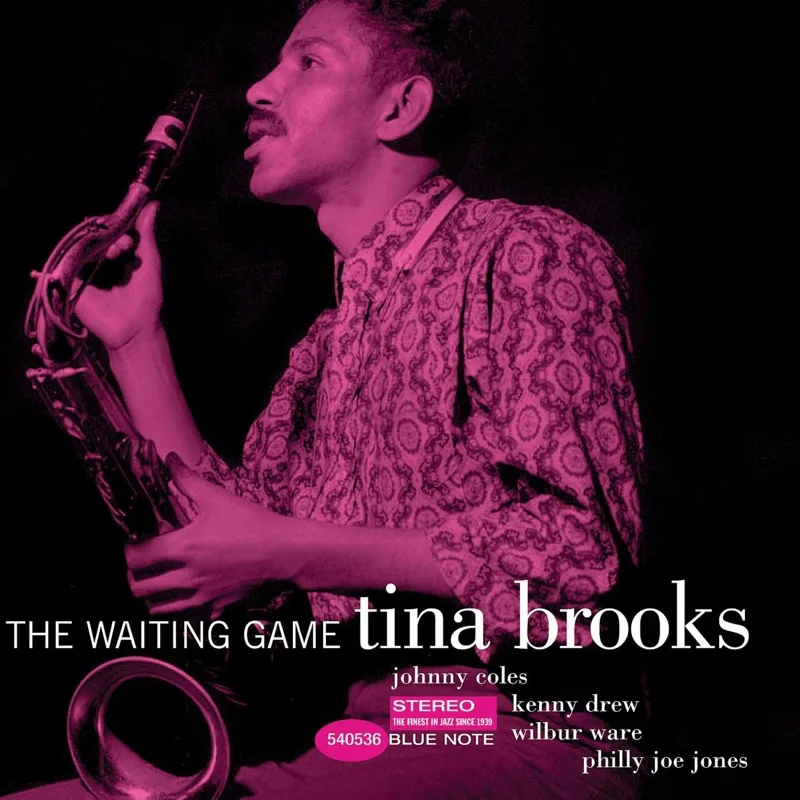
Tina Brooks on the cover of his album The Waiting Game (Blue Note), cover photograph from the Francis Wolff and Mosaic Images collection Album cover art (not a CC-licensed artist photo), used as the only available image showing the artist — Apple iTunes Store album artwork for The Waiting Game (Blue Note) - https://music.apple.com/us/artist/1098218
Harold Floyd Brooks was born on June 7, 1932, in Fayetteville, North Carolina. His nickname, pronounced "Teena," grew out of a childhood pet name, "Teeny." His brother David "Bubba" Brooks was also a saxophonist. The family moved to New York in 1944 and settled in the Bronx, where Brooks started on C-melody saxophone and studied harmony and theory with Herbert Bourne. His first professional work came in 1951 with the rhythm and blues pianist Sonny Thompson, and in 1955 he played with Lionel Hampton. AllMusic also credits him with session work for the R&B singer Amos Milburn. The trumpeter and composer "Little" Benny Harris gave him informal guidance and recommended him to Blue Note producer Alfred Lion.
Brooks's Blue Note years began with sideman dates. On February 25, 1958, he recorded with the organist Jimmy Smith, and Discogs credits him on two tracks of The Sermon! from that session and one track of House Party. On March 16, 1958, at the Van Gelder studio in Hackensack, New Jersey, he made his first session as a leader, Minor Move, with Lee Morgan, Sonny Clark, Doug Watkins, and Art Blakey. It went unissued until Blue Note Japan released it in 1980. In between he played a live Jimmy Smith date at Small's Paradise on April 7, 1958 (issued in 1980 as Cool Blues) and, on May 14, 1958, the sessions that became Kenny Burrell's Blue Lights, where he shared the tenor chair with Junior Cook.
His best-known sideman credit outside the studio was the stage. Jack Gelber's play The Connection, staged by the Living Theater, used a score by the pianist Freddie Redd, with the musicians appearing as characters. Brooks was Jackie McLean's understudy in the production, and on June 13, 1960, he recorded a version of the music with the trumpeter Howard McGhee for the Felsted label. AllMusic calls his work on Redd's score perhaps the most seminal moment of his career as an improviser.
1960 was his busiest year. He played on the debut album of Freddie Hubbard, Open Sesame (June 19), recorded his own True Blue with Hubbard on June 25, and made Shades of Redd with Redd and McLean on August 13. On September 1 and October 20 he led sessions with Blue Mitchell, Kenny Drew, Paul Chambers, and the drummer Art Taylor, the first of them with McLean added. A final leader date, The Waiting Game, followed on March 2, 1961, with the trumpeter Johnny Coles, Drew, the bassist Wilbur Ware, and Philly Joe Jones. Only True Blue appeared in his lifetime, issued in 1960 without much promotion alongside Hubbard's debut. He made no more recordings after 1961.
Heroin dependency and failing health ended his career. Brooks passed away on August 13, 1974, in New York City, of liver failure, at the age of 42. His recorded legacy was assembled after his death. Blue Note Japan issued Minor Move and Street Singer (credited jointly to Brooks and McLean) in 1980, and in 1985 Mosaic Records released a four-LP set produced by Michael Cuscuna, The Complete Blue Note Recordings of the Tina Brooks Quintets, limited to 7,500 numbered sets, which brought out Back to the Tracks and The Waiting Game for the first time. Blue Note put out Back to the Tracks on CD in 1998 and The Waiting Game in Japan in 1999.
Brooks was a tenor saxophonist of the hard bop school with a strong, smooth tone and a steady flow of new melodic ideas. AllMusic's Thom Jurek credits him with stretching the blues framework further than most players of his day, and with a fondness for minor keys and open-ended harmonic figures that his peers envied. He was also a composer: "Street Singer," "Open Sesame," and "Gypsy Blue" are his, and the critic David Rosenthal calls "Street Singer" an authentic hard-bop classic in which pathos, irony, and rage meet in an anguished, sinister performance. Michael Cuscuna, who prepared most of his unissued sessions for release, described him as a sensitive and unique improviser whose lyricism and inner logic were astounding, and argued that lesser talents have been celebrated far more. AllMusic's list of related artists for Brooks includes John Coltrane, Hank Mobley, Dexter Gordon, Charlie Rouse, Booker Ervin, and Sonny Red.
- True Blue (1960, Blue Note) - The only leader album released in his lifetime, recorded June 25, 1960, with Freddie Hubbard, Duke Jordan, Sam Jones, and Art Taylor, and built mainly on his own compositions.
- Minor Move (1980, Blue Note) - His first leader session, recorded March 16, 1958, with Lee Morgan, Sonny Clark, Doug Watkins, and Art Blakey; it stayed in the vault for twenty-two years. Spotify - Minor Move (Expanded Edition) Listen
- Street Singer (1980, Blue Note) - A co-led sextet date with Jackie McLean recorded September 1, 1960, whose title tune is one of his best-known compositions; three of its tracks had come out on McLean's Jackie's Bag.
- Back to the Tracks (1998, Blue Note) - October 1960 quintet date with Blue Mitchell, Kenny Drew, Paul Chambers, and Art Taylor, first released on the 1985 Mosaic set. Spotify - Back to the Tracks Listen
- The Waiting Game (1999, Blue Note) - His last leader session, recorded March 2, 1961, with Johnny Coles, Kenny Drew, Wilbur Ware, and Philly Joe Jones. Spotify - The Waiting Game Listen
- Open Sesame (1960, Blue Note) - Freddie Hubbard's debut album as a leader, recorded June 19, 1960, with McCoy Tyner, Sam Jones, and drummer Clifford Jarvis; Brooks wrote the title tune and "Gypsy Blue." Spotify - Open Sesame
- The Sermon! (1959, Blue Note) - Jimmy Smith's blues date, on which Brooks plays alongside Lou Donaldson and Lee Morgan. Spotify - The Sermon!
- Shades of Redd (1961, Blue Note) - Pianist Freddie Redd's quintet date, recorded August 13, 1960, with Brooks and Jackie McLean in the front line. Spotify - Shades of Redd
Tina Brooks: Full Discography
Discogs artist ID 29978 ("Tina Brooks," real name Harold Floyd Brooks, born June 7, 1932, in Fayetteville, North Carolina, died August 13, 1974, in New York City) lists 182 entries, only a handful of them leader releases; the rest are sideman albums, track appearances, and Blue Note and jazz-label compilations. Other Discogs entries with the same name belong to different people and are not included. A separate Discogs entry, "Tina Brooks Quintet" (artist ID 4830087), holds only a 2015 compilation of master takes. Every leader row below was checked against the individual Discogs release and Wikipedia's album articles; where a year or date is not confirmed, the row says so. Four of his five Blue Note leader sessions were first issued after his death, so the Release Date column gives the first issue and the Notes column gives the reissue path. The sideman table is a selected set of his documented credits, not a complete list.
As Leader / Co-Leader
| Album Title | Recording Date(s) | Release Date | Label | Catalog Number | Format(s) | Personnel | Role | Reissue History | Spotify | Buy | Notes |
|---|---|---|---|---|---|---|---|---|---|---|---|
| Minor Move | March 16, 1958, Van Gelder Studio, Hackensack, New Jersey | 1980 (Japan); CD 2000 | Blue Note | GXF 3072 (Japan LP) | Vinyl, LP, Album, Limited Edition | Tina Brooks (tenor saxophone), Lee Morgan (trumpet), Sonny Clark (piano), Doug Watkins (bass), Art Blakey (drums) | Leader | Included in the 1985 Mosaic set; reissued on CD in 2000 with an alternate take; see Discogs master 293594 | Spotify - Minor Move (Expanded Edition) | — | His first leader session and the first of the shelved Blue Note dates; "Nutville" was brought to the session by Lee Morgan but is a Brooks composition. |
| True Blue | June 25, 1960 | 1960 | Blue Note | BLP 4041 | Vinyl, LP, Album, Mono | Tina Brooks (tenor saxophone), Freddie Hubbard (trumpet), Duke Jordan (piano), Sam Jones (bass), Art Taylor (drums) | Leader | Reissued many times on CD and streaming; see Discogs master 186748 | — | — | The only leader album released in his lifetime. Sam Jones appears by courtesy of Riverside Records. |
| Street Singer | September 1, 1960 | 1980 (Japan) | Blue Note | GXF 3067 (Japan LP) | Vinyl, LP, Album, Limited Edition | Tina Brooks (tenor saxophone), Jackie McLean (alto saxophone), Blue Mitchell (trumpet), Kenny Drew (piano), Paul Chambers (bass), Art Taylor (drums) | Co-leader (billed with Jackie McLean) | See Discogs master 725817 | — | — | Three of its tracks ("Appointment in Ghana," "A Ballad for Doll," "Isle of Java") had already appeared on McLean's Jackie's Bag. |
| Back to the Tracks | September 1 (one track) and October 20, 1960 | 1985 (Mosaic set); Blue Note CD January 27, 1998 | Blue Note | CD 21737; first planned as BLP 4052 | CD, Album | Tina Brooks (tenor saxophone), Blue Mitchell (trumpet), Kenny Drew (piano), Paul Chambers (bass), Art Taylor (drums); Jackie McLean (alto saxophone, "Street Singer" only) | Leader | First issued in the Mosaic box set; reissued on CD in 2006 (BST 84052); see Discogs master 312586 | Spotify - Back to the Tracks | — | The album was scheduled as BLP 4052 and shelved. Discogs also lists a Japanese promotional LP dated June 22, 1990. |
| The Waiting Game | March 2, 1961, Van Gelder Studio, Englewood Cliffs, New Jersey | First issued 1985 (Mosaic set); single album 1999 (Japan CD, October 8, 1999) | Blue Note | TOCJ-66075 (Japan CD) | CD, Album | Tina Brooks (tenor saxophone), Johnny Coles (trumpet), Kenny Drew (piano), Wilbur Ware (bass), Philly Joe Jones (drums) | Leader | See Discogs master 939104 | Spotify - The Waiting Game | — | His last leader session. "David the King," rejected from the October 1960 date, was re-recorded here. |
| The Complete Blue Note Recordings of the Tina Brooks Quintets | March 16, 1958; June 25, September 1, and October 20, 1960; March 2, 1961 | 1985 | Mosaic Records | MR4-106 | Vinyl, 4xLP, Compilation, Box Set, Limited Edition, Numbered | All five leader sessions above | Leader (compilation) | See Discogs master 1285100 | — | — | Produced by Michael Cuscuna; limited to 7,500 numbered sets; first issue of Back to the Tracks and The Waiting Game. |
As Sideman (selected major credits)
| Year | Project (Leader) | Title | Label | Catalog | Role | Notes |
|---|---|---|---|---|---|---|
| 1951 | Sonny Thompson and His Orchestra | The Complete Recordings, Volume 2 (1949-1951) | Blue Moon | Not confirmed | Sideman (tenor saxophone) | His earliest documented recordings; the compilation was issued in 2002. |
| 1958 | Jimmy Smith | House Party | Blue Note | BLP 4002 | Sideman (tenor saxophone), one track | Sessions of August 25, 1957 and February 25, 1958; Discogs credits Brooks on one track. With Lou Donaldson, Lee Morgan, Curtis Fuller, and George Coleman on various tracks. |
| 1959 | Jimmy Smith | The Sermon! | Blue Note | BLP 4011 | Sideman (tenor saxophone), two tracks | Brooks is credited on two tracks recorded February 25, 1958, alongside Lou Donaldson, Lee Morgan, and Art Blakey. Discogs dates the first issue December 1959. |
| 1958 | Kenny Burrell | Blue Lights, Volume 1 | Blue Note | BLP 1596 | Sideman (tenor saxophone), three tracks | Recorded May 14, 1958; Brooks and Junior Cook share the tenor chair, with Louis Smith (trumpet), Duke Jordan and Bobby Timmons (piano), Sam Jones (bass), and Art Blakey (drums). |
| 1958 | Kenny Burrell | Blue Lights, Volume 2 | Blue Note | BLP 1597 | Sideman (tenor saxophone), two tracks | Same May 14, 1958 session; Discogs notes that the first commercial release was in 1961. |
| 1960 | Kenny Burrell with Art Blakey | On View at the Five Spot Cafe | Blue Note | BLP 4021 | Sideman (tenor saxophone) | Live at the Five Spot Cafe, New York, August 25, 1959, with Bobby Timmons or Roland Hanna on piano and Ben Tucker on bass. |
| 1960 | Freddie Hubbard | Open Sesame | Blue Note | BLP 4040 | Sideman (tenor saxophone) | Recorded June 19, 1960, with McCoy Tyner, Sam Jones, and Clifford Jarvis; Brooks wrote the title tune and "Gypsy Blue." |
| 1960 | Howard McGhee Quintet | Music from The Connection | Felsted | FL 7512 | Sideman (tenor saxophone) | Recorded June 13, 1960, with Freddie Redd (composer), Milt Hinton, and Osie Johnson; music from Jack Gelber's play. |
| 1961 | Freddie Redd Quintet | Shades of Redd | Blue Note | BLP 4045 | Sideman (tenor saxophone) | Recorded August 13, 1960, with Jackie McLean, Paul Chambers, and Louis Hayes; Wikipedia dates the release to early May 1961. |
| 1961 | Jackie McLean | Jackie's Bag | Blue Note | BLP 4051 | Sideman (tenor saxophone), three tracks | On the original LP Brooks plays on the sextet tracks (B1 to B3, September 1960) with Blue Mitchell, Kenny Drew, Paul Chambers, and Art Taylor; the A side is a 1959 quintet without him. Wikipedia dates the release June 1961. |
| 1979 | Jimmy Smith | Confirmation | Blue Note | LT-992 | Sideman (tenor saxophone), one track | Previously unissued 1957 and 1958 material; Brooks is credited on A2. |
| 1980 | Jimmy Smith | Cool Blues | Blue Note | LT-1054 | Sideman (tenor saxophone) | Recorded live at Small's Paradise, New York, on April 7, 1958, with Lou Donaldson; first issued in 1980. |
| 1980 | Kenny Burrell | Swingin' | Blue Note | GXF 3070 (Japan LP) | Sideman (tenor saxophone), two tracks | Compilation of unissued material; Brooks is on the May 14, 1958 track A1 and the Five Spot track B3. |
| 1988 | Freddie Redd | Redd's Blues | Blue Note | TOCJ-66076 (Japan CD, 1999) | Sideman (tenor saxophone) | Recorded January 17, 1961, with Jackie McLean and Benny Bailey; Wikipedia gives the first issue as 1988 on Mosaic Records, and Discogs lists the Japanese CD of October 8, 1999 as the earliest standalone CD. |
Brooks also appears on many Blue Note anthologies and reissue sets; these are not itemized.
- Freddie Hubbard - trumpeter on True Blue (1960) and the leader of Open Sesame (June 1960), for which Brooks wrote two of the pieces.
- Jackie McLean - co-leader of Street Singer, the other horn on Jackie's Bag and Redd's Blues, and the saxophonist Brooks understudied in The Connection.
- Freddie Redd - pianist and composer of The Connection score; Brooks played on his Shades of Redd (August 13, 1960) and on a January 17, 1961 session first issued as Redd's Blues.
- Jimmy Smith - organist whose Blue Note sessions of February and April 1958 feature Brooks (House Party, The Sermon!, Cool Blues, Confirmation).
- Kenny Burrell - guitarist on Blue Lights (May 14, 1958) and the live On View at the Five Spot Cafe (recorded August 25, 1959, with Art Blakey).
- Lou Donaldson - alto saxophonist who shared the front line with Brooks on Jimmy Smith's 1958 The Sermon! and Cool Blues sessions.
- Lee Morgan, Sonny Clark, Doug Watkins, Art Blakey - trumpeter, pianist, bassist, and drummer on Minor Move (March 16, 1958).
- Duke Jordan, Sam Jones, Art Taylor - pianist, bassist, and drummer on True Blue, alongside Hubbard.
- Blue Mitchell, Kenny Drew, Paul Chambers, Art Taylor - the 1960 quintet and sextet of Back to the Tracks and Street Singer.
- Johnny Coles, Kenny Drew, Wilbur Ware, Philly Joe Jones - the group on The Waiting Game (March 2, 1961).
- Howard McGhee - trumpeter on Music from The Connection (Felsted, June 13, 1960).
- Lionel Hampton - bandleader Brooks played with in 1955.
- Alfred Lion, Rudy Van Gelder, Michael Cuscuna - the Blue Note producer and the engineer behind the original sessions, and the producer who prepared the unissued material for release.
- Benny Harris, Sonny Thompson, David "Bubba" Brooks - the trumpeter-mentor who sent him to Blue Note, the pianist whose band gave him his first recordings in 1951, and his saxophonist brother.
More Hard Bop Artists
See all 379 Hard Bop artists →More American Jazz Artists
See all 876 American artists →- Wikipedia: Tina Brooks
- Wikipedia: True Blue (Tina Brooks album)
- Wikipedia: Minor Move
- Wikipedia: Back to the Tracks
- Wikipedia: The Waiting Game (Tina Brooks album)
- Wikipedia: Street Singer (album)
- Wikipedia: Music from the Connection
- AllMusic: Tina Brooks biography by Thom Jurek
- Discogs: Tina Brooks (artist 29978)
- MusicBrainz: Tina Brooks
- Jazz.com: Tina Brooks
- Blue Note Records: Tina Brooks