 JAZZPROFILES lives in the music 1,450 Jazz Artists fully Profiled!
 Cosimo Di Ceglie
Last updated September 26, 2026
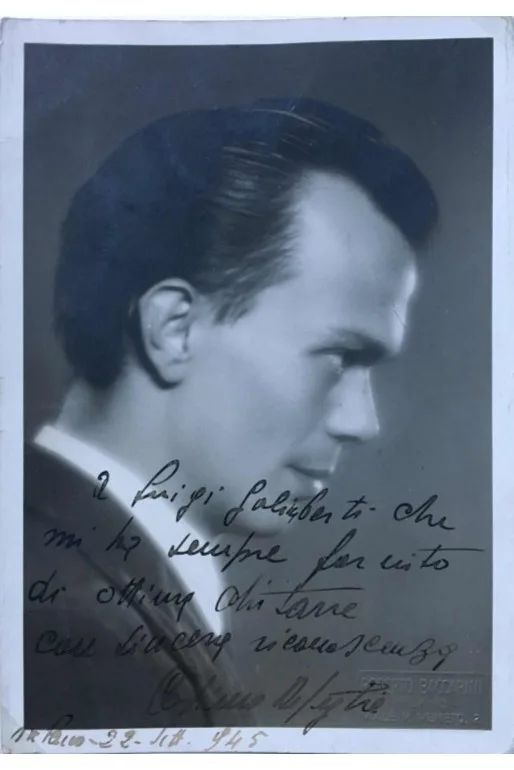
Cosimo Di Ceglie, in a studio portrait photograph carrying his own handwritten dedication to luthier Luigi Galimberti, dated 1945. CC BY-SA 4.0 (Creative Commons Attribution-ShareAlike 4.0 International) — Wikimedia Commons, File:Cosimo Di Ceglie a Luigi Galimberti.jpg, uploaded by Commons user IlTaglia as own work, 31 January 2018.

Cosimo Di Ceglie was born on October 21, 1913, in Andria, in Italy's Puglia region. He started out playing in his hometown's municipal band before moving to Milan in the mid-1930s, where he became the guitarist for fellow Apulian singer Mario Latilla. In the same period he recorded with bandleader Piero Rizza and with the Orchestra del Circolo Jazz Hot di Milano, a Milanese hot-jazz-club orchestra, and joined American trombonist Herb Flemming's touring group — Flemming, a veteran of international jazz revues who had toured Europe, South America and China, brought an internationally seasoned jazz band through Italy in the early-to-mid 1930s. Di Ceglie's work from this period, credited under his own name and alongside these groups, runs from 1936 to 1938.
Around 1938 he co-founded a small combo with pianist Enzo Ceragioli and accordionist Gorni Kramer — the musician who would go on to become, in the words of this vault's own Aldo Rossi profile, "Italy's most important interwar jazz bandleader." Sometimes expanded to a quintet, the group recorded original Italian-language arrangements of American swing repertoire between 1938 and 1941, including 1939's "China Boy," which added alto saxophonist Aldo Rossi and drummer Giuseppe "Pinun" Ruggeri to the core trio. (The group recorded and toured under more than one billing across this period, including one now-disowned period name reflecting American jazz-imitation naming conventions of 1930s Europe; it is preserved for cataloging accuracy in discography-full.md and discussed in cosimo-di-ceglie_notes.md, not repeated here.) During World War II, Di Ceglie stayed active on Italian radio, leading a six-piece ensemble.
Beginning in 1939, alongside his own performing career, Di Ceglie started composing songs for other artists, mostly with lyricist Gian Carlo Testoni. His most historically resonant credits as a songwriter date from 1942: "Quando l'organo suona" (lyrics by Nisa), recorded by the vocal group Quartetto Cetra; "La barca dei sogni" (lyrics by Testoni), recorded by Caterinetta Lescano of the Trio Lescano; and "Oi Marì, oi Marì" (lyrics by Nisa), recorded by the Trio Lescano itself and reissued for years afterward across multiple countries and languages — Discogs documents period pressings in German ("Oh Marie"), Dutch, and other European markets running into the mid-1940s. He returned to songwriting for two Sanremo Music Festival entries: "Buona sera" (1953, lyrics by Maria Evangelisti Tumminelli), sung by Carla Boni and Flo Sandon's, and "Splende l'arcobaleno" (1960), sung by Wilma De Angelis and Gloria Christian. Other songs of his were recorded by Peppino di Capri ("Lady," 1960) and, as late as 1975, by the group Homo Sapiens ("Ballerina").
Di Ceglie also kept recording and performing under his own name and as a bandleader for decades after the war — 78 rpm records, 45 rpm singles and EPs on the Parlophon, Columbia, Music and Sahara labels running from the 1940s into the 1960s and beyond, several under banners such as "Cosimo Di Ceglie e la Sua Orchestra," "e il Suo Quintetto" and "e il Suo Complesso." His English Wikipedia entry, sourced to jazz historian Adriano Mazzoletti's article on Di Ceglie in The New Grove Dictionary of Jazz (2nd edition, ed. Barry Kernfeld), also credits him with later work alongside Adriano Celentano. He died in Milan on August 23, 1980, and is buried in the city's Cimitero Maggiore.
Di Ceglie's documented jazz significance is concentrated in a specific, real window: the mid-1930s to 1941, when he moved through Milan's small international jazz circuit — Herb Flemming's touring American jazz band, the Circolo Jazz Hot di Milano, and the Kramer/Ceragioli combo that adapted American swing standards for Italian audiences. Even Mazzoletti's own Grove Dictionary entry (reproduced closely in Di Ceglie's Discogs artist profile) frames the postwar decades as a separate, "less active" chapter as a jazz performer — a framing this profile preserves rather than blurs. That combo's guitar-piano-accordion instrumentation and small-group format sit inside the same European hot-club/gypsy-jazz-adjacent lineage documented elsewhere on Discogs: one of the trio's period recordings was anthologized decades later on Saga's Jazz À La Gitane Vol. 2 — Gypsy Jazz Around The World (2003).
What follows that window is a long, well-documented second career, distinct in character rather than a continuation of the same jazz identity: four decades as a prolific composer of mainstream Italian song repertoire (Sanremo Festival entries, hits recorded by the Trio Lescano and Quartetto Cetra) and as a working studio and dance-band guitarist across Italian light-music labels. Italian Wikipedia's own genre classification for him reflects exactly this split, tagging him with both "Jazz" and "Musica leggera" (light music). This profile does not treat that second career as diminishing his jazz standing during the period that earned him the Grove Dictionary entry, but it is disclosed honestly here rather than folded into an unqualified "jazz career" spanning his whole working life.
- "China Boy" (1939) — the Kramer/Ceragioli/Di Ceglie combo expanded to a quintet with Aldo Rossi (alto saxophone) and Giuseppe "Pinun" Ruggeri (drums); reissued on Ricordi's 1963 historical anthology 40 Anni di Jazz in Italia, curated by Adriano Mazzoletti. Not found on Spotify. YouTube (uploaded transfer) · Discogs (1963 reissue)
- "Oi Marì, oi Marì" (1942, Cetra) — composed by Di Ceglie with lyrics by Nisa, recorded by the Trio Lescano; reissued for years afterward across several European markets. YouTube (uploaded transfer) Listen
- "La barca dei sogni" (1942/1944, Elektroton) — composed by Di Ceglie with lyrics by Gian Carlo Testoni, recorded by Caterinetta Lescano. Discogs
- "Buona sera" (1953, Cetra) — his 1953 Sanremo Music Festival entry, sung by Carla Boni and Flo Sandon's; eliminated before the final. Discogs
- "Una serata al circo" — a later own-name recording, reissued digitally. Spotify Listen
Cosimo Di Ceglie — Full Discography
Discogs-API-verified. Primary identity: Discogs artist 890329 ("Cosimo Di Ceglie," realname the same, profile text matching the English Wikipedia/Grove Dictionary biography almost verbatim), 232 documented artist-relationship credits across a career running from 1936 into the 1980s. Related group entities resolved to the same person and folded in below: 2506780 ("...E La Sua Orchestra," 30 credits), 2524860 ("...E Il Suo Quintetto," 6 credits), 6689593 ("...E Il Suo Complesso," 4 credits), 1626211 ("tre italiani in america," 3 credits), 4369301 ("Orchestra Del Circolo Jazz Hot Di Milano") and 1340059 ("Orchestra Da Ballo Di Ceglie E Il Suo Ritmo," 17 credits, mostly the 1938-1945 combo era). No Amazon Associates tag has been set up for this vault yet (per this project's standing note); Buy-column links, where given, are plain non-affiliate links.
As Leader — Own Name ("Cosimo Di Ceglie")
All 18 "Main"-role releases documented directly under Discogs artist 890329.
| Year | Title | Label (catalog) | Listen | Buy |
|---|---|---|---|---|
| 1949 | Haway Boogie / Indiana | Parlophon (TT 9297) | not found | not found |
| 1956 | Giuvanne Cu' A Chitarra / Maruzella / Sole Giallo / Piccola Italy / With You / Arrivederci Roma | Parlophon (TT 9854) | not found | not found |
| 1956 | E La Sua Chitarra | Parlophon | not found | not found |
| 1958 | Chitarre Famose | Parlophon | not found | not found |
| 1959 | Maruska / Meridiana / Scettico Blue / Siberiana (EP) | Music (EPM 10156) | not found | not found |
| 1960 | Notte Mia / Splende L'Arcobaleno | Music (2311) | not found | not found |
| 1962 | L'Ultimo Flamenco / L'Inno Goliardico | Sahara (SAH 9015) | not found | not found |
| 1969 | Banjo Man / Mister Dixieland | Carmen Record (CR 603) | not found | not found |
| n.d. | «Themes» Like Old Time / Circus And Variety | Music Scene | not found | not found |
| n.d. | La Chitarra Senza Musica (17 tracks) | Radio Record Ricordi (CSM) | not found | not found |
| n.d. | Rendeira / Pirata / Oslo | Radio Records | not found | not found |
| n.d. | Esistere / Tu Non Puoi Saper | Cooper Records | not found | not found |
| n.d. | Voglio Te / Ma Sei Tu | Cooper Records | not found | not found |
| n.d. | Ai Tempi Di Lautrec / A Las Vegas | Cooper Records | not found | not found |
| n.d. | Nicolaja / Diciottenni In Società | Cooper Records | not found | not found |
| n.d. | Silenzio Per Archi / Dove Sei | Cooper Records | not found | not found |
| n.d. | Io Sono Te / Roma - Paris | Cooper Records | not found | not found |
| n.d. | Preludio Di Un Sogno / No, Non Ritorno Più | Cooper Records | not found | not found |
| n.d. | Smile / Sul Muretto Di Alassio | Parlophon | not found | not found |
Note on "Una serata al circo": this title (Cooper Records, undated on Discogs, filed there as an Appearance credit rather than Main) has a confirmed Spotify album page under Di Ceglie's own name — see Key Recordings in final-profile.md.
As Bandleader — Dance Orchestra, Quintet & Complesso (Postwar)
Three related Discogs entities carry Di Ceglie's postwar dance-orchestra leader credits; representative highlights below, full lists at the linked entity pages.
| Year | Title | Billed As | Label | Discogs |
|---|---|---|---|---|
| 1943 | È Tanto Bello Sognare / Nel Sogno | Cosimo Di Ceglie E La Sua Orchestra | Columbia | 1787040 |
| 1946 | Ripassando La Lezione / Son Pochi Fior... | Cosimo Di Ceglie E La Sua Orchestra | Columbia | 26010418 |
| 1948 | Sotto La Pioggia / Ballerina | Cosimo Di Ceglie E La Sua Orchestra | Parlophon | 2227379 |
| 1954 | Ana | Cosimo Di Ceglie E La Sua Orchestra | Odeon | 20443957 |
| 1961 | Il Mondo Nella Chitarra / Oscurità | Cosimo Di Ceglie E La Sua Orchestra | Arlecchino | 3242291 |
| 1946 | Rumba, Rumba Tabù / La Rumba Della Risata | Cosimo Di Ceglie E Il Suo Complesso | Columbia | 8952785 |
| 1959 | Maruska | Cosimo Di Ceglie E Il Suo Complesso | Music | 11072377 |
| 1943 | Questo Mal d'Amore / Arriva Cosimo | Cosimo Di Ceglie E Il Suo Quintetto | Columbia | 25215574 |
| 1963 | Operetta In Rhythm | (E La Sua Orchestra / E Il Suo Complesso, both credited) | Cetra | 3702076 |
Full entity lists: E La Sua Orchestra (30 credits total, 17 as Main), E Il Suo Quintetto (6 credits), E Il Suo Complesso (4 credits).
The Pre-War & Wartime Jazz Combo, 1938-1941
The historically significant period documented in The New Grove Dictionary of Jazz. Individual 78 rpm sides credited to the trio/quintet with Enzo Ceragioli (piano) and Gorni Kramer (accordion), sometimes expanded with Aldo Rossi (alto saxophone, clarinet) and Giuseppe "Pinun" Ruggeri (drums):
| Year | Title | Label (catalog) | Personnel | Notes |
|---|---|---|---|---|
| 1939 | ...Amare Quando Piove / Notte Blu | Odeon | Kramer/Ceragioli/Di Ceglie combo | Billed "Orchestra Da Ballo Di Ceglie E Il Suo Ritmo." |
| 1939 | Mustafa / Harem | Parlophon | Kramer/Ceragioli/Di Ceglie combo | |
| 1940 | Annie / Montanina | Odeon | Kramer/Ceragioli/Di Ceglie combo | Billed "Orchestra Da Ballo Di Ceglie E Il Suo Ritmo." |
| 1939 | "China Boy" | Fonit (not individually reissued as a dated single; documented via the 1963 and 1996-2005 anthologies below) | Kramer (accordion), Ceragioli (piano), Di Ceglie (guitar), Aldo Rossi (alto saxophone), Giuseppe "Pinun" Ruggeri (drums) | Period billing note: this quintet's contemporary 78 rpm release, and its Discogs artist entity (id 6260708), carry a now-disowned period stage name reflecting 1930s European jazz-imitation naming conventions, reproduced here once, for cataloging accuracy against the label/Discogs record only, and nowhere in final-profile.md or final-blog.md. See cosimo-di-ceglie_notes.md for the full editorial handling, which follows the precedent already set on Aldo Rossi's own discography-full.md in this vault. |
| 1941 | Come Ti Chiami? / Mi Jaca | Odeon | Kramer/Ceragioli/Di Ceglie combo; "Come Ti Chiami?" itself a Di Ceglie composition (lyrics Testoni) sung by Pippo Starnazza | |
| 1941 | Dormi Bambina / Oi Marì | Cetra | Combo/orchestra appearance | Early "Oi Marì" pressing, a year ahead of the better-known 1942 Trio Lescano recording. |
Compilation / Anthology Reissues
| Year | Compilation | Label | Tracks Featuring Di Ceglie | Discogs |
|---|---|---|---|---|
| 1963 | 40 Anni Di Jazz In Italia (curated by Adriano Mazzoletti) | Ricordi (2xLP) | "China Boy," among others from the same Milan hot-jazz circle (also carries Aldo Rossi's "S.O.S." and "Crapa Pelada") | 6927539 |
| 1990 | Jazz And Hot Dance In Italy 1919-1948 | Harlequin | Orchestra Da Ballo Di Ceglie E Il Suo Ritmo track(s) | 7360519 |
| 1996 | Jazz In Italy In The 30's And 40's | Riviera Jazz Records | Quintet-era material, period-billed | 11456131 |
| 1996 | Jazz In Italy In The 30's | Riviera Jazz Records | Quintet-era material, period-billed | 11456377 |
| 2003 | Jazz In Italy In The 30's And 40's — Milano 1939-1947, Volume 3 | Riviera Jazz Records | Quintet-era material | 12703832 |
| 2003 | Jazz À La Gitane Vol. 2 — Gypsy Jazz Around The World | Saga | Trio/quintet-era track | 5228247 |
| 2005 | Jazz In Italy In The 30's And 40's — Milano 1932-1941, Volume 4 | Riviera Jazz Records | Quintet-era material | 13349852 |
| 2008 | Waldeck's Gramophone Vol. 1: Swing & Champagne | Dope Noir | Trio/quintet-era track | 2004334 |
Compositions Recorded By Other Artists (Songwriter Credits)
Sourced from Italian Wikipedia's compositions table, cross-checked against Discogs release data where available.
| Year | Title | Lyrics | Recorded By | Notes |
|---|---|---|---|---|
| 1939 | Bionde e brune | Gian Carlo Testoni | — | His first composition; Testoni's first text as a lyricist. |
| 1941 | Come ti chiami? | Gian Carlo Testoni | Pippo Starnazza | Also released as a Di Ceglie combo 78 (Odeon), see above. |
| 1942 | Quando l'organo suona | Nisa | Quartetto Cetra | Discogs era-adjacent; discography source cites discografia.dds.it, scheda 5070. |
| 1942 | La barca dei sogni | Gian Carlo Testoni | Caterinetta Lescano | Released 1944 on Elektroton (La Barca Dei Sogni / Scherzando Nel Bagno, 29624023) and again 1958 on La Voce Del Padrone (3709491). |
| 1942 | Oi Marì, oi Marì | Nisa | Trio Lescano | Widely reissued: Electrola 1942 (Germany, "Peterle / Oi Marie"), Tempo 1942 ("Schwarze Augen / Oi Marie Oi Marie"), Decca 1943, La Voz De Su Amo 1944 (Spanish market, "¡Oh Mari! ¡Oh Mari!"), Telefunken (undated, "Oh Marie, Oh Marie!"), Cetra (undated, "Oi Mari, Oi Mari / Ciribiribin"), Elektroton (undated, "Una Chitarra Nella Notte / Oi Mari!"). |
| 1953 | Buona sera | Maria Evangelisti Tumminelli | Carla Boni, Flo Sandon's | 1953 Sanremo Music Festival entry; eliminated. Discogs |
| 1960 | Lady | Idalgo Franchini | Peppino di Capri | Discogs (as "Melody From Rome / È Fantastico!," B-side listing varies by pressing) |
| 1960 | Amore abisso dolce | Maria Evangelista Tumminelli | Wilma De Angelis | Discogs |
| 1960 | Splende l'arcobaleno | (Sanremo 1960 entry) | Wilma De Angelis, Gloria Christian | Discogs |
| 1975 | Ballerina | Stefano Scandolara | Homo Sapiens | Discogs master 1101242, no individually dated single release found. |
Later Session / Studio Work (1960s-1980s)
The remaining ~150 Discogs Appearance-role credits under artist 890329 — spanning 1964 to the 1980s across Italian, German, Finnish, Dutch and other European pressings — document Di Ceglie's decades as a working studio guitarist for mainstream pop and light-music sessions, including numerous Adriano Celentano compilation appearances (matching the "later career" credit in his English Wikipedia entry) and Finnish/German-market reissue anthologies of his own earlier songs. Given their number and non-jazz character, they are not itemized individually here; the full list is retrievable directly from Discogs artist 890329.
Spotify / YouTube Availability
No dedicated Spotify artist page could be confirmed for Cosimo Di Ceglie, but one album, Una serata al circo, is confirmed live on Spotify under his name (see Key Recordings in final-profile.md). Two pre-war/wartime recordings ("China Boy," "Oi Marì, oi Marì") were located as uploaded transfers on YouTube via direct search-title matching; neither could be cross-confirmed against a second independent source beyond the search result itself, consistent with this campaign's disclosure standard for 1930s-40s 78 rpm-era material.
Sources
- Discogs API, artist 890329 and the six related group entities named above.
- Italian Wikipedia, raw wikitext of "Cosimo Di Ceglie" (compositions table and 78/45/EP discography section), consulted directly via
action=raw. - SecondHandSongs, work entry for "Buona sera" — https://secondhandsongs.com/work/170025/all
- Enzo Ceragioli (piano) — co-founder with Di Ceglie of the jazz combo that also included Gorni Kramer, active 1938–1941. Not profiled on this site.
- Gorni Kramer (accordion, bandleader) — the third member of the founding combo; went on to become one of Italian light entertainment's most prominent bandleaders. Not profiled on this site or any sibling vault (checked).
- Aldo Rossi (alto saxophone, clarinet) — joined the combo for its 1939 quintet recording of "China Boy," reissued on the same 1963 Mazzoletti anthology documented on both artists' profiles. Profiled separately on this site.
- Herb Flemming (trombone) — American jazz trombonist whose touring international band Di Ceglie joined in the mid-1930s. Not profiled on this site (not an Italian artist and outside this vault's scope).
- Trio Lescano (vocals) — recorded Di Ceglie's "Oi Marì, oi Marì" (1942); group member Caterinetta Lescano separately recorded his "La barca dei sogni" the same year. Not profiled on this site.
- Quartetto Cetra (vocals) — recorded Di Ceglie's "Quando l'organo suona" (1942). Not profiled on this site.
- Nisa (Nicola Salerno, lyricist) — wrote the words for "Quando l'organo suona" and "Oi Marì, oi Marì." Not profiled on this site.
- Gian Carlo Testoni (lyricist) — Di Ceglie's most frequent songwriting partner, credited on his first composition (1939's "Bionde e brune") and "La barca dei sogni" (1942), among others. Not profiled on this site.
- Gianni Basso (tenor saxophone) - tenor saxophonist on the Cosimo Di Ceglie quintet's 1956 Parlophon singles, per Discogs; profiled separately on this site.
More Swing Artists
See all 119 Swing artists →More Italian Jazz Artists
See all 391 Italian artists →- Cosimo Di Ceglie, English Wikipedia
- Cosimo Di Ceglie, Italian Wikipedia
- Cosimo Di Ceglie on Discogs
- Cosimo Di Ceglie on jazzprofiles.com
- r/ItalianJazz
- "Cosimo Di Ceglie," English Wikipedia, citing Adriano Mazzoletti's entry on Di Ceglie in The New Grove Dictionary of Jazz, 2nd edition, ed. Barry Kernfeld — https://en.wikipedia.org/wiki/Cosimo_Di_Ceglie
- "Cosimo Di Ceglie," Italian Wikipedia (raw wikitext consulted directly), citing Gino Castaldo (ed.), Dizionario della canzone italiana (Curcio, 1990), and Eddy Anselmi, Festival di Sanremo: Almanacco illustrato della canzone italiana (Panini) — https://it.wikipedia.org/wiki/Cosimo_Di_Ceglie
- Discogs API, artist 890329 ("Cosimo Di Ceglie"), for identity, name variations, group affiliations and the 232-item release-credit history; related group entities 2506780 ("...E La Sua Orchestra"), 2524860 ("...E Il Suo Quintetto"), 6689593 ("...E Il Suo Complesso"), 1626211 ("tre italiani in america"), 4369301 ("Orchestra Del Circolo Jazz Hot Di Milano") and 1340059 ("Orchestra Da Ballo Di Ceglie E Il Suo Ritmo").
- Aldo Rossi's own jazzprofiles.com profile and
discography-full.md(O-output/54-aldo-rossi-spotlight), for the independently-documented 1939 "China Boy" personnel connection. - "Herb Flemming," English Wikipedia, for independent confirmation of Flemming's international touring career and Italian dates — https://en.wikipedia.org/wiki/Herb_Flemming
- Wikimedia Commons, File:Cosimo Di Ceglie a Luigi Galimberti.jpg, for the portrait used in this profile (see
media.md). - SecondHandSongs, work entry for "Buona sera" (Cosimo Di Ceglie / Maria Tumminelli), for Sanremo 1953 credit confirmation — https://secondhandsongs.com/work/170025/all