 JAZZPROFILES lives in the music 1,572 Jazz Artists fully Profiled!
 Bina Coquet
Last updated September 12, 2026
Listen on Spotify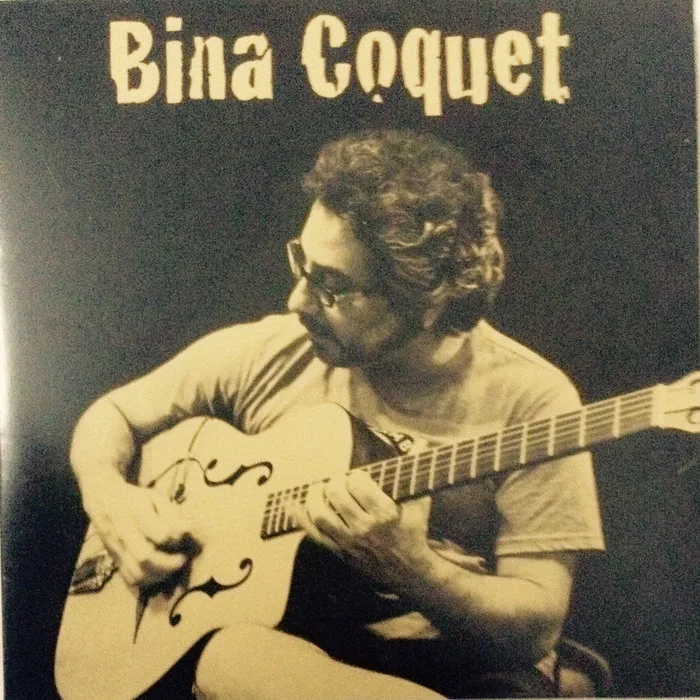
Cover art for Bina Coquet's self-titled album "Bina Coquet" (2016), used as a stand-in — no free-licensed photo of Coquet could be located after a genuine search. Standard copyright, all rights reserved — held by the artist. This is not a Creative Commons–licensed image; it is used here as an honestly-disclosed editorial stand-in for a real photo. — Downloaded directly from the artist's own Bandcamp page (https://binacoquet.bandcamp.com/album/bina-coquet-2016), full-resolution artwork at f4.bcbits.com. Saved locally as portrait.jpg in this folder.
Bina Coquet — born Vinicio Dutra Coquet in Rio de Janeiro in 1973, and raised in São Paulo from before his first birthday — picked up his first guitar at age ten and turned professional twenty years later, in 1994. His first recording, Som da Demo, was a 1995 SESC session credited to "Vinicio Bina Quinteto," working in Brazilian popular styles years before gypsy jazz entered his vocabulary.
The project that first put him on record in a lasting way was a duo with organist Ehud Asherie, billed simply as Bina & Ehud. Asherie — an Israeli-born, New York-raised pianist who studied at Smalls Jazz Club under the late Frank Hewitt and has since been called "a master of swing and stride" by The New Yorker, recording and performing with players like Harry Allen, Peter Bernstein, and Clark Terry — gave the partnership real jazz-scene weight. Together they cut two albums for the São Paulo label Urban Jungle Records, Samba De Gringo (2005) and Samba De Gringo 2 (2007), blending jazz-funk organ trio instincts with samba and MPB repertoire (João Donato, Marcos Valle, Jobim, Luiz Gonzaga) alongside originals credited to both men. Samba De Gringo 2 also brought in the well-known Brazilian singer Céu as a guest vocalist, and a track from the first album, "Hudi's Blue," was later licensed to the German label Agogo Records for a 2011 split 7" single.
Around 2009, Coquet heard a recording by the Brazilian guitarist Garoto that reminded him of Django Reinhardt, and the discovery sent him back to the source. He began serious study of gypsy jazz in 2010, buying his first manouche-style guitar while living in New York around 2010–2011 and developing an early version of the project under the working name "Batuque Manouche." The genre became his main focus for the rest of the decade: he is described in Brazilian and international coverage as the leading gypsy jazz guitarist in the country, and reportedly the first Brazilian musician to take the style to specialized manouche festivals abroad. That work came together on his self-titled 2016 album, Bina Coquet, released on Hot Club Records — the Norwegian label run by guitarist Jon Larsen and dedicated specifically to gypsy jazz — pairing seven originals with five Brazilian standards reworked in Django's two-finger picking idiom.
The years that followed took him onto the international manouche circuit: the Django Amsterdam Gypsy Jazz Festival (2017), Django Northwest Fest (2018), and Django Fest Mill Valley in California (2019), plus dates in Belgium, France, Canada, Paraguay, and Uruguay. Closer to home, he credits the Piracicaba jazz manouche festival and the group Hot Club de Piracicaba — the first Brazilian act to land a track on Jon Larsen's Hot Club Records — with helping build Brazil's still-small gypsy jazz scene. Coquet recorded "Sweet Georgia Brown" with Hot Club de Piracicaba and the American guitarist Richard Smith (a University of Southern California Thornton School of Music faculty member and respected manouche player) for the various-artists compilation Django Festival 11: The Best of Gypsy Jazz Today (2018). He has also worked repeatedly with the Romanian-born, São Paulo-based violinist Florian Cristea — a classically trained player from a family of Roma musicians who joined the São Paulo State Symphony Orchestra and has lived in Brazil for two decades — documented on the studio album Conexão (2021) and the live album Live In USA (2023), the latter drawn partly from their 2019 Django Fest Mill Valley performance.
Most recently, Coquet has pivoted back toward Brazilian roots music without leaving jazz manouche fully behind: the EP Como Uma Onda (2023), the forró-and-Brazilian-rhythms album Psicotrópico (December 2024, recorded with a backing project of the same name alongside Tiago Mecatti), a hand-lathe-cut, one-of-one 7" single called "Forró Psico" (2024, on the Brazilian boutique label Reco-raros), and the 19-track Bina Coquet e Falsos Baianos (released December 2025), which folds gypsy-jazz technique into forró, baião, and other regional Brazilian forms. Spotify's artist page also lists several further 2025–2026 singles and albums (including Sonhando Com Peru, Manhã de Carnaval, Anos 90 Solo, and Até Quando?) that this profile has not independently verified track-by-track against a second source; they are noted here rather than detailed, in keeping with this profile's standard of not asserting more than can be confirmed.
Coquet's signature move is running Django Reinhardt's gypsy jazz vocabulary — the two-finger picking attack, the rhythmic "la pompe" comping, the minor-key harmonic language — through the rhythms of his own country: samba, choro, frevo, baião, and forró all surface inside otherwise orthodox manouche arrangements, a combination reviewers and festival programmers single out as distinctly his own. That fusion took shape gradually rather than all at once: his earlier work with Ehud Asherie sat in a samba-jazz-funk lane closer to the Hammond organ combo tradition, and it was a chance encounter with a Garoto recording around 2009 that pulled him toward Django specifically. Since then his working circle has been telling — a New York stride-and-swing pianist, a classically trained Romanian violinist steeped in Roma folk music, an American manouche specialist teaching at a U.S. conservatory — a cross-section that places him inside the actual international gypsy jazz scene rather than adjacent to it. His most recent records lean further back into home ground, using the same technical vocabulary to reinterpret forró and baião rather than French-style swing standards.
- Samba De Gringo (2005, Urban Jungle Records, as Bina & Ehud) - Debut album-length recording, a samba/jazz-funk duo project with pianist-organist Ehud Asherie; mixes Brazilian standards with originals co-credited to both musicians. No confirmed streaming/Spotify release located; verified via Discogs and Bandcamp.
- Bina Coquet (2016, Hot Club Records) - Self-titled gypsy jazz debut as a leader, on Norwegian guitarist Jon Larsen's genre-specialist label; seven originals and five reworked Brazilian classics. Confirmed via Bandcamp; a same-title entry appears on Coquet's Spotify artist page but this profile could not independently open a distinct Spotify album URL for it, so no Spotify link is asserted here.
- Conexão (2021) - Studio album with Romanian violinist Florian Cristea, bassist Danilo Vianna Castro, and guitarist José Fernando; recorded live at Estúdio Conexão, São Paulo, September 2020. Confirmed via Bandcamp. Buy
- Live In USA (2023) - Live album, all seven tracks featuring Florian Cristea, including a recording from the 2019 Django Fest Mill Valley performance. Spotify - Live In USA Listen
- "Sweet Georgia Brown," on Django Festival 11: The Best of Gypsy Jazz Today (2018, various artists) - Recorded with Hot Club de Piracicaba and American guitarist Richard Smith; a compilation-track credit rather than a leader release, but the clearest documented evidence of Coquet's standing within the international gypsy jazz festival circuit.
Bina Coquet: Full Discography
Identity confirmed via Discogs artist ID 1394022 ("Bina Coquet") and its linked duo entity, artist ID 1394026 ("Bina & Ehud," with Ehud Asherie). Discogs' catalog for this artist covers only the 2005–2024 releases below; the 2016 solo debut and everything from 2021 onward is drawn from the artist's own Bandcamp catalog and Spotify presence (cross-checked against each other), since Discogs has not indexed them as of this research pass (August 2026).
As Leader / Co-Leader
| Album Title | Recording Date(s) | Release Date | Label | Catalog Number | Format(s) | Personnel | Role | Reissue History | Spotify | Buy | Notes |
|---|---|---|---|---|---|---|---|---|---|---|---|
| Samba De Gringo (as Bina & Ehud) | Not specified in Discogs data | 2005 | Urban Jungle Records | UJR-005 | CD, Album | Bina Coquet (guitar, producer, mixed by; co-writer "Alligator Bossa Nova," "Sambanoise," "Blues Pro Wes"); Ehud Asherie (co-producer, Hammond B3/C3 organ, Fender Rhodes; writer "Hudi's Blue"); Edu Ribeiro (drums, tracks 1,4,5,8,9,10); Phil Stewart (drums, tracks 2,3,6,7); Luis Cavalcanti (bass); Walmir Gil (trumpet, flugelhorn); François De Lima (valve trombone); Rubinho Lima (cuica) | Co-leader (duo billing) | "Hudi's Blue" (track 1) later licensed to Agogo Records (Germany) for a 2011 split 7" single with Nenè Vasquez — see below | Not confirmed on Spotify | Bandcamp | Genres per Discogs: Jazz, Latin, Funk/Soul. Mix of Brazilian standards (João Donato, Marcos Valle, Jobim/Aloysio de Oliveira, Luiz Gonzaga) and originals |
| Samba De Gringo 2 (as Bina & Ehud) | Live at Mosh Studio, São Paulo, Feb 22-23, 2006 | 2007 | Urban Jungle Records | UJR 007 | CD, Album | Bina Coquet (7-string guitar, cavaquinho tracks 1&4, shaker, producer, mixed by, mastered by tracks 6-7; writer "Boteco Furacão"); Ehud Asherie (Hammond B3 organ; writer "Forró No Harlem," "Hudi's Samba," title track); Celso De Almeida & Wilson Das Neves (drums); Céu, Dona Inah (guest vocals, track 5); Memeu Cabral (zabumba) | Co-leader (duo billing) | None found | Not confirmed on Spotify | Bandcamp | Genres per Discogs: Jazz, Latin; styles Bossanova, Samba, MPB. Guest vocalist Céu is a well-known Brazilian singer |
| Bina Coquet (self-titled) | Not specified | 2016 | Hot Club Records | Not listed in Discogs (not Discogs-catalogued) | Digital/Streaming, Album | Personnel not fully itemized in available sources; credited collaborators per WebFetch of the album's own Bandcamp page description include de Syllos, Grajew, Teixeira, and Ehud Asherie | Leader | None found | Listed as an album on the artist's Spotify page, but no distinct Spotify album URL was independently located/opened for this title — treat as unconfirmed on Spotify specifically | Bandcamp | Gypsy-jazz debut as leader; 12 tracks, 7 originals + 5 Brazilian classics reworked in Django Reinhardt idiom. Label is Jon Larsen's Norwegian gypsy-jazz specialist imprint |
| Conexão | Live at Estúdio Conexão, São Paulo, Sept 2020 (track 8 live at Django Fest Mill Valley, CA, 2019) | 2021-04-16 | Not specified (independent/self-released) | None found | Digital/Streaming, Album | Bina Coquet (guitar); Florian Cristea (violin); Danilo Vianna Castro (acoustic bass); José Fernando (rhythm guitar, tracks 1,2,4,5,9) | Leader | None found | Not confirmed on Spotify | Bandcamp | 9 tracks; includes two takes of "Se Você Se Acha" and both a studio and Mill Valley-live version of "O Rato Na Boca Do Gato" |
| Live In USA | Includes a track recorded live at Django Fest Mill Valley, CA, 2019 | 2023 | Not specified (independent/self-released) | None found | Digital/Streaming, Album | Bina Coquet (guitar); Florian Cristea (violin, featured on all 7 tracks) | Leader | None found | Spotify - Live In USA | Not located | 7 tracks, all live, all featuring Florian Cristea; overlaps repertoire with Conexão ("Pagode Russo," "Sonhos De Um Louco," "Se Você Se Acha," "O Rato Na Boca Do Gato") |
| Como Uma Onda (EP) | Not specified | 2023-05-20 | Not specified (independent/self-released) | None found | Digital/Streaming, EP | Bina Coquet; Florian Cristea (feat. on "Se Você Se Acha") | Leader | None found | Title track confirmed as a Spotify single/cover; full EP not independently opened on Spotify | Bandcamp listing found via search | 4 tracks: "Como Uma Onda" (a Lulu Santos/Nelson Motta cover), "Se Você Se Acha" (feat. Florian Cristea), "Pé De Valsa" (live in Ireland), "Pagode Russo" (live in USA) |
| Psicotrópico | Not specified | 2024-12-01 | Not specified (billed with backing project "Psicotrópico," incl. Tiago Mecatti) | None found | Digital/Streaming, Album | Bina Coquet with the "Psicotrópico" project / Tiago Mecatti | Leader | Track "Forró Psico" also issued as a standalone hand-pressed 7" single the same year (see below) | "Forró Psico" track confirmed via Spotify search (track ids 4tyLDYaS1owBIGNw0N9Ftn and 5AckGRx0rYeZgXlFyhUcvD, credited "Psicotrópico, Bina Coquet, Tiago Mecatti") — full album not independently opened on Spotify | Bandcamp | 11 tracks blending forró, baião, carimbó, cumbia, lambada, piseiro, and gypsy/manouche technique |
| Bina Coquet e Falsos Baianos | Not specified | 2025-12-25 | Not specified (independent/self-released) | None found | Digital/Streaming, Album | Bina Coquet (manouche guitar, 12-string guitar, added percussion, mixing, mastering); Nando Vicencio (double bass, mixing); Marcos Magaldi (percussion); Mauro Rabello (recording engineer, mixing) | Leader | None found | Not confirmed on Spotify | Bandcamp | 19 tracks, incl. Brazilian standards ("Tico Tico No Fubá," "Carinhoso," "Doralice") reworked alongside originals; most recent full-length release as of this research pass |
Singles (standalone)
| Year | Title | Label | Format | Spotify | Notes |
|---|---|---|---|---|---|
| 2011 | Hudi's Blue / Mi Historia Del Son (split 7", w/ Nenè Vasquez) | Agogo Records (Germany), AR 030 VL | Vinyl, 7", 45 RPM | Not found | Side A is a licensed reissue of the Samba De Gringo track "Hudi's Blue" (Bina & Ehud: Bina Coquet guitar, Ehud Asherie Hammond B3, Edu Ribeiro drums); Side B is Nenè Vasquez's "Mi Historia Del Son (Mo' Horizons Restyle)," not a Bina Coquet recording. Confirmed via Discogs (release 2887140 / master 695091); YouTube video for Side A confirmed: youtube.com/watch?v=hPlEVoeSAog |
| 2023 | Se Você Se Acha | Not specified | Digital, Single | Spotify - Se Voce Se Acha | Standalone single reissue of the song from the 2016 self-titled album and Conexão |
| 2024 | Forró Psico | Reco-raros (run by Arthur Joly) | Vinyl, 7", 33⅓ RPM, hand-lathe-cut, edition of 1 ("edição única 1/1," wax-stamped generic sleeve per Discogs notes) | Spotify - Forró Psico | B-side "Depoimento." One-off collector's item, not a normal commercial pressing — confirmed via Discogs (release 33328182). Same track also appears on the Psicotrópico streaming album (Dec 2024) |
As Guest / Compilation Appearance
| Year | Project (Leader/Artist) | Title | Role | Notes |
|---|---|---|---|---|
| 2018 | Various Artists | Django Festival 11: The Best of Gypsy Jazz Today | Guest guitar | "Sweet Georgia Brown," recorded with Hot Club de Piracicaba and American guitarist Richard Smith; confirmed via Spotify search (album open.spotify.com/album/52JBWffiW2CBkwL0L6Vjxv), not independently opened track-by-track |
Not independently verified — listed for transparency only
Spotify's artist page (open.spotify.com/artist/6SDClpISGcDhTXFcPuCclR) lists several further recent entries this research pass could not independently confirm against a second source in the time available: singles "Sonhando Com Peru" (2024), "Dedada do Papai" (2025), "Manhã de Carnaval" (2025), "Sonhos de um Louco" (2025), and albums "Anos 90 Solo," "Baião de Cinco," "Até Quando?," and "Cissy Strut Oxente" (all listed 2026). These are plausible given Coquet's active, prolific recent output but are not itemized in the leader table above pending confirmation.
Not found / dropped from this profile
- "Bipolar" — named as a track title in the previous version of this profile's biography prose. No trace of this title was found on Bandcamp, Spotify, Apple Music, Discogs, or general web search under Bina Coquet's name. Treated as unverifiable and dropped rather than restated.
- Vinicio Bina Quinteto — "Som da Demo" (SESC, 1995) — Coquet's reported first recording per one Portuguese-language biographical source; not found in Discogs under any of his artist entries and not independently corroborated by a second source. Mentioned in the biography prose with that sourcing caveat, not included in the table above.
- Ehud Asherie - pianist/organist; co-billed duo partner as "Bina & Ehud" on Samba De Gringo (2005) and Samba De Gringo 2 (2007); a recognized New York swing-and-stride specialist in his own right.
- Florian Cristea - Romanian-born, São Paulo-based classical/gypsy-jazz violinist; recurring duo/trio partner on Conexão (2021) and Live In USA (2023), and on international festival dates including Django Fest Mill Valley (2019).
- Richard Smith - American gypsy-jazz guitarist and USC Thornton School of Music faculty member; recorded "Sweet Georgia Brown" with Coquet and Hot Club de Piracicaba for the Django Festival 11 compilation (2018).
- Hot Club de Piracicaba - Brazilian manouche group (founded 2008 by Fernando Seifarth, Marcos Monaco, and Cidão Lima) whose Piracicaba festival scene Coquet credits as central to Brazil's gypsy jazz development; recurring collaborators on stage and record.
- Céu - guest vocalist on Samba De Gringo 2 (2007), track "A Flor E O Espinho."
- Wilson Das Neves - veteran Brazilian drummer, credited on Samba De Gringo 2 (2007).
More Gypsy Jazz Artists
See all 18 Gypsy Jazz artists →More Brazilian Jazz Artists
See all 20 Brazilian artists →- Discogs: Bina Coquet (artist 1394022) — verified via live API
- Discogs: Bina & Ehud (artist 1394026) — verified via live API
- Bina Coquet Bandcamp
- Blog do Inglez de Souza: "Bina Coquet: jazz manouche com ginga brasileira" (2017, Portuguese) — primary biographical source for early career and real name
- AllMusic: Bina Coquet — listed for reference; page blocked WebFetch access (403), not independently read
- All About Jazz: Bina Coquet — listed for reference; page blocked WebFetch access (403), not independently read
- Ehud Asherie — Wikipedia
- Richard Smith (American guitarist) — Wikipedia
- Spotify artist page: Bina Coquet