 JAZZPROFILES lives in the music 1,572 Jazz Artists fully Profiled!
 Richard Galliano
Last updated September 26, 2026
Listen on Spotify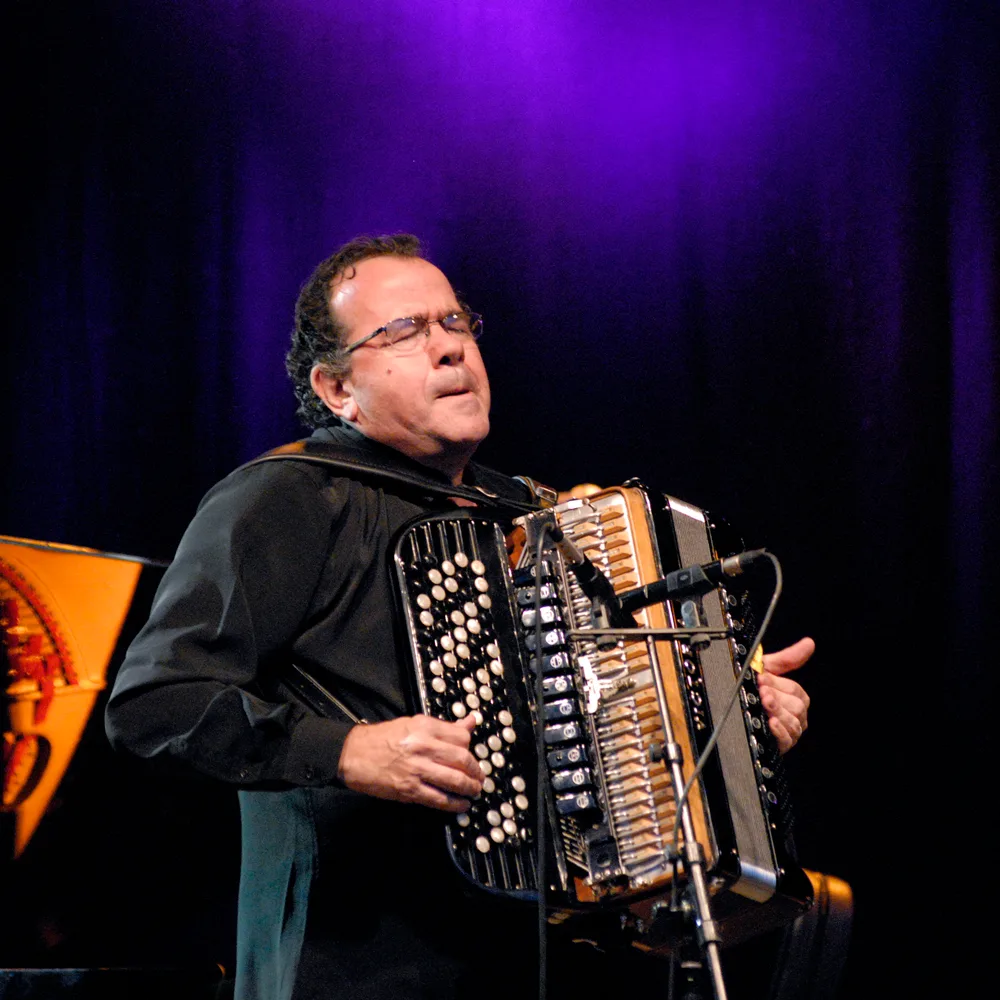
Richard Galliano performing in Stockholm, July 2009 CC BY-SA 3.0 — Wikimedia Commons — https://commons.wikimedia.org/wiki/File:RichardGalliano_Stockholm20090715.jpg

Richard Galliano was born December 12, 1950, in Cannes, France, to a family of Italian heritage. His father, Luciano Galliano, was an accordionist who had emigrated from Italy and settled in Nice, and it was Luciano who put the instrument in his son's hands at age four. As a teenager Galliano broadened his formal training considerably, studying trombone, harmony, and counterpoint at the Nice Conservatoire (the Academy of Music in Nice) alongside his accordion lessons — a classical grounding that would later let him move fluently between jazz, tango, and orchestral writing.
At fourteen, searching for ways to push the accordion beyond its traditional French repertoire, Galliano discovered jazz through recordings of trumpeter Clifford Brown. "I copied all the choruses of Clifford Brown," he later said, "impressed by his tone and his drive, his way of phrasing over the thunderous playing of Max Roach." It was a formative realization: the accordion, at the time, had essentially no presence in jazz at all, and the idea of building one took hold early. In 1966 and 1967 he won first prize at the World Accordion Cup competition in both Spain and France; in the Spanish round, the mandatory piece was a "Chaconne" written by the Israeli accordionist Yehuda Oppenheimer, and the two musicians stayed in touch as friends and occasional collaborators until Oppenheimer's death in 2012.
Galliano moved to Paris in 1973. He soon became a key member of chanson star Claude Nougaro's band, working as both pianist and accordionist through a run of live recordings between 1977 and 1983, and built a reputation as an in-demand session and touring musician across French popular music — appearing over the following decades on records by Charles Aznavour, Juliette Gréco, Francis Cabrel, and dozens of others, alongside jazz and improvised-music dates with Michel Portal, Enrico Rava, Chet Baker, and Anouar Brahem. In 1983 he met the Argentine bandoneon master Astor Piazzolla, the architect of tango nuevo, and the two developed a friendship and mutual respect that would redirect Galliano's career. In 1991, on Piazzolla's direct advice, Galliano returned to the traditional French repertoire he had grown up with — waltzes, javas, tangos, and ballads — and began opening it to jazz improvisation, doing for musette roughly what Piazzolla had done for Argentine tango a generation earlier. The Académie du Jazz recognized the new direction in 1993 with the Prix Django Reinhardt, awarded to the French jazz musician of the year.
The high-water mark of that reinvention came in 1996, when Galliano crossed the Atlantic to record New York Tango at Clinton Recording Studios with bassist George Mraz, drummer Al Foster — whose own career is covered in full in his JazzProfiles.com profile — and guitarist Biréli Lagrène. The album won Galliano the Victoire de la Musique Jazz, France's top jazz honor, in 1997; he won it again the following year for Blow Up, a duo record with Michel Portal. Those two prizes, a decade after Piazzolla's advice sent him back to his roots, marked the point at which Galliano was fully established as the accordion's leading ambassador in modern jazz.
In the 2000s Galliano formed the trio that would become his longest-running and most celebrated jazz project: Mare Nostrum, with Swedish pianist Jan Lundgren — whose own career is covered in full in his JazzProfiles.com profile — and Sardinian trumpeter Paolo Fresu. The group's name, Latin for "our sea," reflected its guiding idea of a shared Mediterranean musical language distributed across three home countries. The debut Mare Nostrum appeared in 2007 on the German label ACT, followed by Mare Nostrum II in 2016, Mare Nostrum III in 2019, and — after sessions recorded in France in the fall of 2024 — Mare Nostrum IV in March 2025, giving the trio an active recording life spanning nearly two decades.
Around the same time, Galliano opened an entirely different chapter by signing to Deutsche Grammophon, becoming, by his own label's account, the only accordionist ever to record for the storied classical imprint. The result was a run of composer-focused albums recast for accordion and small ensemble: Bach (2010), recorded at Notre-Dame-du-Liban in Paris; Nino Rota (2011), made for the film composer's centenary with a jazz quintet including saxophonist John Surman and trumpeter Dave Douglas; Vivaldi (2013), a reworking of The Four Seasons for accordion and string quartet; and Mozart (2016). Across a recording career now spanning more than six decades, Galliano has released over 70 albums under his own name — solo, duo, trio, and orchestral — on labels including Dreyfus, ACT, Milan, CAM Jazz, Resonance, and Deutsche Grammophon, and has appeared as a collaborator with an extraordinarily wide range of artists, from Ron Carter and Wynton Marsalis to Toots Thielemans and Charles Aznavour. In a further honor unusual even by jazz standards, the asteroid 121022 Galliano was named for him.
Galliano's playing rests on two poles that rarely meet in one musician: a classical training rigorous enough to carry Bach and Vivaldi on solo accordion, and a jazz vocabulary built from transcribing Clifford Brown's bebop lines note for note as a teenager. What made him a historic figure rather than simply a virtuoso was the 1991 decision, urged on by Astor Piazzolla, to stop treating French musette as a closed folk tradition and instead open it to improvisation, extended harmony, and swing — the same move Piazzolla had made with Argentine tango decades earlier. The result is a sound that moves comfortably between smoky Parisian waltz, New York-style tango-jazz, and Mediterranean lyricism with Fresu and Lundgren, without ever losing the specific vocabulary — musette's rolling left-hand bass, the bandoneon's breath-like phrasing — that keeps his playing recognizably his own even inside a classical concerto.
- New York Tango (1996, Dreyfus Jazz) - With George Mraz, Al Foster, and Biréli Lagrène; won the Victoire de la Musique Jazz in 1997. Spotify - New York Tango Listen
- Mare Nostrum (2007, ACT) - The debut of his long-running trio with Jan Lundgren and Paolo Fresu. Spotify - Mare Nostrum Listen
- Bach (2010, Deutsche Grammophon) - His first classical album for DG, recorded at Notre-Dame-du-Liban in Paris. Spotify - Bach Listen
- Nino Rota (2011, Deutsche Grammophon) - A jazz-quintet tribute for Rota's centenary, with John Surman and Dave Douglas. Spotify - Nino Rota Listen
- Mare Nostrum IV (2025, ACT) - The trio's most recent album, recorded in France in fall 2024, extending the project's run past nearly two decades. Spotify - Mare Nostrum IV Listen
Richard Galliano: Full Discography (Leader, Selected Major Releases)
Identity confirmed via the live Discogs API: artist ID 258802 ("Richard Galliano"), profile text matches — born December 12, 1950, Cannes — with no collision against the artist's many separate Discogs group-entity IDs (Richard Galliano Septet, Richard Galliano Quartet, Richard Galliano Trio, Richard Galliano New York Trio, Mare Nostrum (2), etc.). Galliano has recorded more than 70 albums as leader since 1979; this table covers his major leader/co-leader releases across eras, each independently verified against Discogs master and release data. Not itemized exhaustively.
As Leader / Co-Leader
| Album Title | Recording Date(s) | Release Date | Label | Catalog Number | Format(s) | Personnel | Role | Reissue History | Spotify | Buy | Notes |
|---|---|---|---|---|---|---|---|---|---|---|---|
| Panamanhattan | Recorded live, July 23, 1990, Fnac Montparnasse, Paris | 1991 | Dreyfus Jazz | FDM 36514.2 | CD, Album | Richard Galliano (accordion), Ron Carter (double bass) | Co-leader (duo) | None found | YouTube - Panamanhattan (Full Album) | — | Billed to "Ron Carter and Richard Galliano"; live duo recording. Not found on Spotify or Bandcamp; full album verified on YouTube |
| Laurita | Recorded Nov. 1994, Studio Ferber; mixed Jan. 1995, Studio Plus XXX | 1995 | Dreyfus Jazz (Disques Dreyfus) | FDM 36572-2 | CD, Album | Richard Galliano (accordion, arranger, composer), Michel Portal (bass clarinet), Didier Lockwood (violin), Toots Thielemans (harmonica), Palle Danielsson (bass), Joey Baron (drums) | Leader | None found | Spotify - Laurita | — | |
| New York Tango | Recorded June 11-13, 1996, Clinton Recording Studios, New York | 1996 | Dreyfus Jazz | FDM 36 581.2 | CD, Album, Digipak | Richard Galliano (accordion), George Mraz (bass), Al Foster (drums), Biréli Lagrène (guitar) | Leader | None found | Spotify - New York Tango | — | Won the Victoire de la Musique Jazz, 1997 |
| Blow Up | Not specified in Discogs data | 1997 | Dreyfus Jazz | FDM 36589-2 | CD, Album | Richard Galliano (accordion, piano), Michel Portal (bandoneon, bass clarinet, clarinet, soprano sax, jazzophone) | Co-leader (duo) | None found | Spotify - Blow Up | — | Duo with Michel Portal; won Galliano a second Victoire de la Musique Jazz, 1998 |
| French Touch | Recorded May 8-10 and June 8, 1998 | 1998 | Dreyfus Jazz | FDM 36596-2 | CD, Album | Richard Galliano (accordion, accordina, producer), Michel Portal (soprano sax), Jean-Marie Ecay (acoustic guitar), J.-F. Jenny-Clark / Rémi Vignolo (double bass), André Ceccarelli / Daniel Humair (drums) | Leader | Reissued/expanded as a bonus-track streaming edition | Spotify - French Touch | — | Streaming edition carries a later catalog date; original CD is 1998 |
| Mare Nostrum | Recorded January 7-11, 2007 | 2007 | ACT | ACT 9466-2 | CD, Album | Richard Galliano (accordion, bandoneon), Jan Lundgren (piano), Paolo Fresu (trumpet, flugelhorn) | Co-leader (trio) | None found | Spotify - Mare Nostrum | — | Debut of the Mare Nostrum trio; billed on Spotify to Fresu/Galliano/Lundgren jointly |
| Bach | Recorded Sept. 1-2, 2009, Notre-Dame-du-Liban, Paris | 2010-04-12 | Deutsche Grammophon | 480 3341 | CD, Album | Richard Galliano (accordion, bandoneon, accordina, composer), Raphaël Pidoux (cello), Stéphane Logerot (double bass), Jean-Marc Apap (viola), Jean-Marc Phillips-Varjabédian / Sébastien Surel (violin) | Leader | None found | Spotify - Bach | — | First of Galliano's four classical albums for Deutsche Grammophon |
| Nino Rota | Recorded Jan. 3-9, 2011, Studio La Buissonne, France | 2011 | Deutsche Grammophon | 476 4615 | CD, Album | Richard Galliano (accordion, accordina, music director), John Surman (soprano sax, alto clarinet), Dave Douglas (trumpet), Boris Kozlov (double bass), Clarence Penn (drums, percussion) | Leader | None found | Spotify - Nino Rota | — | Jazz-quintet tribute recorded for Rota's 100th birthday |
| Vivaldi | Recorded June 2012, Notre-Dame-du-Liban, Paris | 2013 | Deutsche Grammophon | 4810350 | CD, Album | Richard Galliano (accordion, accordina, arranger), Jean-Marc Apap (viola), Jean-Marc Phillips-Varjabédian / Sébastien Surel (violin), Eric Levionnois (cello), Stéphane Logerot (contrabass) | Leader | None found | Not located — no verified album-level Spotify link found; only playlist placements confirmed | — | Reworking of The Four Seasons for accordion and strings |
| Mare Nostrum II | Recorded Feb. 23-26, 2014 | 2016-02-26 | ACT | ACT 9812-2 | CD, Album | Richard Galliano (accordion, bandoneon, accordina), Jan Lundgren (piano), Paolo Fresu (trumpet, flugelhorn) | Co-leader (trio) | None found | Spotify - Mare Nostrum II | — | |
| Mozart | Not specified in Discogs data | 2016-05-20 | Deutsche Grammophon | 4812662 | CD, Album, Stereo | Richard Galliano (accordion, bandoneon), Raphaël Perraud (cello), Sylvain Le Provost (double bass), Bertrand Cervera / Stéphane Henoch (violin), Jean-Paul Minali-Bella (viola) | Leader | None found | Not located — no verified album-level Spotify link found | — | Fourth and most recent Deutsche Grammophon classical album |
| Mare Nostrum III | Not specified in Discogs data | 2019 | ACT | 9877-1 | Vinyl, 2xLP, 45 RPM, Album | Richard Galliano (accordion, bandoneon), Jan Lundgren (piano), Paolo Fresu (trumpet, flugelhorn) | Co-leader (trio) | 180g half-speed mastered vinyl pressing | Spotify - Mare Nostrum III | — | |
| Mare Nostrum IV | Recorded Sept. 30-Oct. 2, 2024, Studio La Menuiserie, France | 2025-03-28 | ACT | ACT 8008-2 | CD, Album | Richard Galliano (accordion, harmonica/melowtone, producer), Jan Lundgren (piano, producer), Paolo Fresu (trumpet, flugelhorn, producer) | Co-leader (trio) | None found | Spotify - Mare Nostrum IV | — | Most recent trio release; nearly two decades after the debut |
Not independently verified
- Piazzolla Forever - listed by Wikipedia's editor-maintained discography as a 2003 Dreyfus release; Discogs' corresponding master (id 4111936) is dated 2021. The discrepancy between sources was not resolved within this pass and the album is omitted from the table above pending verification of which date is correct.
Sources
- Discogs: Richard Galliano (artist 258802) — API-verified master and release data
- Wikipedia: Richard Galliano — supplementary discography cross-check
- Spotify album pages — each link above individually opened and confirmed (title, credited artists, track count) before inclusion
- Al Foster - drummer on New York Tango (1996); profiled separately on JazzProfiles.com.
- Jan Lundgren - Mare Nostrum trio partner since 2007; profiled separately on JazzProfiles.com.
- George Mraz, Biréli Lagrène - rhythm section on New York Tango (1996).
- Paolo Fresu - Mare Nostrum trio partner (trumpet, flugelhorn), 2007-present.
- Michel Portal - frequent duo and quartet partner, including Blow Up (1997), which won Galliano his second Victoire de la Musique Jazz.
- Astor Piazzolla - mentor, met in 1983; his advice directly prompted Galliano's 1991 return to the musette tradition.
- Ron Carter - duo partner on the live album Panamanhattan (1991).
- Claude Nougaro - bandleader Galliano worked under as pianist/accordionist, 1977-1983.
- Giovanni Maier (double bass, cello) - credited alongside Richard Galliano on Italian Ballads (1996, Enrico Rava).