 JAZZPROFILES lives in the music 1,002 Jazz Artists fully Profiled!
 Jack DeJohnette
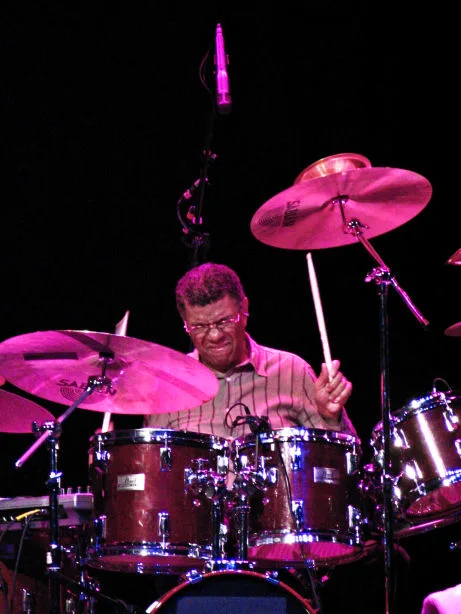
Jack DeJohnette performing at the Bijou Theatre, Knoxville, Tennessee, 2006 CC BY-SA 2.0 — Wikimedia Commons (originally Flickr, photographer Ric Brooks) — https://commons.wikimedia.org/wiki/File:Jack_DeJohnette.jpg

Jack DeJohnette was born August 9, 1942, in Chicago, Illinois, to Jack DeJohnette Sr. and Eva Jeanette DeJohnette. Raised for a time by his grandmother, he began classical piano study at age four with Antoinette Rich and was performing professionally by fourteen. His uncle, Chicago jazz disc jockey Roy Wood Sr., introduced him to the city's clubs, and by his teens DeJohnette had added drums, taught informally by neighborhood player Bobby Miller Jr., to his piano training. He came up in Chicago's fertile early-1960s scene playing R&B, hard bop, and the emerging avant-garde alongside Richard Abrams and Roscoe Mitchell, future pillars of the Association for the Advancement of Creative Musicians, and occasionally sat in on drums with Sun Ra's Arkestra. He graduated from Chicago Vocational School in 1961 already an established presence on the local circuit.
DeJohnette moved to New York in 1966 and joined saxophonist Charles Lloyd's quartet, a band whose incorporation of rock-derived energy made it one of the biggest crossover successes in mid-1960s jazz; the group's 1966 album Forest Flower sold in numbers rare for a jazz record and carried Lloyd's quartet onto rock-festival stages including the Fillmore. In Lloyd's band DeJohnette met pianist Keith Jarrett, beginning a working relationship that would run for nearly four decades. He left Lloyd in early 1968 and spent the following two years in constant demand, working with Jackie McLean, Abbey Lincoln, and Betty Carter before joining Bill Evans's trio later that year; the group's set at the 1968 Montreux Jazz Festival was issued as Bill Evans at the Montreux Jazz Festival. A brief stint with Stan Getz's quartet that November led directly to his first sessions with Miles Davis.
Davis had watched DeJohnette perform at Ronnie Scott's in London in 1968 and, needing a drummer who could carry rock-derived grooves without abandoning jazz's improvisational freedom, brought him into the working band in 1969 in place of Tony Williams. DeJohnette anchored the rhythm section on Bitches Brew (recorded 1969, released 1970, Columbia), the double album that, alongside In a Silent Way, redirected the course of jazz toward fusion; he continued with Davis through 1971, appearing on the Fillmore East and Fillmore West live recordings, Live-Evil, A Tribute to Jack Johnson, and material later gathered on On the Corner and Directions. The Davis band put him alongside John McLaughlin, Chick Corea, and bassist Dave Holland, and it was DeJohnette who drew Keith Jarrett into the group as a second keyboardist.
Through the 1970s DeJohnette built a parallel career as a leader on ECM Records, beginning with his debut The DeJohnette Complex (1969, Milestone) and continuing through Sorcery (1974, Prestige), Gateway and Gateway 2 (1975 and 1978), the ECM trio with Dave Holland and guitarist John Abercrombie that became one of his most enduring associations, and New Directions (1978), with Holland alumnus Eddie Gómez and trumpeter Lester Bowie. In 1979 and 1980 he formed Special Edition, a rotating-horn ensemble built around reedmen David Murray and Arthur Blythe that critics received as a genuine synthesis of avant-garde vocabulary and hard-swinging discipline; the group's debut Special Edition (1980) was named Album of the Year in DownBeat's 1980 critics' poll, and the band continued through Album Album (1984, with Murray, John Purcell, Rufus Reid, and Howard Johnson) and Irresistible Forces (1987, with Greg Osby and Gary Thomas).
DeJohnette, Jarrett, and bassist Gary Peacock had first recorded together on Peacock's 1977 ECM date Tales of Another; in January 1983 Jarrett brought the same trio into the studio under his own name, and the resulting Standards, Vol. 1, Standards, Vol. 2, and Changes launched what became known as the Standards Trio. At a moment when a working band devoted to American-songbook repertoire was considered artistically unfashionable, the trio toured and recorded for more than two decades, through Standards Live (1986), Tokyo '96 (1998), Whisper Not (2000), and The Out-of-Towners (2004), effectively ending only with Jarrett's retirement from touring. DeJohnette received the NEA Jazz Masters Fellowship in 2012 and won two Grammy Awards during this later period, Best New Age Album for Peace Time (2009) and, decades after his fusion-era breakthrough, Best Jazz Instrumental Album for Skyline (2021), a piano trio reunion with Ron Carter and Gonzalo Rubalcaba.
DeJohnette remained active into his final decade, releasing the AACM reunion album Made in Chicago (2015, with Muhal Richard Abrams, Roscoe Mitchell, and Henry Threadgill), the electric quartet record In Movement (2016, with Ravi Coltrane and Matthew Garrison), and Hudson (2017), a quartet with guitarist John Scofield, keyboardist John Medeski, and bassist Larry Grenadier named for the New York valley where all four lived. He died October 26, 2025, of congestive heart failure at a hospital in Kingston, New York, at age 83.
DeJohnette drew on Max Roach, Art Blakey, Roy Haynes, Elvin Jones, Philly Joe Jones, and Tony Williams, but his own playing was distinguished by a pianist's harmonic sense brought to the drum kit: he thought in terms of orchestral color and structure rather than pure time-keeping, an approach one critic described as functioning less as a drummer than as "a percussionist, colourist and epigrammatic commentator" inside the ensemble. That dual foundation, four years of formal piano study preceding his drumming, let him move fluidly between the propulsive, rock-inflected power he brought to Miles Davis's electric bands, the exacting restraint the Standards Trio's songbook repertoire demanded, and the freer, horn-forward writing of his own Special Edition. He periodically returned to the piano itself across his career, recording The Jack DeJohnette Piano Album (1985) and the solo Return (2016), and was widely regarded, in DownBeat's phrase, as one of the era's few genuine "complete musicians" rather than a drummer alone.
- Forest Flower (1967, Atlantic) - As a sideman: the Charles Lloyd Quartet's breakout live album, with Keith Jarrett and Cecil McBee, that gave DeJohnette his first international exposure.
- Bitches Brew (1970, Columbia) - As a sideman: Miles Davis's landmark double album; DeJohnette anchored the rhythm section that helped launch jazz-rock fusion. Spotify - Bitches Brew
- Tales of Another (1977, ECM) - Co-billed to Gary Peacock, Keith Jarrett, and DeJohnette, the session that first paired the trio later reunited as the Standards Trio.
- Special Edition (1980, ECM) - DeJohnette's own quartet debut with David Murray and Arthur Blythe, named DownBeat's 1980 Album of the Year and widely credited as a defining fusion of avant-garde vocabulary with hard-bop discipline. Spotify - Special Edition Listen
- Standards, Vol. 1 (1983, ECM) - The Standards Trio's debut under Keith Jarrett's name, launching a partnership with Jarrett and Peacock that lasted more than two decades. Spotify - Standards, Vol.1 Listen
- Album Album (1984, ECM) - Special Edition's best-known studio date, with David Murray, John Purcell, Rufus Reid, and Howard Johnson. Spotify - Album Album Listen
- Hudson (2017, Motéma) - A late-career quartet with John Scofield, John Medeski, and Larry Grenadier, pairing original material with reworked Dylan, Hendrix, and The Band songs. Spotify - Hudson (Deluxe Edition) Listen
- Skyline (2021, 5Passion) - A piano trio reunion with Ron Carter and Gonzalo Rubalcaba that won the Grammy Award for Best Jazz Instrumental Album. Spotify - Skyline Listen
Jack DeJohnette: Full Discography
Identity confirmed via the live Discogs API: artist ID 238626 ("Jack DeJohnette," matching birth date and instrument credits against Wikipedia and AllMusic). Discogs credits DeJohnette on more than 1,200 releases across 13 pages of the artist-releases endpoint, the overwhelming majority reissues, compilations, and sideman "Appearance" credits accrued across a six-decade career. The table below curates his essential leader and co-leader catalog, plus a representative set of his most historically significant sideman associations; it does not attempt to itemize the full release list.
Two Discogs data quirks are worth flagging for anyone checking this table against the database directly. Album Album (1984) and Irresistible Forces (1987) are both filed under DeJohnette's coarse Discogs role "Producer," which would wrongly exclude them from a role-based leader count; both are billed on the records themselves to "Jack DeJohnette's Special Edition" and are listed here as leader dates. Separately, Discogs' own default link from the Standards, Vol. 1 master record points to an unrelated 2011 single, not the 1983 album; the correct original ECM LP was located directly by catalog number and title match, and the data below comes from that release.
As Leader / Co-Leader
| Album Title | Recording Date(s) | Release Date | Label | Catalog Number | Format(s) | Personnel | Role | Reissue History | Spotify | Buy | Notes |
|---|---|---|---|---|---|---|---|---|---|---|---|
| The DeJohnette Complex | Not confirmed (Wikipedia dates the session 1968; Discogs dates the release 1969) | 1969 | Milestone | MSP 9022 | Vinyl, LP, Album, Stereo | Jack DeJohnette (drums, melodica), Miroslav Vitous / Eddie Gomez (bass), Stanley Cowell (piano, electric piano), Bennie Maupin (flute), Roy Haynes (drums, percussion) | Leader | None found | — | — | DeJohnette's recorded debut as a leader; Haynes, his own early mentor, guests on drums on part of the album |
| Sorcery | Not specified in Discogs data | 1974 | Prestige | P 10081 | Vinyl, LP, Album | Jack DeJohnette (drums, keyboards), Dave Holland (bass), Bennie Maupin (bass clarinet), John Abercrombie / Mick Goodrick (guitar), Michael Fellerman (trombone, idiophone) | Leader | None found | — | — | Transitional record between DeJohnette's Miles Davis tenure and his move to ECM |
| Gateway | Not specified in Discogs data | 1975 | ECM Records | ECM 1061 ST | Vinyl, LP, Album | John Abercrombie (guitar), Dave Holland (bass), Jack DeJohnette (drums) | Co-leader (Gateway) | None found | — | — | Debut of the Gateway trio, one of DeJohnette's longest-running associations |
| Gateway 2 | Not specified in Discogs data | 1978 | ECM Records | ECM 1105 | Vinyl, LP, Album, Stereo | Dave Holland (bass), Jack DeJohnette (drums, piano), John Abercrombie (electric and acoustic guitar, electric mandolin) | Co-leader (Gateway) | None found | — | — | |
| New Directions | Not specified in Discogs data | 1978 | ECM Records | ECM 1128 | Vinyl, LP, Album | Eddie Gomez (bass), Jack DeJohnette (drums, piano), John Abercrombie (guitar, mandolin), Lester Bowie (trumpet) | Leader | None found | — | — | |
| Special Edition | Recorded March 1979 | 1980 | ECM Records | ECM 1152 | Vinyl, LP, Album | Arthur Blythe (alto sax), Peter Warren (bass, cello), Jack DeJohnette (drums, piano, melodica), David Murray (tenor sax, bass clarinet) | Leader | None found | Spotify - Special Edition | — | Named DownBeat's 1980 critics'-poll Album of the Year and awarded the Prix Oscar by the Académie du Jazz; debut of the Special Edition band |
| Tales of Another | Not specified in Discogs data | 1977 | ECM Records | ECM 1101 | Vinyl, LP, Album | Gary Peacock (bass, composer), Jack DeJohnette (drums), Keith Jarrett (piano) | Co-leader (billed to Peacock, Jarrett & DeJohnette) | None found | — | — | Recorded under Peacock's name but co-billed to all three; the session that first paired the trio later reunited in 1983 as the Standards Trio |
| Standards, Vol. 1 | Recorded January 1983, Power Station, New York | 1983 | ECM Records | ECM 1255 | Vinyl, LP, Album | Gary Peacock (bass), Jack DeJohnette (drums), Keith Jarrett (piano) | Co-leader (billed to Jarrett, Peacock & DeJohnette; released under Jarrett's name) | Multiple pressings and a 2011 De Agostini reissue | Spotify - Standards Vol.1 | — | The Standards Trio's debut, launching a partnership that continued for more than two decades |
| Album Album | Not specified in Discogs data | 1984 | ECM Records | ECM 1280 | Vinyl, LP, Album, Stereo | Rufus Reid (acoustic and electric bass), John Purcell (alto and soprano sax), Jack DeJohnette (drums, keyboards, producer), David Murray (tenor sax), Howard Johnson (tuba, baritone sax) | Leader (Special Edition) | None found | Spotify - Album Album | — | Special Edition's best-known studio date; filed on Discogs' artist-releases endpoint under the coarse role "Producer," but billed on the release itself to "Jack DeJohnette's Special Edition" |
| Irresistible Forces | Not specified in Discogs data | 1987 | MCA Impulse! | MCA-5992 | Vinyl, LP, Album | Greg Osby (alto and soprano sax), Jack DeJohnette (drums, keyboards, producer), Lonnie Plaxico (electric and acoustic bass), Mick Goodrick (electric guitar), Naná Vasconcelos (percussion, vocals), Gary Thomas (tenor sax, flute) | Leader (Special Edition) | None found | — | — | Same artist-releases role-tag caveat as Album Album above |
| Made in Chicago | Recorded 2013, Chicago Symphony Center | 2015 | ECM Records | ECM 2392 | CD, Album | Henry Threadgill (alto sax, bass flute), Larry Gray (double bass, cello), Muhal Richard Abrams (piano), Roscoe Mitchell (reeds), Jack DeJohnette (drums) | Co-leader | None found | — | — | Reunion of DeJohnette with three AACM contemporaries at a 2013 Chicago concert marking the organization's history |
| In Movement | Not specified in Discogs data | 2016 | ECM Records | ECM 2488 | CD, Album | Jack DeJohnette (drums, piano, electronic percussion), Matthew Garrison (electric bass, electronics), Ravi Coltrane (tenor, soprano and sopranino sax) | Leader | None found | — | — | Trio linking DeJohnette's generation to the sons of two of his own historic collaborators (John Coltrane and Jimmy Garrison) |
| Return | Not specified in Discogs data | 2016 | Newvelle Records | NV002LP | Vinyl, LP | Jack DeJohnette (piano, composer) | Leader (solo) | None found | — | — | Solo piano album; DeJohnette trained as a pianist before switching primarily to drums |
| Sound Travels | Not specified in Discogs data | 2012 | Golden Beams Productions / eOne | EOM-CD-2403 | CD, Album | Jack DeJohnette (drums, resonating bells, composer), Bobby McFerrin (vocals), Esperanza Spalding (double and electric bass), Lionel Loueke (electric guitar), Bruce Hornsby (composer, vocals) | Leader | None found | — | — | Grammy-nominated for Best New Age Album |
| Hudson | Not specified in Discogs data | 2017-06-09 | Motéma | MTA-CD-228 | CD, Album | Larry Grenadier (acoustic bass, vocals), Jack DeJohnette (drums, wooden flute, vocals), John Scofield (guitar, wooden flute), John Medeski (piano, Rhodes, Hammond B-3 organ, vocals) | Co-leader (Hudson) | Deluxe Edition adds bonus tracks | Spotify - Hudson (Deluxe Edition) | — | Named for the Hudson Valley, where all four members lived; one of the best-selling jazz albums of 2017 |
| Skyline | Not specified in Discogs data | 2021 | 5Passion | 5P-070 | CD, Album | Ron Carter (bass), Jack DeJohnette (drums), Gonzalo Rubalcaba (piano, producer) | Co-leader | First of an intended trilogy | Spotify - Skyline | — | Won the Grammy Award for Best Jazz Instrumental Album at the 64th Annual Grammy Awards |
As Sideman (selected major credits)
| Year | Project (Leader) | Title | Label | Catalog | Role | Notes |
|---|---|---|---|---|---|---|
| 1967 | Charles Lloyd | Forest Flower | Atlantic (1473) | Drums | With Keith Jarrett and Cecil McBee; the live recording that gave DeJohnette his first international exposure | |
| 1968 | Bill Evans | At the Montreux Jazz Festival | Verve Records (V6/8762) | Drums | With Eddie Gomez on bass | |
| 1970 | Miles Davis | Bitches Brew | Columbia (GP 26) | Drums | DeJohnette was the primary drummer across the double album that helped launch jazz-rock fusion; full Miles Davis catalog covered in his JazzProfiles.com profile | |
| 1971 | Miles Davis | Live-Evil | Columbia | Drums | Full catalog in his profile | |
| 1971 | Miles Davis | A Tribute to Jack Johnson | Columbia | Drums | Soundtrack album; full catalog in his profile | |
| 1980 | Pat Metheny, Charlie Haden, Jack DeJohnette, Dewey Redman, Michael Brecker | 80/81 | ECM Records (ECM 1180/81) | Drums | Co-billed quintet date | |
| 1990 | Herbie Hancock, Pat Metheny, Dave Holland, Jack DeJohnette | Parallel Realities | Drums | Co-billed quartet tour and live album |
DeJohnette's Discogs sideman log (well over 1,000 further "Appearance" and "TrackAppearance" credits spanning 1963-2024) also includes further work with the Charles Lloyd Quartet, Stan Getz's quartet (1968-69 and 1973-74), Freddie Hubbard, John Abercrombie's own leader dates, Chick Corea, and dozens of others; not itemized exhaustively here.
- Miles Davis - drum chair in Davis's electric band, 1969-1971, including Bitches Brew, Live-Evil, and A Tribute to Jack Johnson; the association that introduced DeJohnette to John McLaughlin, Chick Corea, and Dave Holland, and through which he brought Keith Jarrett into Davis's band.
- Charles Lloyd - the quartet DeJohnette joined in 1966, where he first met Keith Jarrett.
- Keith Jarrett and Gary Peacock - the "Standards Trio," rooted in 1977's Tales of Another and active under Jarrett's name from 1983 into the 2000s.
- Dave Holland and John Abercrombie - the ECM trio Gateway, formed mid-1970s (Gateway, 1975; Gateway 2, 1978), reunited periodically thereafter.
- David Murray - reed voice of Special Edition across its ECM studio dates (Special Edition, 1980; Album Album, 1984) and later editions of the band.
- John Scofield, John Medeski, and Larry Grenadier - Hudson (2017), a quartet formed among four musicians living in New York's Hudson Valley.
- Ravi Coltrane and Matthew Garrison - In Movement (2016), an electric trio drawing on both men's fathers' associations with DeJohnette's own generation of musicians.
- Ron Carter - the Grammy-winning piano trio Skyline (2021) with Gonzalo Rubalcaba, and earlier the quartet Parallel Realities (1990) with Herbie Hancock and Pat Metheny.
- Bill Evans - trio drummer in 1968, including the group's Montreux Jazz Festival appearance.
- Stan Getz - quartet drummer in late 1968 and again 1973-1974, the second stint bringing Dave Holland into Getz's band.