 JAZZPROFILES lives in the music 1,002 Jazz Artists fully Profiled!
 Grant Green
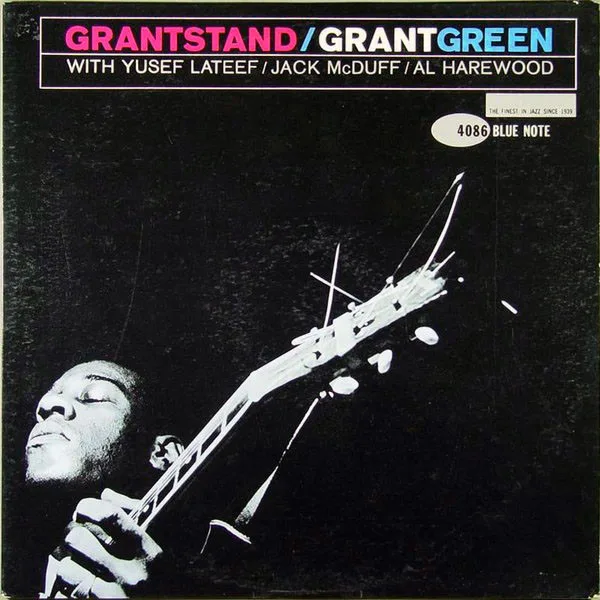
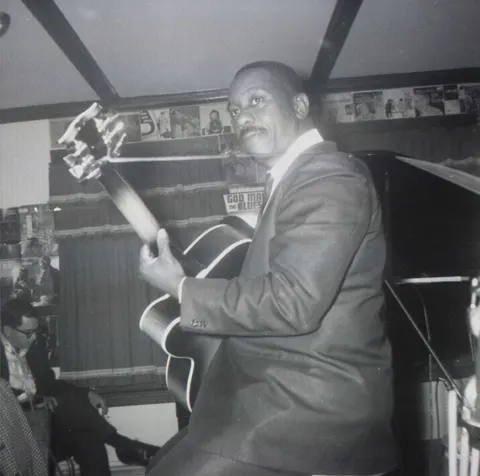
Grant Green playing guitar on the front cover of *Grantstand* (Blue Note BLP 4086, 1962), a Francis Wolff photograph in a Reid Miles cover design Album cover art (not a CC-licensed artist photo). Used as the only available image showing the artist: no free photo of Grant Green exists on Wikimedia Commons (a search of Commons and of Wikidata Q601427, which carries no image property, both came up empty; the only photo used on his English Wikipedia article is tagged non-free fair-use and cannot be reused here) — Discogs release page for Grantstand (Blue Note BLP 4086) - https://www.discogs.com/release/2359684-Grant-Green-Grantstand
Grant Green was born June 6, 1935, in St. Louis, Missouri, to John and Martha Green. His father, who worked at various times as a laborer and as a St. Louis police officer, played blues and folk guitar and gave him his first lessons; Green studied for a year with a teacher named Forrest Alcorn but was otherwise self-taught, learning by ear off records. He made his first professional appearance at 13 in a gospel group, then spent his twenties working in St. Louis jazz and R&B bands, absorbing Charlie Christian's guitar recordings alongside saxophonists Charlie Parker and Lester Young and guitarist Jimmy Raney. His first recordings came in 1959, backing tenor saxophonist Jimmy Forrest on the St. Louis-based United label with drummer Elvin Jones in the group.
In 1959, alto saxophonist Lou Donaldson heard Green playing at a St. Louis bar, hired him for his touring band, and brought him to New York, where Green relocated in 1959-60. Donaldson introduced him to Blue Note Records founder Alfred Lion, and from 1961 to 1965 Green served as the label's house guitarist, appearing on more Blue Note sessions as leader or sideman than any other musician during those years. Rather than confine him to sideman work, Lion had Green record as a leader almost immediately; his actual first session, cut November 16, 1960, and October 27, 1961, went unissued at the time because Green doubted it was strong enough, surfacing only in 2001 as First Session. His first released dates as a leader came in quick succession in 1961: Grant's First Stand (recorded January 28, an organ trio with "Baby Face" Willette and drummer Ben Dixon), Green Street (April 1, a trio with bassist Ben Tucker and drummer Dave Bailey), and Grantstand (August 1, a quartet with Yusef Lateef on tenor and flute, organist Jack McDuff, and drummer Al Harewood). DownBeat's critics named him Best New Star in 1962.
Across the early-to-mid 1960s Green split his time between his own dates and heavy sideman duty, recording with organists Big John Patton and Larry Young, saxophonists Hank Mobley, Ike Quebec, and Stanley Turrentine, and pianist Herbie Hancock, among dozens of others, in a working relationship with Blue Note's house rhythm sections and Rudy Van Gelder's studio that made him one of the most heavily documented musicians on the label. He built a run of concept albums around a single musical theme: Sunday Mornin' (recorded June 1961, gospel), The Latin Bit (recorded April 1962, with congas from Carlos "Patato" Valdes and drummer Willie Bobo), and Feelin' the Spirit (recorded December 1962, spirituals, with a young Herbie Hancock on piano). Idle Moments, recorded in November 1963 with Joe Henderson, Bobby Hutcherson, and pianist Duke Pearson, and not released until 1965, is widely regarded as the finest record of his career. Two 1964 sessions with pianist McCoy Tyner and drummer Elvin Jones on loan from John Coltrane's working quartet, Solid and Matador, sat unissued for fifteen years before Blue Note put them out in 1979, the latter first only in Japan.
Green left Blue Note in 1966 and recorded for other labels, including a 1965 Verve date, His Majesty King Funk, produced by Creed Taylor with organist Larry Young and conguero Candido. From 1967 to 1969 he was largely inactive, sidelined by personal problems and heroin addiction. He returned to Blue Note in 1969 in a harder funk and soul-jazz direction geared to a wider R&B audience: Carryin' On (1970) and the commercially successful Green Is Beautiful (1970) both paired him with drummer Idris Muhammad and saxophonist Claude Bartee, while Alive! (1971) captured his working band live at the Cliché Lounge in Newark, New Jersey. He scored the blaxploitation film The Final Comedown (1972) and cut the double live album Live at the Lighthouse (1972) at Hermosa Beach, California, followed by The Main Attraction (1976), a Creed Taylor-produced Kudu date with guitarist Steve Khan and flutist Hubert Laws in the band.
Green spent most of 1978 hospitalized, and against his doctors' advice went back on the road afterward to keep up with medical bills and child support; that year's Easy, cut with saxophonist Hank Crawford and bassist Buster Williams, was his last studio album. On January 31, 1979, in New York City for an engagement at guitarist George Benson's club, the Breezin' Lounge, Green collapsed in his car and died of a heart attack at age 43. He was buried in Greenwood Cemetery in his native St. Louis; his grave went unmarked until 2017, when the Killer Blues Headstone Project placed a headstone. He was survived by six children, including guitarist Grant Green Jr.
Green approached the guitar the way a horn player approaches a solo: single melodic lines built from the vocabulary of Charlie Parker and Lester Young rather than the block chords and dense voicings that defined most jazz guitar of his generation. Critic Michael Erlewine called him "one of the great unsung heroes of jazz guitar," and jazz educator Wolf Marshall credited his "unique mixture of bebop, blues and funk" with making him one of the defining soul-jazz and hard-bop guitarists of the 1960s. That directness, avoiding chromatic complexity in favor of clean, blues-rooted lines, suited the organ-trio format he worked in constantly, and gave his hundreds of Blue Note sides an unmistakable, immediately recognizable sound whether he was backing a saxophonist or leading his own date. He achieved his signature punchy, midrange-heavy tone, according to his protégé George Benson, by turning down the bass and treble on his amplifier rather than boosting anything. His influence reaches well past his own era: he has since become one of the most sampled guitarists in hip-hop and acid jazz production, and later mainstream-jazz guitarists continue to cite him as a foundational reference point alongside Wes Montgomery, Joe Pass, Jim Hall, and Kenny Burrell; guitarist Roni Ben-Hur names all five in the same breath as his own formative guitar influences.
- Grant's First Stand (1961, Blue Note) - Green's first released leader date, an organ trio with "Baby Face" Willette and drummer Ben Dixon cut in a single January 1961 session. Spotify - Grant's First Stand Listen
- Green Street (1961, Blue Note) - A stripped-down guitar trio with bassist Ben Tucker and drummer Dave Bailey, showcasing the clean, horn-like single-note style at its most exposed. Spotify - Green Street Listen
- Grantstand (1962, Blue Note) - A quartet date with Yusef Lateef, organist Jack McDuff, and drummer Al Harewood; its Francis Wolff cover photo of Green mid-solo is one of the most reproduced images of him. Spotify - Grantstand Listen
- Sunday Mornin' (recorded 1961, released 1962, Blue Note) - A gospel-themed concept date with pianist Kenny Drew, one of several albums Green built around a single musical idiom. Spotify - Sunday Mornin' Listen
- Idle Moments (recorded 1963, released 1965, Blue Note) - With Joe Henderson, Bobby Hutcherson, and pianist Duke Pearson; widely considered the strongest record of Green's career.
- Solid (recorded 1964, released 1979, Blue Note) - A hard-driving sextet date with McCoy Tyner, Elvin Jones, and Joe Henderson on loan from the John Coltrane Quartet's circle, shelved for fifteen years before release. Spotify - Solid Listen
- Matador (recorded 1964, released 1979, Blue Note) - A modal trio session with McCoy Tyner and Elvin Jones, first issued only in Japan the same year as Solid. Spotify - Matador Listen
- Live at the Lighthouse (1972, Blue Note) - A double live album cut at Hermosa Beach, California, documenting the funk-driven working band of Green's second Blue Note period. Spotify - Live At The Lighthouse Listen
Grant Green: Full Discography
Identity confirmed via the live Discogs API: artist ID 12633 ("Grant Green," born June 6, 1935, St. Louis, died January 31, 1979, New York, matching Wikipedia exactly). Discogs credits Green on 972 releases total across every pressing, reissue, and compilation (111 in a "Main"/leader role, 334 sideman "Appearance" credits, 493 track-level "TrackAppearance" credits, and 34 unofficial releases), the product of a genuine leader catalog of roughly 30 studio, live, and soundtrack albums, repackaged and reissued many times over, plus extensive work as a sideman, above all during his 1961-1965 run as Blue Note's house guitarist. Given that scale, this file does not attempt exhaustive coverage. The table below curates the 25 most significant and historically important leader/co-leader releases, plus a representative (not exhaustive) set of his most notable sideman dates, each individually verified against the Discogs release page rather than the coarser artist-releases endpoint.
As Leader / Co-Leader
| Album Title | Recording Date(s) | Release Date | Label | Catalog Number | Format(s) | Personnel | Role | Reissue History | Spotify | Buy | Notes |
|---|---|---|---|---|---|---|---|---|---|---|---|
| First Session | Recorded November 16 (per Discogs) / November 26 (per Wikipedia), 1960, and October 27, 1961, Van Gelder Studio | 2001 | Blue Note | 7243 5 27548 2 3 | CD, Album, Limited Edition, Remastered | Grant Green (guitar); tracks 1-5: Wynton Kelly (piano), Paul Chambers (bass), Philly Joe Jones (drums); tracks 6-7: Sonny Clark (piano), Butch Warren (bass), Billy Higgins (drums) | Leader | None found | — | — | Green's actual first Blue Note session, shelved for 40 years by his own choice before Alfred Lion arranged the January 1961 date that became Grant's First Stand; Discogs carries no personnel for this release, so the credits above are drawn from Wikipedia's sourced personnel listing |
| Grant's First Stand | Recorded January 28, 1961, Van Gelder Studio | May 1961 | Blue Note | BLP 4064 | Vinyl, LP, Album, Mono | Grant Green (guitar), "Baby Face" Willette (organ), Ben Dixon (drums) | Leader | Multiple CD reissues | Spotify - Grant's First Stand | — | Green's first released leader date |
| Green Street | Recorded April 1, 1961, Van Gelder Studio | September 1961 | Blue Note | BLP 4071 | Vinyl, LP, Album, Mono | Grant Green (guitar), Ben Tucker (bass), Dave Bailey (drums) | Leader | Multiple CD reissues | Spotify - Green Street | — | Trio format with no piano or organ, exposing the single-note style directly |
| Grantstand | Recorded August 1, 1961, Van Gelder Studio | February 1962 | Blue Note | BLP 4086 | Vinyl, LP, Album, Mono | Grant Green (guitar), Yusef Lateef (tenor sax, flute), Jack McDuff (organ), Al Harewood (drums) | Leader | Multiple CD reissues | Spotify - Grantstand | — | Cover photo used as this profile's portrait |
| Sunday Mornin' | Recorded June 4, 1961, Van Gelder Studio | October 1962 | Blue Note | BLP 4099 | Vinyl, LP, Album, Mono | Grant Green (guitar), Kenny Drew (piano), Ben Tucker (bass), Ben Dixon (drums) | Leader | Multiple CD reissues | Spotify - Sunday Mornin' | — | Gospel-themed concept album, includes "God Bless the Child" and "Exodus" |
| The Latin Bit | Recorded April 26, 1962, Van Gelder Studio | April 1963 | Blue Note | BLP 4111 | Vinyl, LP, Album, Mono | Grant Green (guitar), Johnny Acea (piano), Wendell Marshall (bass), Willie Bobo (drums), Carlos "Patato" Valdes (congas), Garvin Masseaux (chekere) | Leader | CD reissue | — | — | Latin-jazz concept album; not confirmed on Spotify, so no link is asserted |
| Feelin' the Spirit | Recorded December 21, 1962, Van Gelder Studio | 1963 | Blue Note | BLP 4132 | Vinyl, LP, Album, Mono | Grant Green (guitar), Herbie Hancock (piano), Butch Warren (bass), Billy Higgins (drums), Garvin Masseaux (tambourine) | Leader | CD reissue | — | — | Spirituals concept album, a young Herbie Hancock on piano |
| Am I Blue | Recorded May 16, 1963, Van Gelder Studio | 1964 | Blue Note | BLP 4139 | Vinyl, LP, Album, Mono | Grant Green (guitar), Joe Henderson (tenor sax), Johnny Coles (trumpet), John Patton (organ), Ben Dixon (drums) | Leader | CD reissue | — | — | Sextet date; not confirmed on Spotify |
| Idle Moments | Recorded November 4 & 15, 1963, Van Gelder Studio | 1965 | Blue Note | BLP 4154 | Vinyl, LP, Album, Mono | Grant Green (guitar), Joe Henderson (tenor sax), Bobby Hutcherson (vibraphone), Duke Pearson (piano), Bob Cranshaw (bass), Al Harewood (drums) | Leader | Multiple CD reissues | — | — | Widely regarded as the finest recording of Green's career; not confirmed on Spotify under this exact title, so no link asserted here |
| Talkin' About! | Recorded September 11, 1964, Van Gelder Studio | 1965 | Blue Note | BLP 4183 | Vinyl, LP, Album, Mono | Grant Green (guitar), Larry Young (organ), Elvin Jones (drums) | Leader | CD reissue | — | — | Organ-trio quartet with Larry Young and Elvin Jones |
| His Majesty King Funk | Not specified in Discogs data | 1965 | Verve | V6-8627 | Vinyl, LP, Album, Stereo | Grant Green (guitar), Larry Young (organ), Harold Vick (tenor sax), Candido (congas, bongos), Ben Dixon (drums); produced by Creed Taylor | Leader | CD reissue, 1995 | — | — | Green's only Verve leader date |
| Street of Dreams | Recorded November 16, 1964, Van Gelder Studio | August 1967 | Blue Note | BLP 4253 | Vinyl, LP, Album, Mono | Grant Green (guitar), Larry Young (organ), Bobby Hutcherson (vibraphone), Elvin Jones (drums) | Leader | CD reissue | — | — | Held three years before release |
| Goin' West | Recorded November 30, 1962, Van Gelder Studio | 1969 | Blue Note | BST 84310 | Vinyl, LP, Album, Stereo | Grant Green (guitar), Herbie Hancock (piano), Reggie Workman (bass), Billy Higgins (drums) | Leader | CD reissue | — | — | Concept album of American folk/western melodies, held seven years before release |
| Solid | Recorded June 12, 1964, Van Gelder Studio | 1979 | Blue Note | LT-990 | Vinyl, LP, Album, Stereo | Grant Green (guitar), James Spaulding (alto sax), Joe Henderson (tenor sax), McCoy Tyner (piano), Bob Cranshaw (bass), Elvin Jones (drums) | Leader | None found | Spotify - Solid | — | Held 15 years; personnel drawn largely from the John Coltrane Quartet's circle |
| Matador | Recorded May 20, 1964, Van Gelder Studio | 1979 (Japan only) | Blue Note | GXF 3053 | Vinyl, LP, Album, Limited Edition, Stereo | Grant Green (guitar), McCoy Tyner (piano), Bob Cranshaw (bass), Elvin Jones (drums) | Leader | None found; later reissued outside Japan | Spotify - Matador | — | Modal trio date, first released only in Japan the same year as Solid |
| Born to Be Blue | Recorded December 23, 1961, and March 1, 1962, Van Gelder Studio | 1985 | Blue Note | BST 84432 | Vinyl, LP, Album, Remastered | Grant Green (guitar), Ike Quebec (tenor sax), Sonny Clark (piano), Sam Jones (bass), Louis Hayes (drums) | Leader | None found | — | — | Assembled posthumously from two early-1960s Van Gelder sessions |
| Carryin' On | Recorded October 3, 1969, Van Gelder Studio | 1970 | Blue Note | BST 84327 | Vinyl, LP, Album, Stereo | Grant Green (guitar), Claude Bartee (tenor sax), Clarence Palmer & Earl Creque (electric piano), Jimmy Lewis (electric bass), Idris Muhammad (drums), Willie Bivens (vibraphone) | Leader | None found | — | — | Green's return to Blue Note after his late-1960s inactivity, in a harder funk direction |
| Green Is Beautiful | Recorded January 30, 1970, Van Gelder Studio | 1970 | Blue Note | BST 84342 | Vinyl, LP, Album, Stereo | Grant Green (guitar), Blue Mitchell (trumpet), Claude Bartee (tenor sax), Emmanuel Riggins & Neal Creque (organ), Jimmy Lewis (bass), Idris Muhammad (drums), Candido (congas) | Leader | None found | Spotify - Green Is Beautiful | — | Green's most commercially successful album |
| Alive! | Recorded live August 15, 1970, Cliché Lounge, Newark, NJ | March 1971 | Blue Note | BST 84360 | Vinyl, LP, Album, Stereo | Grant Green (guitar), Claude Bartee (saxophone), Neal Creque & Ronnie Foster (organ), Idris Muhammad (drums), Willie Bivens (vibraphone), Joseph Armstrong (congas) | Leader | None found | — | — | Live document of Green's touring funk-jazz band |
| Visions | Not specified in Discogs data | May 21, 1971 | Blue Note | BST 84373 | Vinyl, LP, Album | Grant Green (guitar), Billy Wooten (vibraphone), Emmanuel Riggins (electric piano), Chuck Rainey (electric bass), Idris Muhammad & Harold Cardwell (drums), Ray Armando (congas) | Leader | None found | — | — | Includes a jazz-funk arrangement of Mozart's Symphony No. 40 |
| Live at the Lighthouse | Recorded live April 1972, The Lighthouse, Hermosa Beach, CA | 1972 | Blue Note | BN-LA037-G2 | Vinyl, LP, Album, Stereo | Grant Green (guitar), Claude Bartee (tenor & soprano sax), Shelton Laster (organ), Wilton Felder (bass), Greg Williams (drums), Gary Coleman (vibraphone), Bobbye Hall (congas, percussion) | Leader | None found | Spotify - Live At The Lighthouse | — | Double live album; a two-record set on original release |
| The Final Comedown (Original Motion Picture Soundtrack) | Recorded 1972, A&R Recording, NYC | 1972 | Blue Note | BST-84415 | Vinyl, LP, Album | Grant Green (guitar, music performed by), Wade Marcus (composed by, conductor); produced by George Butler | Leader (soundtrack) | None found | — | — | Score for the 1972 blaxploitation film of the same name |
| Iron City! | Not specified in Discogs data | 1972 | Cobblestone | CST 9002 | Vinyl, LP, Album | Grant Green (guitar), John Patton (organ), Ben Dixon (drums) | Leader | Reissued 1977 (Muse), CD reissues 1998 & 2003 | — | — | Recorded outside the Blue Note system, for the independent Cobblestone label |
| The Main Attraction | Recorded March 1976, A&R Recording / Van Gelder Studio | 1976 | Kudu | KU-29 | Vinyl, LP, Album, Stereo | Grant Green (guitar, all solos), Steve Khan (guitar), Hubert Laws (flute), Ronnie Cuber (baritone sax), Will Lee (bass), Andy Newmark (drums), Don Grolnick (electric piano, clavinet); produced by Creed Taylor | Leader | CD reissue, 2002 | — | — | Produced by Creed Taylor for his Kudu/CTI imprint |
| Easy | Recorded April 17-20, 1978, Opal Recording Studios, NYC | 1978 | Versatile | MSG-6002 | Vinyl, LP, Album, Stereo | Grant Green (electric guitar), Hank Crawford (alto & baritone sax), Buster Williams (acoustic & electric bass), Jorge Dalto (electric piano, piano), Wayne Morrison (acoustic & electric guitar) | Leader | CD reissues, 2001 & 2007 | — | — | Green's last studio album, recorded against his doctors' advice the year before his death |
As Sideman (selected major credits)
| Year | Project (Leader) | Title | Label | Catalog | Role | Notes |
|---|---|---|---|---|---|---|
| 1961 | Hank Mobley | Workout | Blue Note (BLP 4080) | Guitar | Recorded March 26, 1961, with Wynton Kelly, Paul Chambers, and Philly Joe Jones | |
| 1961 | Lou Donaldson | Here 'Tis | Blue Note (BLP 4066) | Guitar | Recorded January 23, 1961, the session that led directly to Green's own Blue Note contract | |
| 1961 | Ike Quebec | Blue & Sentimental | Blue Note (BLP 4098) | Guitar | Recorded December 16 & 23, 1961, with Sonny Clark, Paul Chambers, and Philly Joe Jones | |
| 1961 | Stanley Turrentine | Up at "Minton's", Vol. 1 | Blue Note (BLP 4069) | Guitar | Recorded live February 23, 1961, with Horace Parlan, George Tucker, and Al Harewood | |
| 1963 | Herbie Hancock | My Point of View | Blue Note (BST 84126) | Guitar | Recorded March 19, 1963, with Hancock, Donald Byrd, Hank Mobley, and Tony Williams | |
| 1964 | Lee Morgan | Search for the New Land | Blue Note (BLP 4169) | Guitar | Recorded February 15, 1964, with Wayne Shorter, Herbie Hancock, Reggie Workman, and Billy Higgins | |
| 1964 | Larry Young | Into Somethin' | Blue Note (BLP 4187) | Guitar | Recorded November 12, 1964, with Sam Rivers and Elvin Jones | |
| 1965 | Donald Byrd | I'm Tryin' to Get Home | Blue Note (BLP 4188) | Guitar | Recorded December 17-18, 1964, a large-ensemble gospel-themed session with Herbie Hancock, J.J. Johnson, and Grady Tate |
Green's Discogs sideman log runs to hundreds of further credits, concentrated overwhelmingly in his 1961-1965 tenure as Blue Note's house guitarist. Wikipedia's own sourced sideman listing additionally documents dates with Baby Face Willette, Brother Jack McDuff, Horace Parlan, Sonny Red, Don Wilkerson, Dodo Greene, George Braith, Mary Lou Williams, Johnny Hodges and Wild Bill Davis, Art Blakey, Rusty Bryant, Charles Kynard, Reuben Wilson, Don Patterson, and Houston Person, among others, spanning 1959 to 1973; those are not itemized here, and each would need its own release-level Discogs check before any personnel claim beyond what is stated above.
- Lou Donaldson - discovered Green in a St. Louis bar in 1959, hired him for his touring band, and introduced him to Blue Note's Alfred Lion, setting up the entire New York phase of Green's career.
- Rudy Van Gelder - the engineer behind virtually every Blue Note session Green ever recorded, from Grant's First Stand in 1961 through the posthumous Matador and Solid mixdowns in 1979.
- Larry Young and Big John Patton - the two organists most closely identified with Green's mid-1960s organ-trio and quartet work, appearing across albums including Talkin' About!, Street of Dreams, Into Somethin', Am I Blue, and Iron City!.
- Elvin Jones - drummer on Green's very first 1959 St. Louis session and, later, on key Blue Note dates including Talkin' About!, Street of Dreams, Solid, and Matador.
- Herbie Hancock - pianist on several early-1960s Blue Note sideman dates with Green, including My Point of View, Feelin' the Spirit, Goin' West, and Search for the New Land.
- George Benson - a self-described protégé who studied Green's tone-shaping technique directly; Green was in New York for an engagement at Benson's own club, the Breezin' Lounge, when he died in January 1979.
- Creed Taylor - produced Green's 1965 Verve album His Majesty King Funk and his 1976 Kudu date The Main Attraction.
- Wikipedia: Grant Green
- Wikipedia: Grant Green discography
- Discogs: Grant Green (artist 12633)
- Wikipedia: Green Street (album)
- Wikipedia: Grantstand
- Wikipedia: Sunday Mornin' (album)
- Wikipedia: Idle Moments
- Wikipedia: Solid (Grant Green album)
- Wikipedia: Matador (Grant Green album)
- Wikipedia: Live at The Lighthouse (Grant Green album)