 JAZZPROFILES lives in the music 2,303 Jazz Artists fully Profiled!
Dorothy Ashby
Last updated November 8, 2026
Listen on Spotify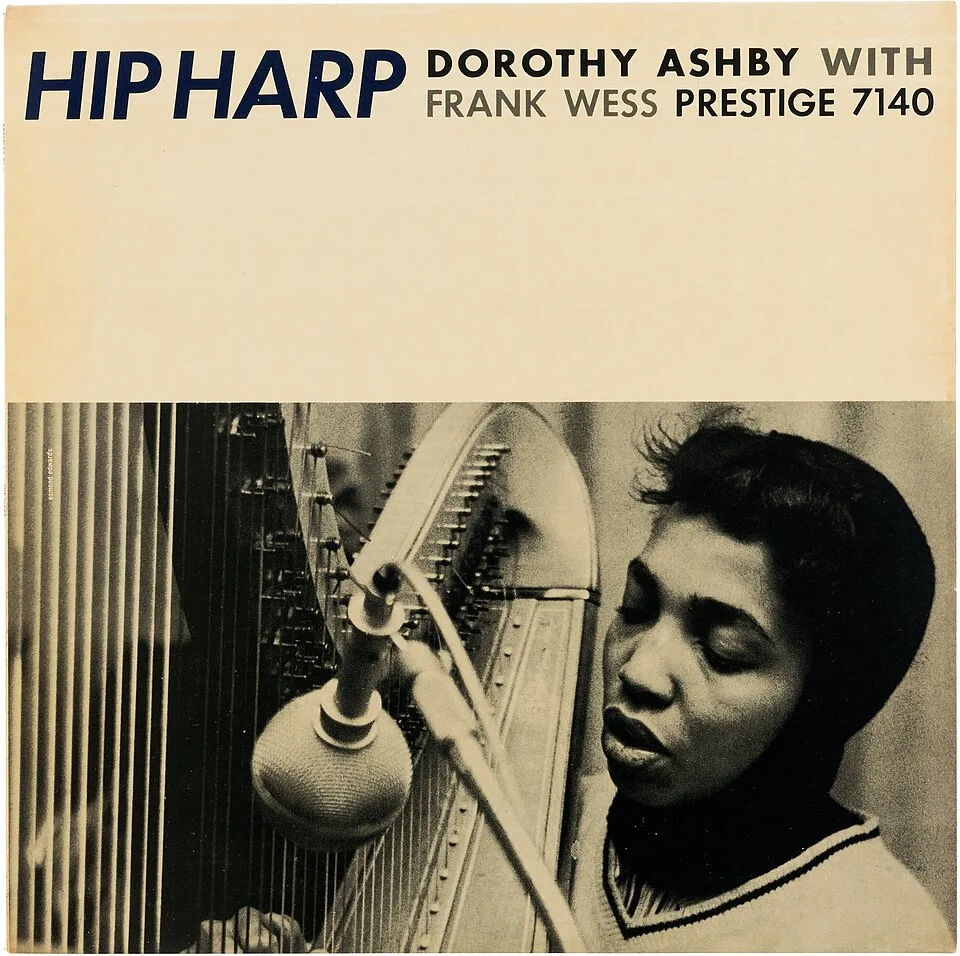
Dorothy Ashby on the cover of her 1958 album *Hip Harp* (Prestige 7140), cover photograph by Esmond Edwards Public Domain (album cover art, not a photograph taken for general release; the Wikimedia Commons file page records the US copyright as not renewed). Used as the only free image showing the artist — Wikimedia Commons — https://commons.wikimedia.org/wiki/File:Hip_Harp.jpg

Dorothy Jeanne Thompson was born on August 6, 1932, in Detroit, and grew up in the Paradise Valley and Black Bottom neighborhoods. Her father, Wiley Thompson, was a self-taught jazz guitarist who often brought other musicians home, and as a girl she backed them on piano. At Cass Technical High School, where Donald Byrd and Kenny Burrell also studied, she tried the saxophone and string bass before her father and her piano teacher steered her to the harp. Her harp teacher was Velma Froude, who schooled her in the strict classical technique of the French harpist Carlos Salzedo and who later taught Alice McLeod, the future Alice Coltrane. At seventeen she entered Wayne State University in Detroit, majoring in piano and music education.
After graduating she worked as a pianist on the Detroit jazz scene, but by 1952 the harp was her main instrument. Other musicians resisted it, hearing it as a classical, somewhat ethereal sound that did not belong in a jazz group, and she answered by organizing free concerts and playing dances and weddings with her trio, which included her husband, John Ashby, on drums. The trio toured the country, and through the 1960s she also hosted a radio show in Detroit, sometimes performing on it with her husband. In 1967 a Detroit public-schools music director, Robert H. Klotman, cited her and the harp and vocal ensemble at Cass Tech as the inspiration for placing ten harps in five inner-city schools. Biographies also say she performed with Louis Armstrong and Woody Herman.
Her debut album, The Jazz Harpist (Regent, 1957), paired her with Frank Wess on flute, bassists Eddie Jones and Wendell Marshall, and drummer Ed Thigpen, and mixed standards such as "Thou Swell" and "Stella by Starlight" with her own pieces "Aeolian Groove," "Lamentation," and "Spicy." Two more albums with Wess followed in 1958 for Prestige and its New Jazz imprint, Hip Harp (with bassist Herman Wright and drummer Art Taylor) and In a Minor Groove (with Wright and drummer Roy Haynes), all three engineered by Rudy Van Gelder. Soft Winds: The Swinging Harp of Dorothy Ashby, recorded for Jazzland in New York on August 15 and 16, 1961, added Jimmy Cobb on drums and Terry Pollard on vibraphone, and she cut a trio album for Argo in 1962, the year Down Beat's critics' and readers' polls honored her. The Fantastic Jazz Harp of Dorothy Ashby (Atlantic, 1965) used bassist Richard Davis, drummer Grady Tate, percussionist Willie Bobo, and four trombones. In a 1983 interview she described the combination of being a woman, being Black, and playing the harp as a triple burden: the audiences she wanted to reach were not interested in the instrument, or in seeing a Black woman play it.
In the late 1960s she moved toward soul and rhythm and blues, working with the Chicago arranger and producer Richard Evans for Cadet. Afro-Harping (recorded in February 1968 at Ter-Mar Studios in Chicago), Dorothy's Harp (March 1969), and The Rubáiyát of Dorothy Ashby (recorded from November 1969 into January 1970, with music inspired by Omar Khayyam's verse) set her harp against string and horn arrangements and funk rhythms, and on the last album she also played the koto and sang. In the 1960s she and John Ashby founded the Ashby Players, a Detroit company that staged plays relevant to the city's African-American community, in Detroit and in Canada; John wrote the scripts, she composed the scores and played harp and piano on the soundtracks, and the actor Ernie Hudson had an early role in the production 3-6-9. She later made recordings and gave concerts mainly to raise money for the company.
Around 1970 the Ashbys gave up touring and settled in California. Her studio career there began, as biographies tell it, when Bill Withers recommended her to Stevie Wonder. She played harp on Withers's +'Justments (1974), on Bobbi Humphrey's Fancy Dancer (recorded in August 1975), on Minnie Riperton's Adventures in Paradise (1975), on Stanley Turrentine's Everybody Come On Out (1976), and on Wonder's Songs in the Key of Life (1976), where her harp is the other voice in the duet "If It's Magic." Her later sessions included dates for Wade Marcus, Earth, Wind & Fire, Johnny Hammond, Sonny Criss, Freddie Hubbard, and Bobby Womack. In 1983 and 1984 she made two solo harp albums of standards and film themes for the Japanese label Philips, Concierto de Aranjuez and Django/Misty, the first recorded in Hollywood on March 7 and 8, 1983. She passed away from cancer at her home in Santa Monica on April 13, 1986, at age 53, and her ashes were scattered over Santa Monica Bay.
Ashby established the harp as an improvising jazz instrument rather than a novelty or a bed of orchestral color, and showed that it could play bebop lines as fluently as a saxophone or piano. Her small-group records of the late 1950s favored a flute-and-harp front line with Frank Wess, a pairing with almost no precedent, and her own writing ran through those albums beside the standards. From the mid-1960s she widened the range: Brazilian songs such as "Reza" and "Canto de Ossanha" on Dorothy's Harp, African percussion and soul arrangements on Afro-Harping, and the koto, voice, and Middle Eastern color of The Rubáiyát of Dorothy Ashby. AllMusic's Ron Wynn called Afro-Harping her best and most complete album, and Thom Jurek wrote that the Rubáiyát may be her greatest moment on record. Her contemporary Alice Coltrane took the harp further into spiritual jazz, and Alice Coltrane's own profile notes that her harp vocabulary had almost no precedent outside Ashby's work. Ashby's records have been sampled widely in hip-hop, by Pete Rock, Jay-Z, J Dilla, Madlib, and others, and Drake built a 2018 track on her version of "The Windmills of Your Mind." The harpist Brandee Younger has recorded her own version of "Afro-Harping."
- The Jazz Harpist (1957, Regent) - Her debut, with Frank Wess on flute and a mix of standards and her own tunes; AllMusic called it her first and best. Spotify - The Jazz Harpist Listen
- Hip Harp (1958, Prestige) - The second harp and flute set with Wess, with Herman Wright on bass and Art Taylor on drums. Spotify - Hip Harp Listen
- In a Minor Groove (1958, New Jazz) - The third album with Wess, with Wright and Roy Haynes, including Oscar Pettiford's "Bohemia After Dark" and "Yesterdays."
- Soft Winds: The Swinging Harp of Dorothy Ashby (1961, Jazzland) - Quartet recording from August 1961 with Jimmy Cobb, Herman Wright, and Terry Pollard. Spotify - Soft Winds: The Swinging Harp of Dorothy Ashby Listen
- The Fantastic Jazz Harp of Dorothy Ashby (1965, Atlantic) - Four originals and six standards, with Richard Davis, Grady Tate, Willie Bobo, and a four-trombone section. Spotify - The Fantastic Jazz Harp of Dorothy Ashby Listen
- Afro-Harping (1968, Cadet) - Soul and African percussion behind Richard Evans's arrangements, the album that most defined her late-1960s sound. Spotify - Afro-Harping Listen
- The Rubáiyát of Dorothy Ashby (1970, Cadet) - Original compositions on Omar Khayyam's verse, with Ashby on harp, koto, and vocals under Richard Evans's direction.
- Songs in the Key of Life (1976, Tamla) - Stevie Wonder's double album, on which her harp is the duet partner in "If It's Magic."
Dorothy Ashby: Full Discography
Discogs artist ID 91960 ("Dorothy Ashby," real name Dorothy Jeanne Ashby, born August 6, 1932, in Detroit, died April 13, 1986, in Santa Monica, California) was read in full on Discogs: 299 entries, 29 of them under the Main role (leader, co-billed, and compilation releases) and the rest appearances, track appearances, and unofficial releases. Two small Discogs entities, "Dorothy Ashby Trio" (artist ID 4915830) and "The Dorothy Ashby Trio" (artist ID 7479820), hold only a handful of 45s and were checked. Her leader output is short enough to list in full: the twelve studio albums below, with the later compilations noted in the Reissue History column. The sideman table is a selection of verified session credits, mostly from the 1970s, and is not exhaustive: Discogs lists well over a hundred appearances, many of them compilations or track-level credits. Recording dates come from Discogs release notes; a few were not stated. Catalog numbers are those of the original US pressings unless noted.
As Leader / Co-Leader
| Album Title | Recording Date(s) | Release Date | Label | Catalog Number | Format(s) | Personnel | Role | Reissue History | Spotify | Buy | Notes |
|---|---|---|---|---|---|---|---|---|---|---|---|
| The Jazz Harpist | Not specified in Discogs data | 1957 | Regent | MG-6039 | Vinyl, LP, Album, Mono | Dorothy Ashby (harp), Frank Wess (flute), Eddie Jones (bass), Wendell Marshall (bass), Ed Thigpen (drums) | Leader | Reissued on CD in Japan in 1992, in the Four Classic Albums Plus set (Avid, 2014), and in the six-LP With Strings Attached box (New Land, 2023); see Discogs master 460443 | Spotify - The Jazz Harpist | — | Debut album. Engineered by Rudy Van Gelder; Ozzie Cadena supervised. Wikipedia assigns Eddie Jones to tracks 3, 6 and 7 and Wendell Marshall to tracks 1, 2, 4 and 5. |
| Hip Harp | 1958 | 1958 | Prestige | PRLP 7140 | Vinyl, LP, Album, Mono | Dorothy Ashby (harp), Frank Wess (flute), Herman Wright (bass), Art Taylor (drums) | Leader (billed with Frank Wess) | Reissued as The Best of Dorothy Ashby; paired with In a Minor Groove on CD (Prestige PCD-24120-2, 1992) and on a 2017 two-LP set (Doxy ACV4009); see Discogs master 381825 | Spotify - Hip Harp | — | Engineered by Rudy Van Gelder; Bob Weinstock supervised; cover photograph by Esmond Edwards. |
| In a Minor Groove | 1958 | 1958 | New Jazz | NJLP 8209 | Vinyl, LP, Album, Mono | Dorothy Ashby (harp), Frank Wess (flute), Herman Wright (bass), Roy Haynes (drums) | Leader (billed with Frank Wess) | Also issued as Dorothy Ashby Plays for Beautiful People; see Discogs master 3520606 | — | — | Includes Oscar Pettiford's "Bohemia After Dark." |
| Soft Winds: The Swinging Harp of Dorothy Ashby | August 15-16, 1961, New York | 1961 | Jazzland | JLP 61 | Vinyl, LP, Album, Mono | Dorothy Ashby (harp), Terry Pollard (vibraphone), Herman Wright (bass), Jimmy Cobb (drums) | Leader | Reissued with bonus tracks on streaming; see Discogs master 634700 | Spotify - Soft Winds: The Swinging Harp of Dorothy Ashby (Remastered) | — | Includes "The Man I Love," "Misty," and "The Guns of Navarone." |
| Dorothy Ashby | Not specified in Discogs data | 1962 | Argo | LP 690 | Vinyl, LP, Album, Mono | Dorothy Ashby (harp), Herman Wright (bass), John Tooley (drums) | Leader | Included in the Four Classic Albums Plus set (Avid, 2014); see Discogs master 392640 | — | — | Trio album. Two of its tracks, "Secret Love" and "Lonely Melody," were also issued as an Argo single (Argo 5406). |
| The Fantastic Jazz Harp of Dorothy Ashby | 1965 | 1965 | Atlantic | 1447 | Vinyl, LP, Album, Mono | Dorothy Ashby (harp), Richard Davis (bass), Grady Tate (drums), Willie Bobo (percussion, tracks 1 and 4-10), Jimmy Cleveland, Quentin Jackson, Sonny Russo, Tony Studd (trombones, tracks 3, 5, 6, 8, 9, 10) | Leader | Reissued on CD in 2000 coupled with Junior Mance's Live at the Top (Collectables); see Discogs master 455164 | Spotify - The Fantastic Jazz Harp of Dorothy Ashby | — | Produced by Arif Mardin and Ollie McLaughlin; Tom Dowd engineered. |
| The Sounds of Christmas | Not specified in Discogs data | 1966 (per Wikipedia; Discogs gives no year) | Tab Records | XCTV-87705, XCTV-87706 | Vinyl, LP | Dorothy Ashby (harp), Jimmy Clark (celesta), Tom Montgomery (organ) | Co-billed (with Jimmy Clark and Tom Montgomery) | No reissue history found; see Discogs master 1832036 | — | — | Carols album; the two other players are credited as staff musicians at Detroit radio stations. |
| Afro-Harping | February 1968, Ter-Mar Studios, Chicago | July 1968 | Cadet | LPS-809 | Vinyl, LP, Album, Stereo | Dorothy Ashby (harp); unnamed orchestra arranged and conducted by Richard Evans | Leader | Reissued on CD in 2003 and as a Deluxe Edition in 2022 and 2024; see Discogs master 59827 | Spotify - Afro-Harping | — | Produced by Richard Evans. Includes "Soul Vibrations," "Little Sunflower," and the film themes "Lonely Girl" and "Valley of the Dolls." |
| Dorothy's Harp | March 1969, Ter-Mar Studios, Chicago | 1969 | Cadet | LPS 825 | Vinyl, LP, Album | Dorothy Ashby (harp), Odell Brown (Fender electric piano), Lenard Druss (flute, oboe); orchestra arranged and conducted by Richard Evans | Leader | Reissued on CD in 2006 and 2015; see Discogs master 175874 | Spotify - Dorothy's Harp | — | Produced by Richard Evans. Includes "Canto de Ossanha," "Reza," and "The Windmills of Your Mind." |
| The Rubáiyát of Dorothy Ashby | November 1969 to January 1970, Ter-Mar Studios, Chicago | 1970 | Cadet | LPS-841 | Vinyl, LP, Album | Dorothy Ashby (harp, koto, vocals), Lenard Druss (flute, oboe, piccolo flute), Stu Katz (vibraphone), Fred Katz (kalimba), Cash McCall (guitar), Cliff Davis (alto saxophone), Ed Green (violin); orchestra arranged and conducted by Richard Evans | Leader | Reissued in the Verve By Request series in 2023; see Discogs master 59832 | — | — | All compositions by Ashby, inspired by the verse of Omar Khayyam. The koto is credited on one track (B5) on Discogs. |
| Concierto de Aranjuez | March 7-8, 1983, Hollywood | 1983 (Wikipedia gives 1984) | Philips (Japan) | 28PJ-4 | Vinyl, LP, Album, Stereo | Dorothy Ashby (harp, arrangements) | Leader | Combined with Django / Misty on a 1990 CD (Philips); see Discogs master 1189492 | — | — | Solo harp, digital recording, produced by Kiyoshi Koyama. |
| Django / Misty | Not specified in Discogs data | 1984 | Philips (Japan) | 28PJ-5 | Vinyl, LP, Album | Dorothy Ashby (harp, arrangements) | Leader | Combined with Concierto de Aranjuez on a 1990 CD (Philips); see Discogs master 510164 | — | — | Solo harp; includes "Round Midnight" and "My Favourite Things." |
As Sideman (selected major credits)
| Year | Project (Leader) | Title | Label | Catalog | Role | Notes |
|---|---|---|---|---|---|---|
| 1968 | The Soulful Strings | The Magic of Christmas | Cadet | LPS 814 | Harp (tracks A1, A2, B2) | Seasonal album on the label where she was recording. |
| 1974 | Bill Withers | +'Justments | Sussex | SRA 8032 | Harp (several tracks) | — |
| 1975 | Bobbi Humphrey | Fancy Dancer | Blue Note | BN-LA550-G | Harp | Recorded August 1975; the harp credit is not restricted to particular tracks. |
| 1975 | Minnie Riperton | Adventures in Paradise | Epic | PE 33454 | Harp ("Love and Its Glory") | — |
| 1976 | Stevie Wonder | Songs in the Key of Life | Tamla | T13-340C2 | Harp ("If It's Magic," track D2) | Her harp is the accompanying voice in the duet. |
| 1976 | Stanley Turrentine | Everybody Come On Out | Fantasy | F-9508 | Harp (tracks A2, B1 to B4) | — |
| 1976 | Wade Marcus | Metamorphosis | ABC Impulse! | ASD-9318 | Harp; soloist on "Daniel" | — |
| 1976 | Johnny Hammond | Forever Taurus | Milestone | M-9068 | Harp (tracks A1 to B3) | — |
| 1976 | Earth, Wind & Fire | Spirit | Columbia | PC 34241 | Harp | Credited at release level without track data. |
| 1976 | Bobby Glenn | Shout It Out | Koala | KST-5004 | Harp | — |
| 1976 | Sonny Criss | Warm & Sonny | ABC Impulse! | ASD 9312 | Harp | Wikipedia dates the album 1977; Discogs lists 1976. |
| 1977 | Freddie Hubbard | Bundle of Joy | Columbia | JC 34902 | Harp | — |
| 1977 | Earth, Wind & Fire | All 'N All | Columbia | JC 34905 | Harp | Credited at release level without track data. |
| 1981 | Bobby Womack | The Poet | Beverly Glen Music | BG-10000 | Harp | — |
| 1984 | Osamu Kitajima | The Source | Electric Bird | K28P 431 | Harp ("The Tatha-Gatha (Buddha)," track A1) | — |
The Discogs entries for several of Bill Withers's greatest-hits compilations also credit Ashby in a production role; those entries are compilation listings and are not treated as performing credits.
- Frank Wess - flutist on The Jazz Harpist, Hip Harp, and In a Minor Groove (1957-1958), the three albums that made the harp-and-flute front line her signature.
- Herman Wright - bassist on Hip Harp, In a Minor Groove, Soft Winds, and her 1962 Argo album.
- Roy Haynes, Art Taylor, Ed Thigpen - drummers on In a Minor Groove, Hip Harp, and The Jazz Harpist respectively.
- Jimmy Cobb - drummer on Soft Winds (1961).
- Terry Pollard - vibraphonist and pianist on Soft Winds.
- Richard Davis, Grady Tate, Willie Bobo - bassist, drummer, and percussionist on The Fantastic Jazz Harp of Dorothy Ashby (1965).
- Richard Evans - Chicago arranger and producer of Afro-Harping, Dorothy's Harp, and The Rubáiyát of Dorothy Ashby (1968-1970).
- John Ashby - her husband, her trio's drummer, and the scriptwriter for the Ashby Players, for whom she wrote the scores.
- Rudy Van Gelder - recording engineer of The Jazz Harpist, Hip Harp, and In a Minor Groove.
- Bill Withers - singer-songwriter who, by biographical accounts, recommended her to Stevie Wonder; she played harp on his 1974 album +'Justments.
- Stevie Wonder - harp duet on "If It's Magic" from Songs in the Key of Life (1976).
- Bobbi Humphrey - harp on Fancy Dancer (1975).
- Stanley Turrentine - harp on Everybody Come On Out (1976).
More Bebop Artists
See all 214 Bebop artists →More American Jazz Artists
See all 820 American artists →- Wikipedia: Dorothy Ashby
- Wikipedia: The Jazz Harpist
- Wikipedia: Hip Harp
- Wikipedia: In a Minor Groove
- Wikipedia: Afro-Harping
- Wikipedia: The Fantastic Jazz Harp of Dorothy Ashby
- Wikipedia: The Rubáiyát of Dorothy Ashby
- All About Jazz: Dorothy Ashby
- Soundfly Flypaper: Dorothy Ashby Was One Fierce Lady Pioneer of Jazz Harp
- Amsterdam News: Jazz harpist and composer Dorothy Ashby
- Discogs: Dorothy Ashby (artist 91960)
- MusicBrainz: Dorothy Ashby
- JazzProfiles.com: Alice Coltrane
- JazzProfiles.com: Frank Wess