 JAZZPROFILES lives in the music 2,303 Jazz Artists fully Profiled!
Tex Beneke
Last updated November 7, 2026
Listen on Spotify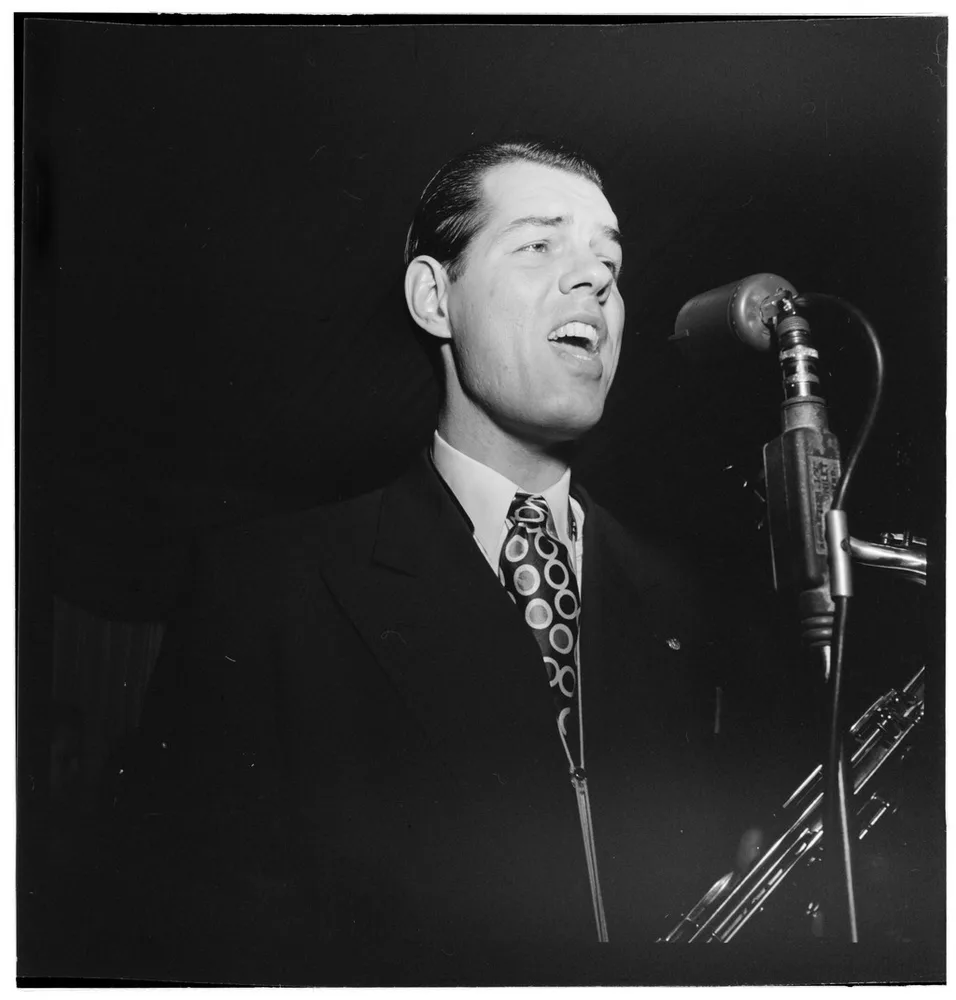
Tex Beneke singing at a microphone with his tenor saxophone beside him, about January 1947, photographed by William P. Gottlieb Public domain. Photographer William P. Gottlieb dedicated his collection to the public domain, and the Library of Congress lists the image as having no known copyright restrictions (Flickr Commons) — Wikimedia Commons: https://commons.wikimedia.org/wiki/File:(Portrait_of_Tex_Beneke,_ca._Jan._1947)_(LOC)_(5189937624).jpg . Original: Library of Congress, William P. Gottlieb Collection, http://hdl.loc.gov/loc.music/gottlieb.09781

Gordon Lee Beneke was born in Fort Worth, Texas, on February 12, 1914. He started on saxophone at nine, moving from soprano to alto and finally to tenor, and played in regional bands in Texas and Oklahoma before his first professional job with the Ben Young orchestra in 1935. In 1938 Gene Krupa, who had just left Benny Goodman and was putting together a band of his own, heard Young's group, could not use Beneke because his saxophone section was already full, and passed the name on to Glenn Miller, who was assembling an orchestra in New York. Beneke joined Miller that year at a reported salary of $52.50 a week.
Miller made him his main tenor soloist, and Beneke played all but a handful of the tenor solos on the band's records and appearances until it disbanded in 1942. On "In the Mood," recorded August 1, 1939, he trades two-bar tenor phrases with his section-mate Al Klink, and the two repeat the exchange on "A String of Pearls" in 1941. He was also the band's male vocalist on its dance and novelty hits. "Chattanooga Choo Choo," recorded in Hollywood on May 7, 1941 for the film Sun Valley Serenade with Paula Kelly and the Modernaires, became the first record certified gold, presented February 10, 1942. "(I've Got a Gal in) Kalamazoo" followed in May 1942 for Orchestra Wives, with Marion Hutton and the Modernaires, and he is credited on "Juke Box Saturday Night" the same year. His New York Times obituary says the two films helped lift him to the top of the Down Beat and Metronome polls. In January 1941 he was one of the players chosen for the Metronome All-Star band that recorded "One O'Clock Jump" and "Bugle Call Rag," alongside Goodman, Coleman Hawkins, Benny Carter, Harry James, Tommy Dorsey, Count Basie, Charlie Christian and Buddy Rich, and he takes a short solo on "Bugle Call Rag."
When Miller broke up the band in 1942 to join the Army Air Forces, Beneke worked briefly with Horace Heidt and then joined the Navy, where he led service dance bands, one of them in Oklahoma. He never played in Miller's Air Force orchestra. Miller disappeared on a flight to France on December 15, 1944. In 1946 Miller's widow and estate authorized a new Glenn Miller Orchestra and put Beneke in charge of it. It opened at the Capitol Theatre in New York on January 24, 1946 for a three-week engagement, carried a large string section modelled on Miller's Air Force band, and had Henry Mancini as its pianist and one of its arrangers, with Norman Leyden also arranging. It recorded for RCA Victor and was an immediate commercial success. "Give Me Five Minutes More," recorded May 27, 1946, and "Hey! Ba-Ba-Re-Bop," a cover of a Lionel Hampton hit that reached No. 4 on the pop chart, both made Billboard's year-end list for 1946. "The Anniversary Song" made the 1947 list, "A Gal in Calico" reached No. 6 in 1947, and "St. Louis Blues March" made the 1948 year-end list. In December 1947 the band drew a record crowd of 6,750 dancers to the Hollywood Palladium.
The estate and its bandleader wanted different things, and the disagreement ended the arrangement. Beneke believed Miller had promised him a band of his own and wanted the orchestra to develop an identity beyond the prewar sound. The estate wanted Miller's songs played in Miller's style, built on the reed-centered sound Miller had made his trademark, and Beneke's obituary in the New York Times says the band's manager and producer insisted that the music stay faithful to Miller's prewar work with no experiments. The string section was dropped in 1949, and at the end of 1950 Beneke left the orchestra and parted company with the estate. He went on as "Tex Beneke and His Orchestra: Playing the Music Made Famous by Glenn Miller." The break was acrimonious at the time, but by 2017 the Miller estate listed him as a former leader of the Glenn Miller Orchestra and the orchestra's website had a page acknowledging his role.
The 1950s were leaner. Beneke recorded for smaller labels such as Coral and competed with other Miller alumni and imitators, among them Ray Anthony, Jerry Gray and Ralph Flanagan. The singer Eydie Gormé worked with his band in 1950, and the drummer Mel Lewis and Bob Brookmeyer, then still a pianist, both passed through it in the early 1950s on their way to jazz careers. In 1958 he reunited with Ray Eberle, Paula Kelly and the Modernaires for the Coral LP Reunion in Hi-Fi, billed to the Former Glenn Miller Singers, which re-created Miller hits in high fidelity, and in 1965 he made Christmas Serenade in the Glenn Miller Style for Columbia. In 1972 he re-recorded his Miller vocals for Time-Life Records' The Swing Era series, produced and conducted by Billy May. Through the 1970s and 1980s he led a band that mixed the old repertoire with newer material, played Disneyland and Knott's Berry Farm, and appeared on talk shows, sometimes in tenor duets with his old section-mate Al Klink on The Tonight Show. He also toured for a time with Helen O'Connell and Bob Eberly, the former Jimmy Dorsey vocalists.
A stroke in the mid-1990s forced him to give up the saxophone, although he kept conducting and singing. He received a star on the Hollywood Walk of Fame in 1991, and in 1998 he launched a tour honoring the Army Air Force Band. Beneke passed away on May 30, 2000, of respiratory failure at a nursing home in Costa Mesa, California, at the age of 86. He is buried at Greenwood Memorial Park in Fort Worth.
Beneke was a swing-era tenor saxophonist and a pop and novelty singer, and the two halves of his reputation point in different directions. As an instrumentalist he was a tenor soloist working inside the Miller arrangements, in short features and section exchanges and not long improvisations. His vocals were the commercial side: easygoing Southern phrasing, often in call and response with the Modernaires, on songs such as "Chattanooga Choo Choo," "Kalamazoo" and the postwar "Five Minutes More," most of them light dance-band or novelty material and not jazz. Jazz listeners more often meet him as a name on Miller records than as a leader. The jazz side is real and documented all the same: the Metronome All-Star date, the tenor exchanges with Al Klink on "In the Mood" and "A String of Pearls," and the judgment of the critic Will Friedwald, who counts him among the major blues singers who sang with the big bands of the early 1940s and singles out his reading of Mary Lou Williams's "What's Your Story, Morning Glory?" with the Miller band. His 1946 cover of Lionel Hampton's "Hey! Ba-Ba-Re-Bop" brought a rhythm and blues number into the same dance-band format. AllMusic files his work under Big Band, Swing and Sweet Bands.
- "In the Mood" / "I Want to Be Happy" (1939, Bluebird B-10416) - Recorded August 1, 1939 with Glenn Miller and His Orchestra, the band's signature hit, with Beneke trading two-bar tenor phrases with Al Klink.
- "Chattanooga Choo Choo" (1941, Bluebird B-11230) - Beneke is the featured singer, with Paula Kelly and the Modernaires, on the first record certified gold. Spotify - Chattanooga Choo-Choo Listen
- Metronome All-Stars, "One O'Clock Jump" / "Bugle Call Rag" (1941, RCA Victor) - The all-star band recorded in New York on January 16, 1941, with a short Beneke solo on "Bugle Call Rag."
- "(I've Got a Gal in) Kalamazoo" (1942, Victor 27934) - The follow-up to "Chattanooga," from Orchestra Wives, with Beneke singing and soloing alongside Marion Hutton and the Modernaires. Spotify - Kalamazoo Listen
- "Give Me Five Minutes More" (1946, RCA Victor 20-1922) - Recorded May 27, 1946 with the estate-authorized Glenn Miller Orchestra, a Billboard year-end hit that year.
- "Hey! Ba-Ba-Re-Bop" (1946, RCA Victor 20-1859) - His cover of a Lionel Hampton hit, No. 4 on the pop chart.
- "St. Louis Blues March" (1948, RCA Victor 20-2722) - W. C. Handy's tune in march tempo, a 1948 Billboard year-end hit. Spotify - St. Louis Blues March Listen
- Reunion in Hi-Fi (1958, Coral) - Billed to the Former Glenn Miller Singers: high-fidelity re-creations of Miller hits with Beneke, Ray Eberle, Paula Kelly and the Modernaires.
Tex Beneke: Full Discography
Discogs artist: Tex Beneke (254907) and Tex Beneke And His Orchestra (1309114) · Real name Gordon Lee Beneke · Born February 12, 1914, Fort Worth, Texas · Died May 30, 2000, Costa Mesa, California
Beneke's recording life falls into three parts: the 1938 to 1942 sides with the Glenn Miller Orchestra, where he is the featured tenor saxophonist and a vocalist; the 1946 to 1950 records of the estate-authorized Glenn Miller Orchestra under his direction, made for RCA Victor; and the records under his own name from 1950 onward for RCA Victor, MGM, Coral, Warner Bros. and Columbia, most of them re-creations of the Miller repertoire. His singles were issued mainly as 78s and are filed on Discogs under two entries, one for Tex Beneke and one for his orchestra. His long-playing catalog is small and is dominated by compilations and reissues of broadcast material, so the tables below list the principal releases and not every pressing.
Leader and Co-Leader Albums
| Album | Year | Label (catalog) | Personnel & Notes | Charts | Listen | Buy |
|---|---|---|---|---|---|---|
| Tex Beneke Plays Hoagy Carmichael for Dancing | 1950 | RCA Victor (WP 267) | Tex Beneke and His Orchestra. A 45 rpm set of six Hoagy Carmichael songs: "Star Dust," "Lazy River," "Lazy Bones," "Rockin' Chair," "Georgia on My Mind" and "Riverboat Shuffle." Liner notes by George T. Simon. An EP pressing followed in 1952 | — | — | — |
| Live Concert: Music Made Famous by Glenn Miller | 1961 | Warner Bros. (W 1428) | Billed to Tex Beneke, Ray Eberle, the Modernaires and the Glenn Miller Orchestra. Twelve tracks including "In the Mood," "Chattanooga Choo Choo," "A String of Pearls," "Serenade in Blue," "Wham" and "American Patrol," plus a Ray Eberle reminiscence. Credited musicians include Paul Tanner, Jimmy Priddy, Jack Sperling, John Halliburton and Zeke Zarchy | — | — | — |
| Music Made Famous by Glenn Miller (Silver Jubilee Album) | 1962 | Warner Bros. (W 1468) | Tex Beneke with Ray Eberle, the Modernaires and Paula Kelly. Twelve tracks including "Tuxedo Junction," "Kalamazoo," "Sunrise Serenade," "St. Louis Blues March," "Blue Champagne" and "Don't Sit Under the Apple Tree." Liner notes by Peter J. Levinson | — | — | — |
| Something Old, Something New, Something Borrowed, Something Blue: Music in the Style Made Famous by Glenn Miller | 1963 | Warner Bros. (WS 1505) | Tex Beneke with Ray Eberle, the Modernaires and Paula Kelly, playing current songs such as the theme from Exodus, "Days of Wine and Roses" and "I Left My Heart in San Francisco" in the Miller style. Arrangements by Alan Copeland; liner notes by Johnny Carson | — | — | — |
| Christmas Serenade in the Glenn Miller Style | 1965 | Columbia (CS 9192) | Billed as featuring the original Glenn Miller singers: Tex Beneke, Ray Eberle, Paula Kelly and the Modernaires. Twelve Christmas songs including "Have Yourself a Merry Little Christmas," "Sleigh Ride" and "White Christmas." Arrangements by Alan Copeland, produced by Irving Townsend | — | Apple Music | — |
| With No Strings | 1976 | Hep | Tex Beneke and His Orchestra | — | Apple Music | — |
| Loose Like | 1983 | Hep | Tex Beneke and His Orchestra | — | Apple Music | — |
Other long-playing releases listed on Discogs under his name include Radio Discs of Tex Beneke (Joyce, 1976), Tex Beneke's Jubilee (Joyce, 1979), Hi There Tex! (Swing World, 1980) and Under the Rainbow (Artistic, 1983).
Selected Singles
| Year | Title | Label (catalog) | Notes | Listen | Buy |
|---|---|---|---|---|---|
| 1946 | "The Whiffenpoof Song" / "Hey! Ba-Ba-Re-Bop" | RCA Victor (20-1859) | Tex Beneke with the Glenn Miller Orchestra. "Hey! Ba-Ba-Re-Bop" is a cover of a Lionel Hampton record, with Beneke, Artie Malvin and the Crew Chiefs on vocals. It reached No. 4 on the pop chart and was on Billboard's 1946 year-end list | — | — |
| 1946 | "Give Me Five Minutes More" / "Texas Tex" | RCA Victor (20-1922) | Recorded May 27, 1946. On Billboard's 1946 year-end list | — | — |
| 1946 | "Oh, But I Do" / "A Gal in Calico" | RCA Victor (20-1991) | "A Gal in Calico" reached No. 6 on the chart in 1947 | — | — |
| 1947 | "Hoodle Addle" / "The Anniversary Song" | RCA Victor (20-2126) | "The Anniversary Song" is on Billboard's 1947 year-end list | — | — |
| 1948 | "St. Louis Blues March" / "Cherokee Canyon" | RCA Victor (20-2722) | Released February 1948. On Billboard's 1948 year-end list | Spotify - St. Louis Blues March | — |
Compilations
| Title | Year | Label (catalog) | Notes | Listen | Buy |
|---|---|---|---|---|---|
| Jukebox Saturday Night | 1992 | Vintage Jazz Classics (VJC-1039) | Compilation | — | — |
| Palladium Patrol | 1995 | Aero Space (RACD 1031) | Compilation | — | — |
| The Best of Tex Beneke | 1998 | Collectors' Choice (CCM-062-2) | Compilation | — | — |
| Tex Beneke and His "Music in the Miller Mood" | 2000 | Soundies (SCD 4130) | Two-CD compilation | Apple Music | — |
| 1964 Live Guard Sessions plus Stars for Defense show from 1960 | 2001 | Jazz Band Records | Compilation of live material | — | — |
| Hey! Ba-Ba-Re-Bop! The Singles Collection 1946-54 | 2022 | Acrobat | Two-CD compilation of his singles | — | — |
As Featured Soloist and Vocalist (selected major credits)
| Year | Project (Leader) | Title | Label | Catalog | Role | Notes |
|---|---|---|---|---|---|---|
| 1939 | Glenn Miller and His Orchestra | "In the Mood" / "I Want to Be Happy" | Bluebird | B-10416 | Tenor saxophone | Recorded August 1, 1939. Beneke and Al Klink trade two-bar tenor phrases |
| 1941 | Metronome All-Stars | "One O'Clock Jump" / "Bugle Call Rag" | RCA Victor | — | Tenor saxophone | Recorded in New York on January 16, 1941 with Benny Goodman, Coleman Hawkins, Benny Carter, Harry James, Tommy Dorsey, Count Basie, Charlie Christian and Buddy Rich; Beneke has a short solo on "Bugle Call Rag" |
| 1941 | Glenn Miller and His Orchestra | "Chattanooga Choo Choo" / "I Know Why" | Bluebird | B-11230 | Vocals, tenor saxophone | Recorded in Hollywood on May 7, 1941, with Paula Kelly and the Modernaires. First record certified gold. Spotify - Chattanooga Choo-Choo |
| 1941 | Glenn Miller and His Orchestra | "A String of Pearls" / "Day Dreaming" | Bluebird | B-11382 | Tenor saxophone | Recorded November 8, 1941. Beneke and Al Klink trade tenor phrases |
| 1942 | Glenn Miller and His Orchestra | "(I've Got a Gal In) Kalamazoo" / "At Last" | Victor | 27934 | Vocals, tenor saxophone | Recorded in Hollywood on May 20, 1942, with Marion Hutton and the Modernaires, for the film Orchestra Wives. Spotify - Kalamazoo |
| 1942 | Glenn Miller and His Orchestra | "Juke Box Saturday Night" | Victor | — | Vocals | With Marion Hutton and the Modernaires |
| 1958 | The Former Glenn Miller Singers | Reunion in Hi-Fi | Coral | FEP 2056 (EP) | Vocals | High-fidelity re-creations of Miller hits with Beneke, Ray Eberle, Marion Hutton, Paula Kelly and the Modernaires. A four-track EP on Coral; the full LP was reissued by Jasmine (JASM 1015) |
| 1971-72 | Billy May (conductor) | The Swing Era (Time-Life Records) | Time-Life / Capitol | — | Vocals | Re-recorded Miller vocals by Beneke appear in the volumes issued around 1971 and 1972, including The Music of 1942-1944: When Sport Was Mighty Sporty |
- Glenn Miller - Beneke was his featured tenor saxophonist and male vocalist from 1938 to 1942, and later led the estate-authorized Glenn Miller Orchestra from January 1946 until the end of 1950.
- Gene Krupa - recommended Beneke to Miller in 1938 after he could not hire him for his own new band.
- Al Klink - fellow Miller tenor saxophonist, his partner in the "In the Mood" and "A String of Pearls" exchanges, and later a regular tenor duet partner on The Tonight Show.
- Paula Kelly, Marion Hutton, Ray Eberle and the Modernaires - the Miller-band vocalists who sang with him on the 1941 and 1942 hits and on Reunion in Hi-Fi (1958).
- Jerry Gray - Miller arranger who wrote the charts for "Chattanooga Choo Choo" and "Kalamazoo" and composed "A String of Pearls," and later a rival bandleader.
- Henry Mancini and Norman Leyden - pianist-arranger and arranger for the 1946 Glenn Miller Orchestra under Beneke.
- Eydie Gormé - sang with his band in 1950.
- Mel Lewis and Bob Brookmeyer - both worked in the Beneke band in the early 1950s, Lewis as drummer and Brookmeyer as pianist.
- Benny Goodman, Coleman Hawkins, Benny Carter, Harry James, Tommy Dorsey, Buddy Rich, Count Basie and Charlie Christian - his section-mates on the January 1941 Metronome All-Star recording.
- Lionel Hampton - wrote and recorded "Hey! Ba-Ba-Re-Bop," which Beneke covered in 1946.
- Mary Lou Williams - composer of "What's Your Story, Morning Glory?," which Beneke sang with the Miller band.
- Billy May - produced and conducted Beneke's 1972 re-recordings of his Miller vocals for Time-Life Records.
- Helen O'Connell and Bob Eberly - the former Jimmy Dorsey vocalists with whom he toured at one point in his later career.
More Big Band Artists
See all 272 Big Band artists →More American Jazz Artists
See all 820 American artists →- Wikipedia: Tex Beneke
- The New York Times: Tex Beneke, 86, A Leader of Glenn Miller's Band (May 31, 2000)
- AllMusic: Tex Beneke biography by Bruce Eder
- Wikipedia: Glenn Miller
- Wikipedia: Glenn Miller Orchestra (1956-present)
- Wikipedia: Chattanooga Choo Choo
- Wikipedia: Hey! Ba-Ba-Re-Bop
- Wikipedia: Five Minutes More
- Wikipedia: Henry Mancini
- Wikipedia: Eydie Gormé
- Wikipedia: Bob Brookmeyer
- Percussive Arts Society: Mel Lewis
- Wikipedia: Metronome All-Stars
- Wikipedia: Billboard year-end top singles of 1946
- Wikipedia: Billboard year-end top singles of 1947
- Wikipedia: Billboard year-end top singles of 1948
- Discogs: Tex Beneke
- MusicBrainz: Tex Beneke
- Wikidata: Tex Beneke
- Library of Congress: William P. Gottlieb Collection, portrait of Tex Beneke, c. 1947