 JAZZPROFILES lives in the music 2,555 Jazz Artists fully Profiled!
Paul Horn
Last updated November 10, 2026
Listen on Spotify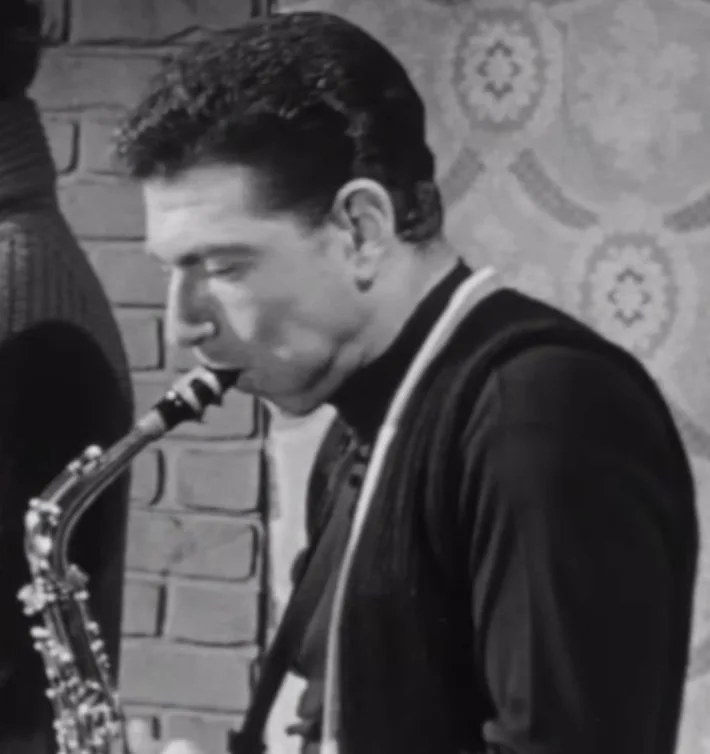
Paul Horn on alto saxophone in Roger Corman's film A Bucket of Blood, 1959 (film still) Public domain (US, copyright not renewed; Commons template PD-US-not renewed) — Wikimedia Commons — https://commons.wikimedia.org/wiki/File:Paul_Horn_in_A_Bucket_of_Blood.webp — Roger Corman / American International Pictures

Paul Horn was born in New York City on March 17, 1930. His family moved to Washington, D.C., when he was four, the age at which he began piano; he took up the clarinet at 12, attended Theodore Roosevelt High School and the Washington College of Music, and played the city's jazz clubs as a teenager. He studied clarinet and flute at the Oberlin Conservatory of Music in Ohio, where he earned a bachelor's degree, and received a master's degree from the Manhattan School of Music in June 1953. He did not take up the flute until he was 19, and it became the instrument he most wanted to play only toward the end of the 1960s.
In 1956 he was hired as a tenor saxophonist by the big band co-led by Eddie Sauter and Bill Finegan, and in the same year he joined Chico Hamilton's quintet in Los Angeles, the chamber-flavored West Coast group built around a cello. He stayed until 1958. A version of the quintet with Horn appears on screen in the 1957 film Sweet Smell of Success, and the group's records from those years include Chico Hamilton Quintet (Pacific Jazz, 1957), Sweet Smell of Success (Decca, 1957) and South Pacific in Hi-Fi (World Pacific, 1958). His own first date as a leader, House of Horn for Dot, was recorded at Radio Recorders in Hollywood on September 27 and 30, 1957, with Fred Katz on cello, Gerald Wiggins on piano, Larry Bunker on vibraphone and Red Mitchell on bass. Plenty of Horn followed on Dot in 1958 with a larger group that included Shelly Manne on drums, Stu Williamson on trumpet and Mongo Santamaría on congas, and a Paul Horn Four album, Impressions!, came out on World Pacific the same year.
Through the late 1950s and early 1960s he was one of Los Angeles's busiest reed and flute players. He recorded with Fred Katz, with Buddy Collette's four-flute Swinging Shepherds (EmArcy, 1958), with Ken Nordine on the Word Jazz albums, and with Shorty Rogers and Pete Rugolo. He was on Cal Tjader's Concert by the Sea (Fantasy, 1959), recorded live in Carmel, California, under the leadership of Cal Tjader, and on Tjader's Latino!, recorded in 1960 and released in 1962. He took part in Duke Ellington's Swinging Suites by Edward E. and Edward G. (Columbia, 1960), became a member of the NBC staff orchestra, and played on Henry Mancini's More Music from Peter Gunn. The Guardian obituary lists singers he recorded with, including Nat King Cole, Frank Sinatra, Nancy Wilson and June Christy, and names Tony Bennett among the stars he worked with. He also worked in film and television: he scored the 1959 animated series Clutch Cargo, played the saxophone solo that opens Roger Corman's A Bucket of Blood (1959), and led his band in the club scene that opens Night Tide (1961).
His own quintet, with vibraphonist Emil Richards, pianist Paul Moer and a bassist and drummer that changed over the years, made a run of jazz albums that began with Something Blue (HiFi Jazz, recorded in March 1960, with Billy Higgins on drums) and moved to Columbia for The Sound of Paul Horn (1961), Profile of a Jazz Musician (1962) and Impressions of Cleopatra (1963). He was also the subject of a television documentary by David Wolper. For RCA Victor he recorded Jazz Suite on the Mass Texts, composed and conducted by Lalo Schifrin for his quintet, a brass section, harps, percussion and a choir, on November 5 and 6, 1964, with Horn as principal soloist on alto saxophone, flute and clarinet; it was released in 1965. Other RCA albums include Cycle (1965), Monday, Monday (1966), a set of pop and folk-rock songs of the day arranged mostly by Oliver Nelson, and the ballad collection Here's That Rainy Day (1966). Horn received five Grammy nominations between 1965 and 1999, three of them in 1965.
A practice of Transcendental Meditation led him away from that career. He studied with Maharishi Mahesh Yogi, was at the Maharishi's ashram in Rishikesh, India, in 1968 at the same time as the Beatles, and made two albums of Indian music for World Pacific, Paul Horn in India and Cosmic Consciousness: Paul Horn in Kashmir. While producing a documentary on the Maharishi he returned to India in April 1968 and, on April 25, recorded solo flute inside the Taj Mahal in Agra, where the dome holds an echo of nearly half a minute and a tomb guard answered with a few chanted calls. Inside was released by Epic in 1969, found a large audience without radio play, and was reported by the BBC in 2001 to have sold over a million copies; it is regularly named as a founding record of new age music. He followed it with Inside II (1972) and Inside the Great Pyramid (1977), recorded in the Great Pyramid at Giza, and went back to the Taj Mahal on March 1 and 2, 1989, for Inside the Taj Mahal II.
In 1970 Horn moved with his family to Victoria, British Columbia, on Vancouver Island, a step that DownBeat reported under a headline about his leaving the United States. He formed a new quintet, recorded film scores for the National Film Board of Canada, and hosted The Paul Horn Show on CTV, where he met the singer-songwriter Ann Mortifee in 1973. He toured China and the Soviet Union, in 1979 and 1983, and released albums from those trips on Golden Flute Records, the label he founded; played his flute for recordings with the killer whale Haida at the Sealand of the Pacific aquarium in Oak Bay; made Altura do Sol (Epic, 1976) with Egberto Gismonti and bassist Ron Carter; and recorded two duet albums with the Native American flutist R. Carlos Nakai, Inside Canyon de Chelly (1997) and Inside Monument Valley (1999). His autobiography, written with Lee Underwood, appeared in 1990 as Inside Paul Horn: The Spiritual Odyssey of a Universal Traveler. He was a frequent instructor at the Victoria Conservatory of Music's summer jazz workshop, and in the 2000s he began spending part of each year in Tucson, Arizona. Horn passed away at his condominium in Vancouver on June 29, 2014, at 84, after a brief illness. He was survived by his wife, Ann Mortifee, and his sons Marlen and Robin.
Horn's early records place him in the cool and West Coast jazz of the 1950s: a clear, accurate tone on flute, alto saxophone and clarinet, chamber-sized groups, and larger projects such as the Schifrin Mass setting. JazzTimes describes those early works as falling squarely into the bop and cool schools. The turn came in 1967 and 1968. Meditation, Indian music and the sound of large reverberant spaces pulled his playing toward slow, spacious improvisation that often set aside jazz rhythm and harmony, and the critic Joachim Berendt, quoted in The Guardian, likened the echo of the Taj Mahal to a hall of mirrors for sound. His later albums, many recorded on location or with players from other traditions in China, Russia, Brazil, Africa, Tibet and the American Southwest, are catalogued today as new age, ambient and world music. The Guardian notes that jazz critics dismissed that later work as weightless and that his serene records dropped out of jazz discographies after the mid-1990s, and it also credits his tone, accuracy and listening. The jazz years, roughly 1953 to 1966, are substantial and documented, yet the best-known part of his catalog lies outside them, which makes him a crossover figure: a working jazz soloist who became one of the first widely known names in new age music.
- Chico Hamilton Quintet (1957, Pacific Jazz) - Horn's first widely heard recording, as the reed and flute voice in Chico Hamilton's cello-led chamber group.
- Plenty of Horn (1958, Dot) - A leader date with brass, tuba, French horn, Fred Katz on piano and a rhythm section, including a four-part suite called "Moods in Brass".
- Cal Tjader's Concert by the Sea (1959, Fantasy) - A live session in Carmel with Cal Tjader's group that includes Horn among its horns, cut in April 1959.
- Profile of a Jazz Musician (1962, Columbia) - A quintet date with Emil Richards on vibraphone, Paul Moer on piano, Victor Gaskin on bass and Milt Turner on drums, with liner notes by Leonard Feather.
- Jazz Suite on the Mass Texts (1965, RCA Victor) - Lalo Schifrin's setting of the Mass for jazz soloists, orchestra and choir, with Horn as principal soloist, recorded in November 1964.
- Inside (1969, Epic) - Solo flute recorded inside the Taj Mahal on April 25, 1968; the album that made his name outside jazz. Spotify - Prologue/Inside Listen
- Altura do Sol (1976, Epic) - Horn plays the compositions of Egberto Gismonti, who joins him on guitar, piano and flute, with Ron Carter on bass and Teo Macero producing.
- Inside the Great Pyramid (1977, Mushroom) - The second landmark site recording, made in the Great Pyramid at Giza and issued with an eight-page color insert.
Paul Horn: Full Discography
Discogs artist: Paul Horn (120312) · Born March 17, 1930, New York City · Died June 29, 2014, Vancouver
Horn made more than 50 albums. This is a selection of his leader and co-leader albums, with the jazz records of 1957 to 1966 first, followed by the meditation, world and new age albums; the full list is on Discogs. Catalog numbers are those of the first or best-documented pressing. Reissue years are given only where the first release is not confirmed.
Leader: Jazz Albums, 1957 to 1966
| Album | Year | Label (catalog) | Personnel & Notes | Listen | Buy |
|---|---|---|---|---|---|
| House of Horn | 1957 | Dot (DLP 3091) | Recorded at Radio Recorders, Hollywood, September 27 and 30, 1957. Horn (flute, alto saxophone, piccolo, clarinet), Gerald Wiggins (piano, celesta), Fred Katz (cello), John Pisano (guitar), Red Mitchell (bass), Forest Thorn (drums), Larry Bunker (vibraphone), Bill Marx (bells) and a small string section. Produced by Tom Mack. | — | — |
| Plenty of Horn | 1958 | Dot (DLP 9002) | Horn (flute, alto flute, piccolo, clarinet, alto saxophone) with Shelly Manne (drums), Red Mitchell (bass), Mongo Santamaría (congas), Larry Bunker (vibraphone, claves), Fred Katz (piano), Billy Bean (guitar), Vincent DeRosa (French horn), Milt Bernhart (trombone), Ed Leddy, Ken Bright and Stu Williamson (trumpets) and Red Callender (tuba). Includes the four-part "Moods in Brass." | — | — |
| Impressions! (The Paul Horn Four) | 1958 | World Pacific (WP-1266) | Horn (flute, alto saxophone, clarinet), John Pisano (guitar), Lyle Ritz (bass), Gene Estes (vibraphone). Produced by Richard Bock, recorded at the Club Renaissance. | — | — |
| Something Blue | 1960 | HiFi Jazz (J615) | Recorded March 1960. Horn (alto saxophone, flute, clarinet), Emil Richards (vibraphone), Paul Moer (piano), Jimmy Bond (bass) and Billy Higgins (drums); four of the six pieces are Horn originals. Produced by David Axelrod, liner notes by Gene Lees. | — | — |
| The Sound of Paul Horn | 1961 | Columbia (CL 1677) | Quintet with Emil Richards, Paul Moer, Jimmy Bond and Milt Turner. Produced by Irving Townsend, liner notes by Leonard Feather. | — | — |
| Profile of a Jazz Musician | 1962 | Columbia (CL 1922 mono, CS 8722 stereo) | Horn (alto saxophone, flute, bass flute), Emil Richards (vibraphone), Paul Moer (piano), Victor Gaskin (bass), Milt Turner (drums). Produced by Ed Kleban, liner notes by Leonard Feather. | — | — |
| Impressions of Cleopatra | 1963 | Columbia (CS 8850) | Eight pieces on Cleopatra themes. Horn (flute, melodica), Victor Feldman (piano), Emil Richards (vibraphone), Chuck Israels (bass), Colin Bailey (drums), Larry Bunker (percussion). Produced by Irving Townsend. | — | — |
| Jazz Suite on the Mass Texts | 1965 | RCA Victor (LSP-3414) | Composed and conducted by Lalo Schifrin; recorded in Hollywood, November 5 and 6, 1964. Horn (alto saxophone, flute, alto flute, clarinet) with Conte Candoli and Al Porcino (trumpets), Frank Rosolino (trombone), Dick Leith (bass trombone), Vincent DeRosa (French horn), Red Callender (tuba), two harps, Lynn Blessing (vibraphone), Michael Lang (piano), Bill Plummer (bass), Larry Bunker (drums), percussion and an eight-voice choir. | — | — |
| Cycle | 1965 | RCA Victor (LSP-3386) | Horn (flute, alto saxophone, alto flute) arranged the program, which includes two "Shadows" pieces dedicated to Ravi Shankar and two credited bagpipers. Bill Plummer (bass), Mike Lang (piano), Lynn Blessing (vibraphone), Bill Goodwin (percussion). Produced by Al Schmitt. | — | — |
| Monday, Monday | 1966 | RCA Victor (LPM-3613 mono) | Pop and folk-rock songs of the day, including "Norwegian Wood," "(I Can't Get No) Satisfaction" and "Eight Miles High." Oliver Nelson arranged most of the tracks and conducted; Horn arranged four. Produced by Al Schmitt. | — | — |
| Here's That Rainy Day | 1966 | RCA Victor (LSP-3519) | Horn (flute, alto flute, bass flute, clarinet) with Ralph Carmichael arranging and conducting, a chorus, Bill Plummer (bass), Bill Goodwin (drums), Mike Lang (piano) and Lynn Blessing (vibraphone). Produced by Al Schmitt. | — | — |
Leader: Meditation, World and New Age Albums, 1967 Onward
| Album | Year | Label (catalog) | Personnel & Notes | Listen | Buy |
|---|---|---|---|---|---|
| Paul Horn in India | 1967 | World Pacific (WPS-21447) | Ragas for flute, veena and violin. Year as listed on Discogs. | — | — |
| Cosmic Consciousness: Paul Horn in Kashmir | 1968 | World Pacific (WPS-21445) | Indian ragas and a prayer song, with tabla. Dedicated to Maharishi Mahesh Yogi. | — | — |
| Inside | 1969 | Epic (BXN 26466) | Recorded inside the Taj Mahal, Agra, on April 25, 1968. Solo flute with an unidentified tomb guard chanting; recording engineer John Archer. Reissued in the 1980s as Inside the Taj Mahal. Reported by the BBC in 2001 to have sold over a million copies. | Spotify | — |
| Paul Horn & The Concert Ensemble | 1970 | Ovation (OV/14-05) | Personnel not itemized. | — | — |
| Inside II | 1972 | Epic (KE 31600) | Includes "The Mahabhutas (Elements)," "Haida," four Bach chorales and a "Kyrie." Produced by Horn. | — | — |
| Visions | 1974 | Epic (KE 32837) | Recorded at A&M Studios, Hollywood. Includes "Guinnevere," "Chelsea Morning" and "Living for the City." The Spotify link is the 2010 reissue. | Spotify | — |
| Paul Horn + Nexus | 1975 | Epic (S EPC 69219) | With the percussion ensemble Nexus (Bill Cahn, Bob Becker, John Wyre, Robin Engelman, Russ Hartenberger, Mike Craden). Horn on flute, alto and bass flute, piccolo and alto saxophone; produced by Horn. | — | — |
| Altura do Sol (High Sun) | 1976 | Epic (PE 34231) | Music by Egberto Gismonti, who also plays guitar, piano and flute. Ron Carter (bass), Dom Salvador (electric piano), Dom Um Romao and Robertinho Silva (percussion). Produced by Teo Macero. Later reissued as The Altitude of the Sun (Black Sun, 1989). | — | — |
| Inside the Great Pyramid | 1977 | Mushroom (MRS-5507) | Recorded live in the Great Pyramid at Giza. Alto flute and voice; issued with an eight-page color insert. | — | — |
| Dream Machine | 1978 | Mushroom (MRS-5010) | Recorded January 23 to 27, 1978, at Capitol Studios, Hollywood, with synthesizers. | — | — |
| China | 1982 | Golden Flute (GFR-2001) | With David Mingyue Liang on cheng, ch'in, sheng and erhu, and a rhythm section. Produced by Horn. | — | — |
| Heart to Heart (with David Friesen) | 1983 | Golden Flute (GFR 2002) | Duets with bassist David Friesen. | — | — |
| Inside the Magic of Findhorn | 1983 | Golden Flute (GFR 2003) | Personnel not itemized. | — | — |
| Jupiter 8 | 1983 | Golden Flute (GFR 2004) | Personnel not itemized. | — | — |
| Live from Russia (With Love) | 1984 | Golden Flute (GFR 2007) | Personnel not itemized. | — | — |
| Inside Russia | 1984 | Golden Flute (GFR 2008) | Personnel not itemized. | — | — |
| In Concert | 1984 | Golden Flute (GFR 2009) | Personnel not itemized. | — | — |
| Connections (with Steven Halpern) | 1984 | Halpern Sounds (HSD 7838) | Duets with keyboardist Steven Halpern. | — | — |
| Traveler (with Christopher Hedge) | 1987 | Golden Flute / Global Pacific (OW 40717) | With producer and composer Christopher Hedge. | — | — |
| The Peace Album | 1988 | Kuckuck (11083-2) | Personnel not itemized. | — | — |
| Inside the Taj Mahal II | 1990 | Kuckuck (11085-2) | Recorded at the Taj Mahal on March 1 and 2, 1989, on soprano saxophone, alto flute, flute and bass flute, with the voice of Saad Ullah Khan. | — | — |
| Brazilian Images | 1991 | Black Sun (15013-2) | Personnel not itemized. | — | — |
| Music | 1993 | Kuckuck (11101-2) | Personnel not itemized. | — | — |
| Africa | 1994 | Kuckuck (11104-2) | Personnel not itemized. | — | — |
| Riviera Concert | Not confirmed | Not confirmed | Live set including "Nature Boy," "Work Song" and "Here's That Rainy Day." The Spotify link is the 2006 reissue. | Spotify | — |
| Inside Canyon de Chelly (with R. Carlos Nakai) | 1997 | Canyon Records (CR-7019) | Duets with the Native American flutist R. Carlos Nakai, recorded on location. | — | — |
| Inside Monument Valley (with R. Carlos Nakai) | 1999 | Canyon Records (CR-7020) | Horn (flute, alto flute, ti-tse, soprano saxophone) with R. Carlos Nakai; produced by both players and Robert Doyle. | — | — |
| Tibet: Journey to the Roof of the World | 2000 | Transparent Music (TMCD-500042) | Personnel not itemized. | — | — |
Compilations and Reissues (selected)
Plenty of Horn (ABC Impulse!, 1978, gathering House of Horn and Plenty of Horn) · Nomad: Selected Pieces 1976 to 1988 (Kuckuck, 1990) · The Jazz Years: Selected Pieces 1961 to 1963 (Black Sun, 1993) · Inside the Taj Mahal I & II (Transparent Music, 2001) · The Sound of Paul Horn / Profile of a Jazz Musician (Collectables, 2002) · Plenty of Horn (Fresh Sound, 2008) · The Stillness Inside: The Meditation Music of Paul Horn (Sounds True, 2011).
Guest and Sideman Appearances (selected)
Drawn from the credit list on English Wikipedia, with titles and labels as given there, and from Discogs for the Tjader, Christy and later items. Track-level credits are not itemized.
| Year | Album | Leader | Label | Notes | Listen | Buy |
|---|---|---|---|---|---|---|
| 1957 | Chico Hamilton Quintet | Chico Hamilton | Pacific Jazz | — | — | |
| 1957 | Sweet Smell of Success | Chico Hamilton | Decca | The quintet that appears in the film. | — | — |
| 1958 | South Pacific in Hi-Fi | Chico Hamilton | World Pacific | — | — | |
| 1959 | Ellington Suite | Chico Hamilton | World Pacific | — | — | |
| 1959 | The Three Faces of Chico | Chico Hamilton | Warner Bros. | — | — | |
| 1957 | Zen: The Music of Fred Katz | Fred Katz | Pacific Jazz | — | — | |
| 1958 | Soul° Cello | Fred Katz | Decca | — | — | |
| 1958 | Folk Songs for Far Out Folk | Fred Katz | Warner Bros. | — | — | |
| 1957 | Word Jazz | Ken Nordine | Dot | — | — | |
| 1958 | Son of Word Jazz | Ken Nordine | Dot | — | — | |
| 1958 | Buddy Collette's Swinging Shepherds | Buddy Collette | EmArcy | Four-flute group. | — | — |
| 1959 | At the Cinema! | Buddy Collette | Mercury | — | — | |
| 1958 | Chances Are It Swings | Shorty Rogers | RCA Victor | — | — | |
| 1961 | The Fourth Dimension in Sound | Shorty Rogers | Warner Bros. | — | — | |
| 1962 | Bossa Nova | Shorty Rogers | Reprise | — | — | |
| 1962 | Jazz Waltz | Shorty Rogers | Reprise | — | — | |
| 1959 | Mongo | Mongo Santamaría | Fantasy | — | — | |
| 1959 | Cal Tjader's Concert by the Sea | Cal Tjader | Fantasy | Recorded live in Carmel, California. | — | — |
| 1961 | In a Latin Bag | Cal Tjader | Verve | — | — | |
| 1962 | Latino! | Cal Tjader | Fantasy | Recorded in 1960; includes Willie Bobo and Mongo Santamaría on drums and percussion. | — | — |
| 1959 | The Music from Richard Diamond | Pete Rugolo | EmArcy | — | — | |
| 1960 | Behind Brigitte Bardot | Pete Rugolo | Warner Bros. | — | — | |
| 1959 | The Song Is June! | June Christy | Capitol | Horn and Bud Shank on alto saxophone and flute, by track. | — | — |
| 1960 | Swinging Suites by Edward E. and Edward G. | Duke Ellington | Columbia | — | — | |
| Not confirmed | More Music from Peter Gunn | Henry Mancini | Not confirmed | Named by The Guardian as a session on which Horn had a key role. | — | — |
| 1964 | More of the Great Lorez Alexandria | Lorez Alexandria | Impulse! | — | — | |
| 1964 | Gone with the Wave | Lalo Schifrin | Colpix | — | — | |
| 1964 | My Fair Lady with the Un-original Cast | Shelly Manne | Capitol | — | — | |
| 1965 | L-O-V-E | Nat King Cole | Capitol | — | — | |
| 1965 | Out of the Woods | George Shearing | Capitol | Recorded in 1963. | — | — |
| 1966 | Pet Sounds | The Beach Boys | Capitol | Listed in Wikipedia's credit list for Horn. | — | — |
| 1970 | Carnegie Hall | Dick Schory (with Gary Burton and Paul Horn) | Ovation | — | — | |
| 1970 | Ladies of the Canyon | Joni Mitchell | Reprise | Listed in Wikipedia's credit list for Horn. | — | — |
| 1978 | Improvisations | Ravi Shankar (with Paul Horn and Bud Shank) | Ravi Shankar Music Circle | — | — | |
| 1980 | Midem Live '80 / Jazz Gala '80 | Stan Getz | RCA; Kingdom Jazz | Festival recordings from Cannes on which Horn is credited. | — | — |
- Chico Hamilton - drummer and bandleader; Horn played reeds and flute in his quintet from 1956 to 1958.
- Fred Katz - the quintet's cellist; he played with Horn on Zen: The Music of Fred Katz (Pacific Jazz, 1957) and on Horn's own House of Horn (cello) and Plenty of Horn (piano).
- Buddy Collette - flutist and reed player who led the Swinging Shepherds, a four-flute group, on EmArcy in 1958.
- Cal Tjader - vibraphonist; Horn is on Cal Tjader's Concert by the Sea (1959) and Latino! (recorded 1960, released 1962).
- Mongo Santamaría - percussionist; he plays congas on Horn's Plenty of Horn, and Horn is listed on his Mongo (Fantasy, 1959).
- Emil Richards, Paul Moer, Jimmy Bond, Victor Gaskin, Milt Turner - the vibraphone, piano, bass and drum chairs in Horn's quintet on his albums of 1960 to 1962; Billy Higgins played drums on Something Blue.
- Lalo Schifrin - composer and conductor of Jazz Suite on the Mass Texts (1965) and leader of Gone with the Wave (Colpix, 1964), on which Horn is listed.
- Oliver Nelson - arranged most of the tracks on Monday, Monday (1966) and conducted the sessions.
- Duke Ellington - Horn is listed on Swinging Suites by Edward E. and Edward G. (Columbia, 1960).
- Shorty Rogers, Pete Rugolo, Henry Mancini - Los Angeles bandleaders and writers whose albums used him: Rogers on Chances Are It Swings (1958) and later titles, Rugolo on The Music from Richard Diamond (1959), Mancini on More Music from Peter Gunn.
- Nat King Cole, Nancy Wilson - singers he recorded with, according to The Guardian; Cole's L-O-V-E (Capitol, 1965) is on Horn's credit list.
- June Christy - Horn is credited, with Bud Shank, on the 1959 sessions for her album The Song Is June! (Capitol).
- Egberto Gismonti - Brazilian composer; Altura do Sol (1976) is built on his music, with Ron Carter on bass.
- Nexus - the percussion ensemble that recorded Paul Horn + Nexus (Epic, 1975).
- R. Carlos Nakai - Native American flutist; duet partner on Inside Canyon de Chelly (1997) and Inside Monument Valley (1999).
- David Friesen, David Mingyue Liang, Christopher Hedge, Steven Halpern - a bassist, a Chinese-instrument player, an experimental musician and producer, and a keyboardist who each shared an album with him in the 1980s: Heart to Heart (1983), China (1982), Traveler (1987) and Connections (1984).
- Ann Mortifee - Canadian singer-songwriter, his wife; they met in 1973 during his CTV series, and she and Chief Dan George are credited alongside Horn on The Ecstasy of Rita Joe (1971).
More West Coast Jazz Artists
See all 38 West Coast Jazz artists →More American Jazz Artists
See all 876 American artists →- Wikipedia: Paul Horn (musician)
- Wikipedia: Inside (Paul Horn album)
- Wikipedia: Jazz Suite on the Mass Texts
- The Guardian: Paul Horn obituary (John Fordham, July 7, 2014)
- Times Colonist: Paul Horn, 84, his flute playing was heard around the world
- JazzTimes: Paul Horn, New Age Music Pioneer, Dies at 84
- Discogs: Paul Horn (artist 120312)
- MusicBrainz: Paul Horn
- JazzProfiles.com: Chico Hamilton
- JazzProfiles.com: Cal Tjader
- JazzProfiles.com: Egberto Gismonti
- JazzProfiles.com: June Christy