 JAZZPROFILES lives in the music 2,555 Jazz Artists fully Profiled!
Egberto Gismonti
Last updated November 10, 2026
Listen on Spotify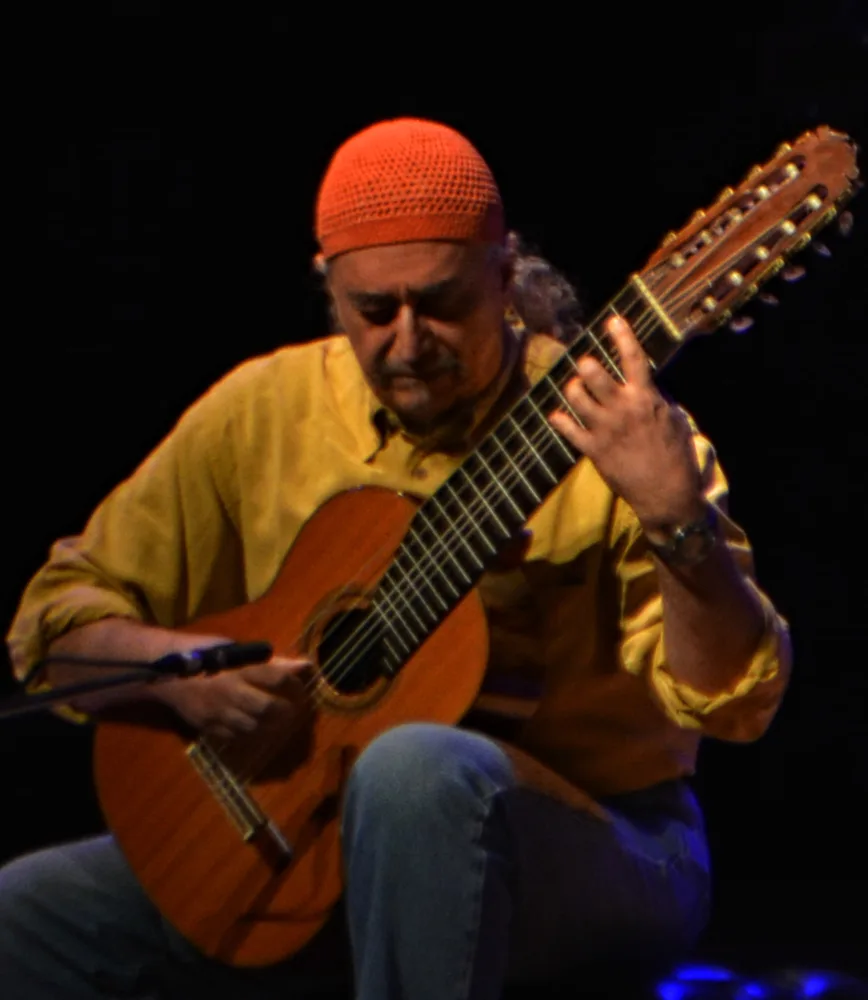
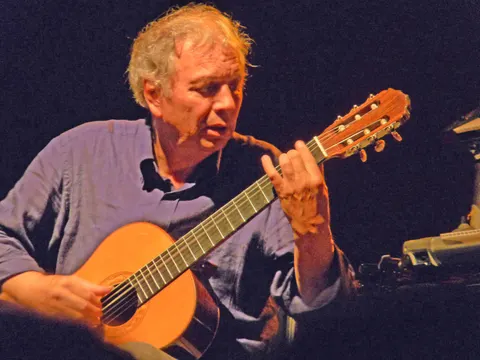
Egberto Gismonti playing a ten-string guitar at the Sala Sinfónica of the Centro Cultural Kirchner, Buenos Aires, June 2017 (cropped from the original frame) CC BY-SA 4.0 — Wikimedia Commons - https://commons.wikimedia.org/wiki/File:Egberto_Gismonti_2017_(cropped).jpg - photograph by ProtoplasmaKid

Egberto Amin Gismonti was born on December 5, 1947, in Carmo, a small town in the interior of Rio de Janeiro state, into a family of musicians. His father, Camilo Amim, was Lebanese and his mother, Ruth, was of Italian descent; AllMusic adds that his grandfather and an uncle led bands. He began on the piano as a small child and studied it for about fifteen years, added flute and clarinet at the Brazilian Conservatory of Music, and took up the guitar in his teens, teaching himself. Because he wanted the guitar to do what a piano does, he had instruments with more than six strings made for him and worked out his own two-handed technique on them. At twenty he turned down a scholarship to study classical music in Vienna in order to work in popular music. In October 1968 his song "O Sonho," which he had arranged for a hundred-piece orchestra, was performed by the group Os Três Morais at TV Globo's third International Song Festival in Rio, and AllMusic reports that it was recorded eighteen times by other artists.
Soon afterward he left for France, where he spent about a year and a half as conductor and orchestrator for the singer Marie Laforêt and became a pupil of the composers Jean Barraqué and Nadia Boulanger. Boulanger urged him to write Brazil's collective experience into his music, and he went home in 1971 to do it. His first LP, Egberto Gismonti (Elenco, 1969), mixed his own songs with a tribute to Wes Montgomery and was cut with the drummer Wilson das Neves and the bassist Sérgio Barroso. Sonho 70 (Polydor, 1970) was produced by Roberto Menescal, and Orfeo Novo (MPS, issued in Germany in 1971) was produced by Joachim Ernst Berendt, with the bassist J.-F. Jenny-Clark and the flutist Bernard Wystraëte. Back in Brazil he made Água e Vinho (Odeon, 1972) with the lyricist Geraldo Carneiro, which holds two of his best-known songs, "Ano Zero" and "Água e Vinho," and then Academia de Danças (EMI/Odeon, 1974), the record AllMusic names as the turning point toward instrumental music and says earned a gold record in Brazil. Between 1972 and 1991, by AllMusic's count, he made nineteen albums for EMI/Odeon.
In 1974 he accepted an invitation to a festival in Berlin and asked Hermeto Pascoal and Naná Vasconcelos to appear with him. There he met Manfred Eicher, the head of ECM Records, and a letter from the label followed in 1975 inviting him to record; according to AllMusic he did not answer until the end of 1976. He had meant to record with his Brazilian band, but the cost of taking them abroad ruled that out, and in Norway he enlisted Vasconcelos instead. Dança das Cabeças was recorded in Oslo in November 1976 and released in 1977 as his ECM debut. AllMusic says it was honored as a pop record in England, a folk record in the United States and a classical record in Germany; English Wikipedia adds that Stereo Review nominated it for album of the year and that it won Germany's Großer Deutscher Schallplattenpreis for 1977.
After that record he went into the upper Xingu region of the Amazon basin and spent about a month with the Yawalapiti, having played his flute for two weeks until their chief, Sapaim, invited him in, AllMusic recounts. Sol do Meio Dia (recorded November 1977, released 1978) is dedicated to the Xingu peoples and brings Vasconcelos, Ralph Towner on twelve-string guitar, Collin Walcott on tabla and Jan Garbarek on soprano saxophone onto some of its tracks. Solo (recorded November 1978, released 1979) is a solo set for piano, eight-string guitar and percussion that AllMusic says sold 100,000 copies in the United States. In 1978 he founded his own label, Carmo, through which he later bought back his early recordings; Portuguese Wikipedia notes that this makes him one of the few Brazilian composers who own their own catalog. In June and November 1979 he recorded Magico and Folk Songs in Oslo with the bassist Charlie Haden and Garbarek, a trio that toured Europe in 1981; one of those concerts, recorded in Munich in April 1981, appeared only in 2012 as Magico: Carta de Amor. The same year he released the double album Sanfona, a studio disc with his quartet Academia de Danças (the saxophonist and flutist Mauro Senise, the bassist Zeca Assumpção, and the drummer Nenê) and a solo concert disc.
Duas Vozes, a second duo record with Vasconcelos, was made in Oslo in June 1984 and released in 1985. Dança dos Escravos (1989) is a solo album of guitar pieces played on six-, ten-, twelve- and fourteen-string instruments. In 1990 he toured the United States with a group that included the cellist Jaques Morelenbaum, the saxophonist and flutist Nivaldo Ornelas and the keyboardist Edu Mello e Souza, and with Morelenbaum, the guitarist Nando Carneiro and Zeca Assumpção he recorded Infância (ECM, 1991) and Música de Sobrevivência (ECM, 1993), the second inspired by the poet Manoel de Barros. Meeting Point (ECM, 1997), which AllMusic says was recorded in 1995, features him as pianist and composer with the Lithuanian State Symphony Orchestra, and ZigZag (1996) is a trio record with Carneiro and Assumpção. In Montreal (ECM, 2001) is a live duo with Haden. Saudações (ECM, 2009) is a double album: the seven-part suite Sertões Veredas: Tributo à Miscigenação, recorded with the Cuban string orchestra Camerata Romeu, and a second disc of guitar duets with his son Alexandre Gismonti. He has also written for film, and AllMusic lists soundtrack work from 1969 and 1971. Portuguese Wikipedia reports that Rolling Stone Brasil named him one of the thirty great Brazilian guitar and violão icons in 2012, and he was still performing in 2025, when he appeared in Santiago, Chile, with Morelenbaum and Daniel Murray.
Gismonti's music spans jazz, Brazilian art music and popular song, and contemporary classical writing. ECM describes his work as standing at the crossroads of Brazil's folk tradition and the world of classical music, in a way that echoes Heitor Villa-Lobos, and adds that he is also a masterful improviser. AllMusic lists jazz first among his genres, with classical, international and new age after it, and names Brazilian jazz first among his styles, ahead of global jazz, samba, Brazilian folk, Latin jazz and chamber music. English Wikipedia opens by calling him a Brazilian composer, guitarist and pianist, and AllMusic reports that Dança das Cabeças was honored as a pop record in England, a folk record in the United States and a classical record in Germany. The jazz connection is real and well documented: his ECM trio with Charlie Haden and Jan Garbarek was an improvising group, English Wikipedia files his ECM albums, including the duos with Naná Vasconcelos, under jazz, and in the mid-1970s he played on records by Cal Tjader, Airto Moreira and Paul Horn. But his own compositions draw on the choro, samba, frevo, baião and forró of Brazil, on the music of the Xingu peoples, on Villa-Lobos, Stravinsky and Bach, and on what he learned from Boulanger and Barraqué, and a large share of his catalog is orchestral, chamber or solo writing rather than jazz. AllMusic observes that jazz plays a significant role among the musical languages he commands, alongside Brazilian popular and folk forms and a classical training. As a guitarist he is known for treating the fretboard like a keyboard, so that one instrument can sound like two players, and for his custom ten-, twelve- and fourteen-string guitars. Portuguese Wikipedia lists Esperanza Spalding, Hamilton de Holanda and André Mehmari among the musicians who have recorded his pieces, and de Holanda and Mehmari devoted a whole album to the music of Gismonti and Pascoal.
- Água e Vinho (1972, Odeon) - The first record built around his songs with the lyricist Geraldo Carneiro, including "Ano Zero" and the title song, two of his best-known pieces.
- Academia de Danças (1974, EMI/Odeon) - The orchestral and band recording AllMusic calls his turning point toward instrumental music; the name was later taken by his working band.
- Dança das Cabeças (1977, ECM) - The duo with Naná Vasconcelos made in Oslo in November 1976, his ECM debut and the record that carried his name beyond Brazil. Spotify - Dança das Cabeças Listen
- Sol do Meio Dia (1978, ECM) - A record dedicated to the Xingu peoples, with Vasconcelos, Ralph Towner, Collin Walcott and Jan Garbarek joining him on individual tracks.
- Magico (1980, ECM) - The first of the trio records with Charlie Haden and Garbarek, recorded in Oslo in June 1979; Folk Songs followed in 1981. Spotify - Magico Listen
- Duas Vozes (1985, ECM) - The second duo with Vasconcelos, recorded in Oslo in June 1984. Spotify - Duas Vozes Listen
- Dança dos Escravos (1989, ECM) - A solo guitar album played on six-, ten-, twelve- and fourteen-string instruments.
- Infância (1991, ECM) - A quartet record with the cellist Jaques Morelenbaum, the guitarist and synthesist Nando Carneiro and the bassist Zeca Assumpção, the first of three ECM albums by that band.
Egberto Gismonti: Full Discography
Discogs artist: Egberto Gismonti (123471) · Real name Egberto Gismonti Amin · Born December 5, 1947, Carmo, Rio de Janeiro, Brazil
Discogs files his work under several entries besides his own: Academia de Danças (his working band), the Egberto Gismonti Group, the Egberto Gismonti Trio and the trio name Magico, and the records billed to those names are included below. Catalog numbers are those of the first or best-documented pressing. The tables list the albums under his name that Discogs documents with release details, which are mostly his ECM albums and his Brazilian EMI/Odeon albums, followed by a selection of his work on other people's records. Singles, film and television soundtrack releases, anthologies and compilations are left out.
Leader and Co-Leader Albums
| Album | Year | Label | Personnel & Notes | Listen | Buy |
|---|---|---|---|---|---|
| Egberto Gismonti | 1969 | Elenco (ME-54) | His first LP, recorded in Brazil. Gismonti on organ, piano, acoustic guitar and vocals, with Wilson das Neves (drums), Sérgio Barroso (bass), Durval Ferreira (guitar on one track) and Dulce Nunes (vocals on one track); includes "Tributo a Wes Montgomery" and "O Sonho" | — | — |
| Sonho 70 | 1970 | Polydor (LPNG 44.044) | Produced by Roberto Menescal; Gismonti arranged and conducted, with Dulce Nunes featured | — | — |
| Orfeo Novo | 1971 | MPS (CRM 752) | Issued in Germany and produced by Joachim Ernst Berendt. Gismonti on guitar, piano and vocals, with J.-F. Jenny-Clark (bass), Bernard Wystraëte (flutes) and Dulce Nunes (vocals) | — | — |
| Água e Vinho | 1972 | Odeon (SMOFB 3746) | Songs written with the lyricist Geraldo E. Carneiro, including "Ano Zero" and the title song; Lindolfo Gaya musical director | — | — |
| Egberto Gismonti | 1973 | Odeon (SMOFB 3824) | A second self-titled album, with lyrics by Carneiro; Mario Tavares conducted and Gismonti orchestrated and conducted the choir; includes "Memória e Fado" and "Academia de Dança" | — | — |
| Academia de Danças | 1974 | EMI/Odeon (XEMCB-7008) | Gismonti on piano, electric piano, guitar, Indian flute, synthesizer and organ, with Luiz Alves (bass), Robertinho Silva (drums), Tenório Jr. (electric piano, organ), Márcio Montarroyos (flugelhorn), Mauro Senise, Nivaldo Ornelas, Danilo Caymmi and Paulo Guimarães (flutes) and an orchestra conducted by Mario Tavares; includes "Palácio de Pinturas" | — | — |
| Corações Futuristas | 1976 | EMI/Odeon (XEMCB 7013) | Recorded with the Academia de Danças ensemble and a string section; the backing vocalists include Joyce and Mauricio Maestro; includes "Dança das Cabeças" and "Carmo" | — | — |
| Dança das Cabeças | 1977 | ECM (ECM 1089) | Duo with Naná Vasconcelos (percussion, berimbau, body percussion, voice); Gismonti on 8-string guitar, piano, wooden flutes and voice. Recorded November 1976 at Talent Studio, Oslo; produced by Manfred Eicher; his ECM debut | Spotify | — |
| Carmo | 1977 | EMI/Odeon (XEMCB-7026) | A Brazilian release; Discogs also lists Academia de Danças on the credits | — | — |
| Sol do Meio Dia | 1978 | ECM (ECM 1116) | Recorded November 1977 at Talent Studio, Oslo. Gismonti on 8-string guitar, kalimba, piano, wooden flutes and voice, with Vasconcelos (percussion, berimbau; tracks 2, 3 and 5), Ralph Towner (12-string guitar; tracks 1 and 5), Collin Walcott (tabla; track 2) and Jan Garbarek (soprano saxophone; track 5); produced by Eicher | — | — |
| Nó Caipira | 1978 | EMI/Odeon (31C 064 422836) | A Brazilian release; Discogs also lists Academia de Danças on the credits | — | — |
| Solo | 1979 | ECM (ECM 1136) | Recorded November 1978 at Talent Studio, Oslo. Solo on piano, 8-string guitar, percussion and voice; produced by Eicher | — | — |
| Magico | 1980 | ECM (ECM 1151) | Trio billed to Charlie Haden, Jan Garbarek and Gismonti. Haden (bass), Garbarek (saxophones), Gismonti (guitars, piano); recorded June 1979 at Talent Studio, Oslo; produced by Eicher | Spotify | — |
| Circense | 1980 | EMI/Odeon (31C 064 422861D) | A Brazilian release | — | — |
| Folk Songs | 1981 | ECM (ECM 1170) | Trio billed to Haden, Garbarek and Gismonti. Haden (bass), Garbarek (soprano and tenor saxophones), Gismonti (guitar, piano); recorded November 1979 in Oslo; produced by Eicher | Spotify | — |
| Em Família | 1981 | EMI/Odeon (31C 064 422893) | A Brazilian release; Discogs also lists Academia de Danças on the credits | — | — |
| Sanfona | 1981 | ECM (ECM 1203/04) | Double album. Disc one, recorded November 1980 at Talent Studio, Oslo, with his quartet Academia de Danças: Gismonti (10-string guitar, super 8-string guitar, Indian organ, piano, voice), Mauro Senise (saxophones, flute), Zeca Assumpção (bass) and Nenê (drums, percussion). Disc two is a solo concert recorded at Amerika Haus, Munich. Issued in Brazil on EMI (31C 164 65055/6) | — | — |
| Fantasia | 1982 | EMI/Odeon (31C 064 422915) | A Brazilian release | — | — |
| Cidade Coração | 1983 | EMI/Odeon (31C 064 422929) | A Brazilian release | — | — |
| Duas Vozes | 1985 | ECM (ECM 1279) | Duo with Vasconcelos (percussion, berimbau, voice); Gismonti on guitars, piano, dilruba, flutes and voice. Recorded June 1984 at Rainbow Studio, Oslo; produced by Eicher | Spotify | — |
| Trem Caipira | 1985 | EMI/Odeon (31C 064 422957) | A Brazilian release | — | — |
| Alma | 1986 | EMI/Odeon (31C 064 422965) | A Brazilian release | — | — |
| Feixe de Luz "Todo Começo É Involuntário" | 1988 | EMI/Odeon (066 790495 1) | Billed to Gismonti and Academia de Danças | — | — |
| Dança dos Escravos | 1989 | ECM (ECM 1387) | Solo album, Gismonti on acoustic guitars of 6, 10, 12 and 14 strings; recorded November 1988; produced by Eicher | — | — |
| Kuarup | 1991 | Carmo (CARMO/4) | Orchestral album, with Jaques Morelenbaum conducting one orchestra and Gismonti conducting the Transarmônica D'Alma D'Omrac Orchestra, and Gismonti as soloist on piano, guitar and bamboo flute; the Discogs master dates the album to 1989 and the 1991 CD is the pressing listed here | — | — |
| Infância | 1991 | ECM (ECM 1428) | Billed to the Egberto Gismonti Group: Gismonti (piano, 10- and 14-string guitars), Nando Carneiro (guitar, synthesizers), Zeca Assumpção (bass) and Jaques Morelenbaum (cello); produced by Eicher | — | — |
| Amazônia | 1991 | EMI/Odeon (796902 2) | With Nando Carneiro, Zeca Assumpção and Jaques Morelenbaum and the Transarmônica D'Alma D'Omrac Orchestra; his children Alexandre and Bianca Gismonti are credited on voice | — | — |
| Casa das Andorinhas | 1992 | EMI/Odeon (780290 2) | A Brazilian release | — | — |
| Música de Sobrevivência | 1993 | ECM (ECM 1509) | Billed to the Egberto Gismonti Group: Gismonti (piano, guitar, flute), Nando Carneiro (guitar, synthesizers, caxixi), Zeca Assumpção (bass, rainstick) and Jaques Morelenbaum (cello); the booklet carries a text by the poet Manoel de Barros; produced by Eicher | — | — |
| ZigZag | 1996 | ECM (ECM 1582) | Billed to the Egberto Gismonti Trio: Gismonti (10- and 14-string guitars, piano), Nando Carneiro (guitar, synthesizer) and Zeca Assumpção (double bass); produced by Eicher | — | — |
| Meeting Point | 1997 | ECM (ECM 1586) | Gismonti on piano as composer and artistic director, with the Lithuanian State Symphony Orchestra conducted by Gintaras Rinkevičius; Eicher executive producer | — | — |
| In Montreal (with Charlie Haden) | 2001 | ECM (ECM 1746) | Duo of Gismonti (guitar, piano) and Haden (double bass), a live recording; Eicher executive producer | Spotify | — |
| Saudações | 2009 | ECM (ECM 2082/83) | Double album. Disc one is the suite "Sertões Veredas - Tributo à Miscigenação" for the string ensemble Camerata Romeu, conducted by Zenaida Romeu; disc two is "Duetos de Violões," ten guitar pieces played with his son Alexandre Gismonti; Eicher executive producer | — | — |
| Magico: Carta de Amor (with Charlie Haden and Jan Garbarek) | 2012 | ECM (ECM 2280/81) | Live double album by the trio, Haden (double bass), Garbarek (tenor and soprano saxophones) and Gismonti (guitars, piano), recorded in April 1981 at the Amerika Haus, Munich; produced by Eicher | Spotify | — |
Sideman and Guest Appearances (Selected)
These are credits where Discogs names him as a performer. The Buy column carries no links.
| Album | Year | Leader | Notes | Listen | Buy |
|---|---|---|---|---|---|
| Identity | 1975 | Airto Moreira | Credited on acoustic guitar, electric piano, piano, flute and synthesizer; the release gives no track breakdown. Produced by Moreira and Herbie Hancock; Arista AL 4068 | — | — |
| Amazonas | 1976 | Cal Tjader | Piano and synthesizer, in a band with Luiz Alves (bass), Robertinho Silva (drums, percussion), David Amaro (guitar) and Dawilli Gonga (keyboards); produced by Moreira; Fantasy F-9502 | Spotify | — |
| Altura do Sol (High Sun) | 1976 | Paul Horn | Gismonti on guitar, flute, piano and bambuzal, and composer of the music, with Ron Carter (bass), Dom Salvador (electric piano), Dom Um Romão and Robertinho Silva (percussion); produced by Teo Macero; Epic PE 34231. Reissued in 1989 as The Altitude of the Sun (Black Sun 15002-2), paired with Horn's recordings with the percussion group Nexus | — | — |
| Open Your Eyes You Can Fly | 1976 | Flora Purim | Acoustic guitar on "San Francisco River," which he also arranged, and on the "White Wing / Black Wing" medley; Milestone M-9065 | — | — |
| Olho d'Água | 1979 | Marlui Miranda | Piano, electric piano, melodica, acoustic guitar, viola caipira and percussion; also artistic producer and arranger, with Mauro Senise (saxophones, flutes) and Zeca Assumpção (bass); Continental 1.01.404.195 | — | — |
| Yeahwon | 2010 | Yeahwon Shin | Featured on piano on "Memória e Fado"; ArtistShare AS0106 | — | — |
Records of His Music by Others
Gismonti is credited on these records as composer, producer or mixer, and the table does not claim that he plays on them.
| Album | Year | Artist | Notes | Listen | Buy |
|---|---|---|---|---|---|
| Gismonti Pascoal: A Música de Egberto e Hermeto | 2010 | Hamilton de Holanda and André Mehmari | A tribute to the music of Gismonti and Hermeto Pascoal; Brasilianos DOPO19 | — | — |
| Universo Musical de Egberto Gismonti | 2019 | Daniel Murray | All compositions by Gismonti, who is also credited as producer and mixer; Carmo CARMO/18, released August 23, 2019 | — | — |
- Naná Vasconcelos - percussionist and berimbau player; duo partner on Dança das Cabeças (1977) and Duas Vozes (1985), and a guest on three tracks of Sol do Meio Dia (1978).
- Charlie Haden and Jan Garbarek - trio partners on Magico (recorded June 1979), Folk Songs (recorded November 1979) and the live Magico: Carta de Amor (recorded April 1981, released 2012); Haden is also his partner on the duo record In Montreal (2001).
- Ralph Towner and Collin Walcott - on Sol do Meio Dia, Towner playing twelve-string guitar on two tracks and Walcott tabla on one.
- Hermeto Pascoal - invited with Vasconcelos to join Gismonti's 1974 appearance at a Berlin festival, the trip on which he met ECM's producer.
- Manfred Eicher - the ECM producer of his records for the label, from Dança das Cabeças on.
- Academia de Danças - his Brazilian working band; on Sanfona (1981) it was Mauro Senise on saxophones and flutes, Zeca Assumpção on bass and Nenê on drums and percussion, and earlier lineups included Robertinho Silva, Luiz Alves and Nivaldo Ornelas.
- Jaques Morelenbaum, Nando Carneiro and Zeca Assumpção - cellist, guitarist and synthesist, and bassist of the 1990s group on Infância and Música de Sobrevivência; Carneiro and Assumpção make up the trio on ZigZag (1996).
- Cal Tjader - Gismonti is credited on piano and synthesizer on Tjader's Amazonas (recorded June 1975, released 1976), produced by Airto Moreira and also featuring the Brazilian rhythm players Luiz Alves and Robertinho Silva.
- Airto Moreira - Gismonti is credited on guitar, piano, electric piano, flute and synthesizer on Moreira's Identity (Arista, 1975).
- Paul Horn - the flutist and saxophonist whose Altura do Sol (Epic, 1976) was built on Gismonti's compositions and featured him on guitar, piano and flute, with Ron Carter on bass; it was later reissued with Horn's recordings with the percussion group Nexus.
- Marlui Miranda - Gismonti produced and arranged her album Olho d'Água (Continental, 1979) and plays piano, guitar and viola caipira on it.
- Yeahwon Shin - guest pianist on "Memória e Fado" on her first jazz album Yeahwon (ArtistShare, 2010).
- Alexandre Gismonti - his son, a guitarist, partner in the second disc of duets on Saudações (2009).
- Camerata Romeu and the Lithuanian State Symphony Orchestra - the string ensemble on the first disc of Saudações and the orchestra on Meeting Point (1997), conducted by Gintaras Rinkevičius.
- Geraldo Carneiro - lyricist of the songs on Água e Vinho (1972) and of several pieces on his 1973 Odeon album.
- Marie Laforêt - the French singer for whom he conducted and orchestrated for about a year and a half beginning in 1968.
- Jean Barraqué and Nadia Boulanger - his composition teachers in Paris.


More Ethno Jazz Artists
See all 250 Ethno Jazz artists →More Brazilian Jazz Artists
See all 36 Brazilian artists →- Wikipedia: Egberto Gismonti
- Wikipedia (Portuguese): Egberto Gismonti
- Wikipedia (German): Egberto Gismonti
- Wikipedia (Spanish): Egberto Gismonti
- AllMusic: Egberto Gismonti biography by Alvaro Neder
- ECM Records: Egberto Gismonti
- Discogs: Egberto Gismonti (artist 123471)
- MusicBrainz: Egberto Gismonti
- Wikipedia: Dança das cabeças
- Wikipedia: Sol do meio dia
- Wikipedia: Solo (Egberto Gismonti album)
- Wikipedia: Mágico (album)
- Wikipedia: Folk Songs (Charlie Haden album)
- Wikipedia: Mágico: Carta de Amor
- Wikipedia: Sanfona
- Wikipedia: Duas vozes
- JazzProfiles.com: Cal Tjader
- JazzProfiles.com: Yeahwon Shin
- JazzProfiles.com: Charlie Haden