 JAZZPROFILES lives in the music 2,059 Jazz Artists fully Profiled!
Nina Simone
Last updated October 29, 2026
Listen on Spotify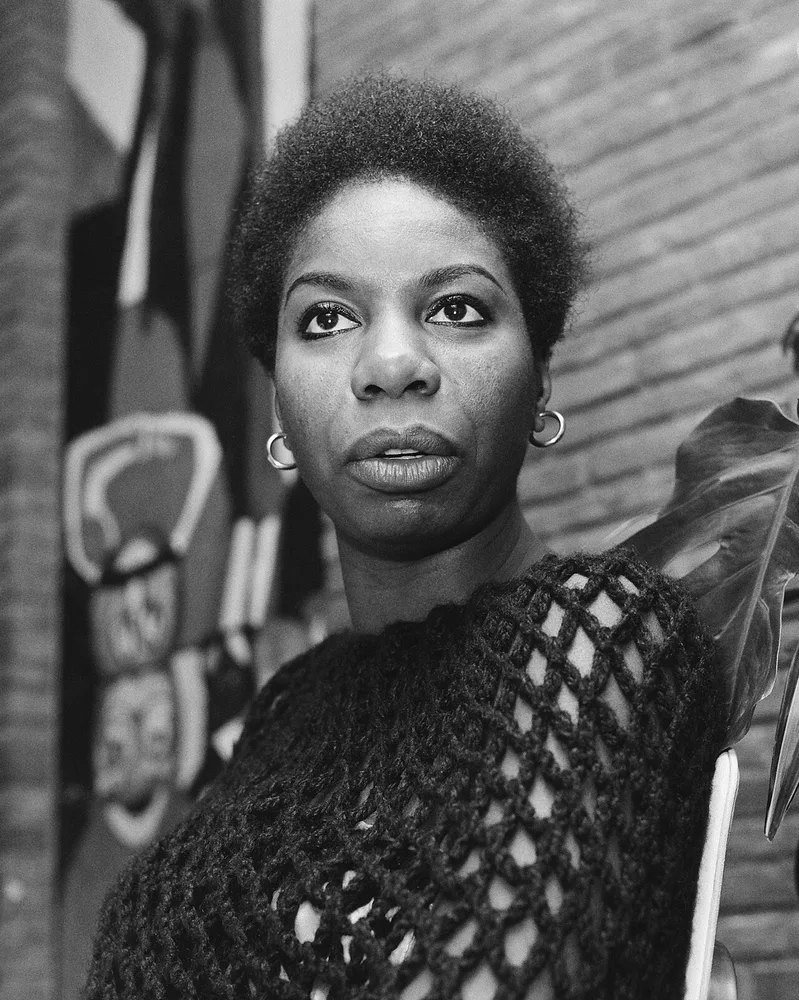
Nina Simone, December 14, 1965 (restored version of a press photograph made in the Netherlands) CC0 1.0 (public domain dedication) — Wikimedia Commons - https://commons.wikimedia.org/wiki/File:Nina_Simone_1965_-_restoration1.jpg - Ron Kroon for Anefo, Nationaal Archief (National Archives of the Netherlands); restored by Bammesk

Nina Simone was born Eunice Kathleen Waymon on February 21, 1933, in Tryon, North Carolina, the sixth of eight children. Her father, John Divine Waymon, worked as a barber and dry cleaner and also performed; her mother, Mary Kate Irvin, was a Methodist preacher. She was picking out hymns on the piano at three or four, played in her local church, and gave her first classical recital at twelve. A fund set up by her music teacher and other townspeople paid for her education, and she graduated as valedictorian of Allen High School for Girls in Asheville. In the summer of 1950 she studied at Juilliard with Carl Friedberg to prepare for an audition at the Curtis Institute of Music in Philadelphia. Curtis turned her down. Her family had moved to Philadelphia in expectation of her admission, and she said for the rest of her life that she was rejected because she was Black, a charge the school has denied. She continued with private lessons under Vladimir Sokoloff, a Curtis professor, and worked as an accompanist and piano teacher.
To pay for those lessons she took a job in 1954 playing at the Midtown Bar & Grill in Atlantic City, New Jersey. The owner insisted that she sing as well as play, and she began performing a mix of jazz standards, blues, hymns and classical pieces under a new name, partly so that her mother would not learn she was playing "the devil's music." Nina came from a boyfriend's nickname for her, and Simone from the French actress Simone Signoret. In December 1957 she recorded thirteen or fourteen songs for Bethlehem Records in New York with the bassist Jimmy Bond and the drummer Albert "Tootie" Heath. She sold the rights outright for $3,000 and later lost out on more than a million dollars in royalties. Little Girl Blue came out in February 1959. She had learned George Gershwin's "I Loves You, Porgy" from a Billie Holiday record, and when Bethlehem finally issued it as a single in 1959 it reached No. 18 on the Billboard Hot 100 and No. 2 on the R&B chart. It was her only US top-twenty pop hit.
She signed with Colpix in April 1959, with producer Hecky Krasnow, on terms that left the choice of material to her. The Amazing Nina Simone followed that year. On September 12, 1959 she made her concert debut at Town Hall in New York, billed on a Jazz at Town Hall evening with the quintets of Horace Silver and J.J. Johnson; the Town Hall album was released that December. The Colpix years produced Nina at Newport (1960), Forbidden Fruit (1961), Nina at the Village Gate (1962), the Ellington tribute Nina Simone Sings Ellington (1962) and Nina Simone at Carnegie Hall (1963), the last with the bassist Lisle Atkinson. In New York she became friends with James Baldwin, Langston Hughes and Lorraine Hansberry. In December 1961 she married Andrew Stroud, a New York police detective who became her manager; she later told the BBC that he abused her psychologically and physically.
In 1964 she moved to Philips, and her music took a political turn. Nina Simone in Concert, taken from Carnegie Hall performances in March and April 1964, opened with "Mississippi Goddam," which she wrote in under an hour after the murder of Medgar Evers on June 12, 1963 and the bombing of the 16th Street Baptist Church in Birmingham on September 15, 1963. The single was boycotted in some southern states. She performed at civil rights gatherings, including the Selma to Montgomery marches, recorded "Four Women" (1966), which was banned by New York's WLIB, and sang "Backlash Blues," with words by Langston Hughes, on her first RCA Victor album, Nina Simone Sings the Blues (1967). With Weldon Irvine she turned an unfinished Lorraine Hansberry play title into "To Be Young, Gifted and Black," first released on Black Gold (1970). On April 7, 1968, three days after the assassination of Martin Luther King Jr., she played Westbury Music Fair, dedicated the night to him, and sang "Why? (The King of Love Is Dead)," written by her bassist Gene Taylor; the recording became part of 'Nuff Said!. In 1969 she appeared at the Harlem Cultural Festival, footage of which is in the 2021 film Summer of Soul. Her RCA singles reached Britain: "Ain't Got No, I Got Life" climbed to No. 2 in 1968 and "To Love Somebody" to No. 5 the following year.
She left the United States in 1970, saying that her protest songs had cost her work, and went first to Barbados and then, at the urging of Miriam Makeba, to Liberia. Her daughter Lisa, who joined her there, has said that her mother was physically and mentally abusive during that period, and Lisa later returned to New York to live with her father. Simone later lived in Switzerland, the Netherlands and France. Her last RCA album was It Is Finished (1974), and she made no record again until Creed Taylor, who had seen her perform in 1977, signed her to CTI for Baltimore (1978); she disliked the production, and it did not chart. In the 1980s she was a regular at Ronnie Scott's in London, where she recorded a live album in 1984, and in 1987 her 1958 recording of "My Baby Just Cares for Me" became a European hit after it was used in a Chanel No. 5 television commercial, reaching the UK top five. Her autobiography, I Put a Spell on You, appeared in the early 1990s, and in 1993 she made her last studio album, A Single Woman, for Elektra. She settled near Aix-en-Provence that year.
Her later life was marked by illness and public difficulty. She was diagnosed with bipolar disorder, and in 1995 a shooting incident involving a neighbor's son near her home in France brought a suspended sentence. She had breast cancer for several years and passed away in her sleep at her home in Carry-le-Rouet on April 21, 2003, aged 70. She had learned only days before that the Curtis Institute would award her an honorary degree. Among those at her funeral were Miriam Makeba, Patti LaBelle, Ossie Davis and Ruby Dee, and her ashes were scattered in several African countries. Her daughter, the singer and actress Lisa Simone, was executive producer of the 2015 documentary What Happened, Miss Simone?, which was nominated for an Academy Award. She was inducted into the Rock and Roll Hall of Fame in 2018 and the National Rhythm & Blues Hall of Fame in 2021, and Rolling Stone ranked her No. 21 on its 2023 list of the 200 greatest singers.
Simone was a classically trained pianist who became a singer by accident, and she never studied voice. She told an interviewer in 1970 that she sang everything she heard and picked the key that hid the limits of her range. What she brought from the keyboard was Bach-style counterpoint, the Romantic virtuosity of Chopin, Liszt and Rachmaninoff, and a contralto she used for sustained notes, long silences and spoken asides to the audience. Miles Davis was among the musicians who admired her ability to play three-part counterpoint inside a pop song and improvise on it. Much of her catalogue sits outside jazz proper: folk and gospel songs, Bessie Smith blues, show tunes, protest songs of her own, and pop and rock covers by Bob Dylan, the Beatles, the Bee Gees and Leonard Cohen. A DownBeat reviewer of Forbidden Fruit said plainly that it was not a jazz album. Her jazz credentials are nonetheless real: she learned her breakthrough ballad from Billie Holiday, recorded a full album of Duke Ellington and Billy Strayhorn songs, shared a Town Hall bill with Horace Silver and J.J. Johnson, worked with jazz rhythm sections for most of her career, and returned to jazz clubs and festivals such as Ronnie Scott's and Montreux in her later years. She is best described as a crossover figure whose roots are in jazz, blues and the classical piano, and whose influence reaches well beyond them. Her songs have been recorded by artists from Aretha Franklin, who recorded "To Be Young, Gifted and Black" on her 1972 album Young, Gifted and Black, to singers working in jazz today, among them Nnenna Freelon, who names her as an early influence. Critics have likened Melody Gardot's phrasing to hers. AllMusic's Mark Deming ranked her among the most gifted and the most eclectic singers of her generation.
- Little Girl Blue (1959, Bethlehem) - The debut, cut in a single long session in late 1957 with Jimmy Bond on bass and Tootie Heath on drums, and the source of "I Loves You, Porgy" and "My Baby Just Cares for Me." Spotify - Little Girl Blue Listen · Buy
- Nina Simone at Town Hall (1959, Colpix) - Her first live album, from the September 12, 1959 concert on a bill with the Horace Silver and J.J. Johnson quintets. Spotify - At Town Hall Listen · Buy
- Nina Simone Sings Ellington (1962, Colpix) - Eleven Ellington-associated songs, arranged by Simone herself with a vocal group, including "Solitude," "Satin Doll" and "It Don't Mean a Thing." Spotify - Nina Simone Sings Ellington Listen · Buy
- Nina Simone in Concert (1964, Philips) - Her first album for Philips and the first with "Mississippi Goddam," recorded live at Carnegie Hall. Spotify - In Concert Listen · Buy
- Pastel Blues (1965, Philips) - Home of "Sinnerman" and "Strange Fruit," played by a small band with Lisle Atkinson on bass. Spotify - Pastel Blues Listen · Buy
- I Put a Spell on You (1965, Philips) - One of her most pop-oriented albums, with "Feeling Good" and a French reading of "Ne me quitte pas," plus the instrumental "Blues on Purpose." Spotify - I Put a Spell on You Listen · Buy
- Wild Is the Wind (1966, Philips) - Contains "Four Women," "Wild Is the Wind" and "Lilac Wine," and was ranked No. 212 on Rolling Stone's 2020 list of the 500 greatest albums. Spotify - Wild Is the Wind Listen · Buy
- 'Nuff Said! (1968, RCA Victor) - Recorded in large part at Westbury Music Fair three days after the assassination of Martin Luther King Jr., it carries "Why? (The King of Love Is Dead)" and her UK hit "Ain't Got No, I Got Life." Spotify - 'Nuff Said (Expanded Edition) Listen · Buy
Nina Simone: Full Discography
Discogs artist: Nina Simone (10584) · Real name Eunice Kathleen Waymon · Born February 21, 1933, Tryon, North Carolina · Passed away April 21, 2003, Carry-le-Rouet, France
Simone recorded more than forty albums between 1959 and 1974 and her catalogue has been reissued and repackaged more or less continuously since, so the lists below are curated: every studio and live album issued with her cooperation, a selection of important compilations and singles, and the main honors. Catalog numbers are those of the original US pressing (mono Colpix issues carry a CP prefix and stereo issues an SCP prefix); chart positions are Billboard 200 and Billboard R&B albums chart unless noted.
Leader: Studio and Live Albums
| Album | Year | Label | Personnel & Notes | Charts | Listen | Buy |
|---|---|---|---|---|---|---|
| Little Girl Blue | 1959 | Bethlehem (BCP-6028) | Recorded in one long session in late 1957. Nina Simone (vocals, piano, arrangements), Jimmy Bond (bass), Albert "Tootie" Heath (drums). Contains "I Loves You, Porgy" (single, 1959: US No. 18, R&B No. 2), "Don't Smoke in Bed," "Plain Gold Ring" and "My Baby Just Cares for Me." She sold the rights outright for $3,000 | Spotify | Amazon | |
| The Amazing Nina Simone | 1959 | Colpix (CP 407) | First album for Colpix, recorded in April 1959 after she left Bethlehem; includes "Children Go Where I Send You" and "Willow Weep for Me" | Spotify | Amazon | |
| Nina Simone at Town Hall | 1959 | Colpix (CP 409) | Her first live album, from the September 12, 1959 concert at Town Hall, New York, on a Jazz at Town Hall bill with the quintets of Horace Silver and J.J. Johnson. Wilbur Ware (bass), Ben Riley (drums); three tracks are studio versions cut the following month | Spotify | Amazon | |
| Nina at Newport | 1960 | Colpix (CP 412) | Live; includes "Trouble in Mind" (single: US No. 92, R&B No. 11) | Spotify | Amazon | |
| Forbidden Fruit | 1961 | Colpix (CP 419) | Al Schackman (guitar), Chris White (bass), Bobby Hamilton (drums). Includes "Work Song" by Oscar Brown Jr. and Nat Adderley, "Gin House Blues" and three Oscar Brown Jr. songs | Spotify | Amazon | |
| Nina at the Village Gate | 1962 | Colpix (CP 421) | Live at the Greenwich Village club; includes "Brown Baby," "Zungo" and "House of the Rising Sun" | Spotify | Amazon | |
| Nina Simone Sings Ellington | 1962 | Colpix (SCP 425) | Songs associated with Duke Ellington and Billy Strayhorn, arranged by Simone with the Malcolm Dodds Singers; includes "Solitude," "Satin Doll" (instrumental) and "It Don't Mean a Thing" | Spotify | Amazon | |
| Nina Simone at Carnegie Hall | 1963 | Colpix (SCP 455) | Live, April 12, 1963, with Lisle Atkinson on bass | not found | Amazon | |
| Folksy Nina | 1964 | Colpix (CP 465) | Live; issued by Colpix in 1964 | not found | Amazon | |
| Nina Simone in Concert | 1964 | Philips (PHS 600-135) | First Philips album, from Carnegie Hall concerts in March and April 1964. Rudy Stevenson (guitar), Lisle Atkinson (bass), Bobby Hamilton (drums); produced by Hal Mooney. First recording of "Mississippi Goddam"; also "Old Jim Crow," "Go Limp" and "Pirate Jenny" | US No. 102 | Spotify | Amazon |
| Broadway-Blues-Ballads | 1964 | Philips (PHS 600-148) | Includes "Don't Let Me Be Misunderstood" (single: US No. 131), "See-Line Woman," "Nobody" and "Night Song" | Spotify | Amazon | |
| I Put a Spell on You | 1965 | Philips (PHS 600-172) | Rudy Stevenson (guitar); Hal Mooney and Horace Ott (arrangement, conducting). Includes the title song (single: US No. 120, R&B No. 23, UK No. 49), "Feeling Good," "Ne me quitte pas" and the instrumental "Blues on Purpose" | US No. 99, UK No. 18 | Spotify | Amazon |
| Pastel Blues | 1965 | Philips (PHS 600-187) | Al Schackman (guitar, harmonica), Rudy Stevenson (guitar, flute), Lisle Atkinson (bass), Bobby Hamilton (drums). Includes "Sinnerman" and "Strange Fruit" | US No. 139, R&B No. 8 | Spotify | Amazon |
| Let It All Out | 1966 | Philips (PHS 600-202) | Live and studio recordings | R&B No. 19 | Spotify | Amazon |
| Wild Is the Wind | 1966 | Philips (PHS 600-207) | Compiled from 1964 and 1965 sessions. Includes "Four Women" (banned by New York's WLIB), "Wild Is the Wind" and "Lilac Wine." Ranked No. 212 on Rolling Stone's 2020 list of the 500 greatest albums | US No. 110, R&B No. 12 | Spotify | Amazon |
| High Priestess of Soul | 1967 | Philips (PHS 600-219) | Includes a new studio recording of "Work Song" and "Come Ye" | R&B No. 29 | Spotify | Amazon |
| Nina Simone Sings the Blues | 1967 | RCA Victor (LSP-3789) | Her first album for RCA. Eric Gale and Rudy Stevenson (guitar), Ernie Hayes (organ), Bob Bushnell (bass), Bernard Purdie (drums), Buddy Lucas (harmonica, tenor saxophone). Includes "Backlash Blues" (words by Langston Hughes), "My Man's Gone Now" and "The House of the Rising Sun" | R&B No. 29 | Spotify | Amazon |
| Silk & Soul | 1967 | RCA Victor (LSP-3837) | Gene Taylor (bass), Eric Gale and Rudy Stevenson (guitar), Ernie Hayes (piano, harpsichord), Bernard Purdie (drums); arranged and conducted by Sammy Lowe. Includes "I Wish I Knew How It Would Feel to Be Free" (Billy Taylor) and "(You'll) Go to Hell," which brought a Grammy nomination | US No. 158, R&B No. 24 | Spotify | Amazon |
| 'Nuff Said! | 1968 | RCA Victor (LSP-4065) | Mostly live at Westbury Music Fair on April 7, 1968, three days after the assassination of Martin Luther King Jr. Rudy Stevenson (guitar), Sam Waymon (organ), Gene Taylor (bass), Buck Clarke (drums). Includes "Why? (The King of Love Is Dead)" and "Ain't Got No, I Got Life" (UK single No. 2) | R&B No. 44, UK No. 11 | Spotify | Amazon |
| Nina Simone and Piano! | 1969 | RCA Victor (LSP-4102) | Recorded in 1967 and 1969; includes "Pirate Jenny" and "Don't Explain" | Spotify | Amazon | |
| To Love Somebody | 1969 | RCA Victor (LSP-4152) | Includes the Bee Gees' "To Love Somebody" (UK single No. 5) and Leonard Cohen's "Suzanne" | Spotify | Amazon | |
| Black Gold | 1970 | RCA Victor (LSP-4248) | Live at Philharmonic Hall, New York, in 1969. Emile Latimer and Tom Smith (guitar), Weldon Irvine (organ), Don Alias (drums, percussion), Jumma Santos (congas). First album release of "To Be Young, Gifted and Black." Grammy nominee, Best Female R&B Vocal Performance (1971) | US No. 149, R&B No. 21 | Spotify | Amazon |
| Here Comes the Sun | 1971 | RCA Victor (LSP-4536) | Pop and rock covers (Dylan, the Beatles and others) arranged by Harold Wheeler and Simone, with orchestra and backing vocals; Sam Waymon coordinated production. Includes a fast, percussive "My Way" | US No. 190 | Spotify | Amazon |
| Emergency Ward! | 1972 | RCA Victor (LSP-4757) | Live and studio recordings; includes "Today Is a Killer" and a reading of George Harrison's "My Sweet Lord" | Spotify | Amazon | |
| It Is Finished | 1974 | RCA (APL1-0241) | Live; her last album for RCA | Spotify | Amazon | |
| Baltimore | 1978 | CTI (CTI 7084) | Produced by Creed Taylor. Eric Gale (guitar), Gary King and Chuck Israels (bass), Jimmy Madison (drums), Nicky Marrero (percussion). Title song by Randy Newman; also "Rich Girl" and "Everything Must Change." Her only CTI album; it did not chart | Spotify | Amazon | |
| Fodder on My Wings | 1982 | Carrere (67885) | First record after a four-year gap, issued by a French label; includes the self-written "Fodder on My Wings" and "I Sing Just to Know That I'm Alive" | not found | Amazon | |
| Nina's Back! | 1985 | VPI (VPI 100-7A) | Studio album on the American VPI label | Spotify | Amazon | |
| Live & Kickin' | 1985 | VPI | Live | not found | Amazon | |
| Let It Be Me | 1987 | Verve | Live, including "Four Women" recorded at Vine St. Bar & Grill | not found | Amazon | |
| Live at Ronnie Scott's | 1987 | Hendring-Wadham (WHCD006) | Recorded at Ronnie Scott's Jazz Club, London, in 1984, with Paul Robinson on drums. Includes "I Loves You, Porgy," "Mississippi Goddam" and "Fodder in Her Wings" | Spotify | Amazon | |
| A Single Woman | 1993 | Elektra (61503) | Her final studio album. Produced by Andre Fischer; Al Schackman (guitar), John Clayton (bass, arrangement), Jeff Hamilton (drums), Gary Foster (reeds), Gerald Albright (tenor saxophone), Jack Sheldon (trumpet), with strings and woodwinds. The Listen link is the 2025 two-disc expanded edition | Spotify | Amazon |
Selected Compilations and Archival Releases
Nina Simone and Her Friends (Bethlehem, 1959, four Simone tracks) · Nina's Choice (Colpix, 1963) · Nina Simone with Strings (Colpix, 1966, strings added to earlier Colpix recordings) · Gifted & Black (Canyon, 1970, built on a 1957 demo with strings added in 1970) · The Best of Nina Simone (RCA, 1970) · My Baby Just Cares for Me (Charly, 1987, reissue of Little Girl Blue after the Chanel hit) · Compact Jazz (Mercury, 1989) · Verve Jazz Masters 17 (1994) · Four Women: The Nina Simone Philips Recordings (Verve, 2003) · The Soul of Nina Simone (RCA, 2005, with DVD) · Mood Indigo: The Complete Bethlehem Singles (2017) · The Colpix Singles (Rhino, 2017) · Nina Simone: The Montreux Years (BMG, 2021).
Selected Singles
| Year | Single | Label | Chart |
|---|---|---|---|
| 1959 | "I Loves You, Porgy" / "Love Me or Leave Me" | Bethlehem | US No. 18, R&B No. 2 |
| 1960 | "Nobody Knows You When You're Down and Out" | Colpix | US No. 93, R&B No. 23 |
| 1960 | "Trouble in Mind" | Colpix | US No. 92, R&B No. 11 |
| 1964 | "Mississippi Goddam" / "Sea Lion Woman" | Philips | |
| 1964 | "Don't Let Me Be Misunderstood" | Philips | US No. 131 |
| 1965 | "I Put a Spell on You" | Philips | US No. 120, R&B No. 23, UK No. 49 |
| 1966 | "Four Women" | Philips | |
| 1967 | "I Wish I Knew How It Would Feel to Be Free" | RCA Victor | |
| 1968 | "To Love Somebody" | RCA Victor | UK No. 5 |
| 1968 | "Ain't Got No, I Got Life" | RCA Victor | UK No. 2 |
| 1968 | "Do What You Gotta Do" | RCA Victor | US No. 83, R&B No. 43 |
| 1969 | "To Be Young, Gifted and Black" | RCA Victor | US No. 76, R&B No. 8 |
| 1978 | "Baltimore" | CTI | |
| 1987 | "My Baby Just Cares for Me" (reissue of the 1958 recording) | Charly | UK No. 5 |
| 1994 | "Feeling Good" (reissue of the 1965 recording) | Verve | UK No. 40 |
Guest Appearance
Pete Townshend's concept album The Iron Man (1989) features Simone singing "Fast Food," alongside John Lee Hooker on another track.
Awards and Honors
| Year | Honor | Work | Result |
|---|---|---|---|
| 1968 | Grammy Award, Best Female R&B Vocal Performance | "(You'll) Go to Hell" | Nominee |
| 1971 | Grammy Award, Best Female R&B Vocal Performance | Black Gold | Nominee |
| 2000 | Grammy Hall of Fame | "I Loves You, Porgy" | Inducted |
| 2009 | North Carolina Music Hall of Fame | Inducted | |
| 2016 | Grammy Award, Best Music Film | What Happened, Miss Simone? | Nominee |
| 2016 | Academy Award, Best Documentary Feature | What Happened, Miss Simone? | Nominee |
| 2018 | Rock and Roll Hall of Fame | Inducted | |
| 2019 | Library of Congress National Recording Registry | "Mississippi Goddam" | Selected |
| 2021 | National Rhythm & Blues Hall of Fame | Inducted | |
| 2023 | Rolling Stone, 200 Greatest Singers of All Time | No. 21 |
- Jimmy Bond and Albert "Tootie" Heath - bassist and drummer on her debut session for Bethlehem, December 1957.
- Horace Silver and J.J. Johnson - the leaders of the two quintets on the Jazz at Town Hall bill of September 12, 1959 where she made her concert debut. Wilbur Ware (bass) and Ben Riley (drums) accompanied her.
- Hecky Krasnow - Colpix producer who signed her in 1959.
- Lisle Atkinson - her bassist from 1962 to 1966, on Nina Simone at Carnegie Hall, Nina Simone in Concert, Pastel Blues and Wild Is the Wind.
- Al Schackman, Rudy Stevenson and Bobby Hamilton - the two guitarists (Stevenson also played flute) and the drummer in her mid-1960s working band; Schackman was her guitarist and musical director for much of her career.
- Hal Mooney and Horace Ott - Mooney produced Nina Simone in Concert and, with Ott, arranged and conducted I Put a Spell on You.
- Gene Taylor - bassist who wrote "Why? (The King of Love Is Dead)" after the news of Martin Luther King Jr.'s death reached him.
- Eric Gale - guitarist on Nina Simone Sings the Blues, Silk & Soul and Baltimore, with Bernard Purdie on drums for the RCA dates.
- Clint Houston - bassist in her band in 1969.
- Weldon Irvine - co-wrote "To Be Young, Gifted and Black" and played organ on Black Gold.
- Creed Taylor - produced Baltimore for CTI (1978) after seeing her perform in 1977.
- Langston Hughes - wrote the words to "Backlash Blues."
- Lorraine Hansberry - friend whose unfinished play lent its title to "To Be Young, Gifted and Black."
- Billy Taylor - composer of "I Wish I Knew How It Would Feel to Be Free," recorded on Silk & Soul (1967).
- Nat Adderley - co-wrote "Work Song" with Oscar Brown Jr.; she recorded it for Forbidden Fruit in 1961.
- Miriam Makeba - friend who persuaded her to go to Liberia in the 1970s and attended her funeral.
- Sam Waymon - her brother, organist on 'Nuff Said!, production coordinator on Here Comes the Sun and writer of "It Be's That Way Sometime" on Silk & Soul.
- Gary Foster, John Clayton and Jeff Hamilton - among the musicians on her last studio album, A Single Woman (1993), where Clayton also arranged.
More Vocal Jazz Artists
See all 220 Vocal Jazz artists →More American Jazz Artists
See all 646 American artists →- Wikipedia: Nina Simone
- Wikipedia: Nina Simone discography
- Wikipedia: Little Girl Blue (album)
- Wikipedia: Nina Simone at Town Hall
- Wikipedia: Nina Simone in Concert
- Wikipedia: Mississippi Goddam
- Wikipedia: Four Women (song)
- Wikipedia: Baltimore (album)
- Wikipedia: Nina Simone Sings Ellington
- AllMusic: Nina Simone biography
- Discogs: Nina Simone
- MusicBrainz: Nina Simone