 JAZZPROFILES lives in the music 1,146 Jazz Artists fully Profiled!
 Noam Wiesenberg
Last updated September 13, 2026
Listen on Spotify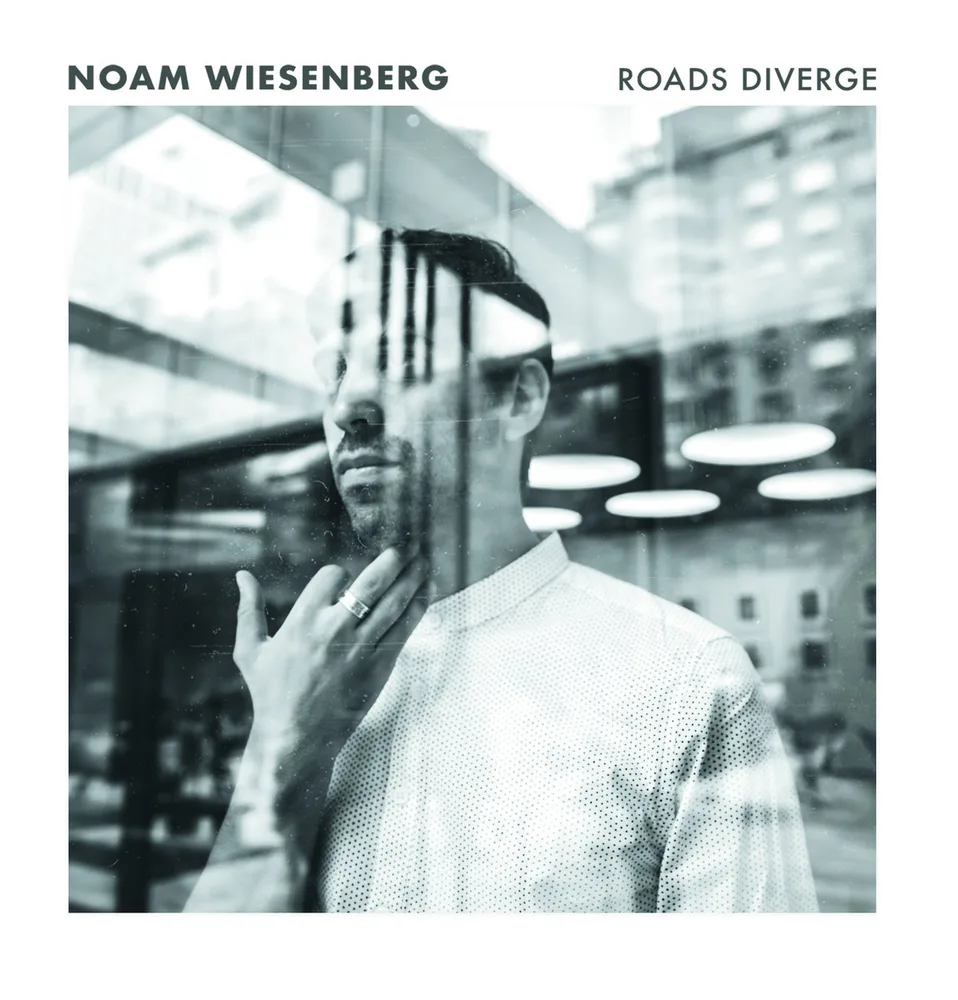
Noam Wiesenberg, on the cover of his 2018 debut album *Roads Diverge* (Brooklyn Jazz Underground Records). Standard copyright, all rights reserved, held by Noam Wiesenberg / Brooklyn Jazz Underground Records. This is not a Creative Commons or public-domain image. A genuine search (Wikimedia Commons Special:MediaSearch and a direct MediaWiki API search under both "Noam Wiesenberg" and the Hebrew "נעם ויזנברג," Wikidata, his official site, and his social media) found no free-licensed or public-domain photograph of him, so this album cover is used here as an honestly-disclosed editorial stand-in per the site's standing "album cover as photo fallback" rule. It qualifies because Wiesenberg himself is clearly and directly pictured, a close double-exposure portrait against a city skyline, not abstract cover art. — Bandcamp (noamwiesenberg.bandcamp.com/album/roads-diverge), full-resolution cover image at https://f4.bcbits.com/img/a1437012026_10.jpg. Downloaded directly and saved locally as portrait.jpg with no cropping and no re-encoding.
Noam Wiesenberg is a double bassist, composer, and arranger who grew up in Tel Aviv, the son of the Israeli composer and pianist Prof. Menachem Wiesenberg, and has spent close to two decades building a working career in New York's jazz scene. In an interview with 15 Questions, he traced his musical start to the cello, at age six, playing classical European repertoire, while his father exposed him at home to a mix that ran from the Beatles and Stevie Wonder to Duke Ellington, Paco de Lucia, Turkish and Bulgarian music, Indian classical music, and klezmer. He switched his focus to the double bass at 20, drawn, per his own biography distributed by Smalls Live, by "the musical capabilities of jazz musicians." Before he left Israel, he built a substantial career there as a cellist and arranger: he played cello, credited as part of the "Moran Ensemble" string section, on Israeli metal band Orphaned Land's acclaimed 2004 concept album Mabool, wrote string arrangements performed by the Jerusalem and Haifa Symphony Orchestras, arranged one track on pop singer Ofer Bashan's 2008 self-titled album, placed second in the "Israeli Jazz Player of the Year" competition, and received a decade of scholarships (1998 to 2008) from the America-Israel Cultural Foundation.
He moved to Boston in 2008, attended the International Association of Schools of Jazz's meeting in Riga that same year, and graduated magna cum laude in Jazz Performance from Berklee College of Music in 2010, after which he relocated to New York. Since 2013, Wiesenberg has served as musical director and strings arranger for singer and guitarist Camila Meza's Nectar Orchestra, the octet Meza built around her 2019 album Ambar. He is also a founding member of Kind Folk, a collective quartet with trumpeter John Raymond, alto saxophonist Alex LoRe, and drummer Colin Stranahan, formed in 2014 and recording for the Fresh Sound New Talent label; the band released Why Not in 2018 and, after Raymond took a teaching post at Indiana University and Stranahan relocated to Denver, reconvened in New York in 2021 to record Head Towards the Center, released in 2022.
Wiesenberg released his debut album as a leader, Roads Diverge, on Brooklyn Jazz Underground Records in May 2018: a set of original compositions built on the idea that the act of choosing matters more than what is chosen, closing with a cover of Radiohead's "The Tourist." The band paired him with trumpeter Philip Dizack, pianist Shai Maestro, drummer Kush Abadey, alto saxophonist and clarinetist Immanuel Wilkins, and, on one track, tenor saxophonist Dayna Stephens. Reviewing the album for All About Jazz, Geno Thackara wrote that "the leader's arranging skills generally keep the piano and dual horns weaving around each other without crowding," praised Wiesenberg's "natural understatement" as a bassist, and called the record "a very colorful debut full of promise and heart." Filipe Freitas at JazzTrail put it more simply: the album "demonstrates sufficient conviction regarding this musician's artistic path."
His second album, NeoNomadic, followed in November 2023 on La Reserve, again built around the theme of home, this time examining what he has called the cognitive dissonance of being a global citizen. The record reunites him with Dizack on trumpet and Abadey on drums, adds guitarist Charles Altura and pianist Mike King, and features tenor saxophonist Melissa Aldana as a guest on "Dark Matter." Speaking to 15 Questions about his creative process, Wiesenberg said: "I believe the music is already there, but like a fine diamond, you have to find it and then polish and clean it until it's perfect." He added that he never writes a tune "as a platform for musicians to improvise," aiming instead for pieces with "an interesting arc," a quality he says listeners have described as cinematic.
Beyond his own catalogue, Wiesenberg's own official biography credits him with performances alongside drummers Ari Hoenig, Billy Hart, Antonio Sanchez, and Jeff "Tain" Watts, pianists Aaron Goldberg and Uri Caine, saxophonists Dave Liebman, Seamus Blake, and Will Vinson, guitarists Lage Lund and Jonathan Kreisberg, and fellow Israeli-born musicians Gilad Hekselman and Yotam Silberstein (see notes.md on the sourcing of this list). He has performed at the Monterey Jazz Festival, the Kennedy Center, and the Blue Note, and toured across Africa, India, and Europe. He teaches bass and composition, giving master classes internationally, and lives in Brooklyn.
Wiesenberg's writing sits at the intersection of the classical training he started as a child and the postbop language he absorbed at Berklee and in New York. He has said he was raised on an unusually wide range of records via his father, spanning the Beatles and Stevie Wonder to Ellington, Paco de Lucia, Turkish and Bulgarian folk music, Indian classical music, and klezmer, and traces of that range surface on Roads Diverge in the Hebrew-titled pieces "Shir Le'Shir" ("song for a song") and "Davka" (a Hebrew word roughly meaning "specifically," or "just to spite"), set alongside straight-ahead postbop writing for a horn-and-rhythm-section band. More than one reviewer has picked up on a Wayne Shorter influence in his harmonic writing. He has also said that he does not write tunes "as a platform for musicians to improvise," preferring compositions with a clear dramatic shape, a quality listeners have told him sounds cinematic. As an arranger, his work runs from small-group jazz to orchestral commissions performed by the Jerusalem and Haifa Symphony Orchestras, and continues today in his role as musical director and strings arranger for Camila Meza's Nectar Orchestra.
- Roads Diverge (2018, Brooklyn Jazz Underground Records) - his debut as a leader, with Shai Maestro, Immanuel Wilkins, Philip Dizack, Kush Abadey, and Dayna Stephens; All About Jazz called it "a very colorful debut full of promise and heart." Spotify - Roads Diverge Listen · Buy
- NeoNomadic (2023, La Reserve) - his second album as a leader, on the idea of home and global citizenship, with guest tenor saxophonist Melissa Aldana. Spotify - NeoNomadic Listen
- Why Not (2018, Kind Folk, Fresh Sound New Talent) - the debut of his collective quartet with John Raymond, Alex LoRe, and Colin Stranahan, praised by All About Jazz as "a selfless statement of the highest order." Bandcamp - Why Not Listen
- Head Towards the Center (2022, Kind Folk, Fresh Sound New Talent) - the quartet's second album, recorded after Raymond and Stranahan had relocated out of New York. Bandcamp - Head Towards the Center Listen
- Mabool: The Story of the Three Sons of Seven (2004, Orphaned Land, Scarecrow Records) - an early credit, on cello with the "Moran Ensemble" strings, on this Israeli band's best-known concept album. Spotify - Mabool Listen
Noam Wiesenberg: Full Discography
Researched via the Discogs API (artist ID 1140328), cross-checked against his official site, Bandcamp, and press coverage. Identity confirmed via extraartists credits naming him directly on every release below; see noam-wiesenberg_notes.md for the identity-resolution writeup. Discogs's own artist profile field describes him as an "Israeli cellist and bassist," matching the two-instrument career this discography documents.
A note on the Buy column: this project does not yet have an Amazon Associates tag configured. Buy links below are plain (non-affiliate) Amazon search links where a listing could plausibly exist, or "not found" where Wiesenberg's independent and self-released catalogue has no Amazon presence. Add ?tag=<ASSOCIATES_TAG> to each once Erik provides one.
As Leader
| Album | Year | Label | Personnel | Notes | Listen | Buy |
|---|---|---|---|---|---|---|
| Roads Diverge | 2018 | Brooklyn Jazz Underground Records | Noam Wiesenberg (bass, compositions), Philip Dizack (trumpet), Immanuel Wilkins (alto sax, clarinet), Shai Maestro (piano, Fender Rhodes), Kush Abadey (drums), Dayna Stephens (tenor sax, track 5) | Debut album; all nine compositions by Wiesenberg except the closer, a cover of Radiohead's "The Tourist." Recorded June 20-21, 2017 at Systems Two, Brooklyn. | Spotify | Amazon search |
| NeoNomadic | 2023 | La Reserve | Noam Wiesenberg (double bass), Philip Dizack (trumpet), Charles Altura (guitar), Mike King (piano), Kush Abadey (drums), Melissa Aldana (tenor sax, guest, track 3 "Dark Matter") | Sophomore album, released November 17, 2023, on the theme of home and global citizenship. | Spotify | not found |
As Co-Leader (Kind Folk)
Kind Folk is a collective quartet formed in 2014: trumpeter/flugelhornist John Raymond, alto saxophonist Alex LoRe, bassist Noam Wiesenberg, and drummer Colin Stranahan, each an equal member rather than a leader-plus-sidemen unit.
| Album | Co-billed with | Notes | Listen | Buy |
|---|---|---|---|---|
| Why Not (2018, Fresh Sound New Talent) | John Raymond, Alex LoRe, Colin Stranahan | Recorded November 19, 2017 at Big Orange Sheep, Brooklyn. Includes a Kenny Wheeler cover ("Kind Folk") and a Charlie Haden cover ("Silence"); Wiesenberg wrote "Capricorn Lady" and co-produced. All About Jazz called it "a selfless statement of the highest order." | Bandcamp | Amazon search |
| Head Towards the Center (2022, Fresh Sound New Talent) | John Raymond, Alex LoRe, Colin Stranahan | Recorded June 8, 2021 at Samurai Hotel, New York, after Raymond took a professorship at Indiana University and Stranahan relocated to Denver. Includes covers of Kurt Rosenwinkel ("Mr. Hope") and Elliott Smith ("Between the Bars"); Wiesenberg co-wrote "Where Am I?" and "Distant Signal" and wrote "Mantrois." Liner notes by David R. Adler. | Bandcamp | Amazon search |
As Guest / Sideman
| Release | Artist | Year | Label | Wiesenberg's Role | Notes | Listen | Buy |
|---|---|---|---|---|---|---|---|
| Mabool: The Story of the Three Sons of Seven | Orphaned Land | 2004 | Scarecrow Records | Cello (credited as part of the "Moran Ensemble" string section, tracks 1 through 12 of disc one) | An early, pre-jazz credit: Wiesenberg on cello, not bass, on this acclaimed Israeli progressive/death metal concept album (Discogs community rating 4.69/5 from 13 votes). | Spotify (title match confirmed; not cross-checked track by track) | not found |
| עֹפֶר בָּשָׁן (self-titled) | Ofer Bashan | 2008 | Hed-Arzi / Anana | Arranger, track 13 ("ירושלים" / "Jerusalem") only | A mainstream Israeli pop album; this is an arranging credit, not a performance credit. | not found | not found |
| Proof | Emily Elbert | 2010 | Not On Label (self-released) | Bass | Singer-songwriter/folk-jazz crossover album. | not found | not found |
| רייכל • פסנתר • שירים (compilation) | Idan Raichel | 2017 | (various, master release) | Appearance (credited on the Discogs master aggregation; the specific track and instrument could not be resolved to a single release version in this build) | See notes.md; this credit is reported with a sourcing caveat rather than a confirmed instrument/track. | not found | not found |
| Stash! | Stash Wyslouch | undated | Not On Label (self-released) | Bass | Bluegrass/string-band artist; no release date recorded on Discogs. | not found | not found |
- Shai Maestro (piano, Fender Rhodes) - on Roads Diverge (2018).
- Immanuel Wilkins (alto sax, clarinet) - on Roads Diverge (2018).
- Dayna Stephens (tenor sax) - guest on one track of Roads Diverge (2018).
- Philip Dizack (trumpet) and Kush Abadey (drums) - on both of his leader albums, Roads Diverge (2018) and NeoNomadic (2023).
- Melissa Aldana (tenor sax) - guest on NeoNomadic (2023), track "Dark Matter."
- John Raymond (trumpet, flugelhorn), Alex LoRe (alto sax), and Colin Stranahan (drums) - his fellow members in the collective quartet Kind Folk, on Why Not (2018) and Head Towards the Center (2022).
- Camila Meza - the bandleader whose Nectar Orchestra he has served as musical director and strings arranger for since 2013.
- Per his own official biography: Ari Hoenig, Billy Hart, Antonio Sanchez, Aaron Goldberg, Uri Caine, Dave Liebman, Seamus Blake, Gilad Hekselman, and Yotam Silberstein (see notes.md for sourcing).
More Post-Bop Artists
See all 507 Post-Bop artists →More Israeli Jazz Artists
See all 228 Israeli artists →- Noam Wiesenberg's jazzprofiles.com profile
- r/IsraelJazz
- Official site
- Bandcamp
- Discogs: Noam Wiesenberg (artist 1140328)
- Spotify
- All About Jazz musician page
- All About Jazz: Noam Wiesenberg musician page, source for career overview and discography pointers
- All About Jazz: Roads Diverge review by Geno Thackara (July 11, 2018), source for the quoted review of his debut album
- Smalls Live: Noam Wiesenberg artist page, source for his early-career biography (cello years, AICF scholarships, Israeli Jazz Player of the Year)
- Noam Wiesenberg's official site: About / Bio page and Brooklyn Jazz Underground Records artist page, sources for his Berklee graduation date, the Camila Meza Nectar Orchestra role, and press quotes
- 15 Questions interview with Noam Wiesenberg, source for direct quotes on his early cello training, his father, and his composing process
- Wikidata: Noam Wiesenberg (Q66417382) and German Wikipedia: Noam Wiesenberg, sources for birth year (circa 1987) and birthplace (Tel Aviv)
- Discogs: Noam Wiesenberg (artist 1140328) and its release history, pulled via the Discogs API, source for verified personnel on every release in
discography-full.md - JazzTrail: Roads Diverge review by Filipe Freitas, source for the quoted review
- WebSearch results on Camila Meza's 2019 album Ambar and the Nectar Orchestra, corroborating Wiesenberg's musical director role independent of his own site
- WebSearch results confirming Kind Folk's formation year (2014), lineup, and the 2018/2022 release history, cross-checked against Discogs releases 14402051 and 32001041
- Menachem Wiesenberg's official site, source for his father's career, used only for the family-background detail in the Biography